No Style

[QUOTE=EarthDragon;1199589]I completly agree, perhaps I am spolied when it comes to pratical forms practice in mantis.

I see your point with bad teachers only teching the show side of thier form and not the combat side.[/QUOTE]

You weren’t spoiled, other people were robbed. I was in MAs for a long time before it dawned on me that not all schools spar hard and drill apps. I always took it for granted.

[QUOTE=bawang;1199525]downward elbow???[/QUOTE]

Yeah, I was like, wtf???

[QUOTE=bawang;1199529]thats why pankration is fake wannabe. unless you dance in a circle naked and oiled to flute, you are not training real pankration.[/QUOTE]

Oily flutes. Too scary.

[QUOTE=YouKnowWho;1199553]Unfortunately most styles just don’t create as good forms as the praying mantis system does.[/QUOTE]

I wouldn’t make that judgement.

[QUOTE=YouKnowWho;1199553]Also the praying mantis forms have no hidden moves. Every moves can be map into combat without any modification.[/QUOTE]

I hate that idea of “hidden moves”.

They are not deliberately hidden. It’s just that the person is not at a level where he can recognize or appreciate the detail.

Secret technique is so much bs. Maybe that’s what fake teachers do to take advantage of gullible wannabees.

I try to forcefeed my students when I teach them. They just can’t take it all in.

“It’s only a secret because you are not paying attention! Do it again!”

[QUOTE=-N-;1199600]I wouldn’t make that judgement.

I try to forcefeed my students when I teach them. They just can’t take it all in.

“It’s only a secret because you are not paying attention! Do it again!”[/QUOTE]

Hit them with a cane. My Sifu used to hit me with a cane. I turned out alright. Now he has given the cane to me.

[QUOTE=YouKnowWho;1199553]The praying mantis system has the best drills. Most of their drills are so long, it almost can be called as form. Drills such as:

  1. wrist grab, foot sweep, hook punch, back fist, upper cut, hammer fist, straight punch.
  2. back fist, hook, hook, back fist, 3 straight punches to the head, one straight punch to the body.
  3. back right palm, right Gou, left chong zhao, right palm, left Diao, right palm.
  4. Mo Pan Shou, left Diao, right palm, righ Gou, left Gou, right chong zhao.[/QUOTE]

Any system can have good drills. Depends on the teacher’s ability.

Some people like to focus on standardized drills from Mantis. That can be as bad as memorizing forms.

The question is if you are able to master the transitions in the drill sequences so they are second nature. Some people get stuck on doing partner drills without engaging the fighting mindset. They just go through the motions. There are tons of videos like this on YouTube.

I put together sequences to teach a particular idea, or to fix a particular problem with the student. I don’t fixate on the drills and I’ll throw them away when I’m done with them.

[QUOTE=-N-;1199602]Any system can have good drills. Depends on the teacher’s ability.[/QUOTE]

Of course a good teacher can create good combo drills. But let’s try to extract drills from TCMA form for the sake of this discussion. The following 2 forms were used by the NanKing Central Kuo Shu Institute as the basic 2 forms to learn by all students.

Lien Bu Chuan:

http://www.youtube.com/watch?v=ECyH84mkt5A

Gong Li Chuan

http://www.youtube.com/watch?v=Zorsx50Dhss

Can anybody extract any good combo drills from these 2 forms?

[QUOTE=-N-;1199600]

I hate that idea of “hidden moves”.

They are not deliberately hidden. It’s just that the person is not at a level where he can recognize or appreciate the detail.

[/QUOTE]

there is no hidden moves. the problem is removal of oral teachings component. the most important parts of teaching that explains things is removed.

what you have is a bunch of deaf mutes dancing like mimes, and trying to find out the application behind the most basic of punches.

words transmit thought. thought is spirit.

[QUOTE=bawang;1199605]there is no hidden moves. the problem is removal of oral teachings component. the most important parts of teaching that explains things is removed.

what you have is a bunch of deaf mutes dancing like mimes, and trying to find out the application behind the most basic of punches.

words transmit thought. thought is spirit.[/QUOTE]
+1 all that.

[QUOTE=YouKnowWho;1199604]Of course a good teacher can create good combo drills. But let’s try to extract drills from TCMA form for the sake of this discussion. The following 2 forms were used by the NanKing Central Kuo Shu Institute as the basic 2 forms to learn by all students.

Lien Bu Chuan:

http://www.youtube.com/watch?v=ECyH84mkt5A

Gong Li Chuan

http://www.youtube.com/watch?v=Zorsx50Dhss

Can anybody extract any good combo drills from these 2 forms?[/QUOTE]
I’m not a Long Fist guy, but how about this section?

I’ll look at it from Praying Mantis point of view.

You use right hand to deflect the high attack upwards. Raise the left knee to dive forward and down into the opening with left low palm attack.

Other person shifts back and clears the low attack and returns a right high attack.

You run into his attack, clear with left hand, and shoot a right punch in his face.

Other person defends the high attack and tries to surprise you with groin kick.

You shoot backwards and clear the low kick and rebound forward with right punch to face again.

Other person shifts back and defends the high attack again and comes back with right punch this time.

You go forward into his counter this time instead of retreating after your right punch.

You use left to clear his right attack and you use like Praying Mantis stealing palms to do right downward palm and left sideways palm to his head.

Other person parries your left palm with his right and counters with left high punch as he escapes back.

You continue your forward drive, grab his left attack and use right forearm smash to side of head for your finishing move.

This sequence might not be exactly what is in the form, but it can be used to drill some useful things.

I would use the knee raise not as an attack or defense, but as an emphasis on seizing the timing and flying in to attack. But if you want, you can say that he is avoiding a leg kick since you like that opening.

Important is the back and forth footwork and to be able to instantly rebound from a defensive footwork back to attacking footwork.

After you come back again with your second high punch, the other person tries to do a variation in his counter by punching instead of kicking. Though you could have him kick again if you make a sideways adjustment to your footwork to help avoid the kick.

This time, instead of retreating, you press forward. This shows the offensive response option compared to the previous defensive response. Presumably by this time you have learned the attackers timing, and try to steal it from him.

He also tries to step it up on you by immediately using his left punch. But you take it over to kill him with your side smash to temple.

At this point in the sequence you can do a transition so the other side does your sequence, and you do the matching moves. Then drill this back and forth until you have lightning speed and agility, or until you are too tired to continue.

You can also give your student some variations on the sequence. For example, the last move can be elbow break/control or shoulder lock if you you continue your motion over on top instead of just sideways. Then use leg trapping, body control, and sinking to apply your force.

For a simple stand alone combo, the left/right/left stealing palm done with ou lou choi timing and transitioning into left grab right side smash is pretty nice.

Finesse of the palm methods, with easy transition into control, and a nice switch into hard method finishing move.

[QUOTE=-N-;1199801]I’m not a Long Fist guy, but how about this section?

I’ll look at it from Praying Mantis point of view.

You use right hand to deflect the high attack upwards. Raise the left knee to dive forward and down into the opening with left low palm attack.

[…]

I would use the knee raise not as an attack or defense, but as an emphasis on seizing the timing and flying in to attack. But if you want, you can say that he is avoiding a leg kick since you like that opening.
[/QUOTE]

Or you can use the leg raise as a hook in combination with the upward deflection.

If you scissor the forces, it will be like Mantis Offers Peach to throw.

Then jam in with the low line palm.

That’s another simple combo attack.

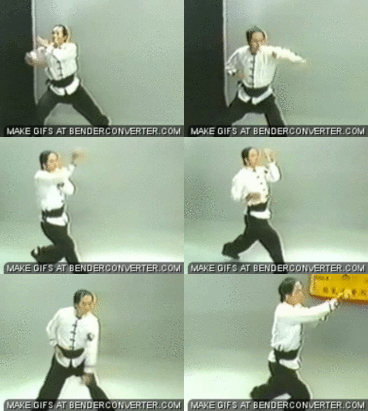
Ok, here’s a section from Gung Lik Kuen you that you can turn into a 2 person drill.
Both start with right side facing each other.

You steal step and make low attack to the leg.

Other person withdraws the right leg and gives you a left punch to the face at the same time.

You spin and grab/clear the left punch with your left. Continue with right forearm smash to the head/neck.

Other person prevents/slips out of the grab before it is complete, clears your left smash with his right. He transfers control of the clear to his left rising hand. He steal steps in to attack low to your leg.

Now you withdraw your right leg while punching to his face with your left.

Other person spins, grabs your attack, and smashes in with right forearm to your head/neck.

You slip out your left before his grab becomes solid, use your right to clear his right smash upwards, transfer control to your left upward hand, steal step to attack low to his leg.

That is one complete cycle. Continue back and forth until speed, agility, power, timing, sensitivity, endurance, explosiveness, etc are improved or you are exhausted.

In the video, his low and high attacks are more vertical than we like. And also too wide and telegraphing. We tend to be more 45 degree arcing down, so there is some sideways to our strikes.

This drill will let the partners train the close timing in escaping the steal step and spin advances.

This also trains the agility to change quickly between defensive and offensive footwork as did the other drill I suggested.

The partners also train the grab(or use a clear if you have gloves on) to open for the forearm strike. They also get to practice the proper timing to neutralize the grab opening.

In countering the high forearm strike, the defense uses Praying Mantis Ou Lou Choi timing with right and left hands to intercept and control, followed by the right low strike.

Both partners get to work on distance adjustments that enable effective attacks/escapes.

Another way to do a partner drill with this is to chase your partner down with the combination attack 10x, then switch immediately and make him chase you back with his 10 attacks.

Drilling this way, you try to cover as much distance as possible on the attacks to develop the ability to overrun your opponent.

The other person needs to escape just enough to make you miss, but still be in position to counter attack. He escapes far enough to make you really have to work to get him.

Good cardio drill, and more fun than running or biking.

Not my first choice for a practical combo, but I use it because you mentioned that low attack in another thread.

Good training exercise with the low/high transitions and the footwork.
[QUOTE=-N-;1199801]I’m not a Long Fist guy,…[/QUOTE]

Both of those 2 forms are not longfist forms. The Lien Bu Chuan came from Sichuan dragon system. The Gong Li Chuan came from the Gong Li system. That’s why if people just skip those 2 forms in their training path, they won’t miss anything. The Tantui is good enough to build up the longfist foundation.

The reason those 2 forms were used as the longfist system beginner level training because when a longfist teacher taugh Tantui to his students, the drop out rate was too high. Most longfist teachers just stopped teaching Tantui.

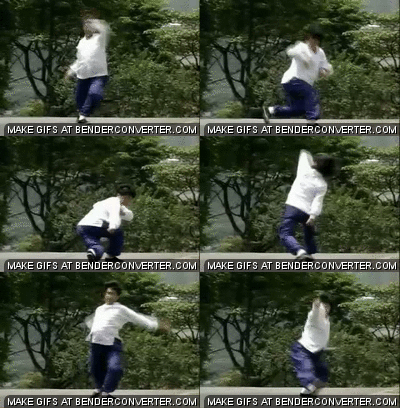
I did use the following move (without the body turning) to win one of my challenge fights. When I was young, I could jump 15 feet by using that footwork.

[QUOTE=YouKnowWho;1200209]

The reason those 2 forms were used as the longfist system beginner level training because when a longfist teacher taugh Tantui to his students, the drop out rate was too high. Most longfist teachers just stopped teaching Tantui.
[/QUOTE]

how come man

[QUOTE=bawang;1200227]how come man[/QUOTE]

The Tantui form has a lot of kicks. For a beginner to hold his leg in the air for a period of time until the teacher has corrected all students postures may be just too hard for beginners. Both Lien Bu Chuan and Gong Li Chuan doesn’t have many kicks. To hold a punching posture for 2 minutes is much easier than to hold a kicking posture for 2 minutes.

[QUOTE=YouKnowWho;1199604]Can anybody extract any good combo drills from these 2 forms?[/QUOTE]

So what drills would you extract if you had to?

[QUOTE=-N-;1200449]So what drills would you extract if you had to?[/QUOTE]
Almost all TCMA forms has such move that your opponent punches/kicks you, you block it, and then do something after that. Some people even call that self defense with higher priority than free sparring.

I don’t like any drills that I have to wait for my opponent to attack me. I like offense drills that I initial my attack whenever I want to. If my opponent attacks me first, I may just move back and play defense until I’m ready to attack back.

If I don’t attack, I can dance around and play defense. If I do attack, I want to finish my fight right at that moment. If I fail, I’ll move back and wait for my oppornity for my next attack. I also don’t like single move drills. I like combo drills that one move can be used to set up another move.

I always like to start from a groin kick, knee joint kick, or foot sweep (kicks that’s hard to be caught). Since my goal is to use kick, punch to set up my throw, any kick, punch combo that won’'t be able to help me to link to my throw will serve me no purpose. After examing all the forms that I have learned in my life time, I finally decide that I just have to create my own drills for the kick, punch, lock, throw, follow on strike integration. The day when I found out what I need, I lost interest in all my TCMA forms. It’s much easier for me to create my own drills than trying to extract drills out of the TCMA forms that I have learned.

[QUOTE=YouKnowWho;1200467]Almost all TCMA forms has such move that your opponent punches/kicks you, you block it, and then do something after that. Some people even call that self defense with higher priority than free sparring.

I don’t like any drills that I have to wait for my opponent to attack me. I like offense drills that I initial my attack whenever I want to.[/QUOTE]

If you can do it against his attack, you can do it against his guard.

[QUOTE=-N-;1199801]

You use right hand to deflect the high attack upwards. Raise the left knee to dive forward and down into the opening with left low palm attack.

Other person shifts back and clears the low attack and returns a right high attack.

You run into his attack, clear with left hand, and shoot a right punch in his face.
[/QUOTE]
Just change “deflect the high attack upwards” to “deflect his guard hand upwards to create your opening”.

If you start further away, then precede with “kick opponent’s shin” before immediately attacking with the upward deflect, middle palm strike, follow up grab punch to face.

Don’t have to wait for him to punch. Just grab his arm/sleeve/shirt and punch his face after the palm attack.

That’s your combination attack started with a kick. Doesn’t have to be defensive at all.

One of my students studied Aiki Jitsu in Japan for over 20 years. Some of his techniques he didn’t like because they only worked when you let the other person attack first.

I said, “What you talking about? Just grab him and punch him first, now continue with your technique.”

It was similar to a Praying Mantis one, and he hadn’t seen it set up with an attack opening.

So he started to relook at a bunch of his Aiki Jitsu. He wasn’t hippy dippy airy fairy either. He used to go into different schools and ask to be taught a lesson. They took that as an invitation to show the white guy how things are done. Sometimes he kicked ass. Other times he got his ass handed to him, which he accepted gratefully.

He ended up with some old school teacher with gang affiliations. And they both went about getting into all kinds of trouble.

[QUOTE=-N-;1200483]If you can do it against his attack, you can do it against his guard.[/QUOTE]

If my opponent attacks me, he has closed in the distance for me so I don’t have to do that myself. To me, it’s a bonus, but I don’t want to be lazy and always expect my opponent to do that for me. I like to train my “mobility”. I like to train combo with fast footwork. If I can still move as fast as the following clip when I’m 80 years old, I’ll be quite happy.

http://www.youtube.com/watch?v=jGxptvJlubY