Yi Chin Ching

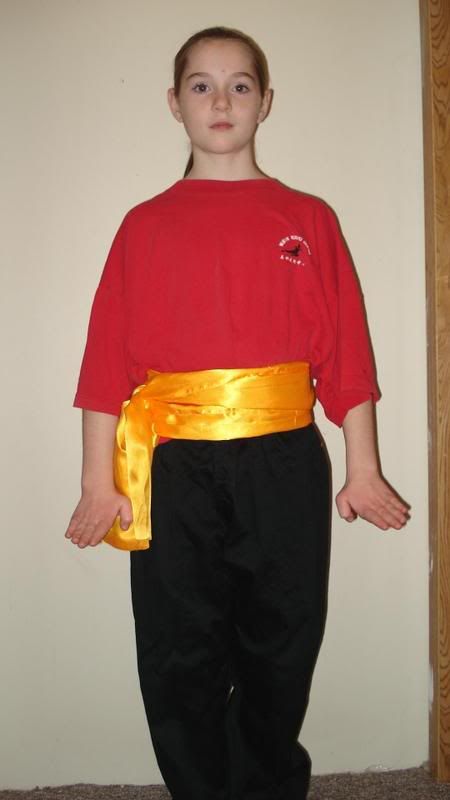
OK there’s no real need for a video here for this. The old Shaolin Yi Chin Ching are quite simple. This first one is my 10 year old daughter doing the first exercise.

The official version says to look east, so ok..look east when you start.

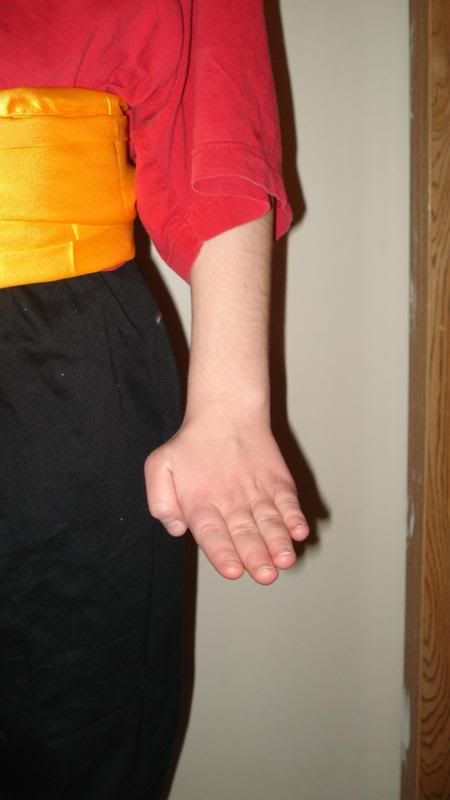
Stand at attention with both arms slightly bent at the elbow. Fingers together and tips facing forward, they should be parallel to the ground. Palm along the side of your leg. Count from 1 to 49. On each count raise the finger tips up and press the palms down. you should not relax the hand between counts but continue to push the finger tips up and the palms down. There should be little external movement, but you should feel extreme tension in your wrist and lower forearms. Breathing throughout this should be normal.

A close up of the hand position.

That’s it. None of the rest of the 12 positions are a great deal harder, but try it and you will feel exactly where this works.

Jeffoo:

Very cool, have you ever seen these exercises done with a certain amount of body/ torso movement done with them, similar to making the chest and back work like pumping a bellows, for lack of a better description. just wondering.

Thanks
Mike Biggie

[QUOTE=Piercinghammer;829077]Jeffoo:

Very cool, have you ever seen these exercises done with a certain amount of body/ torso movement done with them, similar to making the chest and back work like pumping a bellows, for lack of a better description. just wondering.

Thanks
Mike Biggie[/QUOTE]

Oh Hey Mike…I just watched your Hok Fu Gao Cha on youtube. Almost identical to the way I learned it. Very well done.

I have not seen these done this way. The way it was explained to me is these are meant to isolate the areas that you are working and any other movement reduces the effect. Of course when I learned it, my teacher’s way was the only way, but as I have traveled and seen how others do it, I see that there are many differences (most small) in how it is done. To see them done, the Yi Chin Cheng are rather boring to look at…lol but when you do it you can’t deny the effects…

Maybe I’ll just put all 12 up here since it’s pretty easy to do and to explain.

[QUOTE=Piercinghammer;829077]Jeffoo:

Very cool, have you ever seen these exercises done with a certain amount of body/ torso movement done with them, similar to making the chest and back work like pumping a bellows, for lack of a better description. just wondering.

Thanks
Mike Biggie[/QUOTE]

some call it Turtle Breathing…

cool, same first position as our version

we aim for complete contraction of all the muscles in the body at the same time while exhaling all the breath through the mouth while the tongue is touching the roof of the mouth

[QUOTE=Oso;829118]we aim for complete contraction of all the muscles in the body at the same time while exhaling all the breath through the mouth while the tongue is touching the roof of the mouth[/QUOTE]
why?

Because that’s the way I Chin CHing are done, even in SD…LOL…

We’ve got 49 of the suckers, and if you do each one 10 times, by the end of all 49 you feel like you’ve just run a marathon.

Interesting…

[QUOTE=Oso;829118]cool, same first position as our version

we aim for complete contraction of all the muscles in the body at the same time while exhaling all the breath through the mouth while the tongue is touching the roof of the mouth[/QUOTE]

That is interesting… I learned that the tension was more “internal” if you will, and not just contracting muscles in the body. If you relax all the muscles during inhalation then this method is remarkedly similar to Maxalding “muscle control”.

But is that how the Yi Jin Jing is supposed to be performed? Perhaps, it depends on what you want to accomplish with the practice…

Hopefully we can get more insight on this from other forum members who have studied this chigung. Maybe Dale Dugas or Steve Hamp??

-Blake

I only stiffen one muscle when I do the I Chin Ching. I’ll let you guess which one. Ever wonder why it’s called the Bone Muscle Classic? What did you think “Marrow-washing” was?

[QUOTE=cjurakpt;829126]why?

…[/QUOTE]

It’s common place for the tip of the tongue to be on the roof of the mouth to complete the “Grand Cycle” of chi circulation. I found this to be kind of a moot point with these particular exercises and with the Lohan Gong as well since those are all basically dynamic tension types of exercises.

But many teachers who teach Qigong do teach that ALL drills have the tongue placed this way.

[QUOTE=SouthernTiger;829136]That is interesting… I learned that the tension was more “internal” if you will, and not just contracting muscles in the body. If you relax all the muscles during inhalation then this method is remarkedly similar to Maxalding “muscle control”.

But is that how the Yi Jin Jing is supposed to be performed? Perhaps, it depends on what you want to accomplish with the practice…

Hopefully we can get more insight on this from other forum members who have studied this chigung. Maybe Dale Dugas or Steve Hamp??

-Blake[/QUOTE]

The muscle tension is internal and the muscles and tendons being worked are not relaxed a bit during these exercises.

There are 12 postures, each held for a 49 count. Each posture works different muscles. At the end you are indeed tired.

I have found that each teacher teaches these very differently, so I ultimately go back to the original Shaolin Authentic to review each posture and method.

what is the Original Shaolin Authentic?:confused:

[QUOTE=Shaolin Wookie;829132]Because that’s the way I Chin CHing are done, even in SD…LOL…[/QUOTE]
I take it you are being sarcastic, but that’s actually about the most in depth answer most people will be able to offer, unfortunately…

[QUOTE=SouthernTiger;829136]I learned that the tension was more “internal” if you will, and not just contracting muscles in the body. [/QUOTE]
man, that poor musculoskeletal system just takes a beating from “internalists”, like it’s somehow an “inferior” way of doing things; sorry, that’s total BS; ok, WHY is contracting muscles not being “internal”? I mean, I don’t care what you are doing, if you are moving, you’re contracting muscles - there is no other way to move, sorry, unless you are falling down; so then, maybe it has to do with the QUALITY of the muscle contractions and the way that they coordinate through the body, how about that?

[QUOTE=SouthernTiger;829136]If you relax all the muscles during inhalation then this method is remarkedly similar to Maxalding “muscle control”.[/QUOTE]
impossible - if you are inhaling, there is this big old muscle called the respiratory diaphragm that is contracting, along with a number of intercostals, the abdominals (kind of important if you want to get a deep breath), the pelvic floor, and if you are standing, all the postural stabilizers from the foot up, unless you want to fall down on your face or asz, because when you inhale you change your center of gravity…

[QUOTE=SouthernTiger;829136]But is that how the Yi Jin Jing is supposed to be performed? Perhaps, it depends on what you want to accomplish with the practice…[/QUOTE]
ok, that’s a very salient comment - what exactly is one attempting to accomplish with this practice? seriously, what?

[QUOTE=SouthernTiger;829136]Hopefully we can get more insight on this from other forum members who have studied this chigung. Maybe Dale Dugas or Steve Hamp??[/QUOTE]
that would be nice

[QUOTE=Jeffoo;829140]It’s common place for the tip of the tongue to be on the roof of the mouth to complete the “Grand Cycle” of chi circulation. I found this to be kind of a moot point with these particular exercises and with the Lohan Gong as well since those are all basically dynamic tension types of exercises.
But many teachers who teach Qigong do teach that ALL drills have the tongue placed this way.[/QUOTE]
ok, but again, why? and “completing the Grand Circulation” doesn’t count - that’s just a metaphorical descriptor, it doesn’t tell you what’s going on anatomically / physiologically / biomechanically when you do that…

[QUOTE=Jeffoo;829141]The muscle tension is internal and the muscles and tendons being worked are not relaxed a bit during these exercises.[/QUOTE]
tendons are non-contractile; they cannot “be worked” or “relaxed” intrinsically - they can only be placed under tension by the action of the muscle fibers;

[QUOTE=Jeffoo;829141]I have found that each teacher teaches these very differently, so I ultimately go back to the original Shaolin Authentic to review each posture and method.[/QUOTE]
which is basically “Sino-sized” yoga…

what I’m trying to point out is that there are many very interesting ideas about what is going on in the body when you are doing something like YGG, and the problem is that MOST people do it the way they do it because they were taught to do it that way; problem is, they don’t really understanding a) why they are doing it; b) what is actually happening in the body by doing it the way they are doing it; c) how to monitor and self-regulate and CHANGE how they are doing it according to a given circumstance…

It is, basically, Sino-sized Yoga. You take postures, some static, some moving, all of them encompassing some kind of motion. On a purely athletic level, the harder positions test your balance and help strengthen muscle groups that don’t regularly get a lot of exercise (it’s done wonders for my lower back, which has always been a problem for me). Some of them help flexibility. Others, you just focus on your breathing. It’s funny, though, because it’s “static”, one would think that they’re easy. But regularity of motion, deep breathing, focusing on the tension–it’s all a kind of internal motion, if you want to call it that (and I usually don’t, b/c I figure all arts are internal/external nowadays, and it’s pretty d@mn difficult to divorce one from the other without making the art useless). It’s almost like meditation, only “hardcore”…EXTREME! Lol…

[QUOTE=cjurakpt;829145]I take it you are being sarcastic, but that’s actually about the most in depth answer most people will be able to offer, unfortunately…

man, that poor musculoskeletal system just takes a beating from “internalists”, like it’s somehow an “inferior” way of doing things; sorry, that’s total BS; ok, WHY is contracting muscles not being “internal”? I mean, I don’t care what you are doing, if you are moving, you’re contracting muscles - there is no other way to move, sorry, unless you are falling down; so then, maybe it has to do with the QUALITY of the muscle contractions and the way that they coordinate through the body, how about that?

impossible - if you are inhaling, there is this big old muscle called the respiratory diaphragm that is contracting, along with a number of intercostals, the abdominals (kind of important if you want to get a deep breath), the pelvic floor, and if you are standing, all the postural stabilizers from the foot up, unless you want to fall down on your face or asz, because when you inhale you change your center of gravity…

ok, that’s a very salient comment - what exactly is one attempting to accomplish with this practice? seriously, what?

that would be nice

ok, but again, why? and “completing the Grand Circulation” doesn’t count - that’s just a metaphorical descriptor, it doesn’t tell you what’s going on anatomically / physiologically / biomechanically when you do that…

tendons are non-contractile; they cannot “be worked” or “relaxed” intrinsically - they can only be placed under tension by the action of the muscle fibers;

which is basically “Sino-sized” yoga…

what I’m trying to point out is that there are many very interesting ideas about what is going on in the body when you are doing something like YGG, and the problem is that MOST people do it the way they do it because they were taught to do it that way; problem is, they don’t really understanding a) why they are doing it; b) what is actually happening in the body by doing it the way they are doing it; c) how to monitor and self-regulate and CHANGE how they are doing it according to a given circumstance…[/QUOTE]

Thank you so much for your amazingly insightful (and narrow-minded) comments. You have trully shown me the superiority of your intellect and how “the poor little chinese folk dont know science” as I imagine you might say.

I can see that you have generously shared your viewpoints on TCM and other eastern paradigms on other threads so there is prob no need for you to post any more in this thread. No doubt, it would contribute little to the conversation.

That being said, allow me to clarify what I was getting at in my earlier post. What makes the Yi Jin Jing different than any other isometric exercise? Or is it just another isometric exercise? It does not qualify as a dynamic tension set because there is very little to no movement.

Jeffoo - do you perform your YJJ with muscular tension allover your body or just in the forearms and hands?

So, what makes the YJJ so special? I look forward to more comments (with the exception of cjurakpt) on this great exercise set.

-Blake
answer to the question about the placement of the tongue is, it connects the conception vessel.
In the mouth thier is a seperation of this flow a break in the circulation if you will when placing the tongue on the roof of the mouth it bridges this seperation thus completing the flow unbroken.

[QUOTE=Shaolin Wookie;829143]what is the Original Shaolin Authentic?:confused:[/QUOTE]

This was a series of books written around 1920 by Fan Xu Dong (who was Wong Hun Fun’s teacher). My teacher was Wong Hun Fun’s first student and best man at his wedding. Fan was an artist of some note and copied many of the training and fighting methods directly off the Shaolin murals. The Lohan Gong, Yi Chin Ching and other methods were included in the book. Later in 1930, Ji Yin Ming and Guo Cui Ya did a similar book called Lian Gong Mi Jue (Secret Methods of Acquiring Internal and External Mastery).

Both books were designed to bring Shaolin training methods to the masses. Wong Hun Fun took Fan Xu Dong’s book one step further and introduced photographs to accompany the old line art and calligraphy. At the time photos were the state of the art in information technology. Some of the training techniques were excellent and valid still today such as Yi Chin Ching, some of the finger exercises (like pulling the nails out of wood, etc.). Some are more fanciful in nature and include such things as holding a baby calf and jumping over a seedling bush. As the bush and calf grow…you get stronger so you can hold a 1000 Jin (roughly 1lb per Jin) bull while jumping over a 10 foot bush…yeah right. So there’s some very good stuff in the books and some other stuff..all authentic from Shaolin. Very interesting reads.

Yep true Chris the tendons can’t be strengthened. You have what you have and can’t work them. Basically what I’ve found is these exercises work the smaller muscles that provide support to the tendons and joints…at least that’s what it feels like when I practice…

The Grand Cycle of breathing with the tongue out isn’t a theory I prescribe to, but virtually every teacher of breathing teaches it. From a scientific standpoint though it makes no real sense. Even from a chi developing standpoint it doesn’t either.

But yes it’s just the way everyone was taught.

[QUOTE=SouthernTiger;829155]Thank you so much for your amazingly insightful (and narrow-minded) comments. You have trully shown me the superiority of your intellect and how “the poor little chinese folk dont know science” as I imagine you might say.

I can see that you have generously shared your viewpoints on TCM and other eastern paradigms on other threads so there is prob no need for you to post any more in this thread. No doubt, it would contribute little to the conversation.

That being said, allow me to clarify what I was getting at in my earlier post. What makes the Yi Jin Jing different than any other isometric exercise? Or is it just another isometric exercise? It does not qualify as a dynamic tension set because there is very little to no movement.

Jeffoo - do you perform your YJJ with muscular tension allover your body or just in the forearms and hands?

So, what makes the YJJ so special? I look forward to more comments (with the exception of cjurakpt) on this great exercise set.

-Blake[/QUOTE]

We perform the YJJ with the rest of the body at ease…not relaxed per se, just normal. And the tension varies with each exercise. In #1 as I posted it, you feel it most on the back of the hands at the wrist and along the inside of the forearm. #2 which I may post, you feel it along the outermost and innermost parts of your forearms.

But as is so common in all traditional kung fu, it varies from teacher to teacher as to how it’s taught.

[QUOTE=EarthDragon;829156]answer to the question about the placement of the tongue is, it connects the conception vessel.
In the mouth thier is a seperation of this flow a break in the circulation if you will when placing the tongue on the roof of the mouth it bridges this seperation thus completing the flow unbroken.[/QUOTE]

Right I know that’s the theory, but in actuality this is one part that never made much sense. Proper chi breathing is supposed to circulate chi throughout the whole body. So then the chi automatically fills up the body anyway. If Chi is a vital force like say blood circulation, this makes no sense because there is no way to physically connect the pathways for it using this method. Kind of like pumping gas with the gas cap still on. If Chi is a vital force and is more like an energy, this makes no sense either because then there’s just the mass of energy circulating. Energy like that can’t be confined to any defined pathway.

I am not being critical of anyone or they way they were taught, I just wonder what, if any, scientific info may be out there to back this up.