[QUOTE=David Jamieson;1259983]Still not worse than the new lone ranger movie.
[/QUOTE]
Was anything worse than the new Lone Ranger movie? Honestly? I think the plague was probably better.
[QUOTE=David Jamieson;1259983]Still not worse than the new lone ranger movie.
[/QUOTE]
Was anything worse than the new Lone Ranger movie? Honestly? I think the plague was probably better.
Melissa McCarthy’s SNL 2/1/14 monologue
[URL=“http://www.nbc.com/saturday-night-live/video/melissa-mccarthy-monologue/n45813”]
Melissa McCarthy Monologue
S39 E14 | Highlight | Post Date: 02/01/14 | 3:45
Yellowface
Time to start a thread devoted to this topic here. I’m merging both the SNL and HIMYM threads into this one (now above) and will post similar topics here from now on as they appear.
3:00 pm
Feb 3, 2014
TV
SNL, Diversity and Punchlines
Commentary By Jeff Yang

A scene from last weekends Saturday Night Live
NBC
Dear SNL:
Youve had better days, I know. Critics and viewers have beaten you up this season, as youve done your best to fill the gaping holes left by the departures of multifaceted stalwarts like Fred Armisen, Bill Hader and Jason Sudeikis, and before them, breakout stars like Kristen Wiig and Andy Samberg. One of the gripes theyve had has been about who youve filled the holes with: People who, well, look a lot like the fine comic talent that just left. Which is to say, not obviously black, Asian American or Hispanic.
(Yes, I know Fred Armisen is a quarter Japanese and a quarter Venezuelan. And one of newbie Noel Wellss grandparents is Mexican. But I might be one of the only people who knows that, given how theyve been represented on the show.)
In early January, you took a step a big step to address your lack of diversity by bringing aboard new castmember Sasheer Zamata, the first African American woman player for nearly six seasons, and two African American female writers, too: LaKendra Tookes and Leslie Jones. But last Saturday was a reminder that this big step is only the first one.
Thats because, in a show being hosted by the awesome Melissa McCarthy, you turned her opening monologue into a skit about her feud with castmember Bobby Moynihan a feud that erupted into a high-flying, wire-swinging martial arts duel between the duo. Now, lets set aside the fact that the humorous context of their fisticuffs seems to have been anchored in the comic sight of a pair of lovably large people pirouetting through the air; they were game and graceful, and I tip my hat to the midair somersault McCarthy managed to pull off.
But it was almost as if you knew there werent enough yuks in just having McCarthy and Moynihan punching it out, Shaw Brothers style (and you were right). So to underscore the joke, you put a little yellow icing on the cake, bringing in a squinting, eyebrow-quirking Taran Killam in a Nehru jacket to play the fights narrator, complete with stilted accent and gong. (Taran Killam Cobie Smulderss husband. You know, the actress on CBSs How I Met Your Mother who was just slammed for doing yellowface two weeks ago?)
Whoa, SNL. That wasnt cool, and it wasnt particularly funny, either. It looked like a desperate move to save a skit that was going nowhere. It was embarrassing. And even Killam himself seemed to look vaguely uncomfortable, as if he was saying in his head, Im only doing this because Im the closest thing this show has to an actual Asian dude.
SNL and NBC declined to comment.
And assuming thats what was knocking around his subconscious, well, its only because thats true. There arent any Asian Americans on SNL now. Theres never been an Asian American featured player on SNL ever, at least not one who could conceivably have done a less cringeworthy job of playing Killams random Chinese dude than he did. (Rob Schneiders quarter-Filipino heritage had even less of a role in the characters he took on during his SNL run than Armisens quarter-Japanese heritage. Armisen did play a spit-take Japanese schoolgirl on the retired sketch J-Pop America Fun Time Now the ultra-kawaii love interest of none other thanTaran Killam.)
Why does diversity even matter? Well, a good example of why was in the biggest spotlight on Earth last night. You caught the Super Bowl, right, SNL? Okay, maybe not: Competing network. But if you had, youd have seen what happens when you put a diverse team on the field drawing talent from the best of a range of communities. It wasnt always like that. Until 1952, most of the teams in the NFL had never signed a black player. After that year, every team but one integrated their lineups. The lone holdout? The Washington Redskins. Surprise, surprise, right? Team owner George Preston Marshall was quoted as saying Well start signing Negroes when the Harlem Globetrotters start signing whites. It took a threat of eviction before they finally brought on Bobby Mitchell. (It might take the same to get the team to change its defiantly objectionable name.)
NFL is a better game for its diversity. Heck, its the most profitable sport in the world because of it. A hundred million people in the U.S. watched the Seahawks crush the Broncos last night (so much for the Year of the Horse), and the winning team was led by African American quarterback Russell Wilson, with the final touchdown scored by proudly quarter-Filipino wide receiver Doug Baldwin; the Hawks airtight pass defense was coordinated by Japanese American coach Rocky Seto, and the Bowls halftime show was headlined by half-Filipino crooner Bruno Mars. (And I should add, it was one of the best in recent history, at least until those half-naked senior citizens dodged security and bum-rushed the stage.)
Look, I know sports isnt the same thing as comedy. (Although the Broncos were slapstick gold last night. Rimshot!) But the principle is the same. David Henry Hwang a longtime advocate of diversity in entertainment, whose latest play, a dramatized version of Bruce Lees life called Kung Fu, opens at the Signature Theater tomorrow says it best: In failing to become more diverse, SNL and the entertainment industry in general are following a bad business model, because theyre pulling their performers and audiences from an increasingly shrinking demographic, he says. Do you really want to risk having an audience of just old white people?
Inclusion opens up a greater pool of talent, which means a better product on the stage. It also means more eyeballs and more dollars from a broader segment of the population a population whose fastest-growing groups, Hispanics and Asian Americans, are also the ones that youve historically done the worst job of representing, SNL.
And it means that you can tackle topics and situations from a wider array of contexts without slapping bad makeup or a terrible accent on an actor whos going to be skewered after the fact for his or her raceface performance. As cliché as it sounds, it really is more okay for someone to satirize their own group. (And if youre going to mock another one, its always a good idea to remember the guideline to punch up rather than punch down: When we see blackface or yellowface, its almost always the more powerful lampooning the less powerful, because white people overwhelmingly dominate positions of power and access in American media, notes Hwang.)
So inclusion doesnt just mean better talent and bigger audiences: It means you can be harder, edgier, more relevant, because youll be able to address events on a global and multicultural basis without shame or regret.
You play an important maybe unique role, SNL. Its not just the number of people who watch you that matters; its your ability to turn obscure comics into comedy stars, and comedy stars into cultural icons. That outsized role brings with it greater responsibility. It takes effort to find talent that looks like America, but its very possible. Hey, just look at the primetime series on your own network, which launched or accelerated the careers of Asian American comic standouts like Mindy Kaling, Aziz Ansari, Danny Pudi and Ken Jeong. You can make it happen.
Ill be rooting for you, SNL. And if it makes you feel any better, I was rooting for the Seahawks, too.
Yours,
Jeff Yang
Whitewashing? Srsly?
While I respect Constance Wu, I think she jumped the shark on this one. Who knows if Damon will be the great white hope? Take Netflix’s Marco Polo, the ultimate historical whitewashing (especially if you’ve actually read Travels) but I wouldn’t call that project whitewashing. If anything, Polo’s character is downplayed. He’s second stage to the Asian leads.
Matt Damon Movie Slammed For ‘Whitewashing’
31 July 2016
Matt Damon
Matt Damon has been slammed for his new movie ‘The Great Wall’.
Damon plays a soldier in ancient China, who helps to battle against an ancient monster, in the English-language film directed by Zhang Yimou, and the movie has been accused of “whitewashing”.
Taiwanese-American actress Constance Wu took to Twitter to insist, "We have to stop perpetuating the racist myth that only a white man can save the world.
“Can we all at least agree that hero-bias & “but it’s really hard to finance” are no longer excuses for racism? TRY (sic).”
And ‘Fresh Off The Boat’ star Constance posted a lengthy statement, which read: "On The Great Wall. Our heroes don’t look like Matt Damon. They look like Malala. Ghandi. Mandela. Your big sister when she stood up for you to those bullies that one time. We don’t need salvation. We like our color and our culture and our strengths and our own stories.
“Money is the lamest excuse in the history of being human. So is blaming the Chinese investors. (POC’s choices can be based on unconscious bias too) Remember it’s not about blaming individuals, which will only lead to soothing their lame “b-but I had good intentions! but…money!” microaggressive excuses (sic).”
She also hit out at “implied racism”, explaining: "It’s about pointing out the repeatedly implied racist notion that white people are superior to POC and that POC need salvation from our own color via white strength. When you consistently make movies like this, you ARE saying that. YOU ARE. Yes, YOU ARE. YES YOU ARE. Yes, dude, you f**king ARE. Whether you intend to or not. We don’t need salvation. We like our color and our culture and our own strengths and our own stories. (If we don’t, we should) We don’t need you to save us from anything. And we’re rrrreally starting to get sick of you telling us, explicitly or implicitly, that we do.
“Think only a huge movie star can sell a movie? That that has NEVER been a total guarantee. Why not TRY to be better? If white actors are forgiven for having a box office failure once in a while, why can’t a POC sometimes have one? And how COOL would it be if you were the movie that took the “risk” to make a POC as your hero, and you sold the s**t out of it?! (sic).”
‘The Great Wall’ is set for release in China in February, 2017, and in the US two months later.
Zhang Yimou comments
The Great Wall director addresses Matt Damon whitewashing controversy — exclusive
The movie ‘is the opposite of what is being suggested,’ Zhang Yimou tells EW
BY JOE MCGOVERN • @JMCGVRN

(Chris Weeks/Getty Images)
The Great Wall
Posted August 4 2016 — 12:50 PM EDT
On July 28, acclaimed Chinese filmmaker Zhang Yimou (House of Flying Daggers) released the first photos and trailer of his — and his country’s — most expensive movie ever. Many audiences were surprised to see that The Great Wall was not about the construction of China’s 5,500-mile long Wonder of the World, but instead a full-fledged monster movie.
But many more were surprised and disappointed that the film, set about 1,000 years ago, starred white American actor Matt Damon. In a lengthy tweet posted one day after the trailer debut, Fresh Off the Boat star Constance Wu criticized the project for “perpetuating the racist myth that only a white man can save the world” and wrote, “Our heroes don’t look like Matt Damon.”
In a statement provided exclusively to EW, Zhang addresses the controversy, explaining that Damon’s character serves an important plot point, and defends his film against charges of racism. Read his full statement below.
As I suspected…
I’m in that ‘whatev’ group
While I respect Constance Wu, I think she cried ‘wolf’ on this one. She jumped on a bandwagon, a bandwagon that I’m firmly riding, but fingered the wrong film. She wasn’t looking at the whole picture, as we have been with this particular film, since 2012. She should really join our forum here. We’ll allow her, even if she isn’t a martial artist. 
The Great Wall: Why The Matt Damon Whitewashing Is No Big Deal In China
Contrasting Chinese and U.S. reactions to Matt Damon’s casting in “The Great Wall” underscore the difficulties co-productions have appealing to audiences in both countries.
Aaron Fox-Lerner
Aug 30, 2016 4:27 pm

Matt Damon is the star of The Great Wall.
It seems reasonable to expect that a movie called The Great Wall, billed as the biggest production in Chinas filmmaking history, would feature Chinese actors. Instead, when Universal and Legendary released the trailer for Zhang Yimous film, the first face viewers saw was that of the decidedly white Matt Damon, fighting monsters atop the Middle Kingdoms most famous monument.
In America, it was a call to arms in the battle against whitewashing, that curious tendency to insert Caucasian faces where history tells us there were none. We have to stop perpetuating the racist myth that only a white man can save the world, wrote comedian and Fresh Off the Boat star Constance Wu in a lengthy, impassioned statement posted to Twitter. Our heroes dont look like Matt Damon.
China had another take. There, the prevailing sentiment over the trespass on their national identity might best be described as a Whatevs.
On Weibo, essentially Chinas Twitter (the social media service is banned there), searches relating to The Great Wall and whitewashing in Chinese turn up only a few dozen responses at most. Many posts are simply articles explaining the American controversy for Chinese readers. Even of those, most are focused on director Zhang Yimous defense of the film, rather than Wus criticism of it.
Why the collective shrug? In China, Chinese are the majority, said Sally Ye, a Chinese-American producer who has worked in China for more than a decade. They dont have this feeling of representation which people of minority backgrounds would feel in the United States.
Added Wang Xiaoyi, film editor for the Chinese-language Time Out Beijing, So out of five heroes, theres one whos not Chinese.
However, while the US perceives the film is about Matt Damon saving China, people in China think hes just one character out of many. Early marketing in the two countries has been markedly different.
In the US, Damons face occupies most of the poster, with the titular wall merely a detail over his shoulder. The films synopsis on the official website also puts the American actor front and center: Matt Damon leads humanitys greatest fight for survival in The Great Wall from Legendary and Universal Pictures.
By contrast, China is much more interested in the screen debut of Chinese boy-band idol Wang Junkai, who appears alongside fellow boy-band-member-turned-actor Luhan and popular star Andy Lau. The Chinese trailer mixes in images of local actors early on, and a teaser poster from Zhang Yimous Weibo account also positions Damon in equal proportion to his co-stars.
Its just like how the new Independence Day used Angelababy, said Wang, referring to a popular Chinese star whose bit-part casting in the latest Independence Day movie was a clear play for the Chinese market. Zhang Yimou chose Matt Damon because he didnt want the movies audience to be limited to China.
The Damon comparison is a bit generous; Hollywood films ranging from Mission Impossible Rogue Nation to Iron Man 3 pander to China by creating marginal roles for Chinese stars (a move thats inspired mockery both in the US and China). However, co-productions allow foreign companies to dodge barriers that prevent them from participating in the worlds second-largest moviegoing market. China has a 34-film quota on foreign productions, and also allows foreign studios to claim only 25% of a movies box office. If a movie has some Chinese participation, companies can circumvent these limits.
One of the few domestic hits in China this summer has been Skiptrace, an English-language action-comedy directed by action journeyman Renny Harlin (Die Hard 2, Deep Blue Sea) starring Jackie Chan and Johnny Knoxville. In the U.S., the film went to DirectTV July 28, with a theatrical run via Saban Films September 2; in China, its already has made over 800 million RMB (about 120 million dollars). Other co-productions have been even more explicitly aimed at Chinese audiences: 2015s Hollywood Adventures was co-written and co-produced by the Taiwan-born Justin Lin and featured Chinese stars and dialogue, but it was directed by an American, Timothy Kendall, and shot almost entirely in Los Angeles. That film was also a success in China while remaining largely unknown outside it.
Other movies have gone The Great Wall route of shoehorning foreign stars into ancient Chinese settings. Dragon Blade, a 2015 epic about warring Roman factions in Han Dynasty-era China, featured John Cusack phoning it in, Adrian Brody hamming it up, and Jackie Chan sporting dreadlocks. It proved a box-office smash in China, while going practically unnoticed in the US. The critically maligned Outcast (2014) also sent stars Nicolas Cage and Hayden Christensen into historical China, this time as disillusioned medieval Crusaders.
Even for purely Chinese productions, foreign roles ranging from token to central have become commonplace. When I first came to China, the people making movie and TV shows didnt know any foreigners in real life, Jonathan Kos-Read, a Chinese-speaking white actor who was born in Southern California but makes his living in films like Mojin The Lost Legend and IP Man 3 productions targeted to the Chinese audience. But now because theres so many foreigners, most of the writers know a real foreigner And the practical, artistic upshot of that is that they write better, more sophisticated foreign characters who are people before theyre foreigners.
The trajectory of Kos-Read who described himself to me as a minority actor from stock clichés to more complex characters would be the envy of many Asian-American performers who find themselves faced with frustratingly stereotypical roles. While The Great Wall has been a flashpoint in America over the lack of Asian representation, for the Chinese film industry the main issue has been whether the movie will show growing internationalization can lead to success outside of China.
The fact that youre writing an article about Great Wall is kind of a genuine change, Kos-Read said. If it works, thats going to be great. It means a lot more of that is going to happen, and as an actor, itll mean a lot more work.
Still, even with an American star and a Western writing team (among them Max Brooks, Tony Gilroy, and Marshall Herskovitz), Ye believes The Great Wall is aimed mainly at China, with the US as a secondary bonus. I think they took China as priority, she said, but they dont want to not have the US distribution, because its a huge, big-budget film.
Censorship may be another reason why The Great Wall is not controversial in China; as a state-approved production, the governments involvement might be enough to presume national respect. I think that media in China, at least the ones who are going to drive word of mouth for The Great Wall, will want Great Wall to be a success, said one Asian-American working for a large Chinese film company who wished to remain anonymous. Right now SARFT [the State Administration of Radio, Film and Television] is more invested in showing that Chinese filmmakers can make a movie of Western standards than they are in undermining the kind of ideological fiber inside the movie itself.
The Great Wall is clearly aimed at a level of international success beyond any prior Chinese film or co-production and with it, a previously unknown level of scrutiny. As the anonymous film worker put it, even without its whitewashing controversy, The Great Wall is a glaring example of how much people are willing to spend to make the co-production prove its viability. The U.S. controversy over the movies casting shows just how hard that viability may be to achieve.
a petition
DreamWorks: Stop Whitewashing Asian Characters!

author: Julie Rodriguez
target: DreamWorks Studios
signatures: 28,629
28,629
29,000
we’ve got 28,629 signatures, help us get to 29,000
overview | petition
Fans of the iconic 1995 animated Japanese sci-fi film Ghost in the Shell have been anticipating a live-action remake for years – but now, instead of casting an Asian actress, Dreamworks has selected Scarlett Johansson for the lead role! The film revolves around Major Motoko Kusanagi, a member of a futuristic security force tasked with tracking a mysterious hacker.
The original film is set in Japan, and the major cast members are Japanese. So why would the American remake star a white actress? The industry is already unfriendly to Asian actors without roles in major films being changed to exclude them. One recent survey found that in 2013, Asian characters made up only 4.4% of speaking roles in top-grossing Hollywood films.
Dreamworks could be using this film to help provide opportunities for Asian-American actors in a market with few opportunities for them to shine – please sign the petition asking them to reconsider casting Scarlett Johansson in Ghost in the Shell and select actors who are truer to the cast of the original film!
you have the power to create change.
Start sharing and watch your impact grow
I’m now really curious if the opposite has ever happened - like is there an Asian-washing where Chinese actors were cast to play Charlie Brown or something? That must exist, right?
Interesting piece on THR.
APRIL 15, 2016 3:57pm PT by Rebecca Sun, Graeme McMillan
Why Did ‘Doctor Strange’ and ‘Ghost in the Shell’ Whitewash Their Asian Characters?

Marvel’s ‘Doctor Strange’; Paramount and DreamWorks’ ‘Ghost in the Shell’ Courtesy of Film Frame; Paramount Pictures
This week in cultural appropriation: Scarlett Johansson, Tilda Swinton and a conversation between two THR writers.
This week, Marvel dropped the first teaser trailer for Doctor Strange, based on its comic series about a critically injured neurosurgeon who travels to the Himalayas to learn mystic arts from a powerful sorcerer known as the Ancient One. Two days later, Paramount and DreamWorks released the first image from Ghost in the Shell, their live-action adaptation of the Japanese manga about an anti-cyberterror task force set in mid-21st century Japan and led by cyborg Major Motoko Kusanagi.
On paper, it reads like a great week for Asian representation in Hollywood — but the Ancient One and the Major are played, respectively, by Tilda Swinton and Scarlett Johansson. And so these two projects — long-awaited by many fans of their source material — instead join Gods of Egypt, Aloha and Pan as recent inductees to Hollywood’s Whitewashing Hall of Shame.
Below, The Hollywood Reporter’s Heat Vision blogger Graeme McMillan and senior reporter Rebecca Sun discuss the similar circumstances greeting the films so far.
Rebecca Sun: We braced ourselves when the castings were announced, but (just like that Nina trailer) the visual evidence still stung.
In flipping both race and gender to cast Swinton as a character who in the original comics is a Tibetan-born man, Marvel admirably went out of the box to correct one aspect of underrepresentation in its cinematic universe, but did so at the expense of another. Like its fellow Marvel franchise Iron Fist, it is steeped in cultural appropriation and centers around what Graeme previously noted as the “white man finds enlightenment in Asia” trope.
Give Hollywood partial credit for continuously trying to cleverly sidestep the Fu Manchu stereotype of characters like DC’s Ra’s al Ghul and Marvel’s The Mandarin — but why is the solution consistently to reimagine those characters with white actors (Liam Neeson in Christopher Nolan’s Batman films and Guy Pearce in Iron Man 3, respectively)? The Doctor Strange movie doesn’t need its Ancient One to look like Lo Pan in Big Trouble in Little China, but there are creative ways to interpret the character without yet again erasing an Asian person from an inherently Asian narrative.
Graeme McMillan: The casting of Strange is a very frustrating thing; it’s not just the Ancient One that’s racebent — Baron Mordo, a white man in the comics, is played by Chiwetel Ejiofor in the movie; you see him for an instant in the teaser — but it all seems to be done with little thought about the implications of the changes. While I’m happy to see a “white role” played by a black man in the movie, Ejiofor’s casting reinforces the implications of Thor, Captain America: The Winter Soldier and the Iron Man movies that every white hero gets a black sidekick in the Marvel Cinematic Universe (see also Zoe Saldana in Guardians of the Galaxy, but there, she’s painted green, because space).
Switching the Ancient One to Tilda Swinton feels similarly well-intentioned, but thoughtless. On the one hand, yes, you’re trying to sidestep the stereotype present in the source material, but in the most lazy way short of making the character a white man. Wouldn’t a younger Asian actor have offered enough of a play on the trope — not to mention a play on the character’s name — while also avoiding the utter tone-deafness of having Strange head to Tibet in order to learn about enlightenment from another white English person.
Sun: Too many stories, from Lawrence of Arabia to Avatar, relegate natives of a culture to background players and, at best, mentor, antagonist, love interest or sidekick. In Doctor Strange, Swinton fills the mentor role, Mads Mikkelsen is the villain and Rachel McAdams seems to be the damsel, leaving British actor Benedict Wong to play Dr. Strange’s personal valet.
Of the four, he’s the only one not glimpsed in the two-minute trailer, which mostly features Benedict Cumberbatch’s Dr. Strange wandering through streets in Nepal and Hong Kong and learning magical martial arts from Swinton in a temple beautifully appointed with traditional Asian architectural features. In other words, Doctor Strange is a movie that looks very Oriental, except for the people part.
McMillan: To make matters worse — or, at least, more frustrating — there’s the fact that, in the casting of Cumberbatch, Marvel managed to sidestep the possibility of offering up a nonwhite, non-male lead in one of its movies for the first time. Unlike, say, Iron Man or Captain America, there’s nothing inherently gendered or racially-specific in the lead character’s main concept — while it’s unlikely that anyone other than a white man would be chosen to be the figurehead for the U.S. Army in WWII, or the head of a multinational arms manufacturer built up by his genius father, all that’s really required of Dr. Strange is that they’re a successful surgeon who suffers a terrible accident that sets them on a new path afterward. That role, literally, could have gone to anyone.
That train of thought points me toward a theory put forward by comic writer Kurt Busiek on social media recently — namely, that Dr. Strange as a character is an early example of the comic book industry whitewashing itself. The idea, as Busiek lays it out, is that artist and co-creator Steve Ditko “conceived Doc Strange as a stock ‘mysterious Asian mystic’ type”, and later actually changed his look after writer Stan Lee wrote an origin in which he was Caucasian.
It’s a weird coincidence that offers a worrying excuse to those supporting Marvel’s decision to whitewash the Ancient One for the movie: It has historical precedent! Perhaps Doctor Strange, for all its positioning as a project that opens up horizons to new realities and new possibilities, has an accidental metatextual purpose of demonstrating how tied to the safer, cowardly white “norms” entertainment can be.
continued next post
Continued from previous post
Sun: Which brings us to Ghost in the Shell and that first-look image of Scarlett Johansson this week. Ghost in the Shell (at least all previous iterations of it) also is set in Asia, albeit a very different one from that of Doctor Strange. There is no indication that the name of Johansson’s protagonist has changed from the source material IMDb still lists the character as “Kusanagi,” although the press copy released alongside Thursday’s image refers to her simply by her police rank, “the Major.” That photo continues to send an ambiguous message Johansson appears in a short black bob and darkened eyebrows, hewing closely to how Kusanagi is depicted in the comics.
Traditionally, this is a fan’s greatest hope an adaptation as faithful to the source material as possible. But in this case, Paramount/DreamWorks seem to have retained all the markers of Kusanagi’s Japanese identity her name, her basic physical appearance except for the actual ethnicity of her portrayer. Perhaps the whitewashing controversy wouldn’t have gone quite as viral had the producers cleanly erased all traces of the material’s origins, as Edge of Tomorrow did in adapting the Japanese novel All You Need Is Kill and anglicizing protagonist Keiji Kiriya into William Cage, played by Tom Cruise.
McMillan: The comparison to the (lack of) outrage met with Edge of Tomorrow is an interesting one, but perhaps a more appropriate one is the response to the multiple attempts to make a live-action Akira with non-Asian actors which is to say, any of the numerous American attempts to make a live-action Akira. Both Akira and Ghost in the Shell are better-known properties than All You Need Is Kill which started life as a prose novel, which arguably also allowed for more visual/racial deviation as a result and so any attempt to move away from the (to fans) iconic elements of the original are likely to be met with, at the very best, apathy or dismay. Add in the implied racism of casting only Caucasian actors, and you have something that seems utterly guaranteed to upset almost everyone.
By far the strongest response I’ve seen to the Ghost in the Shell casting comes from indie comic writer Jon Tsuei on Twitter, where he argued that the story is “inherently a Japanese story, not a universal one” because of the context in which it was created, specifically the cultural relationship the country had with technology, and how that feeds into the characters’ relationships with tech in the story.
I’m not entirely sold on that line of thinking, I admit in part because I think that the relationship with technology has become a universal thing in the decades since the original manga was published 27 years ago but it touches on the degree to which the story is interconnected with the culture in which it first appeared. Watching filmmakers misunderstand that to such a degree as they appear to have in casting alone doesn’t really offer much hope that they’ll manage to handle the themes of the story with any greater sensitivity.
Sun: The reaction to Johansson’s Ghost in the Shell look reminds me of the backlash when the Nina Simone biopic starring Zoe Saldana was released last month. In both cases, the filmmakers went to some lengths to alter the appearance of their leading ladies, rather than cast actresses who more naturally matched the subjects. What makes these two examples different from the countless instances of actors transforming themselves for a role Steve Carell in Foxcatcher, Nicole Kidman in The Hours is that Asian women and dark-skinned black women rarely get to be the leads in Hollywood movies. So whitewashing any Asian character is unfortunate, but keeping the character Asian-ish (but not actually Asian) is salt on the wound.
Many online commenters have trumpeted Oscar nominee Rinko Kikuchi as the ideal live-action Kusanagi no one has come closer than her to doing it already, as robot pilot Mako Mori in Pacific Rim. Many other actresses of Asian descent have been mentioned as well, but the harsh truth is that their combined star wattage doesn’t even come close to touching Johansson’s.
And therein lies the problem: A Kikuchi (who is four years older than Johansson) or a similar Asian-American actress couldn’t have debuted as the daughter of John Ritter and Sean Connery, as Johansson did in her early films. She likely wouldn’t have gotten her big break as an equestrian-loving teen in Montana opposite Robert Redford in The Horse Whisperer. (She might have made a good Rebecca in Ghost World.) She couldn’t have effectively played an outsider in Tokyo in Lost in Transition, which catapulted her to stardom, or a Dutch painter’s muse in Girl With a Pearl Earring, or Woody Allen’s muse in Match Point, Scoop or Vicky Cristina Barcelona. She couldn’t have played a London magician’s assistant in The Prestige or Mary Boleyn in The Other Boleyn Girl. And most of all, she never, ever would have been cast as the Black Widow in the Marvel Cinematic Universe.
So how does an Asian actor become famous enough to play an Asian character? Judging by Speed Racer (starring Emile Hirsch), Dragonball Evolution (starring Shameless’ Justin Chatwin), Ghost in the Shell and the upcoming Death Note (starring Nat Wolff), Hollywood has yet to answer the question.
You’d think with the trend towards China, getting some Asian actors in the cast would be good global marketing.
Don’t even get me started on this…
It’s a catch-22. There are no Asian (especially Asian-American) actors in Hollywood with any real star power, because they haven’t been cast as leading characters in any ‘important’ movies; yet they haven’t been cast as leading characters in 'important movies because they’re Asian. You have no chance at winning a game you aren’t allowed to play.
I really wouldn’t mind it if Hollywood made a totally different movie based on Ghost in the Shell, changed to ‘Euro-Americanized’ names, places, etc. But to give white actors/actresses the names of Japanese characters from iconic Japanese cinema while actively excluding Japanese talent is a direct insult. It’s certainly neither respectful nor a tribute to the original. In fact, it’s such blatant disrespect any reasonable person has to wonder why, in this day and age of almost overwhelming political correctness and “inclusion”, where EACH and EVERY group, subgroup and sub-subgroup (including LGBT) is actively recruited and cast, why East Asian actors are the only group actively and blatantly marginalized/excluded. The only Asians who are ubiquitously cast and actually allowed to play ‘real human’ characters in Hollywood are East Indians.
As far as global marketing for China, I’ll bet that in general, even Chinese audiences watching American movies probably prefer seeing “American” (read white) actors in them over any Asian-American actors.
Kodansha’s take on this
Ghost in the Shell Publisher ‘Never Imagined’ a Japanese Actress in the Lead Role
Brian Ashcraft
Today 8:00am
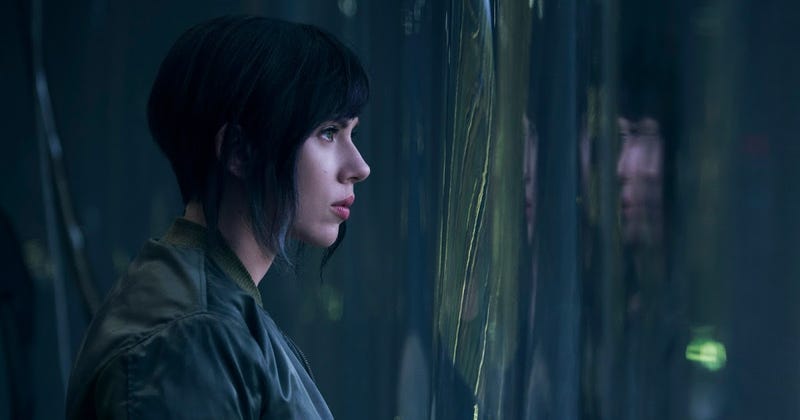
Ghost in the Shell Publisher ‘Never Imagined’ a Japanese Actress in the Lead Role
[Image: Paramount/Dreamworks]
While Scarlett Johansson’s casting as Japanese cyborg Motoko Kusanagi has been controversial in the West, the original Tokyo-based publisher of the Ghost in the Shell manga seems totally cool with it.
Kodansha, one of Japan’s largest publishers, first put out the manga in 1989, and as AnimeNewsNetwork reports, began reprinting the manga after Production I.G successfully pitched the project to Hollywood on its behalf.
[Full disclosure: The now-defunct Kodansha International previously published two of my books.]
“Looking at her career so far, I think Scarlett Johansson is well-cast,” Sam Yoshiba, director of the international business division at Kodansha’s headquarters in Tokyo, told The Hollywood Reporter (via AnimeNewsNetwork and RocketNews). “She has the cyberpunk feel. And we never imagined it would be a Japanese actress in the first place.”
“This is a chance for a Japanese property to be seen around the world,” said Yoshiba.
According to The Hollywood Reporter, this comes after Yoshiba recently came back from the movie’s New Zealand set and said, as The Hollywood Reporter writes, “he was impressed by the respect being shown for the source material.”
Well, save for the bit about the main character being white and all.
While the manga’s publisher might have never imagined a Japanese actress, there was a recent report that stated the filmmakers ran tests to see if Johansson could look Asian through CG.
In Japan, however, many people online don’t seem too upset or even surprised about the casting. Some said they didn’t care because they had no plans to see the film anyway.
Kotaku East is your slice of Asian internet culture, bringing you the latest talking points from Japan, Korea, China and beyond. Tune in every morning from 4am to 8am.
Never mind the publisher’s take. They sold the rights. What about the author?
I never felt that Kusanagi’s cyborg body had a defined ethnicity. Many drawings show her with blue eyes. Maybe the author himself is to blame. Or the artist.
She reminds me of those Korean girls with plastic surgery for a western appearance. It fits the movie’s central theme.
More grist
The complaint grows: first Ghost, then Dr. Strange, and now Power Rangers. :o
OP-ED CONTRIBUTOR
[URL=“http://mobile.nytimes.com/2016/04/23/opinion/why-wont-hollywood-cast-asian-actors.html?mwrsm=Facebook&_r=0&referer=http%3A%2F%2Fm.facebook.com%2F”]Why Wont Hollywood Cast Asian Actors?

DADU SHIN
By KEITH CHOW
APRIL 22, 2016
HERES an understatement: It isnt easy being an Asian-American actor in Hollywood. Despite some progress made on the small screen thanks, Fresh Off the Boat! a majority of roles that are offered to Asian-Americans are limited to stereotypes that wouldnt look out of place in an 80s John Hughes comedy.
This problem is even worse when roles that originated as Asian characters end up going to white actors. Unfortunately, these casting decisions are not a relic of Hollywoods past, like Mickey Rooneys portrayal of I. Y. Yunioshi in Breakfast at Tiffanys, but continue right up to the present.
Last week Disney and Marvel Studios released the trailer for Doctor Strange, an adaptation of the Marvel comic. After exhausting every white man finds enlightenment in the Orient trope in less than two minutes, the trailer presents Tilda Swinton as the Ancient One, a Tibetan male mystic in the comics. Though her casting was no secret, there was something unsettling about the sight of Ms. Swintons clean-shaven head and mystical Asian garments. It recalled jarring memories of David Carradine from Kung Fu, the 1970s television series that, coincidentally, was itself a whitewashed version of a Bruce Lee concept.
A few days later, DreamWorks and Paramount provided a glimpse of Scarlett Johansson as the cyborg Motoko Kusanagi in their adaptation of the Japanese anime classic Ghost in the Shell. The image coincided with reports that producers considered using digital tools to make Ms. Johansson look more Asian basically, yellowface for the digital age.
This one-two punch of white actors playing Asian characters showed how invisible Asian-Americans continue to be in Hollywood. (Not to be left out of the whitewashing news, Lionsgate also revealed the first images of Elizabeth Banks as Rita Repulsa, another originally Asian character, in its gritty Power Rangers reboot.)

Slide Show | Whitewashing, a Long History White actors playing Asian characters demonstrate how invisible Asian-Americans continue to be in Hollywood.
Why is the erasure of Asians still an acceptable practice in Hollywood? Its not that people dont notice: Just last year, Emma Stone played a Chinese-Hawaiian character named Allison Ng in Cameron Crowes critically derided Aloha. While that film incited similar outrage (and tepid box office interest), no national conversation about racist casting policies took place.
Obviously, Asian-Americans are not the only victims of Hollywoods continuing penchant for whitewashing. Films like Pan and The Lone Ranger featured white actors playing Native Americans, while Gods of Egypt and Exodus: Gods and Kings continue the long tradition of Caucasians playing Egyptians.
In all these cases, the filmmakers fall back on the same tired arguments. Often, they insist that movies with minorities in lead roles are gambles. When doing press for Exodus, the director Ridley Scott said: I cant mount a film of this budget" and announce that my lead actor is Mohammad so-and-so from such-and-such.
When the screenwriter Max Landis took to YouTube to explain the Ghost in the Shell casting, he used a similar argument. There are no A-list female Asian celebrities right now on an international level, he said, admonishing viewers for not understanding how the industry works.
Mr. Landiss argument closely tracks a statement by the screenwriter Aaron Sorkin. In a leaked email exchange with studio heads, he complained about the difficulty of adapting Flash Boys, Michael Lewiss book about the Wall Street executive Bradley Katsuyama, because there arent any Asian movie stars.
Hollywood seems untroubled by these arguments. Its not about race, they say; the only color they see is green: The reason Asian-American actors are not cast to front these films is because not any of them have a box office track record.
But theyre wrong. If minorities are box office risks, what accounts for the success of the Fast and Furious franchise, which presented a broadly diverse team, behind and in front of the camera? Over seven movies it has grossed nearly $4 billion worldwide. In fact, a recent study by the Ralph J. Bunche Center for African American Studies at the University of California, Los Angeles, found that films with diverse leads not only resulted in higher box office numbers but also higher returns of investment for studios and producers.
And Hollywoods argument is circular: If Asian-Americans and other minority actors more broadly are not even allowed to be in a movie, how can they build the necessary box office clout in the first place? To make matters worse, instead of trying to use their lofty positions in the industry to push for change, Hollywood players like Mr. Landis and Mr. Sorkin take the easy, cynical path.
Some of the exact same stuff I said in post #13.
Anyway, I won’t be watching either this or the Dr. Strange movie.
Funny how the Smiths and all the African-Americans who boycotted the oscars for being “too white” and not giving enough opportunities to “people of color” are noticeably absent on this issue. I suppose Asian-American actors aren’t people of ENOUGH color. :rolleyes:
Greetings Jimbo,
“Funny how the Smiths and all the African-Americans who boycotted the oscars for being “too white” and not giving enough opportunities to “people of color” are noticeably absent on this issue. I suppose Asian-American actors aren’t people of ENOUGH color.”
I do not think that the many “people of color” in Hollywood, regardless of national origin, have taken themselves to the point where they can actually be an influence. Getting paid seems to be the drive now days. It is most unfortunate. Bridges of mutual support should be established.
The “Asian Card” is the most powerful card to play right now simply because of the money that can be made in the Asian market. One well placed funk over representation can tank a movie’s draw in the Asian market.
I found the Asian response to Dr Strange to be painfully slow on the draw. Yet, I see the momentum building.
mickey
Asia don’t care
It’s an American issue. America will soon need to grapple with not being #1 when it comes to movies.
Asian actors too busy to fret over Hollywood ‘white-washing’
Yuri Kageyama, Associated Press Updated 10:20 am, Thursday, June 30, 2016

Photo: Andrew Medichini, AP
In this Sept. 5, 2007, file photo, Japanese actress Kaori Momoi poses during the photo call for the movie “Sukiyaki Western Django” at the 64th Venice Film Festival, in Venice, Italy. The film world of Asia is too busy making movies of its own to fret much about the debate slamming Hollywood - the casting of white people in roles written for Asians. Momoi, who appeared in “Memoirs of a Geisha,” as well as Russian filmmaker Aleksandr Sokurov’s “The Sun,” suggested acting was ultimately about individual talent, not skin color or nationality

Photo: Lionel Cironneau, AP
In this May 18, 2013 file photo, actor Vijay Varma poses for photographers during a photo call for the film “Monsoon Shootout” at the 66th international film festival, in Cannes, southern France. The film world of Asia is too busy making movies of its own to fret much about the debate slamming Hollywood - the casting of white people in roles written for Asians. The Indian actor who starred in “Monsoon Shootout,” a crime story with multiple endings, shown at Cannes, eloquently directed by Amit Kumar, pointed out insularity was prevalent in Bollywood as well

Photo: Thibault Camus, AP
In this May 11, 2016, file photo, actress Gong Li arrives on the red carpet for the screening of the film Cafe Society and the Opening Ceremony at the 69th international film festival, Cannes, southern France. The film world of Asia is too busy making movies of its own to fret much about the debate slamming Hollywood - the casting of white people in roles written for Asians. Li, the star of Chinese auteur Zhang Yimou’s films, such as “Raise the Red Lantern,” characterized the dilemma as a “problem of marketability.”

Photo: Yoo Hyo-lim, AP
South Korean actress Claudia Kim poses during an interview in Seoul, South Korea, Thursday, June 30, 2016. The film world of Asia is too busy making movies of its own to fret much about the debate slamming Hollywood -_ the casting of white people in roles written for Asians. Kim, known in her native South Korea as Soo Hyun, noted she has been lucky to play independent Asian women in most movies, such as Dr. Helen Cho in “Avengers: Age of Ultron,” the 2015 movie based on Marvel comics. (Yoo Hyo-lim/Yonhap via AP)
TOKYO (AP) — The film world of Asia, known for producing Akira Kurosawa, Satyajit Ray, Brillante Mendoza and other greats, is too busy making movies of its own to fret much about the debate slamming Hollywood — the casting of white people in roles written for Asians.
While hurt, irritated or dumb-founded perhaps about the so-called “white-washing” syndrome, performers here aren’t expressing the level of outrage of a Margaret Cho, George Takei or other Americans, The Associated Press has found.
Many shrugged off the phenomenon as inevitable, given commercial marketability needs, noting Asian films also cast well-known actors over and over.
Casting white people in non-white roles is as painfully old as Charlie Chan and Fu Manchu in American entertainment. That kind of monolithic casting continues — recently with the tapping of Tilda Swinton as a character that was originally Tibetan in the new Marvel “Dr. Strange” movie.
It’s also a sensitive topic. South Korean actor Lee Byung-hun declined to be interviewed through his representative, who noted Lee was set to be in a Hollywood film.
Kaori Momoi, who appeared in “Memoirs of a Geisha,” as well as Russian filmmaker Aleksandr Sokurov’s “The Sun,” suggested acting was ultimately about individual talent, not skin color or nationality.
Momoi praised the devotion, skill and professionalism of Scarlett Johansson, whose starring in “Ghost in the Shell,” based on a Japanese manga, has stirred up an uproar as a prime example of “white-washing.” Momoi played the mother of Johansson’s character.
“I felt blessed to have worked with her,” she said, urging actors to be selective of the directors they choose to work with. “And so what’s fantastic is fantastic. What fails just fails.”
Like other actors with experience in Asia, Momoi saw Hollywood more as an opportunity. She was already a superstar in Japan when she started acting in movies abroad about a decade ago. What she enjoyed was the challenging novelty of it all, “getting away from being Kaori Momoi,” as she described it.
“Compared to Japan, there is so much potential and recognition in the U.S. for independent films,” said Momoi in a telephone interview from Los Angeles.
She got to know film people at international festivals, including Berlin, which showed “Fukushima, Mon Amour,” a film she was in. She has become a director herself, having two films to her credit, including “Hee,” being released later this year, in which she also gives a harrowing rendition of an aging prostitute.
Claudia Kim, known in her native South Korea as Soo Hyun, noted she has been lucky to play independent Asian women in most movies, such as Dr. Helen Cho in “Avengers: Age of Ultron,” the 2015 movie based on Marvel comics.
But she was baffled when she learned a white actress was picked for the Asian role in a Hollywood movie she had auditioned for. She declined to identify that film.
“It is definitely not a pleasant experience,” she told the AP, calling the choice “ridiculous.”
Vijay Varma, an India actor who starred in “Monsoon Shootout,” a crime story with multiple endings that was shown at the Cannes Film Festival, pointed out insularity was prevalent in Bollywood as well.
Families dominate the business, although he was an exception and came from a family unrelated to movies. Bollywood counts on mass appeal, casting the “familiar,” just like Hollywood, he added.
When an effort that defies boundaries turns out to be a great movie, like “Life of Pi,” which starred an Indian actor, combined live action with computer graphics, and had a Taiwan-born director Ang Lee, “it feels really good,” Varma said.
While some Japanese may wonder why Chinese actress Zhang Ziyi is the heroine in “Memoirs of a Geisha,” they also feel no qualms routinely casting Japanese to play Chinese and other non-Japanese Asian roles, feigning embarrassingly phony accents and mannerisms.
Landing roles in Asian movies is relatively off-limits for Americans, usually relegated to blatantly “foreign” roles. Koji Fukada’s “Sayonara” starred Bryerly Long, an American, as a dying woman in Japan, but the film also starred a humanoid robot as her loyal companion.
Gong Li, the star of Chinese auteur Zhang Yimou’s films, such as “Raise the Red Lantern,” characterized the dilemma as a “problem of marketability.”
“Asian culture has not meshed well with U.S. film culture. It’s not integrated. There are a lot of American A-listers who are making movies in China right now, who have not done well. So it’s the same whether you cast a famous actor or not not-so famous one. Chinese people don’t know who they are,” she said as she walked the red carpet recently at Cannes.
Examples abound. “Hollywood Adventures” had an American setting and Chinese stars but was doomed by the stiff translation of English dialogue. Nicolas Cage and Hayden Christensen made the action fantasy “Outcast” for the Chinese market, where it flopped. Jackie Chan’s “Dragon Blade,” co-starring Adrien Brody and John Cusack, was a hit in China, but its U.S. showing failed to replicate the martial arts superstar’s past Hollywood successes.
Matt Damon and director Zhang Yimou are hoping for a better reception in their upcoming science-fiction thriller “The Great Wall.”
And many performers in both places hope for a more multicultural future.
Respecting diversity in casting could lead not only to better films but also a better world, said Monisha Shiva, an Indian-American actress who has worked in both India and the U.S., and found the former to be more empowering.
“I was the center. I was the story,” she said in a telephone interview from New York.
“The magic of acting is to give people visions and imagination, and imagine a different world. You want that. It’s important to use actors of color,” said Shiva. “Art is to start to make new visions. And it’s a way to heal.”
Associated Press writers Angela Chen in Hong Kong and Youkyung Lee in Seoul, South Korea, contributed to this report.
Follow Yuri Kageyama on Twitter at https://twitter.com/yurikageyama
Her work can be found at http://bigstory.ap.org/content/yuri-kageyama
Honestly, I don’t see why Chinese, Japanese, Korean, Indian, etc. actors/actresses based in their native countries would even be asked what they might think of Hollywood whitewashing. A high percentage of Asians in Asia period wouldn’t even comprehend the concept of whitewashing. I’ve always said that it’s an Asian-American issue, not an Asian issue. I give far more credibility to what George Takei, B.D. Wong, Margaret Cho and others have had to say on the matter than I would Kaori Momoi, Gong Li, et al. There are many talented Asian-American actors out there. Why have several of them relocated to work as actors in the countries of their ancestry, even if some of them couldn’t even speak the language?
And for anyone who says that white (or black) people couldn’t become big stars in Japan, China, South Korea, Hong Kong, etc., that is a weak argument. None of those countries are as diverse and multi-cultural as the U.S., which likes to tout that fact, but does not reflect it onscreen.
An explanation from the filmmakers.
‘Doctor Strange’ Writer Explains Casting of Tilda Swinton as Tibetan
Sinosphere
By EDWARD WONG APRIL 26, 2016

Tilda Swinton, at the Berlin International Film Festival on Feb. 11. Some have questioned her casting as the Ancient One in “Doctor Strange.” Credit Michael Kappeler/European Pressphoto Agency
BEIJING — The trailer for “Doctor Strange” from Marvel Studios has ignited outrage against what some people call another example of Hollywood’s racist casting. It reveals that a Tibetan character from the comic book, the Ancient One, is played by Tilda Swinton, a white British actress.
It turns out that the filmmakers wanted to avoid the Tibetan origins of the character altogether, in large part over fears of offending the Chinese government and people — and of losing access to one of the world’s most lucrative film markets, according to one insider account.
In an interview last week, C. Robert Cargill, the main screenwriter, offered that as an explanation for why the Ancient One was no longer Tibetan.
The Tibetan issue is one of the thorniest involving China and other nations. The Chinese Communist Party and its army occupied Tibet in 1951, and Chinese leaders are well aware that many non-Chinese believe that Tibet should have independence or greater autonomy.
Marvel said in a statement that there was no problem with the casting of Ms. Swinton as the Ancient One since the character was written as a Celt in the film and is not Asian at all. Some critics have said that studio executives and filmmakers must have assumed Asian actors had less drawing power than white actors.
In an interview on the pop culture show “Double Toasted,” Mr. Cargill said the decision to rid the character of its Tibetan roots was made by others working on the project, including the director, Scott Derrickson. It came down to anxieties over losing the China market, he said, if the portrayal of the Ancient One ended up stirring political sensitivities in China.
In response to an angry viewer’s question about the casting of Ms. Swinton, Mr. Cargill said: “The Ancient One was a racist stereotype who comes from a region of the world that is in a very weird political place. He originates from Tibet, so if you acknowledge that Tibet is a place and that he’s Tibetan, you risk alienating one billion people.”
He added that there was the risk of “the Chinese government going, ‘Hey, you know one of the biggest film-watching countries in the world? We’re not going to show your movie because you decided to get political.’ ”
Earlier in the interview, Mr. Cargill had acknowledged that the origin story of Dr. Strange in old Marvel comics does involve Tibet, and that his mentor was Tibetan. “He goes to a place in Tibet, the Ancient One teaches him magic, he becomes a sorcerer, then later he becomes the Sorcerer Supreme,” Mr. Cargill said.
The Chinese box office is the world’s second biggest, behind the United States, and Hollywood executives often alter films to avoid offending Chinese officials and to help their movies get shown in China. The Chinese government sets a strict limit on the number of foreign films shown in cinemas each year.
Mr. Cargill’s take on how Chinese officials and moviegoers might react to a Tibetan character was overly simplistic, though. The government and many Chinese people do not deny the existence of the cultural idea of Tibet or Tibetans. They just assert that China should rule the territory.
Mr. Cargill also said that because the original character of the Ancient One was a racist stereotype, the role would be hard to pull off with modern sensibilities. He added that if a Tibetan had been cast, it would result in the stereotypical narrative of a white hero, Dr. Stephen Strange, played by Benedict Cumberbatch, being indoctrinated into Eastern mysticism.
From the trailer, the film appears to retain some of the origin story’s Tibetan Buddhist flavor. There are shots of temples in what seems to be the Kathmandu Valley of Nepal. At one point, Mr. Cumberbatch’s hand turns Tibetan prayer wheels. Ms. Swinton’s character, though Celtic, appears to be training Dr. Strange in Nepal.
Mr. Cargill said some critics had suggested the filmmakers could have cast Michelle Yeoh as the Ancient One. Ms. Yeoh is an ethnic Chinese actress from Malaysia who is a martial arts icon and starred in “Crouching Tiger, Hidden Dragon.”
“If you are telling me you think it’s a good idea to cast a Chinese actress as a Tibetan character, you are out of your **** fool mind,” Mr. Cargill said.
Mr. Cargill also drew a parallel, saying that the only thornier situation he could envision was if Dr. Strange’s origin story had involved him going to Palestine in the 1930s and studying under a Palestinian mentor.
The Ancient One was a character who had “fallen into a weird place,” he said. “There’s a really, really ugly piece of history that we wish there was an easy solution to, and there wasn’t one.”
Mr. Cargill said Mr. Derrickson, the director, hoped that changing the gender would help offset bad choices that had to be made.
Mr. Derrickson, he said, reasoned that “there’s no real way to win this, so let’s use this as an opportunity to cast an amazing actress in a male role.”
“And sure enough, there’s not a lot of talk about, ‘Oh man, they took away the job from a guy and gave it to a woman.’ Everybody kind of decides to pat us on the back for that and then decides to scold us for her not being Tibetan.”
Ms. Swinton, in an interview with Den of Geek, confirmed that the change to the character had been made early in the process.
“The script that I was presented with did not feature an Asian man for me to play, so that was never a question when I was being asked to do it,” she said.
A Marvel press officer issued a statement defending the casting, saying that “Marvel has a very strong record of diversity in its casting of films and regularly departs from stereotypes and source material.”
“The Ancient One is a title that is not exclusively held by any one character, but rather a moniker passed down through time, and in this particular film the embodiment is Celtic,” the company said. “We are very proud to have the enormously talented Tilda Swinton portray this unique and complex character alongside our richly diverse cast.”
Mr. Cargill had a more sober take in the interview on “Double Toasted.” He likened the cultural issue involving the Ancient One to the Kobayashi Maru, a famous battle simulation game in the “Star Trek” universe that Starfleet Academy cadets must play during training. The game had been programmed so that all choices would lead to a loss.
“I could tell you why every single decision that involves the Ancient One is a bad one, and just like the Kobayashi Maru, it all comes down on which way you’re willing to lose,” Mr. Cargill said.
He neglected to mention the fact that James T. Kirk, one of the main heroes of “Star Trek,” famously did beat the game with an unorthodox gambit.
Actually, this is a reasonable argument. That China market is huge and the role of a Tibetan would make it difficult.
Then again, they could have just relocated the Ancient One to Wudang or Songshan or any number of Chinese mystic mountains…:rolleyes:
This is getting kinda funny to me now…
The disregard of the China market is getting twisted up by the ignorant. Some critics are accusing Hollywood of bowing to PRC censors, but that demonstrates a basic misunderstanding of the global film market and how films get approved in China. Censorship is a knee-jerk word here in the U.S. where it freedom of speech is a thing. But in China, that’s not a thing, not at all.
Here’s feedback from a Tibetan:
Hollywoods Latest Whitewash: What Doctor Strange’s Casting of Tilda Swinton Means
By Gelek Badheytsang
April 27, 2016

Still via ‘Doctor Strange’
If you’re not white, chances are when you’re watching a movie or a TV series, you’ll catch yourself on the lookout for anyone who’s not white.
It’s a very minor event, this trying to find someone who looks like you onscreen, and most of us probably do it unconsciously.
That Hollywood has blind spots when it comes to race and race-based issues is not a groundbreaking revelation. Its audience, increasingly non-white and vocal, are challenging the films and their filmmakers about this gap when it comes to who is shown on-screen and who isn’t.
It’s in this context that we find Doctor Strange. Screenwriter C. Robert Cargill, in a fit of exasperation and indignation, responded to criticisms recently that his movie committed the age-old Hollywood tradition of whitewashing by casting Tilda Swinton in the role of the Ancient One. In the Marvel comic book lore, the Ancient One was based on a Tibetan mystical master. He guides the titular hero (portrayed onscreen by Benedict Cumberbatch) in his journey from a brilliant but ordinary surgeon, to a brilliant and powerful superhero; cloaked and ready to join the pantheon of Marvel characters, and the next instalment of the money-printing enterprise that is the Avengers series.
As Cargill explains it, the decision to cast Swinton was not done lightly. “The Ancient One was a racist stereotype who comes from a region of the world that is in a very weird political place,” he says in a video interview posted on YouTube. “He originates from Tibet, so if you acknowledge that Tibet is a place and that he’s Tibetan, you risk alienating one billion people who think that that’s bull****.”
The one billion people that Cargill is referring to are the Chinese people. He continues:
“[You] risk the Chinese government going, ‘Hey, you know one of the biggest film-watching countries in the world? We’re not going to show your movie because you decided to get political.’”
He ends this matter by saying that anyone who proposes casting a Chinese actor in this role as a workaround is “out of [their] **** fool mind and have no idea what the **** [they’re] talking about.”
Cargill is referring to some comments online that suggested the movie could have cast Michelle Yeoh, who is Chinese-Malaysian, instead of Tilda Swinton.

Tilda Swinton as "the Ancient One"bald, but still not Tibetan.
Many Tibetans, like myself, remember the time when Kundun, a film by Martin Scorsese about the Dalai Lama’s escape from Tibet to India, first came out. Scorsese and many of his colleagues were subsequently banned from entering China. That was almost 20 years ago. Disney at the time stood by its project, even in the face of harsh retribution from the Chinese government. In the intervening years, the Chinese market for Hollywood films has grown exponentially.
The demands of “one billion people” outstrip those who number far fewer than 10 million. This is basic economics.
But let me tell you how thrilling it was to see Kundun as a Tibetan. When the movie was screened in theatres in Nepal and India (where there is historically, and still remains, the largest influx of Tibetan refugees) grown men wept and old women prostrated to the image of their spiritual leader on aisles between the seats.
I was around 12 years old at the time in Nepal, and even though I was mostly preoccupied by Teenage Mutant Ninja Turtles and WWE (WWF then), I remember vividly how big of a deal it was that this movie was coming out. Scorsese became a kind of a hero, even though I knew next to nothing at the time about one of the greatest living filmmakers.
There was that undeniable magic of cinemawhen a character looms larger than life onscreen, against the backdrop of the expansive Tibetan landscape (by way of Morocco)that swells your heart and transposes you from inside that packed auditorium to the mountains of Tibet, alongside the Dalai Lama, kicking ass, being kind, crying over the loss of loved ones, and just being human.

Still from the movie ‘Kundun’ (1997) featuring: actual Tibetans as Tibetan monks
There is no amount of dollars or marketing strategy that will quite capture that sense of seeing yourself, or someone like you, projected and humanized on a giant theatre screen. We knew then that in spite of what the mighty Chinese government wanted (the elision of all things Dalai Lama and Tibetan), a short, plucky Italian-American director from the Bronx gave them the finger and realized his vision.
Cargill, it seems, has thrown up his hands. Even though he could doubtless imagine and write pages upon pages of heroic, magical feats for Doctor Strange, on the matter of casting a Tibetan actor, that well is nigh empty. Sorry, but not sorry, because dollars. At least he was honest about it.
The very fact of my existence is a sore point for the Chinese government. Cargill and his ilk would like you to believe that their hands are tied on this matter, but I don’t buy it. Their influence over our (and the Chinese audience’s) decision to buy tickets to their shows extends beyond just cold hard economics. There is something to be said for doing it the right way. For imagining a world (or at least an America) where, for once, the white skin is not the default, neutral canvas.
In the age of #OscarsSoWhite, Cargill’s decision (and his white, male background) is political. Of the panoply of controversies to navigate and confront, he chooses a route that inconveniences him the least.
It’s also a bit rich hearing Cargill speak about how he and his team had to carefully, painfully, consider not casting Asians so as to not reaffirm past stereotypes. That consideration falls flat when Hollywood keeps pumping out movies that showcase white dudes in white saviour roles (see: The Legend of Tarzan, coming to a screen near you later this summer).
For what it’s worth, between a white actor and a non-Tibetan but Asian-American actor playing the role of the Ancient One, my vote (and dollars) will easily go for the latter. In an industry where it’s already hard enough to find roles beyond just extras in the background, here is a character tailor-made for an Asian American actor to shine in. And it goes to Tilda Swinton.
Oh well. I continue to be on the lookout for faces like me. Somewhere in Toronto or Los Angeles, there is a Tibetan kid dreaming to be the next Denzel Washington or Tilda Swinton. I hope she gets a fair shake.
Follow Gelek Badheytsang on Twitter.
Let’s hear from Tilda. I like her.
Tilda Swinton responds to Doctor Strange casting controversy
BY CLARK COLLIS • @CLARKCOLLIS

(Marvel)
Doctor Strange
Posted August 12 2016 — 2:00 PM EDT
Tilda Swinton has responded to the controversy which erupted over her casting as the magic powers-possessing The Ancient One in Marvel’s new superhero movie Doctor Strange. In the Marvel comics, the character, who is responsible for mentoring the titular ex-surgeon in the mystic arts, is traditionally depicted as Asian. Swinton’s playing of the Ancient One became a major news story following the release of the movie’s first trailer last April, with Marvel accused of “whitewashing” the character.
“Anybody calling for more accurate representation of the diverse world we live in has got me standing right beside them,” says Swinton. “I think when people see this film, they’re going to see that it comes from a very diverse place, in all sorts of ways. Maybe this misunderstanding around this film has been an opportunity for that voice to be heard, and I’m not against that at all. But I do think that when people see the film, they’ll see that it’s not necessarily a target for that voice.”
Swinton previously addressed the controversy earlier this year, saying that she “wasn’t asked to play an Asian character, you can be very well assured of that.” Marvel issued a statement at that time, saying that the Ancient One “is a title that is not exclusively held by any one character, but rather a moniker passed down through time, and in this particular film the embodiment is Celtic.”
Director Scott Derrickson also responded to the uproar on Twitter, writing, “Raw anger/hurt from Asian-Americans over Hollywood whitewashing, stereotyping & erasure of Asians in cinema. I am listening and learning.”
Doctor Strange, also starring Benedict Cumberbatch, Rachel McAdams, Mads Mikkelsen, Chiwetel Ejiofor, and Benedict Wong, opens in theaters on Nov. 4. You can see the film’s most recent trailer below.
[QUOTE=boxerbilly;1295518]Well all I know is Gere and Pitt should not go to China.[/QUOTE] Haaaa. Good one, boxerbilly.
