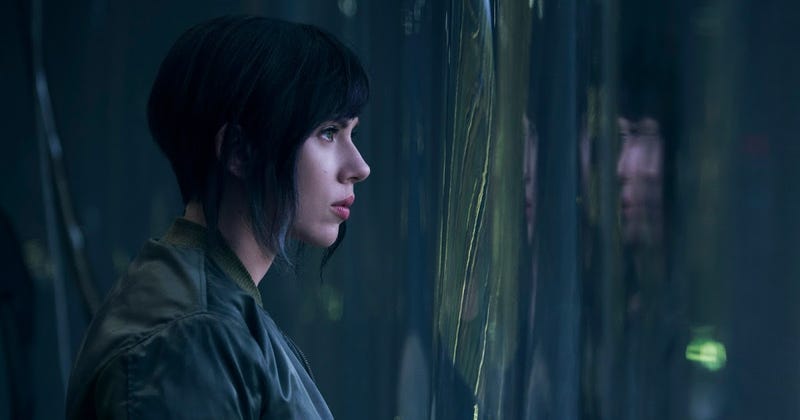
Ghost in the Shell

I’m surprised there isn’t a thread on this already. The original was groundbreaking anime.

Scarlett Johansson Signs On to Star in DreamWorks’ ‘Ghost in the Shell’ (EXCLUSIVE)


January 5, 2015 | 08:30AM PT
Justin Kroll
Film Reporter @krolljvar

Following the success of “Lucy,” Scarlett Johansson looks ready to take on another action pic, this one coming from the world of Japanese anime.

Johansson is set to star in DreamWorks’ adaptation of the popular anime pic “Ghost in the Shell.” Deadline Hollywood had reported that the actress had the offer to star but at the time she was still undecided about taking the role. Sources now say she has agreed to star in the pic.

The story follows the exploits of a member of a covert ops unit of the Japanese National Public Safety Commission that specializes in fighting technology-related crime.

Rupert Sanders is on board to direct. Avi Arad and Steven Paul are producing the film from a script by Bill Wheeler. Mark Sourian is exec producing.

Insiders also tell Variety that Paramount has the option to come on as co-producer and financier and that decision is expected in the coming weeks.

DreamWorks principal Steven Spielberg is a huge fan of the original and has long wanted to get this film off the ground. A commitment from a star like Johansson should help in getting the pic greenlit for production.

Besides Angelina Jolie and Jennifer Lawrence, Johansson is becoming one of the few actresses in town with the clout to get a project greenlit on her name alone.

“Lucy” made $394 million worldwide and Johansson can be seen next in “Avengers: Age of Ultron,” bowing in May. Johansson has also done a nice job of balancing action-heavy tentpoles with serious dramas and comedies.

She received rave reviews for Spike Jonze’s “Her” and is a part of the ensemble of the Coen brothers’ next pic “Hail, Caesar!” She is repped by CAA and LBI Entertainment.

Plus a new anime GitS

Promo for the New Animated Ghost in the Shell Debuts
By Spencer Perry ON January 8, 2015

On the heels of the announcement that Scarlett Johansson will lead a live-action version of Ghost in the Shell, Moca News (Via ANN) has uncovered a promo for an upcoming animated film based on the Japanese series acting as an “evolution” of the story. Check it out below.

Much of the crew for the previously-released Ghost in the Shell: Arise have transitioned into working on this latest film, including director Kazuchika Kise who will also design the characters. “Arise” screenwriter Tow Ubukata will pen the script with music by Corneliu. The cast from Ghost in the Shell: Arise will also take part in the latest film, including Maaya Sakamoto, Ikkyuu Juku, Kenichirou Matsuda, Tarusuke Shingaki, Shunsuke Sakuya, Takurou Nakakuni, Youji Ueda, Kazuya Nakai, and Miyuki Sawashiro.

The film is expected to debut in Japan in early summer with no set American release, but check back here for further details.

//youtu.be/CUEktyhOSxg

If you’ve never seen the original GitS, it is one of the most visionary animes of its time and spawned several more installments in the franchise. I’m a little torn about ScarJo playing Major Motoko Kusanagi as it’s another case of caucasianofying an Asian role. But then again, I’d watch ScarJo floss her teeth. The photo above just doesn’t do her justice.

:smiley: Scar would look good as an Asian brunette.

Scar Jo

She did ok as a Scottish Extraterrestrial in UNDER THE SKIN.

Extraterrestrial is a big jump, but not Scottish

And it’s not as big a jump as Motoko.

It’s like if ScarJo was to play Valerie from Josie and the *****cats. Better than Rosario?

a petition

DreamWorks: Stop Whitewashing Asian Characters!

author: Julie Rodriguez
target: DreamWorks Studios
signatures: 28,629

28,629
29,000

we’ve got 28,629 signatures, help us get to 29,000

overview | petition

Fans of the iconic 1995 animated Japanese sci-fi film Ghost in the Shell have been anticipating a live-action remake for years – but now, instead of casting an Asian actress, Dreamworks has selected Scarlett Johansson for the lead role! The film revolves around Major Motoko Kusanagi, a member of a futuristic security force tasked with tracking a mysterious hacker.

The original film is set in Japan, and the major cast members are Japanese. So why would the American remake star a white actress? The industry is already unfriendly to Asian actors without roles in major films being changed to exclude them. One recent survey found that in 2013, Asian characters made up only 4.4% of speaking roles in top-grossing Hollywood films.

Dreamworks could be using this film to help provide opportunities for Asian-American actors in a market with few opportunities for them to shine – please sign the petition asking them to reconsider casting Scarlett Johansson in Ghost in the Shell and select actors who are truer to the cast of the original film!
you have the power to create change.

Start sharing and watch your impact grow

I’m now really curious if the opposite has ever happened - like is there an Asian-washing where Chinese actors were cast to play Charlie Brown or something? That must exist, right?

filming begins next year

Apr 23, 2015 @ 6:24 AM 253 views
‘Ghost In The Shell’ Movie To Start Filming In 2016


JUSTIN TALLIS/AFP/Getty Images

Ollie Barder
Contributor
I write about video games and pop-culture from Japan.

It seems despite the petitions and general fan based disapproval, Dreamworks are going ahead with the live action adaptation of Ghost in the Shell. According to the movie’s lead actress, Scarlett Johansson, filming will start at the beginning of 2016.

Thus far we know that Rupert Sanders is set to direct the film, based off a script by William Wheeler. The production side of things is also being handled by Avi Arad.

While the creative team behind this doesn’t exactly fill me with confidence, the real clincher is that Hollywood in general still has a poor grasp on dealing with anime and manga related properties.

This is very much evident in the casting of Scarlett Johansson as Motoko Kusanagi, which is a truly bizarre choice.

Some fans have even gone so far to claim “white washing“, as the character’s origins are Asian. While I can understand that reasoning, my issue is that I don’t think she is a good fit for the role.

Not because she is a bad actress, far from it. Just that there are better suited actresses for a part such as this.

On account of all this fans have ended up petitioning Dreamworks to reconsider this crucial casting choice.

It’s clear that, for now at least, the film is going ahead as intended. So it will be very much up Dreamworks to deliver a movie that accurately represents the host property.

While I hope that they can do a good job with this new Ghost in the Shell movie, Hollywood’s prior track record doesn’t exactly fill me with confidence.

It’s total white-washing, but I watched ScarJo in Lucy, so I’ll sit through almost anything for her. Dang, I should review Lucy. It was bad.

Casting call

Only for you kiwis however…wait…is it cool for a yank to say ‘kiwi’ or is it like the n-word here? I don’t mean to offend. :o

‘Ghost in the Shell’ Starring Scarlett Johansson Open Casting Call
October 1, 2015, Casting Calls & Auditions, featured, Ghost in the Shell, New Zealand, Rachel Bullock Casting, Scarlett Johansson

Ghost in the Shell starring Scarlett Johansson is now holding an open casting call in Wellington, New Zealand.

Rachel Bullock Casting posted a casting call for extras to appear in the Dreamworks and Paramount Pictures’ upcoming live-action thriller, Ghost in the Shell. The casting call is for people of all ethnicities, age 18 and over, and able to work.

Filming is started to begin from Wellington’s Stone Street Studios in January 2016.

Dreamworks and Paramount are con-financing and co-producing the film. Paramount will handle the international release of the upcomign feature film and Dreamworks will handle the release according to their original deal with Disney. The movie is set to open on March 31, 2017.

Disney initially scheduled the release of the live-action film for April 14, 2017, but announced its plans to push forward the release of the movie into April.

Scarlett Johansson, the actress most known for Lucy, Lost in Translation, and The Avengers signed on to star in this adaptation of Masamune Shirow‘s manga, and Rupert Sanders (Snow White and the Huntsman) will direct off a script by William Wheeler (Hoax, The Reluctant Fundamentalist).

Johannson revealed earlier in April that the film “will be shooting the beginning of next year, so I think we start production January or February.” Deadline reported earlier this year that she was offered $10 million for the role.

To apply for a background acting role on the upcoming Ghost in the Shell movie, check out the casting call breakdown below:
Ghost in the Shell Open Casting Call

I am casting extras for the following film and we are looking for a wide variety of people. We want to have all ethnicities covered in this film. At this stage we would need people to fill out a form and have a couple of photos taken of them. Please note this is a paid job. If anyone would like to get in touch with me please e mail

extras.lbo@gmail.com

FEATURE FILM LOOKING FOR PEOPLE TO BE EXTRAS

“Ghost in the Shell,” a DreamWorks Studios film shooting in NZ (out of Stone St studios in Wellington) in January 2016. This film is based on the internationally-acclaimed manga and anime series of the same name.

If you or anyone you know are interested in being an extra, are available to work in Wellington, and are aged 18+ please let me know.

Please do not apply, if you are not local or if you do not fit the description.

Beat

Live-action Ghost in the Shell movie casts its first Japanese actor: Beat Takeshi
Casey Baseel about an hour ago

69-year-old set to play key role in Hollywood anime adaptation.

DreamWorks Pictures’ upcoming live-action version of hit manga and anime Ghost in the Shell has ruffled the feathers of a few fans, and not just because of the many, many years that have passed since the still-unfinished picture was first announced. The choice of actress Scarlett Johansson to play the lead role of Motoko Kusanagi has been a divisive decision, with one side of the debate saying the star power she brings gives the project the sort of legitimacy it needs to procure the production and marketing funds necessary to do its exalted source material justice.

On the other hand, others are upset that the Japanese Kusanagi will be being portrayed by the Caucasian Johansson. A common rebuttal to that complaint has been that in the cybernetics-steeped world of Ghost in the Shell, most characters’ bodies are largely artificial, so it’s feasible that Kusanagi could simply opt to put her ghost in a non-Japanese-looking shell with no greater significance attached to the action than wearing a foreign-made piece of clothing.

Still, those hoping for some sort of Japanese presence on-screen were no doubt disappointed when Danish actor Pilou Asbaek was tapped as the ethnically ambiguous Batou, followed by Caucasian American Michael Pitt as the terrorist antagonist Laughing Man. Now, though, the live-action Ghost in the Shell has its first Japanese cast member, and it’s none other than the internationally acclaimed Beat Takeshi.

It’s not like the 69-year-old Takeshi will be making a cameo as a street food vendor or some other such minor background character. He’ll be playing Daisuke Aramaki, the head of Public Security Section 9 and the highest-ranking member of Ghost in the Shell’s team of heroes.

The role marks Takeshi’s first role in a Hollywood movie since another cyberpunk film, Johnny Mnemonic. Given how much more well-known he’s become overseas in the last two decades, it’s likely Takeshi will receive much more screen time than he did in the 1995 Keanu Reeves film.

In regards to Ghost in the Shell, Kitano commented “As it’s a work of stylish entertainment that’s completely different from my own directorial projects, I’m looking forward to seeing how it turns out.” And while Takeshi is both taller and stockier than the extremely diminutive Aramaki, the actor has already expressed a respectful fondness for Section 9’s director, describing him as “A compelling character who emits a unique presence.”

DreamWorks’ Ghost in the Shell is currently scheduled to open on March 31, 2017.

Source: Oricon Style via Hachima Kiko
Images: Ghost in the Shell official website

I come and go with Beat Takeshi. He was great in BR but I hated his spin on Zatoichi.

SCar-Jop as Kusanagi

If memory serves, isn’t Kusanagi nekkid in a few scenes in the original anime? Does that mean we’ll get to see Scar-Jo nekkid?

First Look: Scarlett Johansson In Anime Adaptation ‘Ghost In The Shell’
By Rodrigo Perez | The Playlist
April 14, 2016 at 8:17AM

The #filmtwitter world is focused on France and the Cannes Film Festival announcement this morning, but there’s much more going on beyond the Croisette. Paramount Pictures and DreamWorks Pictures have announced that production has started on “Ghost In The Shell” starring Scarlett Johansson, and they’ve released the inaugural first look image from the movie.

Rupert Sanders (“Snow White And the Huntsman”) is directing the anime adaption, with lensing taking place in Wellington, New Zealand. Paramount Pictures will release the film in the U.S. on March 31, 2017. Press release details below.

The film, which is based on the famous Kodansha Comics manga series of the same name, written and illustrated by Masamune Shirow, is produced by Avi Arad (“THE AMAZING SPIDER-MAN 1 & 2,” “IRON MAN”), Ari Arad (“GHOST RIDER: SPIRIT OF VENGEANCE”), and Steven Paul (“GHOST RIDER: SPIRIT OF VENGEANCE”). Michael Costigan (“PROMETHEUS”), Tetsu Fujimura (“TEKKEN”), Mitsuhisa Ishikawa, whose animation studio Production I.G produced the Japanese "GHOST IN THE SHELL” film and television series, and Jeffrey Silver (“EDGE OF TOMORROW,” “300”) will executive produce.

Based on the internationally-acclaimed sci-fi property, “GHOST IN THE SHELL” follows the Major, a special ops, one-of-a-kind human-cyborg hybrid, who leads the elite task force Section 9. Devoted to stopping the most dangerous criminals and extremists, Section 9 is faced with an enemy whose singular goal is to wipe out Hanka Robotic’s advancements in cyber technology.

“We are so pleased to be in Wellington to shoot ‘GHOST IN THE SHELL,’” said producers Avi Arad, Ari Arad, Michael Costigan and Jeffrey Silver. “The city boasts state-of-the-art production facilities and a rich urban landscape that make it an ideal setting for a sci-fi action film. The crew-base in New Zealand working on the film is first class, and working with Sir Richard Taylor and the team at Weta Workshop is inspirational on every level. The people of New Zealand have been terrific partners in helping us bring this story and its beloved characters to audiences around the world and we are thankful for their continued hospitality.”

Interesting piece on THR.

APRIL 15, 2016 3:57pm PT by Rebecca Sun, Graeme McMillan
Why Did ‘Doctor Strange’ and ‘Ghost in the Shell’ Whitewash Their Asian Characters?


Marvel’s ‘Doctor Strange’; Paramount and DreamWorks’ ‘Ghost in the Shell’ Courtesy of Film Frame; Paramount Pictures

This week in cultural appropriation: Scarlett Johansson, Tilda Swinton and a conversation between two THR writers.

This week, Marvel dropped the first teaser trailer for Doctor Strange, based on its comic series about a critically injured neurosurgeon who travels to the Himalayas to learn mystic arts from a powerful sorcerer known as the Ancient One. Two days later, Paramount and DreamWorks released the first image from Ghost in the Shell, their live-action adaptation of the Japanese manga about an anti-cyberterror task force set in mid-21st century Japan and led by cyborg Major Motoko Kusanagi.

On paper, it reads like a great week for Asian representation in Hollywood — but the Ancient One and the Major are played, respectively, by Tilda Swinton and Scarlett Johansson. And so these two projects — long-awaited by many fans of their source material — instead join Gods of Egypt, Aloha and Pan as recent inductees to Hollywood’s Whitewashing Hall of Shame.

Below, The Hollywood Reporter’s Heat Vision blogger Graeme McMillan and senior reporter Rebecca Sun discuss the similar circumstances greeting the films so far.

Rebecca Sun: We braced ourselves when the castings were announced, but (just like that Nina trailer) the visual evidence still stung.

In flipping both race and gender to cast Swinton as a character who in the original comics is a Tibetan-born man, Marvel admirably went out of the box to correct one aspect of underrepresentation in its cinematic universe, but did so at the expense of another. Like its fellow Marvel franchise Iron Fist, it is steeped in cultural appropriation and centers around what Graeme previously noted as the “white man finds enlightenment in Asia” trope.

Give Hollywood partial credit for continuously trying to cleverly sidestep the Fu Manchu stereotype of characters like DC’s Ra’s al Ghul and Marvel’s The Mandarin — but why is the solution consistently to reimagine those characters with white actors (Liam Neeson in Christopher Nolan’s Batman films and Guy Pearce in Iron Man 3, respectively)? The Doctor Strange movie doesn’t need its Ancient One to look like Lo Pan in Big Trouble in Little China, but there are creative ways to interpret the character without yet again erasing an Asian person from an inherently Asian narrative.

Graeme McMillan: The casting of Strange is a very frustrating thing; it’s not just the Ancient One that’s racebent — Baron Mordo, a white man in the comics, is played by Chiwetel Ejiofor in the movie; you see him for an instant in the teaser — but it all seems to be done with little thought about the implications of the changes. While I’m happy to see a “white role” played by a black man in the movie, Ejiofor’s casting reinforces the implications of Thor, Captain America: The Winter Soldier and the Iron Man movies that every white hero gets a black sidekick in the Marvel Cinematic Universe (see also Zoe Saldana in Guardians of the Galaxy, but there, she’s painted green, because space).

Switching the Ancient One to Tilda Swinton feels similarly well-intentioned, but thoughtless. On the one hand, yes, you’re trying to sidestep the stereotype present in the source material, but in the most lazy way short of making the character a white man. Wouldn’t a younger Asian actor have offered enough of a play on the trope — not to mention a play on the character’s name — while also avoiding the utter tone-deafness of having Strange head to Tibet in order to learn about enlightenment from another white English person.

Sun: Too many stories, from Lawrence of Arabia to Avatar, relegate natives of a culture to background players and, at best, mentor, antagonist, love interest or sidekick. In Doctor Strange, Swinton fills the mentor role, Mads Mikkelsen is the villain and Rachel McAdams seems to be the damsel, leaving British actor Benedict Wong to play Dr. Strange’s personal valet.

Of the four, he’s the only one not glimpsed in the two-minute trailer, which mostly features Benedict Cumberbatch’s Dr. Strange wandering through streets in Nepal and Hong Kong and learning magical martial arts from Swinton in a temple beautifully appointed with traditional Asian architectural features. In other words, Doctor Strange is a movie that looks very Oriental, except for the people part.

McMillan: To make matters worse — or, at least, more frustrating — there’s the fact that, in the casting of Cumberbatch, Marvel managed to sidestep the possibility of offering up a nonwhite, non-male lead in one of its movies for the first time. Unlike, say, Iron Man or Captain America, there’s nothing inherently gendered or racially-specific in the lead character’s main concept — while it’s unlikely that anyone other than a white man would be chosen to be the figurehead for the U.S. Army in WWII, or the head of a multinational arms manufacturer built up by his genius father, all that’s really required of Dr. Strange is that they’re a successful surgeon who suffers a terrible accident that sets them on a new path afterward. That role, literally, could have gone to anyone.

That train of thought points me toward a theory put forward by comic writer Kurt Busiek on social media recently — namely, that Dr. Strange as a character is an early example of the comic book industry whitewashing itself. The idea, as Busiek lays it out, is that artist and co-creator Steve Ditko “conceived Doc Strange as a stock ‘mysterious Asian mystic’ type”, and later actually changed his look after writer Stan Lee wrote an origin in which he was Caucasian.

It’s a weird coincidence that offers a worrying excuse to those supporting Marvel’s decision to whitewash the Ancient One for the movie: It has historical precedent! Perhaps Doctor Strange, for all its positioning as a project that opens up horizons to new realities and new possibilities, has an accidental metatextual purpose of demonstrating how tied to the safer, cowardly white “norms” entertainment can be.
continued next post

Continued from previous post

Sun: Which brings us to Ghost in the Shell and that first-look image of Scarlett Johansson this week. Ghost in the Shell (at least all previous iterations of it) also is set in Asia, albeit a very different one from that of Doctor Strange. There is no indication that the name of Johansson’s protagonist has changed from the source material IMDb still lists the character as “Kusanagi,” although the press copy released alongside Thursday’s image refers to her simply by her police rank, “the Major.” That photo continues to send an ambiguous message Johansson appears in a short black bob and darkened eyebrows, hewing closely to how Kusanagi is depicted in the comics.

Traditionally, this is a fan’s greatest hope an adaptation as faithful to the source material as possible. But in this case, Paramount/DreamWorks seem to have retained all the markers of Kusanagi’s Japanese identity her name, her basic physical appearance except for the actual ethnicity of her portrayer. Perhaps the whitewashing controversy wouldn’t have gone quite as viral had the producers cleanly erased all traces of the material’s origins, as Edge of Tomorrow did in adapting the Japanese novel All You Need Is Kill and anglicizing protagonist Keiji Kiriya into William Cage, played by Tom Cruise.

McMillan: The comparison to the (lack of) outrage met with Edge of Tomorrow is an interesting one, but perhaps a more appropriate one is the response to the multiple attempts to make a live-action Akira with non-Asian actors which is to say, any of the numerous American attempts to make a live-action Akira. Both Akira and Ghost in the Shell are better-known properties than All You Need Is Kill which started life as a prose novel, which arguably also allowed for more visual/racial deviation as a result and so any attempt to move away from the (to fans) iconic elements of the original are likely to be met with, at the very best, apathy or dismay. Add in the implied racism of casting only Caucasian actors, and you have something that seems utterly guaranteed to upset almost everyone.

By far the strongest response I’ve seen to the Ghost in the Shell casting comes from indie comic writer Jon Tsuei on Twitter, where he argued that the story is “inherently a Japanese story, not a universal one” because of the context in which it was created, specifically the cultural relationship the country had with technology, and how that feeds into the characters’ relationships with tech in the story.

I’m not entirely sold on that line of thinking, I admit in part because I think that the relationship with technology has become a universal thing in the decades since the original manga was published 27 years ago but it touches on the degree to which the story is interconnected with the culture in which it first appeared. Watching filmmakers misunderstand that to such a degree as they appear to have in casting alone doesn’t really offer much hope that they’ll manage to handle the themes of the story with any greater sensitivity.

Sun: The reaction to Johansson’s Ghost in the Shell look reminds me of the backlash when the Nina Simone biopic starring Zoe Saldana was released last month. In both cases, the filmmakers went to some lengths to alter the appearance of their leading ladies, rather than cast actresses who more naturally matched the subjects. What makes these two examples different from the countless instances of actors transforming themselves for a role Steve Carell in Foxcatcher, Nicole Kidman in The Hours is that Asian women and dark-skinned black women rarely get to be the leads in Hollywood movies. So whitewashing any Asian character is unfortunate, but keeping the character Asian-ish (but not actually Asian) is salt on the wound.

Many online commenters have trumpeted Oscar nominee Rinko Kikuchi as the ideal live-action Kusanagi no one has come closer than her to doing it already, as robot pilot Mako Mori in Pacific Rim. Many other actresses of Asian descent have been mentioned as well, but the harsh truth is that their combined star wattage doesn’t even come close to touching Johansson’s.

And therein lies the problem: A Kikuchi (who is four years older than Johansson) or a similar Asian-American actress couldn’t have debuted as the daughter of John Ritter and Sean Connery, as Johansson did in her early films. She likely wouldn’t have gotten her big break as an equestrian-loving teen in Montana opposite Robert Redford in The Horse Whisperer. (She might have made a good Rebecca in Ghost World.) She couldn’t have effectively played an outsider in Tokyo in Lost in Transition, which catapulted her to stardom, or a Dutch painter’s muse in Girl With a Pearl Earring, or Woody Allen’s muse in Match Point, Scoop or Vicky Cristina Barcelona. She couldn’t have played a London magician’s assistant in The Prestige or Mary Boleyn in The Other Boleyn Girl. And most of all, she never, ever would have been cast as the Black Widow in the Marvel Cinematic Universe.

So how does an Asian actor become famous enough to play an Asian character? Judging by Speed Racer (starring Emile Hirsch), Dragonball Evolution (starring Shameless’ Justin Chatwin), Ghost in the Shell and the upcoming Death Note (starring Nat Wolff), Hollywood has yet to answer the question.

You’d think with the trend towards China, getting some Asian actors in the cast would be good global marketing.

Don’t even get me started on this…

It’s a catch-22. There are no Asian (especially Asian-American) actors in Hollywood with any real star power, because they haven’t been cast as leading characters in any ‘important’ movies; yet they haven’t been cast as leading characters in 'important movies because they’re Asian. You have no chance at winning a game you aren’t allowed to play.

I really wouldn’t mind it if Hollywood made a totally different movie based on Ghost in the Shell, changed to ‘Euro-Americanized’ names, places, etc. But to give white actors/actresses the names of Japanese characters from iconic Japanese cinema while actively excluding Japanese talent is a direct insult. It’s certainly neither respectful nor a tribute to the original. In fact, it’s such blatant disrespect any reasonable person has to wonder why, in this day and age of almost overwhelming political correctness and “inclusion”, where EACH and EVERY group, subgroup and sub-subgroup (including LGBT) is actively recruited and cast, why East Asian actors are the only group actively and blatantly marginalized/excluded. The only Asians who are ubiquitously cast and actually allowed to play ‘real human’ characters in Hollywood are East Indians.

As far as global marketing for China, I’ll bet that in general, even Chinese audiences watching American movies probably prefer seeing “American” (read white) actors in them over any Asian-American actors.

Scarlett-san

This is kind of silly, but there’s more discussion on the Dr. Strange thread on this, so I’m ttt-ing this one.

//youtu.be/FXEUh61o18c

If Scar-Jo appears nekkid, all is forgiven. :wink:

[QUOTE=GeneChing;1293020]This is kind of silly, but there’s more discussion on the Dr. Strange thread on this, so I’m ttt-ing this one.

If Scar-Jo appears nekkid, all is forgiven. ;)[/QUOTE]

Freddie Wong, what a nut :slight_smile:

Kodansha’s take on this

Ghost in the Shell Publisher ‘Never Imagined’ a Japanese Actress in the Lead Role
Brian Ashcraft
Today 8:00am


Ghost in the Shell Publisher ‘Never Imagined’ a Japanese Actress in the Lead Role
[Image: Paramount/Dreamworks]

While Scarlett Johansson’s casting as Japanese cyborg Motoko Kusanagi has been controversial in the West, the original Tokyo-based publisher of the Ghost in the Shell manga seems totally cool with it.

Kodansha, one of Japan’s largest publishers, first put out the manga in 1989, and as AnimeNewsNetwork reports, began reprinting the manga after Production I.G successfully pitched the project to Hollywood on its behalf.

[Full disclosure: The now-defunct Kodansha International previously published two of my books.]

“Looking at her career so far, I think Scarlett Johansson is well-cast,” Sam Yoshiba, director of the international business division at Kodansha’s headquarters in Tokyo, told The Hollywood Reporter (via AnimeNewsNetwork and RocketNews). “She has the cyberpunk feel. And we never imagined it would be a Japanese actress in the first place.”

“This is a chance for a Japanese property to be seen around the world,” said Yoshiba.

According to The Hollywood Reporter, this comes after Yoshiba recently came back from the movie’s New Zealand set and said, as The Hollywood Reporter writes, “he was impressed by the respect being shown for the source material.”

Well, save for the bit about the main character being white and all.

While the manga’s publisher might have never imagined a Japanese actress, there was a recent report that stated the filmmakers ran tests to see if Johansson could look Asian through CG.

In Japan, however, many people online don’t seem too upset or even surprised about the casting. Some said they didn’t care because they had no plans to see the film anyway.

Kotaku East is your slice of Asian internet culture, bringing you the latest talking points from Japan, Korea, China and beyond. Tune in every morning from 4am to 8am.

Never mind the publisher’s take. They sold the rights. What about the author?

I never felt that Kusanagi’s cyborg body had a defined ethnicity. Many drawings show her with blue eyes. Maybe the author himself is to blame. Or the artist.
She reminds me of those Korean girls with plastic surgery for a western appearance. It fits the movie’s central theme.

More grist

The complaint grows: first Ghost, then Dr. Strange, and now Power Rangers. :o

OP-ED CONTRIBUTOR
[URL=“http://mobile.nytimes.com/2016/04/23/opinion/why-wont-hollywood-cast-asian-actors.html?mwrsm=Facebook&_r=0&referer=http%3A%2F%2Fm.facebook.com%2F”]Why Wont Hollywood Cast Asian Actors?


DADU SHIN
By KEITH CHOW
APRIL 22, 2016
HERES an understatement: It isnt easy being an Asian-American actor in Hollywood. Despite some progress made on the small screen thanks, Fresh Off the Boat! a majority of roles that are offered to Asian-Americans are limited to stereotypes that wouldnt look out of place in an 80s John Hughes comedy.

This problem is even worse when roles that originated as Asian characters end up going to white actors. Unfortunately, these casting decisions are not a relic of Hollywoods past, like Mickey Rooneys portrayal of I. Y. Yunioshi in Breakfast at Tiffanys, but continue right up to the present.

Last week Disney and Marvel Studios released the trailer for Doctor Strange, an adaptation of the Marvel comic. After exhausting every white man finds enlightenment in the Orient trope in less than two minutes, the trailer presents Tilda Swinton as the Ancient One, a Tibetan male mystic in the comics. Though her casting was no secret, there was something unsettling about the sight of Ms. Swintons clean-shaven head and mystical Asian garments. It recalled jarring memories of David Carradine from Kung Fu, the 1970s television series that, coincidentally, was itself a whitewashed version of a Bruce Lee concept.

A few days later, DreamWorks and Paramount provided a glimpse of Scarlett Johansson as the cyborg Motoko Kusanagi in their adaptation of the Japanese anime classic Ghost in the Shell. The image coincided with reports that producers considered using digital tools to make Ms. Johansson look more Asian basically, yellowface for the digital age.

This one-two punch of white actors playing Asian characters showed how invisible Asian-Americans continue to be in Hollywood. (Not to be left out of the whitewashing news, Lionsgate also revealed the first images of Elizabeth Banks as Rita Repulsa, another originally Asian character, in its gritty Power Rangers reboot.)


Slide Show | Whitewashing, a Long History White actors playing Asian characters demonstrate how invisible Asian-Americans continue to be in Hollywood.

Why is the erasure of Asians still an acceptable practice in Hollywood? Its not that people dont notice: Just last year, Emma Stone played a Chinese-Hawaiian character named Allison Ng in Cameron Crowes critically derided Aloha. While that film incited similar outrage (and tepid box office interest), no national conversation about racist casting policies took place.

Obviously, Asian-Americans are not the only victims of Hollywoods continuing penchant for whitewashing. Films like Pan and The Lone Ranger featured white actors playing Native Americans, while Gods of Egypt and Exodus: Gods and Kings continue the long tradition of Caucasians playing Egyptians.

In all these cases, the filmmakers fall back on the same tired arguments. Often, they insist that movies with minorities in lead roles are gambles. When doing press for Exodus, the director Ridley Scott said: I cant mount a film of this budget" and announce that my lead actor is Mohammad so-and-so from such-and-such.

When the screenwriter Max Landis took to YouTube to explain the Ghost in the Shell casting, he used a similar argument. There are no A-list female Asian celebrities right now on an international level, he said, admonishing viewers for not understanding how the industry works.

Mr. Landiss argument closely tracks a statement by the screenwriter Aaron Sorkin. In a leaked email exchange with studio heads, he complained about the difficulty of adapting Flash Boys, Michael Lewiss book about the Wall Street executive Bradley Katsuyama, because there arent any Asian movie stars.

Hollywood seems untroubled by these arguments. Its not about race, they say; the only color they see is green: The reason Asian-American actors are not cast to front these films is because not any of them have a box office track record.

But theyre wrong. If minorities are box office risks, what accounts for the success of the Fast and Furious franchise, which presented a broadly diverse team, behind and in front of the camera? Over seven movies it has grossed nearly $4 billion worldwide. In fact, a recent study by the Ralph J. Bunche Center for African American Studies at the University of California, Los Angeles, found that films with diverse leads not only resulted in higher box office numbers but also higher returns of investment for studios and producers.

And Hollywoods argument is circular: If Asian-Americans and other minority actors more broadly are not even allowed to be in a movie, how can they build the necessary box office clout in the first place? To make matters worse, instead of trying to use their lofty positions in the industry to push for change, Hollywood players like Mr. Landis and Mr. Sorkin take the easy, cynical path.

Some of the exact same stuff I said in post #13.

Anyway, I won’t be watching either this or the Dr. Strange movie.

Funny how the Smiths and all the African-Americans who boycotted the oscars for being “too white” and not giving enough opportunities to “people of color” are noticeably absent on this issue. I suppose Asian-American actors aren’t people of ENOUGH color. :rolleyes:

Greetings Jimbo,

“Funny how the Smiths and all the African-Americans who boycotted the oscars for being “too white” and not giving enough opportunities to “people of color” are noticeably absent on this issue. I suppose Asian-American actors aren’t people of ENOUGH color.”

I do not think that the many “people of color” in Hollywood, regardless of national origin, have taken themselves to the point where they can actually be an influence. Getting paid seems to be the drive now days. It is most unfortunate. Bridges of mutual support should be established.

The “Asian Card” is the most powerful card to play right now simply because of the money that can be made in the Asian market. One well placed funk over representation can tank a movie’s draw in the Asian market.

I found the Asian response to Dr Strange to be painfully slow on the draw. Yet, I see the momentum building.

mickey