If we define your throw as:
A. your opponent’s body flies over you, or
B. you end with single leg balance.
then takedown will be not (A or B) = (not A) and (not B).
For exaqmple, the following are takedown:
- Taiji “diagonal fly”.
- mantis (bow-arrow stance) “waist chop”.
- wrestling “double legs”,
- BJJ “pull guard”.
it all fits (not A) and (not B).
If a mantis guy uses foot sweep to execute “waist chop”, or a wrestlier uses “double legs” to lift his opponent over his head then it will be considered as “throw”.
Something that can get lost in discussions such is this is that the mantis waist chop in 7* really is a waist chop. The striking motion is primary, the throw is secondary. The reason why this is important to bring up is that I see people modifying to make the throw primary and the chop loses its emphasis. The chop is a sharp palm edge strike aimed at the lower floating ribs - the ribs/waist should be stretched and extremely vulnerable because your grasping hand will have their near arm pulled out and outstretched and out of the way (this is the action that sets up the throw). The modifications that start to leak in are 1. there’s no power/sharpness in the rotation on the strike 2. the strike becomes non existent and becomes a push on the upper armpit or arm.
In Shuai Chiao cometition, our tournament rules are:
If an opponent falls or touches the ground without any rotation, this is a 1 point Throw. An example might be to entangle their legs and trip them down and they fall straight down on their butt. Example:

If an opponent feet fly up in the air and there is rotation of their body then this is a 2 point Throw Example:
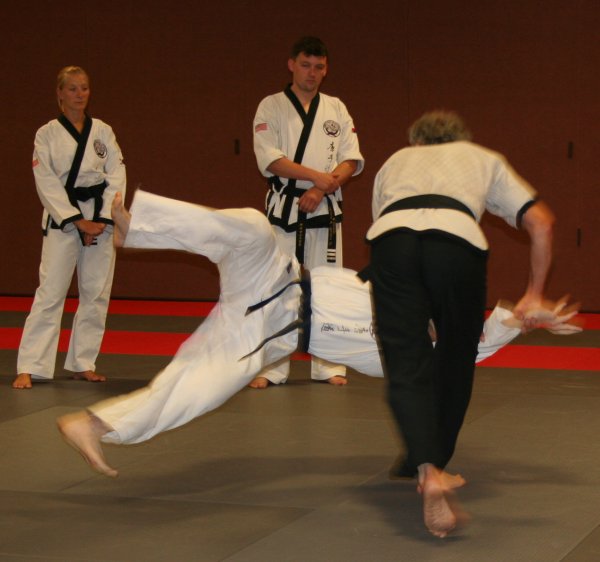
If an opponent feet fly up in the air and they go over the Throwers head with rotation this is a 3 point Throw. Example:

All are considered Throws, but we can divide them into trips, takedowns, sweeps and throw etc.
ginosifu
[QUOTE=MightyB;1125796]the mantis waist chop in 7* really is a waist chop. [/QUOTE]
I find the “7* wasit chop” may work well in clinching situation that you have controlled both of your opponent’s arms. It doesn’t work well in combat situation when your opponent’s back arm is far away from you. It may be easy to get your opponent’s leading leg, but it’s not that easy to get your opponent’s back arm when he stands sideway. Instead of trying to control your opponent’s front leg, if you can control his back leg then you don’t need his back arm, and You can just play with his leading arm instead. The problem of this modification is you have to force your opponent’s feet to be closer, otherwise you may not be able to reach to his back leg (same argument for reaching his back arm).
[QUOTE=YouKnowWho;1125926]I find the “7* wasit chop” may work well in clinching situation that you have controlled both of your opponent’s arms. It doesn’t work well in combat situation when your opponent’s back arm is far away from you. It may be easy to get your opponent’s leading leg, but it’s not that easy to get your opponent’s back arm when he stands sideway. Instead of trying to control your opponent’s front leg, if you can control his back leg then you don’t need his back arm, and You can just play with his leading arm instead. The problem of this modification is you have to force your opponent’s feet to be closer, otherwise you may not be able to reach to his back leg (same argument for reaching his back arm).[/QUOTE]
Standing right lead to right lead - make him move to you either by throwing a jab or waiting for him to strike at you - ou lou choi forcing him to parry across his body (you maintain your grip on his right arm with your left) - tiu sau, yu jom [waist chop] – his left/ back hand had to move up to you to prevent getting hit (you’ll move your left leg up to facilitate as shown in most forms).
Hmm… Seems like most of you are considering a lot of techniques as throws that I would have called a take-down. This is good news for me, means I’m better at ‘throwing’ than I thought I was. 
[QUOTE=ShaolinDan;1125621]Twisting the head to ground, or arm-bar to ground, for example, I would not consider trips, but still take-downs.[/QUOTE]
Using the Chinese vernacular, I would consider these as qinna rather than shuai. Joint controls rather than throws per se.
[QUOTE=MightyB;1125796]Something that can get lost in discussions such is this is that the mantis waist chop in 7* really is a waist chop. The striking motion is primary, the throw is secondary. The reason why this is important to bring up is that I see people modifying to make the throw primary and the chop loses its emphasis. The chop is a sharp palm edge strike aimed at the lower floating ribs - the ribs/waist should be stretched and extremely vulnerable because your grasping hand will have their near arm pulled out and outstretched and out of the way (this is the action that sets up the throw). The modifications that start to leak in are 1. there’s no power/sharpness in the rotation on the strike 2. the strike becomes non existent and becomes a push on the upper armpit or arm.[/QUOTE]
Excellent point!
[QUOTE=ShaolinDan;1125959]Hmm… Seems like most of you are considering a lot of techniques as throws that I would have called a take-down. This is good news for me, means I’m better at ‘throwing’ than I thought I was. :p[/QUOTE]
Probably anything that obstructs the opponent’s balance and puts him on his a$$ or head can loosely be referred to as a throw. 
Great discussion so far all!
So back to the actual original question: What throws/trips/take-downs do you see in the forms?
I provided a convenient format for the answer in the first post:
mantis style - form - technique
Quote:
Originally Posted by ShaolinDan
Twisting the head to ground, or arm-bar to ground, for example, I would not consider trips, but still take-downs.
Using the Chinese vernacular, I would consider these as qinna rather than shuai. Joint controls rather than throws per se.
agreed. thses are joint locking tech, not a throw
At ED and MM
Yeah…never thought they were a throw…used them as examples of ‘take-downs’ that wouldn’t be ‘trips.’
[QUOTE=ShaolinDan;1125974]At ED and MM
Yeah…never thought they were a throw…used them as examples of ‘take-downs’ that wouldn’t be ‘trips.’[/QUOTE]
I agree with you. I just prefer using Chinese martial terms rather than English wrestling terms. :o But yes, “take-down” is certainly an appropriate term for those methods.
Here is a video I did for students that demonstrates the head twisting technique that we use in our style on the wooden dummy. It can be seen at 1:50 -
http://www.youtube.com/watch?v=SJrJvPy5dOo
[QUOTE=mooyingmantis;1125989]I agree with you. I just prefer using Chinese martial terms rather than English wrestling terms. :o But yes, “take-down” is certainly an appropriate term for those methods.[/QUOTE]
I’m not familiar with many Chinese terms…So here’s a question, if you don’t mind. Does the Chinese equivalent for ‘throw’ (shuai?) encompass more techniques than the English wrestling term ‘throw’? 'Cause I’m kind of surprised that a lot of sweeps, which I’d call ‘take-downs’ are being considered throws…is it just that ‘shuai’ is a broader term than ‘throw.’?
[QUOTE=ShaolinDan;1125996]…is it just that ‘shuai’ is a broader term than ‘throw.’?[/QUOTE]
Yes, I believe that would be an accurate statement. As Gino Belfiore, a national and international shuaijiao champion, stated
[QUOTE=ginosifu;1125805]In Shuai Chiao competition, our tournament rules are:
If an opponent falls or touches the ground without any rotation, this is a 1 point Throw
…If an opponent feet fly up in the air and there is rotation of their body then this is a 2 point Throw
… If an opponent feet fly up in the air and they go over the Throwers head with rotation this is a 3 point Throw
…All are considered Throws, but we can divide them into trips, takedowns, sweeps and throw etc.
ginosifu[/QUOTE]
Cool. Thanks. That explains everything. Not a better ‘thrower’ than I thought :(, just better at ‘shuai.’
Thanks for helping me for helping me figure that out.
It’s details like this that make this forum worth all the bs.
[QUOTE=ShaolinDan;1125621]Twisting the head to ground, … but still take-downs.[/QUOTE]
I will consider the following skills as “how to control your opponent’s head and neck” and not throws or takedowns.
(Mo) - Wiping
(Zai) - Helmet taking
(Wu) - Face covering
(Su) - Forehead push
(Huan) - Neck surrounding
(Tuo) - Chin pushing
(Feng) - Throat blocking
[QUOTE=YouKnowWho;1126009]I will consider the following skills as “how to control your opponent’s head and neck” and not throws or takedowns.
(Mo) - Wiping
(Zai) - Helmet taking
(Wu) - Face covering
(Su) - Forehead push
(Huan) - Neck surrounding
(Tuo) - Chin pushing
(Feng) - Throat blocking[/QUOTE]
John,
Do you have any pictorial or video examples of these methods?
[QUOTE=YouKnowWho;1126009]I will consider the following skills as “how to control your opponent’s head and neck” and not throws or takedowns.
(Mo) - Wiping
(Zai) - Helmet taking
(Wu) - Face covering
(Su) - Forehead push
(Huan) - Neck surrounding
(Tuo) - Chin pushing
(Feng) - Throat blocking[/QUOTE]
Now this is far too complicated for me. :o
Does it have to be one or the other? can’t it be both? If it can’t be both, then I’m just lost.
[QUOTE=ShaolinDan;1125996]I’m not familiar with many Chinese terms…So here’s a question, if you don’t mind. Does the Chinese equivalent for ‘throw’ (shuai?) encompass more techniques than the English wrestling term ‘throw’? 'Cause I’m kind of surprised that a lot of sweeps, which I’d call ‘take-downs’ are being considered throws…is it just that ‘shuai’ is a broader term than ‘throw.’?[/QUOTE]
All take downs, trips, throws etc are the category of “Shuai”. Add arm bars and joint manipulation and this is considered “Chin Na”, even if they trip down.
ginosifu
[QUOTE=ginosifu;1126015]All take downs, trips, throws etc are the category of “Shuai”. Add arm bars and joint manipulation and this is considered “Chin Na”, even if they trip down.
ginosifu[/QUOTE]
But it’s never both at once? Trippy.
[QUOTE=mooyingmantis;1126012]John,
Do you have any pictorial or video examples of these methods?[/QUOTE]
It’s easy to understand by just few words.
(Mo) - Wiping - use palm edge to press on forehead or back of neck.
(Zai) - Helmet taking - use fingers to pull forehead back.
(Wu) - Face covering - use hand to push on face or chin.
(Su) - Forehead push - use both hands to push on forehead.
(Huan) - Neck surrounding - head lock.
(Tuo) - Chin pushing - use palm to push chin or side of jaw.
(Feng) - Throat blocking - use hand or elbow to push on throat.
[QUOTE=ShaolinDan;1126013]Now this is far too complicated for me. :o
Does it have to be one or the other? can’t it be both? If it can’t be both, then I’m just lost. :p[/QUOTE]
“Most” of the Chinese throws are (Shang Qun Xia Ban) - tie your opponent’s upper body and trip his lower legs. How do you want to “tie” your opponent’s upper body does not define throw. The way that you use your leg to trip your opponent’s legs will define what throw that you are using. Of course there are “exception”. Sometime you can let your hand to do your leg job, or to let your leg to do your hand job.
For example, you can have
- head lock leg block,
- reverse head lock leg block,
- underhook leg block,
- overhook leg block,
- waist control leg block,
- …
all moves are called “leg block” but with different body controls.
[QUOTE=ShaolinDan;1126016]But it’s never both at once? Trippy. :)[/QUOTE]
There are always exceptions to the rule: Elbow Locking throw is a “Shuai” but you are applying a “Lock” o their elbow at the same time.
ginosifu