VT uses a vertical fist. Looking around the internet there are a lot of ideas about why this might be the case.
Why does your VT use a vertical fist?
VT uses a vertical fist. Looking around the internet there are a lot of ideas about why this might be the case.
Why does your VT use a vertical fist?
If you want your elbow down the options are vertical or palm-up.
Slightly OT
I wrote an article on the vertical fist (or sun fist) some years ago, but it was in a different context. See How Chinese Calligraphy Can Improve Your Kung Fu.
[QUOTE=sanjuro_ronin;1303581]If you want your elbow down the options are vertical or palm-up.[/QUOTE]
Yes, the elbow is the reason for the vertical fist. Why do you want the elbow down in your VT?
[QUOTE=GeneChing;1303582]I wrote an article on the vertical fist (or sun fist) some years ago, but it was in a different context. See How Chinese Calligraphy Can Improve Your Kung Fu.[/QUOTE]
Interesting, thanks
From Gene’s article:
The meaning of this character has no connection with the sun fist. It’s just the shape.
The middle stroke indicates which way the fingers are oriented, and the overall shape resembles a sun fist.
This sounds like half an explanation.
Why use the character for sun [SIZE=7][/SIZE] versus the character for eye [SIZE=7][/SIZE]?
You have enough strokes in the eye character to lay over all four fingers and outline the knuckles, if going for overall shape.
For VT, it’s because we are striking with the bottom three knuckles. That’s why we use the sun character.
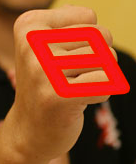
Got me there, LFJ
[QUOTE=LFJ;1303592]
Why use the character for sun [SIZE=7][/SIZE] versus the character for eye [SIZE=7][/SIZE]?
[/QUOTE]
I have no idea. I didn’t make that up. It’s a term that’s bandied about in the southern Chinese Kung Fu circles. Maybe it rhymed with something in some quanpu?
[QUOTE=LFJ;1303592]From Gene’s article:
This sounds like half an explanation.
Why use the character for sun [SIZE=7][/SIZE] versus the character for eye [SIZE=7][/SIZE]?
You have enough strokes in the eye character to lay over all four fingers and outline the knuckles, if going for overall shape.
For VT, it’s because we are striking with the bottom three knuckles. That’s why we use the sun character.
[/QUOTE]
Excellent explanation
So back to the elbow- why is it important to keep the elbow down in VT?
No wrong answers, opinions welcome
[QUOTE=guy b.;1303615]So back to the elbow- why is it important to keep the elbow down in VT?
No wrong answers, opinions welcome[/QUOTE]
I’m thinking it has to do with keeping it close to/near the hip since the two work together in the natural human power chain linkage?
[QUOTE=wckf92;1303621]I’m thinking it has to do with keeping it close to/near the hip since the two work together in the natural human power chain linkage?[/QUOTE]
This is one reason. The other is the use of the elbow in the VT punch, allowing simultaneous attack and defence.
[QUOTE=guy b.;1303586]Why do you want the elbow down in your VT?[/QUOTE]
You don’t want your elbow joint to be “cracked”.
Most CMA systems emphasize that punch should never be a straight line. All straight punches should include arm and fist twisting. That twisting does add in extra power because the twisting path is longer than the straight line path.
[QUOTE=YouKnowWho;1303682]You don’t want your elbow joint to be “cracked”[/QUOTE]
How do you mean?
Most CMA systems emphasize that punch should never be a straight line. All straight punches should include arm and fist twisting. That twisting does add in extra power because the twisting path is longer than the straight line path.
The discussion is about the punch in VT? VT punch does not twist.
Thanks!
[QUOTE=guy b.;1303685]How do you mean?[/QUOTE]
When your opponent punches, if you use one arm to strike on his wrist, use another arm to strike on his elbow joint, you can put pressure on his elbow joint if his elbow joint is pointing side way. If his elbow joint is pointing downward, his elbow joint won’t feel that pressure. This is why in CMA, the
Again, it a trade off between safety and power.
[QUOTE=YouKnowWho;1303698]Again, it a trade off between safety and power.[/QUOTE]
I don’t agree significant power is being traded off. It’s a matter of correct training for punching power, which is a primary focus of VT.
I don’t think that’s a realistic threat, anyway. So, that’s not the reason we use elbow-down punches in VT.
I only know Wing Chun from video lol but like I mentioned in the Rooting thread in the Kung Fu Forum, specialized training evolved from science growing through experience as empires grew older.
First humans fought like monkeys not too much thought in was put into kick boxing combos but lots of power moves were used from monkey speed trying to rip off banana thieves scalps.: Then they started banging each other with fire sticks before the days of bow and arrows.
We can guess the first external styles like kick boxing were based on swinging heavy sticks fast with your back up punch, elbows, kicks and foot trips.
Like bow stance horizontal punch and hook punch is the same body mechanics as swinging a staff with two hands one hand guides the other hand leads. Wax on, Wax off. lol
so by the time you get to Nunchuka and butterfly swords specialized short power weapons after 1000s of years of Martial history they start using specialized short hand two hand strikes like Wing Chun, Bak Mei, Okinawa Karate.
I think if you use horizontal fist with Wing Chuns more upright posture compared to Bak Meis which is a couple inches lower whereas in Hop Gar the closer your knee is to the ground the more swing through in your hook punches like fully twisting your ankle in Muay Thai Shin Round kicks..Wing Chun I think the highest goal of your Sil Lim Tao is to have greater control of your Butterfly Swords so you don`t cut your ear off in a fight and more importantly not stab your training partners when they did not even know you were behind them training other forms, lol.
I think the vertical fist makes for quicker strikes than horizontal fist which is more of a lunge. Like Bak Mei Jik Bo you float and finger strike then sink and horizontal punch do the rolling motion and throw palm to the side which is similar to Wing Chun vertical chain punch if you are holding a knife.
Vertical punch or palm the knife floats and slices, horizontal punch it sinks and stabs.
I cant remember the name of the palm in Jik Bo I think it`s Gwerk Jueng or something but google is failing me, but it shoots out loose and fast like Wing Chun chain vertical punches which reminds me of holding two knives stabbing fast while standing upright instead of fighting like Choy Li Fut from a mid range stance using more thrusting and slicing long fist strikes. Short hand is all about jab,jab,jab instead of smash,bam, boom lol.
[QUOTE=diego;1303718]I only know Wing Chun from video lol but like I mentioned in the Rooting thread in the Kung Fu Forum, specialized training evolved from science growing through experience as empires grew older.
First humans fought like monkeys not too much thought in was put into kick boxing combos but lots of power moves were used from monkey speed trying to rip off banana thieves scalps.: Then they started banging each other with fire sticks before the days of bow and arrows.
We can guess the first external styles like kick boxing were based on swinging heavy sticks fast with your back up punch, elbows, kicks and foot trips.
Like bow stance horizontal punch and hook punch is the same body mechanics as swinging a staff with two hands one hand guides the other hand leads. Wax on, Wax off. lol
so by the time you get to Nunchuka and butterfly swords specialized short power weapons after 1000s of years of Martial history they start using specialized short hand two hand strikes like Wing Chun, Bak Mei, Okinawa Karate.
I think if you use horizontal fist with Wing Chuns more upright posture compared to Bak Meis which is a couple inches lower whereas in Hop Gar the closer your knee is to the ground the more swing through in your hook punches like fully twisting your ankle in Muay Thai Shin Round kicks..Wing Chun I think the highest goal of your Sil Lim Tao is to have greater control of your Butterfly Swords so you don`t cut your ear off in a fight and more importantly not stab your training partners when they did not even know you were behind them training other forms, lol.
I think the vertical fist makes for quicker strikes than horizontal fist which is more of a lunge. Like Bak Mei Jik Bo you float and finger strike then sink and horizontal punch do the rolling motion and throw palm to the side which is similar to Wing Chun vertical chain punch if you are holding a knife.
Vertical punch or palm the knife floats and slices, horizontal punch it sinks and stabs.
I cant remember the name of the palm in Jik Bo I think it`s Gwerk Jueng or something but google is failing me, but it shoots out loose and fast like Wing Chun chain vertical punches which reminds me of holding two knives stabbing fast while standing upright instead of fighting like Choy Li Fut from a mid range stance using more thrusting and slicing long fist strikes. Short hand is all about jab,jab,jab instead of smash,bam, boom lol.[/QUOTE]
So, Jik Bo the finger strike and palm to the side use Wing Chun chain punch theory one hand guards the other strikes which we can say are floating techniques in Bak Mei..I only know half the system bare with me, as I understand the powers change over time like you will naturally sink when you float or vice versa after 5 years of Jik Bo.
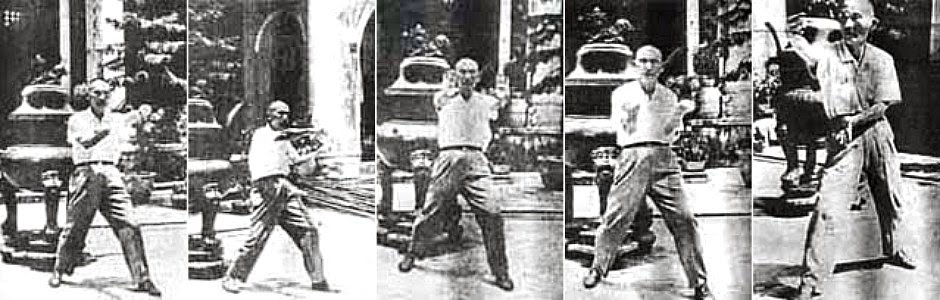
The sink horizontal punch in the second picture of Chueng Lai Chuan doing 9 Step Push is basically grabbing the guys arm and twisting your index knuckle into a soft spot. Ideally you would be using a knife to grab arm twist and stab ribs or side of neck, kidneys.
You can float guard with your other hand and hit fast with a vertical strike which is faster than twisting horizontal if you are striking 10 times, lol prolly speeds up your combo by quarter of a second, Horizontal punch sinks and stabs heavy.
[QUOTE=LFJ;1303699]I don’t agree significant power is being traded off. It’s a matter of correct training for punching power, which is a primary focus of VT.
I don’t think that’s a realistic threat, anyway. So, that’s not the reason we use elbow-down punches in VT.[/QUOTE]
Yes, arm break sounds like a fantasy move.
I think it takes longer to punch hard the VT way, but that is a primary goal of training. Power is sufficient in VT to do the job, and the other benefits of the vertical fist are large.
An additional benefit that probably doesn’t need mentioned is hand safety. Vertical punch makes base knuckle contact to head with knuckles of 3 fingers- very safe. Horizontal punch requires wrist to be cocked to make base knuckle contact, and more likely contacts with 2nd knuckles resulting in hand break. It also stresses thumb and can cause a Bennet fracture. Not a safe way to punch the head.
[QUOTE=guy b.;1303742]Yes, arm break sounds like a fantasy move. [/QUOTE]
Many years ago in one Chicago workshop, a boxer walked toward an old man and said, “I training boxing. If I use boxing on you, what will you do?” The old man said, “come and show me.” The old man started to use continuous left and right front heel kicks to force the boxer to step back against the wall.
Next day, the boxer came to the workshop with his right arm hung from his shoulder.
[QUOTE=YouKnowWho;1303766]Many years ago in one Chicago workshop, a boxer walked toward an old man and said, “I training boxing. If I use boxing on you, what will you do?” The old man said, “come and show me.” The old man started to use continuous left and right front heel kicks to force the boxer to step back against the wall.
Next day, the boxer came to the workshop with his right arm hung from his shoulder.
[/QUOTE]
Interesting anecdote, but the fact is that standing arm bars are a very low % move and I think that the other reasons for using a vertival fist in VT are much more important.
