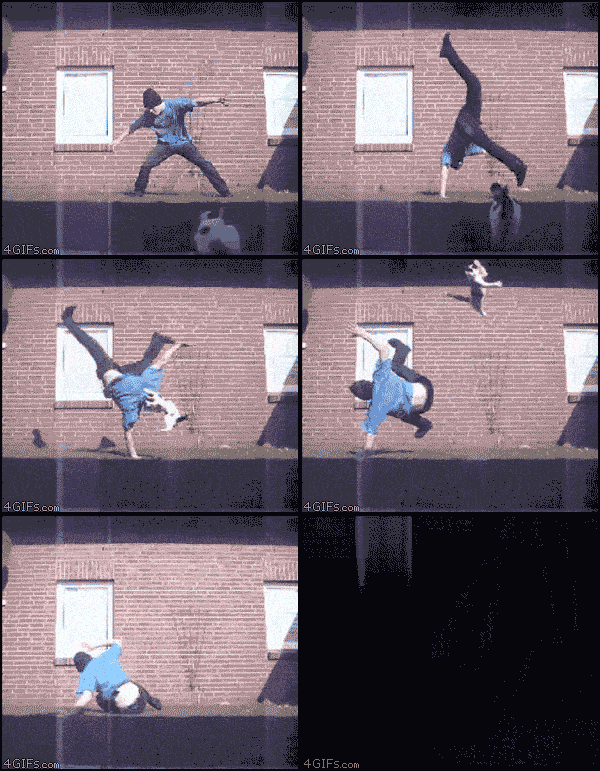
[QUOTE=YouKnowWho;1231640]That was while the “(Wu Feng Qi Feo) - 5 phoenix fly in the sky” was created. In 3 jumping kicks, you use your hands to hit on your body 5 times as if you carry the drum beating with your body.[/QUOTE]
after the qing collapsed and shanpuying were jobless, they were wrestling on the streets and people didnt pay money. they asked streets performers to teach them how to be more flowery so they can make money. before that shuai jiao was 100% mongolian wrestling.
[QUOTE=YouKnowWho;1231640]That was while the “(Wu Feng Qi Feo) - 5 phoenix fly in the sky” was created. In 3 jumping kicks, you use your hands to hit on your body 5 times as if you carry the drum beating with your body.[/QUOTE]
when i trained all these flowery moves, i had no faith in kung fu. when i stopped training them, i believe in kung fu.
[QUOTE=bawang;1231644]when i trained all these flowery moves, i had no faith in kung fu. when i stopped training them, i believe in kung fu.[/QUOTE]
If you can still do triple jumping kick “(Wu Feng Qi Feo) - 5 phoenix fly in the sky” when you are 80 years old, you know the change that you may live through your 90 will be high.
The older you are, ther harder that you can jump. If you jump everyday, your health will be good.
if you read the records of the grand historian, there are sword dances in there. the trick of it in this case though, is that you have an accomplished warrior proven in battle performing a dance of his battle sword before (insert person to be impressed/entertained).
also, if you read Confucius:
'According to the record in the School Sayings of Confucius, Zi Lu, the student of Confucius, ‘ever waved the sword and danced before Confucius’ that is 2500 years ago and the oldest record of the sword dance.
[SIZE=“5”]E[/SIZE]ven wrathful Achillies was noted as performing an excellent Pyrrhic dance (the ancient greek war dance loved by the spartans).
You have to question the nature of all of our training.
If you put a group of people together and tell them to fight all day, every day, and teach them nothing, how long before they evolve their own Martial Art? Very fast indeed. Even better this way as they do not learn by force but realise themselves, then this knowledge is never lost.
After a short time of training in this manner they think of technique. But if as a child they learned the TaoLu, the forms, even if never being told their application, suddenly they understand them, and discover their meaning. Unconsciously they replicate them. This is the method of teaching by suggestion instead of force.
The good teacher provides the opportunity for the self discovery of knowledge.
[QUOTE=bawang;1231634]all forms of entertainment were banned in the ming army except forms. so forms became more complicated in the 1550s, since it became a major form of entertainment.
folk stories also say in the 1700s there was another wave of flowery kung fu, but there is no written history to prove it.[/QUOTE]
When are you going to write a serious paper and quote all your sources?
You come up with a lot of stuff that we don’t see elsewhere on English sites…if you got the pertinent documents arranged cohesively, I think that would be a pretty big service to Kung Fu in the English speaking world.
[QUOTE=Lucas;1231650]if you read the records of the grand historian, there are sword dances in there. the trick of it in this case though, is that you have an accomplished warrior proven in battle performing a dance of his battle sword before (insert person to be impressed/entertained).
[/QUOTE]
This seems to be a very pervasive Old World tradition. Probably New World as well, if I were to take the time to read up on our indigenous warriors.
My question is, should people who don’t go to battle perform the war dance? Would the swordsman be taken seriously had he only practiced his dance and never his craft?
[QUOTE=Kellen Bassette;1231614]So is it possible the origin of forms training may have been more of a ritual than we let on? Could the current popular thinking about this tradition be completely misconstrued?[/QUOTE]
Two or more actions can be defined as a technique definition. Two or more techniques can be defined as a form. Two or more forms can be defined as a kuen. Forms and kuens have different purposes.
Kuens:
begins and ends in the same place.
teaches specific principles of motion and techniques based upon them.
are inclusive in and of themselves. You do not need any ancillary training to understand and develop the skill sets.
each volley is a subset and can be used as a stand alone drill.
Forms:
note or celebrate particular engagements and the particular techniques employed during that engagement. (they could also showcase particular weapons employed.)
emphasis particular volleys or combinations of techniques.
are part of a series of forms that overall can be considered a kuen.
are not stand alone but require a series in progression of training.
Forms come from an era of less distractions. We have xBox, a million channels, good movies, restaurants, and internet porn. Plus a million recreational activities to choose and participate in within minutes of where we live.
They didn’t have that in the not so way back. I like to think of forms as like a step up challenge dance between martial artists. Part martial, part showing off machismo.
[QUOTE=Kellen Bassette;1231676]When are you going to write a serious paper and quote all your sources?
You come up with a lot of stuff that we don’t see elsewhere on English sites…if you got the pertinent documents arranged cohesively, I think that would be a pretty big service to Kung Fu in the English speaking world.[/QUOTE]
Bawang has a secret source that he will never tell anyone because his existence is dependant on making kong foo kids cry. Actually, I think Bawang just wants to make everyone cry.. Either out of rage, frustration, or laughter.
I’ve heard that Adam Hsu talks about some of this in his book The Sword Polisher’s Record. Something about there originally not being a lot of forms or something? I still need to read the book myself.
[QUOTE=Kellen Bassette;1231678]I agree with this. But the student must be put into a situation where self discovery is inevitable.
Think Luke Skywalker in the swamp. [/QUOTE]
I second this. You can’t teach someone all the answers, but you can teach them to the point where they should be able to start figuring things out for themselves. The whole “play with it” concept. There are some people that are too rigid of thinkers to get this, and those people are a different matter entirely.
[QUOTE=Kymus;1231703]I second this. You can’t teach someone all the answers, but you can teach them to the point where they should be able to start figuring things out for themselves. The whole “play with it” concept. There are some people that are too rigid of thinkers to get this, and those people are a different matter entirely.[/QUOTE]
so is it possible the origin of forms training may have been more of a ritual than we let on? Could the current popular thinking about this tradition be completely misconstrued?
[QUOTE=sanjuro_ronin;1231705]I like doing my forms.
[/QUOTE]
I second this. Personally I like playing the bigger / more expressive forms. They’re fun, and all forms require mad skillz if you want to pull them off properly.
It’s the empty cup analogy in a way. There are 3 steps:
[LIST=1]
empty cup
pour tea
drink tea
[/LIST]
A good student is the empty cup, a good teacher is like an unlimited pitcher of tea. If both work well, then the student will know that he needs to drink the tea himself.
[QUOTE=sanjuro_ronin;1231705]I like doing my forms.[/QUOTE]
I don’t think there’s anything wrong with forms. Not until that becomes the prime focus of an art.
I used to go to this real good traditional school. The teacher there had legit lineage and he trained in Taiwan. The forms were good, the school was traditional, on the surface everything looked great.
But there was little focus on the three levels of training resistance and they just did point sparring (I assume because that’s what the tournament rules were).
It’s funny… At first(way back) the argument was “doing forms does not a fighter make” and despite initial resistance, we have all pretty much agreed that this statement is true. If you want to be a good fighter, you fight. Simple… But when did this whole ‘forms vs. whatever’ debate turn into “forms suck and have no use”???
I know that’s not what this thread is about, but it made me think of how much the attitude about forms has changed over the last decade or so.
I like forms. I also like dancing and doing gymnastics. While I do believe that being able to do these things gives me an advantage in ANY physical activity, I mean compared to where I myself would be w/o those skills, but never at any point did I delude myself into thinking that this was the epitome of training. I think the biggest issue here is priorities. As priorities change we change our methods. Simple… no?
I don’t really care where or why forms came about, I just know they have a place in my life. I enjoy the exercise and the change up from the grind of other training methods. Forms are like my reward for doing drills just like air flares are my reward from doing handstand pushups and windmills.
Most of us (I hope) know that there’s something wrong with TCMA today.
Forms sort of stick out, I guess you can say. They’re the whipping boy.
So the reaction a lot of people have is to trash them entirely.
I think the balance is in the middle (not my site, but I think what they’re trying to do is real cool). What are forms but a sequence of movements to help you remember techniques? The real problem is either:
(A) tons of forms
(B) no time spent practicing these movements in different phases of resistance