Martial Art Masters and Medicine

Having been taken through some aspects of TCM during my own training in Lee Shing Wing Chun, I was wondering how many Martial Art Masters outside of China actually have recognition in this area?

Lee Shing was a known Restaurant Owner in Londons Chinatown for over thirty years. His ‘Canton Restaurant’ was the first to be given 24hr licensing, and according to stories, his interest in TCM (especially Herbology) grew throughout his life. He was no Doctor though, but he felt that some types of training were easily compensated with a good brew or soup and this was something I drank myself in my time with his student, Joseph Man.

I have an interest myself, and having attended the London College of Traditional Chinese Accupuncture for a Seminar I recognized most, if not all of the theories discussed from my Kung Fu Training.

I would love to train more in TCM, but this was something that my own teacher had no real interest in due to the ‘aromas of crazy soups!’

Any help and assistance with my study will be most welcome…

[QUOTE=LoneTiger108;807064]Having been taken through some aspects of TCM during my own training in Lee Shing Wing Chun, I was wondering how many Martial Art Masters outside of China actually have recognition in this area?
[/QUOTE]

Quite a few - but generally if they are Chinese and still living in Chinese communities their expertise is not widely known and shared only within the community, and with family and students. For example, Kenny Gong was a Xing Yi teacher in New York’s Chinatown who was well known for his Chinese medicine and bone setting skills.

One of his long-term students, Frank Butler, is the subject of many of the posts below on this forum regarding “Zheng Gu Tui Na.” See also Tom Bisio’s bio at www.tombisio.com.

Best,

Steve

I just bought Bisio’s book Tooth From the Tiger’s Mouth. Good stuff.

Define ‘recognition’

Many TCMA masters have some elements of TCM in their practice. My first Sifu Wing Lam did dit da, but it wasn’t something he was certified in. Back in the late 80’s, I remember him exploring the possibility getting a massage license because at time, there was no certification that really recognized dit da formally. I’m not sure that there is such a thing now. Is there? Another of my Shifu, Tony Chen, his father, Chen Jian, opened a brick & mortar clinic that was just strictly TCM. It was right next door to Tony’s San Leandro school. Both are closed now because that area is undergoing redevelopment.

There are many masters that practice dit da informally like Lam Sifu. They usually only practice on their students and a small number of friends, people in the know. There are also some that are legally certified as clinicians, acupuncturists, massage therapists or any number of other similar degrees. They often offer their services more publicly, since they are ‘legal’. It depends on the individual master.

Raspect!

Lam Sifu’s dit da was what got me on this road to barefoot medicine. I am forever grateful for his inspiration.

This is an interesting subject to me. While I understand the need for quality control and oversight to ensure practitioners of all sorts won’t harm their clients, it also seems to me that people (I’ll say “the people”!) should enjoy as a basic human right, unrestricted and nonjudgmental access to health care, as well as the foods, herbs, vitamins and so forth required to maintain optimum health in our stressful world.

I’ll leave it at that. :stuck_out_tongue:

peace

herb ox

Traditional Healing Arts

[QUOTE=herb ox;807794]… While I understand the need for quality control and oversight to ensure practitioners of all sorts won’t harm their clients, it also seems to me that people (I’ll say “the people”!) should enjoy as a basic human right, unrestricted and nonjudgmental access to health care, as well as the foods, herbs, vitamins and so forth required to maintain optimum health in our stressful world…[/QUOTE]

Can’t argue with that. I think that your statement begs the question of whether, in the absence of “quality control” and “oversight,” traditional healers (and I am speaking here of practioners who have undergone the same kind of long-term, rigorous training that was common, for example, among students of martial art teachers practicing Die Da medicine, or among apprentices of a classically trained Chinese acupuncturist or herbalist) actually posed a substantial risk to their patients in the first place?

This is a separate question from whether, if a traditional healing modality attains a measure of success against, for example, a contagious disease, and it is subsequently shown that a Western drug, for example, attains a similar or greater measure of success against the same disease, then patients should have access to both forms of treatment modalities?

Best,

Steve

Available on the NHS in the UK!

[QUOTE=GeneChing;807731]There are many masters that practice dit da informally like Lam Sifu. They usually only practice on their students and a small number of friends, people in the know. There are also some that are legally certified as clinicians, acupuncturists, massage therapists or any number of other similar degrees. They often offer their services more publicly, since they are ‘legal’. It depends on the individual master.[/QUOTE]

It’s interesting to note the comments on this thread as it does seem that the USA obviously has similar practices than we do in the UK. I will say this though, it is not exactly ‘illegal’ for anyone here to stick a needle in you and charge you money, or even mix you a nice concoxion. There is a standard education system in place which is forever trying to gain recognition from certain authorities but in general a practitioner of TCM in the UK could be ‘anyone’! I was recently treated for a neck injury on the NHS, and the ‘Therapist’ chose Accupuncture and she was quite good IMO.

We have hundreds of TCM ‘Shops’ here in London and, in some cases, the Authentic Chinese ‘Doctors’ backgrounds are harder to trace than a student who has gone to College here. I do believe Plymouth University now recognizes a Masters degree standard in TCM.

My main interest, however, still lies in the Martial Arts and I find it fascinating that the Wing Chun Family have still to release the infamous Dr Leung Jan Books which outline his lifes work in TCM and related Kung Fu training.

substantial risk to their patients in the first place

Having been the victim of TCM overdose on several occasions, I think regulation is a good thing. I’ve had some rather severe allergic reactions, some of which have left me with permanent damage. At the same time, acupuncture in China isn’t regulated in the country. It’s not uncommon for someone to stick an needle in someone else rather casually, for a headache or some other common malady. Of course, given sterility issues, particularly when penetrating the skin barrier, well, that raises a whole mess of other issues.

This is strictly subjective, but my personal experience has been that many martial artists approach TCM with too much machismo - it’s sort of a ‘submit to me and be healed’ philosophy, which might work on the uneducated just as a punitive placebo, but it can be rather destructive. These types of martial artists make bad healers, obviously. They are part and parcel of the trade, just like charlatans that pervade the martial arts in general. While I have looked to tiedazhang in the past, and probably will in the future, I’m always very cautious. Of course, my position on this is somewhat surreal - people always want to impress me. That adds to the machismo factor unfortunately.

TCM Machismo

I guess we’ve had different experiences from different ends of the spectrum. I’ve never felt the “submit to me and be healed” phenomenon, and someone who practices from a desire to impress someone else is just practicing bad medicine…

Best,

Steve

Do you recommend any books on dit da?

Die Da book

[QUOTE=dougadam;810910]Do you recommend any books on dit da?[/QUOTE]

Sure - A Tooth from the Tiger’s Mouth, by Tom Bisio. Available from Amazon.com.

Best,

Steve

Tran Viet Trung

Feature: Vietnamese Kung Fu, traditional medicine master heals, strengthens people’s hearts
Source: Xinhua| 2019-10-31 23:02:30|Editor: Shi Yinglun
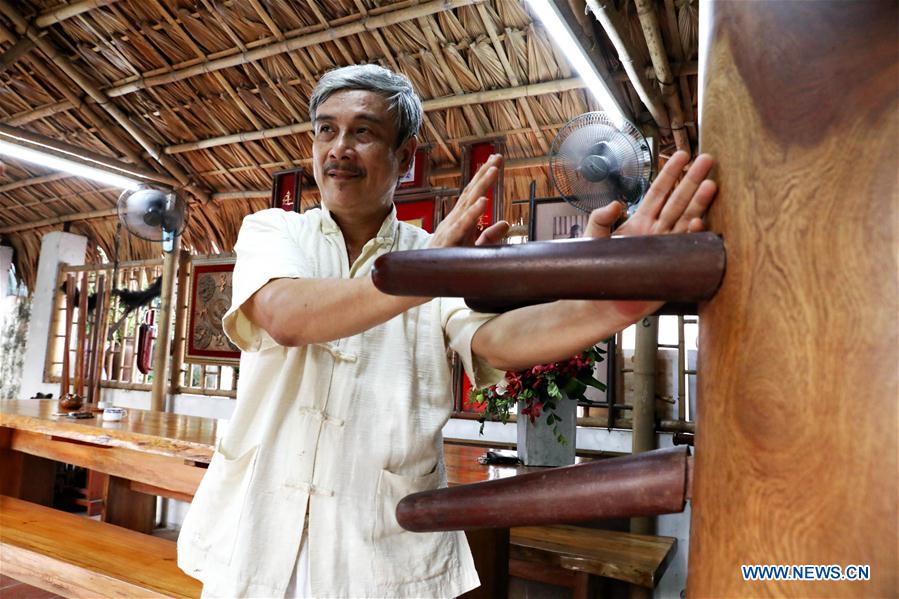

Vietnamese Wing Chun master Tran Viet Trung demonstrates techniques by beating a wooden dummy in Hanoi, capital of Vietnam, Aug. 25, 2019. Sat in a cozy room full of books, herbal medicine and cold remedies on the tranquil outskirts of Vietnam’s capital Hanoi is a grey-haired businessman who has created a new school of Wing Chun, cured patients based on Chinese martial arts and medicine, and written best-selling books about the two spheres.(Xinhua/Wang Di)

by Tao Jun, Wang Di

HANOI, Oct. 31 (Xinhua) – Sat in a cozy room full of books, herbal medicine and cold remedies on the tranquil outskirts of Vietnam’s capital Hanoi is a grey-haired businessman who has created a new school of Wing Chun, cured patients based on Chinese martial arts and medicine, and written best-selling books about the two spheres.

In Tran Viet Trung’s room, above a bookcase packed with Chinese, English, Vietnamese dictionaries, medicine books and novels is an altar with portraits of four well-known Kung Fu grand masters and physicians, including those of Nguyen Te Cong, the Chinese founder of Wing Chun in Vietnam and one of his first Vietnamese proteges Ngo Sy Quy.

Sitting near an antique medicine cabinet with dozens of drawers filled with herbs, minerals and animal bones, the 60-year-old businessman in a milk white costume recalled the ups and downs in his life, especially his lucky chances of meeting highly respected Kung Fu masters and physicians who inspired him to follow the path of eastern martial arts as well as medicine.

“When I was eight years old, my father passed away. Weak and bullied by other children, I wanted to learn martial arts to make myself stronger,” Trung told Xinhua.

As a teenager and during the war, Trung could not completely devote himself to studying martial arts, but he never gave up on his burning desire to master it.

“If you have a passion and keep pursuing it, you will eventually make it,” the wise man said, while casting an eye over the portraits on the altar.

After graduating from the Foreign Trade University in Hanoi, Trung met Ngo Sy Quy, one of the first Vietnamese proteges of Chinese-born Yuen Chai Wan, better known as Nguyen Te Cong in Vietnamese, the founder of Wing Chun in Vietnam.

Wing Chun is a concept-based traditional Chinese Kung Fu style which requires practitioners to undergo intensive physical, mental, breathing, energy and force training in a relaxed manner. Famous for quick arm movements, it maintains practitioners’ flexibility and softness, as well as develops the strength to fight back, like the flexible nature of bamboo. Notable Chinese practitioners of Wing Chun include Ip Man, Bruce Lee and Donnie Yen.

“After coming to Vietnam in the late 1930s, Cong taught Wing Chun to local proteges, including my master Ngo Sy Quy,” said Trung.

Trung added that he has visited China’s southern Guangdong province, hometown of Nguyen Te Cong, and talked to Chinese Wing Chun masters there, to obtain a better understanding of the martial art’s origin and its development in Vietnam.

“Soon after I studied Wing Chun from Ngo Sy Quy, he told me to teach my own students, while studying from him at the same time. I was surprised because I was just a student, so wondered how could I teach others?” Trung recalled. But Trung followed the advice of his master who said: “When we already know the general, we should practice the specific and teaching students is the best way to practicing the specific.”

Since the late 1980s, Trung has taught Wing Chun to many students in Hanoi, first at martial arts centers in the bustling downtown district, and then in the tranquil countryside at his new house adjacent to a pagoda and a communal temple. In 1987, he asked for his master’s permission to establish a new school of Wing Chun named “Duong sinh nhu quyen.” “Duong sinh” means life nourishment, and “nhu quyen” means soft martial art.

“I created the new school to make Wing Chun more suitable to the physique and stature of Vietnamese people and to the modern times, focusing on softness and flexibility factors like snakes and cranes,” Trung explained.

In a mid-autumn afternoon in his house’s garden full of roses and bamboo, Trung’s bright eyes were glued to the arm movements of his students, both elderly like Dang Manh Hung, who has followed him for over 30 years, and young like Khuong Truyen Phuong, who was born in 1993.

Sometimes the grey-haired teacher stopped his students to show them how to punch or kick more quickly and effectively, or skillfully demonstrated techniques of beating a wooden dummy, a typical training tool of Wing Chun practitioners. His movements were as continuous and smooth as flowing water and passing clouds at this time, but as powerful and quick as lightning.

As a businessman, Trung runs a factory which produces handcrafted painting tools for export to support his family, and spends a lot of time wholeheartedly teaching martial arts free of charge, as well as using traditional medicine to cure sick people at little charge.

“I don’t make a living by teaching martial arts or practicing traditional medicine. No matter how modern societies have become, we still have ‘dao nghia’ (sets of basic human relationships) because if we live in a rightful, sincere manner, with care and sacrifice, we will receive priceless things,” said Trung.

When Trung made the statement, a graceful woman, who looked much younger than her age of 60, came across, gleefully telling Xinhua that thanks to martial arts, they became a couple.

“When I was young, one day, I saw him settling a street fight with both strength and manners, I fell in love at first sight,” Tran Hong Minh said with a smile.

And she is also the one that made Trung a practitioner of traditional medicine. Years ago, his wife, Hong Minh, fell ill, and was cured by Nguyen Dinh Tich, chairman of the Vietnam Orientally Traditional Medicine Association, the latter then advised Trung to study traditional medicine. On the altar there are four portraits, including those of Nguyen Dinh Tich and Le Huu Trac, father of Vietnamese traditional medicine.

“My master told me to learn traditional Chinese characters so that I could read original classic books about Chinese medicine. Now I have carefully read most of the classic works of Chinese and Vietnamese great traditional physicians,” Trung stated. Above the medicine cabinet in Trung’s room, there are portraits of six great Chinese physicians, including Bian Que, Hua Tuo, Sun Simiao, Huang Pumi, Li Shizhen and Zhang Zhongjing.

According to Trung, traditional medicine and traditional martial arts “seem to be interrelated, always supporting each other to cure the sick and protect the weak,” and the two are never of the past, but of the present, providing practitioners receive good training and working environments.

To preserve and promote traditional medicine and martial arts, Trung not only offers almost-free medical treatment and teaches Wing Chun free of charge, but also writes books about the two practices.

“I wrote ‘Quyen su’ (Kung Fu Master) based on the marital art life of grandmaster Nguyen Te Cong and my master Ngo Sy Quy and ‘Su de’ (Disciple) about their students as a way of keeping these memories alive for future generations, and disseminating stories with educational values to a bigger audience,” Trung said, noting that “Quyen su” has been reprinted five times so far. He also wrote a book about traditional medicine based on the image of his teacher.

“This year, I will publish a book about my parents, especially about the life of my father, Tran Tu Binh, one of the first 11 military generals of the People’s Army of Vietnam. He worked as the Vietnamese ambassador to China in the 1959-1967 period,” Trung said eagerly, recalling his moments of joyfully playing in Beijing as a toddler.

“I was named Viet Trung (Vietnam-China) because my father at that time worked as an ambassador to China,” Trung said, noting that his father spared no efforts to help develop the fine friendship and cooperation between the two countries.

Now, Trung wants the values of traditional medicine and martial arts, especially those of Vietnam and China, the foundation of the two time-honored heritages, to benefit more and more people and be passed from generation to generation.

“Traditional medicine and martial arts are never backward, they will continue on through the future history of mankind, and people nowadays should preserve and bring them into play,” stated the Kung Fu master-cum-doctor and father of three.

Right beside the altar honoring Trung’s Kung Fu and medicine masters, there is a Chinese calligraphy distich written on red paper which reads: “Medicine heals the diseases of era. Martial arts conquer the hearts of people.”
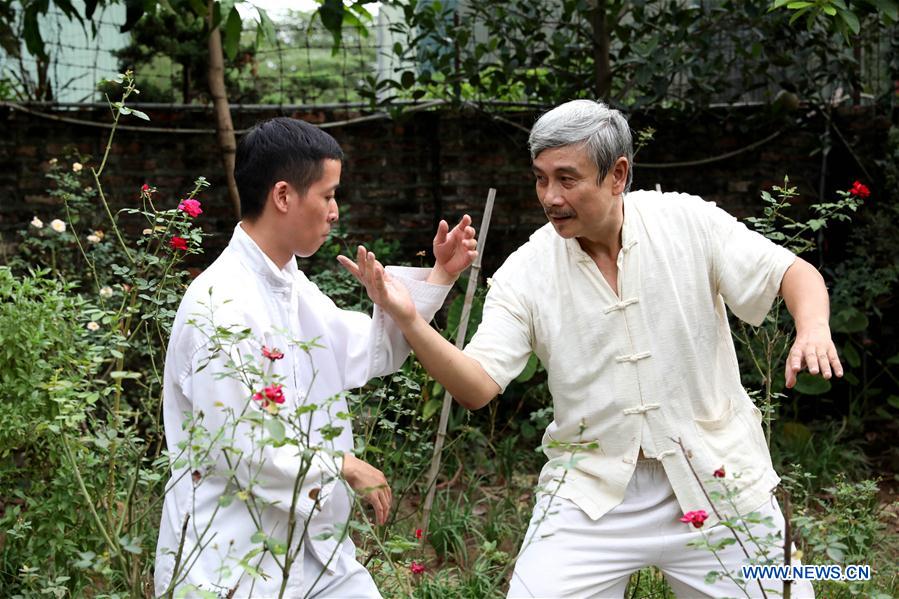

Vietnamese Wing Chun master Tran Viet Trung (R) teaches his student about Wing Chun skills in Hanoi, capital of Vietnam, Aug. 25, 2019. Sat in a cozy room full of books, herbal medicine and cold remedies on the tranquil outskirts of Vietnam’s capital Hanoi is a grey-haired businessman who has created a new school of Wing Chun, cured patients based on Chinese martial arts and medicine, and written best-selling books about the two spheres.(Xinhua/Wang Di)

THREADS
Wing Chun in Vietnam
Martial Art Masters and Medicine

Can Martial Arts Help Kids on the Autism Spectrum?

Research continues to reveal benefits of martial arts for kids on the spectrum.

Posted April 1, 2025 | Reviewed by Monica Vilhauer Ph.D.
THE BASICS

[B]KEY POINTS[/B]
  • Physical activity is a critical part of development in childhood and beyond.
  • Kids on the autism spectrum can benefit from tailored physical activity training.
  • Martial arts can help cognitive control, motor skills, coordination, social skills, and behavioral problems.
Once upon a time, the idea of kids on the Autism Spectrum training in martial arts seemed a contradictory idea. I remember vividly a parent bringing her kids to one of my martial arts classes years ago in the hope that what and how I was teaching might help with some of the social impairments, sensory processing, and repetitive behavior patterns that they were experiencing. Especially, she was concerned about some of the issues that were emerging at school with lashing out physically. Although there was almost nothing in the research literature on this, I was quite hopeful I could help. Experimental evidence supporting this to be the case continues to accumulate and was recently summarized by researchers in China and Poland. [B]Movement is on a spectrum too[/B]

YanAn Wang, Guoping Qian, Sujie Mao and Shikun Zhang from Nanjing and Harbin in China and Gdansk, Poland conducted an extensive review and analysis of data in published studies in their paper “The impact of physical exercise interventions on social, behavioral, and motor skills in children with autism: a systematic review and meta-analysis of randomized controlled trials” in Frontiers in Pediatrics. This effort focused on research studies on many types of physical activity, not only martial arts, and provides a good summary of the overall importance of movement activities for kids on the Autism spectrum. These researchers examined data that included research studies on boys and girls with average group ages of 5 to 15 years and physical activities ranging from general movement to stationary cycling, ball sports, and martial arts. Many benefits for behavior across all ages

Physical activity had positive effects on various domains across all ages with some differences. Older kids showed significant improvement in flexibility and cognitive control, younger kids had significant improvement in motor skills and coordination, and there were significant enhancements in social skills in preschoolers.

Quite importantly, “behavioral problems improved significantly across all age groups” while “Martial arts and ball games were particularly effective in enhancing these domains”. The overall conclusion is that “exercise interventions significantly improve flexibility, cognitive control, motor skills, coordination, social skills, and behavioral problems” in kids on the autism spectrum. Further, these researchers suggest that we must think of “exercise interventions as an effective method to enhance multiple abilities in children with ASD and emphasize the importance of designing personalized intervention programs tailored to different ages and needs”. Martial arts for neurodiversity

Previously, I’ve talked about the benefits of martial arts in helping kids on the autism spectrum with stereotyped behaviors and communication by emphasizing holistic and integrated approaches to mindful movement that may influence sensorimotor interactions. My earlier posts were typically based on results from individual research efforts. I really found this recent summary to be a quite compelling overview of trends in the literature on the benefits of martial arts.

When I came across this research, it brought me back to that time almost 15 years ago with those 2 kids in my karate class. The training really did help them and it really helped me too. While I was guiding them through martial movement, they taught me a lot about adopting different perspectives and how to be creative in my teaching.

(c) E. Paul Zehr (2025)

References

Wang Y, Qian G, Mao S, Zhang S. The impact of physical exercise interventions on social, behavioral, and motor skills in children with autism: a systematic review and meta-analysis of randomized controlled trials. Front Pediatr. 2025 Feb 27;13:1475019. doi: 10.3389/fped.2025.1475019. PMID: 40083436; PMCID: PMC11903732.

Intriguing