…
[QUOTE=Minghequan;1275842]http://www.scmp.com/news/china-insider/article/1581106/chinese-kung-fu-masters-battle-over-inheritance-wing-chun-legacy[/QUOTE]
Hi Ron -thanks for the post. There is no single grandmaster in wing chun. I respect Ip Chun as Ip Man’s son- but I am far from doing Ip Chun’s
approach to wing chun.
This is about the China Intangible Cultural Heritage
I’ve already started another thread about a similar controversy surrounding the Zhang-Sanfeng-Tai-Chi-Chuan-bid-as-China-Intangible-Cultural-Heritage. We’ve been covering in our print magazine since my NOV+DEC 2011 cover story, Escaping Buddha’s Grasp.
“A controversy has erupted in Chinese martial arts circles over who will be chosen as the officially sanctioned inheritor of the legacy of Wing Chun-style kung fu.”
If this is an “eruption”, it is one of the slowest and longest lasting in history.
Only the University of Queensland Pitch Drop Experiment has lasted longer.
My question is why do we need a head piece “Grandmaster” or what ever you call it, to represent all the lineages. It’s better to leave it alone. Let each family do their own thing. As Wing Chun evolves it’s going to change and become perhaps in some families a different style anyway. To me it’s funny,Ip man taught many students yet each one thinks their Wing Chun is special or different..laughable. It’s all the same. The information is encoded in the forms and the songs of the Wing Chun..The only differences are the teachers themselves. Some suck,most are ok and a few are very good. That’s it!
There are systems and cultures that lend themselves to a hierarchy, like the Japanese Koryu, but TCMA are not one of them.
Especially WC it seems.
[QUOTE=Vajramusti;1275849]---------------------------------------------------------------------------------------------
Hi Ron -thanks for the post. There is no single grandmaster in wing chun. I respect Ip Chun as Ip Man’s son- but I am far from doing Ip Chun’s
approach to wing chun.[/QUOTE]ot realize
I did not realize their was a Ip Chun approach to doing Wing Chun. What’s so different from yours? In Wing Chun we have forms,drills,chi sao,gor sao wooden dummy,weapons,sparring/fighting… What do you do that is so special??
This isn’t really about WC feuding
Well, it is and it isn’t. It’s about the Intangible Cultural Heritage bid. In order for such a bid to be submitted, there must be a governing body of some sort in place to submit it. There were nearly 300 submissions for this round, and it’s a big deal, not only because acceptance will grant some government support, but more so because it’s a feeder to the UNESCO Intangible Cultural Heritage. Shaolin has been trying to get that for years (see UNESCO-and-the-politics-of-culture). That’s a huge deal.
Note that Intangible Cultural Heritage includes all sorts of cultural traditions, not just martial arts. It’s food, art, music, dance, countless folk traditions that are bidding for national (and eventually international) recognition in order to give more support for preservation. Now, for something like WC, I have no fear about it going extinct soon. Same for Shaolin really. For high profile martial arts that have a lot of followers, it’s more about face. And you know how the Chinese are about face. But for some of the more obscure styles, like say Sun Bin quan (already accepted as a National Intangible Cultural Heritage, as is Shaolin), it can be great support. So you see why WC wants to pull it together and get China Intangible Cultural Heritage status. If Sun Bin quan has it, why not WC?
We all know the answer. It’s about feuding. :rolleyes:
[QUOTE=stonecrusher69;1275885]I did not realize their was a Ip Chun approach to doing Wing Chun.[/QUOTE]
His approach is to do it for health and not practicality. Come to think of it, many people seem to be unknowingly following his approach! 
[QUOTE=GeneChing;1275893]Well, it is and it isn’t. It’s about the Intangible Cultural Heritage bid. In order for such a bid to be submitted, there must be a governing body of some sort in place to submit it. There were nearly 300 submissions for this round, and it’s a big deal, not only because acceptance will grant some government support, but more so because it’s a feeder to the UNESCO Intangible Cultural Heritage. Shaolin has been trying to get that for years (see UNESCO-and-the-politics-of-culture). That’s a huge deal.
Note that Intangible Cultural Heritage includes all sorts of cultural traditions, not just martial arts. It’s food, art, music, dance, countless folk traditions that are bidding for national (and eventually international) recognition in order to give more support for preservation. Now, for something like WC, I have no fear about it going extinct soon. Same for Shaolin really. For high profile martial arts that have a lot of followers, it’s more about face. And you know how the Chinese are about face. But for some of the more obscure styles, like say Sun Bin quan (already accepted as a National Intangible Cultural Heritage, as is Shaolin), it can be great support. So you see why WC wants to pull it together and get China Intangible Cultural Heritage status. If Sun Bin quan has it, why not WC?
We all know the answer. It’s about feuding. :rolleyes:[/QUOTE]
The Chinese Government tried to destroy TCM it created Wu Shu to fool everyone this is real kung fu now they want to save TCM..LOL
[QUOTE=LFJ;1275895]His approach is to do it for health and not practicality. Come to think of it, many people seem to be unknowingly following his approach! :D[/QUOTE]
Very funny a- hole.. your so clever..:rolleyes:
[QUOTE=stonecrusher69;1275902]your so clever..:rolleyes:[/QUOTE]
My so clever what?
[QUOTE=LFJ;1275895]His approach is to do it for health and not practicality. Come to think of it, many people seem to be unknowingly following his approach! :D[/QUOTE]
Ironically, if you don’t train for practicality, your health may suffer!
[QUOTE=LFJ;1275911]My so clever what?[/QUOTE]
never mind I guess my post was edited. I Just back up a bit,Ip Chun I think is 90 years old now,so I would suppose his health would be more important then training wing chun to be a Bad Ass. However, I don’t think he teaches wing chun just for health. My point is yes we have some teachers that have more or less knowledge then some others and skill level is different also,but Wing Chun is Wing Chun if you know and understand the basics you will be able to grasp the higher levels of the training. No one lineage has the pure Wing Chun. One should just focus on the training instead of the lineage. in the end you will out grow the lineage and the style itself.
[QUOTE=stonecrusher69;1275922]However, I don’t think he teaches wing chun just for health.[/QUOTE]
Then you haven’t been paying attention. He has said so himself and his age has nothing to do with it. He has also admitted that he has never been in a fight in his entire life, and since he doesn’t even teach combat skills, what could he possibly know about fighting?
[QUOTE=stonecrusher69;1275883]My question is why do we need a head piece “Grandmaster” or what ever you call it, to represent all the lineages. [/QUOTE]
In my lineage, after my teacher had passed away, he was the only person who deserved the “Grandmaster” title. There will be no “Grandmaster” in my generation and it’s also not allowed to be used in my next generation. One of my senior brother’s student wanted to promote his teacher to be the “Grandmaster”. It was vetoed by the majority vote.
[QUOTE=LFJ;1275947]Then you haven’t been paying attention. He has said so himself and his age has nothing to do with it. He has also admitted that he has never been in a fight in his entire life, and since he doesn’t even teach combat skills, what could he possibly know about fighting?[/QUOTE]
This is a serious concern. Can a person never have any tournament experience, or street fight experience be able to teach combat? I don’t believe that person can. The reason is simple. His skill has never been tested.
There are many different kind of students. Someone who is
- willing to test his skill against other style, willing to teach your art to the next generation (your art will continue through him).
- willing to test his skill against other style, not willing to teach but keep everything to himself (your art will die at him).
- not willing to test his skill against other style, … (you art could not even reach to him)
In the 3rd situation, whether that person is willing to teach or not, since he has nothing in himself, he has nothing to offer to others.
I’m taking the liberty of changing the title of this thread
The previous title " Of some interest to Wing Chunners" is too ambiguous. What this is really about is Wing Chun’s Intangible Cultural Heritage bid.
Bureaucracy may be wing chun kung fu master’s biggest foe
Ip Chun has helped the martial art pioneered by his father, Yip Man, thrive. But help from the authorities has been severely lacking
PUBLISHED : Thursday, 11 September, 2014, 3:42am
UPDATED : Thursday, 11 September, 2014, 7:41am
Brian Yap brian.yap@scmp.com
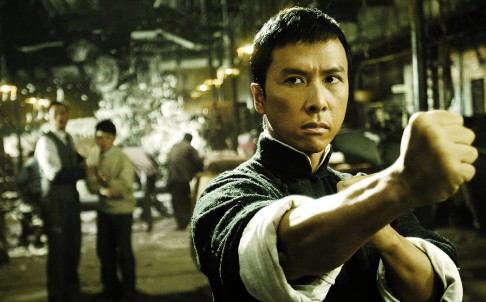
Action star Donnie Yen helped reawaken interest in wing chun with his film Ip Man. Photo: SCMP Pictures
At the age of 90, Ip Chun is as passionate and relentless as ever in keeping his father’s kung fu legacy alive - and the fight with bureaucracy is proving as tough as any opponent.
Ip, who still teaches scores of students every week, speaks of the warm welcome he gets abroad when promoting Yip Man wing chun, the martial art developed by his father, Yip Man. The Guangdong provincial authorities built a lavish memorial for Yip Man, he says, while the Hong Kong authorities have been slow even to recognise Yip Man’s most famous pupil: Bruce Lee.
He had better news in June, when Yip Man wing chun was identified as one of 480 living items of heritage recognised by the city’s government. But Ip Chun is still not convinced.
“We applied to Guangdong and Hong Kong for intangible cultural heritage status in 2009. While we were granted the status by the mainland authorities in just three years, it took Hong Kong five years to give us that recognition,” Ip Chun said. “Compared to many Western countries, and in particular the mainland, the Hong Kong government’s support for the development of martial arts is extremely inadequate.”
The list of intangible cultural heritage aspects was drawn up after a seven-year study, but how the heritage items will be protected remains undecided, and the government is still trying to identify those most at risk of extinction for urgent preservation.

Ip Chun wants to see more done to promote wing chun.
For Ip Chun, there is no help for the classes he teaches at Sha Tin Town Hall every Saturday. Not only is there no financial support, but he must also pay the government HK$650 per hour - in advance, with six months’ payment up front - for each two-hour session. Twice a year he hands over about HK$31,000.
“Of all the cities I have taught and held seminars in, including London and the United States, Hong Kong is the worst,” he says.
While Western countries encourage him to put on free wing chun displays, his ancestral hometown of Luocun in Foshan , Guangdong went even further, building a 13 million yuan (HK$16.4 million) memorial hall to Yip Man. The local government covered most of the cost.
By contrast: “It took exactly 40 years for a five-year Bruce Lee exhibition to be built in Hong Kong,” Ip Chun said, referring to the display of Lee memorabilia running at the Heritage Museum in Sha Tin until 2018.
Yip Man moved to Hong Kong from Foshan in 1949 and began teaching wing chun the next year. He began tutoring Lee when the latter was a teenager. Lee’s surge to international stardom took wing chun to a global audience. But Yip Man would die a few months before Lee in 1972.
Yip Man’s popularity and that of wing chun have enjoyed resurgence since the release of a series of biographical films beginning with 2008’s Yip Man, starring Donnie Yen Ji-dan.
“We have seen our student base increase by more than 50 per cent since [2008]” Ip Chun said. “The reason wing chun has attracted more overseas students than other martial arts is that my late father would only teach high school pupils, because you need to be highly knowledgeable to grasp its concepts.”
Many of Yip Man’s protégés studied overseas in the 1960s and 1970s, devoting themselves to promoting and teaching the martial art on campuses. Some taught more than 100 students.
Now many foreigners come to Hong Kong for in-depth training and get certified by the local association before going back to teach in their home countries.
“While the majority of those teaching wing chun overseas were university graduates and spoke English, many instructors of other forms of martial arts worked in restaurants in Chinatown, so their scope of teaching was confined to one place.”
 Much better Thread Title for search content. My own lineage is not from Master Yip Man but anyone practicing Wing Chun has to acknowledge the fact that Yip Family WingChun is highly responsible for preservation of TCMA Wing Chun today.