The Great Wall

speaking of trying to wrap my head around something…

srlsy? oh man…

World’s worst restoration? China’s Great Wall covered in cement
By Ben Westcott and Serenitie Wang, CNN
Updated 9:47 AM ET, Wed September 21, 2016


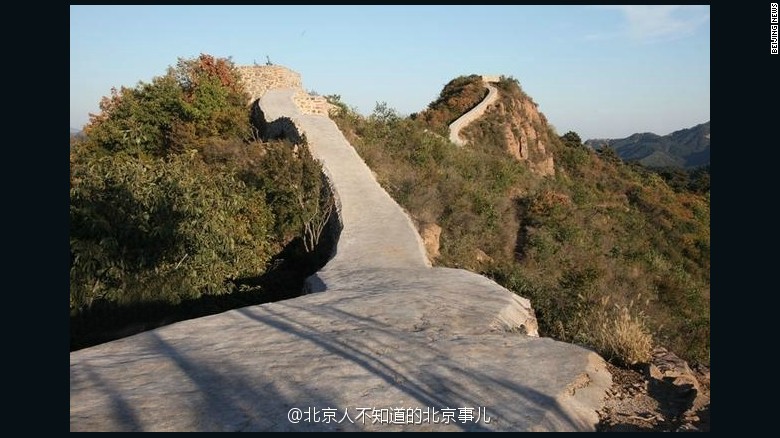
A photo posted on China’s internet showing the Great Wall repaired with cement.

Story highlights
Cement repair widely denounced online by angry netizens
Expert said the repairs had taken away “history”

(CNN)It’s the repair job that’s so ugly you can probably see it from space.
A 700-year-old “wild” stretch of China’s Great Wall has been covered in a smooth, white trail of cement under orders from Suizhong county’s Cultural Relics Bureau, Sina reported on Wednesday.
The repairs were carried out in 2014, but they only came to public attention recently.


Dong said the repair was done “very badly.”

It was an effort to restore parts of the wall which have fallen into disrepair and are not open to the public, but the restoration has been met with condemnation by social media users and advocates.
The repair work took place near the border of Liaoning and Hebei province and photos of the results were widely shared by Beijing News on Weibo this week.
CNN has reached out to the local Heritage Conservation Bureau for comment.
Restoration ‘took away history’
Chinese internet users have slammed the repair job, with the Weibo hashtag “The most beautiful, wild Great Wall flattened” trending online.
“Glad Venus de Milo is not in China, or someone would get her a new arm,” one user said.


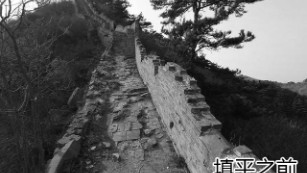
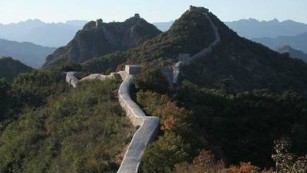
A photo from before China’s Great Wall was cemented.

Great Wall of China Society deputy director Dong Yaohui said the restoration work had been done “very badly”. “It damaged the original look of the Great Wall and took away the history from the people.”
Dong said it was important for the Chinese government as a whole to regulate and streamline Great Wall restoration efforts.
“Although the local government was well intentioned and wanted to restore the bricks of the Wall, the result turned out to be the opposite.”
Since 2006, the Great Wall Protection Ordinance in China introduced strict rules for the development of tourist destinations.

The title of the Great Wall is becoming very ironic

Here is the other side of the whitewashing wall.

Asian Films Looking to Cast More Hollywood Names
Vivienne Chow


Matt Damon The Great Wall UNIVERSAL
OCTOBER 7, 2016 | 02:00AM PT

As China is eager to export its soft power to the world, more Hollywood faces have been cast in Chinese blockbusters in the hope of scoring global releases and winning the hearts of international audiences.

Despite China’s box office slowing down by 21% in the first half of 2016, the country’s film market saw a staggering rise over the past five years on its way to challenge the North America’s position as the world’s No. 1 movie market.

Chinese money is also set to reshape Hollywood through various acquisitions, such as Dalian Wanda Group’s 2012 buy of the AMC theater chain and purchase of Legendary Entertainment in January.

But there is only so much that money can buy. Chinese productions earned little recognition abroad in recent years. The only Chinese-language film that has ever won a foreign-language Oscar was 2000’s “Crouching Tiger, Hidden Dragon,” but the Ang Lee film was billed as a Taiwanese film. The last mainland production that earned a nomination in the race was Zhang Yimou’s “Hero” in 2002.

“China wants to export its films to the world — especially the U.S. — as an achievement of its soft power, but no one wants to watch its films,” says producer and director Peter Tsi, who has helmed projects in Hong Kong, Taiwan and mainland China. “On the other hand, Hollywood is excited about getting into the China market, but the only way to achieve that is through co-production, and they must find subject matter that can resonate with the Chinese audience.”

The controversy surrounding the casting of Matt Damon as the lead in “The Great Wall” is the latest example. Helmer Zhang Yimou had to defend the decision to cast the Hollywood star in his first English-language production — also the first project emerged from Legendary Entertainment’s Legendary East and which cost $135 million — against “whitewashing” criticisms.

Tsi says in order to get Chinese productions distributed in North America and elsewhere, Hollywood faces are needed. “The only way to make it work is to arbitrarily cast a Hollywood actor or two so that U.S. distributors and exhibitors might consider screening them,” he says.

Even though it is China’s first film to reach the $500 million B.O. benchmark and the all-time highest-grossing film in the country, Stephen Chow’s fantasy blockbuster “The Mermaid,” which has a primarily Chinese cast, only had a limited release of 35 screens in the U.S. under Sony’s distribution.

Nevertheless, “The Great Wall” isn’t the first time a Western star has turned up in a Chinese movie. In fact the “Americanization” of Asian productions could be traced back to a 20-minute segment starring Raymond Burr that was edited into the original Japanese “Godzilla” (1954) before it was introduced to American audiences as “Godzilla: King of Monsters!” (1956).

Hong Kong led the trend in the early 2000s as partnerships with U.S. players began. Paul Rudd played an FBI agent in Hong Kong action blockbuster “Gen-Y Cops” (2000), which was produced by Hong Kong’s Media Asia and Regent Entertainment. The film was released in the U.S. in 2002 as “Metal Mayhem.” The 2000 action thriller “China Strike Force,” which had American company Astoria Films on board as one of the production companies alongside Asia’s Golden Harvest, starred Grammy-winning musician Coolio as a drug dealer.

Hong Kong-based Australian actor Gregory Rivers says many Western characters look arbitrary in Asian stories. “Sometimes [the story] doesn’t make sense,” says Rivers, who’s been working on Hong Kong films and TV for nearly 30 years. “Writers [in Asia] were not used to writing Western characters into their stories.”

But when it came to breaking into more and bigger markets, it became inevitable that characters of various nationalities had to be included in Chinese films. As mainland China began to cultivate its commercial cinema more than a decade ago, Donald Sutherland starred in Feng Xiaogang’s comedy “Big Shot’s Funeral” (2001), a collaboration between Columbia Pictures’ Asia arm, based in Hong Kong, and a string of Chinese companies including Huayi Bros.

More Hollywood faces appeared in Chinese productions over the past few years. Christian Bale starred in Zhang’s “The Flowers of War” in 2011. Adrien Brody was cast in Feng’s “Back to 1942” (2012), a Huayi Bros. production that got a U.S. release. Brody returned to China to join Jackie Chan and John Cusack in “Dragon Blade” (2015). Boxing legend Mike Tyson was cast as a crooked property developer in “Ip Man 3” (2015) and had fight scenes with Donnie Yen, who played the title wing chun master.

But before any conclusion can be drawn about “The Great Wall,” which will be released in China in December and in the U.S. by Universal in February, the casting of Bruce Willis in WWII epic “The Bombing” will get attention first. Jointly backed by the state-operated China Film Group and private investors, “The Bombing” has a reportedly $90 million budget. Willis is joined by Brody and an ensemble Asian cast including Korean star Song Seung-heon, Hong Kong actor-singer Nicholas Tse and mainland actor Liu Ye. It was scheduled for release on Sept. 30 in China.

“You want a movie that hits all markets at the same time and so you want to add a Korean or an American in the cast,” Rivers says. “But sometimes it doesn’t work like that.”

In the wake of NYCC

//youtu.be/yiGrLrj6gd4

Matt Damon comments

‘a f–king bummer’

Matt Damon Responds to ‘The Great Wall’ Whitewashing Controversy
Erin Whitney | 2 days ago


Universal Pictures

When the first teaser trailer for The Great Wall debuted this summer, much of the internet responded in a collective thinking face emoji, wondering, why is a white dude the hero of an action movie set in China?

It’s an criticism that’s circulated a lot this year Hollywood, especially around the the casting of Tilda Swinton in Doctor Strange, Scarlett Johansson in Ghost in the Shell, and Finn Jones in Iron Fist. The Great Wall, from Chinese director Zhang Yimou, is the most expensive movie ever made in China and follows Matt Damon defending the 13,000-mile wall against a monster attack. The Atlantic called out the film for whitewashing, while actress Constance Wu tweeted that the films need to “stop perpetuating the racist myth” of the white savior narrative.

During the press conference for The Great Wall following the film’s New York Comic-Con panel on Saturday, Damon was asked about his response the controversy. “It was a f–king bummer,” he said. But Damon wasn’t expecting the backlash, which he says he and the cast felt “wounded” by. “To me, whitewashing, I think of Chuck Connors when he played Geronimo.” The actor went on to defend the teaser, saying it’s too brief of a look to speak for the entire movie and shouldn’t be subjected to the same level of criticism:

[QUOTE]They’re trying to establish a number of things in 30 seconds or a minute or whatever they have; it’s not a full length trailer, it’s a teaser. They’re trying to tease A, the monster. […] They’re trying to speak to a bigger audience. ‘You probably don’t know who this director is in Middle America, the Steven Spielberg of China. Don’t worry, they speak English in this movie’ – you hear my voice speaking English. ‘Don’t worry, Matt’s in the movie, you’ve seen this guy before.’ So they’re trying to establish all these things. And by the way, there are monsters. So there’s a lot of pipe they’re trying to lay in that 30 seconds.

Besides the limited footage in the teaser, Damon emphasized that the movie isn’t based on actual history, but on folklore. He said his co-star Pedro Pascal, (Narcos, Game of Thrones) called him after the backlash joking, “Yeah, we are guilty of whitewashing. We all know that only the Chinese defended the wall against the monsters when they attacked.” Pedro chimed in at the press conference to say that The Great Wall is still a film made from the perspective of a Chinese filmmaker:

We don’t want people to be kept from work that they wouldn’t have the opportunity otherwise, to see that it is very, very specifically Chinese. It’s Zhang Yimou’s lens. It is a creature feature. It’s a big, fantastical popcorn entertainment movie. But it has a visual style that is very very much his and his only.

By the look of the first full The Great Wall trailer that debuted at Comic-Con today, the movie certainly looks like Yimou’s work, with a use of color and stylistic visuals similar to the director’s Hero and House of Flying Daggers. Yimou, through a translator, mentioned earlier in the press conference that the film is based on an ancient Chinese fairy tale about a monster even older than dragons. Yimou responded to the controversy earlier this year telling Entertainment Weekly that Damon plays one of five heroes in the movie, four of which are Chinese characters. “Our film is not about the construction of the Great Wall. Matt Damon is not playing a role that was originally conceived for a Chinese actor,” Yimou said.

But while The Great Wall may be based on a made up story, does that disqualify it from criticisms of playing into the white savior trope? Damon added that he’s still open to criticism, but that he wants audiences to see the movie first:

Look, if people see this movie and feel like there’s some how whitewashing involved in a creature feature that we made up, I will listen to that with my whole heart. I will think about that and I will try to learn from that. I will be surprised if people see this movie and have that reaction, I will be genuinely shocked. It’s a perspective that, as a progressive person I really do agree with and try to listen to and try to be sensitive to, but ultimately I feel like you are undermining your own credibility when you attack something without seeing it. I think you have to educate yourself about what it is, and then make your attack, or your argument and then it’s easier to listen to just from our sides.

The Great Wall also stars Jing Tian, Willem Dafoe, Andy Lau and Chinese boy band member Junkai Wang. The film hits theaters February 17, 2017.

[/QUOTE]

A good story with a great caste.

Will see when it is on Netflix.

Stopped buying DVDs.

Streaming from the web is the new norm.

Damon is sort of a gun slinger. and so much a sword wielder or bow drawer.

Well. It is Hollywood.

:cool:

I can hardly wait for this…

“Public screenings begin from 7pm on Dec. 15, the evening before the official release date.”

How a Monster-Sized Marketing Campaign was Built for China’s ‘Great Wall’ (EXCLUSIVE)

Patrick Frater
Asia Bureau Chief


UNIVERSAL
DECEMBER 4, 2016 | 06:30PM PT

“The Great Wall” presents a whole series of firsts. It is the first movie made in English by ZhangYimou, China’s master of the big spectacle. Costing some $150 million it is possibly the biggest-budget Chinese film of all time. It is certainly the biggest Hollywood-Chinese co-production to data and is Matt Damon’s first Asian movie.

Additionally, it is the first picture to emerge from Legendary East, the Chinese wing of Thomas Tull’s – now Wanda-owned — Legendary Entertainment production powerhouse.

All that is another way of saying there is a lot at stake. And it is why the movie’s upcoming release in China is being delivered to market with an unprecedented marketing and promotional campaign.

“It is a new kind of film,” says producer Peter Loehr, and CEO of Legendary East. The action-fantasy-adventure movie has major elements of Western blockbuster cinema, yet is 20% in Chinese and is directed by Zhang, whose film credits include epic “Hero” and “House of Flying Daggers. His track record mounting massive live events includes the opening and closing ceremonies of the 2008 Olympic Games, and the recent G20 Summit Conference in Hangzhou.

“This film is absolutely what I’ve spent 25 years of my career building up to,” says Beijing-based Loehr, who was previously a Chinese indie producer and later the China head of talent agency CAA.

Jeff Shell, chairman of Universal Filmed Entertainment Group, believes that the film can change the course of Chinese movies in international markets as well. “At Universal we are huge believers in a bright future for Chinese Cinema, fueled by the impressive recent growth of the Chinese theatrical marketplace. Our participation in ‘The Great Wall’ is very exciting to us. The combination of a tentpole scale Chinese-themed picture, the vision of the renowned filmmaker Zhang Yimou, the star power of Matt Damon and the enormous cast of talented Chinese actors make it the ideal vehicle to introduce Chinese creative product to the global audience,” Shell told Variety by email.

The film originated with a high concept idea – that the Great Wall of China only needed to be that size if it was built to keep out something far nastier than mere humans – from Legendary founder, Tull.

“It is not that I actually saw it from a plane. Rather when I was a little boy I heard that the only man-made object you could see from space was The Great Wall of China. Whether it is true or not, I could not conceive of the feat of engineering and ingenuity to build it. And I’ve been fascinated with it my whole life,” Tull says.

The film was shot in mid-2015 and Zhang has spent more than a year in post-production. The China release date of Dec. 16 puts it squarely at the height of peak season cinemagoing in the Middle Kingdom. It releases in North America on Feb. 17 next year with outings in international territories between those dates.

The lengthy post-production period gave plenty of time to cut visual material for promotion. Online marketing is much more important to film releases in China than in Western markets where posters and TV ads may dominate. Producers delivered more than 60 pieces of bespoke video for online consumption, in addition to a conventional trailer, a teaser trailer and three music videos. The trailers have played ahead of nearly every significant local and Hollywood film in Chinese theaters since Oct. 1.

Marketing in China shifted up a further gear with a major event called the “Five Armies Press Conference” on Nov. 15. “The film’s marketing is stretched over a series of events, introducing the film’s worlds in pieces, so that people get to know the concept progressively,” says Loehr. The Five Armies event introduced the battle groups, their leaders and the actors who play them as well as the unique weapons required to fight the film’s monsters.

That has been followed by the release of the first and second singles from the soundtrack. This week (Dec. 6) sees a large glitzy press conference in Beijing with the full cast in attendance, followed by a one day junket for domestic Chinese press, and then another for South East Asian press who are being flown in.

Along the way there will be further reveals about the creatures, their interaction with the human characters and the release of the final song. On Friday, the promotional action shifts to Shanghai for an event with more focus on the movie’s animation and proceeds going to the Great Wall Preservation Fund.

Screenings for Chinese press, friends-and-family and opinion leaders begin from Dec. 12. Public screenings begin from 7pm on Dec. 15, the evening before the official release date. Presentations will use an almost unprecedented combination of format including 2D, 3D, IMAX 2D and 3D, China Giant Screen, and 4DX, the Korean technology that sees supplementary content and screen extensions projected on a cinema’s side walls for a 270-degree effect.

The film was conceived and greenlighted even before Wanda acquired Legendary in the deal that was announced in January this year. Its four financier and presenters are Legendary, Universal Pictures, China Film Group and Le Vision Pictures.

The range of resources that Wanda can bring to bear – China’s largest cinema chain, distribution, and two marketing companies — elevate the film’s launch into a national event. China Film and Wanda’s Wuzhou Distribution firm are the distributors of record, while Legendary and Le Vision (part of the Le Eco group) oversee marketing and promotion.

“Where we might have had 8 people in a marketing meeting for ‘Pacific Rim’ or ‘Godzilla’ that expanded to 20 people on ‘Warcraft,’ including people from Wanda, Wanda Cinema Line and (social media giant) Tencent,” says Loehr. “Warcraft had a stellar opening and achieved a lifetime gross of $220 million, making it the third biggest film this year in China, a figure that dwarfed the $47.2 million it achieved in North America.

“For ‘The Great Wall’ we’ve held marketing and strategy meetings every Saturday with up to 60 people in the room from Legendary, Le Vision, CFG, Wanda Cinema, Tencent, China Movie Marketing Group, Mtime, Wanda Malls and Wanda’s real estate development team,” says Loehr. Some 260 of Wanda’s malls are putting on “Wall” events. Mtime, the movie ticketing and marketing firm Wanda acquired this year, is putting on “Dare to Dream” and Zhang Yimou exhibitions in a further 56 malls and CMMG will promote an augmented reality video game.

“If you are doing things that are formulaic, or that audiences feel they’ve seen before, it is going to be a hard sell,” says Tull. “The canvas and some of what Zhang accomplished is jaw-dropping.”

Hollywood is watching

Hopefully the world will be watching. :rolleyes:

As ‘The Great Wall’ Hits Theaters in China, Hollywood Is Watching
Movie industry sees $150 million picture starring Matt Damon as harbinger for future U.S.-China co-productions

At a cost of around $150 million, “The Great Wall” is the most ambitious co-production between Chinese and Hollywood studios to date and the most expensive film shot exclusively in China. But can it capture a global audience? Photo: Universal Pictures
By ERICH SCHWARTZEL
Dec. 15, 2016 5:30 a.m. ET

In mounting the $150 million historical fantasy “The Great Wall,” some of the biggest entertainment companies in the U.S. and China had to overcome multiple barriers, from state censors to filming in Beijing pollution.

As the movie begins its global rollout with a debut in China on Friday, the biggest hurdle awaits: Getting audiences to show up. The picture stars Matt Damon as a European mercenary detained at the wall who joins forces with Chinese soldiers to repel an army of monsters.

“I don’t know if middle America or Europe or markets around the world will embrace this film,” said Peter Loehr, one of the movie’s producers. “Ultimately the audience decides.”

Hollywood is watching, as several production companies are planning similar U.S.-Sino projects and see “The Great Wall” as a harbinger for their prospects.

As an official co-production between U.S. and Chinese companies, “The Great Wall” combined cast and concepts from both countries in what is believed to be the most expensive movie ever shot exclusively in China. It offers a prelude to what the future of large-scale moviemaking—from preproduction to release—might look like between the two countries.

“I need this movie to succeed,” said a producer on one of those coming co-productions. The prospects are mixed.

“The Great Wall” is expected to be a hit in China, but box-office analysts aren’t hopeful about its chances in the U.S., where it debuts Feb. 17.

In that regard, the movie is another example of a new economic reality in Hollywood, where a solid performance in China can compensate for lousy returns stateside. Once a blip on studios’ radar, the Chinese box office grew nearly sixty-fold from 2003 to 2015, when its revenue passed $7 billion, and is expected to become the biggest in the world in 2019.

The movie’s financiers include Comcast Corp.’s Universal Pictures, Legendary Entertainment—now part of China’s Dalian Wanda Group Co.—China Film Group, and Le Vision Pictures.

Because “The Great Wall” is a co-production, its financial backers based in the U.S. will receive a bigger slice of the ticketing revenue generated in China, and aren’t beholden to marketing rules that Chinese authorities use to make sure their country’s releases aren’t overshadowed by foreign movies.

But those sweetened terms come at a cost, beginning with rules that can feel like creative straitjackets and on-set safety requirements that can be looser than in the U.S.

[QUOTE]‘How do I look Matt Damon in the face when he’s the only one not wearing a mask?’
—A producer of ‘The Great Wall,’ referring to Beijing’s infamous pollution.

Helping get “The Great Wall” over its first hurdle: hiring China’s version of Steven Spielberg to direct. Zhang Yimou’s early films were banned in China, but he has since become his government’s go-to creative ambassador. Mr. Zhang directed the opening ceremonies of the 2008 Summer Olympics, earning him the unofficial title “national master” for his ability to juggle big-budget spectacles and state-backed projects.

“We had a lot of lobbying with some of the censorship board to get them to come around to this, and having a big director certainly helped with that,” said Mr. Loehr, who is also chief executive of Legendary East, the company’s China joint venture.

Filming in China posed inherent problems, like Beijing’s infamous pollution. “How do I look Matt Damon in the face when he’s the only one not wearing a mask?” one producer asked in a meeting.

Clearer skies and more space were found when the crew started filming in Qingdao, a coastal city 400 miles southeast of the capital where Wanda is constructing a sprawling real-estate development known as Wanda Studios Qingdao. Wanda bought Legendary for $3.5 billion in early 2016.

Several Chinese firms are lobbying U.S. studios to move productions to their new sound stages. If the experience of workers on “The Great Wall” is any indication, that migration will feel like a throwback to a more manual, less-regulated moviemaking era.

Costume-armor supervisor Levi Woods had just finished working on “Warcraft,” another Legendary action epic, when he joined “The Great Wall.” The 100 suits needed for “Warcraft” were designed by computer software and 3-D printed, whereas the 500 suits needed on “The Great Wall” were handmade from prototypes created by a sculptor.

Many Western crew members adjusted to a set that didn’t observe some of their longstanding safety practices, such as when Chinese workers applied a sealant that isn’t allowed on sets elsewhere. “I nearly passed out from the fumes that came out of a spray can,” said one crew worker.

Harnesses were routinely ignored when climbing scaffolding, said Guy Micheletti, the movie’s key grip, who supervised lighting and rigging crews. “You had to be a policeman,” he said. A producer said department heads tried to be extra-vigilant on set and pass on best practices.

“The Great Wall” wrapped filming last year, but its challenges didn’t end there. In casting actors that appeal to both markets, it found itself in political hot water.

When the movie’s first trailer was released, several Asian-Americans bemoaned Mr. Damon’s “white savior” narrative in a Chinese story. “Our heroes don’t look like Matt Damon,” said Chinese-American actress Constance Wu.

Mr. Loehr urged critics to see the movie before passing judgment.

A marketing push now under way in China includes tie-ins with Yum Brands Inc.’s Pizza Hut and Ping An Insurance (Group) Co. of China Ltd., and Mr. Damon traveled to Beijing earlier this month, showing off his handwriting with Chinese characters in a press conference.

Does all the work add up to ticket sales? “We’ll see what happens,” said Mr. Loehr.

—Lilian Lin in Beijing contributed to this article.

Write to Erich Schwartzel at erich.schwartzel@wsj.com[/QUOTE]

$67.4M Domestic Debut

$67.4M Debut is respectable considering it’s a not a franchise installment but something new, and it’s only the Chinese market.

China Box Office: ‘The Great Wall’ Stands Tall With $67.4M Debut
8:48 AM PST 12/18/2016 by Patrick Brzeski


Legendary
‘The Great Wall’

Starring Matt Damon and directed by Oscar-nominee Zhang Yimou, the Legendary co-production has notched the fourth-biggest debut of the year in China.

While Rogue One: A Star Wars Story is rocketing into the record books in North America, Legendary Entertainment’s period monster epic The Great Wall is standing tallest in China, the world’s No. 2 box-office market.

The high-profile co-production, which stars Matt Damon as a mercenary fighting for the Middle Kingdom, debuted to a muscular $67.4 million from Friday to Sunday in the country, according to early estimates from local box-office tracker Ent Group (the total can be expected to nudge up slightly come morning, Beijing time).

Directed by Oscar-nominated Chinese helmer Zhang Yimou, the movie is the biggest China-Hollywood co-production ever, with an estimated budget of $150 million. The high-concept, high-stakes project was financed by Legendary, Universal, China Film Group and Le Vision Pictures.

The Great Wall’s debut is the fourth-biggest opening weekend in China this year, behind local all-time box-office champ The Mermaid, Marvel’s Captain America: Civil War ($96 million) and Legendary’s own Warcraft. (Rogue One doesn’t open in China until Jan. 6.) The three-day estimate includes $7 million from 364 Imax screens, making The Great Wall the second-highest December Imax opening ever.

Direct comparisons with Warcraft, directed by Duncan Jones, are somewhat difficult, however, due to the unique window in which that film opened. Warcraft bowed to $46 million on a Wednesday, and then earned $65 million in its first Friday-to-Sunday window later that week. If you consider the full Wednesday-to-Sunday stretch Warcraft’s opening weekend as Legendary did when it announced the total at the time the movie opened to $156 million. However you parse it, Warcraft came out of the gate somewhat bigger than The Great Wall.

The Great Wall’s central concept is that the ancient cultural artifact of its title was built to defend against monsters rather than warring nomads. Damon plays a British mercenary who joins the Chinese to battle an army of Taotie monsters from ancient Chinese mythology who wage an attack every 60 years. The film’s large cast includes Willem Dafoe, Pedro Pascal and an array of top Chinese talent, including Hong Kong’s Andy Lau and local heartthrobs Lu Han and Lin Gengxin.

The film opens in many international territories over staggered dates in the coming weeks, leading up to a North America release on Feb. 17.

Tigers over Great Wall

China Box Office: ‘Tomorrow’ and ‘Tigers’ Climb Over ‘Great Wall’
Patrick Frater
Asia Bureau Chief


COURTESY OF JET TONE FILMS
DECEMBER 25, 2016 | 08:37PM PT

In a Chinese box office contest that pitched Wong Kar-wai against Jackie Chan and Zhang Yimou, new releases “See You Tomorrow” and “Railroad Tigers” debuted ahead of holdover “The Great Wall.” But with big name credentials and large numbers of screens for each, these three were the only serious contenders at the top of the Christmas weekend edition of the Chinese chart.

With as many as 80,000 screenings per day, “See You Tomorrow” (previously known in English as The Ferryman”) earned $40 million in three days, according to data from Ent Group. Produced by Wong Kar-wai and backed by Alibaba Pictures Group, the upmarket romantic comedy boasts a starry cast including Tony Chiu-wai, Takeshi Kaneshiro, Eason Chan and Angelababy.

The latest attempt by Jackie Chan to ease into a more dramatic role, albeit a nationalistic, Chinese versus oppressive Japanese oppressors, one, “Railroad Tigers” took second place with a three-day gross of $30.3 million. It benefited from some 60,000 screenings per day.

“The Great Wall,” the Zhang Yimou-directed popcorn movie saw its screen count plummet as the two newcomers vied for exhibition space. It managed $26.1 million in its second weekend from just under 50,000 screenings per day. That represents a 61% drop compered with its opening weekend of $66 million (including previews). Its per screen average was superior to “Railroad Tigers.” And after 10 days on release “Great Wall” has climbed to a cumulative total of $120 million.

A long way behind, “Hacksaw Ridge” added $4.28 million in fourth place. That gives it a 16 day cumulative of $41.1 million.

“Moana” took fifth spot with $1.68 million. After a long run of 31 days, it has a cumulative $30.3 million.

Fellow holdover, “The Wasted Times” slipped to sixth. It added $1.18 million in its second weekend for a 10-day total of $15.2 million.

Record-breaking Japanese animation, “Your Name” scored $980,000 in its fourth weekend. That lifted its total to $80.5 million after 24 days.

‘I.T.,” the Pierce Brosnan and Anna Friel-starring crime drama, opened with $550,000 in ninth spot.

I suppose I should see See You Tomorrow although I’m not a huge Wong Kar-wai fan.

Blame the media…

…Why not? If it works for the U.S., why not the PRC?
Or do I have that backwards? :confused:

State media rails against film review websites for giving new Chinese movies poor marks
29 December 2016 14:00 AFP 3 min read

Chinese state media have taken popular online movie review sites to task for giving three new domestic blockbusters failing marks, accusing them of trying to undermine the domestic cinema industry by manipulating ratings.

Foreign films are in high demand at the world’s second-biggest box office, a fact that has long annoyed Beijing, which both covets Hollywood’s global reach and economic power and fears that it is exposing domestic audiences to pernicious “Western” thinking.


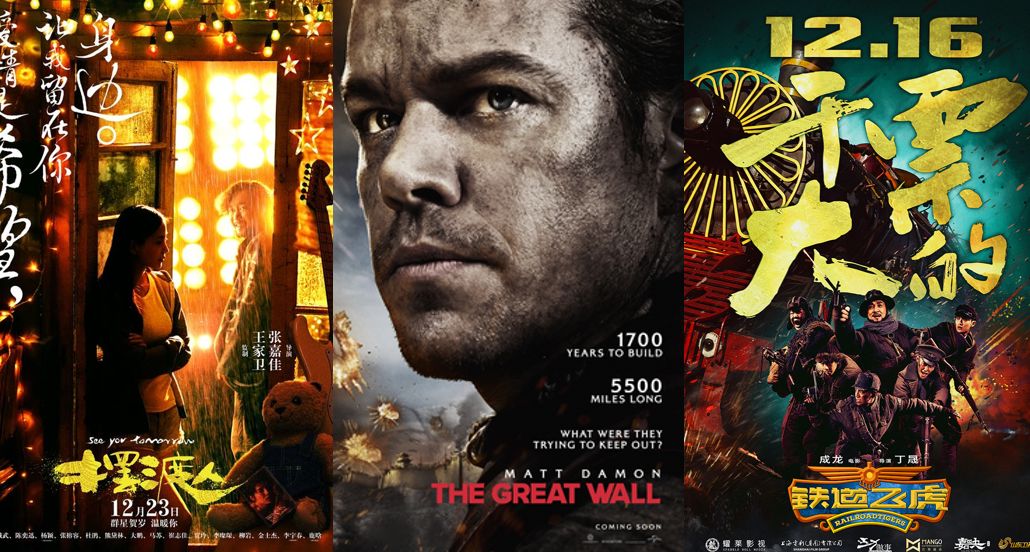
The three Chinese blockbusters.

The number of overseas movies given releases each year is strictly limited, and an opinion piece on the smartphone app of the People’s Daily, the official mouthpiece of the Communist Party, said some influential commentators had made “malicious and irresponsible comments that seriously damaged” domestic films.

The piece, published Tuesday, questioned whether two Chinese film review websites — Douban and Maoyan — were manipulating domestic film ratings by giving them exceptionally low scores.

“Five-star” comments were deleted, while domestic films received thousands of “one-star” ratings even before their midnight premieres ended, state broadcaster CCTV alleged separately.

Following the remarks, Maoyan cancelled part of its film ranking function.

Internet users, however, took the opportunity to write some reviews of their own, bombarding state media with snide remarks about the government’s terrible taste in movies and restrictive attitudes towards free speech.

“You won’t even let us say a movie is terrible,” one commenter said.

//youtu.be/avF6GHyyk5c

Douban’s CEO, too, objected to the characterisation of the site, saying the reviews accurately effect audience opinion.

In response, the People’s Daily seemed to walk back its remarks Wednesday, saying the real reason for the bad ratings might simply be bad movies.

“Can films really be ruined by ‘one-star’ scores? Can the ecological environment of films really be affected by ‘negative comments’?” it asked.

The second article, not the first, reflects the official line, the paper added.

China’s annual box office reached 44.1 billion yuan ($6.34 billion) in 2015, with domestic films securing 61.9 percent of sales, according to China Movie Data Information Network.

In December, three domestic films battled for the country’s box office: “The Great Wall” directed by Zhang Yimou and starring Matt Damon, “Railroad Tigers” starring Jackie Chan, and “See You Tomorrow” produced by Wong Kar-wai.


File photo: Apple Daily.

Ticket sales have been brisk, but audiences panned their poor acting and thin stories.

One common complaint is Chinese censors’ heavy-handed management of the creative process from script to theatre.

In November, the country passed legislation saying films should promote “socialist core values”, while avoiding the kind of themes — sex, violence and politics — that are a large part of Hollywood’s appeal.

Chinese companies have been ramping up investment in the foreign movie industry, but they often have to walk a thin line between balancing strict censorship at home and appealing to global audiences.

In January, Chinese conglomerate Wanda Group signed a $3.5 billion deal to buy Hollywood studio Legendary Entertainment, the company behind the “Batman” trilogy and “Jurassic World”, as well as “The Great Wall”.

The Great Wall is crumbling

I still wanna see it.

China’s most expensive film ‘The Great Wall’ fails to excite filmgoers, or LeEco shareholders
South China Morning Post
Celine Ge, South China Morning Post


Matt Damon Andy Wong/AP Photo

The Great Wall, China’s most expensive film, looks like turning into another money loser for beleaguered Chinese tech giant LeEco, which was betting big that the Hollywood-Chinese co-production would revive flagging investor confidence in the company.

Directed by Oscar nominee Zhang Yimou and starring top US A-lister Matt Damon and Chinese favourites Andy Lau and Jing Tian, the English-language monster-action big-screener costing US$150 million had every reason to be dubbed “the biggest film ever shot in China”, backed by Dalian Wanda Group’s Legendary Entertainment – itself owned and under the watchful eye of China’s richest man Wang Jianlin – and Hollywood’s iconic studio Universal Pictures.

Zhang, who orchestrated the opening ceremony of the 2008 Beijing Olympics, produced the epic with China Film Group and Le Vision Pictures, the film-making unit of LeEco.

But despite its hoped-for blockbuster appeal and such a hefty list of heavyweight backers, mercenary warrior Damon’s efforts at fighting giant monsters to save the Middle Kingdom has failed dismally to impress the critics, and after netting just US$128.04 million in its first fortnight.

Le Vision invested an estimated US$15 million into the film. Experts suggest the movie needs to take in US$450 million at the turnstiles not to be considered a box-office flop.

But in reality analysts now believe it could even fall short of Legendary’s summer offer Warcraft’s total US$211.83 million since June this year.

Zhang’s monsterpiece made a muscular start in its opening weekend, notching up more than US$66 million in takings – but earnings plunged a staggering 61 per cent over the Christmas weekend, according to data from industry researcher Ent Group.

Of course, Christmas is not a national holiday in China, but in recent years the season has emerged as a popular shopping and date-night occasion among young urban Chinese, usually resulting in a healthy box-office frame, according to The Hollywood Reporter.

Despite nationwide hype, The Great Wall lies in second place in the domestic box office rankings after Jackie Chan’s latest action-comedy Railroad Tigers.

The country’s largest cinema operator Wanda even allotted The Great Wall the film more than 50 screening slots among its cinemas across China, which usually ensures better takings, which certainly should have at least pushed it towards covering its huge budget.


A news conference for the movie “The Great Wall”. Andy Wong/AP Photo

The much-vaunted saviour of Chinese cinema actually currently ranks the 11th biggest grosser of the year in China, lagging behind Captain America and home-grown offerings such as Stephen Chow’s The Mermaid, which has netted US$553.8 million after costing a rather-more modest US$60.72 million to produce.

Ray Zhao, an analyst with Guotai Junan Securities, reckons “it will be impossible for The Great Wall to even break even, given a film normally needs to earn three times its budget to do that”.

Filmgoers themselves gave The Great Wall a shoulder-shrugging 5.4 out of 10 on Douban.com, a Chinese movie-ranking platform the equivalent of Rotten Tomatoes, and 5.5 on movie database imdb.com’s ranking system.

Some were confused by the mix of Chinese and American elements in the filmmaking, and wondered who the film was meant to attract, Li Yi, a 29-year-old high school math teacher told the Los Angeles Times.

“Which audience is the film targeting? Older? Younger? Chinese? Foreigners? I can’t figure out who will prefer a film that is neither very Chinese nor very Western.”

The flashy colours, ancient weapons and aerobatic war scenes contributed little to the overall plot, she said, damming it, “a waste of time”.

Some high-profile film critics have also resorted to social media to publicly lambast producer Zhang himself.

“The storytelling is awful and the characters look so plain,”said one, using the handle Disrespecting Movies, whose account has 740,000 followers on China’s Twitter-equivalent Weibo.

“Zhang’s career is dead,” he even concluded.


Zhang Yimou Jason Lee/Reuters

Clearly irritated by the narrative, Le Vision chief executive Zhang Zhao himself launched his own a barbed social media spat with Disrespecting Movies.

“You who curse Chinese films are doomed to rot,” he wrote on his microblog, before publishing a legal letter demanding the critic apologise.

“People already had very high expectations of The Great Wall, but bad reviews spread like wildfire and discouraged many potential moviegoers from going to see it,” said Huang Guofeng, a Beijing-based analyst with consultancy Analysys International.

This is the third big-budget movie to be given generous financial backing by Le Vision Pictures, and had been seen by some as its last genuine chance of delivering healthy income to its flagging annual ledger.

LORD: Legend of Ravaging Dynasties, an animated fantasy starring China’s best-paid actress Fan Bingbing, in which Le Vision ploughed an estimated US$22.2 million, also flopped, even during China’s so-called “Golden Week” holiday this year, with earnings slumping after just the opening day.

Both have added to the gloom of Le Vision’s parent LeEco – whose Shenzhen-listed arm Leshi Internet Information and Technology Corp agreed in May to buy Le Vision for US$1.41 billion, four times the latter’s net asset value.

According to the terms of the agreement, Le Vision is obliged to generate at least US$74.9 million yuan to net profits for 2016.


LeEco CEO Jia Yueting Jeff Chiu/AP Photo

“Le Vision was taken a huge bet – but now the chance of meeting that goal is extremely slim,” said Huang, adding it had also expected the film’s success to bolster overall investor confidence in LeEco.”

The company, which has invested in several high-tech products ranging from electric cars to smartphones, has been burning cash to support its global expansion.

In May, LeEco bought a 48-acre plot in San Jose, California from Yahoo to house its new global headquarters that will have capacity for 12,000 employees.

It also bought Vizio, the second largest TV brand in the US for $2 billion, according to Forbes, and financed Faraday Future, a Los Angeles-based electric car startup that is building a factory in Nevada.

But last month, chief executive Jia Yueting – whose estimated net worth of $6.2bn placed him 31st on the latest Hurun Rich List for China – watched the company’s shares plummet after he admitted it was facing a shortage of cash and was suffering from rapid expansion in too many directions.

“LeEco’s expansion is too fast, and that has caused great challenges to our organisational capacities and fundraising,” Jia said in a lengthy letter to staff.

It then halted trading in its shares in Shenzhen earlier this month, prompting speculation a stock plunge on December 6 triggered margin calls on the credit of Jia and his brother.

It might just take a little more than muscle than Matt Damon to pull Jia and his embattled company out of this particular.
Build a Wall…

Still wanna see it. :o

Why Trump could put a dagger in ‘The Great Wall’
“The Great Wall,” the major US-Chinese co-production starring Matt Damon, is a groundbreaking collaboration. But Donald Trump’s anti-China rhetoric could hurt the fantasy-adventure blockbuster.


Film still The Great Wall (Universal Pictures)

The Americans and the Chinese came up with a good plan. To increase global revenues, production companies from both countries got together for the massive, $150-million film. “The Great Wall” is ringing in a new era in the film industry.
Both countries are meant to profit in this win-win situation: Hollywood stands to benefit from gaining a key to the gigantic Chinese market, which is the second largest in the world. For China, collaboration with the US is a pivotal step toward becoming a global player in the film industry.
But the release of “The Great Wall” roughly coincides with President-elect Donald Trump’s debut on the world stage as a political leader. The film already came out in China and much of Asia and Europe in December and opens in US cinemas on February 17.
Trump’s anti-China rhetoric - which at times seems like the precursor to a trade war - could put a damper on the film’s success.


(picture-alliance/dpa)
The US-Chinese team from ‘The Great Wall’ at their first press conference in 2015

Then there is Trump’s growing disdain for the Hollywood establishment, most recently seen in his post-Golden Globe spat with Meryl Streep. It doesn’t look like he’s going to be lending support to US-Chinese film projects in the near future.
Matt Damon, William Dafoe filmed in China
“The Great Wall,” the largest US-Chinese co-production to date, opens Thursday in German cinemas. Directed by Zhang Yimou of China, the film mainly features a Chinese cast, though the screenplay was written in Hollywood and A-list stars Matt Damon and William Dafoe are also on board. The movie was filmed in English - but in China.
No less than five American and Chinese production companies shared the film’s $150-million price tag. However, the participating US firm Legendary Entertainment was recently bought by the head of China’s powerful Wanda Group.
“The Great Wall” is less a historically accurate story about China’s famous architectural landmark and more of a 3D action-fantasy spectacle that is jam-packed with special effects.


(Universal Pictures)
Tian Jing is one of the Chinese stars in the film

In the 11th century, a handful of European mercenaries led by Matt Damon go out to search for the gun powder that had been invented by the Chinese and find themselves fighting evil - that is, dragon-like monsters - together with the Chinese army.
It’s a digital flick with endless fight scenes and not much depth - a blockbuster that borrows tricks and dramatic details from many other pop films. Artistically, though, it’s a disaster.

Hollywood up against bureaucracy, censorship

But the Chinese and American filmmakers weren’t particularly concerned with making art. “The Great Wall” is meant to achieve record ticket sales in the US, China and around the world.
So far, the Chinese market has not been very easy for Hollywood to crack, since the authorities are still quite strict about allowing foreign films to be shown. Only 34 US films per year are permitted for release in China. The media bureau SARFT in Beijing decides which films those are and when they can run.
The censorship office also gets involved. If a Hollywood film includes too much foul language, brutality or sex, then it has a poor chance of making it into Chinese cinemas.
While there have been recent discussions about raising the quota on US films in China, a slight increase wouldn’t bring in much money. But when Chinese firms are involved in the production, then the film is no longer considered a foreign product and both Chinese investors and producers profit.


(Universal Pictures)
China’s wall gets a digital boost

Chinese film market has tremendous potential

For the Americans, China is the market of the future. As in other industries, the Asian superpower is climbing to the top in entertainment as well. The US may still be the most lucrative film country in the world, but experts predict that the quickly growing cinema market in China will soon overtake the American one.
In China, 20 new cinemas open every day and the industry is booming. Since the large Hollywood studios are now more dependent on revenue from abroad than they used to be, the Chinese market is a must for them. A million-dollar US blockbuster can hardly be financed without a boost from Chinese ticket offices. All the more motivation to work together.
On the other hand, Chinese investors are trying to get a foot in the door on the American market. The Chinese company Alibaba has been collaborating since last fall with Steven Spielberg’s Amblin Partners. Warner Bros., Sony and Universal have all reached out to China and found willing partners.


(picture-alliance/dpa/R. Dela Pena)
Wang Jianlin is a powerful man in the film industry - even in the US

It’s no secret that cinema mogul Wang Jianlin is interested in one of the Hollywood studios. His Wanda Group is already a global cinema leader and owns many in the US. Wanda’s most recent coup was acquiring the US firm that produced the Golden Globe show - Dick Clark Productions.

Will Trump have an impact?

However, US politicians have been resistant to China “meddling” in the film industry. Government representatives recently called for close examination of Chinese investment in entertainment. And the fact that Donald Trump has appointed China-critic Peter Navarro as head of the National Trade Council is likely to worry American and Chinese film investors.
Whether or not Trump really aims to hinder their plans remains to be seen. After all, the US film industry creates countless jobs, which the president-elect is well aware of. For now, the makers of “The Great Wall” can hope that their big-budget flick fills cinemas around the world.

About that wall…

People will blame anything for their failures nowadays, even before they fail. :o

Matt Damon Chinese Epic ‘The Great Wall’ Distancing Itself from Trump’s Wall
Home Culture Wars
By Heat Street Staff | 2:45 pm, January 31, 2017

The Great Wall, the $150 million US/China historical epic starring Matt Damon, is released in less than three weeks.

The movie, set over a millennium ago in ancient China depicts how the Great Wall of China was built, and has already faced spurious claims it is ‘whitewashing’ history by having Hollywood star Matt Damon as its hero.

Now it is facing a new obstacle: the saturation coverage of President Trump’s plan to build a border wall between the U.S. and Mexico.

The film’s distributor Universal is acutely aware that much of the pre-release talk about the movie has consisted of comparisons between the movie and the Mexican wall and is duly seeking to distance itself from controversy to avoid its costly epic being another casualty of Trump.

“The film is not tracking all that well, said a producer who spoke on conditions of anonymity as he is developing several movies with Universal. “Trump’s Mexico wall won’t be why it flops but it’s not certainly helping.”

When Damon’s casting was first announced in Deadline Hollywood, the article declared: “The Great Wall reveals the mystery behind why the Great Wall was built, and the secrets hidden beneath its stones.” But worried about a backlash from both Trump supporters and liberal moviegoers who require a respite from the wall coverage, Universal is playing down the movie’s depiction of the Great Wall of China even though it can never be rid of it since it is er…the movie’s title and subject.

“The marketing initiatives have lately centered around war and warriors, not the wall,” the producer said. “You can barely see the wall itself on the film’s most recent poster and the promotional materials don’t refer to it much. When they do, it’s often called “The Great Wall of China ” to distinguish itself from what’s happening in Mexico.”

[QUOTE]
Film>Movie Poster > Poster and TV Spot of The Great Wall starring => http://bit.ly/2ip5czD #films

LIKE
1
E R N E S T O NODAL
3:43 PM - 14 Jan 2017


The Great WallVerified account
@thegreatwall

Follow
More
Fight for honor, not glory. #TheGreatWall

RETWEETS
33
LIKES
65
mattypage#XperiencePawelStepedmond arReevoSelin.Muh. HilmanMeybol Rosquete
10:05 AM - 22 Dec 2016
4 replies 33 retweets 65 likes
Reply 4 Retweet 33
Like 65


The Great WallVerified account
@thegreatwall

Follow
More
“I’ve fought for greed and gods. This is the first war I’ve seen worth fighting for.” #TheGreatWall

RETWEETS
47
LIKES
96
LuHan French FanbaseValentinAEileen DonovanIsaiah StephensPawelAngela AtheyFerOnly Hanpakmom007
10:57 AM - 9 Dec 2016

Universal is minimizing talk of the wall for fear of unfavorable comparisons that have already been all the rage on social media:

boomhauertjs @boomhauertjs
Matt Damon’s “Great Wall” may be a worse idea than Trump’s wall.
7:40 PM - 21 Jan 2017
Retweets likes

AP @KingIwobi
Matt Damon releasing Wall propaganda my drug #TrumpWall
6:23 PM - 28 Jan 2017
Retweets likes

Evan Fonseca @TheEvanFonseca
Say goodbye to your box office returns, Matt Damon’s “The Wall”. #TheWall #MattDamon #Trump #trumpwall
6:16 PM - 25 Jan 2017
Retweets likes

David Southwell @SubinthePub
I see the new Matt Damon film is The Great Wall. But do they make the dragons pay for it?
8:22 PM - 29 Jan 2017
1 1 Retweet likes

The Great Wall needs to gross $500 million to be profitable and got off to a mediocre start when it was released in Asia over the holiday period. The movie is directed by Chinese filmmaker Zhang Yimou and is financed by Legendary East which is owned by Chinese conglomerate Wanda Group.

Damon, a high-profile liberal, consistently slammed Trump during the election but recently struck a more bipartisan tone. “Damon turned down the chance to star in Manchester-by-the-Sea [which he produced] to star in The Great Wall,” added the source. “He could be forgiven for regretting it. Bryan Cranston was going to star in it at one stage before backing out- he dodged a bullet!”

Universal is dreading the inevitable comparisons between politics and the movie when The Great Wall is released.[/QUOTE]

If someone doesn’t like the concept of the movie they shouldn’t see it. But it’s really stupid of people to equate this with Trump’s proposed Mexican border wall. So now the concept of a wall, ANY wall, has become offensive(!), even when it has zero to do with Mexico? Dumb.

I’m not particularly eager for this movie either way, but from the ads I’ve seen on TV alone, it looks like it was built to keep out a monster(s), and maybe a monstrous horde(?). If anybody should be offended, it should probably be the Mongolians.

Our latest ezine offering

The most expensive Sino-U.S. co-production yet! Read THE GREAT WALL: Who is Going to Pay For It? by Greg Hebert

Seen!

I saw it Saturday. I’ll review it later.

BOM results:

Domestic: $21,651,060 8.1%

  • Foreign: $244,600,000 91.9%
    = Worldwide: $266,251,060

So at $150 M invested, they still made $116+M. But China didn’t get the face it wanted out of it, and in China, face is more precious.

Why Matt Damons The Great Wall Became a Great Big Bomb
An attempt to please both sides of the Pacific missed the mark with a weak plot and underdeveloped characters
Matt Pressberg | February 19, 2017 @ 9:22 AM


Legendary

After years of hype, Legendarys would-be China-U.S. crossover epic The Great Wall crumbled at the box office, earning just $18.1 million during its opening weekend in North America on an estimated $150 million production budget. (The projection for the four-day holiday is $21 million.)

Worse, director Zhang Yimous English-language fantasy epic starring Matt Damon didnt prove to be much of a blockbuster in China either, reeling in a disappointing $170.4 million since it opened in December.

That movie became one of the worst movies in China, Wang Haige, chairman of the Huading Awards (Chinas version of the Peoples Choice Awards) told TheWrap in December.

While it edged out Kung Fu Panda 3 as Chinas eighth-highest grossing film of last year, Legendarys video-game adaptation Warcraft hauled in $220.8 million in China last year with much less hype but an easily identifiable and massive core audience of gamers who got exactly what they wanted.

It wasnt supposed to be like this. In fact, The Great Wall was seen as the first crossover blockbuster for Legendary after Chinas real estate and investment conglomerate Dalian Wanda Group acquired Thomas Tulls 16-year-old production firm last January for $3.5 billion. It was also the first movie filmed at Wandas $8 billion Oriental Movie Metropolis in the city of Qingdao.

Several Hollywood films have been massive hits in China, with Universals Furious 7 and Paramounts Transformers: Age of Extinction topping $300 million at the local box office, but the reverse hasnt held true.

Other than Ang Lees Oscar-winning 2000 action drama Crouching Tiger, Hidden Dragon which hauled in $128 million at the U.S. box office but didnt do nearly as much business in China (although the countrys box office was significantly smaller then) the countrys homegrown movies havent been able to travel well. American entertainment lawyer Sky Moore, who works closely with Chinese studios, called a crossover hit the holy grail for them.

The Great Wall was conceived with seemingly foolproof elements to appeal to crowds in both China and the U.S.: a beloved Chinese director (Zhang), a Hollywood movie star (Damon), and a unity plot that features foreign mercenaries teaming up with 11th-century Chinese military leaders to battle lizard monsters.

But as anyone who has eaten at a fusion restaurant that missed the mark knows, trying to be both things for two separate audiences often ends up satisfying neither. Here are some of the movies shortcomings:

  1. Lost in translation

Most of the movie takes place on, in and directly next to the Great Wall of China, which looked great in 3-D (and very big budget), but means little to American audiences more likely to be motivated to buy tickets to whats essentially a monster fantasy movie.

The 11th-century setting, archery and catapult-heavy battles and historical references, which give the film the Chinese imprint its backers wanted, dont exactly make it easier to appeal to U.S. crowds.

  1. A sidelined star

Damons character, William Garin, gets the most screen time but has almost no backstory we find out early on that hes an enigmatic (British?) mercenary who came to China looking for black powder, and he runs off a list of battles he fought in a 30-second talk with Commander Lin (Jing Tian), but theres just not much there to identify with to other than his skills with a bow and arrow and occasional wisecracks.

Some Chinese critics viewed Damons participation in the film as a pure cash grab. He joined the movie because of the high pay, Wang said. Im against those stars who attempt to get more money to act in the more low-quality movie.

  1. Spectacle over plot and character

Zhang, who directed the opening and closing ceremonies at the Beijing Summer Olympics in 2008, achieves some spectacular and sweeping battle scenes.

But in imitating American fantasy and action movie tropes, the Chinese have not yet mastered the creation of charismatic characters that people will want to follow through multiple films. (We know and love Deadpool after one movie.)

And even the non-Damon characters are underdeveloped, from Chinese star Andy Laus Strategist Wang to Williams partner, Pero Tovar (Pedro Pascal), who reveals his presumed Spanish heritage by saying amigo often in his otherwise all-English dialogue.

  1. The whole whitewashing issue

Last summer, the film came under fire in the U.S. by people who mistakenly thought Damon was playing an Asian character or the white hero who comes to the rescue of nonwhite characters.

But Zhang was quick to come to the actors defense. Matt Damon is not playing a role that was originally conceived for a Chinese actor, Zhang said. The arrival of his character in our story is an important plot point. There are five major heroes in our story and he is one of them the other four are all Chinese.

  1. A crosscultural hodge-podge

Several high-ranking Chinese film executives and Great Wall insiders TheWrap has spoken with over the course of the past year expressed concerns early on that the films disparate elements wouldnt coalesce into something coherent and engaging enough for the American moviegoers higher standards.

Even Chinese critics attacked the films formulaic plot and blatant attempts to appeal to the U.S., and audiences failed to fully embrace it despite the hype and full force of Legendary parent and the country and worlds largest cinema owner Wanda Group behind the film.

The recipe for true crossover movie might include bankable movie stars from both hemispheres, a diverse set of characters comfortable in their own skin, funny one-liners and a good story. That might be called Furious 7.

[QUOTE=Jimbo;1299668] If anybody should be offended, it should probably be the Mongolians.[/QUOTE] Offended Mongolians. :stuck_out_tongue: Good one, Jimbo!

First forum review!

This would’ve been good if it wasn’t so over-hyped. Damon, Dafoe, and my fav Andy Lau all underperform. Jing Tian is ok - Zhang Yimou has always been better with directing women - at least she has cool armor. Zhang tries to poach Kurosawa’s Ran with colored standards but falls short (Dang. No Ran thread here? I must rewatch that an launch one). The taotie would’ve been better if they were tripods, but that’s lost on Americans. Tripod taotie would’ve been more novel as monsters go than devil hounds and a nod to the source material (I’m thinking of the tripod jue () of course, which taotie adorn). Honorable mention for the taotie carapaces. Weak 3D. Absurd physics. Dumb CGI archery. A funny Spaniard. My fav thing was the nunchuk drumming.

Hollywood will lambaste this as a flop at the US box office, but it’s already cleared $267 M worldwide so they made their money back at least.

Not quite the lambasting I predicted above.

How the Chinese Box Office is Saving Hollywood
By Kayleigh Donaldson 02.20.2017

The Great Wall washed up on American shores last week to little fanfare. Following heated discussions regarding the film’s possible status as an example of Hollywood white-washing, the Zhang Yimou-directed action epic opened to a disappointing weekend gross of $17-20m. For a movie of this budget – its $135m price-tag making it the most expensive production shot entirely in China, this would usually be the first sign of a flop. Yet before it even reached American audiences, The Great Wall had grossed close to $225m – $170 million of that in China alone.

When viewed in the context of Western cinema, The Great Wall is an archaic trifle with yet another white male lead incongruously front-and-center; in the context of the ever-growing Chinese market, however, it’s something much more interesting.

Over the past decade, the box office for Chinese cinema-goers has exploded to new heights that have surpassed every other international market. In 2015, gross revenues in the country reached a staggering $7bn, close to double that of 2013. Compare that to the American market, where audiences’ attentions are divided, ‘peak TV’ is at its most saturated and streaming services like Netflix have become legitimate Hollywood power players. For Hollywood, the Chinese market has, in a relatively short amount of time, become a necessary part of blockbuster release strategies.


Jing Tian, one of the stars of The Great Wall.

Savvy moviegoers will have noticed China’s growing influence through some of the past few years’ biggest films: Recognizable Chinese stars have begun popping up in major franchise movies, from X-Men to Star Wars, and Chinese locations have become standard bearers for hot-shot action sequences. Now You See Me 2 set most of its story in Macau, and featured Taiwanese star Jay Chou in a starring role (he also sang the end theme). The film made over $97m in China alone, and now Lionsgate are planning to make a spin-off with a primarily Chinese cast.

The China Movie Channel co-produced Transformers: Age of Extinction also moved part of its setting to the country and earned $222.74 million in ticket sales in less than two weeks. On top of that, the film featured product placement from notable Chinese brands, even in scenes set in rural Texas, which added to the film’s sizeable revenue. Today, Transformers: Age of Extinction is the fourth highest grossing film in China, where it sits alongside three other American produced films in the top 10. One of those films, Duncan Jones’s Warcraft, was almost single-handedly saved from flop status by Chinese audiences.

One studio hoping to continue their Chinese market domination is Disney, whose acquisition of Marvel Studios and Lucasfilm has paid off handsomely in every market, but the success of films like Zootopia (the ninth highest grossing film ever in China) presents a stark contrast from the mid-1990s. In 1996, the country’s governing powers banned filmmaker Martin Scorsese and several production officials from China after they released the film Kundun, on the life of the Dalai Lama. Disney were called out by name for distributing the film, and their works were banned from the country until 1999, after Disney’s pseudo-apology tour just in time for the release of Mulan. Now, the relationship is much stronger, as Disney recently opened a Shanghai resort, which is rumored to have cost $5.5bn.


The Enchanted Storybook Castle at Shanghai Disneyland, which opened last year.

Like Disney’s penance, American studios are pulling out all the stops to ensure their films not only suit Chinese audiences, but also the official censors of the Chinese government. On top of being co-produced by the state-run CCTV China Movie Channel, Transformers: Age of Extinction, as noted by the Guardian, featured a “benevolent” Chinese government rising up as the dominant power while the US government “manages to be both sinister and useless – typified by the black-clad CIA operatives, one of whom gets beaten up by a Chinese character.” The Great Wall may feature Hollywood’s golden boy Matt Damon in the lead role, but it is far from white savior territory in its depiction of China’s army as the bastion of technological advancement and moral superiority.

Yet Hollywood seems to be making less of an impact as China’s own cinema market grows and audiences flock to blockbusters by home-grown talents like Stephen Chow, whose film The Mermaid is the highest grossing film in China, and made half a billion dollars without even having to come to America (although in its extremely limited US release, it did gross close to $1m over 35 theatres). Chinese audiences aren’t turning away from American films entirely, but films like Kung Fu Yoga, Monster Hunt and Mojin: The Lost Legend fill up the highest grossing list easily in ways the international market has not.

Chinese audiences are also less tolerant of failed pandering. As noted by the Wall Street Journal, they welcome Chinese actors with meaty roles in major projects but steer clear of tokenism, which they refer to as ‘flower vases’. Like any nation, Chinese audiences enjoy seeing themselves and their culture on screen, so a film like The Mermaid, which is unmistakably Chinese in its humor, visuals and tone, appeals far more to audiences than merely putting a familiar face in the background.

The Mermaid How the Chinese Box Office is Saving Hollywood
The poster for Stephen Chow’s The Mermaid, China’s highest grossing film of all time.

The Great Wall, too, suffered from this issue. The film’s grosses were strong but nowhere near that of other 2016 releases like The Mermaid or the previous year’s efforts like Monster Hunt. For a film with such a high budget to be grossing a third of the revenues of Chow’s film, which cost a mere $50m, presents a problem for both Chinese and American studios. If audiences aren’t interested, they simply won’t come, no matter how much a film panders to them.

China is still a relatively new and untested market, so its sustainability remains in questions. After 2016 grosses flatlined, fears are growing that the bubble has already burst, which could lead to a downward spiral as budgets increase and box office expectations set $1bn worldwide grosses as the norm. Disney have high hopes for this year’s blockbusters, with the new Pirates of the Caribbean movie projected to do well there, as well as Paramount’s fifth Transformers film, Transformers: The Last Knight. Already, 2017 has seen two Chinese blockbusters – Kung Fu Yoga and Journey to the West: The Demons Strike Back – dominate the box office. It’s a trend Hollywood are hoping will translate for them.

We’ve discussed most of the films mentioned above but I’m too busy at the moment to do the cross linkage.

The Great Flop

THE GREAT FLOP 2/23/17 9 AM
Chinese moviegoers don’t care about your outrage over ‘The Great Wall’ and its white saviors


Universal

By Charles Pulliam-Moore

When Chinese director Zhang Yimou (House of Flying Daggers) released the first trailer of his next big project, The Great Wall, last summer, the film’s plot and casting choices were met with scathing criticism from the public for what seemed to be yet another movie about white men saving hapless people of color.

The Great Wall tells the fictionalized story of two white Westerners searching for gunpowder in China who find themselves suddenly sucked into the Song Dynasty’s epic ongoing war with—bear with me here—vicious aliens who threaten to wipe out the entire population of northern China every 60 years. Though they are the most foreign of foreigners (white, English-speaking people who’ve never been to China), The Great Wall props up William (Matt Damon) and Tovar (Pedro Pascal) as morally dubious heroes whose presence becomes instrumental in the Imperial Court’s ability defeat the alien invaders.

//youtu.be/avF6GHyyk5c

Fresh Off The Boat actress Constance Wu’s critique of The Great Wall‘s casting decisions quickly went viral after she took to Twitter to challenge the idea that movies with white leads were safer financial bets for studios looking for international success.

“Money is the lamest excuse in the history of being human,” Wu tweeted. “Why not TRY to be better? If white actors are forgiven for having a box office failure once in a while, why can’t a [person of color] sometimes have one.”

She continued: “And how COOL would it be if you were the movie that took the ‘risk’ to make a POC as your hero, and you sold the **** out of it?! The whole community would be celebrating!”

Now, seven months later and a few days after The Great Wall‘s premiere in the U.S., early box office numbers show that casting Matt Damon as the white savior in a movie set in ancient China wasn’t nearly enough to entice American audiences to see it. Despite costing around $150 million to produce, The Great Wall has only managed to rake in a mere $21.7 million. Compare that to The LEGO Batman Movie which, despite being in its second week, managed to net $42.5 million that very same weekend.


Universal

The Great Wall‘s American debut appears to be the sort of financial calamity that would scare Universal and the Dalian Wanda Group (the movie’s largest Chinese investor) from even considering another film like it. But when you look at the movie’s performance in China, where it’s been out since December, the story gets a bit more complicated.

I spoke with Jeff Bock, Senior Box Office Analyst with an analysis firm called Exhibitor Relations, about the calculus studios make when preparing for a movie like The Great Wall to be released domestically and internationally. He explained that while we’re used to thinking of American performance as the most important metric of success, the fact that China is now home to the world’s second largest movie market in the world can’t be underestimated.

“A film doesn’t have to be a hit in North America to be a success anymore,” Bock said. “This isn’t anything new, really, as we’ve seen films like Pacific Rim and Battleship, and most recently World of Warcraft and XXX3, perform gangbuster business in foreign territories without being labeled box office hits in North America.”


Universal

To date, The Great Wall has already made $171 million in theaters across China alone. While these numbers are still slightly lower than what either Universal or Wanda hoped to make from the film, the fact that it managed to at least break even (and then some) in China means that another studio wouldn’t necessarily see it as enough of a flop to avoid making more white savior movies.

“Chinese audiences, and most foreign audiences for that matter, have had a steady diet of Hollywood blockbuster since the 1980s, and most of those leads were various shades of white,” Bock said. “Matt Damon is in the film for North American audiences, not Chinese ones, as their recent box office successes can attest to.”

Chinese audiences may be used to consuming Hollywood’s formulaic action romps, but it’s also important to remember that they’re presented with far more movies starring Chinese leads than American audiences. The Mermaid, the most successful Chinese movie of 2016, made $526.8 million, something nearly impossible to imagine in the U.S. They’re probably not going to get up in arms about one movie starring a couple of white men.


Universal

It’s understandable why Asian American actors and viewers would criticize Universal’s decision to release a film set in ancient China with a lead that was never meant to be of Asian descent. It sends a clear message that many studios will choose to produce films like Avatar and Elysium (hey, Matt Damon). It also signals that other American films that borrow heavily from Asian cultures like Ghost In The Shell may still be cast with a white lead.

But The Great Wall‘s financial performance in China could mean that studios won’t ever see a reason to make big-budget, cash-grab films centering Asians or other actors of color in a meaningful way—regardless of how many hashtags of protest they see. Until studios focus on creating international blockbusters that prominently feature heroes of color, we’ll never know just how well audiences might respond to them.

This author gets it. But I think China will keep trying until it cracks the U.S. market. It’s a matter of face.

And now, all the Monday morning quarterback commentary…

I don’t think it puts U.S.-China productions ‘in doubt’. It will make them a little more prudent perhaps, but the payout if a U.S.-China production is too massive for them to stop trying.

Matt Damon’s ‘The Great Wall’ to Lose $75 Million; Future U.S.-China Productions in Doubt
6:00 AM PST 3/2/2017 by Pamela McClintock , Stephen Galloway


Illustration by: John Ueland

The film’s $171 million haul at the China box office is way less than investors had anticipated for the biggest-ever U.S.-China co-production.
The collapse of The Great Wall at the domestic box office (it has made $34.8 million in North America) has iced any notion of a significant future for U.S.-China co-productions. The movie likely will end up with losses of more than $75 million, sources say, and Universal Pictures will be on the hook for at least $10 million.

The studio funded about 25 percent of the film’s $150 million production budget, the rest coming in equal parts from Legendary Entertainment, China Film Group and Le Vision Pictures. But Universal also covered Wall’s global marketing expenses, conservatively estimated at $80 million-plus. The film earned $171 million in China (a disappointment) and is expected to top out at about $320 million globally. That’s way less than investors had anticipated for the biggest-ever U.S.-China co-production. “The fusion of the No. 1 and No. 2 movie markets in the world will eventually happen, but it is a misfire, domestically speaking,” says box-office analyst Jeff Bock. Adds one Hollywood executive who has dealt extensively with China, “There’s no question but that it’s a failure.”

The good news for Universal is that its share of this failure will be relatively modest. The studio gets to collect a roughly 10 percent distribution fee from all theatrical revenue (between 40 percent and 50 percent of the total box office), and box-office rentals likely will recoup much, if not all, of its marketing outlay before other investors dip into whatever money is left to cut into production costs. The four partners will split any further theatrical income equally.

If the movie generates hoped-for ancillary revenue (including $20 million from domestic home entertainment and as much as $40 million from international home entertainment, with $25 million to $30 million from TV — admittedly, a best-case scenario), that will further stanch the red ink.

Still, the crumbling of this Wall has toppled much hope for major Sino-American pictures. Among the lessons insiders have learned are the difficulties of finding stories that meld Eastern and Western characters and the challenges of blending crews, which in Wall’s case meant hiring 100 interpreters and solving conflicts that allegedly took place among some below-the-line workers.

“This was the first movie of its type,” says one executive connected to the project. “You’re trying to appeal to everyone, and you’re not compelling enough to appeal to anyone. It feels like Esperanto.”

To date, the studios have viewed officially sanctioned China co-productions with skepticism, even though they offer vastly greater financial benefits, enabling backers to pocket 43 percent of ticket-sale revenue out of the country, far more than non-co-productions allow. Past tentpoles, such as Paramount’s Transformers: Age of Extinction and Disney’s Iron Man 3, were briefly planned as co-prods before their producers realized the depth of Chinese involvement and script control.

The highest-profile co-productions in the works are low- to midbudget period pieces such as Skydance and Alibaba’s World War II drama The Flying Tigers, written by Randall Wallace (Braveheart), and producers Mark Gordon and Hawk Koch’s road movie Edge of the World, to be co-produced by Pegasus and China Film Group.

Instead, studios have focused on strategic partnerships to boost their returns. Sony struck a financing deal with Dalian Wanda Group, and Paramount recently closed a purported $1 billion pact with Shanghai Film Group and Huahua Media Group.

Developing fully Chinese content with local joint ventures also is seen as a safer bet than co-productions. Warner Bros. is at work on a slate of a dozen Chinese-language films for its Flagship Entertainment banner, a partnership with Beijing-based China Media Capital.

Set in the time of the Song dynasty, Wall tells the story of European mercenaries, led by Matt Damon, who join forces with the Chinese to fight rampaging monsters. It’s not the first feature director Zhang Yimou has made with an American star: He teamed with Christian Bale on 2011’s The Flowers of War, solely financed by Chinese money. That $94 million movie earned $96 million in China but perished in the U.S. with $311,000.

Regardless of Wall’s failure, one analyst predicts Hollywood will be back for more. “The market opportunities are too substantial to ignore,” says Eric Handler of MKM Partners. “The problem with The Great Wall in the U.S. was poor reviews. At some point, someone will find the right formula.”

Patrick Brzeski contributed to this report.

This story first appeared in the March 17 issue of The Hollywood Reporter magazine.