Sumo

Sumo scandal

This first one has vid.

Sumo ‘stables’ searched in Japan probe
By the CNN Wire Staff
July 7, 2010 10:05 a.m. EDT
Sumo ‘stables’ searched in Japan probe

Tokyo, Japan (CNN) – Tokyo Metropolitan Police on Wednesday searched sumo training facilities, or stables, as they continue to gather evidence on a widespread gambling scandal that has tarnished Japan’s national sport.

Police searched the Onomatsu stable in Chiba prefecture – the training base of 34-year-old wrestler Ozeki Kotomitsuki who admitted to illegally gambling on professional baseball games – and the Tokitsukaze stable in Tokyo.

The scandal has rocked sumo wrestling in Japan, where national identity is closely linked to the sport and where top wrestlers can become national heroes.

On Sunday, the Japan Sumo Association dismissed Kotomitsuki and his stable master – or coach – Otake.

In addition, Japan’s national broadcaster NHK decided that it will not broadcast live the next tournament, scheduled for Sunday. It is the first time in 57 years that NHK will not carry the competition live.

The sumo association has sought to repair the damage. The association’s chairman said on the association website that the situation is “unprecedented and critical.” He also promised to try to “regain the fan’s confidence … as soon as possible.”

Japan police raid sumo stables over gambling scandal

(AFP) – 12 hours ago

TOKYO — Japanese police raided two sumo stables Wednesday, seeking evidence in their probe of a gambling scandal linked to yakuza crime groups which has rocked the nation’s ancient sport.

Police officers in dark suits walked into the Onomatsu and Tokitsukaze stables in Tokyo, where wrestlers have been involved in illegal gambling on baseball games and other sports, footage by public broadcaster NHK showed.

The police were expected to raid some 30 locations linked to the sumo world, including other stables, where wrestlers live and train.

The Japan Sumo Association has admitted that scores of wrestlers had gambled illegally and banned more than 10 from the next tournament starting Sunday in the central city of Nagoya.

Betting in Japan is permitted only on horse racing and certain motor sports.

The association has fired wrestler Kotomitsuki, 34, a high-ranking “ozeki” second only to “yokozuna” grand champions, along with his stablemaster Otake, 42, for taking part in illegal gambling on baseball.

The scandal has shocked the Japanese public, which expects sumo wrestlers and their masters to act as role models.

Japan’s state broadcaster NHK, furious over the scandals, said Tuesday it will not air an upcoming sumo tournament, the first time it has scrapped the broadcast since they began in 1953.

Police last month arrested a former wrestler-turned-gangster, Mitsutomo Furuichi, 38, on extortion charges after he had allegedly blackmailed Kotomitsuki, threatening to expose his gambling.

olympic sumo?

women’s sumo?

In Sumo’s Push for the Olympics, a Turn Away From Tradition
By DANIEL KRIEGER
Published: October 18, 2010

OSAKA, JAPAN — For years, promoters of sumo have been pushing for the sport’s inclusion in the Olympic Games. To get there, the International Sumo Federation has thrown its weight behind a form of the game that would offend purists and surprise most everyone else: women’s sumo.

The sumo wrestler Miki Satoyama, right, threw her opponent during the heavyweight class of the Japan women’s sumo championships in Sakai city, in southern Osaka on Oct. 3.

Sumo officials have long tried to get their sport, for years identified with giant men with topknots shoving each other in a ring, into the Summer Games. But when the International Olympic Committee declared in 1994 that single-sex sports could no longer qualify as candidates for the Games, that was enough to turn tradition on its head. Since then, sumo has been coming into its own internationally as an equal opportunity sport.

Such a radical change to Japan’s ancient national sport did not come easy, and the initial push came from outside the country. Among those who lobbied the I.F.S., as the sumo federation is commonly known, was Stephen Gadd, the general secretary of the European Sumo Union and president of the Netherlands Sumo Federation.

Men’s sumo first started gaining a following internationally in the mid-1980s as part of a campaign by Japan to spread its culture internationally. More than a decade later, women’s sumo started gaining followers as the I.F.S., which oversees 87 member nations, started pushing for a women’s version of the sport.

“We held the very first women’s sumo tournament with the European Championships in 1996,” he said. “After that, it really took off in Europe.”

While European women, especially those familiar with combat sports, felt no qualms about giving sumo a go, Japanese women had more to contend with than just the Europeans, who outsized them. Their biggest hurdle came from a stigma that can be traced back to the 18th century, when, as entertainment for men, topless women sumo-wrestled blind men. Though this lewd variety eventually faded away in the mid-20th century after being banned repeatedly, a ceremonial form has continued in regional festivals so far out on the fringe of society that it remains virtually unknown.

So when the Women’s Sumo Federation was set up in Japan in 1996, Japanese women were hardly clamoring to get involved, given the common belief that women just do not do sumo. After all, they had always been kept out of legitimate competition because of the sport’s cardinal rule: Women cannot touch or enter the sacred wrestling ring, the “dohyo,” lest they contaminate it with their “impurity.”

“In the professional sumo world,” said Gadd, “women in sumo is as unthinkable as a rabbi sponsoring a pork farm.”

But along with the rise of amateur sumo abroad, women’s sumo in Japan has been making strides. “A growing number of women are involved, certainly in the hundreds,” said Katrina Watts, president of the Australian Sumo Federation and a stadium announcer for sumo events, including the World Championships. “I’d say it’s a good sport for women because it’s a body contact sport without being violent.”

Nowadays, girls can even go to high school or college on a sumo scholarship. And there are women-only tournaments, like the All-Japan Women’s Sumo Championships, which took place this month in Osaka.

Forty of the top sumotori in the country gathered for the 15th edition at the Ohama Park Sumo-jo. Shinsaku Takeuchi, the event’s organizer and head of the Women’s Sumo Federation, said that in recent years women had been getting better and tougher. “Women’s sumo is becoming even more vicious than the men’s,” he said.

Takeuchi explained that what set amateur sumo apart from professional was the inclusion of gender and weight classes and the removal of the religious ceremonies, which are still very much a part of men’s professional sumo. Amateur sumo has also been spared the recent scandals that have tainted professional sumo in Japan, including a baseball betting scandal that laid bare the professional sport’s link with organized crime.

Originally performed as a Shinto ritual to entertain the gods so they would bestow a good harvest, the game dates back well over a thousand years. It is a trial of strength in which 48 techniques may be employed to throw an opponent off balance so he steps out of the ring or falls to the ground. A match begins with a head-on collision, followed by a wild fit of shoving, lifting, throwing, tripping, slapping, yanking or any combination thereof. It is often over in less than 10 seconds but can last a minute or more.

An 18-year-old high school senior from Tottori, Yuka Ueta, was the strongest wrestler of the tournament. At 125 kilograms, or 275 pounds, she plowed her way through five matches in the open weight class, dispatching each opponent within moments to earn her first gold medal in the senior group.

In August, competing among the world’s top sumo wrestlers, she won a bronze medal at the Sportaccord Combat Games in Beijing, her best showing yet at an international tournament. But at the World Championships this past weekend in Warsaw, she did not fare as well, placing fifth in the open weight class. Ueta got into sumo at age 10 when she was encouraged to give it a try. “Normal-sized people can do any sports they like,” she said, “but someone who is heavy doesn’t have many options. Sumo is perfect for this kind of woman. And if she has a complex about her body, that will change with sumo.”

Another powerhouse, Sayumi Sasaki, from Aomori, took her fourth All-Japan gold medal in the 65-kilogram-and-over class. But at 21, she has decided to hang up her loincloth following the Warsaw games, where she was knocked out in the first round by the Russian winner of the heavyweight gold, Anna Zhigalova.

Though Japanese women make up the greatest number of participants, Europeans tend to dominate, which was the case in Warsaw. East Europeans won gold medals in three out of four divisions, and the only Japanese medalist of the tournament was the lightweight Yukina Iwamoto, who took a silver medal, losing to Alina Boykova of Ukraine.

“Foreign players like the Russians and Ukrainians have more passion for sumo than we do and train harder,” said Sasaki. “It’s too difficult to beat them.” Even Yuka Ueta said she was no match for them.

As for the battle to make it into the Olympics, Stephen Gadd says the best chance is if Japan hosts the 2020 games. “Getting into the Olympics will give sumo the push it needs to become a major international sport,” he said. And now that the gender barrier is broken, one less obstacle stands in its way.

Meant to post this yesterday

It was front page news in yesterday’s S.F. Chronicle. I love it when martial arts of any sort make the front page. It’s just a shame that it’s for a scandal.

Sumo questions wrestlers in bout-fixing scandal
By ERIC TALMADGE, Associated Press
Monday, February 7, 2011

(02-07) 19:48 PST TOKYO, Japan (AP) –

Japan’s sumo association began questioning dozens of top wrestlers Tuesday in a widening investigation into allegations of bout-fixing that have deeply tarnished the image of the nation’s ancient national sport.

The Japan Sumo Association said it was quizzing all wrestlers in the sport’s two top divisions to find if they were involved in fixing the outcome of matches. It expected to put together an initial report on their findings by the end of the week.

Sports Minister Yoshiaki Takaki said he was deeply concerned by the scandal, in which more than a dozen wrestlers or coaches have been implicated.

Amid a public outcry, the sumo association has decided to cancel its next major tournament — the first time that has happened in 65 years — and forego a number of exhibition or charity events until the matter is resolved.

“Sumo is in a crisis,” Takaki said after meeting association officials Tuesday. “We hope for a quick investigation into the nature of this incident.”

The latest scandal surfaced last week, when police informed sumo officials they had found suspicious text messages on the mobile phones of several wrestlers. The phones had been confiscated in an investigation into another scandal that came to light last year involving wrestlers betting on baseball games, allegedly with gangsters acting as go-betweens.

The scandal has become a national embarrassment for Japan because sumo is generally seen as a symbol of Japanese culture, and not merely a sport. Unlike other sports, the sumo association has special status that affords it tax benefits, and its wrestlers appear in public clad in traditional robes and wear their hair in top-knots.

There were indications that not all wrestlers were being cooperative with the investigation.

Kyodo news service and Japan’s public broadcaster NHK said that some wrestlers had broken or replaced their old phones, possibly to avoid having them checked for incriminating text messages.

One wrestler said his wife stepped on his and broke it, Kyodo reported.

Allegations of match-fixing have long shadowed sumo, but the association has staunchly denied them and none had ever been proven.

Where there is money there is corruption, that’s a given.

Good thing Kung Fu Tai Chi magazine isn’t corrupt…

…oh wait.

shoot. :frowning:

:wink:

Sumo was just recovering from all the scandals of recent years, and now this…

This is big … Black sox big, despite the practice being an Ill-kept secret.

I’d be suprised if Sumo didnt have fixed fights, betting and its share of dirty secrets and scandals. Sumo is OLD! All sports have their fair share.

I recently began training sumo. my first competition will be in June. awesome art. until now I thought it was merely a lot of pushing, but the tactics are pretty much judo with no gi and striking is allowed. matches are fast, hard and typically over in less than a minute -kind of sounds like a street fight.

420 lb body slam

13th Annual US SUMO OPEN - Byamba vs. Kelly

[QUOTE=SevenStar;1212414]I recently began training sumo. my first competition will be in June. awesome art. until now I thought it was merely a lot of pushing, but the tactics are pretty much judo with no gi and striking is allowed. matches are fast, hard and typically over in less than a minute -kind of sounds like a street fight.[/QUOTE]

how did your comp go?

ouch

sux to be the ref sometimes

vs 2013/09/24

um…

Special photo booths let you pose with sumo wrestlers without having to strap on a loincloth
Casey Baseel 3 days ago

Should your visit to Tokyo coincide with a sumo tournament being held in the city, you really owe it to yourself to see the sport in person. Tickets are reasonably priced, the matches are fast-paced and showcase a surprisingly large variety of techniques (many similar to those of offensive linemen in football), and there’s really no way to properly convey the amazing controlled ferocity through a television screen. Best of all, the arena is compact enough that even the cheap seats provide a good view of the action.

And in case you need an added incentive, the venue is now home to two special sticker picture booths, where a little digital photo manipulation allows you to take a snapshot with your favorite sumo wrestler.

As we said, the Kokugikan, Tokyo’s sumo arena in the Ryogoku neighborhood, is intimately sized enough to give spectators plenty of chances to see the competitors, called rikishi, up-close and personal. Still, the big boys are here to slap each other around, not snap pictures with the fans, so it’s unlikely you’ll get the chance to talk one of the sports more prominent figures into taking the time to pose with you.

Instead, visitors to the Kokugikan can make use of two purikura machines, the photo sticker booths that are a mainstay of Japanese video game arcades and entertainment centers. Each machine is loaded with images of the 42 wrestlers of sumo’s top division, the makuuchi.

One of the machines

The Japan Sumo Association showcased the machines through its official Twitter account, with former rikishi and current sumo coach Asakayama demonstrating as he took what he says is his first set of purikura in 20 years.

No, the booth isn’t small. Asakayama is just big.

One round of purikura costs 500 yen (US$4.80), for which shutterbugs get to choose two rikishi to pose with. As has become standard, the machines are operated by touch screens, and after snapping the photo users can add stamps and other decorations.

Asakayama’s first selection was the 23-year-old rising star Endo.

The retired wrestler showed a bit of favoritism with his second choice, posing inside a frame with personal friend Aminishiki, whom Asakayama affectionately calls Ami-tan.

Both machines can be found on the second floor of the stadium. For those of you worried about using up all your stickers, fear not, as a digital copy of the photos can also be sent to your mobile phone for safekeeping.

Stadium information:
Ryogoku Kokugikan /
Address: Tokyo-to, Sumida-ku, Yokoami 1-3-28
130-0015 28
There’s a arcade of these Japanese photo machines in the Japantown Kinokuniya mall in S.F. I find it daunting personally as it seems expensive for what you get. But if this machine showed up there, perhaps I’d brave it.

female sumo

//youtu.be/Vpf_Q2Qrxfk

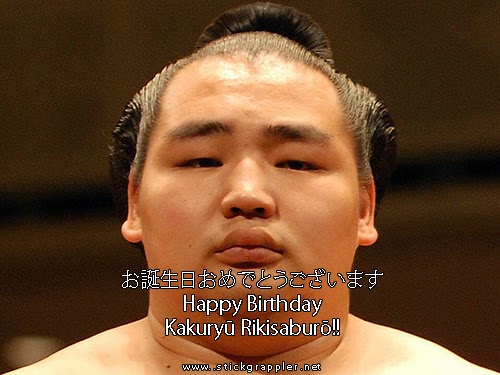
  • Happy 29th Birthday Kakury Rikisabur!!

Posted over the weekend to my site and didn’t get a chance to post here:

  • Happy 29th Birthday Kakury Rikisabur!!

Kakury is the 71st Sumo Yokozuna. He is the the fourth Mongolian to do so and the sixth foreign-born yokozuna.

Posted some of his matches as well as a highlights clip in his honor! Enjoy!

http://www.stickgrappler.net/2014/08/happy-29th-birthday-kakuryu-rikisaburo.html

Sumo humor

who knew?

//youtu.be/mdszgf9ncY8

sumo ROCKS!

I’d love to see these guys on a double bill with BabyMetal :smiley:

//youtu.be/jfF3SQ2vVyc

Hakuho!

6:11 pm JST Jan 23, 2015 Sports
Sumo Yokozuna Hakuho Breaks All-Time Championship Win Record
By Jun Hongo


Mongolian-born sumo grand champion Hakuho (right) performs a ring-entering ceremony at Meiji Shrine in Tokyo on Jan. 7.
Agence France-Presse/Getty Images

Sumo grand champion Hakuho broke the all-time tournament win record Friday, clinching his 33rd trophy after winning his bout against Kisenosato.

The match was too close to call the first time around as the wrestlers tumbled out of the ring together and landed at almost exactly the same moment. Referees called for a rematch, and this time Hakuho pushed his opponent out of the ring.

The 29-year-old has maintained a perfect record in the 15-day tournament that began on Jan. 11 and is now 13-0. There are two days still left, but all the other wrestlers competing have at least three losses.

By winning his 33rd tournament, Hakuho put himself one championship ahead of the late Taiho, the legendary yokozuna from the 1960s.

Hakuho started the year tied with Taiho with 32 tournament wins, but it was widely considered a matter of time until he became the sole record holder. He had won five of the six tournaments in 2014 and nine of the past twelve. Harumafuji has the second most championship wins among active sumo wrestlers with six.

Hakuho, who is 192 centimeters (6 feet, 3 inches) tall and weighs 157 kilograms (346 pounds), arrived in Japan from Mongolia in 2000. He was named yokozuna, the highest rank for a sumo wrestler, in 2007, and had an overall record of 880 wins and 186 losses at the beginning of the current tournament.

Taiho was born to an Ukranian father and a Japanese mother on the Russian island of Sakhalin in May 1940. He made his sumo debut in 1956 and became a yokozuna in 1961. He won 872 bouts and lost 182 before retiring in 1971. He died on Jan. 19, 2013, at age 72.

A Mongolian. Congrats!

In today’s SF Chron

Shame I didn’t hear about this earlier. I’d have loved to grab a selfie with a Sumo champ.

More pix if you follow the link.

Grappling with what to ask 2 famous Japanese sumo wrestlers

By Tony Bravo Updated 4:29 pm, Sunday, April 19, 2015


People with the Asian Art Museum, retired sumo wrestlers Yamamotoyama Ryuta (AKA: Yama) and Ulambayaryn Byambajav (AKA: Byamba) along with founder of USA Sumo, Andrew F. Freund have lunch in Japanese Inner Sunset restaurant Nabe in San Francisco, Calif., Saturday April 18, 2015. Photo: Sophia Germer, The Chronicle

Photo: Sophia Germer, The Chronicle
Image 1 of 10

The Inner Sunset eatery Nabe is known for serving chankonabe, the hot pot stew famously consumed by Japan’s sumo wrestlers, but the restaurant never played host to any of the culturally revered athletes before Saturday.

“We’re trying to make sure there’s enough … space for everybody,” assistant manager Kevin Kim said a few minutes before the arrival of Byambajav Ulambayar, known in the sumo world as Byamba, and Ryuichi Yamamoto, known as Yama, for lunch with a group from the Asian Art Museum.

The pair of world champion sumos were in town from Los Angeles for a demonstration of their 2,000-year-old sport at the museum’s One Night in Tokyo fundraiser the evening prior in conjunction with the current exhibition “Seduction: Japan’s Floating World.” Wendy and Richard Yorke were the lucky raffle winners of a lunch date with the wrestlers and USA Sumo director Andrew F. Freund (who also interpreted): They invited friends Alicia Chang, Juliet and Chip Bergh and Helina and Yat-Pang Au to join them.

“The agility of their bodies and incredible feats of athleticism have always fascinated me,” said Yorke, who watched broadcasts of sumo matches growing up in his native England. “Seeing the demonstration last night, I realize that in many ways it (sumo) tells the story of the culture of Japan.”

After most of their lives as sumos, Byamba and Yama are used to being in the public eye and seem especially used to fascination with their diets and size. Mongolian-born Byamba is 6 feet, 1 inch and weighs in at 370 pounds, Yama is considered the heaviest Japanese person in history at 6 feet, 4 inches and 600 pounds. The wrestlers, both 30, eat two big meals a day, forgoing breakfast because of their morning training.

They declined to say how many calories they consume in a day, but Freund told guests to consider how many calories a day the average-size person eats, then multiply that in accordance to the sumo’s size (in a 2014 Yahoo Sport interview, Byamba said he eats 10,000 calories a day).

It’s the nutritional value of chankonabe’s vegetable-rich, high-protein broth that makes it the signature food of the sumo: The calorie count is upped by adding sumo-size portions of rice and noodles as well as more protein-filled fish and meats, eaten in equally large quantities. Yama ordered shabu shabu (thinly sliced beef) with kurobuta pork, extra-spiced, then requested additional garlic; Byamba had the sukiyaki.

Of course, their lunch companions peppered them with questions they’ve probably been asked many times in the past.

How do they fly? One first-class ticket usually works for either sumo; two economy seats can also work, but the leg room is problematic.

Do they drink? Neither would comment, then ordered sake.

What are their favorite foods? Sumo are generally great cooks since they learn to make chankonabe as a young student sumo (Yama began training at 7, Byamba 15) but they also know the risk of empty calories and stick to clean food, with Yama joking his favorite food is rice.

“Are you single?” Helina Au asked. Yama answered yes. Byamba said he was “single in San Francisco.”

“We should set you up!” Juliet Bergh offered, with Au chiming in that she was on the case.

When asked whether or not they were able to wear jeans at their sizes, Byamba said he has a size 46 waist, but Freund pointed out there were usually not a lot of off-the-rack options for Yama’s 76-inch waist.

“What about a pair of custom Levi’s?” Chip Bergh offered. When Freund asked if it was possible to accommodate that on a Saturday during their short trip, Bergh nodded. “I’m the CEO of Levi Strauss.”

After arranging a fitting at the Levi’s store on Market Street Bergh inquired about the possibility of staging a sumo match in Northern California since “We (Levi Strauss) have a stadium now” in Santa Clara.

The fitting at Levi’s necessitated a change of plans: Byamba would now travel alone on his original flight that afternoon while Yama would get measured for a pair of jeans, after which he and Freund would stay on as the Aus’ guests and attend the annual soiree at Oakland’s Crucible art center that evening. After taking Yama’s measurements at Levi’s, tailor Liz Valashinas found to the group’s surprise that there was a pair of existing 74-inch waist jeans in the store.

“They were here as part of a store promotional display,” Valashinas said. Aside from shortening the length and a few customizable details, the pants were a fit.

“I haven’t had a pair of denim pants since middle school,” Yama told the Levi’s team.

The group separated after lunch with the sumo making a photo-op stop at the Japantown Cherry Blossom Festival.

“Everyone should stand next to one of these guys once,” said high school festival volunteer Brittanie North after posing with the sumo and her cousins.

Tony Bravo is a San Francisco Chronicle staff writer. E-mail: tbravo@sfchronicle.com Twitter: @TonyBravoSF

[QUOTE=GeneChing;1275116]
//youtu.be/Vpf_Q2Qrxfk
[/QUOTE]

I am sorry but I refuse to watch this unless the females wear the traditional attire.

i was pretty disappointed when i read about steroids use in sumo wrestling