There have been some good points made here. The botton line is whether or not we consider Comstock, Jail Rock, 52 Hands/Blocks, etc., real MAs they are still very effective. Beware of someone shouting out numbers at you in the midst of a fight. They are yelling out the number of stitches your going to get on your face or arms when they slap the razor between their fingers across your face and arms.
PR
Phils last post reminded me of something. I used to do WT with this black guy about my height but about twice as wide (and none of it fat!) He was in the air force and supposedly grew up in compton (circa 70s.) He did this one unexpected attack on me, didnt hurt me terribly, but he stepped forward and grabbed me with his LEAD hand, pulling me into him, while his rear hand reached all the way around to the other side of my head (which he adroitly slapped.) As I analyzed it, it wasnt terribly painfull, but he had me gripped **** tight and I wasnt going anywhere…and if that slapping hand had held a box cutter or screwdriver…
Like I said before it would be great to start a compilation of unexpected attacks. And really its one of the reasons I quit doing TMA, though even MMA and combat sports lack it (though tony blauer has mentioned more than anyone I’ve seen)-the unexpected attack. Obviously one has to handle punches, kicks, sparring,etc…but defending against an unexpected attack, or even INITIATING one is a whole different beast.
The same goes with weapons…I know a lot of FMA guys who are quick with weapons. But I dont know a one that practices drawing weapons, or fouling someones draw. I mean I can use a knife/stick, but I dont go walking round town with one in my hand as it tends to attract armed men in blue.
Thanks for the links PR.
Here are some shots taken from some old surveillance tapes of JR being used against a wall and with a shiv.
Originally posted by Knifefighter
[B]Here are some shots taken from some old surveillance tapes of JR being used against a wall and with a shiv.
JAILHOUSE ROCK [/B]
Now that you mention wall. I remember stories of how JHRs would train by placing one heel aganist a wall and the other foot in front while guys would throw punches at them. They had to block and counter without moving their rear heel off of the wall.
PR
Originally posted by RedJunkRebel
Thanks for the links PR.
You’re very welcome.
PR
It’s amazing what humans do to survive…
Slightly OT
This has been a big scandal in our area. It reminds me of so many movies that I’ve seen…
When Prison Guards Force Inmates to Fight
April 6, 2015
by Max Cherney

San Francisco Hall of Justice, which includes the county jail. Photo via Wikimedia Commons
On at least two occasions in March, Sheriff’s Deputy Scott Neu allegedly used threats of violence and rape to coerce inmatesincluding 150-pound Rico Garcia and 350-pound Stanley Harristo square off against one another in an out-of-sight hallway in the bowels of San Francisco County’s main jail. Four other deputies reportedly wagered on the bouts.
The resulting injuries were minor, as Neu apparently prohibited hitting in the face. But the deputy allegedly instructed the two men not to seek medical treatment for their wounds, and threatened to thrash them if they did.
The disclosure by the local public defender’s office prompted national headlines about the violence in the San Francisco County systemwhich likely has been going on for some time, including more fights and other forms of physical abuse. But what’s unusual about the San Francisco fights is not that they occurredviolence between inmates and guards is routine in prisons across the country. What’s truly weird is that the matches were in a county jail, not state or federal prison.
“It was shocking for it to be at 850 [the county jail’s downtown address on Bryant Street],” says Eli Crawford. At one time Crawford was a part of a notorious African American prison gang, the Black Guerilla Family. Now, decades later, after about 30 years in federal prisonCrawford jokes that he toured the country on the US government dimehe runs Raw Talk, a program that helps at-risk men and women change their lives.
“I know a guard who used to work downtown [at the jail],” Crawford says. “He called me the other day because he was really ****ed up about [the gladiator matches]. You know, because you got these new deputies in here now. These younger guys who’ve never really been through any of this. They’ve changed the whole nature of the county jail systemand [Sheriff Ross] Mirkarimi, he’s not paying attention.”
One reason county jails are unlikely venues for guard-organized fights is that the institutionsand the people insidearen’t as dedicated to the criminal mentality as those in state and federal prison. Simply put, there are fewer killers and other violent men in county jails than prisons. And any uncompromising thugs that happen to locked up in county are only there for a little while as they awaititrial.
“In county jail we’re talking about the low levels of criminals, people doing wino time,” Joe Loya, a retired bank robber turned author, says. (“Wino time” is prison slang for any stint that’s shorter than a year, Loya explains.) “To the prisoners [in jail] they are still people who aren’t dedicated to the convict code. It’s easier for them to [snitch].”
State and federal prisons are a different story. Perhaps the most egregious example in recent history of guards orchestrating fights among inmates was also in California. In 1996, a number of prison guards at Corcoran State Prison in the San Joaquin valley blew the whistle on abuse dating back years, which included arranging fights in one of the yards. Many of the others go unreported, according to Loya, because of the code of silence that exists between inmates and also between guards. But it’s definitely going on.
“People are people, bro,” says Jesse De La Cruz, a gang expert with a doctorate in social work. De La Cruz used to be affiliated with a Latino street gang in Northern California, and the prison gang that backs it from the inside. He’s served 30 years inside state prisons, rattling off a laundry list that includes so of the country’s worst, such as Pelican Bay.
“These [guards], and the majority of the police don’t have the ethical training,” he tells me. “They walk into a jailhouse and what happens is this: The institution takes hold, and they’re surrounded by negative energy on a daily basis. So if they have any dark spots, they come out. It manifests itself. They become just like the monsters that they’re caging.”
Ultimately, eight prison guards charged by federal prosecutors for the abuses at Corcoran were acquitted in 2000, a verdict De La Cruz marvels at. “Regular people just don’t believe officers are capable of that kind of violence,” he says. De La Cruz suggests that scandals like the one in San Francisco and Corcoran are unusual. What’s more common, he thinks, are day-to-day abuses of the power. Setting a problematic prisoner up for a nasty and violent encounter with an enemy, for exampleor simply not stepping in to prevent a clobbering.
“I’ve been part of the conspiracy to make [guard-sanctioned assault] happen,” says Loya, the retired bank robber, who served time in federal prisons across the country. “I know it can happen, I know the human material needed to make it happen. Prisons are corrupting, toxic places that cannibalize those who live and work in them.”
The gladiator matches aren’t isolated to California. Across the country in St. Louis, a 2012 lawsuit alleged that at least two guards, and possibly more, coerced prisoners to fight one another. Using the promise of special privileges, extra food and snacks, the guards reportedly bribed attackers into fighting others, and like in San Francisco, are accused of making bets on the results. “For a guard it’s easy to, you know, get in the ear of a gang banger to promise commissary, or phone calls in exchange for a fight,” says Crawford. “The guards know that these young guys don’t know anything.”
Despite the uproar over the San Francisco scandal, violence and abuse within American prisons is not likely to change any time soon, according to the ex-cons and experts I canvassed. The real issue is the environmentthe jail or prison institution itself.
A nowfamous Stanford Unviersity experiment published in 1973 by Philip Zimbardo and a research assistant sought to recreate the experience of incarceration for both the jailers and prisoners, and thrust a group of otherwise healthy and non-criminal students into the situation. Essentially, the “guards” quickly grew went off the rails, but they were not permitted by the researchers to use physical violence, and so instead verbally attacked the “inmates.”
The power, in other words, went to their heads.
“Prison really is a matter of the strong survive, the weaker members get preyed on,” says Rachyll Dempsey, a forensic psychologist who used to conduct mental health evaluations at San Quentin state prison.
Dr. Terry Kupers is a psychiatrist at the Wright Institutea clinical psychology graduate school in Berkeleywho’s studied prisons and the effects they have on the inhabitants. He argues that there are three things needed to create the violent conditions inside the country’s jails and prisons: one group of people that has all the power (guards), a second group that has none and no recourse if their rights are violated (inmates), and third, a strict code of silence"so the perpetrators can do violence and sexual abuse without abandon," as Krupers puts it. He believes that all three conditions are present in the jails and prisons where fights occurtypically maximum security facilities, such as the seventh-floor unit in which the San Francisco inmates resided.
“The solution, the remedy is that there has to be an incredibly good selection of staff, and there has to be really solid education for the guards,” Krupers says. “There also has to be outside supervision, because now nobody cares. Society is locking them up and throwing away the key. And society has to take responsibility, and say you can’t do that in our name.”
After all, despite years of reporting about guard-initiated gladiator fights on Rikers Island, violence there continues nearly full force. Neither the funding New York City Mayor Bill de Blasio has announcedtens of millions of dollarsor an investigation by the Justice Department has changed the culture of brutality in the facility.
Splashy headlines about gladiator-style fighting between inmates aren’t likely to spark an overhaul of San Francisco County jails, either.
“It’s part of doing time,” Loya says. “We understand that violence is bred into jails, and designed into the prison. There are these moments.”
A two-fer today
I guess it’s not just California (although we do have a considerable corrections industry here). :o
Prison Guards ‘Staged Gladiator-Style Fight’
Two inmates were brought together in a section where they were supposed to be segregated - before one was killed, it is claimed.
09:30, UK,
Wednesday 08 April 2015

Carlos Manuel Perez Jr had two children
Prison guards allegedly created a “gladiator-like scenario” to let two handcuffed inmates fight before a corrections officer shot one dead and wounded the other.
The trainee officer at High Desert State Prison fired four shotgun blasts according to the lawsuit filed at a Nevada state court by the family of the dead prisoner, 28-year-old Carlos Manuel Perez Jr.
Lawyer Cal Potter, representing the family, claimed the shooting on 12 November was an execution.
He said guards had staged the fight by allowing two inmates to encounter each other in a shower hallway in administrative segregation (ad seg) - where prisoners are supposed to be kept apart for their safety.
“Officers know they will see a fight if they release ad seg inmates that are supposed to be in walk-alone status,” he said.
“Defendants … refused to intervene. On the contrary (they) created a gladiator-like scenario and allowed the inmates to fight.”
The lawsuit names two corrections officers and a shooter, said to be a trainee, by their last names only.
It alleges wrongful death; excessive force; deliberate indifference to Perez’s medical needs; negligent training and supervision; and intentional infliction of emotional distress. It seeks unspecified damages in excess of $30,000 (£20,000).
Perez was serving 18 months to four years for hitting a man in the head with a two-by-four piece of wood in downtown Las Vegas in 2012.
The Clark County coroner ruled his death a homicide, after finding he died of gunshot wounds to the head, neck, chest and arms.
The other inmate, Andrew Jay Arevalo, 24, survived with gunshot wounds to the face, according to his attorney, Alexis Plunkett. She said her client told her that he and Perez were handcuffed when they were shot.
Arevalo is serving two to six years in prison after being jailed in June 2013 for burglary.
Ms Plunkett said she planned to file an excessive force lawsuit over the coming weeks on Arevalo’s behalf.
Mr Potter represents Perez’s brother, Victor Perez, and mother, Myra Perez, both of Reno, and two children, aged 3 and 2.
The lawyer said Perez’s family was given conflicting statements during initial meetings with prison administrators after his death, and were not told Perez had been shot.
“They were devastated three days later when they went to the mortuary and learned that Carlos had … multiple gunshot wounds to his face and upper body,” he said.
Deputy prisons chief Brian Connett has insisted the state Department of Corrections is a responsible steward of the safety and security of guards and inmates.
He has said the shooting came in response to two inmates fighting at the prison, which houses around 3,500 inmates. The three accused corrections officers remain on paid leave pending action by the attorney general.
Deputy Neu & Deputy Jones plead not guilty
More on Deputy Neu & Deputy Jones
Two defendants in SF jail fight-club case plead not guilty
By Vivian Ho Updated 6:51 pm, Monday, March 7, 2016

Photo: Santiago Mejia Santiago Mejia, Special To The Chronicle
Former San Francisco Sheriff’s Deputy Scott Neu, center, after his court appearance at the Hall of Justice on Monday in San Francisco. Neu, 42, pleaded not guilty of allegedly staging gladiator-style fights between inmates.
A San Francisco sheriff’s deputy and former deputy pleaded not guilty Monday to charges that they forced jail inmates to fight each other for the guards’ entertainment.
Former Deputy Scott Neu and Deputy Eugene Jones remained silent as their attorneys entered pleas on their behalf in San Francisco Superior Court.
Neu, 42, was the alleged ringleader and faces 17 criminal counts, including felony charges of assault under color of authority and of making threats, that carry a total sentence of up to 10 years in state prison. Jones, 45, was charged with two felony counts of assault under color of authority and several misdemeanors, punishable by a total of five years behind bars.
Another deputy, Clifford Chiba, is accused of two misdemeanor counts of inflicting cruel and unusual punishment and one misdemeanor count of breaching his official duties. He is scheduled to be arraigned Tuesday.
All three defendants are free on bail.
The allegations stem from two fights that took place March 5 and 6, 2015, in County Jail No. 4 at 850 Bryant St. Former inmates Ricardo Palikiko Garcia and Stanley Harris said the deputies had threatened them with violence or withheld food to force them to engage in fights for deputies to bet on.
Garcia said the first fight had resulted in injuries to his ribs that were so painful he could not sleep on his side. Despite his injuries, Jones and Neu forced the two to fight again the next day, Garcia said.
Harris, who is overweight, said Neu would “train” him for fights by making him exercise, in one instance forcing him to do 200 pushups in an hour. Neu also regularly forced Harris and other inmates to gamble for food, clean clothing and bedding, prosecutors say.
Neu has since been fired, and Jones was placed on unpaid administrative leave. Chiba is still on active duty, working in jobs that do not put him in contact with inmates.
Outside court, Harry Stern, an attorney for Neu, said District Attorney George Gascón was blowing the case out of proportion.
“The district attorney has decided to cause this kind of smokescreen and charge this case that by all rights never should have reached this sort of level,” Stern said. “There were a couple of fights, a couple of scraps and wrestling matches in the jail. They started out, from my understanding, out of a disagreement over who was in better shape and nothing more than that. In retrospect, it wasn’t the best use of time and resources, but it certainly isn’t a criminal matter.”
Max Szabo, a spokesman for the district attorney, called Stern’s statements “absurd.”
“The district attorney is committed to having a clean justice system in San Francisco and one that San Franciscans can be proud of,” he said. “This behavior threatens a clean system, and I think he’s very committed to making sure people are held accountable for their actions.”
Vivian Ho is a San Francisco Chronicle staff writer. Email: vho@sfchronicle.com Twitter: @VivianHo
Slightly OT
This reminded me of a Kung Fu movie, or the creation tale for Xingyi Bengquan.
Ahok’s ‘spirits remain high’ inside prison, using time to study Mandarin and kung-fu says legal team
By Coconuts Jakarta May. 31, 2017
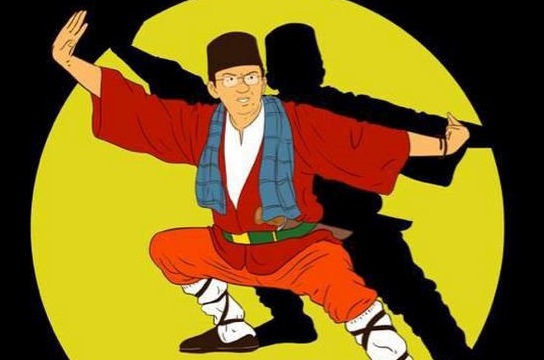
Ahok in the style of Indonesian hero Si Pitung crossed with a kung-fu warrior. Illustration by @demokreatif
We haven’t heard much from former Jakarta Governor Basuki “Ahok” Tjahaja Purnama since he made the surprising decision to withdraw his appeal of the shocking 2-year sentence he was given at the conclusion of his blasphemy trial. But for those worried about how he’s doing in prison, according to his legal team, Ahok is doing pretty much a-ok.
The team regularly visits Ahok at the Mako Brimob prison facility in Depok in which the former governor is currently being held. One member of the team, Teguh Samudera, said Ahok’s routine hasn’t changed much since he was first imprisoned on May 9. According to him, Ahok spends a good part of each day reading the Bible and writing down his personal thoughts and reflections.
Teguh said he hadn’t noticed much of physical change in Ahok over the three weeks he’s been in prison, except for noting that the former governor had actually gained a few kilograms.
“His weight has increased, he’s bulkier. He also practices kung fu body balancing, learns Mandarin, and regularly receives fan letters from his supporters,” Teguh said as quoted by Kompas.
Teguh said Ahok has received around 300 letters of support from his fans, delivered through his legal team, mostly containing letters of hope and prayer for the man many believe to have been unjustly imprisoned. Many have sent books as well.
“From his tone of voice, he has not changed, which is to say he still always thinks in a positive way. His spirit remains high,” Teguh said.
His supporters will certainly be happy to hear that, though Ahok still has a long way to go before his sentence is fulfilled, although there is a chance it could be reduced by several months for good behavior. And while the former governor withdrew his sentence appeal, his lawyers are still attempting to have his prison sentence commuted to house arrest.
There is also another sentence appeal, filed by the prosecution (given the fact that they had asked the judges to hand Ahok a sentence of two years probation on a lesser charge) which is still under consideration as the attorney general has not yet decided whether to withdraw it as well.