continued from previous

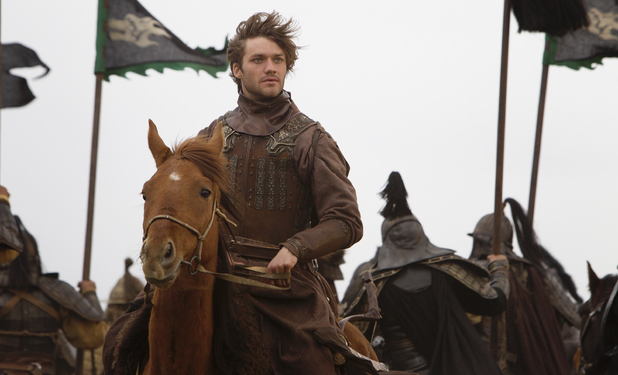
The series, which cost $90 million for the first 10 episodes, used hundreds of extras in filming. Credit Phil Bray for Netflix
“At the heart of it is a universal story,” said John Fusco, the creator and an executive producer of the series. “The journey of Marco Polo is the hero’s journey, one that all cultures across the globe can relate to.”
Mr. Fusco is intimate with that journey. Known for his work on “The Forbidden Kingdom,” the martial-arts film, and on the thriller “Young Guns,” he said he was captivated as a child by Chinese culture and has been fascinated with Marco Polo’s story ever since. “You cannot read about that stuff without coming across the name Marco Polo,” Mr. Fusco said.
While shooting “Forbidden Kingdom” in 2007, he and his son, Giovanni, then 13, crossed Central Mongolia on horseback, following the Silk Road and tracing the Genghis Khan trail. Along the way, Mr. Fusco said they encountered story after story about Kublai Khan and Marco Polo and the missions the adventurer took to various Mongolian villages.
“It always circled back around to Marco Polo and Kublai Khan,” Mr. Fusco said. “That always fascinated me because so few people make the connection between the two. Marco Polo has been kind of buried under this cloud of rather banal historical dust when the true story is so much more exciting.”
After pitching the idea around Hollywood, Mr. Fusco eventually heard from Harvey Weinstein, whose company has been expanding its television business.
Ben Silverman, chairman of the multimedia studio Electus, recalled having lunch with Mr. Weinstein about five years ago at the rooftop garden of the Peninsula Hotel in Beverly Hills, talking about great stories in the public domain that would intrigue viewers across cultures. The two brainstormed about how to create an East-meets-West drama that would include the appeal of a foreign land, but also a Western character who could connect it.
Continue reading the main story Continue reading the main story
“Immediately, it was Marco Polo,” Mr. Silverman said. “There was genuine excitement about bringing the Asian storytelling style to the global audience.”
The Weinstein Company and Electus announced in 2012 that they had found a home for the series on Starz, the premium cable network, with Mr. Fusco as the writer. At the time, Mr. Weinstein boasted to the Hollywood publication Variety that the program would be “one of the most expensive shows ever done for pay TV.”
Production soon hit roadblocks. Executives wanted to shoot the series in China, but censors raised issues about the violence and sexual aspects of the story. Projected costs started escalating.

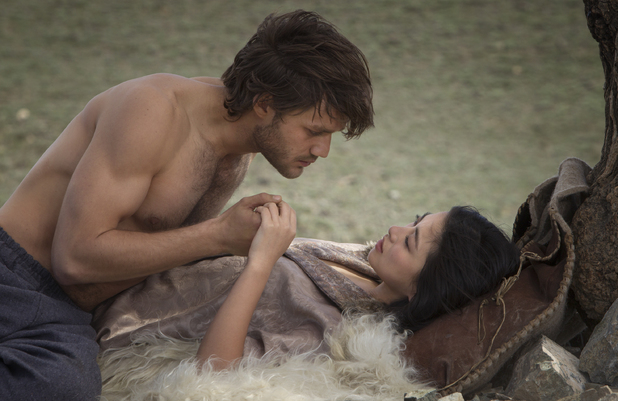
Lorenzo Richelmy with Zhu Zhu in a scene from the new series; Mr. Richelmy was cast as Marco Polo after a global search. Credit Phil Bray for Netflix
Seeking a bigger budget, producers took the idea to Netflix, which had recently started pouring resources into its own original series. Mr. Sarandos said Netflix was not looking specifically for a show that would appeal to international audiences, but rather human stories that were rich and relatable. He picked up Mr. Fusco’s scripts, which had been inspired by Marco Polo’s own accounts, couldn’t put them down and signed on to the project.
“The characters that were created and the relationships that were created, you can lift them up from the time and the place and put them somewhere else, they would work just as well,” Mr. Sarandos said. “They were that well written.”
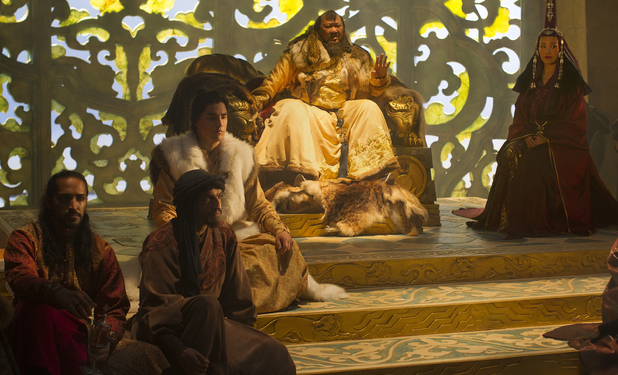
The resulting production is on a scale much larger than the series planned at Starz. The construction crew included 400 people, with an additional 160 in the art department. The team built 51 sets in Malaysia, including Kublai Khan’s opulent throne room. For battle scenes, hundreds of extras appeared costumed and on horseback.
A global search to cast the role of Marco Polo came down to the wire. Producers had looked at more than 100 actors, holding auditions in London, Australia and Los Angeles, but still hadn’t found their star. Mr. Fusco’s wife, an acting coach and a teacher of Shakespearean drama, stayed up one night, went through the audition tapes and found a little-known Italian actor named Lorenzo Richelmy.
Mr. Richelmy, 24, flew to Malaysia and landed the role. He started an intensive training program that included four hours in the gym, martial arts and horseback-riding lessons each day.
Producers brought on a team of cultural advisers and historians to ensure that the narrative would be authentic enough to hold up to viewers worldwide. They noted details, such as how men would bow before the emperor and how to hold shields when riding horses. Filming wrapped up in Malaysia in August after a five-month shoot that started in the canals of Venice.
“We just tried to make the most exciting, entertaining show we could about this very special world and hope that it would be accessible in a lot of different markets, in a lot of different regions,” said Dan Minahan, an executive producer of the series.
Netflix, which has said it would spend more than $600 million in 2014 to woo people to try the service, has an extensive marketing campaign for “Marco Polo.” It will take cast members to the Comic Con conference in Brazil, for example, and display costumes and props from the series at a mall in Mexico. Other promotions include television, print and digital ads. The tagline is “Worlds will collide.”
The buzz around the show will also serve as a promotional tool for Netflix as it enters new markets, Mr. Sarandos said. Although it doesn’t currently operate in Asia, it hasn’t ruled out the possibility.
Mr. Sarandos likened Netflix’s global expansion to Marco Polo himself. “At some point or another we have all been a stranger in a strange land,” he said. “Netflix is that stranger in a strange land.”
5 days to go…