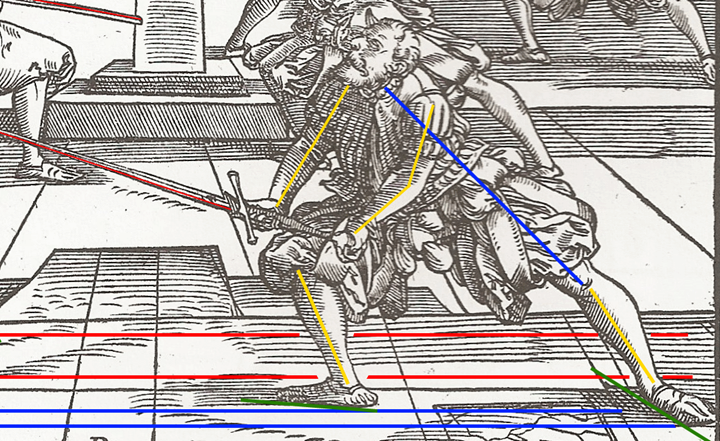
In the following pictures, you can see 1 and 2 have perfect body alignment that head, body, and back leg are all in a straight line. 3rd picture has different body alignment which is different from 1 and 2. People may say that 1 and 2 has forward lean but 3 has no lean.
Which body alignment do you like and why? Your though?
I would say first picture is “bad” in sense I can control his head because of it’s position in relation to his hips and knees… but some tai chi guy will tell me this is daoist magic secret and he can blow me up at 20 yards with a QI ball
[QUOTE=lkfmdc;1258894]I would say first picture is “bad” in sense I can control his head because of it’s position in relation to his hips and knees… [/QUOTE]
[QUOTE=YouKnowWho;1258895]That’s an interested angle to look at.[/QUOTE]
so called “tai chi classic” says to keep the head erect… good wrestling, keep your head erect or I snap you down, in “friendly” folk style I just smash your face into the mat, not so “friendly” I neck crank you or choke you. On paper, classic seems to be telling you to do a good thing, but the pictures either don’t follow the classic, or the classic is lying to us
1st, too much, head over toes. 2nd, almost but not enough. 3rd, I really dislike like this way personally, fine if you are in XuBu, but for a lunge this is strange to me.
General rule I use for a lunge, rear foot in straight line with striking shoulder (be it front or rear) through the body.
I prefer to lean without pressure on the lower back, leaning forewards but side on so as to use those side muscles i don’t know the name of.
The one I would personally prefer is the second photo. The first one looks very unstable, especially considering how narrow his stance is. It’s way too vulnerable to being pulled or struck. The second position looks the most natural for a strike or throw, although I would prefer the right (rear) foot with the toes a bit more forward; his rear foot looks turned to the side or facing slightly to the rear. If this were during a strike or leg sweep/throw, that might make your balance/stability awkward, and affect your ability to generate force from your rear foot for a strike. I prefer the second position, but with the right foot facing more like that in the third photo.
Of course this all depends on what you are doing. Are you striking or evading? grasping or throwing? Striking or blocking? Even within striking, are you striking forwards, twisting, hammering down, lifting up? Some require leaning, some require twisting etc. Every technique follows ShenFa instead of trying to fit into a preset stance.
In my experience, leaning is an absolutely essential skill and one should fill his form with it. When I spar I try to dodge a punch by an inch. In a brawl I dodge a punch by about 2 feet. Its not so much a conscious choice, it just happens. I have observed this in many others. When people are in real danger they make these larger movements. Leaning makes all the difference.
2nd picture is proper. Never lean past your own toes, never let your kneed go passed your toes. 3rd picture is fine doing taiji for health for old people and not wanting them to have sore knees the next day.
[QUOTE=YouKnowWho;1258890]Which body alignment do you like and why?[/quote]
[QUOTE=-N-;1258911]For what purpose?[/QUOTE]
[QUOTE=YouKnowWho;1258913]I’ll say for the following purposes:
health,
art (pleasant to watch),
combat application.[/QUOTE]
[QUOTE=RenDaHai;1258918]Of course this all depends on what you are doing.[/QUOTE]
[QUOTE=SPJ;1258924]Again the center line of balance would be different relative to the opponent’s power and move, when you are neutralizng.[/QUOTE]
I should have said for what combat purpose. But RDH and SPJ have answered the question. SPJ also answered in the other thread. Depends on what you are trying to accomplish.
[QUOTE=Orion Paximus;1258919] Never lean past your own toes, never let your kneed go passed your toes.[/QUOTE]
In the above pictures 1, 2, 3, that your gravity center is still inside of your base. You apply force F to lean but the gravity P will pull your body back. This kind of “lean” will have no usage because the gravity P will be against the your force F. This kind of lean is “not over-committing”.
In picture 4, 5 that you move your gravity center to be outside of your base. You apply force F to lean and the gravity P will help you to pull your body into that direction. Since now your force F can take advantage on the gravity P, this kind lean will be useful. This kind of lean is “over-committing”.
When you have “over committed” your lean, you will need to know how to recover your balance back. Here is 1 example.
[QUOTE=YouKnowWho;1258940]In the above pictures 1, 2, 3, that your gravity center is still inside of your base.
[…]
In picture 4, 5 that you move your gravity center to be outside of your base.
[…]
When you have “over committed” your lean, you will need to know how to recover your balance back.[/QUOTE]
If you are taking down the other guy, you are concerned with not just your own center of gravity, but the combined center of gravity of you and the other person which may or may not be outside your base.
Once you release, your own center of gravity may be outside your base.
In striking and throwing, Praying Mantis can use a jump to recover. We treat the mechanics as a dynamic system.