there was an article in Martial arts training magazine once that told about the dangers of certain popular conditioning exercises. It said something like, “Do not blame your instructor for passing these methods down to you. Blame the tradition for passing it down to him.” My feelings exactly. Overall, in most aspects of the training, any sifu knows better than me. However, I have done extensive research on many body conditioning methods, and some of the ones that are still commonly practiced today are definitely not safe. A good sifu should respect your concern about the safety of your well-being. If you do not care about your well-being, who will?
Just about any school makes you sign a legal waiver saying that you assume the risk associated with the training. Therefore, from a legal point of view, what reason does a sifu have for caring about the safety of youe well-being?
From what I’ve read, it seems as though you have some issues. And this thread has gotten totally off of the subject. What you should ask yourself are your training brothers and sisters healthy. Is your Sifu healthy. Is your Si-Gung healthy. Is this right for you. Everyone who has ever studied has had doubts about his or her instructor, but when you take it to this level. maybe you should consider researching an instructor that suits you. Gung hei faat choy.
No offense, but I do not think that I was the one who took this thread off of the subject. What is Si-Gung? I have never heard of that term before. Also, even if the Sifu and his assistant instructor’s are healthy, then how do you know that the liniment that they use for themselves is the same one that they have you use? Maybe I do ponder too much, but I would rather be safe than sorry. You really have to take into consideration that the damage that you inflict upon yourself with body conditioning methods must be removed immediately, so only a fool would be so quick as to trust just any old jow. I like to think of myself as an intellectual. I am sorry if I am offending anyone by saying this.
What does Gung Hei fat Choy mean?
MaFuYee- I completely understand your viewpoint and i can also understand the injuries involved with those practices. You also touched on the crucial factor that separates legit iron palm versus other breaking methods. The slight dropping of the palm is the key. Most learned iron palm practitioners can break when holding their palm at solar plexus height. There are many methods of breaking, but iron palm’s practices and training is in a league of it’s own.
Humblewarrior- From your posts it is clear that you really don’t know what to look for in an iron palm instructor. You are very skeptical and untrusting, this is a bad thing when trying to learn valued teachings from a traditional sifu. From your statements it is also clear that you are probably not ready for iron palm training. There are many things that are supposed to be learned before you even start iron palm training. Internal workings and theory, chi gung, energy respiration techniques are all involved with pre-iron palm training.
Please don’t take this personally or the wrong way. I am not trying to put you down in anyway. I just don’t like the fact that people think they can just pick up iron palm by reading a book, watching a video, etc. This practice can severly hurt you if practiced wrong, that much is clear.
As for jow, jow is just not used for iron palm breaking. It is used primarily as a bruise liniment. There are different kinds of jow for certain practices. It is like the analogy that Brian Gray used. Dit Da Jow is like toothpaste. All toothpastes have different ingredients that do different things, but what makes them all the same is the fact that they clean your teeth.
As for the sifu’s not looking out for you. Well that’s a tricky subject. Let me say this though, when you have found the right one you will know it.
Peace 
Yes, Illusionfist. I know that there is a difference between dit da jow, which is for sore muscles, and iron palm liniment, which is for iron palm training, wooden dummy training, and breaking boards. No offense, but I thought that I already said that I do not any any intention of doing this kind of training without a sifu’s supervision. Even once I do find a Sifu, I would prefer that he would let me put off doing any iron palm training at least for a good year or two, not only to prepare me for the training, but also so that he can prove to me that he desrves my trust. Illusionfist, I have to thank you for being the only one here to give me somewhat of a safe answer. I do not mean to offend the other guys, but, with the excepton of illusionfist, you guys kept go around and around in circles without really directly addressing my concerns. Thanks again, illusionfist. I still think that I should get some good books on chinese medicine to get a better idea of whether or not the liniment I am interested in using works.
Mafuyee, I apologogize for including you in that. You have helped to illustrate my concerns.
Humblewarrior :
My sifu is a perfect example about your questions. I was training under another teacher and not happy with his training methods. Seeing the strenght, power & hardness that my Sifu had and all the answers to the questions about conditioning, i decided to follow him. When you train in proper Iron Palm training including all conditioning you should feel the difference within 4-6 weeks approx. Some sooner, some later. But check out the credibility of your Sifu and Si-gung(sifu’s teacher).Nothing about training is guaranteed. I have trained with many teachers to find that what I have is the best and most traditional
Well, let’s say that I get a liniment from someone who is both a sifu and a qualified herbalist. Then i would not have to rely on my particular sifu’s jow, right? Don’t you think that a sifu would be more likely to let me use a jow that, although not his, is from a reputable source? Don’t you feel that my sifu should be concerned about my mental piece of mind? I do not mean to troll here, but I think relying totally on your own siu’s judgement is really limiting yourself.
The only way you will EVER get a good recipe for dit dat jow is from a sifu that gives it to you. NO sifu in his right mind will sell a really good recipe in a magazine. He will only give it to a few select students.
forgive me but I think you have it backwards… You are soposed to earn your Sifu’s trust. He is soposed to let You know when it is time to more on to iron plam.
Find a sifu that you want to earn the respect of, work for that. When the time comes for “special training” He or She will let you know.
It really is not a good idea to mix jow from one place and training from another.
Why is that?
Originally posted by word:
“No sifu in his right mind will ever sell a jow in a magazine. He will keep it a secret to his select students.”
Well, Brain Gray, Wing Lam,and Paul Hwang all sell there jows in magazines. Do you think that all of these guys need psychological help?
[QUOTE=humblewarrior;24812]I have read that frank Yee has shared his own personal dit da jow formula on his hung gar tapes that he made with ESPY-tv. Is it good for iron palm, breaking boards, hitting and kicking bags, and wooden dummy training? I know that Frank Yee is supposed to be a well-respected sifu.[/QUOTE]
Here it is. The first one is a Dit Da Jow the second is a defacto “iron palm medicine” (). The names are in Cantonese:
- Dong Gwai mei (root of a plant. is warm and sweet & spicy
- Tin Chut (main root, is warm Sweet and Little Bitter
- Tau Yan (seed of prune, is Neutral, Swee and Bitter)
- Chek Cheuk (part of root, Cool and bitter ( 1-4 reduce swelling and Pain)
- Sou Muk (body/stem of plant, Warm and Bitter)
- Hung Fa (Flower Head, Warm and Spicy)
- Jat Lan - (Leaf, Branch or Stem of Plant, Little Warm, Sweet & Bitter) (5-7 reduce bruises, black & blues, promote circulation to damaged areas)
- JookDuen (Root, Warm & Spicy)
- Gwat Soy Bow (Root, Warm & Spicy)
- Gee Yin Tong (Metal Dust, Warm & Spicy)(8-10 to help heal broken bones)
- Ng Ga Pei (Skin/Bark of Plant, Warm and Spicy)
- Chun Muk Gwa (Papaya, Warm and Sour)
- Foon Gan Tong (Root, Cool and Little Bittler)(11-13 strengthen Bones & Tendons)
- Fong Fung (Root, Warm, Sweet & SPicy)
- Gwai Gee (Stem/Shoot, Little Warm & SPicy)
- Gweng Wood (Root, Warm Spicy & Bitter)
(14-16 Helps to counteract Viruses or changes in Weather, Draft/Chills)
Removes the cold out of the injury
17. Hute Git (Juice/Nectar of Fruit, Warm & Spicy)
18. Yee Heung (Nectar of Skin/Sap of Plant, Neutral and Bitter)
19. Mood Yeuk (Nectar of Skin/Sap of Plant (Neutral and bitter)
(17-19 Stops Bleeding of Minor cuts/scratches on injury,
promotes new skin growth, also reduces pain) Jow is not used on open wounds)
20. Gum Cho (Root, Neutral, & Sweet)- combines medicine and kills germs(anticeptic)
21. Dai Wong (Main Root, Cool and bitter) - Balances medicine cools down all the hot and warm incredients)
The above jow will become stronger with age.
Tit San Jeung Dit Da Jow (Iron Sand Palm medine) This medicine is to be heated and only lasts for about 2-3 weeks then has to be thrown out.
- Dong Gwai Mei
- Chek Cheuk
- Fu Gwat (Tiger bone, Spicy, Sweet & Warm. Reduces Pain and Swelling. (very hard ingredient to get today due to the ban on this item by US Customs)
- Tao Gwa choy (body of plant, Spicy & Warm - Strengthens bones and
reduces pain and Anti-Bacterial) - Ngau Dai Lik (root, Neutral Sweet Taste, Strengthens Tendons and increases blood circulation.
- Jook Duen
- Gee Yin Tong
- Sun CHun Cho (entire plant except root, neutral, bitter, sweet -
relaxes and strengthens tendons) - Lak Gan (Salty & Warm, Strengthens Tendons)
- Goon Gun Tang (plant, little bitter, cool, stengthens tendons)
- Sin Hok Cho (plant, neutral bitter strengthens tendons, stops
bleeding, antibacterial. - Yee Heung
- Mood Yeuk
- Hung Fa
- Sou Muk
- Gwai Gee
- Chuen Lin( Cool, Anti-bacterial)
- Gum Cho
Directions:
Add the herbs to one and one half gallons of water. Heat in a china or high quality stainless steel pot. Do not use aluminum pot. Heat the mixture until it boils, then simmer over low heat for 45 minutes. Do not boil again.
Each time you train, heat the medicine to near boiling and then let it cool. It should be as warm as the trainee can stand without burning when the trainee soaks his hands.
Master Frank Yee
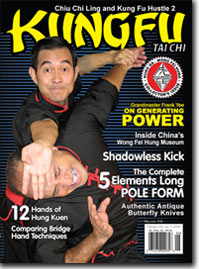
Speaking of Master Frank Yee (and his dit da jow recipe), he was on our May+June 2006 cover
https://www.kungfumagazine.com/forum/showthread.php?49671-So-I-got-to-make-dit-da-jow-the-other-day
Frank-Yee-s-dit-da-jow-Is-it-any-good