 Sounds like an Catholic Inquisition re-run.
long form journalism from the Atlantic
American Exorcism
Priests are fielding more requests than ever for help with demonic possession, and a centuries-old practice is finding new footing in the modern world.

Clay Rodery
MIKE MARIANI DECEMBER 2018 ISSUE RELIGION
Louisa muskovits appeared to be having a panic attack. It was March of 2016, and Louisa, a 33-year-old with a history of alcohol abuse, was having a regular weekly session with her chemical-dependency counselor in Tacoma, Washington.
Louisa had recently separated from her husband, Steven. When the counselor asked about her marriage, she said she wasn’t ready to talk about it. The counselor pressed, and again Louisa demurred. Eventually the conversation grew tense, and Louisa started to hyperventilate, a common symptom of a panic attack.
The counselor rushed down the hall to get Louisa’s therapist, Amy Harp. Together they moved Louisa to Harp’s office, where they felt they could better calm her. But once Louisa was there, Harp recalls, her demeanor transformed. Normally friendly and open, she started screaming and pulling out clumps of her hair. She growled and glared. Her head flailed from side to side, cocking back at odd angles. In jumbled bursts, she muttered about good and evil, God and the devil. She told the counselors that no one there could save “Louisa.”
According to Harp, Louisa seemed to vacillate between this unhinged state and her normal self. One minute she would snarl and bare her teeth, and the next she would beg for help. “It definitely had this appearance where she was fighting within herself,” Harp told me.
Harp had never seen this kind of behavior before, and wasn’t sure what to do. But she knew that Louisa had occasionally experienced episodes in which she felt something indescribably dark overtake her, and that she would read scripture to beat back these states. “You need to read Bible verses,” Harp said. Her bearing still frantic, Louisa picked up her smartphone and began looking up passages. As she read, she started to calm down. Her flailing diminished; her frenzied affect ebbed. She vomited in a trash bin, and after that she was her old self again, full of apologies, her eyes wet, her face red.
The encounter left Harp baffled about what she’d just witnessed. For Louisa it had a more profound effect, prompting a search for answers that would ultimately lead her away from modern medicine and its well-worn paths for mental-health treatment, and toward the older, more ritualized remedies of her Catholic faith.

Louisa Muskovits experienced a series of troubling episodes that her therapists couldn’t explain. These incidents led her to seek spiritual help. (Ian Allen)
The conviction that demons exist—and that they exist to harass, derange, and smite human beings—stretches back as far as religion itself. In ancient Mesopotamia, Babylonian priests performed exorcisms by casting wax figurines of demons into a fire. The Hindu Vedas, thought to have been written between 1500 and 500 b.c., refer to supernatural beings—known as asuras, but largely understood today as demons—that challenge the gods and sabotage human affairs. For the ancient Greeks, too, demonlike creatures lurked on the shadowy fringes of the human world.
But far from being confined to a past of Demiurges and evil eyes, belief in demonic possession is widespread in the United States today. Polls conducted in recent decades by Gallup and the data firm YouGov suggest that roughly half of Americans believe demonic possession is real. The percentage who believe in the devil is even higher, and in fact has been growing: Gallup polls show that the number rose from 55 percent in 1990 to 70 percent in 2007.
[QUOTE]The official exorcist for Indianapolis has received 1,700 requests so far in 2018.
Perhaps as a result, demand for exorcisms—the Catholic Church’s antidote to demonic possession—seems to be growing as well. Though the Church does not keep official statistics, the exorcists I interviewed for this article attest to fielding more pleas for help every year.
Father Vincent Lampert, the official exorcist for the Archdiocese of Indianapolis, told me in early October that he’d received 1,700 phone or email requests for exorcisms in 2018, by far the most he’s ever gotten in one year. Father Gary Thomas—a priest whose training as an exorcist in Rome was documented in The Rite, a book published in 2009 and made into a movie in 2011—said that he gets at least a dozen requests a week. Several other priests reported that without support from church staff and volunteers, their exorcism ministries would quickly swallow up their entire weekly schedules.
The Church has been training new exorcists in Chicago, Rome, and Manila. Thomas told me that in 2011 the U.S. had fewer than 15 known Catholic exorcists. Today, he said, there are well over 100. Other exorcists I spoke with put the number between 70 and 100. (Again, no official statistics exist, and most dioceses conceal the identity of their appointed exorcist, to avoid unwanted attention.)
In October of last year, the U.S. Conference of Catholic Bishops had Exorcisms and Related Supplications—a handbook containing the rite of exorcism—translated into English. The rite had been updated in 1998 and again a few years later, but this was the first time it was issued in English since it had been standardized in 1614. “There’s been a whole reclaiming of a ministry that the Church had set aside,” one exorcist from a midwestern diocese told me.
The inescapable question is: Why? Or rather: Why now? Why, in our modern age, are so many people turning to the Church for help in banishing incorporeal fiends from their body? And what does this resurgent interest tell us about the figurative demons tormenting contemporary society?
In 1921, a German psychologist named Traugott Oesterreich collected historical eyewitness accounts in his book Possession: Demoniacal and Other. One incident that crops up again and again involves a young woman named Magdalene in Orlach, Germany. Born into a family of peasant farmers, Magdalene was an industrious child, “threshing, hemp-beating, and mowing” from dawn until after dusk. Late in the winter of 1831, Magdalene began seeing strange things in the barn where she tended cows. By the following year, she was being tormented by voices, sensations of physical assault, and, according to witnesses, spontaneous outbursts of flames.
That summer, Magdalene complained of a spirit that had “flown upon her, pressed her down, and endeavored to throttle her.” Soon, she would fall victim to full possessions: An entity she referred to as the “Black One” would descend and supplant her consciousness with its own. “In the midst of her work she sees him in human form (a masculine shape in a frock, as if issuing from a dark cloud; she can never clearly describe his face) coming towards her,” a contemporary observer wrote. “Then she sees him approach, always from the left side, feels as it were a cold hand which seizes the back of her neck, and in this way he enters into her.”
[/QUOTE] continued next post
Continued from previous post
One witness to Magdalene’s possessions was dumbfounded. “The transformation of personality is absolutely marvelous,” he wrote.
[QUOTE]The girl loses consciousness, her ego disappears, or rather withdraws to make way for a fresh one. Another mind has now taken possession of this organism, of these sensory organs, of these nerves and muscles, speaks with this throat, thinks with these cerebral nerves, and that in so powerful a manner that the half of the organism is, as it were, paralyzed.
The case studies Oesterreich collected served as one of the chief inspirations for William Peter Blatty’s 1971 novel, The Exorcist, which was adapted into the 1973 horror film of the same name—it was nominated for 10 Academy Awards, and is considered by many to be one of the most frightening films ever made.
Another inspiration for The Exorcist was the 1949 case of a teenage boy known by the pseudonym “Roland Doe.” He was an only child who developed a strong attachment to his aunt, a spiritualist who showed him how to use a Ouija board. After she died, Roland and his parents reported strange phenomena in their house—furniture moving on its own, scratching noises coming from Roland’s mattress, objects levitating. The paranormal occurrences, Roland’s parents observed, always seemed to happen around their son. According to some accounts, a priest conducted an exorcism on Roland at Georgetown University Hospital, a Jesuit institution in D.C., during which the boy managed to snap off a bedspring from underneath his mattress and use it to slash the priest’s arm.
Roland and his parents eventually left their home in Maryland to stay with extended family in St. Louis. There, priests carried out at least 20 exorcisms over the course of a month. Witnesses claimed that Roland spoke in a deep, unrecognizable voice and spouted Latin phrases he’d never learned. He reportedly vomited so profusely that the exorcist performing the rite had to wear a raincoat, and he fought so violently that 10 people were required to hold him down. One of the priests said that at a certain point he saw the word hell appear as though etched into Roland’s flesh.
In April 1949, several hours into an exorcism, Roland finally surfaced from his trancelike state. “He’s gone,” Roland told the priests. Several researchers have since cast doubt on whether anything supernatural took place during the exorcisms, but none has been able to definitively contradict the priests’ accounts.
Part of The Exorcist’s appeal may have been the faint but unmistakable sense that it was drawn from real events. One Catholic exorcist I spoke with who was around for the film’s release believes that its success revealed a latent aspect of the American character. “It confirmed something deep in the popular imagination,” the priest, who asked that I not use his name so as to keep his identity as an exorcist private, told me. “Very visceral, very irrational, beyond science, far buried underneath medicine and psychology: this huge fear that these things are true.”
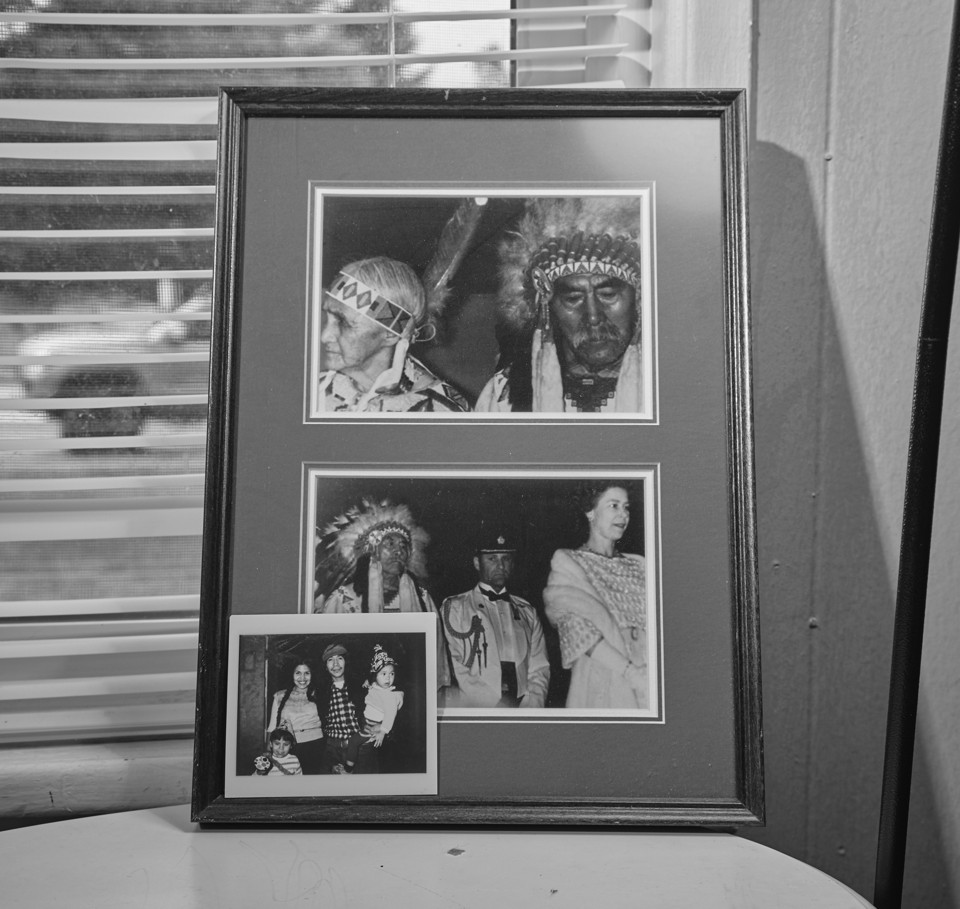
Louisa’s grandmother, who was an American Indian and a devout Catholic, warned her about evil spirits. (Ian Allen)
Louisa’s troubles had started long before that late-winter session with her chemical-dependency counselor. In 2009, at age 26, she’d had an experience in the middle of the night that had left her badly shaken. She was living in Orlando with Steven, and she’d just fallen asleep. Louisa had recently given birth to their first child, a son, who was tucked between his parents in bed. At one point during the night, she awoke and found herself paralyzed. “There was something holding me down,” she remembers. “I couldn’t move, I couldn’t breathe, and I thought I was going to die.” She desperately wanted to wake up Steven, but her body was inert, pinned to the mattress. All she could move were her eyes, and they darted around the room in horror.
When Louisa told friends and family about the episode, most shrugged it off. Some suggested that it might have been a lingering effect of having just undergone a strenuous delivery (she had needed a cesarean section). Louisa decided they were probably right.
In 2011, she was finishing up her undergraduate degree in women’s studies at Washington State University. For a required internship that fall, she chose to travel to Kathmandu, Nepal, to work for an organization that provides aid to impoverished women and children in the region.
After a month in Kathmandu, Louisa became infected with E. coli and had to be hospitalized for two days. When she was discharged, she debated flying home right away. She’d completed her internship, but her scheduled flight wasn’t for another four weeks. She’d been looking forward to making the famous Annapurna Base Camp trek. But now she was drained and weary of her surroundings. The other interns had left the apartment complex where she was staying, and the city’s streets had been shut down because of political protests.
The night after she left the hospital, Louisa locked the door to her apartment, secured the window with a wooden bar, and went to bed. As Louisa tells it, she awoke in the darkness to the sound of someone’s breathing. It seemed close: She could feel the hot exhales on the back of her right ear and her neck. There’s no way anybody could get into the room, she thought, lying motionless in her sleeping bag. How is this possible?
Thoughts of evil spirits rushed to Louisa’s mind. Her grandmother, who was both an American Indian and a devout Catholic, had warned her about them. If Louisa ever encountered evil spirits, her grandmother had told her, she should do her best to ignore them, because they feed on attention. Louisa tried, but the breathing continued, a heavy, rhythmic rasp. Then, after a minute or so, she felt a hand brush against her collarbone.
At that sensation, which to this day she cannot account for, Louisa leapt out of her sleeping bag and ran to turn on the light. She swears that as soon as she flipped the switch, she heard a pack of stray dogs break out in wild yelps. By dawn Louisa had cleared out, walking several miles to the U.S. Embassy in Kathmandu. She took the next flight back to Orlando.
Louisa had yet another incident in 2013, just after giving birth to her second child, a daughter. This episode was more like the first—she woke up abruptly, only to find her body locked in place—but with the added shock of what seemed to be visual hallucinations, including one of a giant spider crawling into her bedroom. Louisa was so jolted that she barely ate or slept for three days. “I didn’t feel safe,” she said. “I felt violated.”
She’d been seeing a psychiatrist in Orlando. “This is the third time this has happened,” Louisa remembers telling her. “Am I crazy?” The doctor flashed a look of surprise but offered no satisfying insights. So Louisa turned to the internet.
Sleep paralysis seemed like a promising explanation. A phenomenon in which sufferers move too quickly in and out of rem sleep for the body to keep up, sleep paralysis causes a person’s mind to wake up before the body can shake off the effects of sleep. Hovering near full consciousness, the person can experience paralysis and hallucinations.
But Louisa didn’t think this could account for the hand on her collarbone, which she swore she’d felt while she was completely awake. She started to wonder whether something was pursuing her. Amid consuming fear, she waded into some darker internet waters: elaborate descriptions and YouTube testimonials of people who claimed that a demon or some other evil entity had dragged them down to hell. She pored over artists’ renderings of hell—naked bodies writhing like snakes, being consumed by orange flames. “I became obsessed with this topic,” she told me.
On the Sunday after her third incident, in the grips of these new fears, Louisa attended Mass in Orlando, at Saint James Cathedral. After the service, she recounted all three of her experiences to the priest, who immediately asked whether she’d ever dabbled in the occult. When she told him that she had used a Ouija board after her grandfather had passed away a couple of years earlier, he told her to get rid of it, along with anything else that could be construed as occult: tarot cards, amulets, pagan symbols, even healing crystals and birthstones. Any of these things, he told her, could serve as a doorway for a demon.
[/QUOTE] continued next post
Continued from previous post
It may surprise some Catholics to learn just how literally the modern Church interprets Satan and his army of demons. While many people today understand the devil as a metaphor for sin, temptation, and unresolvable evil in the world, the pope consistently repudiates such allegorical readings.
In sermons, interviews, and occasionally in tweets, Pope Francis has declared that Satan—whom he has referred to as Beelzebub, the Seducer, and the Great Dragon—is a literal being devoted to deceiving and debasing humans. In an apostolic exhortation released in April, he wrote, “We should not think of the devil as a myth, a representation, a symbol, a figure of speech or an idea,” but rather as a “personal being who assails us.”
Exorcisms also occur in some Protestant and nondenominational Churches, but the Catholic Church has the most formal, rigorous, and long-standing tradition. The Church sees the influence that demons and their leader, the devil, can have on human beings as existing on a spectrum. Demonic oppression—in which a demon pressures a person to accept evil—lies on one end. Demonic possession—in which one or more demons seize control of a person’s body and speak through that person—lies on the other end.
Catholic priests use a process called discernment to determine whether they’re dealing with a genuine case of possession. In a crucial step, the person requesting an exorcism must undergo a psychiatric evaluation with a mental-health professional. The vast majority of cases end there, as many of the individuals claiming possession are found to be suffering from psychiatric issues such as schizophrenia or a dissociative disorder, or to have recently gone off psychotropic medication.
[QUOTE]Father Thomas said that as many as 80 percent of the people who come to him seeking an exorcism are sexual-abuse survivors.
For some, being told they do not suffer from demonic possession can be a letdown. Father Vincent Lampert, the exorcist from Indianapolis, remembered a young man who came to him seeking an exorcism but was told he was experiencing symptoms of schizophrenia. “You can tell me that I’m schizophrenic, but you can’t tell me why,” Lampert recalled the young man saying. “If it’s demonic, at least I have my why.”
If neither the mental-health evaluation nor a subsequent physical exam turns up a standard explanation for the person’s affliction, the priest starts to take the case more seriously. At this point he may begin looking for what the Church considers the classic signs of demonic possession: facility in a language the person has never learned; physical strength beyond his or her age or condition; access to secret knowledge; and a vehement aversion to God and sacred objects, including crucifixes and holy water.
Only a very small number of exorcism requests make it through the discernment process. The Catholic exorcists I interviewed—each with more than a decade of experience in the role—had worked on only a handful of cases deemed to be true possession. “The Church wants to tread lightly and be skeptical” when examining possible cases of demonic possession, Lampert said, and thus treats exorcism “like a nuclear weapon”—a countermeasure that is important to have in the arsenal but that should be used only when no other explanation can be found.
The ritual begins with the exorcist, who is typically assisted by several people, sprinkling holy water on the possessed person. The exorcist makes the sign of the cross and kneels to recite the Litany of the Saints, followed by several readings of scripture. He then addresses the demon or demons, establishing the ground rules they must abide by: to reveal themselves when called, give their names when asked to identify themselves, and leave when dismissed. Because the exorcist is working with the full authority of God and Jesus Christ, Catholic doctrine stipulates, the demons have no choice but to obey.
At the rite’s climax, sometimes an hour or more into the ritual, the exorcist calls on the devil directly: “I cast you out, unclean spirit, along with every Satanic power of the enemy, every specter from hell, and all your fell companions.” Sessions typically end with a closing prayer and a plan to continue. For those few people the Church believes are truly possessed, a half-dozen or more exorcisms may be carried out before the priest is confident that the demons have been fully expelled.
According to catholic doctrine, in order to take possession of a person in the first place, demons rely on doorways—what the priest in Orlando warned Louisa about. These can include things like habitual sin and family curses—in which an act of violence or iniquity committed by one generation manifests itself in subsequent generations. But the priests I spoke with kept coming back, over and over, to two particular doorways.
Nearly every Catholic exorcist I spoke with cited a history of abuse—in particular, sexual abuse—as a major doorway for demons. Thomas said that as many as 80 percent of the people who come to him seeking an exorcism are sexual-abuse survivors. According to these priests, sexual abuse is so traumatic that it creates a kind of “soul wound,” as Thomas put it, that makes a person more vulnerable to demons.
The exorcists—to be clear—aren’t saying sexual abuse torments people to such an extent that they come to believe they’re possessed; the exorcists contend that abuse fosters the conditions for actual demonic possession to take hold. But from a secular standpoint, the link to sexual abuse helps explain why someone might become convinced that he or she is being menaced by something sinister and overpowering.
The correlation with abuse struck me as eerie, given the scandals that have rocked the Church. But it doesn’t seem to answer the “why now?” question behind exorcism’s comeback; no evidence exists to suggest that child abuse has increased. The second doorway—an interest in the occult—might offer at least a partial explanation.
Most of the exorcists I interviewed said they believed that demonic possession was becoming more common—and they cited a resurgence in magic, divination, witchcraft, and attempts to communicate with the dead as a primary cause. According to Catholic teaching, engaging with the occult involves accessing parts of the spiritual realm that may be inhabited by demonic forces. “Those practices become the engine that allows the demon to come in,” Thomas said.
In recent years, journalists and academics have documented a renewed interest in magic, astrology, and witchcraft, primarily among Millennials. “The occult is a substitution for God,” Thomas said. “People want to take shortcuts, and the occult is all about power and knowledge.” One exorcist pointed to Harry Potter. The books and films “disarmed Americans from thinking that all magic is darkness,” he said.
After listening to the priests and poring over news articles, I started to wonder whether the two trends—belief in the occult and the rising demand for Catholic exorcisms—might have the same underlying cause. So many modern social ills feel dark and menacing and beyond human control: the opioid epidemic, the permanent loss of blue-collar jobs, blighted communities that breed alienation and dread. Maybe these crises have led people to believe that other, more preternatural, forces are at work.
But when I floated this theory with historians of religion, they offered different explanations. A few mentioned Pope Francis’s influence, as well as that of Pope John Paul II, who brought renewed attention to the exorcism rite when he had it updated in 1998. But more described how, during periods when the influence of organized religions ebbs, people seek spiritual fulfillment through the occult. “As people’s participation in orthodox Christianity declines,” said Carlos Eire, a historian at Yale specializing in the early modern period, “there’s always been a surge in interest in the occult and the demonic.” He said that today we’re seeing a “hunger for contact with the supernatural.”
Adam Jortner, an expert on American religious history at Auburn University, agreed. “When the influence of the major institutional Churches is curbed,” he said, people “begin to look for their own answers.” And at the same time that there has been a rebirth in magical thinking, Jortner added, American culture has become steeped in movies, TV shows, and other media about demons and demonic possession.
Today’s increased willingness to believe in the paranormal, then, seems to have begun as a response to secularization before spreading through the culture and landing back on the Church’s doorstep—in the form of people seeking salvation from demons through the Catholic faith’s most mystical ritual.
[/QUOTE] continued next post
Continued from previous post
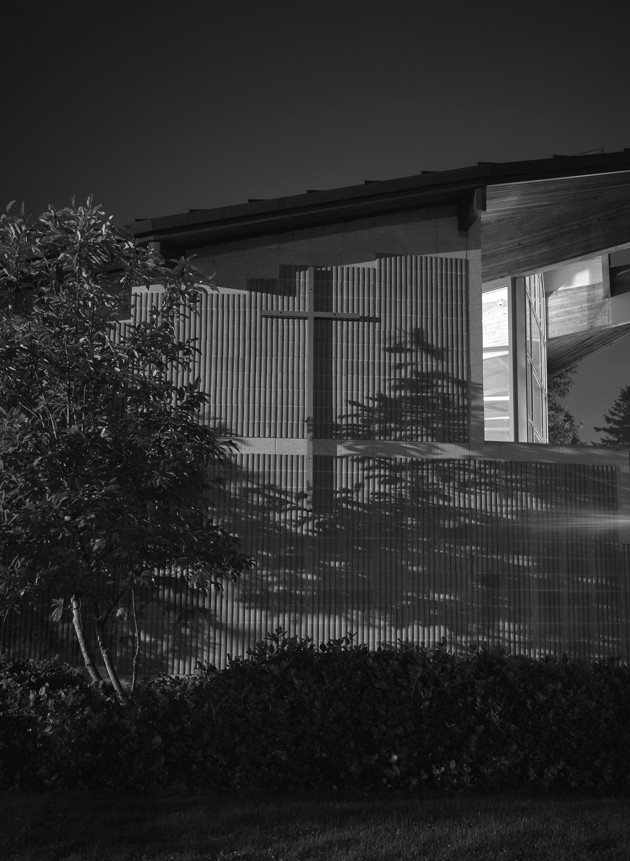
Louisa sought help from a priest at Saint Stephen the Martyr Church in Renton, Washington. (Ian Allen)
When i first began talking with Louisa, she recounted the three nighttime episodes in great detail, giving me the impression that they were the only precursors to the incident in Amy Harp’s office. But just after my visit to Tacoma in March, I spoke by phone with Steven, with whom Louisa had recently reconciled, and he told me that she had been suffering for years from daytime episodes, too. The incidents in the middle of the night frightened Louisa more and felt, to her, more supernatural, but Steven found these daytime experiences much harder to explain.
One of these episodes occurred on the Saturday after Thanksgiving in 2014. Louisa had followed the instructions of the priest at Saint James Cathedral, throwing out her Ouija board and some healing crystals. She and Steven had moved back to Washington State with their two children, hoping that proximity to family and friends would do her good. They settled into a routine—Steven worked at a nearby warehouse; Louisa looked after the children—and for a while, Louisa all but forgot the nighttime incidents in Orlando.
[QUOTE]When Steven first started witnessing Louisa’s episodes, he assumed they were symptoms of a psychiatric disorder.
On that November Saturday in 2014, Louisa spent a few hours at a friend’s house in Tacoma. She came home in the early evening and spent some time upstairs in her bedroom. She eventually returned to the living room and spoke briefly with Steven. Then she fell silent. When she began talking again, a new persona emerged. Normally an affable, meandering conversationalist, Louisa assumed a slow, measured tone.
Steven had seen these transformations before, at least half a dozen times during the decade or so he’d known Louisa, who could never remember them afterward. Recognizing the signs of what was happening, he told me, he grabbed his tablet and began filming.
The footage is dark and the sound quality poor. The camera is pointed directly at Louisa. The video lasts for about 20 minutes. “You humans have your own sense of time,” Louisa tells Steven at one point. “I have plenty of time. I have all the time in the world.” She then shifts into a staccato whisper. “It’s your wife I want,” she says, “not only her body, but her soul.” As she speaks, she jerks her head from side to side, at first quickly, like a marionette, then slowly, like a viper swaying to the sounds of a snake charmer’s pungi.
Halfway through the video, Louisa leans toward Steven and freezes, her face just a few inches from his. “God can’t save her,” she tells him. “Do you understand that? She’s mine.” After a period of tense silence, she suddenly arches her spine, and her face goes through a series of contortions.
As I watched, I struggled to make sense of what I was seeing. The grating static and long, empty silences lent an air of both amateurism and authenticity—I didn’t get the feeling that the video had been faked. All I could settle on, though, was that the camera had captured Louisa in some kind of dissociative state in which her emergent identity believed itself to be inhuman.
When Steven first started witnessing these episodes, he assumed they were symptoms of a psychiatric disorder. Louisa certainly had had her share of struggles: In addition to these unexplained incidents, she also suffered from post-traumatic stress disorder and had a history of alcohol abuse. But Steven changed his mind when, he claims, strange things began happening alongside Louisa’s episodes—electronic devices abruptly turning on, lights he was sure were broken suddenly illuminating. The things he’s seen since knowing Louisa, he told me, “disturb your reality.”
Wynonna Gehrke, who became close friends with Louisa at Washington State University, recalls witnessing something similar. One night, they were hanging out at Gehrke’s house along with another friend when Louisa slipped into a persona her friends didn’t recognize. The emergent identity told them it was a demon that wanted to hurt Louisa. “Her facial expression,” Gehrke told me—“it didn’t seem like her. It creeped me out so bad.” Fearing for both her own safety and Louisa’s, Gehrke wrestled her friend to the ground and eventually managed to calm her. She gave Louisa her bed that night, and she slept on the couch.
On a mild, drizzly morning in late March, I made plans to meet Louisa at Saint Stephen the Martyr, a Catholic church in Renton, Washington. It was Palm Sunday, and parishioners began pouring in long before the start of the 8:30 Mass. I found a seat in one of the back pews and waited for Louisa.
Midway through the service, I felt a hand brush my shoulder. It was Louisa. She’d arrived late and was listening to the Mass from the foyer with her third child, a 1-year-old daughter.
A few minutes later I slipped out to join them. Louisa pushed the baby back and forth in a stroller while her eyes strained toward the altar. She’d told me that the Catholic churches she’d spent time in as a child had always been a source of calm for her—the readings, rituals, and silent prayer ineffably soothing. Although this wasn’t the church she regularly attended, she knew the priest, Father Ed White, well.
After her experience with her chemical-dependency counselor in 2016, she’d become convinced that she was being harassed by a demon and had started looking for a Catholic exorcist. A woman she’d met online suggested she contact White. He wasn’t the designated exorcist for the Archdiocese of Seattle, but he had experience in deliverance ministry—the work of helping people overcome different kinds of spiritual difficulties through prayer.
In his first session with Louisa, in early 2017, White began by encouraging her to discuss the problems she was experiencing. He then left for a few minutes, returning with the purple stole around his neck that priests wear for both confessions and exorcisms. At that point the session took on the more structured feel of a Christian ritual.
In his deliverance ministry, White often asks the person he’s counseling to renounce evil spirits. But when he gave Louisa a piece of paper with renunciation prayers to recite, she froze. Struggling to read the words in front of her, she began moaning and then dry-heaving. Moments later, she slipped into guttural babbling.
Louisa’s upper body began contorting, her neck swinging at unnatural angles. White remembers her appearing as though she was in agony. “It didn’t strike me as voluntary or concocted,” he told me. At one point while he was praying aloud, she broke out in hysterical laughter.
[/QUOTE] continued next post
Continued from previous post
After the first session, White considered starting the discernment protocol for an exorcism. He invited Louisa back for a second session, which went more smoothly. The two talked and prayed, and Louisa read the renunciation prayers without a problem. “Because I saw progress with what I was doing,” White told me, “I thought it was debatable as to whether she needed an exorcist.” Eventually, because she seemed to be responding to the prayers, White made the determination that Louisa’s case was one of demonic oppression, not possession. She would not have an exorcism.
After mass, i met louisa at her home in Tacoma, a two-story clapboard house 10 minutes from the Puget Sound, where she described the larger arc of her life and the torments she’d endured.
Louisa’s parents separated when she was 3 years old. Her mother eventually remarried and settled with Louisa and her older brother in Fife, a small city just east of Tacoma. Louisa’s childhood and adolescence were marked by abuse: She was molested by a family member, which has caused lifelong post-traumatic stress. She still has nightmares about the experience. “It’s like I’m back there again,” she said. “Thirty years ago, all over again. And then I wake up and I’m like, I’m okay. I’m not there.” But the dreams are saturated with the same sense of helpless dread that pervaded her childhood, which she compares to being “in hell, almost.”
As we talked, the baby, quietly tucked in the crook of Louisa’s arm, fell asleep. With her other hand, Louisa dabbed her eyes. To this day, specific triggers—including certain music genres and foods—will send her into a gale of rage and despair. “Walking by a store and it’s playing ’60s music, like Beach Boys or something, I would lose it,” she said. Hamburger Helper, too, has permanently absorbed some residue of her abuse: She thinks her abuser must have made it shortly before or after a molestation episode.
Some abused children are subjected to such agonizing experiences that they adopt a coping mechanism in which they force themselves into a kind of out-of-body experience. As they mature, this extreme psychological measure develops into a disorder that may manifest unpredictably. “There is a high prevalence of childhood abuse of different kinds with dissociative disorders,” Roberto Lewis-Fernández, a Columbia University psychiatry professor who studies dissociation, told me. In certain countries, including the U.S., Lewis-Fernández explained, the prevalence of physical and sexual abuse among people with a dissociative disorder is particularly pronounced.
Several psychiatrists I’ve asked about Louisa’s case felt that some type of dissociative disorder—whether dissociative identity disorder or a subtype linked to PTSD—could be a plausible clinical explanation for what has been happening to her. But Amy Harp, Louisa’s former therapist, was less certain. “I see a lot of trauma, and it manifests in a lot of different ways,” she told me. Louisa’s, though, was “the most extreme I’ve ever seen.” She ultimately found Louisa’s episodes ambiguous—“possibly trauma, possibly something else.”
Jeffrey Lieberman, the chairman of Columbia’s psychiatry department, told me that if you conducted a survey of the population seeking exorcisms, a great majority would likely suffer from a known psychiatric condition, and dissociative identity disorder would be “at the top of that group of conditions.” But Lieberman also acknowledged the possibility that a small percentage of these cases could be spiritual in nature. Over the course of his career, he’s seen a couple of cases that “could not be explained in terms of normal human physiology or natural laws.”
The most recent edition of the Diagnostic and Statistical Manual of Mental Disorders, known as the DSM-5, seems to recognize this still-mystifying dimension in abnormal psychology: It lists a “possession-form” subtype of dissociative identity disorder and notes that the “majority of possession states around the world” are an accepted part of specific spiritual practices—whether they be trances, shamanic rituals, or speaking in tongues. The DSM-5 is not saying that possession is a scientifically verifiable phenomenon, but rather is acknowledging that many people around the world understand their abnormal mental experiences and behaviors through a spiritual framework. Lewis-Fernández, who was on the committee that made this change, explained that Western psychiatry had long failed to accommodate widespread spiritual traditions. There are “societies where the supernatural is a daily occurrence,” he said. “It’s really modern Western societies that draw a sharp line between experiences attributed to the spiritual or the supernatural, and the material, daily world.”
Pore over these spiritual and psychiatric frameworks long enough, and the lines begin to blur. If someone lapses into an alternate identity that announces itself as a demon bent on wresting away that person’s soul, how can anyone prove otherwise? Psychiatry has only given us models through which to understand these symptoms, new cultural contexts to replace the old ones. No lab test can pinpoint the medical source of these types of mental fractures. In one sense, the blurry shadow-selves that surface in what we call dissociative states and the demons that Catholic exorcists believe they are casting out are not so different: Both are incorporeal forces of ambiguous agency and intent, rupturing a continuous personality and forever eluding proof.
Louisa has never gotten a diagnosis of dissociative identity disorder. And she’s always had a bracing faith in the Catholic Church. When I visited her, she told me she hoped to make another appointment with Father White sometime soon. She also talked about possibly reconnecting with Amy Harp, whom she’d stopped seeing last year but with whom she’d seemed to have had a strong, trusting relationship. I didn’t know which path to healing, if any, she would choose. She seemed torn between the avenues of faith and psychology, uncomfortably astride two roads that ran alongside each other but never quite converged.
About a month after I visited her, I got a call from Steven, who told me that Louisa had had another incident. At first he’d thought she was having a seizure—several years had passed since he’d seen one of her dissociative episodes—and he’d considered calling an ambulance. But as he watched, an alternate identity once again took over Louisa, referring to her in the third person and threatening her life. The episode lasted only a few minutes, but it shook Steven. “When you’re witnessing it, it seems like it’s going on forever,” he told me.
Whatever was tormenting Louisa wasn’t finished with her yet. When I texted her the next day to see how she was doing, she told me she was managing as best she could. Earlier that morning, she said, she’d made another appointment with Father White.
This article appears in the December 2018 print edition with the headline “Why Are Exorcisms On the Rise?”
Intense tale. Kinda wish it came out a month ago for Halloween.
Why exorcisms are on the rise…
Well, there is an inordinate amount of people who seem to be adopting superstition as their new form of religion as their old religious tendencies seem to be abandoned, but they (people) need some kind of connection to something other, something divine, anything. Anything to validate the ideas associated with the core belief system they had installed in their formative years.
It’s very hard to break from one’s core beliefs. they go deep. They are a big chunk of who we each are and we pile our identity on top. Our personal identity is tied to our self worth and how we create value and how we value ourselves and others.
This is a desire. It is a desire that causes us to suffer. We can ease that suffering by practicing the 8 fold path. The 8 fold path or middle way is to
act right, speak right, do the right thing for a living, think in the right manner, conduct ourselves in the right manner, concentrate in the right way, be mindful in the right way, hold the right attitude by way of mental effort.
With the right spirit, there is no religion. All religion is same in context and you can open your eyes and see the world and yourself for what it is and who you are. It’s all beautiful really, delicate, sensitive and impermanent from first breath to last.
But of course, you already know this. 
Another reason they’re on the rise might have to do with the popularity of all those ‘paranormal investigator/ghost hunter’ shows. And all of them tend to focus on the ‘scary’ and ‘evil’ aspects of spirit; they very seldom focus on the positive and the ‘light’. There is no balance, and it’s created an over-fascination for (and over-identification with) the dark side.
Possessed
Better than ‘my dog ate my homework’. :rolleyes:
By Arzia Tivany Wargadiredja
|
04 April 2019, 4:25am
Kids Keep Getting ‘Possessed by Spirits’ During Indonesia’s High School Exams
Is it time to abolish standardised testing?
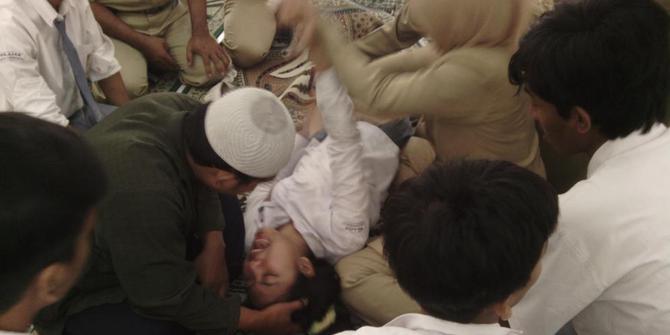
A scene from a school in Yogyakarta, where a student became possessed. Photo by Kresna, uploaded with permission by merdeka.com
By the time Fachruzio Alfarisi graduated high school last year, he’d seen a lot. There’s nothing more memorable, however, than seeing six of his classmates collapse on the ground, sob uncontrollably, and shout at the top of their lungs in his senior year. Fachruzio knew immediately what was going on: his friends were possessed by an evil spirit.
Students being possessed is strangely a common occurrence in Indonesia. It happens everywhere from bigger cities like Jakarta, Bandung, and Yogyakarta, to small towns like Lingga, Payakumbuh, and Malili. These incidents get in the way of school activities, sometimes to the point where students are told to stay home instead. At-school possessions usually happen to only one to a handful of students at a time, but there have been instances where hundreds of students were allegedly overcome by evil spirits at once. Often, school officials respond by inviting a cleric to conduct exorcisms.
That day, Fachruzio helped carry his possessed friends to the schools mosque. After they regained consciousness, Fachruzio returned to class but began to feel a strange sensation all over his body. At this point, he was convinced he should do nothing but read verses from the Holy Quran.
I told my friends that I was being possessed too, but no one believed me, probably because I looked really calm," he told VICE. "After that I called my mom and had her read me the Kursi verse, because it was really hard for me to read it myself at the time.
Soon after, he said that he lost consciousness. According to his friends, Fachruzio was shrieking and writhing for a half hour, until he finally calmed down and opened his eyes.
Fachruzio said many believed that the incident that day was caused by a ghost from a nearby university who had also possessed female students from the high school at a dance competition a few days earlier. But psychologists think there’s another force at play here: stress-inducing standardised tests.
When psychologists from the University of Indonesia conducted a study in 2007 on a high school in Bandar Lampung where four students had been possessed, they found that each of the students had experienced varying degrees of anxiety and depression at the time of the incident. To the experts, the students’ mental health condition was probably a more likely explanation to why the students fell into a hysteria.
Siswanto, a psychology professor at Soegijapranata Catholic University in Central Java, came to the same conclusion after years studying mass hysteria cases in Indonesian schools. He said that what Indonesians call a demonic possession is really a symptom of Dissociative Identity Disorder (DID), as outlined in the World Health Organizations International Classification of Diseases 11.
In areas with a strong religious influence and a strong belief in the supernatural, possessions are understood to be caused by external factors like spirits, he told VICE.
So why does this happen so often in schools? Siswanto said the timing and the victims of these incidents offer a clue. So-called possessions usually happen to final year students in high schools between September and Februarythe six-month period before the exams that take place in March.
The exam season is a highly stressful time for students, because failing the tests means having to stay in school another year to retake them. Each year, the pressure from these tests are so high that last year some students even wrote, on the comment section of the Ministry of Education and Culture’s Instagram account, that the tests made them want to die. Though incidents of possessions can happen anywhere and to anyone, Siswanto said that middle and high school students face an enormous pressure during their senior year because the country’s education system relies heavily on students’ test scores.
With students, becoming possessed can be a reaction to the harsh environment, Siswanto told VICE. Remember the time when the national exams was the sole determining factor of graduation? Each district put pressure on teachers, who put pressure on students. They were forced to study every day. They were all stressed out. They faced more pressure at home, too, so they didn’t have anywhere to channel their stress."
The terror of national exams nearly ended in 2015, when former Minister of Education and Culture Anies Baswedan, who is now Jakarta’s governor, ruled that passing the exams were no longer the only graduation requirement. When Muhadjir Effendy replaced Baswedan as minister in 2016, the exams were almost cut entirely. But the plan was canceled because the government was afraid that students wouldn’t be motivated to study if the national exams were abolished.
Judging from how rampant these incidents of possessions are in Indonesian schools, it seems like what the students need are not mass prayers before an exam, or exorcists on stand by. But unless the government comes up with new, less-stressful ways to test students, there will always be stories just like Fachruzio’s.
Yuen Ming-kuen
We don’t have a ‘Busted Taoists’ thread (yet :rolleyes:) so I’m posting this in Busted Internal Practitioners and copying it to Exorcism.
Taoist monk molested mother and her 15-year-old daughter to ‘purge them of evil spirits’, Hong Kong court hears
District Court hears Yuen Ming-kuen told women he had special healing powers to negotiate with spirits which included touching their breasts and genitals
Deputy district judge Terence Wai slammed ‘ridiculous stories’ and convicted Yuen of six counts of indecent assault and one of assault occasioning actual bodily harm
Jasmine Siu
Published: 7:33pm, 3 May, 2019
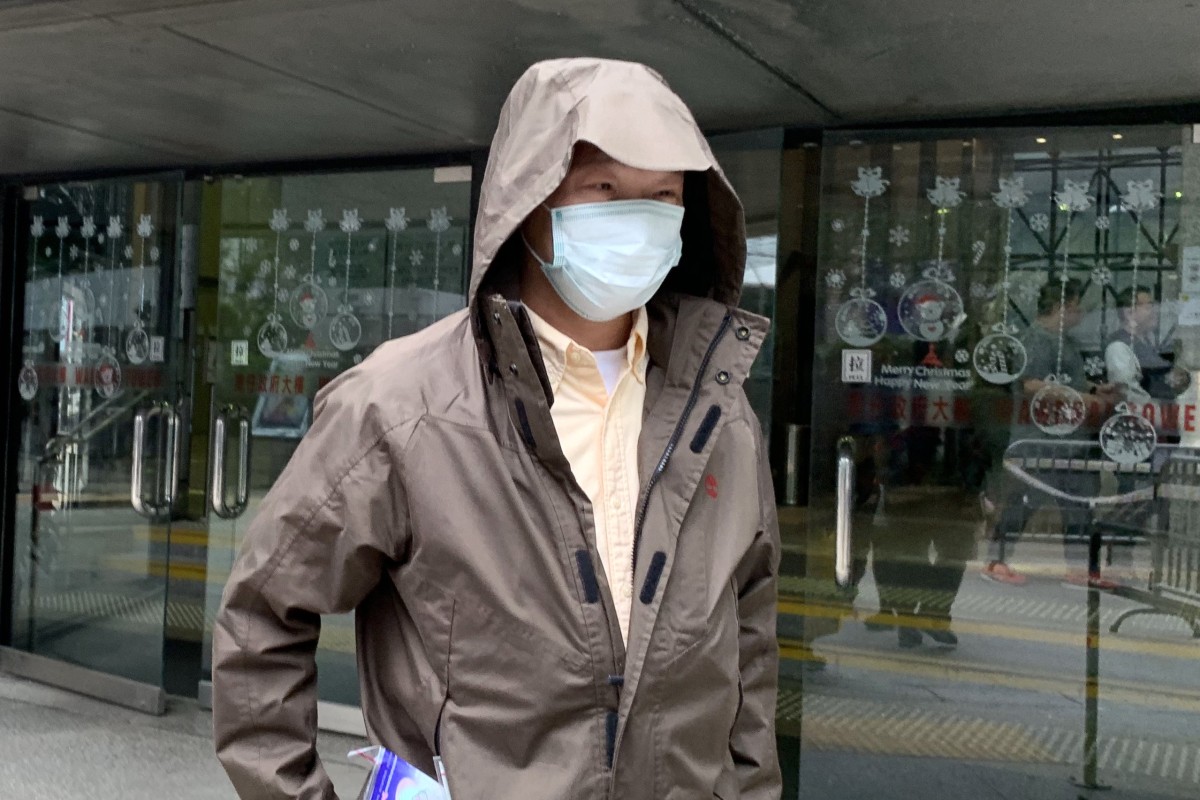
Yuen Ming-kuen kept his eyes closed the judge recounted how he had used various excuses to assault the mother on six occasions in seven months before groping her 15-year-old daughter. Photo: Jasmine Siu
A self-proclaimed Taoist monk in Hong Kong molested a mother and her daughter to exorcise evil spirits, a court was told on Friday.
Yuen Ming-kuen, 57, told the women he had special healing powers to negotiate with spirits and purge them through religious rituals that included touching their breasts and genitals.
Security guard Yuen also struck the mother’s head repeatedly during what he called a “fight with evil spirits possessing the woman”, the District Court heard.
The man claimed he had learned such methods from an arhat – a person who has reached nirvana – in his dreams.
But deputy district judge Terence Wai found these to be “ridiculous stories” and convicted Yuen of six counts of indecent assault and one of assault occasioning actual bodily harm.
“The defendant was a dishonest man,” Wai said. “His acts were all part of a scam.”
Yuen kept his eyes closed as Wai recounted how he had used various excuses to assault the mother on six occasions in seven months before groping her daughter, 15, while she slept on March 29, 2017 to “check whether she had been infected by poison” found in corpses.
Neither women could be identified for legal reasons.
The court heard Yuen was first introduced to the mother on August 26, 2016 when her friends arranged for a Taoist monk to visit her flat because she had complained about it being haunted.
Yuen said he sensed evil spirits in the house and sealed the premises before groping the woman, claiming her breasts and vagina were harbouring spirits and harmful beads produced by the spirits raping her.
Two similar treatments were performed on September 3 and 23, during which Yuen reported seeing the ghost of an unborn child troubling the woman since she had an abortion.
On all three occasions, Yuen said he had obtained consent to touch the woman during his HK$7,500 therapy.

The District Court heard Yuen Ming-kuen was first introduced to the mother in August 2016 when her friends arranged for a Taoist monk to visit her flat because she had complained about it being haunted. Photo: Nora Tam
The victim paid HK$2,500 in total to Yuen, as she did not have enough money.
But he also groped the woman’s breasts without her consent on other occasions because he claimed he did not want the spirits to hear his plan and she was in too much pain for him to delay treatment.
Dr Lee Yiu-fai, an abbot of Sik Sik Yuen Wong Tai Sin Temple summoned by the prosecution, said Taoist rituals would never involve sex or physical contact, and explained Buddhist practices were even stricter.
The judge also observed on Friday the mother’s health had worsened since Yuen began his treatment and concluded she had only “reluctantly acquiesced” to the physical touching because she felt helpless.
He acquitted Yuen of one other count of indecent assault since the mother had failed to give consistent details on what happened.
In mitigation, defence counsel Paul Wu argued neither victim had mentioned any psychological trauma as a result of his client’s assault and urged the judge not to call for impact assessment.
The judge disagreed.
Wai also found it necessary to assess Yuen’s psychological condition, considering he had openly assaulted the women while others were in the room.
Further mitigation, pending these assessments, will be heard on June 13 before Yuen is sentenced on the following day.
Indecent assault is punishable by 10 years’ imprisonment.
This article appeared in the South China Morning Post print edition as: ‘Exorcism’ monk guilty of molesting pair
I really try to avoid getting overly political on the forum…
…but the post title above was actually in my auto-queue now… :o
Trump’s ‘personal pastor’ expels demons from the White House on National Day of Prayer
Sky Palma
Posted on May 3, 2019
While some may agree that demons currently inhabit the White House, exactly which demons need to be cast out is up for debate.
During an event at the White House commemorating the National Day of Prayer, representatives of different faiths took the podium and showered President Trump with accolades — as well as God.
Towards the end the event, Trump’s spiritual adviser and “personal pastor” Paul White-Cain took the podium and declared the White House to be “holy ground” and warned any demons not loyal to the Trump administration to stay away.
“We thank you for this wonderful White House, for our president, first lady, first family and administration,” White-Cain started out. “We declare it to be holy ground. I will bless the Lord at all times, and his praise shall continually be in my mouth. So as we thank you for the goodness, for the prosperity of our nation, for your blessing, for your hand.”
Citing Ephesians 6:12, White-Cain suggested that Trump’s actual political opponents may not be of this world.
“So we declare every demonic network to be scattered right now,” she commanded.
She then declared there to be a “hedge of protection over our president, first lady, every assignment, the purpose they carry and the mantle.”
Watch the White-Cain in the video below. The relevant portion begins at about 58:57:
From Quartz:
White-Cain, who delivered the invocation at Trump’s inauguration address, became the president’s spiritual advisor in the early 2000s, after he saw her televised sermons, according to the Guardian. Trump called her unexpectedly, repeated several of her sermons “verbatim,” White-Cain said, and told her she had the “it factor.”
Like Trump, she is on her third marriage, hers to Journey keyboardist Jonathan Cain. Cain was on the White House’s public list of attendees at today’s event, along with the rest of the religious leaders who spoke, but White-Cain was not listed. She did, however, note her appearance on Instagram.
White-Cain sees Trump as much more than a politician who seeks her guidance. During an appearance on The Jim Bakker Show back in 2017, she said compared Trump to a “king” assigned to carry out “God’s plan.”
“It is God that raises up a king,” she said. “It is God that sets one down and so when you fight against the plan of God, you’re fighting against the hand of God.”
Featured image: screen grab/NBC News
Rev. Dr. William Weaver
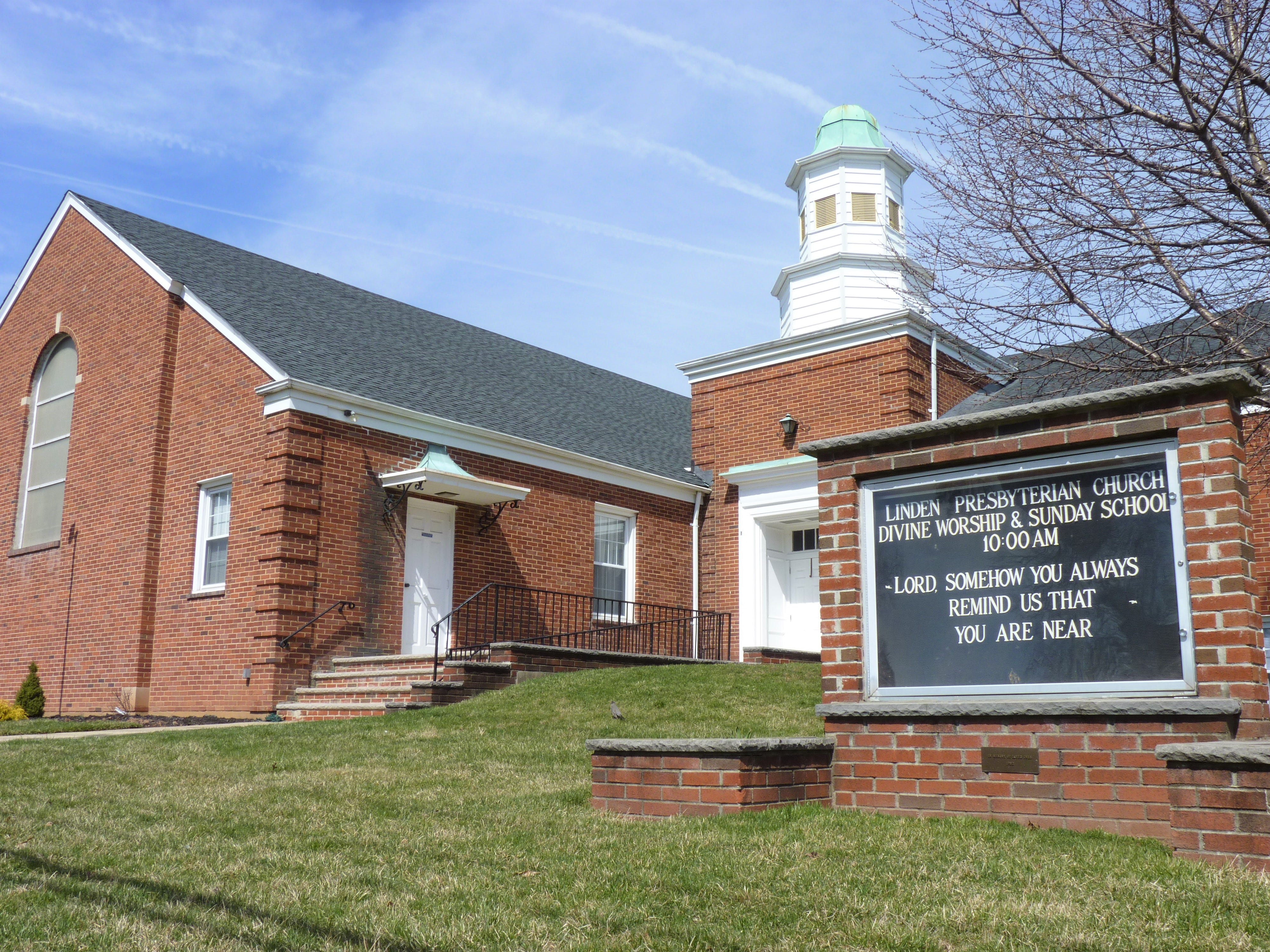
Longtime Linden minister used oral sex in exorcism ritual, men claim
A Presbyterian minister with deep ties to Union County stands accused of using oral sex in exorcism rituals on victims seeking his counseling.
Nick Muscavage, Bridgewater Courier News
Updated 6:34 a.m. PDT June 8, 2019
Editor’s note: This article contains graphic descriptions that are sexual in nature. The three individuals making the allegations have agreed to allow their names and details of the allegations from the testimonies to be published. Reader discretion is advised.
A Presbyterian minister, who said he was following the Bible, used Native American exorcism rituals, gemstones and even oral sex to extract “evil spirits” from men undergoing crises in their lives, the church and men claim.
The so-called healing acts, which date to 1999, were allegedly performed by the Rev. Dr. William Weaver, a prominent Presbyterian minister who served as pastor at Linden Presbyterian Church for 39 years, one of two Presbyterian churches in Linden, a city with a population of over 40,000. He also held several public roles, including chaplain for a county police department.
Weaver, 69, was scheduled to face his three accusers during an internal church trial, but on Jan. 25, 2019, one day before the trial was to begin, he renounced the jurisdiction of the Elizabeth Presbytery. He was accused by the church of “multiple acts of idolatry and sexual misconduct.”
The church charges have no bearing on the secular government’s civil and criminal courts. No public charges have been filed against Weaver. The men said they did report the sexual encounters to authorities, but the Union County Prosecutor’s Office said they could not confirm nor deny information regarding this matter.
With his renouncement, Weaver gave up his ordination and membership in the Presbyterian Church but also avoided a religious trial. He then moved to a gated retirement community in Lakewood.
The trial was scheduled after the men alerted the Elizabeth Presbytery, which oversees 41 Presbyterian churches in Somerset, Hunterdon, Middlesex and Union counties.
The Presbytery determined, through an investigating committee, “that there are probable grounds or cause to believe that an offense was committed by the accused,” according to the official church charges. If Weaver was found at the religious trial to have violated church rules, the most punishment he would have faced would have been expulsion from the Presbyterian ministry.
“In April 2018, the Presbytery of Elizabeth received allegations of multiple instances of sexual misconduct perpetrated by William Weaver, who was a minister member of the Presbytery. The Presbytery of Elizabeth, a regional body of the Presbyterian Church (U.S.A.), takes seriously any allegation of misconduct,” the Rev. Leslie Dobbs-Allsopp, interim leader of the Elizabeth Presbytery, said in a statement.
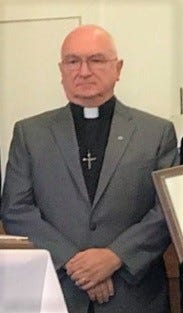
The Rev. Dr. William Weaver.
~SUBMITTED PHOTO
She said the Presbytery’s response to these allegations was in accordance with its policy on sexual misconduct and the Book of Order, the Constitution of the Presbyterian Church in the United States.
“Mr. Weaver was placed on administrative leave while the Investigating Committee conducted interviews with multiple witnesses,” Dobbs-Allsopp continued. “The allegations were found to be credible, and disciplinary charges were filed, and an ecclesiastical disciplinary hearing date was set.”
She also said Weaver renounced the jurisdiction of the Presbyterian Church (U.S.A.) on the eve of his ecclesiastical disciplinary hearing, which halted the disciplinary proceedings.
In doing so, Weaver renounced the jurisdiction of the church, is no longer part of the Presbyterian Church “and he is no longer an ordained minister.”
Dobbs-Allsopp said that means Weaver may not perform any work of any kind on a paid or volunteer basis within any church in the Presbyterian Church in the United States or any other organization within the jurisdiction of the Presbyterian Church in the United States.
“Once Mr. Weaver renounced jurisdiction, the disciplinary charges became public subject to the Presbytery’s sexual misconduct policy,” she said. “Pursuant to the Rules of Discipline in the Book of Order, the charges were read to the Presbytery in March 2019 at the next Stated Meeting following Mr. Weaver’s renunciation. The Presbytery of Elizabeth supports, prays for, and seeks healing, wholeness, truth, and justice.”
When reached by phone for comment, Weaver said: “I’m not able to respond. Thank you.”
Weaver, once described as a “shepherd” in the church by one of the men who said he was victimized by the preacher, is now separated from his flock.
‘Like a Jekyll and Hyde’
Weaver, a graduate of Princeton Theological Seminary, has served as chaplain of the Union County Police Department, the Vietnam Veterans of America Chapter No. 779, and the Hospice Division of Robert Wood Johnson University Hospital, where he also served as a member of the ethics committee, according to his resume on Linkedin.com.
Sebastian D’Elia, director of communications for Union County, confirmed that Weaver worked as a chaplain for the county police department from 1999 to 2007.
Audrey Pereira, associate representative to the Vietnam Veterans of America Chapter No. 779 and the wife of the organization’s president, also confirmed that Weaver was a chaplain for the group.
“We don’t know who else has been hurt by this,” she said. “God forbid there are more out there.”
continued next post
Continued from previous post
[QUOTE]We don’t know who else has been hurt by this. God forbid there are more out there.
Audrey Pereira, associate representative to the Vietnam Veterans of America chapter where Weaver served as chaplain
Pereira described Weaver as a “smart and cunning” man who did do good things, such as praying with veterans in the hospital, but did so with a “mask” hiding his alleged misdeeds.
“He did good on one hand, but he’s like a Jekyll and Hyde,” she said. “On the other hand, he did this evil to who knows how many. It can’t just have been these guys, there has to be more.”
Pereira said Weaver actually performed an “exorcism” in her Linden home, which her family thought had a poltergeist.
Although RWJ did not confirm Weaver’s connections to the hospital — declining multiple requests from My Central Jersey and the USA TODAY NETWORK New Jersey to do so — Pereira said she personally saw Weaver acting as a chaplain at RWJ Hospital in Rahway on several occasions while she and her family were in the hospital.
“I was in the hospital and he would visit when he was the resident chaplain,” Pereira said. “Within the last 10 years he was there.”
She also said she was a member of Linden Presbyterian Church, but stopped going after she learned of the allegations against its minister.
A suitcase of feathers, gemstones and Ziploc bags
“If you mentioned Bill Weaver’s name in Linden or Union County, people would say, ‘Oh, we love Bill!” said A.J. Meeker, one of the men claiming to have been sexually abused by Weaver. “He volunteered all over the place, he was moderator of the Presbytery. He did a lot of things and was very well connected.”
Meeker, of Edison, now 37, said he was 20 when he began seeing Weaver as a counselor in 2000. He was one of the three men who detailed their allegations in impact statements and delivered them to the Presbytery. For this article, My Central Jersey and the USA TODAY NETWORK New Jersey separately interviewed the three men who claim to be victims, as well as two other individuals who were informed by the men of the incidents, and reported from the impact statements.
The three men said they also informed law enforcement of the allegations against Weaver, including the Union County Prosecutor’s Office, New Jersey State Police and the state Attorney General’s clergy abuse hotline.
Mark Spivey, director of communications for the Union County Prosecutor’s Office, said he “cannot confirm nor deny” information relating to Weaver.
Meeker had flunked out of college and moved out of his family’s house, according to his impact statement to the Presbytery. He said he had a strained relationship with his father and his stepmother was not speaking to him. His biological mother stopped communicating with him when he was 15, he said.
“I have dealt with the abandonment issues, depression and anxiety that this caused. I was dating my soon-to-be ex-wife and became a member of the Linden Presbyterian Church,” Meeker wrote in his statement. “While going there, I found Rev. Bill Weaver to be a kind and compassionate person who was very easy to talk to.”
When he began seeing Weaver for counseling sessions, the minister told him that there are “individuals based around the Watchung Reservation” who were engaged in spiritual warfare to attack people with evil energy. The minister also recited the Full Armor of God verses from Ephesians 6:10-18.
“Put on the full armor of God, so that you can take your stand against the devil’s schemes,” the passage states. “For our struggle is not against flesh and blood, but against the rulers, against the authorities, against the powers of this dark world and against the spiritual forces of evil in the heavenly realms. Therefore put on the full armor of God, so that when the day of evil comes, you may be able to stand your ground, and after you have done everything, to stand.”
Meeker said the counseling sessions were held in a bedroom of the manse, the house owned by the Presbyterian church for its ministers. Before the sessions began, Weaver would open a square suitcase that he kept in his office holding the same items the other men also described in statements and interviews: feathers, assorted stones, buckeyes, a magnetic strip, an angel coin and Ziploc bags.

The manse on Georgian Drive in Linden owned by the Elizabeth Presbyterian where the Rev. William Weaver lived while serving as the minister of Linden…
NICK MUSCAVAGE/STAFF PHOTO
Every meeting with Weaver began the same way, Meeker said. The minister told him to undress completely and lie on the bed. Then he placed an angel coin — a coin with an angel or saint printed on it used for praying — on Meeker’s forehead and wrapped a magnetic strip around his head to keep it in place.
Weaver then would place a series of stones on both of Meeker’s feet his hands and on the left side and right side of his chest.
“I was told that for him to get everything out me, I needed to lay completely still to not move the stones on my feet,” Meeker said in the impact statement. “He would then take out the feather and scan my body from my neck to my stomach.”
Weaver then opened Meeker’s mouth, placed his own mouth on top of Meeker’s mouth, and moved his tongue around “to see if I had anything in my mouth or throat,” Meeker wrote.
Then the interaction became sexual, with Weaver engaging in oral sex, according to Meeker.
“He would then ingest my ejaculate and then would spit up multiple pieces of plastic or metal into a Ziploc bag,” Meeker stated.
He said he began to ask Weaver about the necessity of the ritual and asked the minister if he was using the same techniques on women. Weaver, according to Meeker’s statement, said “everything would come out of a woman’s navel and every 30 days their cycle would clear them out.”
Weaver said the evil energy manifested itself into what he called “hits.”
He also told Meeker that if the “hits” were left inside of him, they would cause infertility and erectile dysfunction.
After every session, Meeker wrote, “he would then hold me and say he loved me and he would protect me, and he would never let anything bad happen to me.”
Weaver also told him he could never mention what happened because “nobody would understand.”
Meeker described Weaver as “a shepherd of the flock” and affectionate.
“He was very touchy-feely, like everyone got a hug or a kiss on the cheek, or stuff like that,” Meeker said in a phone interview. “He was just very hands-on — never inappropriate publicly — it was just like he was very loving and very caring.”
Weaver also strove to represent a “picture of piety,” according to Meeker.
“He always wore his shirt and collar, which Presbyterians don’t do,” Meeker said.
‘I thought it was all helping’
William Weist told of a similar account of his encounters with Weaver.
Weist, Pereira’s son, was one of the few people present when his soon-to-be wife’s son, Rusty, 26, was found floating lifeless in the Delaware River three days after a boating accident in 1999. He was the one who called the police and he was there when Rusty’s body was pulled out of the water.
“As clear as day, I can still see Rusty there,” Weist said through tears. “I can see that image.”
The trauma tormented him, so when a friend recommended he speak to Weaver in counseling sessions, Weist was interested.
“I was at an extremely low point,” he said.
Weist, 52, of Edison, who never considered himself a devout Christian but always was spiritual and faithful, began meeting with Weaver and discussing other tumultuous points in his upbringing, such as the death of close relatives and tensions that arose later in life. He was in his early 30s at the time.
“We went through the whole thing,” Weist said about the counseling sessions. “It was always wrapped around the Bible and Bible verses, and Jesus loves you, and all this stuff, and it just evolved.”
Often catching his attention, hanging on the wall of Weaver’s church office, was a picture of Jesus hugging a man.
In his impact statement he sent to Presbytery officials, Weist said that he and Weaver often spoke about Heaven and the spirit world.
[/QUOTE] continued next post
Continued from previous post
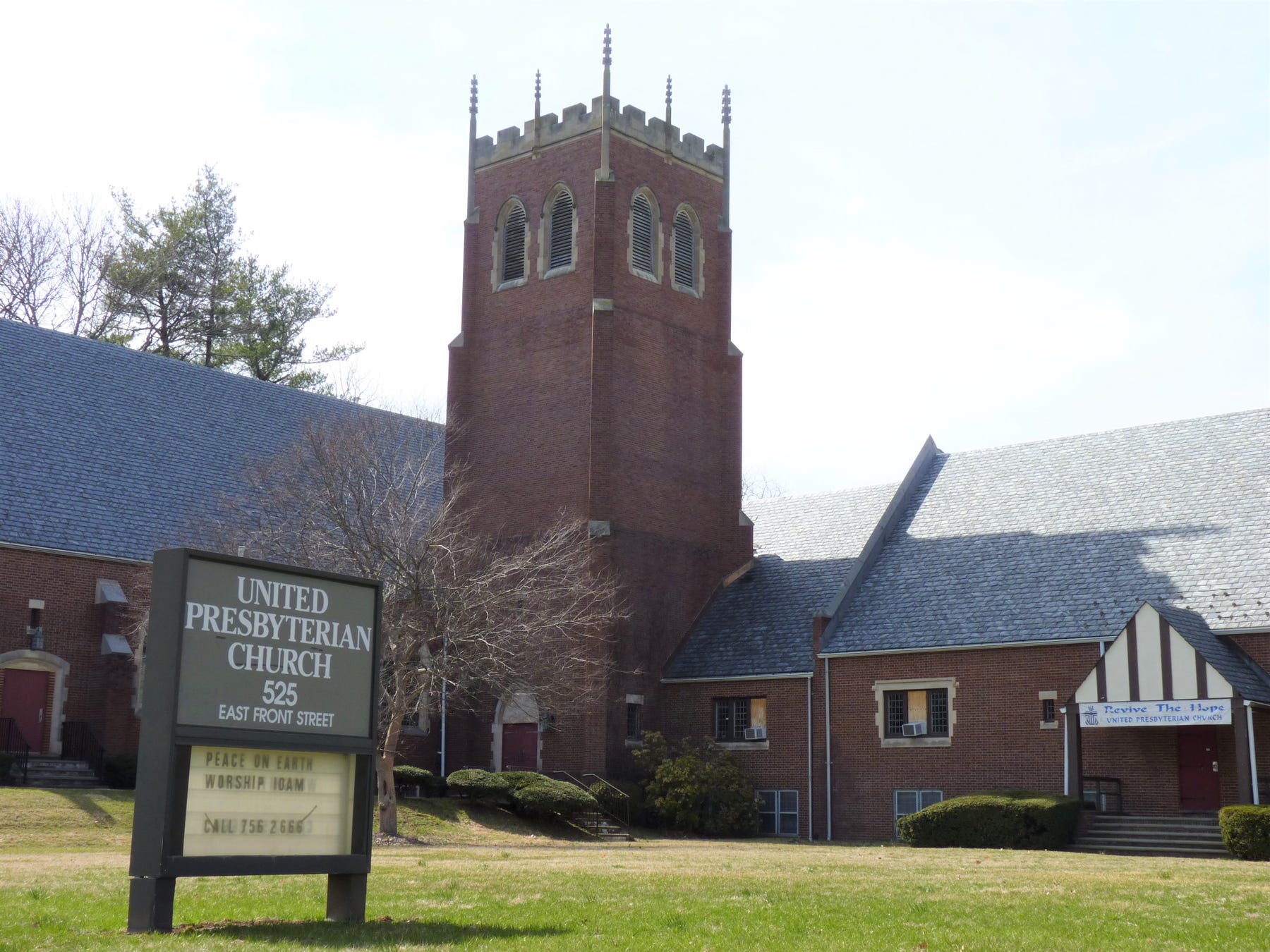
United Presbyterian Church in Plainfield, which is where the Elizabeth Presbytery is based out of.
NICK MUSCAVAGE/STAFF PHOTO
“We talked about what Heaven must be like, that Jesus is always there for us and we are never alone,” he wrote in the statement. “We would pray together during the sessions, usually at the end.”
During the next few sessions, Weaver began to introduce certain gemstones that he said were supposed to help sense the spirits clearer. Weaver told him the stones helped “ward off evil spirits,” according to his letter. Weist remembers feeling his tensions ease, and thought the sessions were helping.
“I was able to now have those memories and not get upset by them, so I thought it was all helping,” Weist said in the letter.
Then events took an unexpected turn.
Weist was set to marry his fiancée in February 2000 and he was struggling with his relationship with his mother, whom he said never fully supported the relationship. Weaver eventually presided over the wedding.
After the wedding, Weist’s meetings with Weaver took place either in the church office or Weaver’s home, where they met in the family room. Their talks became focused on Weist having to defend himself from evil spirits.
Weaver, according to Weist, would talk about old Native American rituals that were supposed to prevent evil spirits from harming him. Weaver instructed Weist to sit quietly with gemstones or magnets placed in his hands and on his head. Weaver would light candles “strategically placed” in the room. He told Weist the ritual was based on the Ephesians bible verse of the Full Armor of God.
‘I just couldn’t face what had happened to me’
About a month later, in the spring of 2000, Weaver told Weist that in order for the ritual to be more effective, they had to go upstairs where he could lay down with more stones and candles.
“I felt uneasy, but I took his word that this was necessary,” Weist wrote in his statement. “It wasn’t long after that where I now had to have my shoes off with gemstones placed on my ankles, and my shirt off as well.”
Over the next few visits, Weaver informed Weist that he had suffered “hits” from the spirit world and they needed to be brought out through his semen by oral sex.
Weaver told Staunton he had to lay still, with the stones on and around him, and let the reverend “get it out.”
“Feeling mortified was an understatement, but I didn’t want to say he was wrong, after he helped me to this point,” Weist said in his statement. “I was so confused and upset I remember praying to God please let me get this over with!”
The “hit” finally passed and Weaver repeated the Full Armor of God verse.
Weist returned the following week hoping that the worst was over, but Weaver told him he had suffered another hit.
“This time was different as the only way to get it fully out was for him to draw it out with his mouth,” Weist wrote in his statement. “I was so afraid and scared.”
[QUOTE]I was so confused and upset I remember praying to God please let me get this over with!
William Weist, one of the men claiming to have been sexually abused by Weaver
Weist remembers screaming in his mind for God to help him.
“When it was over,” Weist said in his statement, “he showed me what looked to be a tiny metal ball and said that was what he got out of me.”
He said Weaver was able to take advantage of him because he was at such a low point in his life.
“I was so scared with everything that I was dealing with,” Weist said. “I just felt scared, it was very raw.”
When Weaver told Weist he had evil spirits inside him, Weist believed him and became even more frightened and panicked.
He remembers thinking: “I’m scared to death now there’s something else wrong with me. There’s something wrong with me that I can’t help. This is Biblical.”
But after a few more sessions, Weist stopped meeting with Weaver.
“I felt so small and worthless, like a piece of trash in the street,” Weist said. “I just couldn’t face what had happened to me.”
He trusted Weaver and saw him as a religious leader.
“This is a man of God,” Weist said.
The case against Weaver
On Oct. 8, 2018, members of the Elizabeth Presbytery’s investigating committee wrote in official Presbytery charges that the Rev. William Weaver committed “multiple acts of idolatry and sexual misconduct” against three men.
The church charges claimed that in one of the counseling sessions, Weaver “professed” he was one-eighth Cree and had received “secret training” by Cree elders.
The Cree are one of the largest groups of first nation Native Americans in North America and mainly live in Canada. In the United States, the Cree have historically lived west of Lake Superior and today live mostly in Montana on the Rocky Boy’s Indian Reservation, which they share with the Ojibwe.
The Elizabeth Presbytery defines sexual misconduct as an abuse of authority and power, breaching Christian ethical principles by sexually misusing a trust relationship, according to the Presbytery’s policy. It has no bearing on the more familiar secular courts where civil and criminal trials are held.
The Presbytery, in its policy, said sexual abuse occurs “whenever a person in a position of trust engages, with or without consent, in a sexual act or sexual contact with another person to whom s/he owes a professional and pastoral responsibility.”
The church charges say Weaver used rose quartz, angel coins, buckeyes and a feather to remove small objects from victims’ nude bodies through bodily tissue, without bleeding or injury, to their *****es and “removed them by means of ejaculate induced by manual or oral stimulation.”
The church charges also claim that Weaver downloaded multiple videos from a pornographic website that caters to gay men to a church-owned computer in his office at the Linden Presbyterian Church in February 2018.
In addition to the three men who claim to have been victimized by Weaver, the charges list two other people Weaver counseled between 2001 and 2007 by removing the “hits” through their navels by using his mouth.
Inspired by spiritual healing?
Dr. Timothy Thomason, a licensed psychologist, professor at Northern Arizona University and a member of the Society of Indian Psychologists, has written many scholarly articles about counseling with Native Americans.
One of the main differences in modern medicine compared to cultural Native American medicine is that Native Americans, like many other cultures, believe illnesses can be caused by spirits and possession.

Inside the Watchung Reservation in Union County.
~FILE
In a 2008 research paper titled “Possession, Exorcism, and Psychotherapy,” Thomason wrote, “Many Native American tribes believe in spirit possession, and healers often suck illness-causing spirit objects out of patients.” The paper does not detail any sexual interaction. Thomason declined to be interviewed for this article.
A.J. Meeker, one of the three men who made allegations against the Linden Presbyterian minister, remembered that Weaver had said there were “individuals based around the Watchung Reservation” who were engaged in spiritual warfare to attack people with evil energy.
It’s unclear why Weaver believed there was a war against evil spirits in the Union County park bisected by Route 78. In the early 1970s, a 16-year-old Springfield girl named Jeannette DePalma was found dead at the Houdaille Quarry right outside of the Watchung Reservation. Newspapers began to run stories about occult symbols found near the murder scene.
That murder has never been solved.
A question of consent
Robert Fuggi, of the Fuggi Law Firm in Toms River, a lawyer who specializes in litigation brought by victims of sexual abuse, said he believes Weaver’s alleged conduct could be viewed as criminal.
“If you look at the sexual abuse statutes, they talk about unlawful, unwanted, non-consensual contact, and certainly the argument would be that this pastor manipulated his position of authority,” said Fuggi, who does not represent any of the men who claim to have been victimized by Weaver. “In the guise of practicing care and counseling to these individuals, he manipulated them for his own sexual purposes.”
Fuggi said he believes the victims were “unwilling and unwitting” and “did not consensually engage in the sexual assaults, they consensually engaged in what they thought was a pastoral counseling session.”[/QUOTE]
So disturbing
so much for that separation of church & state…
…ain’t that america…
JUL 19, 2019 AT 3:27 PM.
In Bizarre Move, US House Chaplain Gives ‘Exorcism’ Prayer to Drive Demons Out of Congress
The US House chaplain just gave an emergency prayer in Congress to drive out the “spirits of darkness."
ELIAS MARAT
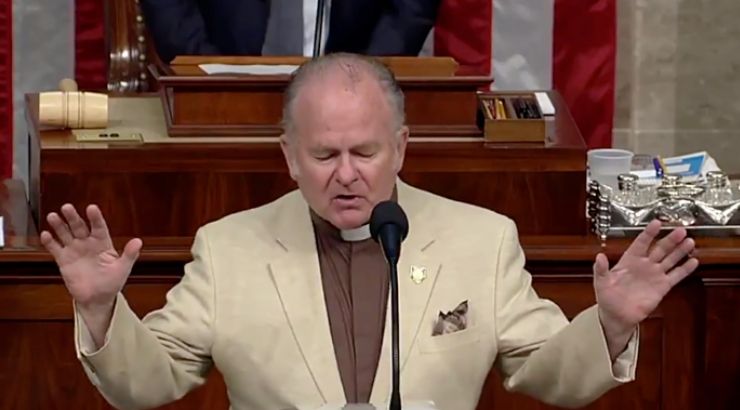
(TMU) — There’s no question about it—things have gotten rough in Congress, especially given the past week’s fallout over Donald Trump’s racist tweets against four Democratic congresswomen.
But if the official U.S. House Chaplain Rev. Pat Conroy is to be believed, this isn’t so much a question of the president’s white nationalism or the supposedly “un-American” nature of the four Democratic congresswomen he attacked.
Instead, this is a problem of demonic possession of the legislature, or as the Jesuit priest put it, “spirits of darkness.”
On Tuesday, the 68-year-old chaplain intervened during the House vote to condemn as racist Trump’s now-infamous tweets. In a prayer that was apparently inspired by Catholic exorcism rites and “traditional blessings for homes or other buildings,” Conroy prayed:
“This has been a difficult and contentious week in which darker spirits seem to have been at play in the people’s house.
In Your most holy name, I now cast out all spirits of darkness from this chamber, spirits not from You … I want every member of the House to be able to say ‘amen,’”
[QUOTE]CSPAN
@cspan
House Chaplain Pat Conroy’s opening prayer: “This has been a difficult and contentious week in which darker spirits seem to have been at play in the people’s house. In Your most holy name, I now cast out all spirits of darkness from this chamber, spirits not from You.”
Embedded video
2,802
6:10 AM - Jul 18, 2019
Twitter Ads info and privacy
2,479 people are talking about this
The strange call for divine intervention came amid the raging battle that followed the president’s tweets telling the four congresswomen to “go back” to their supposedly “home” countries, despite three of them being born in the United States and the fourth, Ilhan Omar, being a naturalized citizen.
The raging partisan contention over the tweets has seen those on the political right support Trump and demand that their opponents abstain from characterizing the tweets as racist. Meanwhile, members of the political left have condemned the president for resorting to classical fascist tropes.
Conroy told CNN that he saw a clear theological aspect to the battle during Tuesday’s raucous vote when House Speaker Nancy Pelosi fled the room angrily after Republican Rep. Doug Collins demanded she retract her description of the tweets as racism. Democratic Rep. Doug Collins, who presided over the vote, then dropped his gavel and abandoned the chair in a move without precedent. Only after two hours of bickering were the lawmakers able to get back to business.
The clergyman said:
“I was on the House floor on Tuesday … and to me, it felt different than other days. It felt like there was something going on beyond just political disagreement. The energy of the House was very off. No one was relishing what was happening.”
Conroy rarely mentions the infernal side of the religious coin, but for him, the dark side of the supernatural always stands in divine contrast to the heavenly. He added:
“If you are a person of faith … ultimately everything in our lives, our communities and our culture is a battle between darker spirits and our better angels.”
As to whether the chaplain is taking sides in the battle and sees “darker spirits” at work in Trump’s tweets or in the Democratic congresswomen’s responses, Conroy remains decidedly non-partisan. He said:
“You heard it, I wasn’t picking sides … That’s ultimately the goal every day. I want every member of the House to be able to say ‘amen.'”
One wonders if the chaplain is equally concerned by demonic spirits when the Democrats and Republicans agree to prioritize literal “fire-and-brimstone” over bread and butter, as was the case last Friday when the House approved the massive $733 billion war budget for the 2020 National Defense Authorization Act (NDAA).
Perhaps God truly does work in mysterious ways.
By Elias Marat | Creative Commons | TheMindUnleashed.com[/QUOTE]
This is so sick that it sounds like one of sanjuro_ronin’s porn parodies.
More on Rev. Dr. William Weaver two post above.
Pastor Accused of Sucking Out “Evil Spirits” with Oral Sex to Face Secular Court
BY DAVID GEE
JULY 25, 2019
A U.S. court will finally hear claims involving the New Jersey pastor who was credibly accused of using oral sex during exorcisms to extract “evil spirits” from men. (Yeah, that’s what they’re calling it.)
Until now, only a church court was considering any disciplinary actions.
Rev. Dr. William Weaver, a minister who worked at Linden Presbyterian Church for nearly 40 years, allegedly said he was following the Bible when he used oral sex and Native American rituals to “remove demons” from troubled church members.
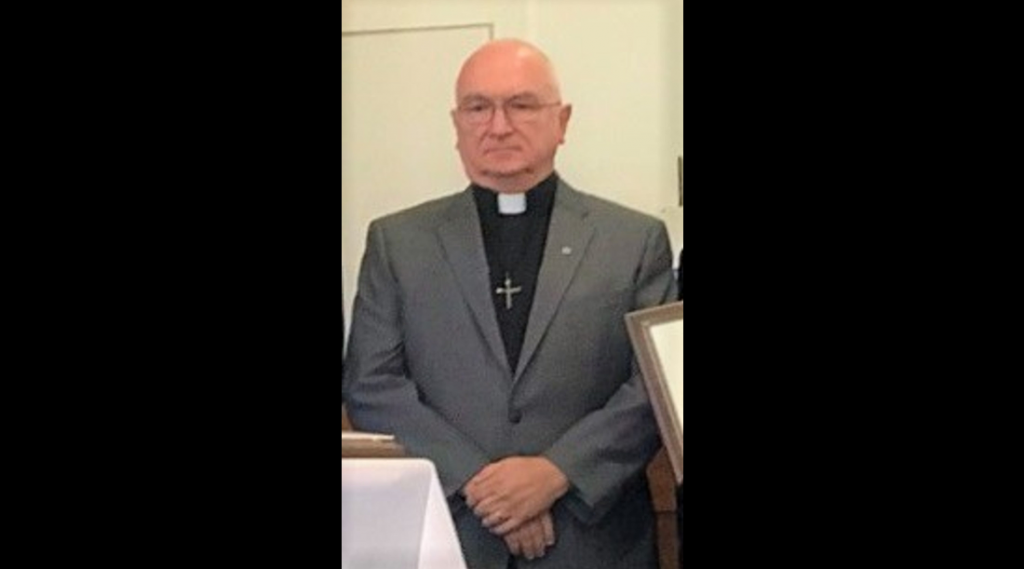
The reporter who broke the story emphasized in June that the church investigation was separate from any official inquiry.
[QUOTE]The church charges have no bearing on the secular government’s civil and criminal courts. No public charges have been filed against Weaver. The men said they did report the sexual encounters to authorities, but the Union County Prosecutor’s Office said they could not confirm nor deny information regarding this matter.
With his renouncement, Weaver gave up his ordination and membership in the Presbyterian Church but also avoided a religious trial. He then moved to a gated retirement community in Lakewood.
Weaver may have thought that giving up his position in the church meant he could retire in peace, free from any formal proceedings, but that’s no longer the case. In fact, just a couple of weeks after we last posted about this story, three men and one woman filed a civil lawsuit against him.
[Weaver] is accused of sexual assault, aggravated assault, sexual battery, false imprisonment and intentional infliction of emotional distress, misrepresentation and gross negligence, in the 105-page lawsuit filed Tuesday by Toms River attorney Robert Fuggi in Middlesex County Superior Court.
The lawsuit also names as defendants the Linden Presbyterian Church, the Presbytery of Elizabeth and the Presbyterian Church (USA).
There’s a chance Weaver could finally face justice for his crimes since the church was clearly incapable of levying any kind of punishment. At least the victims will get a chance to make their case in front of an objective party. And authorities could still bring a criminal case against the disgraced preacher.[/QUOTE]
Do we need a “Busted Exorcists” thread?
…maybe, huh? :mad:
Woman sues archdiocese after ‘lay exorcism’ leaves her emotionally damaged
Crux Staff Aug 16, 2019

Linda Blair played the demon-possessed Regan MacNeil in the 1973 film The Exorcist. (Credit: Warner Bros./AP.)
A woman in Texas is suing the Archdiocese of Galveston-Houston and her parish claiming she suffered psychological and emotional abuse through a lay-led exorcism during a retreat.
Beth Ann Andrews filed her lawsuit on July 25 after attending a “Faith in the Fire” event, which is associated with the Catholic Charismatic movement.
According to its website, the Faith in the Fire retreat “provides its participants the opportunity to reconnect with what matters and share their faith journeys in a loving community.”
“The whole purpose of me attending the retreat was to get close to God and the Catholic faith,” Andrews told ABC13 Eyewitness News.
She said she wasn’t informed that “exorcisms” would be performed by the lay leader of the retreat.
According to Church law, exorcisms can only be performed by authorized personnel, but the Church has published a book of “Prayers Against the Powers of Darkness” that can be used by anyone.
Andrews told the television station that the retreat leader abused his power and authority by inappropriately discussing sexual topics.
She is seeking monetary damages and a change of archdiocesan policy when it comes to training lay leadership.
St. Anthony of Padua Catholic Church in The Woodlands, the parish named in the suit, responded to the accusations in an Aug. 15 statement in the parish bulletin.
“The parishioner plaintiff alleges that she was subjected to non-physical, psychological and emotional abuse by a lay volunteer. The parishioner further alleges that the Archdiocese and the parish failed to properly train and supervise the lay volunteer,” the statement said.
The parish said Andrews brought her concerns to parish personnel, and that the parish leadership “promptly and appropriately” responded to her concerns.
“The parish met with the parishioner plaintiff, immediately removed the lay volunteer from all ministry, contacted the Archdiocese, and indefinitely suspended the ministry programs associated with the plaintiff’s concerns,” the statement said.
“St. Anthony of Padua Catholic Church categorically denies that the parishioner plaintiff was damaged by anything that parish leaders did or failed to do,” the statement said.
The parish said it has “no ill will” towards Andrews, and “will continue to look for a redemptive outcome.”
Aleksandr Gabyshev
Siberian shaman arrested after traveling nearly 2,000 miles to ‘exorcise’ Putin
By Amy Woodyatt, Darya Tarasova and Nathan Hodge, CNN
Updated 12:57 PM ET, Fri September 20, 2019
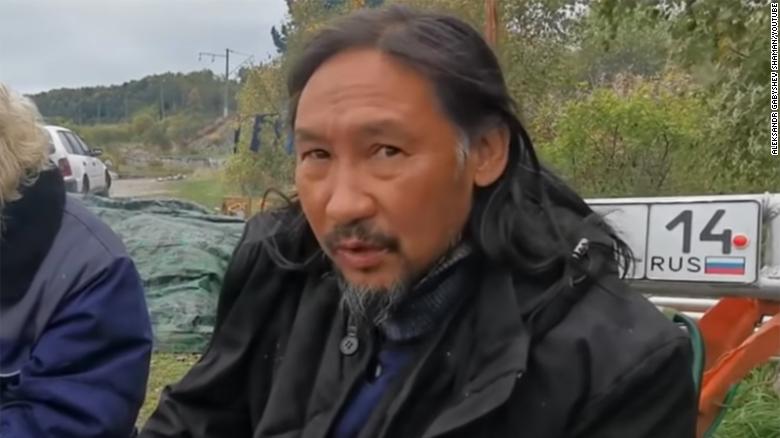
Amnesty International says Aleksandr Gabyshev was arrested by armed police nearly 2,000 miles into his walk to Moscow.
(CNN)A shaman on a 5,000-mile journey to “exorcise” President Vladimir Putin has been arrested by Russian armed police, a human rights organization has said.
Amnesty International said Thursday that Aleksandr Gabyshev is a “Siberian shaman walking across Russia to Moscow and promising to use his magic powers to ‘purge’ President Vladimir Putin in 2021.”
Speaking in a video on his Instagram account, Gabyshev called Putin “a beast, a fiend of hell, the son of Satan,” and said the purpose of his trip to Moscow was to “exorcise” the Russian leader.
Amnesty said armed and masked law enforcement officials “encircled” Gabyshev’s camp near the village of Vydrino, in the Russian republic of Buyratia, and “took away the shaman” on Thursday.
Russian state news agency RIA-Novosti, citing local media reports, said supporters of Gabyshev had staged protests over recent elections in Buryatia, and that criminal charges had been brought against the shaman.
Kremlin spokesman Dmitry Peskov said the presidential administration was not aware of Gabyshev’s detention and referred questions to local law enforcement.
On Thursday, RIA-Novosti cited the press service of Buryatia’s Ministry of Internal Affairs as saying that police had detained a wanted shaman who was going to Moscow, and returned him to Yakutia, the federal Russian republic where the crime was alleged to have been committed.
Yakutia’s Ministry of Health said on Friday that Gabyshev had been sent to a psychiatric hospital, where he would undergo tests.
“Aleksandr Gabyshev, a shaman from the Russian republic of Yakutia, began his 8,000km journey to Moscow in March,” Amnesty International said in a statement published online.
“Since then, he has covered about 3,000km, attracted many followers and addressed numerous spontaneous public gatherings along the way,” the organization added.
“According to eyewitnesses, on the morning of 19 September, armed and masked law enforcement officials encircled the site near the village of Vydrino where Aleksandr Gabyshev was camping with his companions. They took away the shaman without revealing their identities or explaining their actions. His fate and whereabouts are still unknown,” the human rights organization said in a statement published online.
Police in Buryatia and Yakutia could not immediately be reached by CNN.
Well, here you have it. I’m splitting off a Busted Exorcists thread from our Exorcism thread. WTH is happening here? 
slightly ot
CONSERVATIVE PASTOR SAYS GRETA THUNBERG IS ‘PSYCHOLOGICALLY DISTURBED,’ POSSESSED BY ‘DEMONIC SPIRITS’ AND ‘NEEDS JESUS’
BY AILA SLISCO ON 12/17/19 AT 9:29 PM EST
A conservative evangelical pastor has proclaimed that climate activist Greta Thunberg is “the most iconic picture of the death of the west” who may be possessed by a “demonic spirit,” after being outraged that the teen was named Time magazine’s 2019 Person of the Year.
“Friends, this is it,” said pastor Kevin Swanson on Monday’s edition of his evangelical Generations Radio podcast. “This is the unravelling of the western world. This is what it looks like.”
Swanson also made disparaging remarks about the appearance of the 16-year-old, who he mockingly dubbed “the prophetess of the new age.” He claimed Thunberg, who has Asperger syndrome, is “psychologically disturbed.”
“Her face is contorted in a horrible, horrible shape,” claimed Swanson. “But whatever the case, she does have these psychiatric disorders and I guess that’s no secret, that’s been around.”
The pastor also insisted that the “disturbing” young climate change activist was being used by “other demonic spirits” to take control of the world.
“I have to say, there’s something very disturbing about the appearance of and the presentation of this Greta Thunberg,” he said. “Now she’s being trotted out in front of the others, the other demonic spirits are using her to lead the world, wherever it’s going. I don’t know where this world is going.”
Swanson used Bible passages to illustrate his arguments. One compared Thunberg to a boy whose “demonic spirit” was said to have been driven out by Jesus. Another referenced a warning about civilization being harmed when children become insolent “oppressors” while women “rule over” society.

Swedish climate change activist Greta Thunberg pictured at a “Fridays for Future Strike” event in Turin, Italy on December 13, 2019.
STEFANO GUIDI/GETTY
Thunberg’s view that climate change is threat to earth caused by humans, which is in line with the scientific consensus, clashes with the minority denialist opinion held by Swanson. An episode of his radio show from five days earlier promoted discredited theories denying climate change.
“Friends, if this isn’t a quintessential demonstration of the death of the west, of what an entire empire, what multiple empires look like at the verge of collapsing, this is it,” he claimed. “It’s ridiculous. On the one hand, we want to be compassionate with Greta. I truly believe that Greta needs Jesus and short of her coming to Christ, I don’t know what is going to happen to this young lady. It’s sad to watch her. It’s a sad to see her in the condition that she is in.”
Swanson was appalled that Time would name Thunberg Person of the Year, and later decried what he referred to as society’s “fetish” for youth. He claimed that allowing young people to develop culture or “establish music tastes” will lead to “entire empires” being destroyed and “imploded.” The notion of women taking leadership roles in politics also seemed to greatly trouble Swanson.
The Colorado-based Swanson has previously been known for his vociferous anti-gay rhetoric, which has included speaking in favor of the death penalty for ****sexuality. He has made multiple claims that terrorist attacks and natural disasters are punishment from God for “sins” related to LGBTQ people. He once claimed that the movie Frozen was being used to convince children to become gay and accept bestiality.
Swanson is also a self-styled authority on homeschooling. His website lists qualifications which include having “homeschooled himself in the 1960s and 70s.”
Couldn’t climate change be punishment from god for greed and wastefulness? :rolleyes:
That so-called pastor (and any loyal followers of his) who see only the demonic in others need to take a good look within themselves. Unfortunately, by their very nature, they will never do that.