Cultural Appropriation

This recent controversy gave me pause (and not for the 'squint your eyes comment)

The Bruno Mars Cultural Appropriation Conversation Is the One We Should Be Having
BY KIANA FITZGERALD
MAR 13, 2018


Image via Getty/Kevork Djansezian
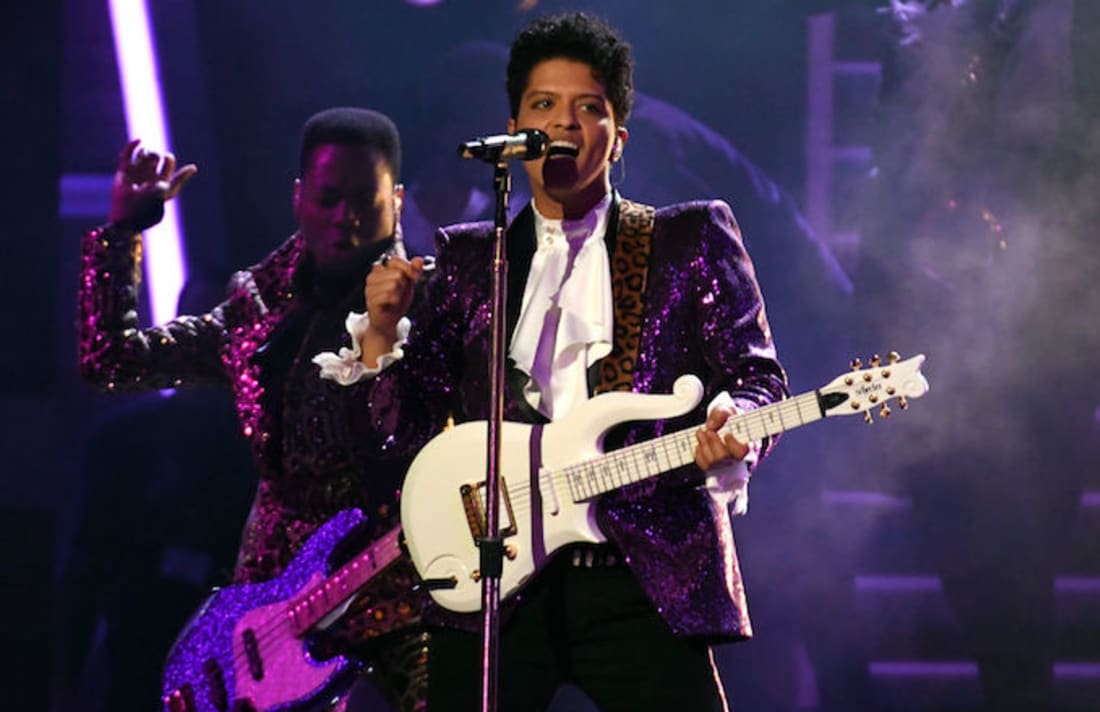
By now, you’ve heard the internet’s tectonic plates shifting again. This week, the fault line is Bruno Mars. On one side of the divide, you have people asserting that Bruno Mars is, as a non-black performer excelling at creating traditionally black art, a cultural appropriator. On the other side—a side that seems much bigger today—are Bruno supporters who believe he’s done no wrong.

Depending on how you squint your eyes, they’re both right. This isn’t a cut and dry issue, there’s a Venn Diagram here mixing up those who think it’s clear-cut appropriation, those who wonder why we can’t just let Bruno live, and the very tangled overlap in the middle which concedes that both camps make some good points.

Nobody wants anyone to come for their fave, no matter how tangential. I get it. But this discussion constantly lingers in the background of our consciences like a boogeyman, drifting forward incrementally every time a non-white artist dominates in the black space (read: often). Bringing this conversation forth comes with a cost. Let the internet tell it, Bruno is being targeted by a mob of angry black haters. Seren Sensei, the outspoken writer/YouTuber/activist/artist who made her opinion of Bruno Mars explicitly clear in the viral clip shared online last week, was faced with a 7-day suspension from Twitter when Bruno Mars’ stans reported her en masse in retaliation.

[QUOTE]hannie
@hannahmburrell
this is why i hate bruno mars @seren_sensei says it all

6:45 PM - Mar 8, 2018
42.6K
18.1K people are talking about this
Twitter Ads info and privacy

Seren Sensei is being penalized for pointing out a very real thing that’s wrong with the industry and the Recording Academy today: “The issue is we want our black culture from non-black bodies,” she says in the clip. It’s hard to argue against her when you look at the history books.

The most popular name in music associated with appropriation is Elvis Presley, a man who eventually became the King of Rock and Roll. Presley was discovered by record producer and industry visionary Sam Phillips in the mid-1950s. According to TIME, Phillips said the following just before crossing paths with Elvis: “If I could find a white man who had the Negro sound and the Negro feel, I could make a billion dollars.” He may not have made a cool billion dollars off of Elvis in the end, but it was a billion-dollar idea that proved to be a winning ticket for executives that followed him. Presley sang a watered down version of black blues and it worked tremendously well commercially, providing a blueprint for popular music that we’re still seeing used now.

IN SOME WAYS, BRUNO MARS IS THE PERFECT CASE STUDY FOR CULTURAL APPROPRIATION IN THE HERE AND NOW, SIMPLY BECAUSE HE MAKES THE CONVERSATION MORE MESSY AND COMPLICATED.

For examples that this is still going on today, look no further than the top 10 of the current Billboard Hot Rap Songs chart. Three out of 10 slots are occupied by Post Malone, a white artist who, despite making rap music, has gone out of his way to publicly distance himself from the genre—yet here he is, present and accounted for. Another three slots are taken by NF and G-Eazy, who are also white, and 6ix9ine, who is Mexican and Puerto Rican. The latter is the most polarizing but perhaps the most culturally synonymous, as the pivotal movements aligned with hip-hop—break dancing, DJing, and graffitiing—were pioneered by blacks and Latinos working together in the streets of New York. (6ix9ine also uses the n-word like his life depends on it, but that’s a conversation for a whooole other day.)

We’ve made progress, in a way: instead of a black/white conversation, we’re now being inclusive with our shade. Artists like the outwardly harmless Bruno are discovering that people of color can get this work, too. This is where things get uncomfortable. No self-respecting person of color wants to bring another POC down, but the point still stands: Bruno isn’t black, but makes black-indebted music, and has profited handsomely for it. However, let’s say Bruno was the exact same figure, with the exact same style and team—but white. He would likely have way more success (let’s be real), and this cultural appropriation debate would have happened long ago. It would be tired by this point, like the current conversation is, but it would be tired because black people would have come to the conclusion that he was an offender by now. Justin Timberlake, a known… appreciator of black music, escaped the wrath of the internet just before suspicions of appropriation became a mainstream cultural concern. We all see it now: he’s already being escorted out of the paint, after re-routing to pop-country land and leaving behind fans of color who loved his hip-pop/R&B.

In some ways, Bruno Mars is the perfect case study for cultural appropriation in the here and now, simply because he makes the conversation more messy and complicated. He might be the hardest working man in show business. He pumps out music like he’s running out of time. He sets every stage on fire that he ever touches and pays homage as often as he can to the music he’s recreating (the man got Babyface a Grammy this year, after all). There are worse examples of cultural appropriators, but that doesn’t mean he should get an automatic pass.

The machinations that took Bruno to the top of the charts—literally: as I write, Bruno Mars just passed Usher for most No. 1 Billboard Radio Songs among males—are just as real as his work ethic. Bruno is just one facet of a much larger cultural trend that’s becoming more and more obvious. When Seren Sensei says, “We want our black art from non-black bodies,” it rings true—the examples go back for decades—yet we’re still chasing evidence that it’s even happening at all. [/QUOTE]

Here’s the Seren Sensei vid that reignited this fuss:

//youtu.be/UDflHjSFqZI

Now I’m assuming Sensei Ai****emasu is hapa (mixed Asian) or for her to call out Mars is like the…pot calling the kettle black? :eek:

Okay, that was probably the wrong way to go with this. As you all know, I tend to avoid politrix here because it really distracts from the topic on hand - MARTIAL ARTS - but I’m currently invested in some research on the influence of Kung Fu films on Hip Hop so the notion of cultural appropriation is vexing me. :o

lol, oh man.
Bruno Mars, a Filipino, Mexican, mixed bag of human is culturally appropriating things?
That’s hilarious. Seriously, it’s things like this that make me understand the word “libtard” on some days.

Hey, have you met our Prime Minister Dress up?
Here’s some cultural appropriation for you.

I’m a Sikh!

I’m Chinese!

I’m Hindu now!

Wait, no, I’m a Muslim!

Ok, I’m a native Canadian!

I hear he’s on his way to Ireland next…

Well, now he’s got all the Toronto taxi-drivers’ votes.

[QUOTE=rett2;1307861]Well, now he’s got all the Toronto taxi-drivers’ votes.[/QUOTE]

he’s got a couple of really good people doing really good things too.
But sadly, he feels the need to do these weird ass things.

You take the good, you take the bad, etc etc etc.

[QUOTE=GeneChing;1307847]Here’s the Seren Sensei vid that reignited this fuss:

//youtu.be/UDflHjSFqZI

Now I’m assuming Sensei Ai****emasu is hapa (mixed Asian) or for her to call out Mars is like the…pot calling the kettle black? :eek:

Okay, that was probably the wrong way to go with this. As you all know, I tend to avoid politrix here because it really distracts from the topic on hand - MARTIAL ARTS - but I’m currently invested in some research on the influence of Kung Fu films on Hip Hop so the notion of cultural appropriation is vexing me. :o[/QUOTE]

That woman has zero Japanese ancestry. Apparently, she appropriated the name from some TV show. And I guess Wu Tang Clan didn’t appropriate Chinese culture. :rolleyes: Who the hell cares about the color of the artist? Are they good or not, and do you like listening to them or not? It’s not as if Bruno Mars is a white man putting on blackface to perform in the way that many white actors have put on yellowface to play appropriated (or plain insulting stereotypical) Asian roles. I’m not really a hip-hop fan, so I couldn’t care less about that genre, but I despise hypocrisy. The fact is, depending on how long her ancestors have been in this country, there is a BIG probability that she’s more mixed (white European, and maybe some Amerindian) than she even realizes.

[QUOTE=David Jamieson;1307860]

I hear he’s on his way to Ireland next…[/QUOTE]

(sorry, couldn’t help it)

Barbara Kay: Cultural Appropriation is an absurd concept

It’s just another Marxist Tool used to create division and annihilation of cultural and social integrity. Actually more insidious and nefarious than absurd.

//youtu.be/8jAWEVyRgZc

Barbara Kay: Cultural Appropriation is an absurd concept

he’s got a couple of really good people doing really good things too.
But sadly, he feels the need to do these weird ass things.

You take the good, you take the bad, etc etc etc.

He’s just a modern version of Nero or Caligula: the elite partying while their minions burn civilization.
..
Trudeau just follows a simple formula given to him in the Globalist memos:

  1. Destroy the old culture with Marxist Ideology and Globalist control of the propaganda by the MSN that that also got him elected.
    2 Import the replacement population that hates Western culture as much as the Marxists do and will vote liberal and achieve a one party totalitarian state.

Easy Peasy - No thinking required, he just has to memorize ideological speeches and use them in programmed responses… and in between party like there is no tomorrow ! (there isn’t).

:slight_smile: Bruno Mars is just filling in the Prince slot for making gold creds now that Prince is off-stage.

[QUOTE=Jimbo;1307863]That woman has zero Japanese ancestry. Apparently, she appropriated the name from some TV show. And I guess Wu Tang Clan didn’t appropriate Chinese culture. :rolleyes: Who the hell cares about the color of the artist? Are they good or not, and do you like listening to them or not? It’s not as if Bruno Mars is a white man putting on blackface to perform in the way that many white actors have put on yellowface to play appropriated (or plain insulting stereotypical) Asian roles. I’m not really a hip-hop fan, so I couldn’t care less about that genre, but I despise hypocrisy. The fact is, depending on how long her ancestors have been in this country, there is a BIG probability that she’s more mixed (white European, and maybe some Amerindian) than she even realizes.[/QUOTE]

follow the money lol, usually these sjw types in the media are just trying to get your 5 dollar donation to their ****ty VLog on Twitch.. back in the day it would be to their crappy newsletter:D

No different than local street hustlers selling ****ty dime bags at your local festival.

Like the womans march had pro islam pink ***** hat signs marching 3 blocks away from a group of Harry Potter witches with purple green hair holding signs saying satan against trump. lmao

as a Canadian I died. Allah has no love for the devil yet there they were sporting pink ***** hats.

most these protestors on the right and left have good ideas but the unions behind them are anti american spreading division for 5 dollar donations when no western election can get more than 70 percent of voters to turn out. Then it`s just two sides split down the middle, the state suffers.

A different kind of Cultural Appropriation filled with Love…

Greetings,

This following still stands up well:

https://www.youtube.com/watch?v=2z3wUD3AZg4

We need more of this.

mickey

We need more Cultural Appropriation

Japan now celebrates Halloween better than America where the fun has been taken out of it by the Marxist attacks of “cultural appropriation”.

In fact in America, if you celebrate Halloween too much, you may be forced to commit seppuku.. well, the social equivalent.. an apology, then being fired etc…

//youtu.be/NR2Yz3x9EJY

Halloween in Japan - Tokyo Costume Street Party

..
Well that Dave Chapelle skit was really racist and lacked diversity. He didn’t include Native Americans who could have picked “Pocahontas” (Warren).
That is the problem with “Marxist Intersectionality”, there is no end to the subdivisions.

This is going to the dogs

I had a feeling this might be the next flashpoint trend. I’m just waiting for it to hit the Kung Fu in Hip Hop…

[URL=“https://www.hollywoodreporter.com/news/wes-andersons-isle-dogs-is-cultural-appropriation-hollywoods-next-big-battleground-1098228”]
Wes Anderson’s ‘Isle of Dogs’: Is Cultural Appropriation Hollywood’s Next Big Battleground?
6:30 AM PDT 3/29/2018 by Marc Bernardin


Courtesy of Fox Searchlight Pictures

Who gets to make what art? And where should we draw the line between ripping off and paying homage to another culture, asks a Hollywood Reporter columnist.

I grew up on a steady diet of Godzilla movies — as a kid born in New York in the 1970s, my viewing habits were a constant rotation of giant monster flicks, syndicated kung fu movies, and Star Wars knock-offs. When I finally got to write my first comic book it was called Monster Attack Network and it was about, among other things, a Pacific Island paradise that was routinely beset by giant monsters. I understood the metaphor behind Godzilla and why it is so specifically Japanese — the internalized guilt of the only country to have been subject to nuclear bombings is haunted by a monster fueled by atomic fire, one that would destroy Japanese cities over and over and over again.

When I co-wrote that comic book in 2004, with Adam Freeman, I didn’t give a second thought as to whether I should tell this story, one that has so many signifiers from a culture that wasn’t my own. I just thought it was fun.

But today, in the midst of an awakening to the artistic (and financial) merits of inclusion and representation, we’re having a much different conversation than has ever taken place between artists and audiences: Who gets to make what art?

Wes Anderson’s Isle of Dogs is wading into a world that didn’t exist when he started making his stop-motion fable about a Japanese boy lost on a completely canine island. Even two years ago, when Travis Knight’s Kubo and the Two Strings hit theaters, the conversation there was about whitewashing, about populating an inherently Japanese story with an overwhelmingly white voice cast. But few of the people who came for Kubo didn’t take issue with the fact that the story was being told by an almost entirely non-Japanese creative team. (You have to scroll a bit on Kubo’s IMDb page before you get to John Aoshima, the head of story.)

But as traditionally marginalized audiences begin to find their collective voice, things that used to fly … don’t. In Isle of Dogs, Anderson sets his boy-and-his-pooch story in the fictional island of Megasaki, where a nation’s dogs have been exiled, left to fend for themselves. The conceit of this film is that all of the dogs speak English, and are voiced by actors like Edward Norton, Bill Murray, Jeff Goldblum, Liev Schreiber, Bryan Cranston and Scarlett Johansson. The overwhelming majority of the human characters are Japanese and they all speak in Japanese, which is conveyed to an English-speaking audience through subtitles or a translator or, sometimes, not translated at all.

Cinema is an empathy-injection mechanism. It maneuvers us, emotionally, so we can care about people who don’t exist, who we have never and will never meet. The issue that surfaces in Isle of Dogs is whom are we being asked to empathize with?

We empathize with those we can understand. Literally. By placing the Japanese characters behind a wall of language, Isle of Dogs is placing its empathetic weight on the canine characters. Which are all voiced by white actors.

So when film critics like The Los Angeles Times’ Justin Chang or culture writers like Mashable’s Angie Han wonder why Isle of Dogs needed to be set in Japan at all, as it doesn’t really ask us to care about Japanese people, they have a point. This is a story that could’ve been set in Iowa for all it cares about the humans. As much as it seems that Anderson does have a real fondness for Japan — and the story is co-credited to Japanese actor Kunichi Nomura — he treats the culture a bit like wallpaper, set behind his drama as opposed to an integral part of the drama itself.

The question of who gets to make what art is a t***** one. Are we allowed, as artists, to tell stories that move us, or are we supposed to pass some kind of test to be allowed to tell those stories? And who is grading that test? If I’m, say, a Mexican filmmaker who loves giant robots and giant monsters, do I have to present myself to an anime gatekeeper for permission? If I’m a Scottish filmmaker who desperately wants to devote years of his life to tell a romance set in Mumbai during a run on Who Wants to Be a Millionaire, can I just do it … and later win an Oscar for it?

Isn’t the beauty of art that it affects us profoundly and deeply, becoming a part of who we are in the world? And if that’s so, how can anyone be barred from making the art that moves them?

That’s an even harder nut to crack when it comes to music. The legacy of black music in America is a long one, fraught with many of the same problems that come with the legacy of black people in America. Jazz, soul, gospel, rhythm and blues, rock and roll, hip hop can all trace their origins to people of color in this country — and all of those musical modes have become an inseparable part of the fabric of modern culture. Is it wrong for a kid who grew up listening to Motown to want to make music that sounds like Motown? Do we penalize Bruno Mars for making the music he was born in the bosom of? Do we have to go back in time to tell Dave Brubeck that jazz isn’t his to play, or inform Freddie Mercury that gospel isn’t to be touched, or remind every white boy that ever picked up a guitar that unless he pays restitution to Chuck Berry, we’re taking that ax away?

No, of course not. We are the world we live in. And our world is enlivened by the culture we consume. It’s an ecosystem that must be allowed to nurture itself if it’s going to continue. Telling an artist that she or he can’t make art is too close to censorship for my taste.

That said, the free pass that storytellers used to get when they decided to employ cultural signifiers as fetishized exoticism is a thing of the past. So what’s the way forward? Hell if I know. This area of study is fuzzy at best and offensive at worst. But I’m going to make two suggestions.

First: Do the work. It would be easy to try and call out director Ryan Coogler for hiring a white guy to compose the Black Panther score. And not just any white guy, but a guy from Sweden — the whitest of white places. But Ludwig Goransson did the work. Not only has he scored each of Coogler’s movies, but he’s produced artists like Chance the Rapper and Donald Glover. And when Coogler brought him on board for Panther, he took it very seriously. “I was incredibly excited as it was a dream of mine to score a superhero movie,” Goransson told THR by phone during a break from producing the new Childish Gambino album. “I also felt incredible pressure to pay homage to African culture and its traditional music. It’s not lost on me that I’m a Swedish guy from one of the coldest countries in the world.”

He spent months researching traditional African music and went to the continent itself to travel with African musicians, before recruiting some to play on the score itself. Goransson did the work and it shows.

When Pixar makes a movie like Moana or Coco — films rooted in very specific cultures with centuries’ worth of tradition — they send their filmmakers on extensive research trips. Such effort both allows for accuracy and sensitivity when portraying those cultures and lets the storytellers be inspired by the very people and places they’re dramatizing — and incorporate that inspiration into the work.

“Not only is [Coco] based in a real place, in Mexico, but it’s based in real traditions, so we knew it was very important to do the research, to get every detail recorded,” said Coco co-director Adrian Molina in the film’s press materials. “So that when we get back to Pixar and we start deciding what is this town going to look like, what is this grandmother going to wear, what kind of dancing and music are they going to listen to, it can all come from an informed place.”

And second: Don’t be a strip-miner. Don’t treat culture like some kind of Vegas buffet, filling your plate with exotic flavors and setting it in front of a Caucasian protagonist to be tickled and amused by. Remember the importance of empathetic weight: Who is the story about? And if it’s about a person from the culture you are drawing from, you’ve already gone a long way towards achieving a fidelity of intention as well as execution.

If I was writing Monster Attack Network today, knowing what I know about the world I live in at the moment, would I still do it? Yeah, I would. It came from a place of love. But I’d make the hero of the tale a Pacific Islander instead of a beefy white guy. (Funnily enough, when Disney optioned the comic a little over a decade ago, they did so for Dwayne Johnson to star. They were way ahead of that particular curve.)

But that’s just me. Maybe there are no easy answers. Maybe this is an issue we will all have to stumble blindly through until someone figures out how to turn on the light. Maybe the first step is realizing precisely how long we’ve been in the dark.

Artists can borrow whatever they want from wherever they want. It’s okay. In fact it’s vital to allow them that freedom. This is just a couple of newspaper columnists who need to make up fake problems to have something to write about. Wes Anderson’s films are consistently awesome… will definitely be seeing this one.

Utah teen shamed for ‘racist’ prom dress

//youtu.be/86YtNylzn2k

That’s not racist.

Trudeau

[QUOTE=David Jamieson;1307862]he’s got a couple of really good people doing really good things too.
But sadly, he feels the need to do these weird ass things.

You take the good, you take the bad, etc etc etc.[/QUOTE]

What was the good again?:stuck_out_tongue:

Circus Canada

[QUOTE=rett2;1312910]What was the good again?:p[/QUOTE]

Depends if you are on the good side. Government for the Government, of the Government, by the Government is a good thing to oppose toxic nationalism. As a post nationalist country with no core Identity, Canada needs to stop the cultural appropriation of such things as the British Legal System.
..
Only those far right extremists like the former AG would oppose the building of a new reformation and purge of toxic cultural appropriation of fuddy-duddy laws in the former Canada. As the CBC reports , The leader Trudeau has sacrificed himself as a feminist and supporter of native rights to build the International Not-Canada economy in opposing the machinations of the former “what-was-her-name-and-who-cares?”.

Makes sense to me.

Update on the Gong Show in India

//youtu.be/57j4fI3_HOI

Bill Maher - ‘Cultural Appropriation is just something that was made up’

No One is Hurt by the Made Up “Cultural Appropriation”

//youtu.be/F4c5EgYepzo

Here’s one

Good ol’ Kardashians…

Again, I don’t know where to post this

[URL=“https://www.latimes.com/entertainment/la-et-kim-kardashian-kimono-trademark-cultural-appropriation-20190625-story.html?outputType=amp&__twitter_impression=true&fbclid=IwAR0c2bwLYrBcgxYv6j4nhtuzfwXu3MbV6AuPJHu3dx3Q4yUjvleGc3Ls1N0”]
Kim Kardashian just trademarked ‘Kimono.’ Let the backlash begin
By CHRISTIE D’ZURILLA
JUN 25, 2019 | 12:15 PM


Kim Kardashian West at the 2018 MTV Movie & TV Awards in Santa Monica. (Jordan Strauss / Associated Press)

Kim Kardashian West launched a shapewear line Tuesday with the unfortunate name Kimono Solutionwear. Because Kim, get it?

And so began another round of Kim K. being accused of cultural appropriation. Like when she wore Fulani braids, or an Indian headpiece or looked like she was in blackface.

It appears nobody in Kardashian’s orbit was too worried that the Japanese got to “kimono” first, a few centuries back, when they named those loose-sleeved robes that are traditionally worn as formal outerwear.

“Finally I can share with you guys this project that I have been developing for the last year. I’ve been passionate about this for 15 years. Kimono is my take on shapewear and solutions for women that actually work,” Kardashian wrote Tuesday on Instagram.

“I would always cut up my shapewear to make my own styles, and there have also been so many times I couldn’t find a shapeware [sic] color that blended with my skin tone so we needed a solution for all of this.”

While the coming-soon line appears to be body-inclusive, running in sizes from XXS to 4XL and in nine skin-toned shades, the brand’s name upset some people on social media, who called it “problematic at best” and tagged Kardashian a “culture vulture,” among other names.

“Rih would never. Bey would never. Anyone with a working brain would never,” wrote Twitter user stylevoguette, referencing Rihanna and Beyoncé.

A user going by Leisha_17 had a different complaint, however, tweeting: “Probably is a good product but the name… I hear it as ‘Kim, oh NO!’”

Kardashian was also dragged for not using any plus-size models in her images. And for not having zippers. All told, it looks like a lot of ways to lose.

Incidentally, the word Kimono has previously been trademarked twice by others, for products including software and “sheaths for pens.”

However, “Kimono,” “Kimono Body,” “Kimono Intimates” and “Kimono World” do appear to be among the other Kardashian-empire trademarks filed and awaiting review. For the most part, the applications target clothing (shapewear, lingerie, T-shirts) and products made of leather or imitation leather (handbags, wallets, dog harnesses, whips).

Yes, whips. Maybe they’re supposed to go with future lingerie?

Christie D’Zurilla

Christie D’Zurilla covers breaking entertainment and celebrity news. A graduate of USC, she joined the Los Angeles Times in 2003 as a copy editor and has more than 25 years of journalism experience in Southern California. As befits her beat, she has a high tolerance for inappropriate behavior.

about that backlash… #KimOhNo

Go get her, Tamlyn. Hope you get a role in Cobra Kai

JUNE 26, 2019 2:14PM PT
Kim Kardashian Wests Kimono Shapewear Sparks Backlash
By AUDREY CLEO YAP


CREDIT: CLINT SPAULDING/SHUTTERSTOCK

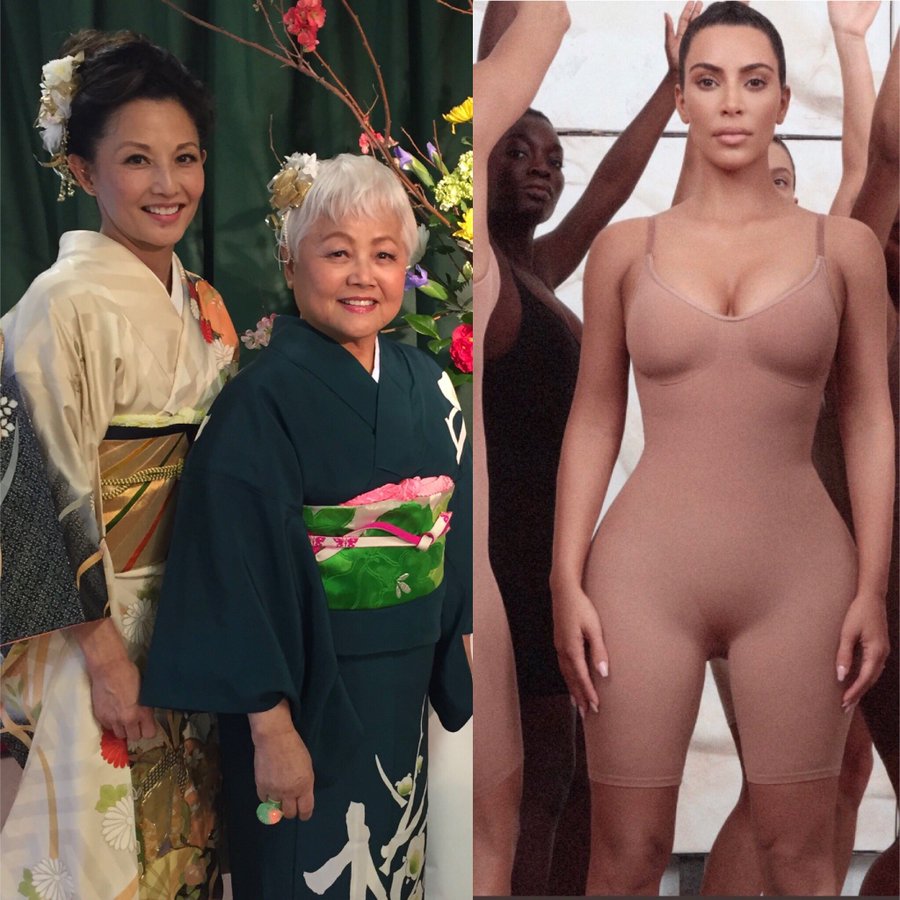
UPDATED: West announced on Tuesday that she was launching a line of form-fitting shapewear in nine different skin tones and a range of sizes. But the name of the reality stars latest business venture Kimono is already wrapped up in controversy. Kimonos are Japanese robes traditionally worn at formal affairs, prompting some to accuse the businesswoman of cultural appropriation. Using the hashtag #KimOhNo on social media, critics called the line disrespectful; users like Japanese American actor Tamlyn Tomita are posting pictures of actual kimonos.

[QUOTE]
View image on Twitter

Tamlyn Tomita

@thetamlyntomita
One is KIMONO. One is Kim shamelessly selling a line of shapewear. Which yall dont need. #kimono

2,598
3:13 PM - Jun 25, 2019
1,406 people are talking about this
Twitter Ads info and privacy

Accompanying a side-by-side photo of Tomita in the traditional robe and of West in her branded shapewear, Tomita wrote, One is KIMONO. One is Kim shamelessly selling a line of shapewear. Which yall dont need.

West addressed the controversy in a statement to The New York Times Thursday, saying that she has no plans to design or release any garments that would in any way resemble or dishonor the traditional garment, but also did not plan to change the brands name.

Kimonos are not traditionally worn as undergarments.

In a series of tweets posted on Wednesday, West used the hashtag #KimonoBody to promote the line. She also revealed that musician husband Kanye West drew the brands logo.

This is not the first time the 38-year-old has faced allegations of cultural appropriation: In 2018, West drew backlash after crediting her braided hair to Bo Derek from Dereks 1979 film 10. The style, known as Fulani braids, has its origins in West Africa and the Fula ethnic group.

Since announcing the line, West who said she has worked on the line for the past year has posted a series of pictures of its offerings, including bodysuits, briefs and bras.[/QUOTE]