Cultural Appropriation

#KimOhNo FTW!

Kim Kardashian West finally caves on Kimono brand after cultural appropriation accusations
By CHRISTIE D’ZURILLA
JUL 01, 2019 | 8:15 AM


“When I announced the name of my shapewear line, I did so with the best intentions in mind," Kim Kardashian West said Monday in a notice that she would change the name. (Laura Thompson / TNS)

Bowing to pressure, Kim Kardashian West will change the name of her Kimono Solutionwear line, presumably to something less controversial, the reality star-turned-entrepreneur announced Monday morning.

“When I announced the name of my shapewear line, I did so with the best intentions in mind,” Kardashian West said on social media. “My brands and products are built with inclusivity and diversity at their core and after careful thought and consideration, I will be launching my Solutionwear brand under a new name.”

The announcement pointedly left out the hot-button word that set off the controversy last week: Kimono, which KKW had applied to trademark in various permutations. She did praise “the direct line of communication with my fans and the public,” which apparently has been on fire since she launched the line Tuesday.

Kardashian West was quickly accused of cultural appropriation of the name. In a Thursday statement to the New York Times, in which she defended her understanding and “deep respect” for the meaning of kimono in Japanese culture, she said she had no plans to change the name.

But on Monday she was singing a different tune.

[QUOTE]
kimkardashian
Verified

Liked by
2,051,581 others

Verified
Being an entrepreneur and my own boss has been one of the most rewarding challenges I’ve been blessed with in my life. What’s made it possible for me after all of these years has been the direct line of communication with my fans and the public. I am always listening, learning and growing - I so appreciate the passion and varied perspectives that people bring to me. When I announced the name of my shapewear line, I did so with the best intentions in mind. My brands and products are built with inclusivity and diversity at their core and after careful thought and consideration, I will be launching my Solutionwear brand under a new name. I will be in touch soon. Thank you for your understanding and support always.
7h

“I am always listening, learning and growing — I so appreciate the passion and varied perspectives that people bring to me,” she wrote on Instagram.

It’s unclear whether one of the voices she listened to was that of the mayor of Kyoto, Japan, who on Friday sent a letter, obtained by The Times, that in part described kimono as “a fruit of craftsmanship … [that] truly symbolizes sense of beauty, spirits and values of Japanese.”

Mayor Daisaku Kadokawa also specifically asked Kardashian West to reconsider using the word kimono in her trademark.

“We are currently undertaking initiatives nationally to make ‘Kimono Culture,’ symbol of our culture and spirits, registered to UNESCO’s Intangible Cultural Heritage list. We think that the names for ‘Kimono’ are the asset shared with all humanity who love Kimono and its culture therefore they should not be monopolized,” Kadokawa wrote before inviting Kardashian West to visit the city and deepen her understanding.

On Monday, commenters were already suggesting names like sKim Wear or KimBody in response to her Instagram notice.

Christie D’Zurilla

Christie D’Zurilla covers breaking entertainment and celebrity news. A graduate of USC, she joined the Los Angeles Times in 2003 as a copy editor and has more than 25 years of journalism experience in Southern California. As befits her beat, she has a high tolerance for inappropriate behavior.[/QUOTE]

Well that’s a teaching momemt and a happy ending. :slight_smile:

An epilogue?

Even though this is done, I’m going to split Kim Kardashian Kimonos #KimOhNo into its own indie thread off the Cultural Appropriation thread. I’m not sure why. Maybe because I like the alliteration of title. :o

//youtu.be/rS_Bm6M4Mws

Kyoto mayor asks Kim Kardashian West to reconsider choice of ‘kimono’ for underwear brand
KYODO JUL 1, 2019

KYOTO - Kyotos kimono-loving mayor sent a letter to American pop culture icon Kim Kardashian West asking her to reconsider trademarking kimono as the name of her new underwear brand, the ancient capital said Monday.

Kimono is a traditional ethnic dress fostered in our rich nature and history with our predecessors tireless endeavors and studies, and it is a culture that has been cherished and passed down with care, wrote Mayor Daisaku Kadokawa, who is renowned for always wearing kimono while carrying out official duties.

The mayor said not only Japanese but also foreign tourists often stroll around Kyoto wearing kimono, adding that his city is trying to have kimono culture registered on UNESCOs Intangible Cultural Heritage list.

We think that the names for kimono are the asset shared with all humanity who love kimono and its culture, therefore they should not be monopolized, Kadokawa wrote.

A spokeswoman for the municipal governments traditional industries section said the message has been sent to Kardashian West in English by post and in an email, as well as being uploaded onto the mayors official Facebook page. However, the city has yet to receive a reply from the American celebrity.

Kardashian West released details about her upcoming Kimono Solutionwear collection on social media last week. Kimono is my take on shapewear and solutions for women that actually work, she wrote.

However, her announcement was slammed on social media, with people creating a pun hashtag #KimOhNo to pour scorn on the name.

Kadokawa, who is serving his third term as mayor of Kyoto, began wearing kimono soon after he was elected in 2008. He does so in support of the traditional industry.

The mayor ended his letter by inviting Kardashian West to visit Kyoto, asking her to experience the essence of Kimono Culture and understand our thoughts and our strong wish.

The Mahjong Line

I didn’t cut&paste all of the IG posts.

Mahjong Set for the ‘Stylish Masses’ Accused of Cultural Appropriation
BY ISA PERALTA
JANUARY 5, 2021
4 MINUTE READ

Editor’s Note: This article has been updated with a statement posted by the Mahjong Line on the company’s Instagram and Facebook on Tuesday. O&H Brand Design, which helped design the tiles, also released a separate statement saying they have since cut ties with The Mahjong Line.

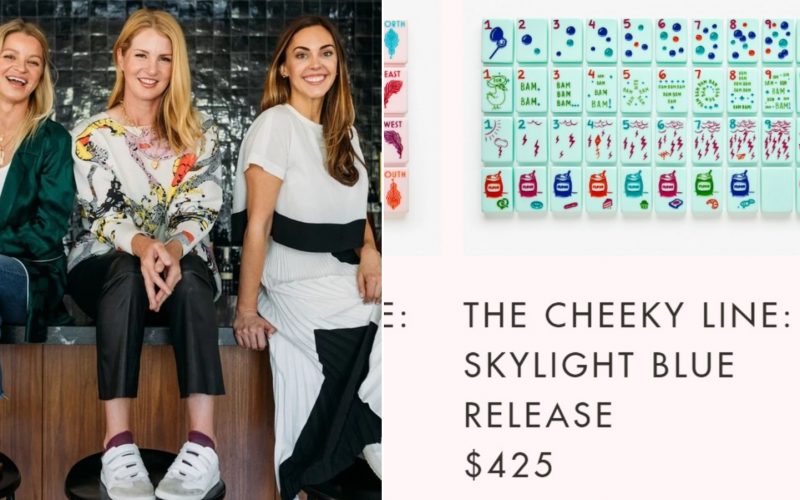
The Mahjong Line, a company created by three women from Dallas, Texas, has stirred online controversy for its products that give Mahjong “a modern makeover as playable works of art.”

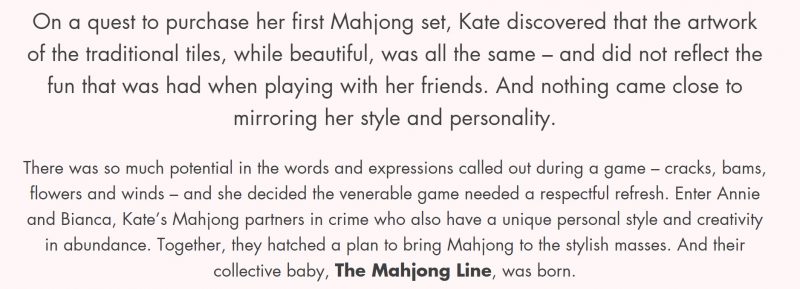
Background of the company: According to Paper City, Kate LaGere first learned how to play Mahjong in Dallas in 2018. LeGere wanted to own a unique set of tiles but could not find anything beyond those with traditional designs. She eventually teamed up with friends and fellow Mahjong players Annie O’Grady and Bianca Watson to create The Mahjong Line.

According to the company’s About Us page, LaGere decided Mahjong “needed a respectful refresh.” LeGere, O’Grady and Watson “hatched a plan to bring Mahjong to the stylish masses.”

The company’s website currently offers five different collections ranging from $325 to $425.
The Mahjong Line also offers accessories, such as a playing mat priced at $50.

Facing backlash: Several Facebook users expressed outrage over the products by commenting on The Mahjong Line’s Facebook posts. Users accused the company of not having any employees of Asian descent and profiting off the whitewashing of a game with Chinese origins.

Several Twitter users also shared their opinions on The Mahjong Line:

Response to outrage: The Mahjong Line has yet to release a statement addressing the allegations of cultural appropriation, and the company has disabled comments on their Instagram posts. Their Facebook page is still currently active.

NextShark has reached out to The Mahjong Line for comment via email, their Facebook page, and their Instagram account. Below is a statement posted to the company’s social media accounts on Tuesday evening:

“We launched this company in November of 2020 with pure intentions and a shared love for the game of American Mahjong, which carries a rich history here in the United States. Our mission is to combine our passion for art and color alongside the fun of the game while seeking to appeal to novices and experienced players alike. American Mahjong tiles have evolved for many decades and we’d like to be part of this evolution in the most respectful and authentic way possible.

While our intent is to inspire and engage with a new generation of American mahjong players, we recognize our failure to pay proper homage to the game’s Chinese heritage. Using words like ‘refresh’ were hurtful to many and we are deeply sorry.

It’s imperative our followers know we never set out to ignore or misrepresent the origins of this game and know there are more conversations to be had and steps to take as we learn and grow. We are always open to constructive criticism and are continuing to conduct conversations with those who can provide further insight to the game’s traditions and roots in both Chinese and American cultures.”

O&H Brand Design, a full-service branding, advertising and graphic design agency based in Dallas, also released a recent statement for their part in creating The Mahjong Line tiles. They have since cut ties with The Mahjong Line.

“We are deeply and sincerely sorry for the role we played in the creation of The Mahjong Line tiles and brand. There was a clear lack of awareness, cultural appreciation and respect on our part during our design process. We own that and apologize for it.

We must do better, and we are taking steps to educate ourselves so that we do not make these types of mistakes again. We have also begun the process of researching ways to learn from the Asian-American community in our city and region so that we can better understand, respect and honor it moving forward.

We have also terminated our relationship with The Mahjong Line.

While our apology can not change the work we did, we humbly ask for the opportunity to improve both as a company and as individuals moving forward.

– The O&H Team”

Featured Image via themahjongline.com

Threads
Mahjong
Cultural-Appropriation

Karen, Queen of Congee

[URL=“https://news.yahoo.com/karen-queen-congee-draws-backlash-175825923.html”]‘Karen, Queen of Congee’ draws backlash over brand ‘improving’ ancient Asian dish for the Western palate

Carl Samson
Tue, July 20, 2021, 10:58 AM·4 min read

A breakfast brand that “improves” congee for the Western palate has stirred controversy over the weekend after Twitter users accused it of cultural appropriation.

Company background: Founded in 2017 in Eugene, Ore., Breakfast Cure sells packets of various “congee” flavors that emphasize “organic, gluten-free, whole grains and a wide variety of ingredients.” It calls each of its servings a “bowl of zen.”

Breakfast Cure was founded by Karen Taylor, a licensed acupuncturist who started eating congee some 25 years ago and became interested in the process of slow cooking grains for better digestion. Since then, she says she has tried different combinations to find “some really tasty, healthy ones, some based on ancient tradition and some [her] own creations.”

There are currently 13 flavors of Breakfast Cure’s prepackaged “congee.” These include “Apple Cinnamon,” “Coconut Blueberry Bliss,” “Golden Spice,” “Karen’s Kitchari,” “Mango and Sticky Rice,” “Masala Chai Spice,” “Mega-Omega,” “Om Berry,” “Pear-Fection,” “Pineapple Paradise,” “Romano Bean Dream,” “Tangled Up in Blueberry” and “Three Treasures.”

The brand says its “simple congee method” spreads the wisdom that warm, cooked foods “heal, soothe and energize.” Listed benefits include hydration, gentle cleansing and an overall metabolism and energy boost.

What critics are saying: The company started receiving backlash over the weekend after one Twitter user accused it of cultural appropriation. Other users have since joined to criticize its methods and statements.

In a thread, Twitter user Casey Ho (@CaseyHo) shared screenshots of Breakfast Cure’s Instagram posts, including a photo of its all-white team. She also shared what appears to be an earlier version of Taylor’s blog post titled “How I discovered the miracle of congee and improved it.”

In her original post, Taylor wrote that she has spent a lot of time “modernizing” congee “for the Western pallet [sic]” so that “you” can eat it and find it “delicious,” not “foreign.” The post appears to have been edited as of this writing, but a quick Google search still shows the original title.

Chinese American writer Frankie Huang (@ourobororoboruo) is one of Breakfast Cure’s critics, writing: “Like a broken record, I must say that it’s unbelievably annoying to see white people ‘interpret’ cultures of millions and billions of living people like they’re archeologists. Being treated like we are dead makes me want to lie down.”

Jenn Fang of Reappropriate (@reappropriate) also took a jab at Breakfast Cure: “Congee isn’t just ‘boiled rice,’ it also contains some specific and traditional flavor profiles one shouldn’t just totally ignore; and certainly not treat as bizarre or unappetizing… It’s definitely offensive for anyone trying to ‘reinterpret’ congee to do so by framing the traditional version as gross and icky, and that their ‘reinterpretations’ will save it in some way by making it better or easier for white folks.”

Taylor, who was once referred to as "Our Founder and Queen of Congee” on the company website’s Meet the Team page, is now solely called “Our Founder.” The “Queen of Congee” title prompted some users to poke fun at Taylor’s first name, Karen, a pejorative alias that has come to represent problematic white women on the internet.

Company responds: In a statement to NextShark, Breakfast Cure apologized for their problematic language and vowed to continue supporting the Asian American community. The company said they have donated to the Asian Mental Health Collective and are currently supporting Asian Americans Advancing Justice.

Read Breakfast Cure’s full statement below:

"At Breakfast Cure, the heart of our mission is to create delicious whole food breakfasts to give you the fastest homemade meal possible. Our Oregon porridge is inspired by traditional rice congee, an incredible, healing dish with references dating back to 1,000 B.C.

"Recently, we fell short of supporting and honoring the Asian American community and for that, we are deeply sorry. We take full responsibility for any language on our website or in our marketing and have taken immediate steps to remedy that and educate ourselves, revising our mission to not just creating delicious breakfast meals, but becoming a better ally for the AAPI community.

“Previously, in March we donated 15% of sales to the Asian Mental Health Collective, posting our support and denouncing Asian hate. We will continue to donate 1% of all sales or 10% of profit, whichever is larger to non-profit and activist organizations. Currently, all purchases support Asian Americans Advancing Justice.”

Featured Image via Made With Lau

threads
Chinese-food
Cultural-Appropriation

[QUOTE=GeneChing;1321455]threads
Chinese-food
Cultural-Appropriation[/QUOTE]

Seems pretty silly considering that Chinese restaurants catering to western customers already often tailor the food to what they consider to be western taste.

[QUOTE=GeneChing;1321455]threads
Chinese-food
Cultural-Appropriation[/QUOTE]

I sometimes watch Karens getting beaten by an Asian… really worth it.

Cultural Appropriation?

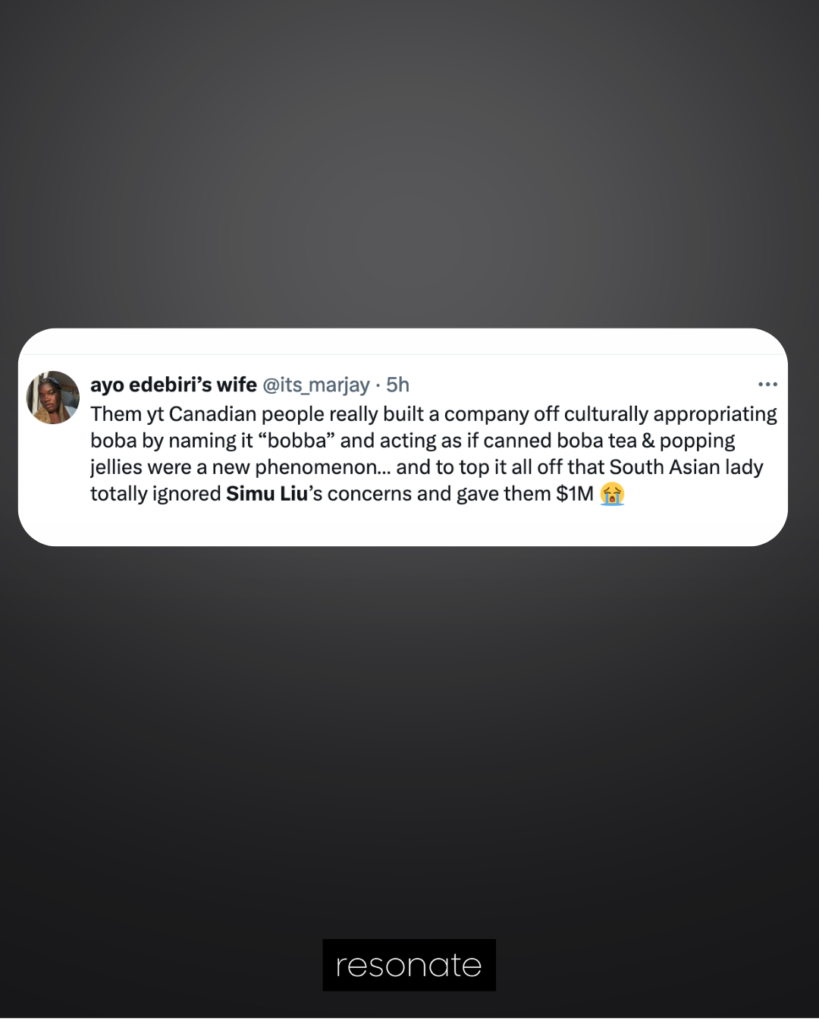
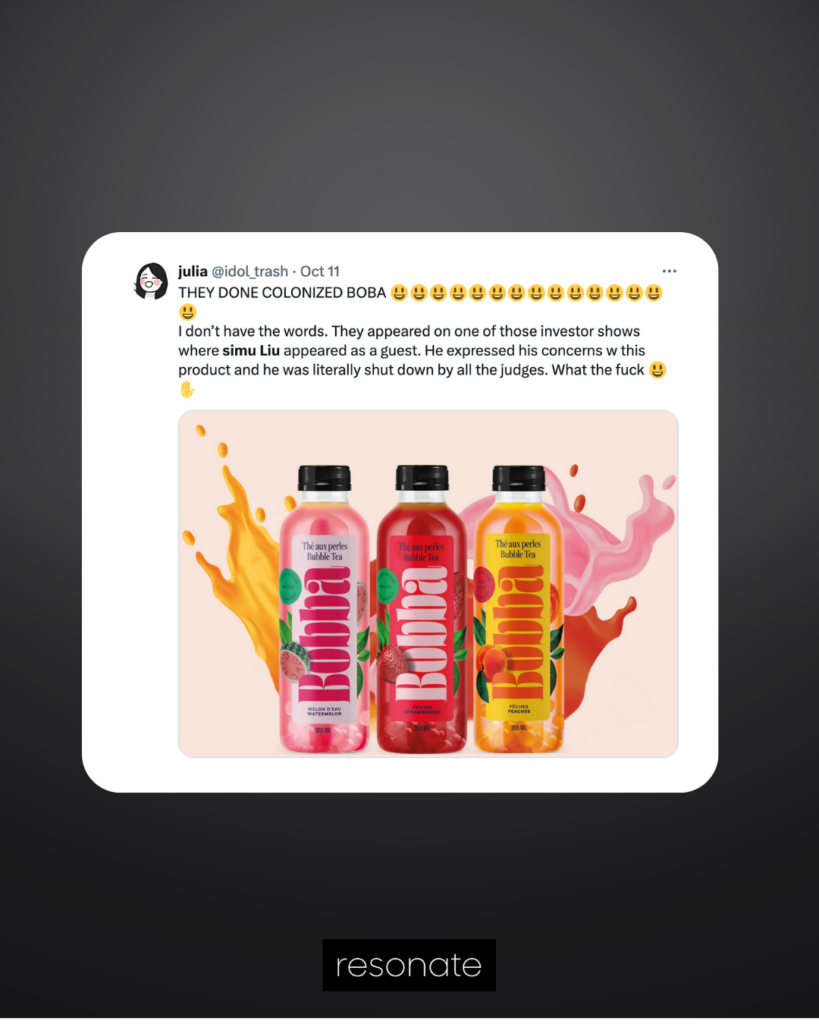
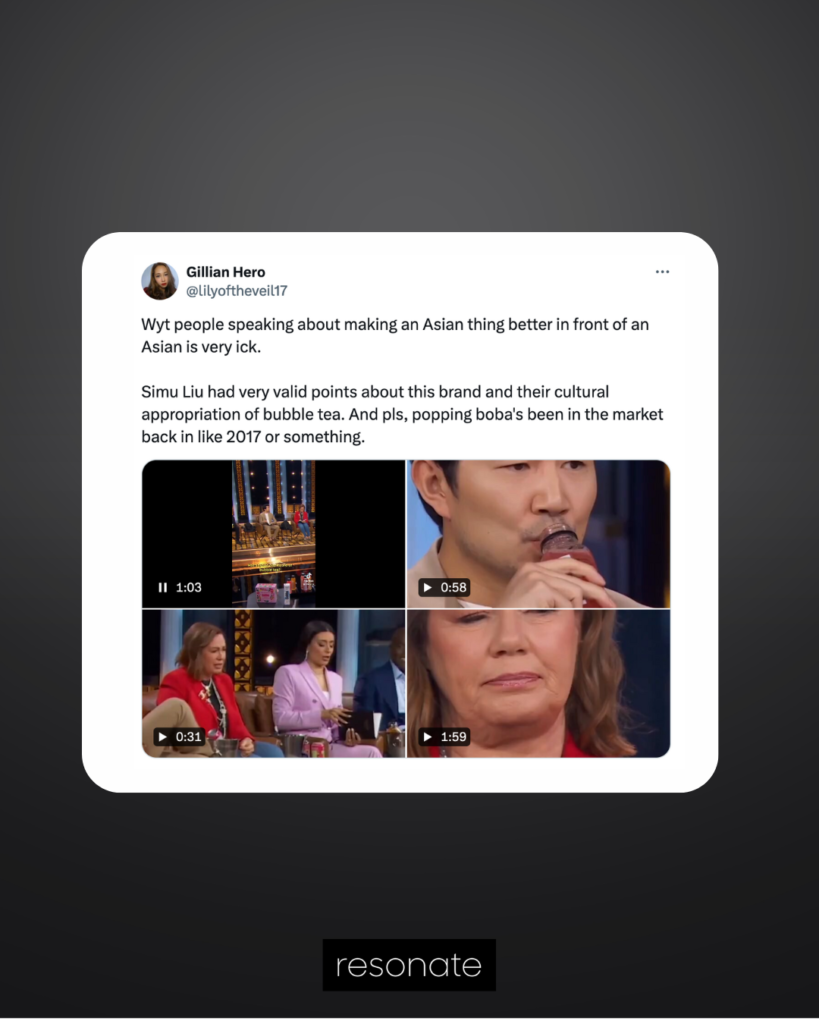
‘Dragons’ Den’: Simu Liu Calls Out Bubble Tea Company Bobba for Cultural Appropriation
Resonate Team13 October 20246 mins

Simu Liu, the acclaimed Chinese-Canadian actor known for breaking barriers in Hollywood with his roles in Marvel’s Shang-Chi and Greta Gerwig’s Barbie, has found himself at the center of a cultural appropriation controversy following his recent appearance on CBC’s Dragons’ Den.

The popular reality show, which invites aspiring entrepreneurs to pitch their business ideas to a panel of seasoned investors, took an unexpected turn when Liu challenged a bubble tea company on their approach to the beloved Taiwanese beverage.

The company, Bobba, presented their product as a “convenient and healthier ready-to-drink experience,” boasting innovations such as alcoholic bubble tea and grab-and-go popping boba. However, Liu raised concerns about the company’s lack of Asian representation and their framing of the product as an improvement on the original.

“There’s an issue of cultural appropriation,” Liu stated. “There’s an issue of taking something that’s very distinctly Asian in its identity and quote-unquote ‘making it better,’ which I have an issue with.”

https://twitter.com/playingcnmymind/status/1844760976068919330

This sparked a tense exchange with the company’s founders, Sebastien Fiset and Jess Frenette, who defended their product and highlighted their partnership with a Taiwanese supplier. “It’s a good question because our best partner is in Taiwan, actually,” Fiset explained. “So they make all the recipes, all the boba. We travel to Taiwan; we speak with them. They’re part of our team. It’s really important for us. So that’s the best part — that’s the cultural part of our product.”

However, Liu remained unconvinced, emphasizing the importance of acknowledging the drink’s cultural origins and actively working to uplift minority entrepreneurs. “I am studying your can, and I am looking for anything that tells me where boba came from. And where boba came from is Taiwan,” Liu pointed out.

“You know, I started this venture company for a lot of reasons, but really, primarily to uplift minority entrepreneurs. And not only do I feel like this is not happening here, but that I would be uplifting a business that is profiting off of something that feels so dear to my cultural heritage. I want to be a part of bringing boba to the masses, but not like this. So for that reason, I’m out.”


Liu’s decision to withdraw his support for “Bobba” has resonated with many viewers, sparking a wider discussion about cultural appropriation, representation, and the responsibilities of entrepreneurs when engaging with products and traditions from different cultures. Social media platforms have been abuzz with comments both supporting and criticizing Liu’s stance.

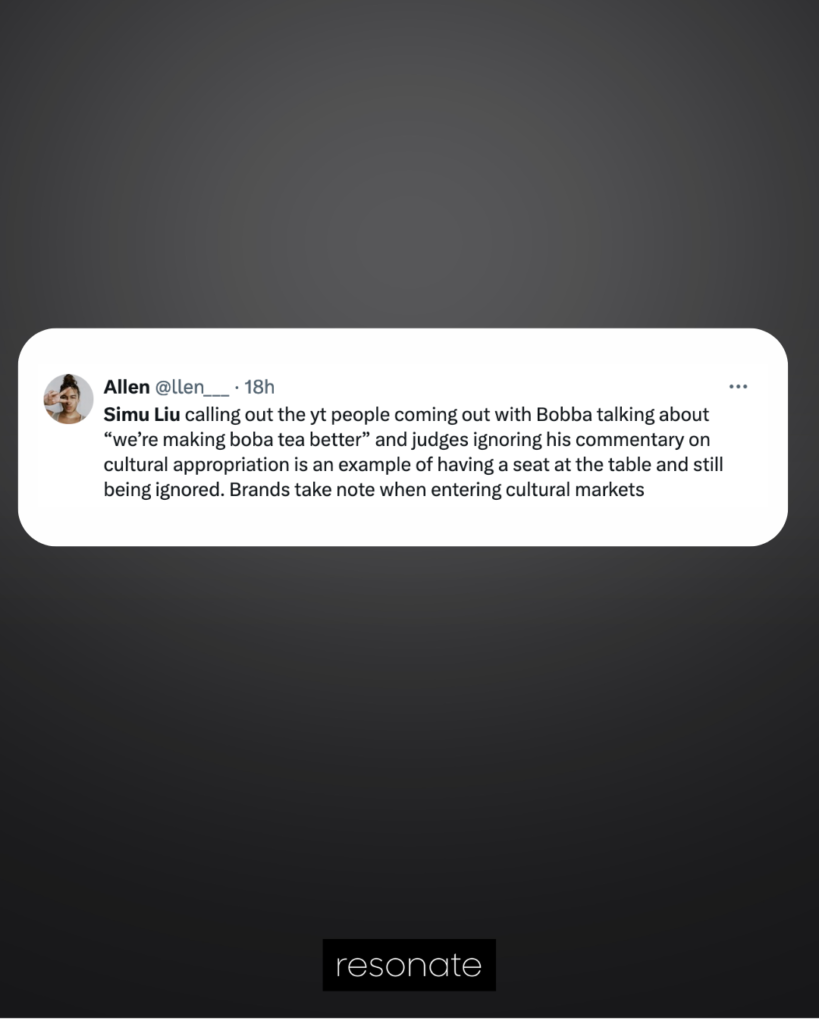
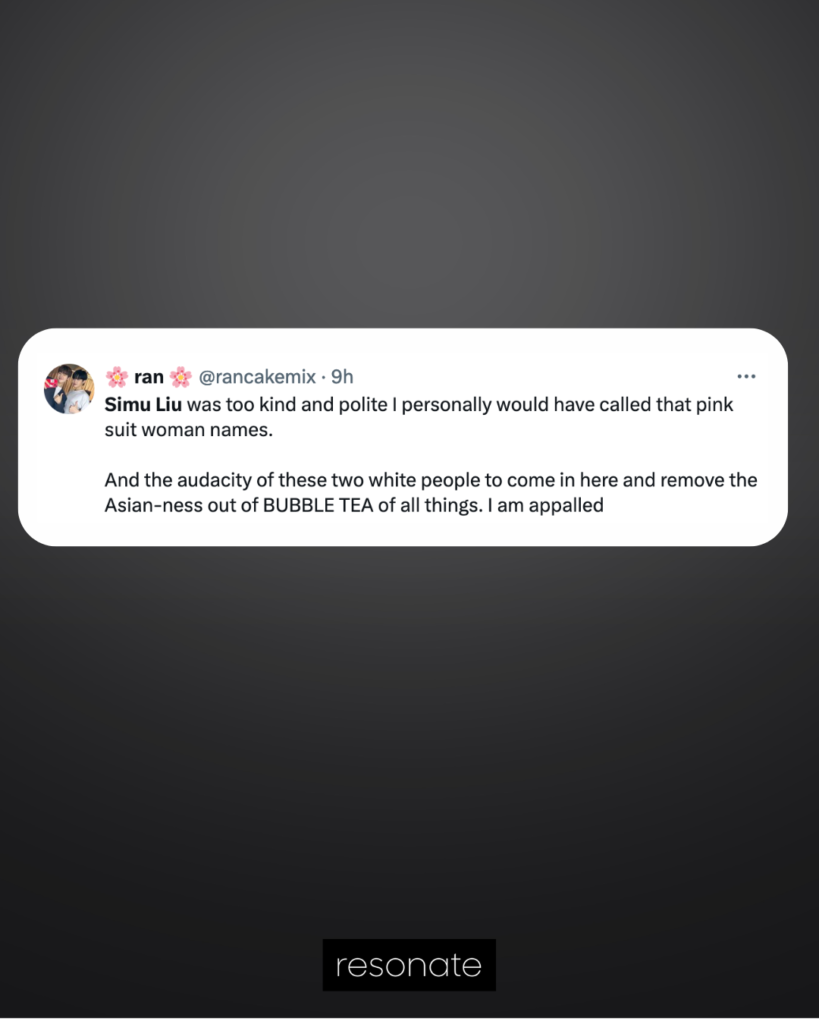
Some users have applauded Liu for using his platform to call out what they perceive as cultural appropriation and for advocating for greater respect and recognition of Asian culture. One Twitter user commented, “Simu Liu calling out the yt people coming out with Bobba talking about ‘we’re making boba tea better’ and judges ignoring his commentary on cultural appropriation is an example of having a seat at the table and still being ignored. Brands take note when entering cultural markets.”


The episode concluded with “Bobba” accepting an offer from another investor, Manjit Minhas. However, the controversy surrounding Liu’s comments has left viewers pondering some important questions.

Did Simu Liu go too far in his criticism, or was he justified in raising concerns about cultural appropriation? Should entrepreneurs be held to a higher standard when it comes to respecting the cultural origins of products?

Bubble Tea - Boba
Cultural-Appropriation

Pho

[URL=“https://nextshark.com/uk-pho-restaurant-trademark-backlash-response”]
UK restaurant chain responds to latest backlash over ‘Pho’ trademark

via @phorestaurant
By Carl Samson
2 days ago
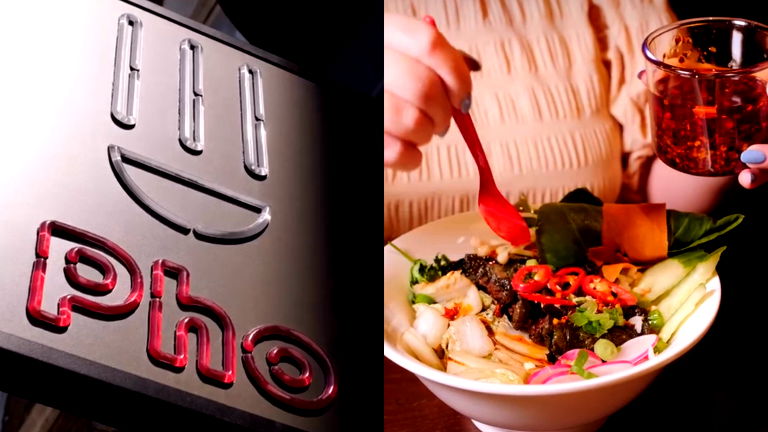
U.K.-based chain Pho Restaurant has issued a statement in response to renewed backlash over its trademark of the word “Pho.”

About the trademark: Founded in 2005 by Stephen and Juliette Wall, Pho Restaurant trademarked the words “PHO,” “Pho” and “pho” in the 2000s as part of their branding efforts. The couple, who fell in love with pho during a trip to Vietnam, said they filed the trademark to protect their restaurant’s identity. They first faced backlash in 2013 after reportedly forcing Mo Pho, a smaller Vietnamese-owned business, to change its name due to infringement. In a video posted over the weekend, TikToker @Iamyenlikethemoney called attention to the issue, reviving criticism against the company.

What the company is saying: Pho Restaurant addressed the latest controversy in an Instagram post on Thursday, saying that its trademark has been “misunderstood.” The chain stressed that it “would never attempt to trademark this dish” and that “ph” — Vietnam’s national dish and how it is spelled there — “doesn’t belong to anyone but the people of Vietnam.” The company responded similarly in 2013, saying they only trademarked “the restaurant name, not the dish” after they “came under attack by a large U.S. chain restaurant” that sought to enter the U.K. In their recent statement, Pho Restaurant further clarified that their trademark does not limit other businesses to use “ph” in their names and denied suing Vietnamese businesses.

Reactions: Despite Pho Restaurant’s attempts to explain its stance, social media users remain outraged. One Instagram user alleged that their business was among those targeted back in 2013. “The absolute LIES in this post. You would ‘never attempt to trademark this dish,’ yet I was one of the MANY independent Vietnamese restaurants targeted by this restaurant chain and their IP lawyers in 2013. Badgered to change our branding,” they noted.

As if the is SEO…:rolleyes:

Hallmark’s new mahjong movie slammed over ‘embarrassing’ lack of Asian stars: ‘Collective ancestral sigh’

“Nothing says Happy AAPI Month like appropriating Asian culture,” one user commented of the film that stars Tamera Mowry-Housley, Paul Campbell, and more.

By Joey Nolfi

Updated on April 22, 2026 12:19 p.m. ET

Yan-Kay Crystal Lowe, Melissa Peterman, Tamera Mowry, Fiona Gubelmann in 'All's Fair in Love and Mahjong'

Yan-Kay Crystal Lowe, Melissa Peterman, Tamera Mowry, Fiona Gubelmann in ‘All’s Fair in Love and Mahjong’.Credit:

Hallmark

  • Hallmark announced a new television film, All’s Fair in Love and Mahjong, set to premiere in May during Asian American and Pacific Islander Heritage Month.

  • The film stars Tamera Mowry-Housley, Melissa Peterman, Fiona Gubelmann, Paul Campbell, and Yan-Kay Crystal Lowe.

  • The network responded to the criticism in an email statement to Entertainment Weekly.

A new Hallmark TV movie centered around the popular, culturally Chinese tile-based game of mahjong has been slammed over alleged lack of onscreen Asian representation.

After Hallmark shared the poster for the upcoming All’s Fair in Love and Mahjong, comments flooded in, criticizing the film for featuring only one primary cast member of Asian descent: Yan-Kay Crystal Lowe, who is of Scottish-Chinese ancestry. Lowe stars in the film opposite Tamera Mowry-Housley, Melissa Peterman, Fiona Gubelmann, and Paul Campbell.

“Collective ancestral sigh…” wrote Wong Fu Productions creative Philip Wang, while writer Kat Lieu pointed out that the film is set to be released in May, at the start of Asian American and Pacific Islander Heritage month.

“Ah yes, nothing says Happy AAPI Month like appropriating Asian culture,” Lieu wrote.

Other comments ranged from calling the project “embarrassing” to one person questioning whether or not the characters and cast could effectively play the game at the center of the plot.

“Can anyone in the cast actually read the characters on the tiles or are they just all channeling their inner Marco Polo?” the comment read.

According to a Hallmark press release, the film was directed by Jessica Harmon, with a script by Betsy Morris and Nina Weinman. The film is a Muse Entertainment Production, with Joel S. Rice, Aren Prupas, Allen Lewis, Ronni Rice, and Charles Cooper serving in various producer roles.

In a statement to Entertainment Weekly, a Hallmark spokesperson writes, “All’s Fair in Love & Mahjong is a love story with connection at its core, highlighting family, friendship, and motherhood with warmth and humor. The movie honors the heritage of mahjong by recognizing the game’s Chinese origin and its unique ability to connect cultures, generations, and communities.”

EW has reached out to representatives for Muse, Harmon, and all members of the principal cast for comment.

According to Hallmark’s official synopsis, the film follows a school nurse who “finds unexpected hope through teaching mahjong, the centuries‑old Chinese game, that helps her build community and open her heart again.”

Stills from the film see the project’s predominantly female cast engaging in various social activities: singing karaoke, having drinks at a bar, and posing for pictures at a park.

Melissa Peterman, Yan-Kay Crystal Lowe, Fiona Gubelmann, Tamera Mowry in 'All's Fair in Love and Mahjong'

Melissa Peterman, Yan-Kay Crystal Lowe, Fiona Gubelmann, Tamera Mowry in ‘All’s Fair in Love and Mahjong’. Hallmark

In a Time piece published in 2021, writer Cady Lang summarized the power of mahjong as an enduring staple in Chinese American culture.

“This throughline of connection is one that also spans generations and groups. As a young Chinese American girl growing up in the Bay Area, I played mah-jongg as a way to bond with my grandparents,” Lang wrote at the time. “Now, after moving to Brooklyn as an adult, playing mah-jongg at a local Asian grocery store has become a weekly fixture on my social calendar, as friends who learned how to play American-style with their bubbes shuffle tiles alongside new friends from the neighborhood who are playing for the first time.”

Get your daily dose of entertainment news, celebrity updates, and what to watch with our EW Dispatch newsletter.

The game also served as a prominent plot point in John M. Chu’s blockbuster adaptation of Kevin Kwan’s Crazy Rich Asians, during a key climactic scene between Constance Wu and Michelle Yeoh.

All’s Fair in Love and Mahjong is set to premiere Saturday, May 9 on Hallmark.

With the shifts in world power being ever more prominent, what used to be dreaded rituals of media humiliation from Hollyweird now rings ever hollow. Its powers becoming ever more irrelevant. Nowdays when I rarely/accidentally come across typecasting I don’t feel anything at all. It’s like an arrogant child pushing and punching a small tree until it grows ever larger and taller.

1 Like