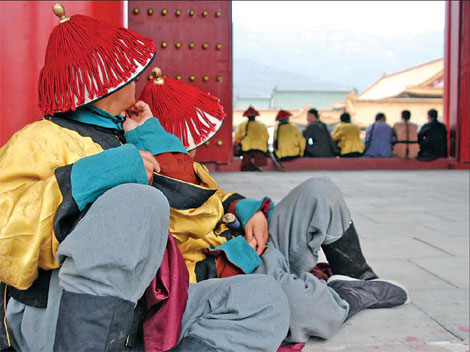
Chollywood rising

[QUOTE=SimonM;1107882]I suspect part of Zhang Ziyi’s issue in china was the “too much like Gong Li” effect.

Also, for reasons I’ve never been able to fully comprehend a lot of Chinese men I spoke to found her really ugly.[/QUOTE]

Wow. I certainly wouldn’t think of her as ugly. I wonder if it had to do with her having been so visible internationally, so quickly?

The xinhua version

I know…this is redundant to my KFP2 post, but that was the Variety version.

China’s box office soared by nearly 18 pct in first half of 2011
English.news.cn 2011-07-13 19:44:00

BEIJING, July 13 (Xinhua) – China’s overall box office earnings for the first half of 2011 reached nearly 5.7 billion yuan (881 million U.S. dollars), up nearly 18 percent year-on-year, the State Administration of Radio, Film and Television (SARFT) said in a report issued Wednesday.

Domestic films took in 2.93 billion yuan, an increase of 38 percent over the same period last year, while foreign films raked in 2.77 billion yuan, up 1.6 percent, according to the SARFT film bureau.

“Beginning of the Great Revival,” a star-studded film marking the 90th anniversary of the founding of the Communist Party of China (CPC), topped the domestic list, with earnings of 304.69 million yuan as of the end of June, according to the report.

Hollywood blockbuster “Kungfu Panda 2” was the highest-ranked foreign film, pulling in ticket sales worth 596.75 million yuan, followed by “Pirates of the Caribbean: On Stranger Tides” (472.06 million yuan) and “Fast Five” (255.14 million yuan), the report said.

China’s 2010 box office topped an unprecedented 10 billion yuan, according to the report.

China film propanganda? Really?

Funny, I was just ruminating about this while watching Bodyguards & Assassins again last night.

China’s film industry
Kung fu propaganda
There’s a ton of easy money in praising the party
Jul 14th 2011 | HONG KONG | from the print edition

THERE are two ways to make a box-office smash. One is to take an exciting script, hire famous actors, shoot a rollercoaster of a film, distribute it widely and market it deftly. This is the Hollywood way, and it worked pretty well for Harry Potter.

The Beijing way shares some features with the Hollywood way, such as hiring lots of stars and distributing the film widely. But the magic ingredient behind China’s latest blockbuster was one unavailable to the mightiest Tinseltown mogul. It was the power of the party.

“The Beginning of the Great Revival”, a celebration of the founding of the Communist Party, opened at every cineplex in China on June 15th, in time for the party’s 90th birthday. Competing films with a shred of drawing power were blocked, even the awful “Transformers 3”. Many state-owned firms ordered their staff to attend. Schools organised trips so that pupils could watch and learn from the exploits of a youthful Mao Zedong. Government departments deployed waves of bureaucratic bottoms to fill seats. Online reviews alleging that the masterpiece was rather dull were censored. Success was assured.

The film was not, as you might imagine, a piece of government-produced propaganda. It was a piece of for-profit propaganda, produced by the country’s biggest film company, the China Film Group (CFG). Along with a smaller firm in which it holds a 12% stake, CFG controls more than half of all domestic film distribution in China. The two firms also distribute the 20 foreign films that China allows in each year.

CFG spins tales of love, disaster, war and kung fu, of course. But the easy money is in patriotic pap. In recent years, the firm has produced “Nanking! Nanking!” (about heroic Chinese resistance to Japan during the second world war) and “The Founding of a Republic” (about the Communist takeover in 1949).

Such films are profitable partly because their stars do not expect to be paid much, if anything. About 100 famous actors worked for nothing on “The Founding of a Republic”. An even more impressive 172 stars with Chinese ties signed on for “The Beginning of the Great Revival”, for compensation that, according to the director, amounted to less than the cost of lunch boxes for the crew.

“The Founding of a Republic” cost 30m yuan ($4.6m) to make and brought in a tidy 420m yuan. “The Beginning of the Great Revival” cost 80m yuan, but has been a bit of a disappointment at the box office, having brought in only 340m yuan so far. Still, that is a return that would thrill any investor in Hollywood.

Cinema in China is booming (see chart). In 2010 box-office revenues grew by 64% to just over 10 billion yuan. More than 520 films were made—about as many as in America. Only India produces more. China boasts the world’s largest outdoor film studio, called Hengdian World Studios, which includes a full-scale mock-up of the Forbidden City.

Tickets to Chinese cinemas are costly—about 80 yuan at weekends. The lack of copyright protection means that almost all revenue must come from the box office rather than from DVDs or television. Audiences are paying for the experience of an afternoon away from their cramped apartments, rather than simply to see the film (illegal versions of which are widely available). Cinemas are clean and airconditioned. Many have state-of-the-art screens and sound systems. The snacks are quite good, too.

Smash hits such as “Great Revival” may not travel well. Foreign bottoms are less biddable. But as Sam Goldwyn supposedly said: “Don’t pay any attention to the critics; don’t even ignore them.”

We’ve discussed The Beginning of the Great Revival here and The Founding of a Republic here. We haven’t discussed Nanking! Nanking!, but we did discuss Nanking. :wink:

PE in Chinese film

Private Equity, not Physical Education. I know you were confused. Not quite sure how private equity figures into a communist government. Not sure I really want to know, come to think of it…:rolleyes:

July 18, 2011, 2:44 PM ET

They’re Gonna Put PE In The Movies (In China)
By Jonathan Shieber

Some of China’s top funds and investors are getting into the film and culture business in China in a bigger way as the Chinese government tries to boost China’s cultural clout.

The Chinese film industry has long envied Hollywood’s international clout and the Chinese government jealously eyes the soft-power muscle of the U.S. film industry as a potent force behind the American “brand,” so it’s no wonder the government is pumping billions of yuan into investment firms to build up its own players.

Leading the charge is BOC International Holdings Ltd. (BOC International), a subsidiary of the Bank of China, which earlier in July raised the target size of its private equity fund focused on the media industry to 20 billion yuan ($3 billion) from an initial CNY10 billion target, according to analysts and reports in the state-run China Daily. So far, the fund has raised CNY4 billion ($615.8 million) from its initial backers.

The BOC International fund has some state-backed competition from rival CCB international (Holdings) Ltd., an investment bank owned by China Construction Bank Corp., which launched a CNY2 billion ($307.7 million) CCB International Cultural Industry PE Fund in Beijing in April.

Both funds invest in industries such as publishing, film and broadcasting. The BOC International fund has reportedly backed China Publication Group and Xinhuanet.com, according to China Daily, which itself cited Shanghai Securities News, a financial publication owned by Xinhua. CCB International made its first investment in the privately held Beijing Galloping Horse Film & TV Production Co.

“While they will make investments in privately held companies like Galloping Horse, most of the funds would go to state-owned media companies,” said Ran Wang, chief executive of the investment bank China eCapital, and an advisor on the Galloping Horse transaction. “That would restructure the media industry to spin off some of their operations and assets into market-driven and commercially viable new-media focused entities.”

Not to be outdone, venture capital and growth capital investors SAIF Partners and IDG Capital Partners, as well as Matrix Partners China and Sequoia Capital China have all backed companies in the media industry as well.

IDG Capital and SAIF Partners have jointly invested in the stealthy film production company Sky Land, which produces, distributes and finances China-themed films that target audiences in both the U.S. and in China.

One of the company’s first films to receive a U.S. distribution deal is ‘Snow Flower and the Secret Fan,’ which was financed and jointly produced by Sky Land and individuals including Wendi Deng Murdoch, wife of News Corp. Chairman and Chief Executive Rupert Murdoch, and IDG Capital Partners chief Hugo Shong. News Corp. is the publisher of the Wall Street Journal, and of this blog.

According to its website, Sky Land’s Los Angeles office is now accepting film submissions, but aspiring screenwriters should be sure not to send anything that might offend Chinese sensibilities.

Sky Land is still private, but other venture-backed companies in the media industry, like Bona Film Group Ltd., which was backed by Matrix Partners China and Sequoia Capital China, listed in December 2010 on Nasdaq.

U.S. investors have their own China gateway in the newly formed Legendary Pictures East, a joint venture between the privately held Legendary Pictures LLC and the Shenzhen-listed Huayi Brothers. Legendary is backed in part by Accel Partners, which is also a partner of IDG Capital.

CORRECTION: Film production company Huayi Brothers is listed in Shenzhen. A previous version of this post mistakenly said Huayi was listed in Hong Kong.

Good Xinhua take on things

Chinese films explore ways to compete with Hollywood
English.news.cn 2011-08-30 10:37:00
by Yang Liang, Yang Aihua

BEIJING, Aug. 30 (Xinhua) – For Hollywood, the Chinese film market presented a splendid box-office report this summer.

And among the top five box-office hits of all time in China, three are from Hollywood: “Avatar” with 182 million U.S. dollars, “Transformers: Dark of the Moon” with 145.5 million dollars and “Kung Fu Panda 2” with 91.5 million dollars.

However, “Legend of a Rabbit,” a 3D animated movie produced completely by a Chinese team and aimed at competing with the best of the West, grossed only 16.2 million yuan (2.5 million dollars) in the Chinese market last month after its release on July 11.

The 18.8-million-dollar 3D production, which took more than 500 animators three years, on Sunday shared the Best Animation Award of Huabiao, China’s highest government honor in the film industry, along with three other animations.

The different performances of China’s “Rabbit” and the United States’ “Panda” in the world’s fastest growing movie market, whose box office gross increased by 64 percent last year to 1.5 billion dollars, also mirrored the wide gap between the box-office receipts of the two countries’ films in each other’s market.

In the last few years, China has become a key destination for big Hollywood films. “Avatar,” “Transformers: Dark of the Moon,” “Inception” and “2012” all grossed more ticket numbers in China than they did anywhere else outside the United States.

However, Chinese films, even the blockbusters at home such as the earthquake drama “Aftershock,” could not make a success on the U.S. market.

SUCCESSES RARE FOR CHINESE FILMS IN U.S. MARKET

Chinese-made films were first launched in North America in the 1980s.

However, successes had been rare until December 2000, when “Crouching Tiger, Hidden Dragon,” a kungfu drama directed by Ang Lee, hit the screen.

As the most profitable Chinese film, the movie, released by Sony Pictures Classics, grossed a total of 128 million dollars in roughly 2,000 theaters in the United States.

Almost four years later, “Hero,” a smash directed by Zhang Yimou and distributed by Miramax, made another wave by garnering 53.7 million dollars in ticket sales, making it the second most profitable Chinese film in the U.S. market and a No. 1 movie at the U.S. box office for two weeks in a row.

But still, many Chinese films have met with failures in terms of box office record after brief showings in a small number of U.S. theaters.

“Aftershock,” which grossed over 100 million dollars in China, earned only 60,954 dollars in 25 U.S. theaters. John Woo’s 80-million-dollar “Red Cliff” netted merely 627,047 dollars in 42 U.S. theaters in 2009.

China Lion Film Distribution, a Los Angels-based company that distributes Chinese-language films via an exclusive deal with AMC, North America’s No. 2 theater chain, for the U.S. and Toronto markets, has distributed several Chinese-language films in the United States over the last year, including “Aftershock,” “The Warring States,” “A Beautiful Life” and “If You Are the One II.”

“If You Are the One II,” a romantic comedy directed by Feng Xiaogang, earned 427,000 dollars, with more than 90 percent of the viewers being Chinese or Chinese Americans.

Such earnings, humble even by Chinese standards, are already much better than other Chinese films released in the United States. Most of the Chinese-language films were just screened in around 20 U.S. theaters. Over the decade, although Chinese films have increased their presence in U.S. theaters, most U.S. moviegoers still tend to patronize Chinese martial arts films rather than straight dramas or comedies.

Those Chinese films that are not kungfu movies are usually screened in “art house” cinemas in major cities – the main location for foreign-language films from around the world.

“Chinese films in the United States are subject to market forces,” Richard L. Anderson, an Oscar winner in sound effect, told Xinhua. “The U.S. distribution companies are audience-driven. They buy what they think they can sell here.”

STORY-TELLING IS THE BIGGEST ISSUE

Then, what are the reasons that make the “audience-driven” U.S. distribution companies think Chinese films are not marketable?

Foreign-language films rarely find more than a niche audience in the United States. Their tastes and cultural preferences obviously are barring them from watching Chinese-language films.

“Red Cliff” ended in a fiasco with only 627,047 dollars on the U.S. market. But in Japan, the film quickly became a phenomenon when it opened in 2008 and was one of the hottest movies that year.

Besides hot actors in the movie, Japanese viewers’ knowledge of the Chinese novel “Romance of the Three Kingdoms,” which the movie was adapted in part from, served well.

It was the same case in France for “Detective Dee and the Mystery of the Phantom Flame.” The kungfu movie, directed by Tsui Hark, did fairly well when it opened in the European country in April. It ranked the ninth in the French box office back then, an excellent performance for a foreign film.

Experts say that the success of the movie was due to the French people’s familiarity with the main character, Detective Dee, who had been made famous in Western countries by late Dutch diplomat and writer Robert Van Gulik.

Van Gulik translated “Dee Goong An (Stories of Detective Dee),” an 18th-century Chinese detective novel, into English and used it as the basis for his own series of detective novels about Judge Dee.

Besides the preference of the U.S. audience to local films, Chinese films have their own problems.

Technology has always been an integral part of filmmaking. But lack of professionals in filmmaking has plagued the Chinese industry for years.

Feng, director of “Aftershock,” said that when he shot the earthquake drama, numerous disaster scenes had to be processed abroad.

Although there was an imported apparatus with more than 5,000 functions of audio and visual effects, the machine could not play its due role “because technicians can only use perhaps 500 of them,” Feng said.

Meanwhile, although there are a small group of actors, directors and producers at the top of the movie industry who are extraordinarily successful, talent among screenwriters and directors has not been actively cultivated.

“Money is not the problem. The film industry is desperate for creative talent,” said Wang Zhongjun, chairman of Huayi Brothers Media Group, China’s first listed private film company.

Three years ago, when “Kung Fu Panda” broke the Chinese box office record for highest-grossing animated features with 180 million yuan (26 million dollars), many questioned why the DreamWorks film had not been made by a Chinese company, as it borrowed heavily from Chinese culture.

For years, local moviegoers have been complaining why Chinese animations could not be as funny and palatable as their Hollywood counterparts.

“Dinosaur Baby,” a local animation screened in April and May, lost out to Fox’s “Rio.” When “Legend of a Rabbit” was released last month, many questioned the originality of the movie, saying it was just an imitation of “Kung Fu Panda” and even the posters were alike.

The U.S. audience’s preference to domestically produced movies and China’s lag in filmmaking technology are certainly obstacles, but insiders say that story-telling seems to be the biggest problem that fails Chinese films in both domestic and foreign markets.

Mark Osborne, one of the directors of “Kung Fu Panda,” once said that if Chinese animation filmmakers want to learn something from Hollywood, they should learn “how to tell an interesting story.”

Hollywood’s story-telling methods are not unique to the United States but are universal ways to attract human souls, he said.

Yin Hong, a professor of film and television studies with Beijing-based Tsinghua University, said that Chinese films have not yet found a cultural and artistic strategy for telling a Chinese story with a global perspective and for expressing universal cultural values through film language.

“The American society is such a multi-racial, multi-cultural culture that they have been able to make movies for the lowest common denominator,” Chris D. Nebe, an acclaimed Hollywood writer, producer and director, told Xinhua in Los Angeles. “That’s why everybody understands them and likes them.”

continued next post…

from previous

CO-PRODUCTION A WAY OUT

China has been endeavoring to let its films go global in ways including participation in various film markets and renowned international film festivals.

But among the efforts, experts say creative partnerships between Chinese and foreign companies are one of the most important and effective ways.

Co-production can help not only to grow China’s own industry but also to export Chinese movies. Introducing Chinese movies to the world is part of China’s cultural strategy that helps to build up its soft power.

“To increase our share in the international film market, we must spend much more efforts on film promotion and marketing,” Yang Buting, board chairman of China Film Promotion International, told Xinhua.

“Hollywood’s successful global distribution system will benefit Chinese films through co-production. To cooperate with foreign companies, it will be their job to distribute the film in their countries. This is much more effective than selling the film by ourselves,” said Yang.

Actually, partnerships between Chinese and Hollywood moviemakers have been proliferating. Oscar-winning actor Christian Bale played the leading role in Zhang Yimou’s “The 13 Women of Nanjing.”

Meanwhile, Mike Medavoy, producer of “Black Swan,” who was born in Shanghai, is working with Beijing-based film promoters to help Chinese films go global. Hugh Jackman starred in “Snow Flower and the Secret Fan,” Wendi Murdoch’s first co-produced movie.

In addition, Oscar winner Branko Lustig, producer of “Schindler’s List,” has announced his plan to produce “The Melanie Violin,” a movie about Jewish refugees in Shanghai during the Second World War.

In one of the latest big moves, Huayi Brothers Media, China’s largest independent film studio, and Los Angeles-based production company Legendary Entertainment, maker of such global box-office hits as “Inception” and “The Dark Knight,” formed in June a new China-U.S. venture called Legendary East.

Earlier this month, the newly-formed, Hong Kong-based and Chinese-managed entertainment company announced its first project: “The Great Wall,” which is designed to be a “globally-appealing” adventure movie and will be directed by Edward Zwick, director of “The Last Samurai.”

In China, the project will be distributed by Legendary East’s co-production partner, Huayi Brothers. Warner Bros. is expected to handle other territories.

As China is advancing fast, especially in film financing and distribution, some have warned that what is more important is the real quality of movies.

“I know some films were done in only a month. No one talked thoroughly of the screenplay. It is not this case in Hollywood. A good screenplay needs to be worked on time and time again,” Gong Li, one of the best known Chinese actresses in Hollywood, told Xinhua.

Since 2005, the Chinese government has invested heavily in infrastructure projects, including new theaters in China’s major cities. There are now more than 6,000 screens across the country, and many of them are digital. In 2010, more than four screens were set up every day.

But with the high speed of hardware development, the artistry of Chinese films is yet to improve. According to Yin, the Tsinghua University professor, only about 100 of the 500-plus movies produced in China last year met acceptable art standards.

“It is easy to buy buildings, for example, and see the cash flow. It is harder to go into the software business of making films. It has to be done methodically and in a way that makes both economic and strategic sense,” said Medavoy, producer of “Black Swan.”

Meanwhile, Dan Mintz, CEO of DMG Entertainment, pointed out that identifying the target audience group is the key to success for co-produced works. It is either an international film with Chinese elements or a Chinese film with global faces.

For a Chinese filmmaker to win over the U.S. viewers, the most important thing is that he has to incorporate the Chinese elements with Western ones in terms of story-telling and film techniques, said Nebe.

The Hollywood writer was involved in producing with Chinese filmmakers “Mysterious China,” an award-winning series of documentaries exploring China and its 5,000-year-old culture.

“Since we want ‘lao wai’ (foreigners) to understand China, we have to give them information in the ‘lao wai’ fashion,” he said.

(Additional reporting by Wang Jun in Los Angeles, Jiang Zhenni and Tang Ji in Paris, Rong Jiaojiao in New York, and Wang Fengfeng in Washington)

I’m inclined to agree. Chollywood is all about co-production now.

Speaking of co-production…

This article sums up a lot of the discussion across several threads on this forum.

Hollywood targets Chollywood as LA studio enters $220m joint venture

Legendary Entertainment’s Chinese partnership bypasses limit on number of foreign films released, and their box office takings

Dominic Rushe
guardian.co.uk, Monday 22 August 2011 16.14 BST

The Hollywood producer behind the Hangover movies and Inception has joined forces with a Chinese studio to create a $220.5m (£134m) venture aimed at China’s increasingly lucrative film market.

The partnership between Legendary Entertainment and Huayi Brothers Media Corp plans to make one or two “major, event-style films” a year for worldwide audiences starting in 2013.

The two companies said they were selling a 50% stake in the venture, Legendary East, to Hong Kong construction company Paul Y Engineering.

The deal allows Legendary Entertainment to bypass Chinese import restrictions that limit the number of foreign movies released in China to about 20 a year and restrict box office takings for foreign firms.

Hollywood is increasingly targeting the Chinese market, which is adding 1,400 screens a year. Chinese box office takings rose 64% to $1.5bn (£910m) in 2010, a fraction of the US’s $10.6bn receipts, but a growth rate that puts the country on course to become one of the largest film markets in the world.

Legendary Entertainment’s chairman, Thomas Tull, said: “With China’s rapid economic growth and rich cultural background, this is a film-making marketplace on the rise.”

Kelvin Wu, chief executive of Legendary East, said: “We want to do globally appealing movies, so there will be a lot of elements involving east meets west.”

Recent Huayi releases include Aftershock, a record-breaking disaster movie directed by Chinese box-office favourite Feng Xiaogang, the kung fu drama Shaolin and critically acclaimed fantasy epic Detective Dee and the Mystery of the Phantom Flame. Its films accounted for 17% of China’s box office in 2010.

“There’s huge room for growth and we want to be ready to enjoy the bigger market when it’s there. We don’t want to come in when the market is mature,” said Wu.

The joint venture is the latest in a series of Sino-US ventures as Hollywood targets “Chollywood”. Walt Disney has worked on several coproductions with Chinese firms, including a reworking of its hit High School Musical, in partnership with Huayi Brothers.

Beijing-based DMG Entertainment recently agreed to finance Looper, a sci-fi movie starring Bruce Willis, after the production signed up Chinese star Xu Qing. Relativity Media, producer of Cowboys & Aliens, recently agreed to make and distribute movies in China with Beijing-based Huaxia Film Distribution Co. The remake of Karate Kid, starring Jackie Chan and Jaden Smith, was produced by Sony’s Columbia Tristar and state-owned China Film Group. News Corp’s Fox Searchlight and Beijing-based IDG China Media teamed up for Snow Flower and the Secret Fan. Wendi Deng, wife of News Corp chairman Rupert Murdoch, is listed as a coproducer.

The rise of China is even redefining Hollywood villainy. MGM recently cut the Chinese baddies out of its remake of submarine drama Red Dawn and replaced them with North Koreans. Chinese flags were digitally altered and dialogue re-dubbed for fear of angering the Chinese authorities, which have a history of banning western film-makers.
My only addition here is that Disney’s Chinese version of HSM flopped, remember?

More on Co-production

Chollywood co-productions. Perhaps that should be the subject of my next Chollywood column in KFTC…

September 08, 2011, 5:45 PM EDT
China and Hollywood Team Up for More Co-Productions
The mainland is using partnerships with Western studios to develop its own movie business
By Frederik Balfour and Ronald Grover

Bruce Willis’s mob hit man travels to the future in next year’s movie Looper. Thanks to backing from Beijing-based DMG Entertainment, that future is in China. DMG funded the production on condition that the location was moved from France and a role was written especially for Chinese actress Xu Qing. By jumping through these hoops, the movie now qualifies as a Chinese co-production, exempting it from the nation’s 20-film-per-year import quota and allowing foreign backers to keep three times as much in box office receipts. “We are trying to be relevant to a significant market,” says DMG Chief Executive Officer Dan Mintz. “The industry is growing like a rocket ship.”

Looper is one of a wave of Sino-U.S. productions as Hollywood looks to expand in China, which is adding more than 1,400 cinema screens a year. The 2010 remake of Karate Kid, starring Jackie Chan and Jaden Smith, was produced by Sony Pictures’ (SNE) Columbia TriStar and state-owned China Film Group. Fox Searchlight Pictures and Beijing-based IDG China Media teamed up for Snow Flower and the Secret Fan. “Everyone is coming in to join the bandwagon,” says Hong Kong-based Bill Kong, who co-produced the 2000 hit Crouching Tiger, Hidden Dragon. “Ten years ago, if you made $3 million in China, you would be jumping up and down. Today it’s more like one or two hundred million.”

Box office receipts in China grew 64 percent last year, to 10.2 billion yuan ($1.6 billion), according to the State Administration of Radio, Film and Television. While that’s a fraction of the $10.6 billion in U.S. receipts, according to Box Office Mojo, China is a huge potential growth market for Hollywood. Its cinema-building will more than double the number of screens by 2015, from 6,200 at the end of 2010, says Mintz.

James Wang, 41, and his older brother Dennis made their first movie, the comedy Party A, Party B, in the mid-1990s. It earned $4 million, “a blockbuster at the time,” he says. Last year, Wang, CEO of Huayi Brothers Media, China’s largest independent film producer, released Aftershock, a Feng Xiaogang film about the 1976 Tangshan earthquake. It made $105 million.

Beijing is using its quota system to prevent the spread of foreign culture and promote its fledgling domestic film industry. “China is keen on promoting its soft power,” says Shen Dingli, a professor at the Center for American Studies at Shanghai’s Fudan University. Joint film productions serve “the political purpose to promote our culture and systems with Hollywood’s competence.”

DMG is raising $300 million for a fund to help U.S. film franchises qualify as co-productions. To gain that status, films must be licensed by China’s media regulator, which sets rules on the film’s finances, its location, and the percentage of Chinese stars in the cast. Among the benefits: A co-production gets to keep 47 percent of box office receipts, vs. as little as 13.5 percent for imported films. Kong turned The Mummy: Tomb of the Dragon Emperor into a co-production with NBCUniversal’s Universal Studios and China Film Group four years ago. Filming took place in China, and Jet Li and Isabella Leong were among the Chinese actors added to the cast. “It wasn’t a great movie, but it utilized a big American franchise in China,” Kong says. “The time will come when there are more.”

Huayi’s Wang recently teamed with Thomas Tull, founder of Legendary Pictures, whose hits include The Dark Knight and The Hangover, to start a venture called Legendary East. The unit will make films in China targeting international and local audiences, financed in part through the sale of a 50 percent stake to Hong Kong-based Paul Y. Engineering Group for $220.5 million. West Hollywood-based Relativity Media, one of the financiers of Cowboys & Aliens, on Aug. 14 announced a $100 million joint venture with Huaxia Film Distribution to produce films and TV shows in China.

Getting the formula right isn’t easy. Some U.S. hits have struck gold in China, with Avatar grossing $216 million in ticket sales. By contrast, the Chinese version of High School Musical, made by Huayi with Walt Disney (DIS) in 2010, earned less than $155,000. Chinese audiences, says Wang, don’t like musicals.

The bottom line: Hollywood studios are teaming up with Chinese film companies to bypass profit-restricting quotas on foreign films on the mainland.

Balfour is Asia correspondent for Bloomberg Businessweek in Hong Kong. Grover covers the media and entertainment industry for Bloomberg Businessweek in Los Angeles.

China operation

KFP2’s impact really shows the paradigm shift.

DreamWorks ‘eyes China operation’
(AFP) – 5 hours ago

BEIJING — The Hollywood company behind the hit “Kung Fu Panda” movies is to open a new Shanghai operation to make films specifically for China’s booming market, a recruitment firm told AFP on Wednesday.

DreamWorks Animation has hired Los Angeles-based RSR Partners to recruit a president for the planned venture, making it the latest in a line of Hollywood giants to attempt to break into the potentially lucrative market.

No one at the Los Angeles-based DreamWorks could immediately be reached for comment, but a letter from RSR to prospective hires seen by AFP said the company was looking to “establish a production and development presence in China”.

The “Kung Fu Panda” movies were made with a Chinese audience in mind and the second in the franchise became the highest-grossing animated feature ever screened in the country when it was released this year, taking 597 million yuan ($93 million).

Several Hollywood companies are trying to get a foothold in China, where box office sales rose 64 percent to $1.5 billion in 2010, making it the world’s fastest-growing movie market.

RSR managing director Gary Matus told AFP his firm had been hired to recruit staff for DreamWorks’ expansion into China, but that he did not know when the new venture would open.

“There are regulatory hurdles that remain,” Matus said, adding that the search process would take at least 90 days.

Foreign media companies setting up shop in China must work with local majority partners and are subject to strict regulations about the sort of content they are allowed to produce for distribution inside the country.

China limits to 20 a year the number of imported films it allows to share box office takings, but foreign companies can skirt the import cap by co-producing films with Chinese partners.

DreamWorks chairman Lewis Coleman met with the state-run China Film Group in Beijing two weeks ago, a source who asked not to be named told AFP.

The move comes weeks after two other Hollywood production companies, Relativity and Legendary, launched ventures with Chinese partners.

In August, DreamWorks became the second Hollywood studio after Warner Brothers to enter into a distribution deal with the popular Chinese online video sharing site Youku.com.

In 2008, the company’s co-founder Steven Spielberg drew China’s ire by quitting as advisor on the Beijing Olympics to protest the country’s failure to pressure the government of Sudan over the conflict in Darfur.

A third -wood

The distance between Chinese movie and Hollywood is not just a red carpet
By Regional Representatives Oct 18, 2011 10:25AM UTC
By Anastasia Wang

Have you been impressed by the dragon dress displayed by Bingbing Fan, a famous Chinese actress, at the Cannes festival red carpet? Not only on the international red carpet, Chinese actresses also try to do their best at home.

Along with Chinese movies received some awards in some international filmfests, and China has its own film festival – the Shanghai Film Festival, Chinese female movie stars have appeared in many festivals and given various fashion shows on every red carpet.

Actually, compared to the film and awards, actresses’ dresses can often attract more attention and arouse more discussions on the internet. So, it seems that the fashion show do help those girls be famous or more famous at home. However, how does it work abroad? At the end of the day, they gave the show to hunt opportunities in foreign market, didn’t they?

Miss Fan’s dragon dress was a huge topic, so huge that when another actress copied this idea in China, she also got big attention and both of their pictures occupied the important positions in the entertainment section for many days. Other than such discussions, what we and she really expect are invitations to some Hollywood movies and the opportunity to show the world the quality of Chinese movies. But there is no hint yet.

Well, once upon a time, in the 1930s’, a Chinese well-known actress walked out and reached London. She didn’t give any show but received great treatment – she was invited and given a tour to British movie manufactory, and was asked to sign for foreign stars and take pictures with them. She is Die Hu, the movie queen in China at that time. After her, nobody else has been so concerned.

She was famous for leading in Chinese action movies. In those days, Chinese action movies and Hu’s “Kungfu” were fascinating to non-Chinese audiences. They were admired. This admiration still works when it helps Bruce Li, Jackie Chan and Jet Li become the most famous action actor in Hollywood, and helps Chinese director An Li back to the stage when he succeeded in directing the Chinese action movie Crouching tiger, hidden dragon.

But what is weird is that most of those movies are produced by Hollywood rather than Chinese film industry. From then on, many Chinese movie stars seek to have a place in Hollywood, like wearing unexpected dresses. Well, why not produce something really influential ourselves, by all means, there is a biggest market in China. Maybe it is time to have a third –wood apart from Hollywood and Bollywood.

Just an excuse to post Bingbing in her ‘dragon’ dress (cranes actually, but who’s quibbling?)

US-China Film Summit

Asia Society Southern California EMAsia Initiative
presents
THE US-CHINA FILM SUMMIT

US-China Film Summit is an annual gathering of thought leaders between Hollywood and China.

In 2011, the Summit is being hosted in Los Angeles and Beijing.

Join film industry leaders from Hollywood and China including top executives, government officials, producers, professionals and creatives, for an informative afternoon on the latest trends in US-China co-productions and collaborations. The US-China Film Summit highlights the growing entertainment media opportunities between established Hollywood and rapidly-emerging China.

Los Angeles Branch

November 1, 2011
2:00 - 5:30 PM reception to follow

Location: Landmark Theatres
10850 West Pico Blvd Los Angeles, CA 90064

1st Panel: Finance and Business Update
Panelists

Ryan Kavanaugh, CEO of Relativity Media

Dan Mintz, CEO of DMG

Ivy Zhong, Co-Chairman of Galloping Horse Media Group and President of Galloping Horse Film Co.,Ltd.

Moderator
Steve Saltzman, Partner at Loeb & Loeb

2nd Panel: Bridging the Creative Gap
Panelists

Tom DeSanto, Producer of “Transformers” & "X-Men” series

Dayyan Eng, Director and producer of "Inseparable” starring Kevin Spacy and Daniel Wu

David Linde, CEO of Lava Bear Films

Moderator
Bennett Pozil, Senior Managing Director - Capital Markets of East West Bank

Summit Chairman
Peter Shiao
CEO of Orb Media Group
Chairman of Entertainment and Media for Asia Society Southern California

Admission:
$95 General Admission
$75 Members
$25 Students with ID (limited availability)

The Summit Chairman, Peter Shiao was behind the Shaolin Summit earlier this year.

Summit follow up

Relativity’s Kavanaugh a No-Show at Upbeat U.S.-China Film Summit
By Fred Schruers at TheWrap
Tue Nov 1, 2011 4:27pm EDT

Just 48 hours after controversy began to swirl around his studio’s much ballyhooed Chinese co-production/distribution arrangement, Ryan Kavanaugh canceled his appearance at a four-person panel at the Asia Society’s U.S.-China Film Summit Tuesday.

The panel’s moderator blamed it on a scheduling conflict.

On Sunday, TheWrap reported that human rights groups had rebuked Relativity following the studio’s decision to film its upcoming co-produced comedy “21 and Over” in a Chinese city with an oppressive government.

If any of the 300 film industry types who filled a theater at the Landmark complex in West Los Angeles Tuesday for the event surmised Kavanaugh’s absence had something to do with that, no one present was vocal about it.

It was left to seasoned producer and executive David Linde, who as co-head of Focus Films made Ang Lee’s “Crouching Tiger Hidden Dragon,” a $235 million worldwide success, to be hailed as the key pioneer in a fusion between Chinese and American filmmaking that’s still moving grudgingly.

Deflecting the praise of panel moderator Bennett Pozil, who oversaw the film’s financing at East West Bank, Linde claimed he brought the movie to life with pre-sales around the world mostly because, “I was young and stupid and eager and excited.”

Just as crucially, he said, his partnership with Lee on such earlier, smaller global successes as “Eat Drink Man Woman,” meant that foreign rights buyers “knew that when we knocked on the door, it was their chance to stay in business with a guy who’d had not only artistic but real commercial success.”

Only 5 percent of the “Crouching Tiger’s” worldwide gross was in China, Linde said. He added, however, "People who might have been familiar with Chinese [martial arts] genre films and the country’s art house films hadn’t previously realized there could be a real marriage between the two.”

Joining Linde on the panel, along with Janet Yang (“The Joy Luck Club” and the upcoming “Shanghai Calling”) and filmmaker Dayyan Eng (whose fully Chinese-funded production stars Kevin Spacey) was writer-producer Tom DeSanto, a creative force behind global blockbusters “Transformers” and “X-Men”.

In fact, as China grinds its way from being the world’s second most prosperous market for blockbusters (and fourth globally for all box office) and towards what most observers believe will be No. 1 stature in a few years, the mood was upbeat and apolitical.

The panelists agreed that for all the progress that seems within reach, time is still needed. And China’s 7,000 cinemas, which have been proliferating at the pace of six per day, are still inadequate to answer the demand from audiences in the country that’s now around 1.33 billion in population.

Linde’s Lava Bear Films, which has a hand in Zhang Yimou’s upcoming “Heroes of Nanking” starring Christina Bale, was greeted as something of a pioneer and hero when introduced to appear on the afternoon’s second panel, “Bridging the Creative Gap”.

Echoing sentiments from producer Dan Mintz (whose "Looper” with Bruce Willis and Joseph Gordon-Levitt is a Chinese-American co-production), Linde noted that the real growth in a teamed Sino-American film industry will only come when there’s a real cultural cross-fertilization by filmmakers.

Linde said that American producers “need to find ways to interact (with the Chinese) in a progressive and proactive way … by focusing on each other’s culture. Then we can expand the potential of any movie. That’s been my great lesson.”

DeSanto self-deprecatingly said he’d adapted “Transformers” “from the original Shakespeare,” and that even he was surprised that after “every studio in town” initially passed on the franchise, the Chinese and other audiences would embrace a film in which cars turned into robots “and solved the world’s problems by punching each other out … but seeing kids in China wearing Bumble Bee tee shirts, I realized the commonality of our cultures.”

He added, however, that he skipped the chicken feet served at a celebratory banquet in Beijing.
What? Too chicken for chicken feet?

Meanwhile, back in China…

This is sort of like Chollywood’s Universal Studios theme parks. Sort of…

The reel world
Updated: 2011-10-28 09:28
By Yin Yin (China Daily)

A fighting scene in the TV series Romance of the Three Kingdoms is relived at Wuxi Studio, a movie set located near Taihu Lake. [Zhu Wanchang / For China Daily]

Chinese movie towns get in on the act and become tourist attractions

Chollywood, as the Chinese film industry is sometimes called, is taking a leading role in the tourism industry. A growing number of tourists are flocking to movie towns and parks to relive their favorite scenes on the silver screen.

These sites offer a blend of film and traditional Chinese culture to become enjoyable tourist attractions in their own right.

Here are three well-known spots to visit:

  1. Hengdian World Studios

Known to many as China’s answer to Hollywood, this movie town consists of two huge modern film studios and 12 filming sets that span various Chinese dynasties.

The studios are located in Dongyang in East China’s Zhejiang province, 160 km from the provincial capital of Hangzhou.

More than 400 films have been made in Hengdian, including major works such as The Emperor and the Assassin directed by Chen Kaige and Zhang Yimou’s Hero and Curse of the Golden Flower.

One of the studios’ largest buildings is an imperial palace built to look like the early Chinese dynasties of the Qin (221-206 BC) and Han (206 BC-AD 220) periods. The site is still frequently used to shoot movies based on these times.

The Dazhi Temple houses a 28.8-meter-high statue of Sakyamuni in its Great Buddha’s Hall. The indoor statue is considered the largest of its kind in the country.

The movie site also offers entertaining rides and spectacular performances, such as man-made volcanoes that erupt and torrential floods that “sweep” through parts of the area.

Some buildings on site are also based on one of China’s most prized scroll paintings, Along the River During the Qingming Festival, which dates back to the Song Dynasty (960-1279) and consists of a panoramic display of riverside city celebrating the Tomb Sweeping Festival.

  1. Shanghai Film Shooting Base

What was Shanghai like in the 1930s when it captured the imagination of the world as one of the most enchanting cities of the East?

Located in the Songjiang district of southwest Shanghai, this shooting base offers a peek at what the “Paris of the East” was like and acts as a theme park reproducing Shanghai during some of the city’s most colorful times.

Visitors will find many familiar scenes in the park, including Nanjing Road in the 1930s, the downtown of Old Shanghai, European-style buildings, a classical Catholic church, Suzhou Creek and landmark bridges. There is also a cross-town tram for visitors to further relive bygone eras.

Wanderers can stop by at the Town God’s Temple (Chenghuangmiao), a Taoist temple for the guardian of the city and where the Eight Immortals of Taoist legend are engraved in a richly decorated archway.

Vintage shops out on the streets display the prosperity of Old Shanghai. At the watchmaker’s shop, tourists can look at many kinds of clocks made in a classic style. In the clothing store, Chinese qipao dresses and Western-style clothes are displayed to help reproduce precious slices of life in Shanghai that are fast disappearing in today’s world.

Canals and cars of the early 20th century dotting the base act as props for movies and backdrops for snap-happy visitors.

Iconic Chinese actors such as Zhou Xuan, Ruan Lingyu and Shangguan Yunzhu are also honored with wax figures on the site.

When audiences watch scenes of Old Shanghai in their favorite Hong Kong or Chinese mainland productions, chances are they are looking at this filming base.

  1. Wuxi Studio

This movie set, located near the scenic Taihu Lake, has been home to popular TV offerings such as the Romance of the Three Kingdoms and The Water Margin.

An area set aside for the Three Kingdoms period (AD 220-280) alone occupies 35 hectares. Structures such as Emperor Wu’s Palace, Ganlu Temple and the Beacon Tower in the style of the Eastern Han Dynasty (AD 25-220) can be found here.

Special effects used to depict the decisive Battle of Red Cliffs serve up ancient warships berthed along the river and dazzling battle flags flown at gates to help recreate a grand and solemn moment that turned the tide of Chinese history.

A scenic spot found in the Water Margin is located next to the Three Kingdoms set and is made up of three main areas. Visitors in the County area can take in scenes depicting the life of people during the Song Dynasty.

Buildings in the Capital area are exquisite and showcase the prosperity during those times. The Liangshan Mountain area is built beside a lake in line with the main Water Margin story for visitors to share the camaraderie of Liangshan’s 108 heroes.

The studio’s Tang Dynasty (AD 618-907) Town was constructed for a number of movie series and occupies 15 hectares. Visitors can view palaces, an imperial garden, ancient streets and an area modeled after the Huaqing Hot Spring in Shaanxi province. Tourists also get a chance to enjoy extravagant Tang palace celebrations and dances.

In European Town, located on the other side of Taihu Lake, attractions include a recreation of the Arc de Triomphe, British gardens, a Spanish bullfight arena and Florentine aristocratic square.

Huayi Brothers’ H plan

This is dated, but notable for this thread. I’m tempted to start a thread devoted to the Huayi Brothers. But then again, this thread should serve as that just fine.

Huayi Brothers’ “H Plan”: the 10 new films they have in production for 2011
Posted on February 25, 2011 by admin

February 24, Huayi held a major press conference announcing their upcoming productions and releases for 2011. Their “High Hope Plan” shows a bullish perspective on the Chinese box office with 10 films slated for release in 2011 – a record for the studio. Among them three productions helmed by big-names in the Chinese industry: Feng Xiaogang, Jackie Chan, Tsui Hark. Huayi President Wang Zhonglei announced that the “H plan” was being put into force with 10 films involving 11 directors: Xia Yongkang (), Chan Kwok-Fai (), Lin Shuyu (), Wu Ershan (), Stephen Fung (), Niu Chengze (), Pang Ho-Cheung (), Ronny Yu (), Jackie Chan (), Tsui Hark (), Feng Xiaogang (). Wang stated: “We define ourselves by our new mission: we promise a new responsibility to spectators and will use all our strength to bring a new hope to Chinese language film.”

Huayi Brothers 10 films in the “H project”:

Quanqiu Relian- Xia Yongkang () and Chan Kwok-Fai () directing; Chen Guo () producing.

Xingkong- Lin Shuyu () directing; Chen Kuo-Fu () producing.

Painted Skin 22- Wu Ershan () directing; Chen Kuo-Fu () producing.

Taichi- Stephen Fung () directing; Jet Li () producing.

LoveLOVE- Niu Chengze () directing.

Hui Saijiao De Nvren Zuihaoming- Pang Ho-Cheung () directing.

Yangjiajiang- Ronny Yu () directing; Raymond Wong () producing.

Shi’er Shengxiao- Jackie Chan () directing; Stanley Tong () producing.

Detective Dee Prequel- Tsui Hark () directing; Shi Nansheng () producing.

(Future unnamed project)- Feng Xiaogang () directing.

At the conference Feng Xiaogang stated that he had been wanting to make his new film for ten years, but due to a number of different reasons it had never come together. He is planning an adaptation of the Liu Zhenyun novel “Wengu 1942 (1942)” about the great famine of 1942 in Henan Province, which in his own words plans to be “a stirring history of the national soul ().” Aftershock‘s massive box office haul in 2010 has certainly shown the financial benefits of filming China’s historical tragedies. But, the 1942 setting provides a much more comfortable time period than last year’s Tangshan earthquake epic, which occured during a power struggle in the CCP after Zhou Enlai’s death and as people prepared for the massive power vacuum after Mao’s imminent passing and led to the lackluster response to the earthquake that no doubt resulted in many more deaths. Many people criticised the film for historical “white-washing.” The 1942 setting, in this sense, is great because one can fully explore its causes and flatly lay the blame at two easy and, mostly importantly, politically-endorsed targets – Japan and Jiang Jieshi’s (Ch’iang Kai-Shek) Guomindang. The one set back would be unwanted comparisons to the famine caused by Mao’s Great Leap Forward (), which was far worse in scale, but I’m sure Feng will skillfully skirt these issues.

Out of the ten, three have budgets over RMB 100 million: Jackie Chan directed and Raymond Wong produced Shi’er Shengxiao (), director Ronny Yu’s Yangjiajiang () is the first slated for release and most important, and Stephen Fung’s Tai Chi (). Stephen Fung assures us that “this will be completely different from other films about Tai Chi. This will have lots of special effects and show the civil and military uses of Tai Chi, the hardness and the softness, and also stress how it leads to a harmonious village.” Well given that, one can hardly see how it won’t do as well as last year’s Confucius, which also suffered under the pressure of filming something that has been deemed intrinsic to the 5,000 years of Chinese civilization. I particularly liked how Tai Chi would be in line with Hu Jintao’s vision of a “harmonious society (),” SARFT tick.

The “H plan” (nothing to do with heroin) also involves three sequels: Quanqiu Relian (), Detective Dee: Prequel (), Painted Skin 2 (2). It is unclear, however, whether Detective Dee and Painted Skin will be returning their rather star-studded, hence expensive, lineups. But, Quanqiu Relian seems to have amassed a nice selection of younger Hong Kong stars. With girls, Rene Liu (), Gui Lunmei (), and Angelababy (Ms. Baby to you) starring. And boys, Aaron Kwok (), Eason Chan (), Jing Boran () starring.

The other highlight would be Pang Ho-Cheung’s () description of how he would direct Hui Saijiao De Nvren Zuihaoming (), where he seemed to be paraphrasing the Methodman and Redman blaxploitation-stoner flick How High (“If we study high, take the test high, get high marks”). Playing on the “High Hope Plan” Pang Ho-Cheung said: “I hope we produce a ‘HIGH’ movie, I myself will shoot it ‘HIGH,’ and the audience should watch it and feel ‘HIGH.’” We can only hope as much Mr. Pang.

WSJ put out a nice overview article on Black Friday

I think we’ve got a thread going on each of the films mentioned in this article on this forum. BTW, I’ve finally found online stats of China’s box office: China Box Office Performance

ARTS & ENTERTAINMENT
NOVEMBER 25, 2011

Hollywood’s New Kick
From Russell Crowe to Steven Soderbergh, top actors and directors are leaping into the global market for martial-arts movies. Why everybody is kung fu fighting.

By DON STEINBERG

In “Haywire,” director Steven Soderbergh’s movie due in January, Gina Carano is an international black-ops agent whose handlers betray her, so she needs to beat the brains out of a series of gentlemen, using roundhouse head kicks, low leg sweeps, suffocating choke holds and limb-cracking arm bars. Ms. Carano, a star mixed-martial-arts competitor, is demure and brutal in her leading-lady debut opposite veterans including Michael Douglas, Ewan McGregor and Antonio Banderas. She looks like the cute girl in your office, if the cute girl could choke out Michael Fassbender with a leg triangle.

Four Decades of Martial Arts Movies

Forty years after Bruce Lee’s “Fists of Fury” hit U.S. theaters in 1971, martial-arts movies are hitting the A list. The kung fu fix that we used to mainline from Hong Kong—with a little help from Japanese samurai flicks and artless American duds—now is available from a surprising number of countries.

As the world is shrinking, it’s also coming together in its appreciation of kicking, lunging and screaming. Filmmakers in countries like Thailand and Indonesia do just fine feeding their own high-powered local economies—Asia-Pacific box office was up 21% in 2010. But everyone is exporting, too, with an especially covetous eye on China, especially if import restrictions lift.

Gareth Evans is a Welshman who directed “The Raid,” an Indonesian action film which features the martial art known as silat. “This genre travels well,” he says “You don’t need to understand a foreign language to understand a martial-arts film.” Sony snapped up the U.S. rights to “The Raid,” one of several new films tailored partly for Western audiences, a generation happily raised on videogame mayhem.

Hollywood also is gearing up with bigger-budget films, with better scripts, more-accomplished directors, and bigger stars than Chuck Norris, Steven Seagal and Jean Claude Van Damme. With international revenues increasingly important, studios are targeting Asia with all kinds of films: “Avatar” and “Inception” were big hits in China. But “Kung Fu Panda 2” broke the opening-weekend record there this summer.

The marquee names attached to martial-arts projects are piling up like Uma Thurman’s body count in “Kill Bill.” Ryan Gosling has been training in Muay Thai to star in “Only God Forgives,” about an exile in Bangkok who takes on nasty gangsters, to be directed by his “Drive” director Nicolas Winding Refn. Leonardo DiCaprio is attached to a planned series of films based on the Don Winslow novel “Satori,” about a martial-arts-trained assassin. Keanu Reeves has wrapped up “47 Ronin,” a Japanese martial-arts epic due next November, and plans to make his directorial debut helming “Man of Tai Chi,” which he says will include 18 fights and 40 minutes of kung fu action.

Russell Crowe recently finished shooting “The Man With the Iron Fists” in Shanghai with Lucy Liu. The gory kung fu extravaganza was co-scripted by Eli Roth and musician RZA, who directed it.

“It’s a blend of classic kung fu moviemaking with Hollywood storytelling,” says RZA, whose rap group Wu-Tang Clan got its name from his lifelong fanaticism for vintage kung fu flicks.

Filmmakers already redid “The Karate Kid”—now there’s talk of a feature-film version of the 1970s TV series “Kung Fu.” In December, Robert Downey Jr. will display kung fu mastery in the “Sherlock Holmes” sequel, battling Dr. Moriarty in a climactic balcony fight. Next July, Christian Bale will put his kung fu training to work again as Batman, facing a villain played by Tom Hardy, who became a star this fall playing a mixed-martial-arts fighter in “Warrior,” and with Anne Hathaway, who studied martial arts prepping to be Catwoman.

It’s not hard to imagine why some of Hollywood’s rich and famous have embraced martial arts. It’s a lifestyle double play: Eastern philosophy plus a hard-core workout.

“We’re in more of a fitness-obsessed Hollywood, an extreme-fitness-obsessed Hollywood,” says Colin Geddes, a martial-arts-movie expert and programmer for the Toronto International Film Festival. So Evan Rachel Wood knows tae kwon do. Taylor Lautner and Courtney Cox do karate. Naomi Watts does Brazilian jiu-jitsu.

Mr. Downey has credited kung fu with helping him kick drugs. He has worked with Wing Chun kung fu trainer Eric Oram since 2003.

“I was his fight double in the first film [in 2009], but I didn’t need to do much,” says Mr. Oram, who also has trained Mr. Bale and Jake Gyllenhaal.

Asian pop culture began seeping into the West in the 1990s, with a stream of Japanese imports: “Mighty Morphin Power Rangers,” Nintendo’s Pokemon, “Iron Chef” and anime cartoons, notes Adam Ware, CEO of Mnet, a new U.S. cable channel featuring only Asian content. Decades of videogames like “Mortal Kombat” and “Street Fighter” have put martial arts in front of a generation. So have the karate and tae kwon do academies that seem to be in every town in America, trying to teach our kids some discipline. And mixed martial arts, where athletes combine Japanese, Chinese, Thai, Brazilian and American fighting styles, has exploded as a professional sport. The Ultimate Fighting Championship and Fox recently signed a $90 million, eight-year TV deal. (Fox is owned by News Corp., which publishes The Wall Street Journal.)

It’s no surprise all this could lead to Michael Cera and Jason Schwartzman clashing swords in the comic-book-and-videogame-inspired movie “Scott Pilgrim vs. the World” (2010), or Emily Browning facing a giant samurai in “Sucker Punch” (2011).

continued next post

continued

from previous post

Once upon a time, it was Hong Kong that cranked out most of the world’s kung fu and swordplay movies, notably from the prolific Shaw Brothers studio. But early films weren’t especially accessible to Western audiences. Director King Hu’s “Come Drink With Me” (1966), which any genre snob will tell you is a seminal masterpiece, begins like a familiar Western. Bandits kidnap the governor’s son on a dirt trail, hoping to trade him for their leader, who is in jail. The governor sends a killer called Golden Swallow—his daughter. The gang confronts her in a bar. She wins a sword fight and pays the proprietor for two horses. Then it quickly gets un-Western: the bandits shoot a boy in the eye with a poison dart. Then there’s a musical number.

Bruce Lee was able to bridge cultures. Born in San Francisco to globe-trotting parents, he became a child actor in Hong Kong, where he learned kung fu and became a dance champion. He returned to the U.S. at age 19, invented the awesome “1-inch punch” (an extended-arm shoulder shrug), and trained celebrities in “the way of the intercepting fist.” His role as Kato in the 1966 TV series “The Green Hornet” led to American success for his Hong Kong-made fight films, beginning with “Fists of Fury.” With his ****y smile, come-fight-me hand gestures, and graceful but deadly moves, the chiseled Mr. Lee became an international sex symbol.

“There was physical appeal to him you didn’t generally get in traditional representations of Asian men,” says Minh-Ha Pham, an assistant professor of Asian studies at Cornell University. “His popularity among African-American and Latino audiences is interesting, too, as a racial underdog during the civil-rights era.”

After Mr. Lee died in 1973, Hollywood’s attempts to put Western (white) actors in his place fell flat. Messrs. Norris, Seagal and Van Damme were accomplished athletes, but they just seemed ****y out there. Anyway, why is a Chicago cop using Japanese aikido against armed drug dealers, like Mr. Seagal did in “Above the Law”?

"People are like, ‘Why is he running around kicking people and no one’s shot him yet?’ " says Marrese Crump, an American martial artist who is starring in a new film being made in Thailand.

Hollywood auteurs like Mr. Soderbergh are trying to class things up. Of his “Haywire” he says: “I think there’s maybe an assumption that if you take someone like Gina [Carano] and put them in a movie, it’s going to have the patina of a B-movie. We wanted it to look like a piece of cinema.”

In the 1980s, acrobatic Jackie Chan restored the fun by adding slapstick and hit-the-rewind-button stunts, performed without a double. He leaped from a cliff onto a hot-air balloon (“Armour of God”) and slid down the outside of a skyscraper (“Who Am I?”). Mr. Chan co-starred with Chris Tucker in the blockbuster “Rush Hour” in 1998, the same year Jet Li made his Hollywood debut in “Lethal Weapon 4.”

Other kung fu talent streamed to America in the wake of Hong Kong’s 1997 turnover from the British to China. To make “The Matrix” (1999) and its sequels, the Wachowski brothers hired legendary Hong Kong action director Yuen Woo-Ping as a fight choreographer—so Michelle Yeoh’s scorpion kick from Mr. Yuen’s “Tai-Chi Master” (1993) became Carrie-Anne Moss’s scorpion kick in “The Matrix Reloaded” (2003). It reportedly took Ms. Moss six months to learn the move, in which you bring a leg looping up from behind your head, like a scorpion’s tail, to bonk someone on the noggin.

“Crouching Tiger, Hidden Dragon” smashed more barriers in 2000. Director Ang Lee, like Bruce Lee, was multicultural. Born in Taiwan, he’d directed “The Ice Storm” and other American films before “Crouching Tiger” and set out to make a picture that would please both sides of the Pacific. Wire-guided fighters alighting on treetops were wondrous to American audiences, but that was old hat for Mr. Lee, more like an homage. On the DVD commentary for the movie, Mr. Lee and producer/writer James Schamus joke about how they played to Western tastes by starting the movie with scene-setting dialogue instead of fights.

“I kind of feel sorry for the Chinese audience,” Mr Lee says. “They have to wait 15 minutes before the action takes off.”

Since then China’s film business has boomed. Despite restrictions, Chinese box office rose 64% in 2010, to $1.5 billion, and is on track to hit $2 billion this year, already one-fifth of U.S.-Canada revenues, according to the Motion Picture Association of America. The aggressive expansion is attracting U.S. filmmakers who want to tap the fast-growing market with China-friendly themes that make government censors happy. It’s no coincidence the 2010 “Karate Kid” remake, with Mr. Chan and Jaden Smith, replaces the Japanese karate of the original with Chinese kung fu (Mr. Chan’s “Rush Hour 3” had been banned in China, presumably for depicting a Chinese crime family). Films made as co-productions with Chinese companies aren’t considered foreign there, so they can skirt the state quota of 20 imports per year. Mr. Reeves’s “Man of Tai Chi” is being funded by Australia-based Village Roadshow along with the state-backed China Film Group and Wanda Group, China’s largest movie-theater operator.

The Chinese market is large enough that films made there don’t need Western appeal to make big money. “The question is, will their industry evolve the way Hong Kong’s did, with a focus on exports, or more like India, where the country is so large and the tastes so specific that it’s a completely in-country industry?” says Jonathan Wolf, managing director of the American Film Market.

One 2011 Chinese martial-arts film with Western sensibilities is “Wu Xia,” from director Peter Chan, which Weinstein Co. signed for U.S. distribution at Cannes (so far there’s just a Blu-ray with English subtitles available). Hong Kong superstar Donnie Yen portrays a modest papermaker raising a family in a quiet village—but he may be a vicious killer in hiding! When he displays a bit too much expertise dusting off a pair of thieves, a detective (Takeshi Kaneshiro) starts poking around. The story focuses on character and plot more than many Chinese epics do, and its presentation is modern, using slow-mo fight replays and computer-animated anatomy sequences to illustrate the forensic detective work.

“The Raid” from Indonesia combines SWAT-team-versus-gangster slaughter with a discipline of martial arts called silat. Mr. Evans, the director, who discovered lead actor Iko Uwais while filming a documentary about silat in West Sumatra, explains the technique: “All of the strikes are done with an open palm. You strike with base of your hand, and your fingers are kind of in a claw, so you can immediately grab and pull the person back in, for an extra hit.” Sony Pictures bought the American rights to “The Raid” based on 10 minutes of raw footage shown in a Cannes hotel room this spring.

“The Raid” wraps its brutal fighting around an ingenious premise. A crime lord based on the top floor of a building has leased lower floors to various criminals, and the SWAT team must defeat opponents one level at a time before reaching the boss. It’s a videogame. Still, Mr. Evans says it took creativity to feature so much martial arts in a movie where everybody is packing heavy artillery.

“We had to find ways we could get weapons to run out of bullets, to break, people to lose helmets,” he says. “The first 20 minutes is very gunplay-heavy. We gradually get rid of those guns and move towards nightsticks and knives. Once we lose those, we can go into hand-to-hand combat. We didn’t want it to start martial-arts-heavy, because it just wouldn’t make sense. I’m hoping that plays well in the U.S.”

Flowers top 2011

Well played by Zhang Yimou. I guess I have to see this now…

Box Office Report: Christian Bale’s ‘Flowers of War’ Already Top-Grossing Chinese Film of 2011
3:55 PM PST 12/30/2011 by Pamela McClintock

“The Flowers of War”
The historical epic, directed by Zhang Yimou, has earned nearly $70 million in China since opening two weeks ago.

Zhang Yimou’s The Flowers of War, with Christian Bale headlining, is doing big business in its home country, where it’s already become the top grossing Chinese film of 2011.

Through Dec. 29, the movie has grossed $66 million (400 million yuan) at the Chinese box office, where it’s competing with Jet Li action pic Flying Swords of Dragon Gate. Flowers of War, about the Japanese invasion of Nanjing, opened Dec. 16.

Until Flowers of War, the No. 1 Chinese film of the year was Beginning of the Great Revival, which grossed $62 million.

Hollywood tentpoles are the top two earners overall – Paramount’s Transformers: Revenge of the Fallen grossed a massive $145.5 million in China, followed by DreamWorks Animation and Paramount’s Kung Fu Panda 2 with $92.2 million. Both films had the advantage of higher 3D ticket prices.

Among other Hollywood movies, Disney’s Pirates of the Caribbean: On Stranger Tides eared $71.8 million China, while Warner Bros.’ Harry Potter and the Deathly Hallows Part 2 grossed $63.6 million.

Flowers of War will pass Pirates this weekend, and has a shot at overtaking Kung Fu Panda 2.

Costing $100 million to produce, Flowers of War is the most expensive Chinese production in history and was fully financed by Zhang Weiping’s New Pictures Film Co. It’s one of the first times that a Western actor has played the lead role in a Chinese production of this size.

Bale’s recent dust up with Chinese security guards when trying to visit blind activist Chen Guangcheng haven’t hurt the movie. Bale attempted to met with Chen days after attending the premiere of Flowers of War in Beijing.

Flowers of War is China’s official submission for the Oscar for best foreign language film, and is being distributed in the U.S. by Chris Ball’s Wrekin Hill Entertainment.

Come to my room tonight for the audition

Isn’t that phrase on every director’s text quick notes?

Acting’s school of hard knocks
Updated: 2012-01-27 07:29
By Liu Wei (China Daily)


Extras clad in Qing Dynasty costumes take a break on a palace set in China’s biggest film base in Hengdian, Zhejiang province. Photos provided to China Daily

Young would-be actress finds that getting into the glamorous world of film is not an easy act. Liu Wei reports.

“Come to my room tonight for the audition,” was the only message she got - nothing more, just a simple text message.

And it had Zhang Wenli thinking that maybe it was time to give up her dreams of being a film star.

The year was 2006, and Zhang had worked for her third year as an extra in Hengdian, a small town in Zhejiang province, and China’s largest film center. It has every kind of set imaginable - palaces, residences, old streets, different dynastic settings, and so on.

Every day, producers and directors are at work on dozens of films or TV dramas with everyone, from the big shots, such as Jet Li and Jackie Chan, down to thousands of bit-part actors and part-timers, such as Zhang.

She first went to Hengdian in 2004, as an 18-year-old dance student at a community college. At her school in Shandong province, 1,100 km from Hengdian, she’d heard endless stories about the town, from seniors who had worked there.

She had long dreamed of being a film star since back when she was a girl, and now she found that she just couldn’t wait any more. She pleaded with her parents and teachers, explaining that acting in a real film would teach her a lot more than reading books in school.

Finally, she boarded a train to Hengdian with two classmates. The three girls didn’t even know the journey would take 15 hours, but, with all the excitement, they didn’t sleep a wink on the train.

The joy and excitement didn’t last long. The only lodging they could find was a 20-square-meter room, which they had to share. They walked around the town leaving their address with the actors’ guild, and in the first week found nothing at all.

Acting’s school of hard knocks

Then, just as they were about to run out of money, they found a notice stuck to their door asking them to come join a TV drama at 6:00 the next morning. The three girls laughed with surprise and hugged each other. But that first job turned out to be nothing more than just standing around with hundreds of the “emperor’s maids”.

Then Zhang got a bit luckier and was picked out by the assistant director, who asked her to just say one sentence. She made four attempts at the 10 words and couldn’t pronounce them correctly. The director gave up and asked her to count from one to 10. Then he said he’d have someone dub the part in later.

Zhang was irritated and bravely pushed the director to give her a fifth chance. This time it was a success and she ended up with 40 yuan ($6) for the day, twice the amount her friends had made. And she thought she was now starting out on the path to becoming the next Zhang Ziyi or Gong Li.

For the next two years, she got nothing but small roles with just a few lines.

She tried to improve her acting skills, watching one film after another at the Internet cafes in town. She didn’t have enough money to buy a computer.

Looking back, she says, “Watching how an actor steals the show was the most important part of my self-study.” If she got any role in a TV drama, she would use what she’d learned.

At one point, she was playing a concubine who was standing by a table as the man and his wife were having dinner. The next take had the wife flying into a rage and slamming her bowl down on the table. The script had no description of Zhang’s response, but she shivered dramatically when the bowl hit the table. The director liked it and kept the cut in the final version.

By her third year in Hengdian, Zhang could earn about 4,000 yuan ($634) a month, but she didn’t find her dream getting any closer.

There were literally thousands of extras working in Hengdian, very few of them from the top list. Most had never even studied acting in school. At the same time, there were hundreds of film or drama school graduates flooding into the town and the industry every year.

Once, while she was a stand-in for the supporting role in The Forbidden Kingdom, which starred Jackie Chan, Zhang met the star himself. Chan gave the bit-part actors some of his own brand of clothing, but the most useful thing he gave Zhang was a bit of advice: Being an actor isn’t easy.

“I began to regret quitting school so early,” she says. “I’d hoped to learn more about acting and become a qualified actress.”

Soon, as she got a peek at the darker side of the industry, she found she might need more than just acting skills: She might need a hard heart.

One director said he appreciated her talent and wanted her to star in his next work. Zhang was overjoyed and eagerly did what he asked her to do in his text message: go to his room at midnight for an audition. She ended up humiliated and outraged, but managed to escape.

The third time this happened, Zhang sadly decided to give up her dream.

“I’m not saying all actresses need to go through this experience to be famous, but things like this do happen and I’m just not tough enough to handle them,” she explains.

And, “I was an extra, without a diploma, and no outstanding skills or powerful friends in the industry. I felt helpless.”

She thought that working behind the scenes might at least give her something more “down-to-earth”. So she made friends with some of the crew members, make-up artists, cinematographers and prop makers, and learned a lot.

Then in late 2006 she found out that some college students were making a movie in Yunnan province and were looking for an assistant to the producer. She sent them an e-mail.

The film was a bold attempt by a group of students who were a bit younger than she was and they soon became friends. The students liked her and didn’t really care whether she was a veteran or not. The filming was more like an adventure that allowed young people to come together.

Zhang made full use of this unusually precious chance and scouted around for actors and locations, negotiated with locals over room rents or the use of cattle, and coordinated the actors’ and producers’ schedules.

“I was like a lunatic,” she recalls with a laugh. “On the bus, on the streets, literally everywhere, I’d grab complete strangers I thought might be good in our film. Some got angry and some thought I was a bit crazy.”

For help, she turned to some friends she’d made during her Hengdian years. Some sent her samples of call sheets, others taught her over the phone or Internet about communicating with actors, producers and directors.

For one week, her first meal of the day came after midnight and scripts covered her walls, her bed, and floor. Call sheets and scripts littered the place. After the filming finished, she got a second chance to work for a TV drama.

And, she still watches a lot of films - on her laptop. Her focus has shifted to film budgets, flaws in production and design, and figuring out how the producer juggles the schedules of two lead actors.

Her dream of becoming a big star may have ground to a halt, but Zhang’s good at comforting herself.

“I’ve seen Jackie Chan. Every step, every move he makes, he’s surrounded by a dozen or more people. That’s not an easy life to lead,” she concludes.

More on Flowers

Flowers of War probably deserves its own thread. It’s not MA-oriented but obviously a significant Chinese film.

January 31, 2012, 2:26 PM HKT

Flaying ‘Flowers’: An Example of Western Media’s Bias Against China
By Yiyi Lu

There has been a long and on-going debate between some Chinese and westerners on whether the western media are biased in their China coverage or not. As defenders of western media rightly point out, negative news and critical commentaries may displease the Chinese, but they do not necessarily amount to biased coverage. Besides, there are plenty of positive stories about China in the western media too.

But the accusation of bias does not seem entirely unfounded. A case in point: Western media’s treatment of Zhang Yimou’s Nanjing massacre film “The Flowers of War.”

When news came out that “Flowers” had failed to win a Golden Globe award and was not even shortlisted for an Oscar nomination in the best foreign-language film category, some Chinese said the result was just what they had expected given that the film had been described as an anti-Japanese propaganda in biased western media reports.

On the issue of China’s dispute with Japan over the presentation of World War II history, there is a clear tendency for many western media reports to employ double standards, underplay the sufferings of the Chinese people during Japanese occupation and turn the coverage of the history dispute into attacks on the Chinese government.

In a post entitled “The Flowers of War Brings out the Worst of Western Media,” Cfensi, a general news blog on Chinese entertainment, comments on some examples of tendentious western media reports about the film:

Jonathan Landreth at the AFP skillfully uses the title “Christian Bale denies his Chinese film is propaganda” followed by the statement that the film is one of “a string of films and TV series from China promoting national unity against an evil Japan.” …he’s excellent at making falsehoods true – first make an arbitrary accusation, then make the accusation’s denial the headline, and finally affirm the accusation as fact without any evidence whatsoever.

Laurie Burkitt and Tom Orlik at the WSJ…complain that “nuanced treatment of the Chinese characters is in stark contrast with portrayal of the Japanese as monochrome monsters.” Do these people not realize the immorality that comes from humanizing (aka: finding excuses) for rapists and mass murderers? Maybe, just maybe, there’s a reason why we don’t expect films with good Japanese soldiers during the Nanking massacres, just like how we don’t expect there to be good Nazis in a Holocaust movie.

While the Cfensi post may be too harsh, the comparison of “Flowers” with Holocaust movies is telling. Numerous Holocaust movies have been made that portray Nazis as evil incarnate, but one does not see western media describing them as anti-German propaganda that “lacks subtlety.” Yet, when Chinese films on the Japanese occupation during World War II come out, western media reports are often quick to deplore their portrayal of Japanese soldiers as “one-dimensional savages” and their “demonization of the Japanese army,” despite acknowledging that the Japanese army had committed many atrocities, including during the Nanjing Massacre.

According to Cfensi, a number of western media outlets, including Variety, Los Angeles Times, The Guardian and CNN, also erroneously claimed that the Flowers of War was partially funded by the Chinese state, implying that the film was state-backed nationalistic propaganda. In fact, it only received a loan from a private Chinese bank.

Accusing “Flowers” of being anti-Japanese propaganda or “one-dimensional” is but the latest manifestation of mainstream western media’s propensity to criticize China when covering the history of China’s fraught relations with Japan. Often, reports on Chinese protests over perceived Japanese attempts to whitewash its militaristic past are turned into warnings about rising Chinese nationalism deliberately fostered and manipulated by the Chinese government. Stories about new Japanese history textbooks that gloss over Japan’s wartime aggression become discussions of problems with China’s own history textbooks.

For example, in April 2005, after protests broke out in China following the approval of new Japanese textbooks that whitewashed Japan’s wartime atrocities, AFP’s coverage contained the following:

While learning materials in [Chinese] mainland high schools take special pains to outline Japanese aggression beginning with the 1874 invasion of Taiwan, China’s involvement in the 1950-53 Korean war is dismissed in one sentence.

The Los Angeles Times said:

China has criticized Japan in recent weeks for whitewashing its militarist history, focusing in particular on a junior high school textbook recently approved by Tokyo.

“Yes, what Japan did in World War II is horrible,” said Sam Crane, Asian studies professor at Williams College in Massachusetts. “But the embarrassing fact for the Communist Party, and one that is not taught in Chinese schools, is that the party itself is responsible for many more deaths of Chinese people than those caused by Japanese militarism.”

And the Financial Times offered its readers the following:

For those seeking graphic if not necessarily balanced accounts of Japanese infamy, there is no better place to look than China…

But China’s schoolbooks, carefully edited to ensure they do not contradict the official historical verdicts of the ruling Communist party, have their own conspicuous absences. Texts for middle and upper school students give great detail about the party’s resistance against Japanese oppression, but gloss over or ignore most of its less glorious moments. The brutal 1989 suppression of pro-democracy protests centred on Beijing’s Tiananmen Square is ignored.

It is not that Chinese history textbooks do not have their own problems, or that western media do not have the right to discuss those problems. But there is an appropriate time and place for such discussions. To attack Chinese schoolbooks in the middle of reports about Japanese attempts to whitewash its history of invasion and occupation of other countries is morally dubious to say the least.

Suppose, when discussing Nazi Germany’s treatment of Jews, western media reports were to say: “Yes, the Jewish people suffered a great deal during World War II, but Israel has also occupied Palestinian territories and killed innocent Palestinian civilians.” They would cause public outrage and may even be accused of trying to make excuses for the Holocaust. Yet, it has been perfectly acceptable for western media to effectively say “Yes, Japan did horrible things to the Chinese, but the Chinese government did horrible things to its own people too.”

Do we take this to mean Japan’s wartime atrocities in China are insignificant? Do the Chinese have no right to criticize Japanese textbooks?

It is one thing for western media to be critical of the Chinese government and the Chinese Communist Party. It’s quite another to let their views of the CCP color their reports on the history row between China and Japan. Using criticisms of the CCP to divert attention away from the suffering of the Chinese people at the hands of Japanese militarists during World War II — and the refusal of some Japanese to fully acknowledge the past — and to do so consistently, this is what I would call biased media coverage.

Yiyi Lu, an expert on Chinese civil society, is currently working on a project to promote open government information in China. She is the author of “Non-Governmental Organisations in China: The Rise of Dependent Autonomy” (Routledge 2008).

Should have seen this coming

I’ve been thinking the category II & III is China but that’s actually an HK thing.

Thu, 02 February 2012 03:52 AM (HKT)
Bona to introduce movie ratings to China
By Stephen Cremin

Tue, 31 January 2012, 16:15 PM (HKT)
Exhibition News

Chinese cinema exhibitor Beijing Bona Starlight Cineplex Management , a subsidiary of Bona Film Group Ltd , announced yesterday that it will introduce its own movie ratings system.

China does not currently have a nationwide film classification system and widespread industry calls to introduce one have not been supported by government agencies. Many ratings systems operating internationally are themselves industry-run.

The announcement was made on Weibo, China’s Twitter-like micro-blogging service. While the initial posts have since been deleted, Starlight’s general manager Huang Wei () has since clarified the chain’s position in local media interviews.

Huang stresses that the motivation is to help audience members make decisions about films that have already been approved for cinema exhibition by the State Administration of Radio, Film & Television (SARFT) .

He specifically emphasised the need to support children and elderly cinema patrons and stated that the system, whose details are still under discussion, will be modelled on the three-category Hong Kong system due to its innate simplicity.

Jin Bo (), marketing director of Bona Cineplex (), stated that the in-house system — which could launch in late February — will only give guidance and will not enforce any age restrictions.

There are signs that Chinese censorship has become more leniant in the past eighteen months, in what has proven to be a cyclical process over the past decade with SARFT reacting to films that have been perceived to cross a line.

With no hard-and-fast rules, the degree of censorship is somewhat dictated by the willingness of producers and distributors to negotiate over requested cuts. Several key figures in SARFT are former film-makers who can be sympathetic to applicants.

Examples of recent Chinese films with adult themes that might be age restricted in Europe and North America include JIANG Wen 's Let the Bullets Fly (2010) and LU Chuan 's City of Life and Death (2008).

Film-makers that have come out in support of a classification system in the past include ZHANG Yimou , whose The Flowers of War and Shanghai Triad (1995) are both R-rated in North America.

There are persistent claims that the introduction of a classification system in China would boost box office as it would broaden the range of films produced and exhibited, and help target the marketing of individual films to specific groups.

For example, relaxed censorship has helped give birth to a local horror genre with Chinese cinemas currently screening bloody slasher Harpoon (pictured) starring Monica MOK and South Korea’s PARK No-shik .

At a Beijing Screenings forum in Sep 2010, USC professor Stanley Rosen stated that surveys indicate that 90% of the Chinese population support the introduction of a local classification system.