Chollywood rising

Filmmaker Aims to Build Chinese Hollywood
2008-02-20 17:34:44 CRIENGLISH.com

Hong Kong film director Stanley Tong is more ambitious than just being a filmmaker - He is spearheading a new project that aims to eventually construct China’s own Hollywood.

Tong, who is also the president of the Hong Kong-based China International Media Group Limited, on Monday inaugurated the construction of a television and film industry base in Kunming, capital of southwestern Yunnan province.

The Kunming TV, Film and New Media Industry Base will be located near the tourist hotspot of Dianchi Lake. It will be jointly invested by Tong’s company and the Dianchi National Tourist Resort.

A joint venture has been set up and has set aside three billion yuan (US$418 million) for the plant’s first phase, which when completed will stretch over three square kilometers, Web site Sohu.com reported.

Tong, whose popular works include “The Myth” and “Police Story 3,” is confident to develop the Chinese Hollywood.

“Everything relating to the film industry will be seen there,” Tong said about the site’s scale.

To distinguish itself from shooting bases such as the Hengdian World Studios in eastern Zhejiang province, which is already the major shooting site for Chinese films, the Kunming base will be an all-in-one complex integrating film and television shooting, advanced production and tourism facilities.

The base will also contribute significantly to the country’s digital entertainment industry, Tong adds. Digital entertainment refers to interactive entertainment, such as video games, that are computer-made and Internet-based.

“In short, the base will push the entertainment industry to an unprecedented level.” Tong said.

Tong’s latest film The Volunteers is just premiering now (not even on IMDB yet). His film before that was Jackie Chan’s the Myth.

“The Volunteers” Premieres in Beijing
2008-03-06 11:01:42 CRIENGLISH.com

“The Volunteers,” a movie produced by Hong Kong action director Stanley Tong and starring rising stars Tong Dawei and Yang Ruoxi, premiered in Beijing on Wednesday.

The Beijing Morning Post reported that all major cast members attended the premiere.

The movie tells the stories of a group of young graduates dedicated to teaching in rural areas of southwestern China’s Yunan Province.

“Being a volunteer is a glad thing in itself. You feel the happiness of giving when you are helping others,” Stanley Tong, the director behind international superstars such as Jackie Chan, Sammo Hung and Michelle Yeoh, says of “The Volunteers.”

Playing opposite children is a great challenge, said leading actor Tong Dawei, who is also the volunteer’s ambassador for the 2008 Beijing Olympics.

However, Yang Ruoxi, who plays Tong’s girlfriend in the movie, enjoyed working with her young costars.

“I am very close to the children. We play games together, share snacks and have secret talks,” the actress said.

Chollywood rising

Time to start a thread specifically on the rise of China’s film industry.

China’s booming boxoffice buoys HK biz
May 12, 2010, 05:00 AM ET

BEIJING – Hong Kong’s film industry had a good year in 2009, despite competing with big blue Avatars and world-ending Mayan calendars. The Special Administrative Region’s filmmakers can thank their northern neighbors for that.

Hong Kong entertainment of all kinds, particularly film and music, has been popular in the rest of China since the late 1980s. However, it wasn’t until more recently that more than just the biggest names – think Chow Yun-fat, Andy Lau and Jackie Chan – could cash in more readily. They just have to speak Mandarin rather than their native Cantonese.

While the Hong Kong film industry hit the doldrums as it entered the 21st century, it is Hong Kong’s 1997 political reunion with China that has helped show it the way out.

Two main factors have helped the industry: a trade agreement between Hong Kong and the rest of the People’s Republic of China, and China’s rapidly expanding boxoffice.

Hollywood studios still chafe against a quota that restricts the number of revenue-sharing films imported into China to just 20 a year. However, Hong Kong co-productions face no such hurdle.

Thanks to the Closer Economic Partnership Arrangement, co-productions that meet certain requirements, such as meeting minimum standards for investment from a China-based producer and the use of Chinese film crews, the resulting film can be released throughout China as a local production.

Although an economic boon, the CEPA, signed in June 2003, is a double-edged sword for filmmakers. It means bigger potential boxoffice, but to gain access to the lucrative China market, films must also pass censorship. This has eliminated several favorite Hong Kong themes, including the supernatural and stylized violence, from potential script choices. Even the industry’s top names have run afoul of the censors: producers of Jackie Chan’s “The Shinjuku Incident” didn’t even bother applying for distribution approval, fearing the required cuts on the violent film would be too extensive.

However, it is bigger boxoffice that has attracted a new corps of producers and directors. China’s total boxoffice could reach almost $1.5 billion this year, following a record 2009 that grew 44% compared with the previous year, with “Avatar” becoming the nation’s all-time No. 1 film earlier this year. China still has about one-tenth the number of screens as the U.S., despite regular cinema construction during the past several years.

Growing boxoffice numbers have led to new ventures targeting this rising market. The new crop of investments already is bearing fruit: “Bodyguards and Assassins,” directed by Teddy Chen and produced by Cinema Popular, a joint venture between Hong Kong’s Peter Chan Ho-sun and China’s Huang Jianxin, took in almost $44 million on a budget of $23 million. It is just one of 15 films the company plans to produce in its first three years.

– Steven Schwankert

When was the last time you heard “up 86% in the first half”?

Lifted by ‘Avatar,’ Chinese box office take surges 86 percent in first half of the year
The Associated Press
By MIN LEE Associated Press Writer
HONG KONG July 21, 2010 (AP)

The Chinese box office surged 86 percent to $714 million in the first half of the year, the country’s top film official said, lifted by the phenomenal success of the Hollywood 3-D sci-fi epic “Avatar” and other popular American imports.

The final year-end box office take is expected to hit $1.5 billion, Film Bureau Director Tong Gang said on the sidelines of a film festival in the northwestern city Yinchuan on Tuesday, according to the official Xinhua News Agency.

Tong said China has made 288 movies in the first half of 2010 and is projected to complete 500 this year — a number that will make it the third most prolific industry in the world after those in India and the U.S.

Hollywood productions dominated their Chinese competition in the first six months. The top five movies in the period were “Avatar” ($204 million), “Ip Man 2” ($34 million), “Alice in Wonderland” ($33 million), “Iron Man 2” ($26 million) and “Clash of the Titans” ($25.8 million), according to figures posted on the website of the State Administration of Radio, Film and Television. “Ip Man 2,” a biopic of Bruce Lee’s kung fu master starring Donnie Yen, is the only Chinese-language release on the list.

“Avatar” was a huge global hit, earning $2.7 billion worldwide, according to the box office tracking website Box Office Mojo, in part helped by higher ticket prices for 3-D movies. The James Cameron production replaced “Titanic” — also directed by the Canadian-born filmmaker — as the global box office champion of all time.

The booming southern province of Guangdong sold the most movie tickets ($121 million), followed by the capital Beijing ($79 million), Shanghai ($67 million), eastern Jiangsu province ($51 million) and southwestern Sichuan province ($50 million).

The results come as Beijing ponders how to further open up its entertainment markets in line with World Trade Organization requirements. In a ruling in December, the WTO urged China to let foreign film studios distribute their own movies in the country. The state-owned China Film Group is the current gatekeeper. Beijing has agreed to comply with the ruling by March 2011.

But the December ruling does not address China’s quota for foreign films. China Film Group only splits profits with foreign studios on 20 of their exports a year — a restriction that effectively limits the country to 20 foreign blockbusters a year. The state-owned company also buys other foreign productions at flat fees.

I got some soft results on Karate Kid in China, but no hard numbers yet.

bummer

I just launched a new column in our Sep Oct 2010 issue called Chollywood Rising.

Movies provide poor returns for overeager investors
* Source: Global Times
* [00:24 August 03 2010]
By He Mingzi

The State Administration of Radio, Film and Television (SARFT) recently revealed the total box office of movies in Chinese cities for the first half of this year. Up to the end of June, the total revenue had reached a historical high of 4.8 billion yuan ($708 million), suggesting the great potential of the Chinese movie market.

However, Chinese movies are not looking so promising, apart from a few big hits.

For example, among the over 20 Chinese movies that were screened in June, only two of them made a profit. Despite the superficial prosperity in the cinemas, as many as 70 percent of Chinese movies fail to break even.

The Chinese movie industry has been growing at an astonishing speed of 30 percent a year, and now it has turned into a market of nearly 10 billion yuan ($1.5 billion). Investors have rushed to put their money into movies. But the problem is, with so much hot money rushing into “Chollywood,” will the hasty investment receive any payoff?

Currently, the biggest hit in Chinese cinema is Aftershock, a tragic family story made by veteran director Feng Xiaogang who is known for his successful comedies such as Be There or Be Square and World without Thieves. Since the movie’s first public showing on July 22, all theaters have been packed with tearful moviegoers.

Feng set a goal of 500 million yuan ($74 million) in box office after he finished making the movie, but the positive feedbacks and high enthusiasm of the audiences have made the goal a mere conservative estimate. It is believed that Aftershock will break the box office record for Chinese domestic movies in the next few weeks.

But a single success doesn’t cover the overall losing business of Chinese movies. The crazy hyping of the entertainment business in China has made the movie business a tempting piece of cake that everyone wants to have a bite of.

For example, from May 11 to June 10, over 180 movie projects have been approved by SARFT.

But in the last two years, there have been about 400 movies a year, which means that one month has seen almost half the number of movies in an average year already made.

And there are more than 200 companies and organizations that are investing in the movie business in the current market, making the film indus-try even more like the property market.

Since the global financial crisis hit China in 2009, investors in China have been anxious to find places to put their money. Since the harsh policies on controlling the housing market and regulating the stock market left little room for speculation or any irregular behaviors, the new rising market of the movie business has naturally become an easy way out for the hot money.

The reasons for the enthusiasm can be traced back to the national policy to promote the development of the cultural industry. With money flowing into the movie-making market from all directions, the actual emphasis and efforts put on raising the quality of Chinese movies have actually decreased.

However, after a year’s frantic pursuit of the new gold in the movie business, investors are starting to see the downturn. Apart from a few minor-ity successes, the majority of movies have produced little return for investors. The fast food culture might work for a short while for the movie industry and the benefits brought by the quick cash may seem tempting, but in the long term, in a business that should be about creativity and profession, utilitarianism is bound to fail.

Undeniably, not every movie in the world is a winning business, and definitely not in a still immature Chinese market. It’d be more sensible to cut down on the quantity and raise the quality of Chinese movies, while investors would be better off looking at putting money into purchasing and upgrading cinemas, which is what the public really wants.

IMAX in China

Stumbled upon this while reading up on Monkey King - IMAX-3D featuring Donnie Yen.

IMAX further expands in China
By Wu Chong (China Daily)
Updated: 2010-08-03 09:12

NEW YORK - Canadian movie format company IMAX Corp has recently signed another agreement to team up with Chinese partners to open more theaters in China.

On July 21, IMAX signed an agreement with Guangzhou Jinyi Film & Television Group to open eight IMAX theaters in China. The agreement adds to the four IMAX theaters already contracted to Jinyi.

The 12 IMAX theaters are scheduled to be completed by December 2010.

IMAX is expediting its growth in China through its ambitious plan to bring China’s total number of IMAX theaters to at least 65 by 2014.

IMAX further expands in China

Rechard Gelfond, cheif executive of IMAX Corp
“China, Russia and Japan are right now our biggest growing points,” said Rechard Gelfond, cheif executive of IMAX Corp. “It is interesting that China has many new multi-use complex infrastructures, and it’s easy to integrate IMAX theaters (into them).”

In addition, the exploding number of new theaters and rapid growth of the middle-class population in China in recent years has also given IMAX new impetus to grow in this market, Gelfond said.

Several weeks ago the Canadian company inked a deal with Lumiere Pavilions, a private movie exhibition company to install 3D IMAX theater systems. The first system will be open in Chongqing at the end of 2010, and the second in downtown Guangzhou in August 2011. The installation of the third one will be completed by 2012.

Earlier this year IMAX hooked up with Wanda Cinema Line Corp to add another three theaters in Guangzhou, Wuhan and Dalian, which will bring Wanda 14 IMAX screens total by the end of 2012. In June, it also announced a partnership with Huayi Bros Media Corp to produce three IMAX-formatted movies.

“Our overall strategy in China is to continue the growth of the IMAX theater network through partnerships with the country’s leading exhibitors, media companies and commercial real estate developers,” Gelfond said.

“Our Chinese network is scheduled to at least double in size over the next couple of years, and the high number of signings we’ve had year-to-date worldwide is positioning us for significant network growth in 2010, 2011 and beyond.”

According to the CEO, the company’s strategy is to penetrate the first-tier cities by setting up more theaters and to introduce “portable IMAX” theaters into second-tier cities, which have no equivalent infrastructure available yet.

“Portable theaters,” as Gelfond described them, are like the bubble over a tennis complex, which can be blown up temporarily and then taken down easily. With this technology, IMAX will be able to overcome the shortage of facilities in less developed cities and expand its presence further.

According to IMAX, the company has sold 103 theatre systems globally this year to date, compared to only 35 systems in 2009. And it’s estimated that the company has built more than 350 IMAX theatres in 42 countries, with about 60 per cent in North America.

China is IMAX’s fastest-growing market with 23 IMAX cinemas opened to date.

Besides plugging in more IMAX screens in China, the Canadian company is also “exploring the business of digitally re-mastering mainstream Chinese films into IMAX format,” the CEO said. “China is the first place we produced local films.”

Aftershock, the company’s first product with Huayi Bros, was just released across China with a version that has been digitally re-mastered for IMAX presentation. Gelfond said the early results of the movie were very promising, and the two partners will soon announce their next plan.

But he added that in addition to their relationship with Huayi, IMAX is also “in discussion” with other studios to explore the business of “releasing local films in the format”. Additional deals of this kind may be announced during the year, Gelfond added.

The company recently announced a rise in its second quarter earnings, with revenue jumping 38 percent from $40.4 million last year to $55.6 million. Besides its strong growth in China, the company also sees a promising future in the Russian market, which it signed a deal for up to 14 theatres this week.

china second largest economy in the world.

its still way way way below the US. even in a recession we are mighty. but in fourteen years who knows.

China Passes Japan as Second-Largest Economy
nytimes

*
  Share
*
  retweet
* Email
* Print

On Monday August 16, 2010, 12:20 am EDT

SHANGHAI — After three decades of spectacular growth, China passed Japan in the second quarter to become the world’s second-largest economy behind the United States, according to government figures released early Monday.

The milestone, though anticipated for some time, is the most striking evidence yet that China’s ascendance is for real and that the rest of the world will have to reckon with a new economic superpower.

The recognition came early Monday, when Tokyo said that Japan’s economy was valued at about $1.28 trillion in the second quarter, slightly below China’s $1.33 trillion. Japan’s economy grew 0.4 percent in the quarter, Tokyo said, substantially less than forecast. That weakness suggests that China’s economy will race past Japan’s for the full year.

Experts say unseating Japan — and in recent years passing Germany, France and Great Britain — underscores China’s growing clout and bolsters forecasts that China will pass the United States as the world’s biggest economy as early as 2030. America’s gross domestic product was about $14 trillion in 2009.

“This has enormous significance,” said Nicholas R. Lardy, an economist at the Peterson Institute for International Economics. “It reconfirms what’s been happening for the better part of a decade: China has been eclipsing Japan economically. For everyone in China’s region, they’re now the biggest trading partner rather than the U.S. or Japan.”

For Japan, whose economy has been stagnating for more than a decade, the figures reflect a decline in economic and political power. Japan has had the world’s second-largest economy for much of the last four decades, according to the World Bank. And during the 1980s, there was even talk about Japan’s economy some day overtaking that of the United States.

But while Japan’s economy is mature and its population quickly aging, China is in the throes of urbanization and is far from developed, analysts say, meaning it has a much lower standard of living, as well as a lot more room to grow. Just five years ago, China’s gross domestic product was about $2.3 trillion, about half of Japan’s.

This country has roughly the same land mass as the United States, but it is burdened with a fifth of the world’s population and insufficient resources.

Its per capita income is more on a par with those of impoverished nations like Algeria, El Salvador and Albania — which, along with China, are close to $3,600 — than that of the United States, where it is about $46,000.

Yet there is little disputing that under the direction of the Communist Party, China has begun to reshape the way the global economy functions by virtue of its growing dominance of trade, its huge hoard of foreign exchange reserves and United States government debt and its voracious appetite for oil, coal, iron ore and other natural resources.

China is already a major driver of global growth. The country’s leaders have grown more confident on the international stage and have begun to assert greater influence in Asia, Africa and Latin America, with things like special trade agreements and multibillion dollar resource deals.

“They’re exerting a lot of influence on the global economy and becoming dominant in Asia,” said Eswar S. Prasad, a professor of trade policy at Cornell and former head of the International Monetary Fund’s China division. “A lot of other economies in the region are essentially riding on China’s coat tails, and this is remarkable for an economy with a low per capita income.”

In Japan, the mood was one of resignation. Though increasingly eclipsed by Beijing on the world stage, Japan has benefited from a booming China, initially by businesses moving production there to take advantage of lower wages and, as local incomes have risen, by tapping a large and increasingly lucrative market for Japanese goods.

Beijing is also beginning to shape global dialogues on a range of issues, analysts said; for instance, last year it asserted that the dollar must be phased out as the world’s primary reserve currency.

And while the United States and the European Union are struggling to grow in the wake of the worst economic crisis in decades, China has continued to climb up the economic league tables by investing heavily in infrastructure and backing a $586 billion stimulus plan.

This year, although growth has begun to moderate a bit, China’s economy is forecast to expand about 10 percent — continuing a remarkable three-decade streak of double-digit growth.

“This is just the beginning,” said Wang Tao, an economist at UBS in Beijing. “China is still a developing country. So it has a lot of room to grow. And China has the biggest impact on commodity prices — in Russia, India, Australia and Latin America.”

There are huge challenges ahead, though. Economists say that China’s economy is too heavily dependent on exports and investment and that it needs to encourage greater domestic consumption — something China has struggled to do.

The country’s largely state-run banks have recently been criticized for lending far too aggressively in the last year while shifting some loans off their balance sheet to disguise lending and evade rules meant to curtail lending growth.

China is also locked in a fierce debate over its currency policy, with the United States, European Union and others accusing Beijing of keeping the Chinese currency, the renminbi, artificially low to bolster exports — leading to huge trade surpluses for China but major bilateral trade deficits for the United States and the European Union. China says that its currency is not substantially undervalued and that it is moving ahead with currency reform.

Regardless, China’s rapid growth suggests that it will continue to compete fiercely with the United States and Europe for natural resources but also offer big opportunities for companies eager to tap its market.

Although its economy is still only one-third the size of the American economy, China passed the United States last year to become the world’s largest market for passenger vehicles. China also passed Germany last year to become the world’s biggest exporter.

Global companies like Caterpillar, General Electric, General Motors and Siemens — as well as scores of others — are making a more aggressive push into China, in some cases moving research and development centers here.

Some analysts, though, say that while China is eager to assert itself as a financial and economic power — and to push its state companies to “go global” — it is reluctant to play a greater role in the debate over climate change or how to slow the growth of greenhouse gases.

China passed the United States in 2006 to become the world’s largest emitter of greenhouse gases, which scientists link to global warming. But China also has an ambitious program to cut the energy it uses for each unit of economic output by 20 percent by the end of 2010, compared to 2006.

Assessing what China’s newfound clout means, though, is complicated. While the country is still relatively poor per capita, it has an authoritarian government that is capable of taking decisive action — to stimulate the economy, build new projects and invest in specific industries.

That, Mr. Lardy at the Peterson Institute said, gives the country unusual power. “China is already the primary determiner of the price of virtually every major commodity,” he said. “And the Chinese government can be much more decisive in allocating resources in a way that other governments of this level of per capita income cannot.”
HK rising

HK is still the entrepôt, even for Chollywood.

Tomson Group returns to entertainment
Property developer enters Greater China distribution
By Karen Chu
August 23, 2010, 04:28 AM ET

HONG KONG – Hong Kong-listed property developer Tomson Group ventures into entertainment and film distribution with the formation of the Tomson International Entertainment Distribution Ltd., under the listed group.

The company will be overseen by Yvonne Chuang, in the position of senior VP and general manager. The main direction of Tomson International Entertainment is now acquisition and distribution of American, European and Asian indies, both commercial and arthouse cinema, as well as Hong Kong-China co-productions, to release in Hong Kong and Taiwan. Tomson now aims to distribute around 10 films per year in the region, said Chuang, who will begin acquiring titles for the company at the upcoming American Film Market in the fall.

The Hong Kong-based company with a branch in Taiwan is also planning to distribute big-budget co-productions and Chinese productions. “Films like John Woo’s ‘Red Cliff’ or ‘Three Kingdoms’ (starring Andy Lau, Donnie Yen and Maggie Q) were co-produced with a Hong Kong investor and released in Hong Kong and Taiwan with the help of an outside distributor. Apart from the foreign titles, these big-budget Hong Kong-China co-productions are the films we are interested to distribute,” said Chuang, who is experienced in both sales and acquisition during her time managing the Fortune Star Chinese-language film library, then under News Corp., and also film acquisition for Celestial Pictures.

Tomson International Entertainment is a subsidiary of Hong Kong-based property developer Tomson Group, which focuses on the development and construction of property in Pudong district, China’s financial hub in Shanghai. The venture marks a return to film industry of Tomson Group chairman Hsu Feng, the award-winning producer from Taiwan, who shepherded such Greater China cinema classics as director Chen Kaige’s “Farewell, My Concubine” (1993) and “Temptress Moon” (1996), along with Yim Ho’s “Red Dust” (1990) before leaving film for property development.

Besides film acquisition and distribution, the company also plays the role of events organizer for Taiwan singers in Hong Kong and vice-versa, and plans to expand into talent management. Tomson International Entertainment is aiming to develop into an integrated entertainment company, with film production as the next step in its three-to-five year plan. The company intends to utilize its background in Taiwan, Hong Kong and China to develop co-production projects in the Greater China region, Chuang said.

After Donnie, there’s John

Imagine if Red Cliff had been done in IMAX…

John Woo Makes IMAX Debut With ‘Flying Tigers’
By MIKE FLEMING | Monday August 30, 2010 @ 11:38am EDT

IMAX Corporation announced that John Woo and his producing partner Terence Chang will have their next film, Flying Tigers, digitally remastered for The IMAX Experience. The film–a Hollywood-China joint production with China Film Group as lead Chinese financier–tells the story of the American Volunteer Group and its later incarnation as the 14th Air Force during WWII. Led by Air Force General Claire Chennault, the joint air forces consisted of American and Chinese pilots flying side by side against the Empire of Japan. Shooting begins next spring.

Said Woo: “It has always been a dream of mine to explore shooting with IMAX cameras and to work in the IMAX format and the strong visual element of this film is incredibly well-suited to the tastes of cinemagoers today. Using IMAX for Flying Tigers would create a new experience for the audience and I think it would be another breakthrough for Chinese movies.”

Last week when I wrote about Mike Medavoy and The Wildest Dream director Anthony Geffen’s plans for a company formed to make 3D documentaries on larger than life subjects, Geffen said that exploiting the expanding IMAX screens were an important part of that business plan. Getting in on the ground floor of Chinese produce seems a smart way for IMAX expansion in an untapped region with massive growth potential.

Chinese indies

Some good stats in this article.

Sep 1, 2010
Now showing in China - independent films
By Mitch Moxley

BEIJING - While Hollywood blockbusters and state-funded historical epics continue to dominate China’s box office, a vibrant independent film scene is quietly growing.

Lacking distribution channels that lead to wide audiences, these films, which tend to focus on aspects of day-to-day life in China, are finding a home at the few independent cinemas that exist here and at film festivals dedicated to independent and documentary filmmaking at home and abroad.

“Although these kinds of films aren’t allowed to be screened at most theatres, independent film is developing well in China,” Cui Weiping, a film professor at the Beijing Film Academy, told Inter Press Service (IPS). “You can find people talking about them at university lectures, in art salons, etcetera. Independent film is an influential part of China’s film industry.”

China’s box office take is expected to hit US$1.5 billion this year, according to the state-run Xinhua News Agency. Hollywood films, 20 of which are allowed to play in China per year, continue to be the biggest money makers. Avatar, James Cameron’s 3-D epic, has pulled in $204 million in China so far in 2010.

China’s home-grown, big-budget film industry is also growing. Aftershock, which focuses on the 1976 Tangshan earthquake, recently became the highest-grossing Chinese film in history after it earned $79 million in ticket sales as of early August, overtaking The Founding of a Republic, a 2009 film that depicts Mao Zedong’s rise to power and pulled in $62 million.

Film Bureau Director Tong Gang told Xinhua that China had made 288 movies in the first half of 2010 and is projected to complete 500 this year, which will make China the third-largest film producer in the world, after India and the United States. Only a small number of Chinese films make it to theatres, and many of these are produced by the state-run China Film Group and often play on a swelling national pride to attract wide audiences.

The growing number of big-budget films playing in China’s multiplexes is not necessarily a bad thing for independent cinema in the country, said Wu Jing, programming and marketing manager at Broadway Cinematheque, an independent cinema in Beijing. As the audience for big-budget films grows, an interest in independent films will emerge accordingly, Wu told IPS.

“Cinema is growing very fast in China,” she said. “As the audience grows, they become eager to find other things to see.”

Broadway Cinematheque was founded 14 years ago in Hong Kong by Bill Kong, producer of films including Crouching Tiger, Hidden Dragon and Hero. The Beijing branch, which opened in December 2009, hosts a number of film festivals - including, recently, a tribute to Charlie Chaplin - and helps shine the spotlight on local talent. The cinema also hosts lectures and runs a library, bookstore and cafe.

More than half of the films screened at Broadway are made by Chinese directors. Even though these films all meet Wu’s definition of independent movies - they do not appear in commercial theaters - they are still subject to the country’s censors, as are all films played in China.

China currently has film festivals dedicated to independent and documentary films in Beijing, Shanghai, Nanjing, Guangzhou and Chongqing, and some of China’s independent films are finding a small audience abroad. dGenerate films, a US-based distributor, carries 25 titles available for online streaming at $5 per film, and for purchase at varying prices.

Independent cinema in China emerged in the 1980s, when underground films were made outside of state funding. Some were screened at international film festivals
. In the 1990s, national control of distribution was opened up, allowing filmmakers to cooperate with private businesses to see their films distributed.

Notable films representative of this period, according to Beijing Film Academy’s Cui, include Wu Wenguang’s 1990 documentary Bumming in Beijing, considered one of China’s first independent documentaries, and Zhang Yuan’s 1993 film Beijing *******s, one of China’s first independently produced films.

Broadway Cinematheque’s Wu said that for independent film to truly thrive today and reach a wider audience, China’s censor system will need to be overhauled - something unlikely to happen anytime soon. She also worries about the aspirations of younger directors, whose goals are to make big-budget films destined for commercial theatres.

The weakened international film market, meanwhile, gives little incentive for Chinese directors to make controversial films that skirt the censors in order to appeal to an international audience, Wu said.

For some filmmakers, however, China is the land of opportunity.

Qiao Li, 24, was born in Jinan, Shandong province, raised in Melbourne, Australia, and in 2006 moved to Beijing, where he co-wrote and co-directed a feature film called Ring Roads and has maintained a constant stream of work since then. He says the low cost of entry and the freedom he has as an independent director working outside the mainstream Chinese film industry have given him opportunities that do not exist in Australia.

“The reason I decided to work in China were the many, many opportunities available to a filmmaker here,” Qiao told IPS. “China to me seemed like a land of potential and where there didn’t seem to be many rules and for me, that was all I needed to know to make my mind up to be based here. The overall industry here is thriving and it’s free enough to let me do my thing and still be able to pay the rent, and that’s something I would have had a hard time doing back home.”

In the wake of Venice

Chinese film industry aims to challenge Hollywood
guardian.co.uk, Monday 13 September 2010 17.03 BST
Investment in film-making and cinemas is part of a bid to counter western cultural dominance

China is on course to build a record number of cinemas this year in a burst of movie infrastructure development that is partly aimed at rivalling the “soft power” of Hollywood.

Following the state-backed expansion of China’s TV and newspaper industries since 2009, the government is promoting a major push of film production and distribution.

The state council, China’s cabinet, has issued new guidelines for the booming industry that have helped film-makers secure bank loans and reach a wider audience.

Qiang Zhongyuan, a director with Beijing Forbidden City Film Company, says the measures have helped him to double his budget this year, which means more films and higher quality work.

“In the past we normally invested 4m-5m yuan on one movie, but now we can go for big productions costing 30m or sometimes even over 100m.”

Despite the widespread piracy of films which means illegal DVDs often go on sale within days of a new cinema release the authorities are ramping up cinema construction to draw more audiences to screenings.

“So far this year, we have already matched the number of total theatres built last year, but we still have yet to meet the increasing demand,” Zhao Shi, deputy director of the state administration of radio, film and television, said at a recent press conference.

Industry analysts says the speed of growth a reflection of a wider economic boom as much as state policy is so fast that China could start to overtake the US in key benchmarks.

“I am forecasting the day when China will catch up with the US in box office takings. It may happen in my lifetime, faster than we expect because of the appreciation of the yuan against the dollar,” wrote Raymond Zhou, the author of a book on the economics of Hollywood, in a recent Xinhua news agency article.

He notes that, since 2004, US box office earnings have increased by just 6%, while China’s have surged fourfold. “Under these circumstances, it is not inconceivable that China may buy up a Hollywood studio in the not-so-distant future,” he wrote.

Such talk is reminiscent of Japan’s economic heyday in the late 1980s and early 1990s, when Sony snapped up Columbia studios.

Although that purchase shook many in the American film industry, it did not herald a transformation of Hollywood, nor did it prove a game-changing projection of Japanese cultural power.

China’s ambitions, however, are more strategic. Last year the government reportedly injected £4bn into Xinhua, state broadcaster CCTV, and the People’s Daily newspaper in a move to strengthen the country’s media voice. All of these organisations have subsequently ramped up their English language content in a bid to counter what is widely seen in Beijing as a biased western media and an overly strong advocacy of western values.

Xiang Yong, deputy director of the Institute for Cultural Industries at Beijing University, sees the promotion of the domestic film industry in the same light.

“There’s a saying that Hollywood is the real foreign ministry of the US, which shows the importance of the movie industry,” Xiang said.

“From a cultural perspective, the promotion of the movie industry is an important way to strengthen the soft power of our country.”

Been scanning the Venice Film Festival news where Legend of the Fist: The Return of Chen Zhen, Reign of Assassins (Jianyu Jianghu) & Detective Dee and the Mystery of the Phantom Flame were showcased. They all open in the next few weeks.

China Film Industry Report, 2009-2010

This report is a little out of my price range

China Film Industry Report, 2009-2010

Published: Sep/2010
Hard Copy USD $1,400
Pages:71 Electronic(PDF) USD $1,500
Report Code: ZHR005 Enterprisewide USD $2,100
Price (Chinese Version + English Version) USD $2,000

Abstract
Currently, China’s film industry is experiencing a golden period. No matter what film production, box office, financing and cinema construction witness the explosive growth.

In 2009, Chinese mainland achieved RMB6.206 billion of film box office, with a growth rate of as high as 43%. Over the past five years, it grew at a CAGR of 30%, far higher than that of China’s GDP.

In H1 2010, the film box office in China exceeded RMB4.8 billion, rising 107% from that in the same period of 2009, and surpassing that of the year 2008, showing hug potentials of Chinese film market.

In early 2010, the State Council Secretariat Guiding Opinions Concerning Stimulating Flourishing and Development of the Film Industry was issued to firstly specify the film industry into national strategic industries.

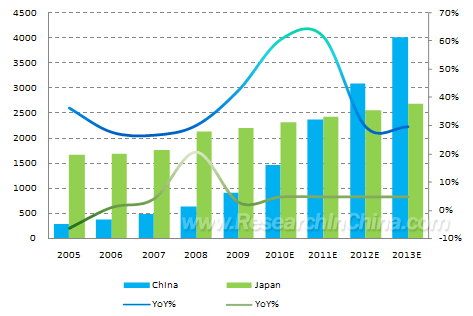
The boom of China’s film market during 2008-2009 has spurred the flood of capital into the film industry. The film industry of China will continue to grow at a rate of over 60% both in 2010 and 2011, while the growth rate will slow down after 2012. In Japan, the film market gets increasingly saturated, and the growth rate tends to be moderate. As is presented below, China will become the world’s second largest film market by 2012, with the domestic box office revenue surpassing Japan’s.

Comparison of China’s and Japan’s Box Offices and Growth Rates, 2005-2013E (Unit: USD mln)

Source: ResearchInChina

The film producers, distributors and exhibitors all have extended towards upstream or downstream in order to maximize its profit from every industrial link by the model of production+distribution+cinema. The mergers among leading companies in upstream, middle stream and downstream are driven by capital to achieve maximal margin. The state-owned companies like China Film Group Corporation (CFGC) and Shanghai Film Group Corporation are accelerating to build cinemas and cinema circuits by their advantageous positions, and they are expected to go public in 2010 to obtain more fund. Huayi Brothers Media Corporation, the leader in private film firms, was successfully listed in 2009. Poly Bona, a film distribution company, not only participates in cinema construction, but also develops towards the upstream production to make more profit.

Meanwhile, a group of new investment entities presented themselves in Chinese film production market. Especially, the box office success that Perfect World and Letv.com respectively invested Sophie’s Revenge and Welcome to Shamatown achieved has attracted foreign capital to aggressively enter the film production sector.

China’s film production market characterizes still a low concentration degree. CFGC and Huayi Brothers, respectively ranking the first and the second places, only occupies 10% and 9% market shares. Meanwhile, China’s top four film producers only accounts for 26% of total film box office, still less than that of the United States’ three producers in China, 27%.

However, the film distribution market of China is comparatively monopolized, with a higher concentration degree in box office. In 2009, the top four film distributors, CFGC, Huaxia Film Distribution, Poly Bona and Xiying Huayi occupied 75.7% market shares in all, and revenue-sharing imported film could be only distributed by CFGC and Huaxia Film Distribution. CFGC continued to take a lead in distribution market by right of its rich cinema circuit resource.

China has a relatively high concentration degree in cinema circuit field, since the top four, Wanda International Cinema, China Film Stellar Theater Chain, Shanghai United Circuit and New Film Association, totally covers 46.8% of box office shares. Of which, backed by Wanda’s business, Wanda cinema circuits have seized the central business district, and increases 100 screens annually.

Along with the explosive growth of film box office, only approximately 130 films of the total 465 China-produced films were exhibited in cinemas in 2009, and the rest 2/3 were not, which was mainly caused by the inadequacy of cinemas and screens that couldn’t afford to exhibit so many films. Therefore, cinema investment will be the focus of China’s film industry development in a long run.

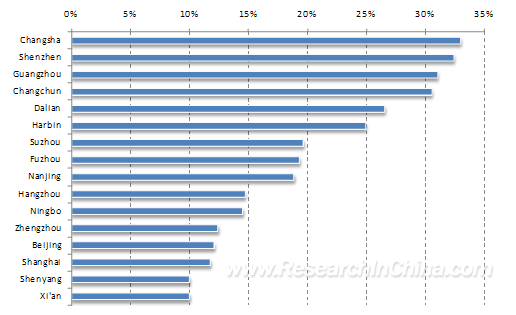
In spite of the strong growth of film box office revenue in first-tier cities like Beijing, Shanghai and Guangzhou as well as still vast room for cinema investment, the fierce competition also get increasingly intensified. In comparison, the emerging second-tier and third-tier cities such as Changchun, Changsha, Dalian and Xi’an grow up and all have great market potential. Based on the analysis of comprehensive factors like consumption level of urban residents, cinema box office, regular urban population, audience number per exhibition, local housing price, cinema number and screen number, the cinema investment rating model is built to conclude the ranking of top 16 cities in China by investment value, as is shown below.

China’s Top 16 Cities by Cinema Investment Value, 2010

Source: ResearchInChina

The report makes an in-depth analysis of status quo, competition layout and major companies of production, distribution, exhibition and derivative commodities of China’s film industry chain, and forecasts cinema construction in hotspot cities, and film derivative market.

IMAX signed

Sept. 21, 2010, 4:04 p.m. EDT · Recommend · Post:
Imax shares rally on China theater deal
Big-screen operator reach key deal to expand in Asia region
By Shawn Langlois, MarketWatch

SAN FRANCISCO (MarketWatch) — Imax Corp. shares jumped almost 7% on Tuesday after the big-screen theater operator announced a day earlier that it signed its largest deal ever in Asia.

Imax (IMAX 17.02, -0.03, -0.15%) stock closed up$1.09 at $17.05. It has risen 90% in the past year.

The Mississauga, Ontario-based company said late Monday that it reached a deal with a subsidiary of South Korea’s CJ CGV Co. to install 15 Imax systems in China.

“We have been successful with our current Imax theatres in Korea, and with Imax’s impressive film slate, which is targeted to include mainstream Chinese films, we are pleased to expand our Imax footprint,” said Kim Joo Hyung, CEO of CJ CGV.

The terms were not disclosed, but Imax explained that it would “trade a lower up-front fee than we receive in a typical sales deal” for “a larger share of the box office generated” by the theaters.

The move gives Imax “increased participation in the growing box office in China, which has more than doubled” in the past two years.

CJ CGV already operates five Imax theaters in South Korea, and under a joint venture the two companies disclosed in March, CJ CGV now has committed to opening a total of 35 Imax theaters.

Imax overall now has a total of 96 theaters scheduled to be open in China, its second-biggest market after the United States. In total, the company operates 447 theaters across 47 countries.

Shawn Langlois is a reporter for MarketWatch in San Francisco.

“expand the IMAX footprint.” What an odd way to phrase it.

interesting

I’m not quite sure what this means in the big scheme of things, but it certainly makes for a good post here.

China takes first stake in Hollywood firm
Chengtian pays $25m for 3.3% of Legendary Pictures
By Jonathan Landreth
Sept 27, 2010, 07:42 AM ET

BEIJING – It’s finally happened: a Chinese entertainment company has bought a piece of Hollywood.

Though Chengtian Entertainment is a subsidiary of Hong Kong-listed Orange Sky Golden Harvest Entertainment, the company that on Monday bought a 3.3% share of “Inception” producers Legendary Pictures of Los Angeles is Beijing-based and focused squarely on China’s booming entertainment market.

After months of speculation that a cash-rich Chinese bidder, or one from Bollywood, might pick up a debt laden Hollywood property such as MGM, Chengtian CEO Chen Xiaowei, formerly president of Nasdaq-listed The9 – one of China’s largest online gaming companies – called Chengtian’s partnership with hit-factory Legendary a “match built in heaven.”

“Chengtian and Legendary will produce and distribute films in China and around the world and also produce and distribute games,” Chen told The Hollywood Reporter before boarding an airplane to meet Legendary founder Thomas Tull for the first time.

“I’ve watched ‘Inception’ twice and I told Thomas over the phone that this deal feels like a dream,” she said, noting the deal was negotiated in under a month. “I want to meet him to make sure it’s real.”

The purchase of Legendary shares for HK$194 million ($25 million) comes at a time when Hollywood’s box office growth is dwarfed by China’s, where ticket sales jumped an astonishing 80% in the first half of this year as a newly-wealthy middle class flocked to hundreds of gleaming new cinemas nationwide.

Having a way to say a film was made with a Chinese partner could help Legendary get its products into the booming market around a Chinese government-imposed import cap that limits to 20 the number of foreign films allowed to share in their box office receipts here each year.

Founded in 2005, Chengtian invested in John Woo’s pan-Asian co-production and box office hit “Red Cliff” (2008) and also made the commercially underwhelming 2009 sequel “Storm Warriors II” directed by the Hong Kong-based fraternal duo Danny and Oxide Pang.

Chengtian made a bigger name for itself when chairman Wu Kebo began in 2007 to amass a majority stake in the storied Hong Kong film company Golden Harvest, of Bruce Lee and Jackie Chan fame, and when Wu partnered Chengtian with Avex of Japan, that country’s largest independent record label.

In addition to film production and distribution, Chengtian runs an artist management company and has divisions in charge of television, online entertainment and advertising. Chengtian parent, Orange Sky Golden Harvest, was founded in 1970 as Golden Harvest. The OSGH Group, of which Chen is co-CEO with Kelvin Wu, also operates 29 multiplexes with 229 screens in China, Hong Kong, Taiwan and Singapore.

In a statement released from Los Angeles late Sunday, Legendary called its new partnership with Chengtian a “strategic investment.” “The transaction is part of an effort to explore broader partnership opportunities in China and beyond,” the statement said.

Not only does China, now the world’s No. 2 economy, have more web surfers and mobile phone users than any other nation, but over the last few years the country also rapidly has become the second largest market for theatrically screened Hollywood exports. “Avatar” alone grossed more than $200 million here.

With partner Warner Bros., Legendary’s productions include “Inception,” which has grossed more than $750 million worldwide, “Clash of the Titans” ($491 million worldwide), “The Dark Knight” ($1 billion worldwide), “300” ($456 million worldwide) and “The Hangover” ($467 million worldwide).

“Legendary’s products have a natural game element to them,” Chen said, noting that a three-way partnership with her former employer, The9, “was not discussed in negotiations with Legendary.” Chen said Chengtian was “evaluating gaming opportunities.”

The Chengtian-Legendary transaction could allow Legendary “to diversify its content production and distribution strategies beyond filmed entertainment to other mediums not excluding digital, television and video games,” the statement from Legendary said.

Among the game universe-to-film projects Legendary currently is in the process of adapting are “Warcraft,” to be directed by Sam Raimi (“Spiderman”); “Godzilla,” based on Toho Company’s famed giant Japanese lizard; Warren Ellis’ “Gravel,” and “Mass Effect,” based on Electronic Arts and BioWare’s hit videogame franchise.

Chen, who was appointed Chengtian’s first CEO on July 2, joined the company after a stint at The9, where, beginning in May 2008, she renegotiated the company’s operating contract with game designers Blizzard for the hugely successful “World of Warcraft” franchise and also helped rebuild The9’s own game development team.

Before The9, the University of Pittsburgh-educated Chen worked as a consultant for Mc Kinsey & Co in New York and was a television producer for China Central Television.

In the wake of Venice

Marco Mueller honored by Republic of China
Venice head gets Friendship Award from prime minister Wen Jiabao
By Eric J. Lyman
Oct 5, 2010, 09:30 AM ET

ROME – Venice Film Festival artistic director Marco Mueller will be presented with the Friendship Award from Wen Jiabao, the prime minister of the Republic of China, the festival announced Tuesday.

The award, which will be presented Thursday in a private ceremony in Rome, will be given to mark the opening of the Year of Chinese Culture in Italy and will be one of the official functions of Wen’s official state visit to celebrate that event.

Mueller, who has lived in China and who speaks fluent Mandarin, has been a long-time proponent of Chinese film and has brought scores of Chinese productions to the Venice Festival, which concluded its 67th edition last month.

“The vitality of Chinese film no longer needs confirmation,” Mueller said in a statement. “Even the casual spectator, who happened by chance to view the final rebounds of the great martial arts cinema, can clearly see why: a plastic sense that is constantly regenerated, stylistic elements that remain personal, aesthetic experimentation that never wanes.”

For the record, Venice showcased Reign of Assassins (Jianyu Jianghu), Detective Dee and the Mystery of the Phantom Flame, & Legend of the Fist: The Return of Chen Zhen. 13 Assassins was also shown, but that’s not Chollywood.

Excellent update info on the new revolution in the Entertainment Industry. Thanks Gene. :slight_smile:

Thanks PalmStriker

Chollywood Rising is the name of my new print-only column in Kung Fu Tai Chi. I launched it in the last issue.

I was torn between posting this on our RoA or RC threads but decided this needed a bump as my column is due. :wink:

* October 7, 2010, 1:05 PM HKT

The Continuing Return of John Woo
By Dean Napolitano

The recent two-part Chinese historical epic Red Cliff marked a return to Asia for legendary Hong Kong director John Woo after more than a decade in Hollywood. With his latest projectthe martial-arts film Reign of Assassins, starring Michelle Yeoh as a Ming Dynasty-era assassin struggling to leave her past behindMr. Woo is again sticking to home turf. The film business in China is growingand growing fast, says Mr. Woo. There are good opportunities for all kinds of directors.

Mr. Woo has inspired a generation of filmmakers with his unique style of extreme action and *detailed storytelling in movies from Hong Kong (The Killer) to Hollywood (Face/Off). Last month, he was awarded the Golden Lion for Lifetime Achievement at the *Venice International Film Festival. Its a great honor, he says, but I wouldnt say I had much *influence.

Reign of Assassins, opened in China last week and hits screens around the region this month. It was written and directed by Taiwans Su Chao-pin. Mr. Woo serving as co-director and co-producer.

Q. What do you like about working in mainland China?

A. There are so many talented young people in China. They have great passion, and they love to learn. That is one of the reasons why I came back to make Red Cliff.

Q. How does working in China compare with the U.S.?

A. There are so many meetings in Hollywood. You have to make compromises. I feel free working in China. We have one meeting to talk about the budget and we go ahead and do it. But we still need to learn so much from Hollywood.

Q. Whats your role?

A. I see myself as a bridge. I *always try to bring in the good things from both sides. We can learn from each other.

Q. Whats the future for the Hong Kong and mainland China film industries?

A. I think they are merging into one. Hong Kong filmmakers need a bigger market. Hong Kong and mainland China people have *different lifestyles and cultural backgrounds, but its nice to see them work together to create something new.

Q. Whats next for you?

A. I go where the work is interestingfor the moment thats China and America. I have three projects developing in Beijing and three in Hollywood. I love work. I dont want to stop.

On a side note, look at what happened to China’s remake of High School Musical.

Flying Tigers

Woo vs. Cruise? Interesting…very Chollywood vs. Hollywood…

Tom Cruise vs John Woo For ‘Flying Tigers’
By MIKE FLEMING | Thursday October 7, 2010 @ 7:01pm EDT

EXCLUSIVE: John Woo and Terence Chang might well be getting off the tarmac first with their WWII saga Flying Tigers. But New Regency, 20th Century Fox, and Tom Cruise are still fighting the good fight on a rival project that carries the identical title. They’ve hired Kirk Ellis to rewrite a draft of Flying Tigers that was done by Cruise’s Valkyrie scribe Christopher McQuarrie and Mason Alley. Both films are based on the story of the volunteered fighter squadron formed by General Claire Chennault to help the Chinese fight against the Empire of Japan before the United States entered WWII. The aging Chinese planes were no match for the superior Japanese forces, until the volunteers arrived in American-made P-40 War Hawks. The two squadrons flew side by side, in fighter planes emblazoned with the gaping tiger’s teeth logo. After Pearl Harbor, the Flying Tigers became an effective squadron in the U.S. Air Force. Jeff Greene is producing.

Cruise has long wanted to play a pilot in a period war movie, and has been attached to several WWII aviator pictures. He’s always got multiple offers, and I’m told reliably that despite reports, he is not attached to the Warner Bros script El Presidente. He’s obviously not taking part in the Flying Tigers movie directed by his Mission: Impossible 2 helmer Woo, who with Chang have mounted a Hollywood-China joint production with China Film Group as the lead Chinese financier. They expect to shoot next spring, and signed a deal for the footage to be remastered for the IMAX Experience. My experience on these races is that whether it was The Last Samurai (a race Cruise won) or Alexander the Great, once a picture makes it into production, the other one gets shelved.

Ellis won two Emmy Awards for the HBO miniseries John Adams, writing 7 episodes of the mini.

It’s all about the 4th to the last paragraph.

China National Day box office hits $42 mil
Week-long holiday a winner for “Detective Dee”
By Jonathan Landreth
Oct 9, 2010, 10:44 PM ET
BUSAN, South Korea – China’s movie ticket sales during the recent National Day holiday rose 12% over the same week-long period last year to reach 280 million yuan ($42 million), led by audiences flocking to see director Tsui Hark’s “Detective Dee and the Mystery of the Phantom Flame.”

“Dee,” from distributors Huayi Brothers, stars Hong Kong actors Andy Lau and Carina Lau and Chinese actress Li Bingbing. The film has grossed 180 million yuan ($27 million) since its bow on Sept. 29, just before the Oct. 1-7 holiday.

Also strong during the period was “Reign of Assassins,” from directors Su Chao-pin and John Woo, which sold tickets worth 30 million yuan ($4.5 million), according to a report from the Xinhua News Agency, citing Liu Hui, deputy general manager of Beijing-based UME Huaxing Cinema, one of the nation’s largest theatrical circuits.

Ticket sales of 50 million yuan ($7.5 million) over the holiday pushed “Inception” up to a China gross of 400 million, making it only the fourth import ever to pass the $60 million mark.

Box office takes of this size have become possible in China only in the last 18 months as the nation’s growing middle class develops a movie-going habit at the hundreds of new multiplexes going up around the country.

Three other Hollywood blockbusters also grossed $60 million in China since early 2009, “2012,” “Transformers II,” “Avatar.”

As with these films, it was the state-run China Film Group, the nation’s de facto monopoly importer, that distributed “Inception.”

In March 2011, China is supposed to allow greater overseas participation in the distribution of copyrighted cultural content, including movies, to be in compliance with a Dec. 2009 anti-protectionist ruling at the World Trade Organization.

More on Dee & RoA.

my thing is china is the second biggest economy in world and yet they still receive world aid, from the US and other countries(to those fearmongers, who keep blabbing about the 50 billion in us bonds china bought, its nothing in comparison that america has given to china since ww2). i feel like this is a key point in their growth, they use other countries moneys to develop while using their own burgeoning economy to become a global super power…and lets not forget to mention darfur…everybody knows how much i love asian cinema but, it just unnerves me a bit, that i have yet to see china make a major philanthropic contribution to a third world country.

Korea is what? Kollywood?

This could have gone on our RoA thread, but given the buzz, RoA is now figuring to be a major factor in the rise of Chollywood.

10-11-2010 10:20
Jung looks to China beyond Hollywood


Korean heartthrob Jung Woo-sung, right, and Michelle Yeoh in a scene from John Woo’s “Reign of the Assassins.” Su Chao-bin co-directed the film, which is showing at the ongoing Pusan (Busan) International Film Festival, before opening in theaters nationwide on Oct. 14. /Courtesy of SBS Contents Hub

By Lee Hyo-won

As Asia’s leading cinema event, the Pusan (Busan) International Film Festival (PIFF), whose 15th edition opened Thursday, most appropriately showcases the latest trends, including most notably the ever-expanding influence of Sino-cinema.

Similarly, superstar Jung Woo-sung has looked to China for his much anticipated overseas debut: He stars opposite Michelle Yeoh in the John Woo-powered epic “Reign of Assassins,” which is featured in PIFF’s non-competitive section Window on Asian Cinema.

``Hollywood is not my final destination,’’ Jung told reporters Tuesday in Seoul after the press preview. While local actors such as Jun Ji-hyun (Gianna Jun), Rain or Jang Dong-gun have knocked on Hollywood’s door, So Ji-sub made his overseas debut in China with Zhang Ziyi.

``In Hollywood, Asian actors can assume lead roles continuously only if they master martial arts, like Jet Li or Jackie Chan… But I do have small hopes of becoming a noted actor in pan-Asian regions,’’ he said.

This isn’t his first project to be fully based in China. He played the lead in Hur Jin-hon’s ``A Good Rain Knows,’’ which is set in Chengdu and co-stars Chinese actress Gao Yuan-yuan.

Reign of Assassins,’’ co-directed by Taiwanese writer-director Su Chao-pin (Silk’’), premiered at the Venice Film Festival last month. ``Mr. & Mrs. Smith relocate to ancient China in the dazzling martial-arts epic,’’ according to the Hollywood Reporter, and indeed Yeoh and Jung play an ordinary married couple, each unaware the other is a world-class assassin. Guns, bombs and other modern spy gadgets are replaced by elaborate wire tricks and sword-swinging, while being peppered with dashes of comedy and romance.

The 37-year-old said it was a great pleasure working with Yeoh.

``When I first heard about the casting, it’s true I felt a little pressured but I didn’t mind the age difference,’’ he said about his co-star, who is 11 years older.

``Ms. Yeoh is a respectable veteran actress and world-class star but she is extremely humble. I thought she was a beautiful actress who is aging with grace. I was the only foreigner on the set and so she paid a lot of attention and care, to make sure I wasn’t uncomfortable.’’

Working in a foreign language, however, was a challenge. I was worried whether I would sound awkward to native Chinese speakers, but I’m glad to hear it sounds OK,’’ he said, when a reporter complimented his pronunciation. The romance is central to the film, and it was really important to deliver the lines with feelings of affection. I think I mastered the Chinese lines naturally while working with Ms. Yeoh.’’

Starring in a Chinese martial arts movie, moreover, proved to be a great adventure. I always carried around a sword,’’ he said. Hong Kong cinema has adopted Hollywood-style system, and so it’s much more advanced than domestic filmmaking. We filmed for 12 hours every day and took mandatory breaks once a week.’’

During PIFF, ``Reign of Assassins’’ will show Friday at 9:30 p.m. and Oct. 10 at 9:30 a.m. at Lotte Cinema Centum City. It will open in theaters nationwide on Oct. 14. Distributed by SBS Contents Hub.