doubtful considering kung fu action films, have a larger foreign audience and sale potential over chinese dramas and comedies. which really dont translate well to the western markets. so idk if itll be a game changer, maybe but $$ talks. as we all know.
I wonder what Xi will think of the upcoming Red Dawn remake?
Legend of Mulan
I guess we’ll have to start a thread on Z’s new project
Banking on blockbusters
* Source: Global Times
* [09:06 December 14 2010]
By Chen Yang

When Hollywood films are seeing increasing box office revenues in China, Americans seem largely unaware of China’s film industry except for a few famous names such as Zhang Ziyi and Jackie Chan.
Bona Film Group, a Chinese film distributor, made its debut on the Nasdaq Thursday. However, the company’s stock price slumped 22.35 percent to $6.6 from its $8.5 IPO price on the first trading day.
As China’s first film company to go public in the US, Bona’s experience was in contrast to its competitor Huayi Brothers Media Corp, whose shares increased by nearly 150 percent to 63.66 yuan ($9.56) the day it debuted on China’s Nasdaq-style growth enterprise board market last October.
Looking longterm
“It might take more time for US investors to understand our business better, as there are some differences between film industries in China and the US,” said Xu Liang, Bona’s chief financial officer, in a telephone interview Thursday. “We look for a long-term return on investment for our shareholders.”
Xu said Bona plans to expand overseas distribution channels for Chinese-made films, as well as cooperate with foreign studios to produce films. Its latest movie, co-produced with a Canadian company, is a 3D English film Legend of Mulan, with Dutch director Jan de Bont and Chinese actress Zhang Ziyi as Mulan.
“Co-production will enable the film to have significant box office appeal for the US audiences, and help us gain distribution rights in China,” he said, adding that in China only State-owned film companies have distribution rights for imported films, while co-produced films can be treated as domestic ones.
Xu is optimistic about Bona’s growth prospects based on China’s booming film market. “Cinema visits per year per person is only 0.3 in China, while this figure is 4.3 in the US,” he said. “If every Chinese goes to cinema one time every year, China will become the world’s second largest film market with annual ticket sales of 30 billion yuan ($4.5 billion).”
Box office sales up
China’s box office revenues totaled 8.7 billion yuan ($1.3 billion) as of November 30 this year, according to EntGroup, an entertainment consultant in Beijing. Several films shown in December, including Harry Potter and the Deathly Hallows and Sacrifice, are still boosting ticket sales.
EntGroup earlier estimated domestic box office revenues will hit 10.3 billion yuan ($1.55 billion) this year, a 65 percent year-on-year growth, mainly boosted by imported blockbusters Avatar and Inception, as well as the Chinese-made film Aftershock.
“If the growth rate can keep around 40-50 percent, China will likely to jump from the sixth to the No.2 spot in the world by box office revenues next year,” said Gao Shouzhi, EntGroup’s vice president.
But the number of viewers has not grown as fast as box office revenues. Mao Yu, an official within the State Administration of Radio Film and Television, said earlier that the number of moviegoers visiting theaters was around 200 million as of October, the same level as all of last year.
As the inflation continues to rise, analysts doubt consumers will pay to watch films due to high ticket prices. The average ticket price is around 36 yuan ($5.40) in China, accounting for 2.5 percent of urban residents’ disposal income every month, while the percentage is only 0.5 in developed countries, said a report released by Deloitte Consulting earlier this year.
Investors interested
However, the film industry’s high growth rate has attracted investors. Coalmine owners, property developers, Wenzhou merchants and private equity funds managers are reportedly ready to step into the film sector.
“Investment mainly goes into film production and theatre building sectors, as their entry barriers are relatively lower than that of the distribution sector,” said Gao from EntGroup.
In China, normally theaters take half of the box office revenues, film producers take 40 percent and film distributors the remaining 10 percent.
But the film industry might not be as profitable as outsiders think. “Producing films is high risk … while building theatres is an investment that will take 4-5 years to recover costs,” he said.
China produced 456 films last year, and about 300 films were shown on the big screen. Some films apparently get rejected by movie theater owners for poor quality, while others lack big name actors or directors.
“If the average investment on a film is 5 million yuan ($751,000), then producers lost about 1 billion yuan ($150.2 million) in total,” said Xue Shengwen, an entertainment industry analyst from Shenzhen Zhongzhe Investment Consulting. “With an increasing number of modern theaters emerging around the country, more domestic films will have the chance to be shown,” Gao said.
Spin-off products lacking
Industry watchers say Chinese film companies rely too much on box office revenues. “Earnings from box office make up more than 70-80 percent of a film’s total revenues in China,” Gao said. “While ticket sales only account for less than 30 percent in Hollywood film productions, the others mainly come from selling derivative products.”
Xu from Bona said revenues from television royalties, new media and home video products only account for 7-10 percent of their total revenues.
“China lags so far behind the US, especially in developing film derivative products,” said Wu Jun, president of Shanghai Movie Shine Entertainment Merchandising, who has launched a retail chain selling film memorabilia since 2002.
But the business has not run as well as Wu expected. “We opened more than 20 stores in movie theatres around 2005, but most didn’t make money,” he said, adding that he only keeps two stores running in Shanghai now.
Wu said local film producers have not focused much on exploring film spin-off products.
“We mainly sell imported film memorabilia … but high prices prevent audiences from buying and some would rather buy unlicensed ones,” he said.
Gao said China’s film industry chain has not fully matured compared with the Hollywood model.
“Lack of talents and rampant piracy hinder the development of film derivative products,” he said.
Wu is now turning to the online game sector, but he still waits for the opportunity.
“China’s film derivative product market will grow up one day, when film producers become familiar with marketing and audiences become accustomed to paying for more than a film ticket,” he said.
China Daily’s Top 10 for 2010
There are pics with each film but I’m too lazy to cut & paste them here. Follow the link if you want to see.
Movies for keeps
By Raymond Zhou (China Daily)
Updated: 2010-12-28 08:04
The year has seen Chinese cinema mature with films that have not just performed well but pushed the boundaries in terms of plot and execution. Raymond Zhou picks the top 10.
Chinese cinema is expected to pass a milestone in 2010. Its gross box-office revenue is likely to be more than 10 billion yuan ($1.5 billion) for the first time (counting just the mainland). That’s roughly the same as the US box office in dollar terms. If you factor in the currency disparity, per-capita, consumption and the ancillary market such as television and DVD rights, it is still minuscule, but hints at the vast potential that has been tapped into seriously only in the past five years.In terms of the quality of offerings, Chinese cinema has always been the target of public ridicule. Simply put, it is an industry people love to hate and yet cannot stop talking about. This year, diversity has taken reign and big-budget period dramas with their all-too-familiar sequences of kungfu fighting have given way to a rich crop of genres, some hard to categorize. Whatever your taste, you will find something to your fancy. The following are 10 feature films our editors consider worth recommending.
Let the Bullets Fly
This is a year when China’s triumvirate of top filmmakers (Zhang Yimou, Chen Kaige and Feng Xiaogang) all had new releases, but were upstaged by someone who calls himself “an amateur”.
Jiang Wen is an actor-turned-director and has made only four full-length features since 1994. But the scarcity of his output correlates with high quality.
His new movie (pictured above), set in the early 20th century, is a fast-paced heist movie. Well, “heist” could be a misnomer because the coveted object is the position of a county magistrate and all the loot it comes with. It also has the feel of a western when scenes move outside the county town.
Jiang has a sense of humor that’s not just black, but pitch dark. Many of the lines have layers of meaning, which may yield contradictory interpretations. His subtle use of anachronism and the symbolic meaning of many scenes and props have become an object of cinephile obsession. All actors are perfectly cast.
Movies for keeps
Monga
Gangster movies have been done to death in Hong Kong. So, when Taiwan’s Doze Niu tried his hand at this hoary genre, nobody expected him to breathe new life into it. The story is predictable, but the way he tells it, with a refreshingly good-looking young cast, has turned heads and created a box-office bonanza.
Though not shown officially in the mainland, the movie has strong word-of-mouth and was avidly downloaded and watched. Essentially this is a coming-of-age story framed in a gangster narrative. The chase and fight sequences exude a vim and vigor that’s more musical than a crime spree. The theme of bonding has a sincerity reminiscent of a good love story.
Movies for keeps
Echoes of the Rainbow
This intimate story of a Hong Kong family struggling through the 1960s and 70s is a microcosm of the British colony and its Chinese inhabitants on the verge of an economic miracle.
Based on the family history of writer-director Alex Law, it is full of bittersweet details. Simon Yam and Sandra Ng deliver top-notch performances of restraint and refinement.
Movies for keeps
Deep in the Clouds
This small movie has not had a wide release yet, though it won several accolades at the Shanghai Film Festival. It is about a mountain village caught between the need to protect the eco-system with its black bears and the yearning for a better life.
Using locals who had barely seen a movie and an ethnic language not even understood by the director, the movie has an authenticity and also a lyrical beauty rarely seen in a message film.
Movies for keeps
Aftershock
Book-ended by two major earthquakes, beginning with the Tangshan earthquake of 1976 and ending with the one in Sichuan in 2008, this is supposed to be a disaster film, but Feng Xiaogang mustered the courage to turn it into a family drama of love and generational misunderstanding.
Perhaps it is easier to approach the movie as a Chinese equivalent of Sophie’s Choice. There are details in the movie about survivors hardly known to outsiders, such as the annual ritual of burning paper in the early morning of the anniversary of the loved one’s death. Xu Fan’s performance packs a punch in portraying a survivor’s guilt and the love of a mother under life-and-death circumstances.
Movies for keeps
Lost on Journey
This little comedy could have been inspired by Planes, Trains and Automobiles, a Steve Martin laugh fest about the trials and tribulations of a journey back home. The Chinese version consists of uniquely Chinese situations, with the duo of comedians representing two halves of society.
The movie is perfectly paced, with plenty of comic chops to keep one laughing. It also has a heart that goes to those less fortunate. While all ends well, the journey is symbolic on a certain level of what the country is going through on the whole.
Movies for keeps
Vegetate
This is social realism at its most critical, the kind of movie enshrined in Chinese textbooks yet rarely seen on the big screen. This sharp criticism of China’s pharmaceuticals industry, which churns out so many products you’d wonder if there is any testing or inspection, is built on a series of twists and turns that’s melodramatic on the surface yet hint at inner truth.
A worthy follower of Julia Roberts’ Erin Brokovich or Russell Crowe’s The Insider, Vegetate falls short on casting and the absence of star power hinders its box-office performance.
Movies for keeps
Detective Dee and the Mystery of the Phantom Flame
This lavishly produced whodunit shows China during its most extravagant period, the Tang Dynasty (AD 618-906), with the sole female ruler in its history, Empress Wu Zetian, on the throne. The intricate plot keeps the audience on edge and the starry cast is matched by the mammoth but ingeniously conceived set.
It is a Chinese response to the new Sherlock Holmes movie starring Robert Downey Jr., but Detective Dee, though a historical figure, was mostly created by a European sinologist. So, cross-cultural influences go to the very root of this action suspense thriller.
Movies for keeps
The War of Internet Addiction
This is not a theatrical release, but an online feature made by maneuvering visual elements in games, but with an original storyline and dialogue dubbed by people all over the Net.
But the movie is more than a technical feat. It gives voice to a huge swath of the online population whose frustrations at being cut off from their favorite online game has come to exemplify an age of angst and anger. The climax scene is so heartfelt it has the effect of a bolt of thunder.
Movies for keeps
Love in a Puff
Pang Ho-Cheung captures the urban vibe in this quietly observant study of modern dating.
The free-flowing plot is a reflection of a new generation with its laissez-faire attitude and hard-to-define notions about love.
Movies for keeps
Honorable mention:
Avatar and Inception (pictured above) are not Chinese fare, yet their impact has gone beyond the film industry in China.
The former has set a new box-office record that may take years to be surpassed and along with it, a new standard for technical excellence and imagination.
The latter has kindled a public interest in dream interpretation, something Sigmund Freud never achieved on such a scale among the Chinese populace.
(China Daily 12/28/2010 page18)
Odd article
It just had to be posted here.
China’s Rise: The Kung Fu Film Version
Judah Grunstein | Bio | 25 Jan 2011
As a fundamental part of what I consider to be my parental duties, I’ve been broadening my son’s already healthy exposure to kung fu movies over the past few months. And I’m repeatedly struck by how many insights they offer into the formative folklore that animates modern-day China. Like Westerns for America, they are heavy in caricatures and historic inaccuracies. But they also reflect, at times crudely and at others quite elegantly, Chinese culture’s self-image and its view of the “other.”
So as much as I found last week’s bilateral summit between Presidents Barack Obama and Hu Jintao dramatically overblown – both are coming off lousy years, and neither exercises as much influence over policy outcomes as the media coverage suggests – I thought the calm after the storm would be a good time to offer up what I think of as the Kung Fu Film Version of China’s Rise.
First up is the Bruce Lee classic, “Fists of Fury,” which, for anyone unfamiliar with China’s colonial past, gives a good idea of the degree to which the humiliations of the foreign concession period remain present in the modern collective imagination. In the film, the Japanese function as the hated occupier/oppressor in concession-period Shanghai. But the nature of the concession arrangement was such that it left plenty of resentment to go around. Unlike other countries, which experienced the oppression and humiliation of colonial occupation at the hands of one Western colonial power, China was partially partitioned among them all. What’s more, its history of being occupied predates Western colonialism, with classics like “The 36th Chamber of Shaolin” already dealing with the Manchu occupation. Many Americans don’t realize that China’s insistence on sovereignty and the ability to defend it – i.e., its current military modernization program – is driven not just by a desire to avoid accountability on its human rights record, but also by a centuries-long chip on its shoulder.
Similar themes are treated in Jet Li’s “Once Upon a Time in China,” with the bad guy in this case represented by an American entrepreneur engaged in what amounts to human-trafficking of Chinese laborers for the construction of the railroads. The movie obliquely references the Chinese contribution to and underlying resentment of America’s own rise. But its major theme is the country’s introduction to modernism, and the complicated relationship that results. Jet Li’s character is both a kung fu master and a practitioner of classical Chinese medicine, and the film protrays the sophistication of both. Nevertheless, the disdain with which Li initially greets such modern artefacts as the camera and the pants suit, brought back to China by Westernized Chinese, soon gives way to curiosity. By film’s end, though Li emerges victorious, he is confronted with the tragic conclusion that the virtuosity of Chinese culture is no match for the brute force of Western guns. The solution – as reflected by the contemporary Chinese approach to modernization but especially to military modernization – is the famous “Chinese characteristics”: the power of modern technology grafted onto the principles of classical Chinese strategic thinking. So area denial instead of forward positioning, and minimal nuclear deterrence instead of massive arsenals.
The third film that struck me as being very relevant these days is “Hero,” also with Jet Li. Besides a gripping story structure and fight scenes that integrate the fantastic without indulging in the cartoonish (the flaw that most purists will find with “Crouching Tiger, Hidden Dragon”), the film also illustrates Chinese conceptions of the trade-off between freedom and stability, and the delicate balance between concentrated power and tyranny. I won’t go into any more detail, because it really is a film where the first viewing should be without spoilers, but suffice it to say that it reinforces a theme that Thomas P.M. Barnett frequently references – namely, that China will democratize on China’s schedule, not on America’s.
Finally, there’s John Woo’s recent magnum opus,“Red Cliff,” whose French title is the more-accurate, “The Three Kingdoms.” I wrote about it when I first saw it in the theater almost two years ago, in the context of American hubris in Iraq. It’s essentially the story of how asymmetric tactics and classical strategies defeat a massively superior force equipped with more advanced firepower. At the time, I argued that it was a juxtaposition of America, post-Iraq, to America, pre-Iraq: the urge to empire against the defense of liberty. But my thinking today is that it reflects an unexplored alternative narrative to China’s rise. The dominant narrative is that China’s rise represents the emergence of a rival to the U.S. for global hegemony in the post-Cold War world order as conceived of by American strategists. By this thinking, the goal is to integrate China into the global governance system so that it becomes a “good citizen,” ready to take up the security and stability responsibilities incumbent upon a hegemon. But “Red Cliff” suggests an alternative reading, whereby China is not interested in being a hegemon, but rather simply wants to pursue its national interests free from American and Western tutelage.
That’s actually reassuring, in the sense that it removes the kind of head-to-head rivalry that increasingly frames most American coverage of China’s rise. But it’s actually a bit more worrisome if you believe that America is in decline, and that the increasingly multipolar world order depends on the multilateral global governance system – backed up by a global hegemon willing to enforce its rule sets – to keep from falling into utter chaos.
Time borrowed my story idea!
Check out my January February 2011 Chollywood Rising column and compare.
As Its Box Office Booms, Chinese Cinema Makes a 3-D Push
By Hillary Brenhouse Monday, Jan. 31, 2011
In the thick of a classical revival, when China’s literati returned fawningly to ancient prose, the folk epic Journey to the West was published in the vernacular of the country’s streets and market stalls. It was the 16th century, and so uneasy was the novel’s author at having written it, as one modern scholar put it, “in the vulgar tongue” that he chose anonymity. In the few hundred years since, the Chinese masterwork has been adapted for theater, television and the big screen, including a particularly grandiose, costly new film to be released in 2012. The movie will appear in the contemporary language of the people: 3-D.
China is in the throes of a cinematic growth spurt. Last year, box-office takings in the Middle Kingdom swelled 64% to reach an all-time high of $1.5 billion. At the source of the surge was James Cameron’s sci-fi spectacular Avatar, which raked up over $205 million in China, or just under 10% of its global gross — a record for the country. The enormous success of the import has spurred on a burgeoning domestic industry. China rolled out 526 pictures last year — up 15% from 2009 — rendering it the third largest maker of movies after Bollywood and Hollywood. The standard for Chinese blockbusters has also shot up; this month Let the Bullets Fly became, with a haul of over $100 million, the most profitable homegrown film in the nation’s history.
The elements have aligned such that the development of China’s 3-D movie market is rushing alongside its box-office boom. It’s a fortunate confluence: as multiplexes are springing up in a dizzying infrastructure expansion, new cinematic technology and investor wealth are streaming in. It takes less than $60,000 to make 3-D-capable digital-projection systems of the kind China is now building. “Show one Avatar and you’ve made that sum back,” says Hong Kong film producer and distributor Nansun Shi. In places with far longer cinematic traditions, retrofitting old theaters has been that much more pricey and time-consuming. China’s Film Bureau reported in January that the country erected 313 theaters and 1,533 screens in 2010 for a total of over 6,200 screens. About 80% of those are digital and so far 1,100 of them 3-D-enabled, a number second only to the 6,000 or so 3-D screens in the U.S. Steeply priced 3-D tickets have, naturally, helped widen sales. But wider film sales — or rather the profusion of movie-house shrines being built to them — have also fueled the rise of 3-D.
It is a cultural moment — and a commercial opportunity — not to be misspent. As Yu Dong, chief executive of leading Chinese production company Bona Film Group, lamented at June’s Shanghai International Film Festival, “China has created a superhighway for 3-D films, but has so far left the lanes open only to Hollywood studios.” One of the most highly attended seminars at that gathering considered how local filmmakers might respond to Avatar’s overwhelming achievement. Not so long ago, audiences in China had to be briefed on how to wear their 3-D glasses. Now moviemakers are scrambling to deliver three-dimensional images to a nation delighting in its own modernity.
But China’s Avatar, should a domestic effort match that movie’s success, will not look like Cameron’s. As Shi says, “We don’t do science fiction.” Even when the packaging is of the cutting edge, Chinese pictures heave with history. Right now filming in a wintry Beijing, the $50 million 3-D feature Monkey King, by Hong Kong director Soi Cheang and featuring Chow Yun-fat, is based on an episode from that 16th century fable Journey to the West. The story is of a Chinese Buddhist monk sent, with a supernatural primate and other companions, to India in quest of religious scriptures. In a separate effort, Shi and her husband, the Hong Kong director Tsui Hark, are now shooting Flying Swords of Dragon Gate, a 3-D film starring Jet Li that is a remake of a martial-arts movie set in the Ming Dynasty. A new 3-D animation for release in July will pit an ancient rabbit in tai chi slippers against — what else? — a kung fu panda.
Still, for all their nationalist vigor, these vast-budget ventures are reliant on foreign help. Local production teams are as yet unprepared to go it alone and, by Tsinghua University cinema scholar Yin Hong’s estimate, will not arrive at America’s current technological standards for another 10 years. “The 3-D generation is here,” he says. “China is not ready, but we have to cope.” Monkey King has imported the whole of Hollywood’s tech force: for 3-D and IMAX effects, it will employ Avatar’s production crew, and for special effects, the same Weta Workshop that enlivened the Lord of the Rings trilogy. “Not enough people in China are trained in 3-D and we don’t have the experience to make a movie of Hollywood quality,” says director Cheang. “For us, this is just the beginning. But in this market, you have to move fast.”
Local filmmakers are hoping to learn from the hired help to imbue their movies with that immersive, Avatar-esque quality that is so well suited to China’s majestic period pieces. Now is as crucial a time as any: in mid-March, by a World Trade Organization ruling, China will further open its film market to foreign flicks and a wave of fresh competition. “It’s not about the money,” Shi says of the country’s cinematic belatedness. “It’s about a knowledge base that cannot be built up overnight. In America, the role of film has been completely different than it has been here.” In other words, now that China speaks the language, it has quite a lot of reading to do.
Actually, the 3D push is pretty obvious for anyone watching Chollywood now, so I’m not accusing Brenhouse of plagiary at all. If anything, I’m just boasting about being ahead of TIME on this one. It’s not often I can say that. Actually, it’s never happened before. Subscribe now and get a jump on TIME. I’m just sayin… 
Forbes cover story
I was wondering how I missed this and then I saw the publication date.
On The Cover/Top Stories
A New Studio System
Gady Epstein, 02.03.11, 06:00 PM EST
Forbes Asia Magazine dated February 14, 2011
Louis B. Mayer and Jack Warner had the right idea in prewar Hollywood, thinks Qin Hong of Beijing.
In 2006 the young and not-yet-renowned director Lu Chuan took his idea for an ambitious epic about the Japanese massacre at Nanjing, already rejected by a major Chinese studio, to a young, unknown film producer who, as one of the producer’s own friends chided him, “didn’t know anything about movies.” Qin Hong, then 35, had taken the helm of Stellar Megamedia Group, a moneylosing company whose listed Hong Kong arm was on the verge of liquidation, selling off assets to stay afloat.
It didn’t seem like a good time to take a big gamble on a movie–especially one that could run afoul of history-sensitive censors, that would be shot in black-and-white and that would ultimately require a budget of $10 million. All in an immature movie market with a shortage of quality cinemas, where $10 million in total box office qualified as a certifiable hit, far short of what Qin would need to make his money back on Lu’s film.
Did Qin want to take that big a risk? He couldn’t get his money in fast enough. “He called me, he said he finished the whole script in one night and he decided to make this movie,” Lu says. “He gave me the money without a contract. That really touched me. Without a contract, without anything, he gives me the money.”
City of Life and Death went on to become one of China’s top-grossing films of 2009, with $26 million in receipts, making Lu a star director and catapulting lead-investor Qin into his next role, Hollywood-style movie mogul, at just the right moment. For the last 18 months Qin has been buying up movie theaters, signing stars and directors to his in-house agency, and making movies with his contracted talent to show in his theaters. He is in a costly race with private rivals and with the government’s vaunted China Film Group to integrate vertically like Hollywood in the 1930s. The valuable prize at stake is China’s suddenly lucrative box office in the 2010s.
The nation known internationally for movie piracy is entering its own golden age of cinema-going: Box office receipts in China grew an astounding 64% in 2010 to $1.5 billion, on top of more than 40% growth the year before. That is still far behind the $11 billion collected in the U.S. and Canada last year, but China could surpass the number two and three markets, Japan ($2.7 billion in 2010) and India (estimated $2.2 billion), by 2012. In January the Chinese Western Let the Bullets Fly became the top-grossing domestic film ever, with more than $100 million in ticket sales. The country has more than 6,000 movie screens and is on its way to 20,000, adding new screens at the rate of 4 per day, mostly digital and many of them 3-D-capable, in modern multiplexes that hardly could be found in China a decade ago. Industry predictions of 40% annual growth for the next five years would have China potentially rivaling the U.S. for box office supremacy by the end of the decade.
“Nobody could have guessed where we are today five years ago,” says Peter Chan, a star Hong Kong director who is working with Stellar to market his films in China, including the big-budget martial arts film Swordsmen, due out later this year. How big can the market get? “Anything is possible. I think it’s beyond anybody’s imagination, because we’re actually talking about the tip of the iceberg right now.”
Rising up to profit from this is a Beijing version of Hollywood’s infamous studio system, when the Big Five studios owned not only their movies, but also the talent that made them and the theaters that showed them, before a 1948 Supreme Court decision broke up their oligopoly. Sixty years later Qin and his competitors believe a sharp-elbowed campaign of vertical integration will be necessary to survive in what Qin calls China’s “competitive monopoly” system. (Japan also developed integrated studios, in Toho and Shochiku.)
“Lots of people have seen the future potential of the film market, but the competition is fierce,” Qin says. His personality seems made for the task. Stocky in build, open-faced with semi-rimless glasses, Qin compensates for his unassuming appearance and lack of a film background with a serious demeanor, a steady diet of Marlboro cigarettes and a Hollywood-size ego.
From his office in downtown Beijing, Qin coolly runs down the weaknesses of his formidable competitors: Blockbuster-making studio and talent agency Huayi Brothers, whose film Aftershock took in an estimated $100 million last year, is making a very late and modest entry into the cinema-operating business; the leading non-state-owned distributor Bona Film Group, which had a lackluster U.S. IPO in December, has quickly accelerated its production of movies but must play catch-up to sign talent and add theaters; and real estate giant Dalian Wanda Group, though positioned to remain the dominant owner-operator of cinemas, is starting from close to zero in production and talent.
continued next post
from previous
“Stellar is the one that’s involved in all parts of the business,” Qin says, and he plans to take on each competitor in its area of strength, with increased recruitment of talent to build an agency to challenge Huayi Brothers’ much larger roster, and a planned $135 million invested in 18 to 30 films over the next three years.
The costly, risky but potentially most lucrative cornerstone of Qin’s strategy is the expansion of movie theaters, which keep half of the box office (minus a chunk for their landlords), providing the crucial cash flow needed to build Beijing’s studio system, as movie productions still often end up in the red. Theaters also take half the gate on foreign movies like Avatar, which smashed all domestic competitors with more than $200 million in ticket sales in China. Stellar, which had only 3 theaters as of July 2009, now operates 22 cinemas with 135 screens, making Qin’s the seventh-largest movie theater company in China, according to Shanghai cinema consultancy Artisan Gateway. Industry leader Wanda, led by billionaire Wang Jianlin, has 71 cinemas and a big advantage for expansion with its own mall developments in China, but Qin plans to have more than 70 theaters by year’s end, 120 in 2012 and 200 cinemas with 1,500 screens by the end of 2013, Qin says, which he hopes will put Stellar second behind Wanda.
To pay for all this, Stellar’s Hong Kong-listed affiliate SMI Corp. has raised $100 million through several rounds of sales of shares and convertible notes, and will seek an additional $65 million to $130 million in a third round this year, Qin says, before raising more cash with a planned U.S. listing by next year. Qin’s older brother, Qin Hui, owns 66% of SMI–a stake worth $208 million that Qin Hong says the brothers share, along with real estate and other assets that he declines to put a price tag on but says are roughly as valuable as their SMI stake. In earlier days in Beijing, where the brothers were raised, Qin Hong took on more low-key work in the brothers’ telecommunications business, while Qin Hui built some of the brothers’ early fortune on a Beijing nightclub that has since been shut down by authorities. The elder Qin has receded into the background in recent years after cooperating with investigators in two high-profile corruption cases, but his stamp on the company remains. Some of Qin Hui’s unlisted assets are, according to SMI’s securities filings, the very movie theaters that the listed SMI has been buying, as the Qins established a cinema-acquisition pipeline.
“In the next three to five years we plan to build even more theaters, to invest in even more films, to make Stellar one of the largest movie companies in China.” Qin breaks into a rare, almost imperceptible smile as he modifies his bluster, “The largest private movie business.”
The big question mark in the growth of not just media but also any industry in China is the government and its state-owned champions, whose efforts to encroach on, acquire, squeeze out or simply shut down private players come under an intimidating banner: guo jin min tui, “the state advances, the private sector retreats.” The biggest state-owned presence in movies, China Film Group, has its own plans for vertical integration, including the addition of dozens of cinemas and an eventual IPO, and has government muscle to make life difficult for competitors.
Stellar has a partnership with China Film in the nation’s second-largest theatrical circuit, China Film Stellar, which delivers movies to more than 100 theaters for a small cut of the substantial box office, but it is unclear if the two will cooperate or part ways as their ambitions collide in the years ahead.
The government also aids domestic private players by keeping foreign competitors effectively leashed with strict regulations on film production, importation, distribution and exhibition. Some of these rules are supposed to loosen up as soon as this year under a hard-fought WTO case, but Beijing can be expected to do its best to limit Hollywood’s incursions.
In 2002 Warner Brothers began opening multiplex cinemas with some success until the government changed the rules on foreign ownership, leading to Warner’s exiting the market in 2006. Along the way, the Time Warner unit helped develop a market that lacked multiplexes. Audience interest and especially content had been lacking in the previous two decades, when the government not only tightly capped film imports but also channeled its entertainment and propaganda investments into television broadcasting, which could reach all homes regardless of income, without a massive venue build-out. Now both state-owned and private companies are building out theaters, bidding up leases in a manner that could threaten the overleveraged.
Ultimately the fuel for Stellar’s long-term expansion must come from the box office receipts at its own theaters. China’s box office gross could reach $7 billion by 2015, and Qin’s goal is to take in 10% of that from Stellar-operated theaters–compared with the 2.6%, or $40 million, Qin says his theaters collected in 2010.
continued next post
last part
from previous two posts - this is the kicker as it names the moguls.
Last year Stellar had the 10th- and 16th-highest-grossing theaters in China, according to Artisan Gateway figures, with combined box office receipts of nearly $17 million, and Qin’s newest theaters are moving quickly up the rankings. One of them in Beijing was number one nationally in December, says consultancy EntGroup. SMI added four more theaters in January. “We know if we rest, we may be swallowed by others,” Qin says. Five years after City of Life and Death he is still rushing to put his money into the movies.
The Moguls
Huayi Brothers
Wang Zhongjun and Wang Zhonglei have a talent agency and the services of blockbuster director Feng Xiaogang, whose earthquake drama Aftershock took in $100 million at the box office in 2010, the record-holder for a domestic film until Let the Bullets Fly passed it in January. Huayi Brothers, which went public in 2009, is valued at more than $1 billion.
Bona Film Group
Yu Dong runs the leading non-state-owned film distributor and has good relations with his former employer, state-owned China Film Group. He owns a small number of theaters but has accelerated his movie production line. Bona’s big-budget martial arts epic The Flying Swords of Dragon Gate, starring Jet Li, is due out at the end of this year.
Stellar
Qin Hong, 39-year-old chairman of Stellar Megamedia Group and its Hong Kong-listed affiliate SMI Corp., has more theaters than any of the other hitmaking studios. He works with famed director Chen Kaige and up-and-coming star director Lu Chuan, whose City of Life and Death earned $26 million in 2009.
China Film Group
Han Sanping is the government’s godfather of Chinese movies. China Film Group does not have a track record of producing hits, but the other moguls seek out producing partnerships with the biggest state-owned player. Huayi’s Aftershock, Bona’s The Flying Swords of Dragon Gate and Stellar’s City of Life and Death all share a co-producer in China Film Group.
Dalian Wanda Group
Wang Jianlin, billionaire chairman of China’s commercial-property colossus, has the most movie screens in China. His company has a cinema division that is expected to maintain the lead in theaters and box office receipts as the national box office grows to $7 billion in 2015, but the company has a long way to go to catch up in producing movies.
In the wake of the Oscars
There’s a lot of talk of China, but no Oscar contenders.
Live Academy Awards Broadcast Unseen by One of Hollywood’s Biggest Markets: China
9:56 AM 2/28/2011 by Jonathan Landreth
BEIJING – Chinese director Zhang Yimou probably smiled at Christian Bale’s Best Supporting Actor Oscar win.
While the prize could brighten the Chinese director’s decision to cast the English actor in his next picture – a Nanjing Massacre drama the two were shooting together just days ago in China – Bale’s win for The Fighter, which went unreleased here, was virtually unnoticed across the nation.
So, too, were the Oscars as a whole, since watching the 83rd Academy Awards half a world away from Hollywood proved a challenge even for cinephiles dedicated enough to try to glimpse a bit of the Oscar glamour via pirated TV or illegal website.
Star Movies Hong Kong’s licensed live coverage, replete with commentators speaking from what appeared to be a fancy brunch, reached luxury hotels in China, but average Chinese tuning in from home 16 hours ahead of L.A. could see only the red carpet festivities and no more, on Web portals and video sharing sites.
To see the awards ceremony, hosted by actors James Franco and Anne Hathaway – both relative unknowns here – most Chinese viewers had to wait until 10:30pm for state-run China Central Television’s planned 90-minute edit, or turn to often unstable live Internet streams of U.S network ABC’s official all-English broadcast, pirated from all over as one Ohio storm warning during an illegal webcast revealed.
Although Hollywood movies on average grossed more per title in China in 2010 than their homegrown competitors, only two of the 10 films nominated for Best Picture screened here last year, due partly to government limits on film imports. Toy Story 3 was China’s 26th most successful film of the year and Inception rose to the No. 4 spot, selling tickets totaling $68.2 million.
No matter how much the business of Hollywood and China are intertwined these days – Avatar grossed $204 million here, more than anywhere else outside the U.S.– the lack of a widely available live Oscar broadcast here reflects the distance that remains between the two film cultures, one veteran and one upstart.
Chinese film critic Raymond Zhou told CCTV that the Academy is a decidedly U.S.-oriented institution that falls down in its international film selection process.
“The Oscars are not the Olympics of the film industry,” said Zhou, who allowed that just as the Academy’s mission seems too narrow, neither does China’s Film Bureau grasp the subtleties of the criteria for a Best Foreign Language Film nomination.
Only two citizens of the People’s Republic of China have ever won Academy Awards, both composers. Su Cong shared with Ryuichi Sakamoto and David Byrne for Best Original Score of The Last Emperor in 1987. Tan Dun won for the score of the 2000 Hong Kong-China co-production Crouching Tiger Hidden Dragon.
“We’re either sending movies that are too commercial or too ideology-driven,” Zhou said. China’s 2010 submission, Aftershock, Feng Xiaogang’s blockbuster, was disliked by some American critics for appearing to try to pack too much message into a film about the 2008 Sichuan earthquake. “The secret is to submit films that can be loved by the target audience, the Oscar voters,” Zhou said.
Meanwhile, many Chinese, like many Americans, seem more interested in the culture of celebrity surrounding the Oscars than they do in the filmmaking the awards are supposed to celebrate.
Chinese web portal Tencent partnered with L.A.-based Metan Entertainment to feature two segments of two to five minutes each day for a week in the run up to the Oscars, focusing on subjects such as Rodeo Drive shopping for Oscar Night fashions, and what celebrity chef Wolfgang Puck would cook for Academy guests.
Metan CEO Larry Namer, founder of E! Television, says that gauging who in Hollywood is famous in China proved an initial challenge for the producers of the weekly entertainment industry show called Hello Hollywood Metan now syndicates to 54 mostly second-tier cities across China.
“The people who get ignored in Hollywood on Oscar night, the TV people like Wentworth Miller, have huge value in China,” said Namer, referring to the star of Fox TV’s Prison Break, a widely pirated and wildly popular show here over the last several years.
Miller’s famous enough in China to have driven a delayed Chinese theatrical release of Resident Evil: Afterlife to gross a respectable $21.9 million, more than the $17.8 million grossed by Toy Story 3’s own delayed release.
The one 2010 Oscar-nominated film made in China about a Chinese subject didn’t win. The Warriors of Qiugang was a short subject documentary by Ruby Yang, a Hong Kong-born Chinese, and American Thomas Lennon. The film about Chinese crusaders against environmental degradation apparently didn’t live up to the pair’s earlier China AIDS documentary, which won the Oscar in 2007.
That film, The Children of Yingzhou District, never screened widely in China, where censors are careful not to approve films deemed threatening to the stability of the one-party government. But Zhou said the Ministry of Health embraced Yang even if many media authorities did not. It remains to be seen if her latest work, three years in the making, will ever surface in theaters here.
Zhou said CCTV had abandoned efforts at live coverage of the Academy Awards ceremony last year with the nomination of China’s Unnatural Disaster: The Tears of Sichuan Province, a short documentary about the 2008 earthquake.
Official Chinese news reports on the 2010 Oscars omitted mention of it and the two filmmakers, Jon Alpert and Matthew O’Neill, told The New York Times China refused to give them visas to return.
The Chinese Film Industry is Set to Surpass North America’s
by Tony D’Altorio, Investment U Research
Tuesday, March 1, 2011
Forget the Oscars… Movie lovers and investors alike should take note of the Chinese film industry instead.
Back in January, China’s cinematic market produced the largest grossing domestic film ever – Let the Bullets Fly – a western, that raked in over $100 million in ticket sales.
Despite the rise of piracy over the last few years, the cinematic culture in China is finally looking up.
For years, it has suffered from poor films, poor movie theaters and a thereby natural lack of consumer interest. But film companies now expect good things ahead, thanks in part to China’s rapidly growing middle class.
And heavy investments into new cinemas certainly don’t hurt either…
The Silver Screen Finds Gold in China
It’s not Hollywood yet, but China’s overall box-office receipts grew 40% in 2009. They rose the same last year as well, rising to $1.5 billion.
China now has over 6,200 movie screens, after adding 1,500 in a single year. That number keeps on growing, with about 3 screens added per day, a faster pace than anywhere else.
Within five years, the country should have 20,000 screens, more than triple its current total. And unlike in the U.S., most of the new screens are digital and 3-D capable.
Box-office revenues should surpass Japan and India, the second and third largest markets, by the end of 2012. And they could grow to $7 billion by 2015.
That can’t yet compare to North America’s 2010 total of $11 billion. But if it continues to grow 40% annually, China’s cinematic market will surpass all of that by the end of the decade.
Tony Adamson, marketing head of DLP – the digital cinema technology arm of Texas Instruments (NYSE: TXN) puts its sheer size into perspective. He says, “China could have as many as 100,000 screens and it would not be over-screened.”
That projection looks good to Chinese movie studios and theater chains. And North American-based cinema equipment and technology firms like it too.
Investing in China’s Film Industry Boom
China’s movie-going boom opens up several noteworthy investment opportunities…
* For one, investors can buy into equipment makers that sell their wares there. That group includes RealD (NYSE: RLD), the force behind 3D technology’s growing popularity.
* There’s also small-cap Ballantyne Strong (AMEX: BTN), which resells digital cinema projectors and manufactures movie screens and other equipment. Its biggest customer is state-owned China Film Group’s cinema-building arm, China Film China Investment.
* Imax (NYSE: IMAX), the large-format motion pictures and systems specialist, presents another opportunity. It plans to build 96 cinemas in China this year, up from an original 15. Most of that growth will be in smaller Chinese cities, some of which don’t have cinemas yet. Most industry insiders expect cinema construction to spread like wildfire in those areas.
And the rate of urbanization and availability of digital projection seem to agree.
Chinese Film Industry Restrictions Still Allow Profits
The Chinese government only allows 20 foreign films to show per year. And only two state-owned companies control that quota.
That means the best way to play the situation is through Chinese film company Bona Film Group ADR (Nasdaq: BONA).
Bona started out in film distribution, then branched into film production. Today, it is one of China’s largest non-state film companies, along with Enlight Pictures and Huayi Brothers Media Corporation.
Bona often teams with non-mainland partners, often from Hong Kong, in its productions. That’s certainly true of The Flying Swords of Dragon Gate, which stars Jet Li and will release at the end of the year.
And expect China’s film industry to fly high as time moves on. This investment looks like it’s going to be a blockbuster.
Here’s one more from WSJ
* February 28, 2011, 9:51 PM HKT
China Vies for its Own Hollywood
By Jason Chow
The Chinese government recently announced an ambitious plan to more than double the size of its entertainment and other cultural industries in the next five years — see the story here by the WSJ’s Laurie Burkitt – adding more weight to the fight between Hollywood and China for the country’s entertainment dollars.
The plan focuses on the development of film and television production in China, a strategy designed to stimulate the domestic industry as well as increase China’s cultural sway throughout the world. Already, Chinese film studios produced 15% more films in 2010 compared with the year before, according to media research firm EntGroup Inc. Those domestic films reaped $532 million overseas in box office receipts last year, according to the government.
Hollywood is undoubtedly watching closely. China allows only 20 foreign movies to be screened in the country’s theaters each year — a system that rankles U.S. studios who want a bigger chunk of this budding moviegoing market. The issue has gone all the way to the World Trade Organization, which has demanded that China open up its film market to a higher number of foreign films. China will address the WTO on the issue this month, and some observers say the country will acquiesce and allow more foreign access.
What makes Hollywood salivate is the vast growth of the Chinese market. Last week, the Motion Picture Association of America said global revenue hit a record $31.8 billion in 2010, up 8% from the year before. The biggest driver? Ticket receipts in China: 2010 box office sales totaled more than $1.5 billion, a sixfold increase in five years. “Avatar” was the biggest box-office winner, earning $204 million in 2010. Meanwhile in the U.S., ticket sales were flat for the year.
Of course, as we reported in late October, the uptick in ticket sales in China was due less to more moviegoers than to ticket prices: “The number of filmgoers remains steady at 200 million, almost the same year-over-year,” according to the story. “Tickets are just getting more expensive, says Mao Yu, vice director of the State Administration of Radio Film and Television, which tracks the country’s box office. In China, an Imax ticket costs as much as 150 yuan (roughly $22.50). The price of a regular ticket usually falls between 30 and 40 yuan. And as Imax expands in China, it looks like prices will continue to climb.”
Last week, Imax announced plans to have more than 300 theaters in Greater China in five years, up from about 100 as of last month. Already, China is the company’s second-largest market.
Ultimately, the Chinese government hopes that by becoming a major player in the entertainment industry, it can sell a softer image of the country overseas. How this goal will play out against the country’s censorship rules remains to be seen. So far, China’s central government hasn’t revealed any intentions to relax its grip over its control on content. And of course, little was said about the piracy issue that plagues the country’s entertainment industry.
I gotta figure a way to invest in this beyond just writing a column for the mag on it. :rolleyes:
I’m gonna add my 2 cents. i like the HK films from the 80’s and 90’s better then i liked the ones from the 2000’s. I thought Hong Kong was already the Hollywood of China?
National Film Museum
@Shaolinlueb, I feel ya, but there’s this new movement with Chinese film that’s emerging from China’s growing middle class. Read over some of the articles posted on this thread and you’ll see why it’s more relevant now than ever.
China through the Lense: National Film Museum
2011-03-04 18:04:19 CRIENGLISH.com Web Editor: Duan Xuelian
Chinese films are more than just kungfu and period dramas, and before Jackie Chan, Andy Lau and Ge You, there were scores of other stars that brought memorable stories alive on screen.

There are about 4,300 photos on display in the China National Film Museum’s exhibition halls, illustrating Chinese film and its history. [Photo:CRIENGLISH.com]

One exhibition hall features life-size recreations of iconic Chinese film characters. [Photo:CRIENGLISH.com]
By Angela Pruszenski
Chinese films are more than just kungfu and period dramas, and before Jackie Chan, Andy Lau and Ge You, there were scores of other stars that brought memorable stories alive on screen.
The 38,000 square meter China National Film Museum pays tribute to China’s long and colorful movie-making history and reveals some secrets of film production.
The world’s love affair with films began in 1895 when the Brothers Lumiere debuted their 50 second motion picture showing a busy French train station at the Grand Cafe in Paris. Audiences around the world were enthralled with the new form of entertainment, and the industry exploded. China first experimented with movie-making in 1905 with the production of a 3 minute Peking Opera short, “Ding Jun Shan,” or “Conquering Jun Mountain.”
Half of the museum’s 20 exhibition halls are dedicated to illustrating the history of Chinese film, with a special hall dedicated to the film industries of Macao, Taiwan, and Hong Kong. Much of the story is illustrated using old pictures of movie stars and film scenes, with about 4,300 stills in the entire museum.
Other displays include life-sized figures of actors or scenes, including a re-enactment of the first film screening and China’s first movie production. One of the more unique items is director and Chinese cinema pioneer Zheng Zhengqiu’s old desk, which may remind visitors of the desks for very early Hollywood writers. “The exhibition about Chinese film history is very popular, especially among seniors because they grew up watching old Chinese films. Currently, only our museum has information of these old films,” Gu Liang, an interpreter and tour guide at the museum explained.
The other half of the exhibition halls delve into the behind-the-scenes tricks of film production. And entire set created to look like the Chinese countryside is on display, and production equipment visually creates different times of day, along with rain and snow. Visitors can watch all these changes take place from a balcony. Other models show various early cinema camera tricks, such as reverse-action shots and using graphics on a piece of glass to simulate difficult to build sets.

A visitor examines movie photos in the first floor of the China National Film Museum. [Photo:CRIENGLISH.com]

The China Nation Film Museum’s IMAX theatre has a screen 27 meters wide and 21 meters high. [Photo:CRIENGLISH.com]
Visitors can get in on the fun here; aside from simply looking at displays about film-making, there are two blue-screen scenarios to try. One scene involves visitors sitting on a motorbike surrounded by a blue set, while the screen shows them furiously trying to outrun a Tyrannosaurus Rex. The other allows visitors to sit on a magic carpet that moves and turns, while the screen replaces the blue set with aerial views of China’s best scenery.
No film museum would be complete without a theater, and the China National Film Museum has plenty of those — three 35mm theatres, a digital projection hall, and a massive, 27 meter wide and 21 meter high IMAX theatre. “IMAX films use 70mm, offers a much higher resolution,” according to Maggie Song, assistant director of the film museum’s administration office.
Films are screened Tuesday-Sunday, and tend to attract large audiences. When the film Avatar debuted in IMAX, the theater managed to serve about 10,000 people in back-to-back showings.
The museum was founded in 2005 to commemorate the 100th anniversary of Chinese film, and is the largest professional film museum in the world. "“When the museum was founded, a group of film experts and artists researched and collected these films and photos from China and all over the world.” Maggie Song said of the museum’s collections. The entrance to the museum features autographs of famous film stars and directors from all over the world, who attended the museum’s opening.
Getting to the museum is a bit of a hike, with its location near the Airport Expressway in Beijing’s northeastern part. However, visitors with enough time for the long commute will find the China National Film Museum, the world’s largest professional film museum, well worth the visit for its vivid look at Chinese film history and a rare look at old techniques.
Logistics:
Address: 9 Nanying Lu, Chaoyang District
Hours: Tue-Sun 9am-4.30pm (last entry 4pm)
Admission: Free (bring passport or ID card), movie ticket prices vary
Phone: 6431 9548

The production of the first Chinese movie, “Conquering Jun Mountain,” is recreated in the museum. [Photo:CRIENGLISH.com]

Visitors can try to outrun a T-rex using blue-screen techniques in one of the museum’s interactive exhibits. [Photo:CRIENGLISH.com]
The binge
China is on a cinema-building binge
The growth in movie theaters is frenetic, with plenty of room for expansion, but it’s not clear how much that might help Hollywood.
March 06, 2011|By David Pierson, Los Angeles Times
Reporting from Shengzhou, China-- —
LIGHTS, CAMERA, CHINA!
This is the first in a series of occasional reports on China’s fast-growing film industry and the opportunities – and challenges – it presents for Hollywood.
Not long ago when Zhang Guomiao wanted to see a film, he’d head for the village square. There, itinerant cinema operators would unfurl a canvas screen, set up some static-filled speakers and show a grainy movie in the open air.
“We had to bring our own stools if we wanted to sit,” said Zhang, 47, who remembered chickens clucking by his feet and neighbors talking loudly. “You couldn’t hear much of the movie.”
The cinema-building binge is powered in part by ideology. The Communist government is a major investor in film production, distribution and movie houses. Film is a way to strengthen state influence at home and export Chinese culture abroad.
Movies are “part of a country’s soft power,” said Han Sanping, the head of state-owned China Film Group.
Still, the main drivers are practical. Unlike in the U.S., where DVD sales can account for as much as 40% of a film’s revenue, rampant piracy has forced studios here to depend almost exclusively on domestic box-office receipts. Bankrolling more pictures and boosting profits requires more screens.
Then there’s boredom. As Chinese workers grow richer and have more leisure time, they’re itching for something to do. The typical ticket costs about $5, slightly less than what many new college graduates earn per day. Still, Chinese movie fans have shown a willingness to pay a premium for better sound, a better picture and swanky venues to hang out with friends.
“There really wasn’t much to do here” before the multiplex opened in Shengzhou, said Wang Jinjin, a 24-year-old employee at a local pharmaceutical company. Wang, who earns about $400 a month, said he’s visited the theater three times within a few weeks, treating his girlfriend to a ticket, popcorn and bottled water each time. He particularly liked the special effects in Sony Pictures’ horror sequel “Resident Evil: Afterlife.”
Hollywood movies consistently draw big crowds here and capture upward of 40% of annual ticket sales. Warner Bros.’ “Avatar” is the top-grossing film of all time in China, topping $200 million at the box office.
But just how much Hollywood will benefit from China’s ambitious cinema expansion remains to be seen.
The Motion Picture Assn. of America has complained for years about strict government limits on the number of foreign films that can be shown in Chinese theaters, which in turn encourages piracy. Warner Bros., a pioneer in cineplex building in China, pulled out in 2006 when Beijing banned majority ownership of cinemas by foreign firms.
The U.S. scored a victory when the World Trade Organization ruled that China must end the government’s monopoly on the distribution of imported books, movies and films by March 19. But that ruling said nothing about the film import quota, which remains intact for now.
In the meantime, Chinese movie studios are ramping up cinema construction and trying to boost the quality of homegrown films to keep patrons filling all those new seats. That’s a tall order for an industry that churns out a lot more flops than blockbusters. Still, three Chinese productions — “Let the Bullets Fly,” a gunslinging action comedy; “Aftershock,” about the devastating 1976 Tangshan earthquake; and “If You Are the One 2,” a romantic comedy sequel — were smash hits at the box office last year.
And despite Warner Bros.’ quick exit from China, some foreign exhibitors see opportunity there. Imax Corp. of Canada plans to triple its presence in China to 300 theaters by 2016. South Korean-owned Lotte plans to have 70 screens in China by the end of the year.
Though about half the theaters in China have some degree of government ownership, the largest cinema developer is privately held Wanda Group, which has doubled its screens to 600 since 2008. With competition growing in China’s biggest cities, exhibitors are looking to seize untapped markets in the country’s backwaters.
In Shengzhou, a former agricultural center turned manufacturing hub, local authorities determined that the city was ripe for a modern multiplex. Aside from evening strolls, karaoke and card games, there wasn’t much for workers to do in the city known as China’s necktie capital.
So in 2009, Zhejiang Film Co., which is owned by the provincial government, turned to Pan Xiaming, one of its young managers, to secure a location and oversee construction. The son of tea and sugar-cane farmers, Pan, 28, started at China’s fifth-largest cinema chain as a projectionist. The Shengzhou native is so passionate about film that he once traveled 80 miles to the tourist city of Hangzhou to watch “Avatar” in 3-D.
“The whole time I was in the theater, I kept imagining how great it would be to have this in my hometown,” Pan said.
Situated in a busy shopping mall, near the city’s most expensive town houses, Pan’s cineplex — Shengzhou Time Movie World — was an instant success. Pictures including Disney-Pixar’s “Toy Story 3” and “Aftershock” played to sold-out crowds on weekends after it opened in the summer.
“It’s much better than watching movies off the Internet,” said Wang Jiayi, a sporting-goods store clerk who has visited the cinema six times. “You can’t feel it off a computer screen.”
These days he visits a new seven-screen multiplex outfitted with plush seating, 3-D screens and popcorn imported from the U.S. The rice farmer went with friends to see the best-picture Academy Award nominee “Inception,” marveling at the science-fiction thriller’s special effects, throbbing soundtrack — and the clean cinema floors.
FOR THE RECORD:
Chinese cinemas: A March 6 article about China’s fast-growing cinema industry said the movie “Avatar” was a Warner Bros. film. The movie was released by 20th Century Fox.
“The movie was very hard to understand, but the cinema was very comfortable,” Zhang said. “As a farmer, I thought it was very luxurious.”
Across China, millions of people like Zhang are experiencing modern cinemas for the first time. State-of-the-art theaters are replacing dilapidated movie houses not only in wealthy urban centers like Beijing and Shanghai but in outposts like Shengzhou in central Zhejiang province, which has grown into a bustling city of about 800,000.
Over the last four years, the number of screens in China has doubled to more than 6,200, a figure that’s projected to double again by 2015. Box-office receipts hit a record $1.5 billion last year, according to the State Administration of Radio, Film and Television.
That’s still well behind North America, where there are more than 40,000 screens and box-office revenue was $10.6 billion in 2010.Still, China is already considered the world’s No. 4 movie market, behind only North America, the European Union and Japan. And with only one screen for every 220,000 Chinese residents, exhibitors have plenty of room to grow.
“China’s cinema industry is practically going from two tin cans and string to an iPhone 4 in one fell swoop,” said Rance Pow, president of Artisan Gateway, an entertainment consulting firm.
Pan met one family who watched three different movies in a single day. He even persuaded his parents to come. It was the first time they had ever seen a film in a cinema. They wept through a screening of “Aftershock.”
“Many people were having their first experience in a cinema,” said Pan, whose sober black suits can’t disguise his boyish features. “A lot of our customers were in their 50s or older and haven’t seen a movie on a big screen in 10 or 20 years. They realized things have changed a lot.”
At first glance, Shengzhou Time Movie World could pass for any cineplex in a U.S. suburb. The familiar aroma of buttery popcorn wafts through a carpeted lobby. Movie times are displayed on a large digital screen above ticket clerks in Pepto-Bismol-colored uniforms. Theater seats feature cup holders for jumbo-sized servings of soda.
But alongside the Dove chocolate, Lay’s potato chips and Haagen-Dazs ice-cream bars at the concession counter are packs of dried prunes, squid and smelt. Ushers have to remind some patrons to stub out their cigarettes in the smoke-free facility.
At an early-evening screening of “Harry Potter and the Deathly Hallows,” the differences between the Chinese and American moviegoing experiences were clear.
Viewers talked through the entire film, reading subtitles and gleefully sounding out the English dialogue whenever they could.
“Ah, I get it now, they all have magic,” said one woman to her companion in an excited voice, some oversharing that carried to the other 50 patrons.
Cellphones rang incessantly. One woman answered her iPhone six times. Someone in the back hocked spit. Not once did anyone complain.
“After all,” Pan said, “it’s still a village.”
I had a squid popsicle at a movie theater near Shaolin Temple once. It was peculiar tasting…
Chinawood?
What happened to Chollywood? ******, do I have to change the name of my print column now? :rolleyes:
China is poised to become the world’s second largest film market. But does it want to watch Hollywood films, or its own?
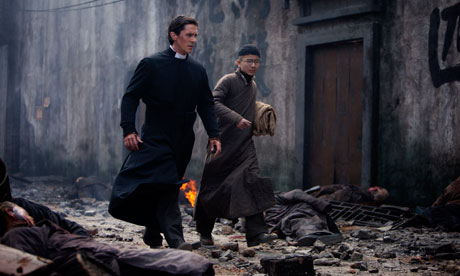
The Heroes of Nanking, made in China starring Christian Bale, was made with international audiences in mind, says director Zhang Yimou
Po, the Kung Fu Panda, may look like an innocuous, chubby animal, but he could turn out to be the most devastating double agent on the world stage since Mata Hari shimmied her way to infamy in the first world war. Last week, the sequel to the Chinese-themed, US-made animation broke box-office records in China, taking 125m yuan (£11m) in its opening weekend. It’s great news for its creators at DreamWorks, mildly irritating news for Chinese animators and intriguing news for the rest of the cinemagoing world, coming just as a newly confident China squares up to the original moviemaking superpower.
In Hollywood, movies that borrow far-eastern exoticism to entertain western audiences are as old as Mann’s Chinese Theatre – and usually as authentically Chinese. Kung fu movies have been popular in the west since the 70s, and Hong Kong cinema gained its own foothold when director John Woo exported his signature “gun fu” to Hollywood with The Killer in 1989, following in person four years later
What is new, however, is the tempting prospect of more than a billion Avatar-appreciating movie fans in mainland China. Already the world’s second largest economy, China is set to overtake Japan and become the second largest cinema market after the US. According to the predictions of the China Film Producers’ Association, by 2015 China will have built more than 7,000 new cinemas, and have annual box-office receipts of up to £3.7bn – which would explain Hollywood’s increasingly unsubtle efforts to woo Chinese audiences. Last year’s remake of The Karate Kid replaced Japanese karate with Chinese kung fu and a California setting for a Beijing location shoot. Seth Rogen’s version of The Green Hornet passed over more obvious casting choices for the role of the sidekick Kato in favour of Jay Chou, who was little-known in the west, but a bankable heartthrob in the far east.
Like a suitor spurned, in 2007 the US also lodged a complaint with the World Trade Organisation over China’s protectionist film distribution practices. This March’s decision in the US’s favour prompted speculation over whether China would relax the strict quota system for the release of foreign films. And if it did, how would that affect local film-makers? It seems the Chinese film industry has responded by remembering a favourite teaching of ancient military philosopher Sun Tzu: attack is the best form of defence.
This month, Legend of a Rabbit will open in China, the first release from a 4.5bn yuan (£420m) animation facility developed by the Chinese state as – at least in part – a response to the success of the first Kung Fu Panda film. As a challenger to the big Hollywood studios, it will join Hengdian World Studios in Zhejiang province, which since the mid-1990s has steadily grown to become the world’s largest outdoor film studio. Crouching Tiger, Hidden Dragon (2000), Hero (2002) and the American martial arts film The Forbidden Kingdom (2008) all made use of the complex’s historical sets, which include a full-scale replica of the Forbidden City. To call it “Chinawood” would seem a tad reductive.
Why is the Chinese government investing so generously in cinema? As Hollywood’s international reach proves, a healthy film industry extending a nation’s cultural reach can be as useful to a nascent superpower as any number of nuclear warheads. Or, from a perspective less tinged with cold war nostalgia, China’s economic prosperity affords it the opportunity to present its own image to the world, unmediated by Hollywood.
Not that it will be easy. “The western perceptions of China as an ageless rural country with a repressive ‘red’ regime remain a difficult obstacle for Chinese filmmakers – other than by designing these fantastic tales of martial arts set in ancient China,” says Yingjin Zhang, author of A Companion to Chinese Cinema. Raymond Zhou, a film critic and columnist for the China Daily newspaper, agrees that using cinema to introduce the real China to the rest of the world may present some difficulties. “Traditional Chinese values are mainly non-confrontational and do not make good movies,” he says. “It’ll take a genius to tell a quintessential Chinese story on screen and be successful all over the world.”
Could that genius be Zhang Yimou? A member of the first generation of directors to graduate from the reopened Beijing Film Academy following the Cultural Revolution, he is the most internationally successful director to emerge from mainland China, and along with Ang Lee, from Taiwan, among the most important Chinese-language directors working today. His 2002 film Hero opened at No 1 in the US box office, making it the second-highest grossing foreign-language film in US history (after Mel Gibson’s The Passion of the Christ) while his 2004 followup House of Flying Daggers grossed a healthy $93m (£56m) worldwide.
Yet even a director of Zhang’s standing has found that foreign interest dwindles when he strays too far from the martial arts (wuxia) formula. A Woman, a Gun and a Noodle Shop, Zhang’s Gansu province-set remake of the Coen Brothers’ 1984 film Blood Simple, made only a miniscule proportion of Hero’s $53m (£32m) box office and went straight to DVD in this country. Zhang chalks this up to cultural differences. “It’s black humour and I think that has many local facets, like the language, the way they talk, the gestures and so on. So it’s normal that people [in the US] don’t get much of it. It didn’t really bother me.”
Expectations are much higher for Zhang’s latest film, The Heroes of Nanking, which is scheduled to wrap this week. A big-budget historical drama about the 1937 massacre of Chinese citizens by Japanese troops, it is no wuxia spectacular, but it does benefit from the presence of a western star in Christian Bale. Fresh from his Oscar win for The Fighter, Bale plays an American priest who helps hundreds of civilians escape death. The Dark Knight is yet to open in China (Warner Bros cited “cultural sensitivities”), but Bale has a following among young Chinese thanks to the country’s vigorous trade in pirate DVDs, which have long been a key way for Chinese viewers to see foreign films.
Zhang says The Heroes of Nanking was made with international audiences in mind. “First of all, the story is very international. It has a universal message about humanitarianism, about love and redemption, and also we have Christian Bale. And the other thing is almost half of it is in English.” But the real strength of the film, says its Hollywood-based executive producer David Linde – who also worked on Crouching Tiger, Hidden Dragon – is that while its story is quintessentially Chinese, it has an appeal that transcends national borders. “A great signature director working with an incredibly inspiring actor? That in and of itself is thrilling. When do you get an opportunity where different cultures truly connect, in story, performance and direction? Really, very rarely.”
It might seem unrealistic to expect US appetites for foreign film to broaden as fast as the Chinese appetite is growing, but Linde, who has worked with directors including Ang Lee, Pedro Almodóvar and Alfonso Cuarón, says there’s hope. “There’s clearly a real fascination with China. I don’t know about England, but, as one small example, one of the things you’re seeing a lot here is students increasingly studying Mandarin, instead of the more traditional French and Italian.” And now that nervous jokes about a Mandarin-speaking future have become a mainstay of American political comedy, might curiosity about the new paymaster translate into box-office receipts? “I think that the opportunity for Chinese film-makers here is pretty significant.”
What matters for Chinese film-makers, Zhang says, is not whether they will be able to reach foreign audiences, but whether they’ll be able to satisfy their own. “The market is growing very fast and well-known directors don’t necessarily develop at the same pace. We have an old Chinese saying: ‘It takes 10 years to grow a tree, but 100 years to make a man.’ Maybe this will break the limitation on internationally imported films, so we can have films from all over the world to fulfil the people’s need.”
That, of course, is where Hollywood steps in. When The Heroes of Nanking opens in the US, it will likely be accompanied by the rustle of both popcorn boxes and Hollywood screenwriters riffling through Chinese history books, on the hunt for suitable western characters. It can’t be long before Reese Witherspoon is trading Mandarin quips with Tony Leung in her latest romantic comedy and James Cameron is directing Chow Yun Fat in a sci-fi blockbuster. When that happens, we’ll know exactly which cuddly panda was responsible.
• This article was amended on 10 June 2011. In the original, Zhang Yimou was referred to throughout as Yimou. This has been corrected.
Z
Z is one of the few Chinese on Hollywood’s A list (that’s right, Z is an A ;)) which makes this comment more interesting.
West isn’t always best, says Zhang
Mon, Jun 13, 2011
By Joy Fang
CHINESE actress Zhang Ziyi couldn’t be less bothered about not snagging a role in Hollywood.
“America is not the only market available,” said Zhang, 32, when asked about her ambitions there. After all, Crouching Tiger, Hidden Dragon (2000) was a huge hit there, while Memoirs Of A Geisha (2005) saw her breaking into the United States with a role that had her speaking in English.
But Zhang, it seems, prefers to stay on home turf.
She noted that the movie industry in China is developing quickly, with movies like action-comedy Let the Bullets Fly (2010), which starred veterans like Chow Yun Fat, raking in more than US$100 million (S$124 million) at the domestic box office.
The Chinese market is so hot right now that major movie studios want a slice of the pie.
Last year, for instance, media giant Fox produced its first Mandarin film, Hot Summer Days. The movie raked in US$20 million in China, where 1,000 new movie theatres opened last year alone.
“Of course, people will view Hollywood as the standard,” said Zhang in an interview that was part of the inaugural ScreenSingapore event.
“It’s good if we can get a chance to go there and experience what filming is like there. But if there’s nothing suitable, we shouldn’t force ourselves to take on any role just so we can be in Hollywood.”
Besides, the opportunities for Asian actors to express their voices truly are too few, she added.
One of ScreenSingapore’s ambassadors, Zhang - along with a slew of other stars that included South Korea’s Lee Byung Hun and Taiwan’s Van Ness Wu - walked the red carpet last Saturday at Shaw Lido for the premiere of actor, director and producer Tom Hanks’ latest film, Larry Crowne. The gala premiere served as the closer for the week-long fest.
Now, said Zhang, roles in blockbusters take a backseat to those she considers more “meaningful”.
Her recent role in Til Death Do Us Part (also known as Love For Life) had her acting with Aaron Kwok as two Aids patients who fall in love.
“I want roles that pose a challenge. I’ve tried big commercial films and a variety of different genres. Now I feel I should choose those with more depth,” she said.
“To me, there’s no difference filming in China or in Hollywood - except in location. Ultimately I want to star in something that has value, that will be remembered and discussed long after.”
Zhang has pushed away a few Hollywood scripts, even though studios offered her a lot of money, she revealed.
And what of her time in Singapore, where Zhang - who broke up with her fiance, Vivo Nevo, late last year - has spent more than a week?
“I toured the Night Safari, had hawker food,” she said.
And, she added, she hit Orchard Road, where the Great Singapore Sale was on. There, she found things that were “really cheap”, she enthused.
well i wouldnt call her A list. but she was hot for a bit, but she went ice cold, both here and in china for a while. and while the US is certainly not the only market. its still the biggest financially and globally. and i dont see that changing anytime soon. its been proven that hollywood films are depression/recession proof. remember in 09 when the bottom almost fell out? quantum of solace made close to 100million that same weekend.
I can understand Zhang wanting to take on more meaningful roles, as opposed to taking just any role Hollywood may have offered to her. I’ll bet most of those roles she refused were as the lead’s ‘exotic Asian girlfriend.’
yea i agree jimbo. or probably action roles. i think ken watanabe is the asian darling in hollywood now. he is what chow yun fat should have been.
I suspect part of Zhang Ziyi’s issue in china was the “too much like Gong Li” effect.
Also, for reasons I’ve never been able to fully comprehend a lot of Chinese men I spoke to found her really ugly.