Location, location, location
Wu Dang
China/Hong Kong
Period martial arts adventure
2012, 2.35:1, colour, 100 mins

Directed by Patrick Leung ()
Wu Dang
By Derek Elley
Fri, 20 July 2012, 23:15 PM (HKT)
Light action-adventure works OK as family fare but not much more than that. Asian and genre events.
Story
Shanghai, early Republican China, 1920s. Professor Tang Yunlong (Vincent Zhao), a widowed adventurer, returns to China from the US for the first time since he left during the Qing dynasty. He is sponsoring some 500th anniversary martial arts games at a Daoist monastery in the Wudang Mountains, Hubei province, in which his teenage daughter, Tang Ning (Josie Xu), is to compete. En route to Shanghai’s railway station, Yunlong stops off to advise a friend from the Manchu nobility on the purchase of a 2,000-year-old sword, reputed to have magical properties, that has long gone missing. The seller is an overseas Chinese arts trafficker, Paul Chen (Shaun Tam), who is asking US$300,000. Yunlong spots that the sword is a fake and narrowly escapes alive when Chen tries to kill him. However, Yunlong manages to keep a coded Wudang treasure map he found in the sword’s box. Among those assembling for the games is Tian Xin (Mini Yang), a member of the clan who once owned the sword, who has been entrusted by her grandfather to recover it and has a copy of the same treasure map. Tian Xin and Tang Ning both win their initial heats in the games, though Yunlong tells his daughter to take things more seriously. Searching separately in the mountains one night, Yunlong and Tian Xin find a cave with some swords but are attacked by their guardian, monk Bai Long (Dennis To). Yunlong and Tian Xin agree to join forces, with her keeping the sword and him keeping the rest of the treasure. Meanwhile, Tian Ning has got to know a young monk, Shui Heyi (Louis Fan), who is being trained by the chief abbot, Xie (Henry Fong), in “sleeping kung-fu”. Yunlong and Tian Xin try to decipher the secrets of the treasure map, but then Chen turns up looking for revenge.
Review
Wu Dang is a period martial arts adventure whose slim story and so-so protagonists are dwarfed by the spectacular setting of the eponymous mountains in central China. Seen as a family film aimed at young audiences, it works just fine, with good action (staged by Hong Kong veteran Corey YUEN ), okay visual effects (revolving round an ancient magic sword), plain colloquial dialogue, and a plot that a five-year-old could follow. Largely made, like current release The Four , by Hong Kongers using Mainland money and locations, it has a similarly routine, somewhat old-fashioned feel; unlike the more ambitious The Four, it at least knows what it is and gets the job done in a professional way.
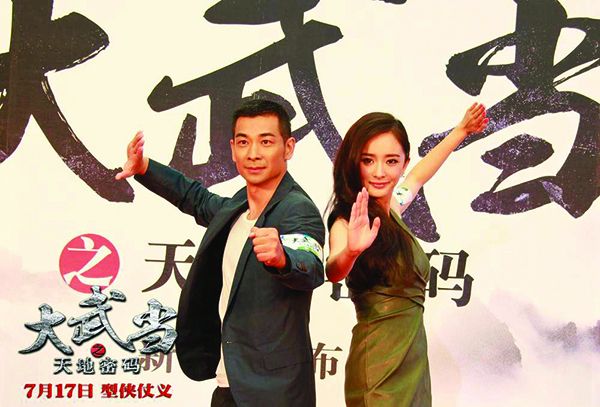
The movie is the first feature in five years by director Patrick LEUNG , a onetime assistant to John WOO who also did second unit work on Red Cliff (2008). Leung’s initial action dramas, like Somebody Up There Likes Me (1995) and Beyond Hypothermia ° (1996), had real personality, but during the past decade or so he’s become more of a genre journeyman (La Brassiere (2001), Demi-Haunted (2002), The Twins Effect II (2004)). Wu Dang starts by looking like a lavish, period treasure-hunter adventure but soon gets strapped by the weak script by writer-producer Khan CHAN , gaping plot holes, and lack of a budget appropriate to the production. As an adult action-drama, it doesn’t really cut the mustard. What keeps it watchable are the light leading performances by throaty Mainland hottie Mini YANG (in her first starring role in a major movie), likeable Hong Kong actor-martial artist Louis FAN , 14-year-old Mainland actress Josie XU (CJ7 (2008), Starry Starry Night ) and even martial arts veteran Vincent ZHAO , who shows some signs of a mature personality here as an early 20th-century treasure hunter.
When he does leap into action, Zhao is as reliable as ever. Yang employs the same perky offhandedness that made her bird-spirit in Painted Skin: The Resurrection so enjoyable and, though never remotely believable as a martial artist, goes through the moves okay. Yuen’s action sequences are the highlights, with slick use of wire-work, slo-mo and inventive choreography that actually advance the plot: in one sequence, Yang and Zhao’s characters start to bond in more way than one, as do Fan and Xu’s characters in another. Hong Kong veteran Lincoln LO 's score is acute, and editing by CHEUNG Ka-fai very smooth throughout. But the real star is the Unesco World Heritage Site in northwestern Hubei province, with its mountain peaks, precipitous Daoist monasteries and ethereal cloudscapes.
I like how this is tied to both The Four and Painted Skin 2.