This sounds strangely intriguing, but then again, I was amused by Mr. and Mrs. Incredible…:o
The Sword Identity
China
Costume martial arts drama
2011, colour, 1.85:1, 110 mins
Directed by Xu Haofeng ()
The Sword Identity
By Derek Elley
Mon, 12 September 2011, 17:10 PM (HKT)
Original, lowkey satire of martial-arts codes that’s too academic for its own good. Festivals, especially Asian and genre.
Story
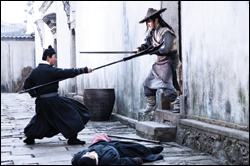
Shuangye town, southern China, late Ming dynasty. For 200 years there has been a rule that newcomers can open a martial-arts school only if they can best all four of the existing ones. One morning two men in straw hats and with elongated, Japanese-like swords enter the town and challenge the status quo. After a fight in Wuyi Alley against students of the four schools, and the schools’ overall leader Qie (Ma Jun), one is killed and the other escapes to a boat on which there are four travelling dancers. The mysterious swordsman (Song Yang) is the last surviving bodyguard of General Qi Jiguang, who defeated Japanese pirates by using Japanese swords. He teaches one of the dancers, Sailan (Xu Fujing), a single move with a bamboo pole by which she can repel attacks on the boat from behind a curtain. The martial arts students, beaten off one by one, have all been told the boat is full of Japanese pirates. Meanwhile, venerable martial artist Qiu Dongyue (Yu Chenghui), once the town’s number one, returns from the mountains to which he’d fled after discovering his young wife (Zhao Yuanyuan) was having an affair with her bodyguard Gan Gang (Ma Ke). After also being defeated by Sailan’s bamboo pole, he’s carried to the home of Qie. Meanwhile, the mysterious swordsman attacks Qie’s home and comes across Qiu’s wife, who has come looking for her husband. The swordsman teaches her a single move based on the position of an attacker’s shadow, and she uses this to defeat more locals who come in search of a rumoured Japanese pirate. But when her lover returns, Qiu schemes to have them both kill each other by mistake. And Qie still thinks he can defeat the “Japanese pirate” behind the curtain on the boat.
Review
A straightfaced send-up of the rigid codes of combat that ruled the martial-arts world, The Sword Identity is a nice idea that’s treated way too academically for a full-length movie. First-time director XU Haofeng is the only martial-arts novelist (plus Beijing Film Academy graduate, drama director, film critic, Taoist scholar and martial artist) to have become a film-maker. But what works on paper in his mould-breaking novels (Departed Warriors , 2006, Taoist Mountain , 2007) seems stiff and arch on the big screen, more suited to a half-hour short than almost two hours.
Adapted by Xu from one of his old novellas, but considerably altered in the process, the film has a neat comic premise: that trained swordsmen, because they’re locked into a rigid mindset, can be defeated by a simple trick with a bamboo pole by a dancing girl. And the movie, immaculately researched down to the smallest details of late Ming dynasty dress and weaponry, has a refreshingly different look from most swordplay movies. But between all the period detail and martial egos, Xu too often loses sight of narrative concerns, making the plot difficult to follow with its many ellipses and losing the thread of black comedy that should propel the whole concept into a piece of entertainment.
Xu has also worked as martial-arts consultant on WONG Kar-wai 's long-gestated The Grandmasters , and the fights are deliberately staged in a swift, “hard” way in which a couple of moves decide the outcome. This approach isn’t new to the genre; but along with his avoidance of any visual effects it bolsters the satirical take on regular swordplay movies, as well as being intermittently entertaining. After the first half-hour, however, Xu brings no new ideas to the table, and the movie more and more becomes a scholarly exercise that goes round in circles, with even the bursts of action losing their freshness.
Photography in a southern canal town has a greyish look — spotted with dashes of colour by the dancing girls’ costumes — that fits the “realism” of the movie. Among a cast of largely newcomers, BFA graduate SONG Yang has an easy charm as the mysterious swordsman who undercuts the status quo, and quarter-French model-turned-actress XU Fujing adds some welcome (and very pouty) humour as an ethnic-minority dancing girl. Of the two veteran cast members, MA Jun manages to look exactly like an imposing Terracotta Warrior as town baddie Qie, while real-life martial artist YU Chenghui (who starred opposite Jet LI in The Shaolin Temple (1982)) looks like he’s stepped straight off a Chinese scroll in his long white hair and conical hat.
Xu, who produced, wrote, directed, edited and choreographed the movie, has the clear makings of an original film-maker but also needs to work alongside experienced collaborators to realise his particular vision. The film’s original title could roughly be translated as On the Trail of Jap Pirates, the Chinese using a somewhat derogatory period term for Japanese () which can also mean “dwarf”.