Jama
There is a review of the book in the current issue of The Journal of Asian Martial Arts.
Joy chaudhuri
Jama
There is a review of the book in the current issue of The Journal of Asian Martial Arts.
Joy chaudhuri
[QUOTE=r.(shaolin);865604]I’m not convinced, as Shahar suggests, that late Ming hand combat was not created for fighting but were design for healing and religious self-cultivation and that Shaolin monks turned their attention away from weapons training during the Qing period.
I would suggest that bare-hand combat was integral and practiced in conjunction with weapon combat at Shaolin from its very beginnings. There is good historical evidence that bare hand combat was integrated and used in combination with hand held weapons particularly sword and short bladed weapons from the earliest times. The techniques of bare-handed close combat were sophisticated effective during the medieval period – well before the Ming dynasty. Unarmed fighting was part-and-parcel of weapons combat. Close bare-hand combat tactics were taught for their relevance to to real combat in all old school Chinese martial arts, either on their own or in conjunction with various weapons. The distinguishing features of pre-modern Shaolin martial arts was the assumption that close quarter tactics could be used and might often prove decisive when fighting with swords, of with staff weapons and the unarmed combat could be effective against an armed assailant. This was the real business of serious fighting where there was no rules and one would need to be prepared to use a foot, head, or knee when fighting at close quarters with weapons. These ‘wresting’ like tactics were not for sport but to disable, kill an enemy or to deal effectively with an armed adversary in the event of weapon being dropped or broken.
Effectiveness was central to Shaolin as it was with most martial art training even during the Qing Dynasty. Healing and religious self-cultivation although were important had there own sets.
Generally the curriculum of traditional Chinese martial arts systems, including Shaolin, included more weapons training than bare-hand training. That began to change after 1911 during the Republic of China.
r.[/QUOTE]
What do you base that on?
[QUOTE=sanjuro_ronin;865613]What do you base that on?[/QUOTE]
Fair question.
A number of things, but to start with a couple of points, both Emperor Qianlong ( ) and his predecessor Yongzheng Emperor () knew that martial arts were practiced at Shaolin. Dr. Shahar notes this in his book. As he points out, there are documents from 1726 which show that Yongzheng Emperor was aware of Shaolin monks military training. In 1750 Emperor Qianlong stayed over night at Shaolin and must have been aware of this as well, because later, in 1775, he harshly and angrily criticized the governor of Henan, Xu Ji for enlisting Shaolin monks to train his troops in spear fighting. The Emperor’s reaction clearly indicated he was well aware of the Shaolin monk’s expertise in weapons when he wrote, “How could they (the Henan’s regional government) disrupt the monk’s vocation calling them to demonstrate and having them sell their military skills?”
In Shaolin’s Baiyi Hall, the now well known Qing Dynasty fresco’s depict not ‘neigong exercises’, but rather, recognizable and practical combat methods the majority of the illustrated postures being paired fighting sets. One of these large frescos depicts mostly weapons again the majority are paired / two persons contact sets. Clearly Qing Dynasty officials were aware of martial art practice at Shaolin presences of government officials can be seen in both frescos. I would say it is rather curious that, if the main focus of Qing Dynasty Shaolin practice was healing and religious, no postures are found in these frescos that resemble neigong or any postures shown in Wang Zuyuan’s () book, Neigong Tushuo ().
I would add that Wang’s short stay at Shaolin (less than a year) can hardly warrant him the credibility of being a Shaolin exponent let alone an authority or expert in Shaolin, or for that matter, what he learned there was even characteristic of Shaolin practice.
r.
[QUOTE=r.(shaolin);865808]
In Shaolin’s Baiyi Hall, the now well known Qing Dynasty fresco’s depict not ‘neigong exercises’, but rather, recognizable and practical combat methods – the majority of the illustrated postures being paired fighting sets. One of these large frescos depicts mostly weapons – again the majority are paired / two persons contact sets. Clearly Qing Dynasty officials were aware of martial art practice at Shaolin – presences of government officials can be seen in both frescos. I would say it is rather curious that, if the main focus of Qing Dynasty Shaolin practice was healing and religious, no postures are found in these frescos that resemble neigong or any postures shown in Wang Zuyuan’s () book, Neigong Tushuo ().
[/QUOTE]
But wouldn’t you agree, and what I think Shahar was pointing out, was that Shaolin monks came to see the practice of fighting techniques as vehicles for their ch’an practice- they didn’t differentiate and saw martial arts as multipurposed, even developing spiritual myths to handle their practice in the face of buddhist norms. We know today that many martial forms which many would classify as ‘external’ for example, were and can be executed as ‘internal.’
I think you also mean to say, health and not ‘healing’. I did not get the sense from Shahar’s work that he felt like the monks were spending all that time trying to heal themselves. Certainly training martial arts to build up one’s health and protect it is nothing new or revelatory per se, this book just goes to show that this marriage is beyond our oral tradition or traditions internal to Shaolin.
Also, for dramatic purposes, I can readily see why an artist would show what he did as subject matter for the frescoes as opposed to the far less dramatic chi kung forms, and again I would suggest that the martial forms were considered spiritual- as they are considered today.
In re to the frescos; Two man sets in and of themselves are a highly ritualistic practice and used for several different things. Not the least of which is the development of how to interact with another more so than how to bring defeat to another.
there is an expectation and the knowledge included of a counter to every attack and those sets becoming very much along the lines of advanced breath work and tactile meaning ascribed to the concepts of yin and yang.
this is where the martial marries the zen practice on at least a few levels.
Hi Richard,
[QUOTE=richard sloan;866134]But wouldn’t you agree, and what I think Shahar was pointing out, was that Shaolin monks came to see the practice of fighting techniques as vehicles for their ch’an practice-[/QUOTE]
I don’t disagree that Chan and Buddhist nomenclature, and concepts permeated martial art practice at Shaolin, what I do question is the premise that Shaolin martial practice at Shaolin during the Ming and Qing period was created not for fighting, but designed, as Shahar says, for “healing/ therapeutic” and religious self-cultivation.
Today most people don’t understand the context of martial arts, in 19th and early 20th century China, and its seriousness. Poverty, uprisings, and remoteness of Henan province made it one of the most dangerous areas in China up to the modern period. Robber bands have a long history in Henan, even in the modern era its been bandit ridden. As an example during the mid 1800’s, the Taiping rebels devastated the the government army in Henan and attacked and raided villages and monasteries alike. Basically poverty has plagued the region and it has had continuous heavy fighting from ancient times.
[QUOTE=richard sloan;866134]
I think you also mean to say, health and not ‘healing’. I did not get the sense from Shahar’s work . . . [/QUOTE]
Actually Dr. Shahar uses both words “healing” as well as “therapeutic” (read as pertaining to the treating or curing of disease; curative) in the conclusion of his book.
cheers,
r.
Hmm, what is very interesting about Many of Shaolin’s nei gong sets, such as Six Harmony Gong, Chan Yuan Gong, Luohan 13 Gong , Rou Gong, and others is that they can also be used as self defense sets very easily (in fact I spend three days teaching this in a seminar I gave in Spain recently).
And, not only can you apply these Shaolin nei gong sets as empty hand self defense sets, but you can also do them with a staff (taught that too), and with double swords or double knives (showed how that works too at my seminar).
So, the health and the martial aspects are one in these most important nei gong sets, without these nei gong sets there would not be any Chen TJQ, XY, and Ba Gua today.
[QUOTE=richard sloan;866134]. . .even developing spiritual myths to handle their practice in the face of buddhist norms [/QUOTE]
As one Buddhist scholar pointed out to me.
“I would caution anyone about “Buddhist norms”. Although there is an emphasis on non-violence, there are several scriptures that allow self-defense, defense of the Dharma, and a text that seems to be presenting the idea that killing (as by a warrior) is just empty.”
r.
General Sinha comes to mind.
Did anyone notice the paralells between the picture Meir Shahar paints of the Shaolin institution and the institution of the Knights Templar?
Both rooted in misleading mythos and confusing historical switchbacks.
Greek heroes and Shaolin gods
Prof. Meir Shahar’s book The Shaolin Monastery mentions how Vajrapani, the protector of the Buddha, was worshiped as the de facto guardian deity of the Shaolin Monastery. One legend set during the Red Turban Rebellion in the Yuan Dynasty states the rebells were besieging the monastery when a lowly kitchen worker threw himself into an oven and emerged a mountain-striding giant wielding a long fire poker as a makeshift staff. After he had defeated the rebells, all of the other monks realized that it was none other than Narayana (one of the his Chinese names). Thus, he was also worshiped as the progenitor of the famous Shaolin staff method.
A Shaolin stele portraying Vajrapani in his Narayana form

Another legend says that devotees could gain supernatural strength and boxing abilities if they prayed to him most ardently. However, this strength could only be achieved by him ‘force-feeding’ the vegetarian monk raw meat. This legend is the root of all meat-eating martial monks. (It’s important to note that Bodhidharma was not associated with Shaolin arts until 1629, when the Sinew Changing Classic was written by a Taoist.)
Prior to and slightly after entering China, the Buddhist version of Vajrapani was always depicted with a club instead of a staff. His name actually translates as “thunderbolt in hand”. According to several books, his portrayal as a muscular, club-wielding man was supposedly influenced by statues of the Greek hero Hercules.
Tang Dynasty depiction of Vajrapani

Greek statue of Hercules

A Greco-Buddhist culture thrived in Pakistan, Afghanistan, and India during the 4th century BCE to the 5th century CE. In fact, the 2nd century ruler Menander I was the first recorded westerner to convert to Buddhism. These people were known for their Greek influenced art.
Greco-Buddhist statue of Vajrapani (left) and Buddhist monks

Greco-Buddhist statue of the Buddha and Vajrapani (right).
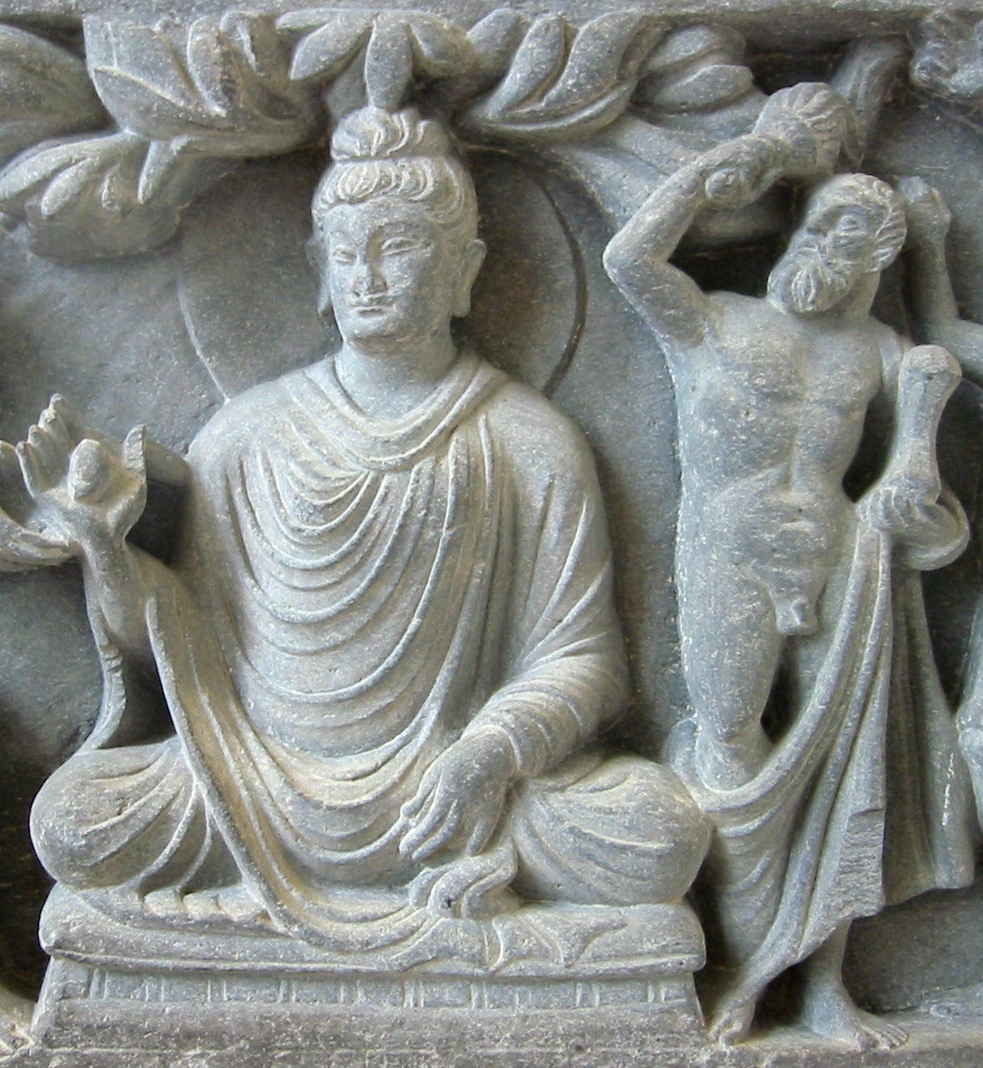
Did you notice how in all the statues of Vajra and Herc, besides the club and bare chest, one of the central motifs seemed to be him shifting his weight onto one leg? Look at them again.
If statues of Hercules truthfully influenced Vajra’s look, then Herc indirectly influenced Shaolin lore. Another interesting thing is that the Spartans believed themselves to be descendants of Hercules. So, the Greco-Buddhist art has a connection to both the Spartans and Shaolin warrior monks. How cool is that?
While Vajrapani, or Jinnalou in Mandarin, could have been modeled after Hercules but his status is not as important and influential to the Chinese as Nalakuvara (Na Jia - ) who is non other than Alexander the Great. In Hindu mythology, he is revered as Skanda, the second son of Shiva. Skanda in Chinese Buddhist community is known as Wei Tuo (). He is often depicted as the guardian warrior or personal guard of Avalokistesvara Bodhisattva or Guan Yin Pu Sa. Wei Tuo is also a martial arts division of Shaolin which is called Wei Tuo Liu He (Liu He for short) that is famous for its spear and staff. So in Chinese Na Jia is the Daoist (Thunder Sect) version of Alexander the Great; while, Wei Tuo is the Buddhist version.
That is very cool!
[QUOTE=mantis108;878695]While Vajrapani, or Jinnalou in Mandarin, could have been modeled after Hercules but his status is not as important and influential to the Chinese as Nalakuvara (Na Jia - ) who is non other than Alexander the Great. In Hindu mythology, he is revered as Skanda, the second son of Shiva. Skanda in Chinese Buddhist community is known as Wei Tuo (). He is often depicted as the guardian warrior or personal guard of Avalokistesvara Bodhisattva or Guan Yin Pu Sa. Wei Tuo is also a martial arts division of Shaolin which is called Wei Tuo Liu He (Liu He for short) that is famous for its spear and staff. So in Chinese Na Jia is the Daoist (Thunder Sect) version of Alexander the Great; while, Wei Tuo is the Buddhist version.[/QUOTE]
That is awesome stuff! Could your refer me to the books or journal papers you got this info from? Cross-cultural assimilation is one of my favorite subjects.
Why was my thread about the Hercules connection to Vajrapani moved to this thread? Yes, I mention Shahar’s book, but it was not the main focus. This was meant as a stand alone thread. Can someone at least make the last couple of comments their own thread again and put in the main Shaolin area?
Does anyone know of any written records that conclusively show that a martial art existed before the Ming dynasty at Shaolin (or elsewhere)?
Did all such things get destroyed during the Cultural Revolution, and during the many battles and wars?
Anyone know if Meir Shahars books is being repinted?
Because I cant find it, except at least close to double the price. Where to get it?
[QUOTE=Cimaroon;886634]Because I cant find it, except at least close to double the price. Where to get it?[/QUOTE]
Isn’t it available still at Amazon.com?
I got it from there and fast too.
It’s now available in paperback.
It’s an academic press so go directly to the source:
[URL=“http://www.uhpress.hawaii.edu/cart/shopcore/?db_name=uhpress&page=shop/flypage&product_id=5309&category_id=b3e6237d1b1b3b8594488ed1c40d0dfb&PHPSESSID=f0fe1150a75405bd4bfcc8506180eed2”]The Shaolin Monastery: History, Religion, and the Chinese Martial Arts
by Meir Shahar
paper, ISBN 978-0-8248-3349-7, $23.00
Amazon indeed :rolleyes:
BTW, I just heard from Meir. He’s in Taiwan now at a Nezha festival. Nezha is his next focus of research.
Thanks for the link Gene. Amazon had one for $168!