Tea

,

Hello,
I’ve been reading the forums for a bit now and I’ve noticed a few tea connoisseurs here. I had a quick question about buying online. I’ve noticed a couple places they list the date (month/year) that their “premium” teas have been harvested. Was wondering if this is just marketing tactic or what. The specific site I was looking at was http://www.redblossomtea.com/index.php

Appreciate any info. Thank you :slight_smile:

matt

Matt,

It is not a marketing gimic. These kinds of loose tea are more for the serious tea drinker who knows. I am learning but understand some of the concepts involved. My favs are Green Oolongs that have decent flavor but still light colored compared to the darker traditional Oolongs you see in the most stores and restaurants.

The prices are not bad for a pound of tea which will make some serious large amounts of brewed tea.

Thanks for the link.

Be well,

Dale

If you live near any major chinatown, you are better off buying from a tea shop tan online. Any oolong in the 100.00 price range is going to be medium-high quality (if the seller is honest).

Also, ask the shop keepr or if online, send a description of the taste you want, they should know there tea’s.

Also, I dont belive there is any benifit to taking oolongs with ginseng, as froma TCM standpoint the tea affects the quality of ginsengs properties and they really shouldnt be taken together.

Allthough, if you like the taste then that is your personal decision.

High grade oolongs can get quite expensive, the most ive tried is about 350.00 per pound, but there are some ive seen up to 500.00lb

again, better to get a sample if possible. If your going to pay around a hundred dollars a pound, you should get to try it out.

Make sure you get a clay tea pot to dedicate to each style of tea you brew, so if you brew oolongs, use oolongs only in that pot, or jasmine, or green etc…the flavors will stay in the pot as the the oils from the tea vaporize into the steam and absorb into the pores of the pot.

I just bought a low medium grade ( 70.00lb ) ti quan yin (a bit darker than green oolongs ) that was well worth it. I live close to Los Angels Chinatown so I can check out the tea up close. lucky me.

good luck in your tea hunting.

Thank you for the tip Dale. From my (limited) understanding so far is teas like the green and white can only be picked (or should rather) at very specific times of the year. So I wasn’t sure if they were just listing “common” knowledge or helpful info. Looking around some more, I see that you are indeed correct as I’ve found a few shops now that list havesting times. And not always can you go by what “should be”.

bigdoing-
I’ll check around town for shops. I was personally looking at the white tea (Silver Needle), but I would also like to find others for more of a “casual” type of consumption. Yes I saw one online shop, for 1/4 pound of Silver Needle the price is $671.00. Didn’t know they could get that expensive!

Thanks for pointing out about using different pots. I figured just use one pot, but what you said about the pots makes perfect sense. My cast iron pans are the same way :slight_smile:

Appreciate the help so far, definitely some useful information for me (and anyone else new to tea). Take care.

matt

check out www.teance.com
i know one of the owners and the manager, both are my “siblings” in taijiquan. i have had their tea on several different occasions, and it rocks! now, generally i am a coffee snob, but if i do drink tea, it’s theirs. they do internet orders, also (if you can’t get to the bay area).

red blossom - good bi lo chun and li shan.

teance - i had one called four seasons oolong once at a friends house from them. It was really good. I dont think they carry it anymore though.

Holymtn.com- lots of good pu-erh - a good gyokuro too.

itoen.com - great sencha and matcha

i wish i could order more tea…

Tea

http://www.youtube.com/watch?v=w_j3ThSg068

I was like WOW.

:eek::confused::rolleyes::):smiley:

http://www.youtube.com/watch?v=Q-4UFjviFNU&feature=related

:smiley:

http://www.youtube.com/watch?v=CZOy6WOL8fY&feature=related

7 fairies

wow.

:smiley:

http://www.youtube.com/watch?v=ltY1BiqhOwM

http://www.youtube.com/watch?v=sPsfl7QyI30&NR=1

a new garden that will be opened around chinese new year.

a must visit.

:D:)

http://www.youtube.com/watch?v=YLOqoykoF7E&feature=related

so it is catching on in the west.

:smiley:

http://www.youtube.com/watch?v=jmgoxq32ayg&NR=1

:smiley:

That’s pretty cool! I’ve been brewing loose-leaf for quite a bit… I might have to give one of those a whirl. If nothing else, it would make a heck of a party trick.

Kung Fu Cha

I’m moving this to the TCM forum. I have my reasons why.

Kung Fu tea ceremony promotes tranquility, harmony
by Jaye Beeler | Grand Rapids Press Food Editor
Wednesday November 26, 2008, 8:16 PM

Press Photo/Emily ZoladzCurtis Smith, Grand Valley State University professor of Chinese language and literature, demonstrates a traditional southern Chinese tea ceremony recently.

Curtis Smith, associate professor of Chinese language and literature at Grand Valley State University, cradles the unglazed clay teapot from the Yixing village in Jiangsu province near Shanghai – a recent purchase from Taipai, Taiwan, this summer.

Smith neatly arranges the 8-ounce tea pot and another tea pot pitcher on a bamboo tea tray with three itty-bitty tea cups. He readies a kettle with nearly boiling water and sets up his tea paraphernalia – a set of beautiful bamboo tea spoons, a tea scoop, long-handled tweezers, a tea strainer and a tea poke to clear leaves from the spout. He keeps a cloth nearby for spills.

“This is called Kung Fu tea. Kung Fu actually doesn’t mean martial arts. It means ‘hard work,’ so Kung Fu tea is a more labor-intensive way to make tea,” says Smith, who holds a doctorate from National Taiwan Normal University.
FOR EXAMPLE

Three kinds of Chinese tea are available at Asian markets and Chinatowns.

• Unfermented or green tea: Has green spiky leaves like an evergreen. When brewed, looks greenish in the cup. Has a purer, delicate aroma and is refreshingly stimulating.

• Fully fermented or black tea: Full-bodied, rich, reddish brew with warm, pungent qualities.

• Semi-fermented or wulong (oolong) tea: Has long, curly leaves rolled into tiny balls; varies in its green hues. When brewed, it unfolds to reveal two leaves and one shoot (bud). Its fragrance and flavor changes throughout the steeping process. Perfectly complements rich, flavorful food.

A Kung Fu ceremony promotes harmonious tea-making and tea-drinking.

“A Chinese tea ceremony is all about the experience of drinking good tea, so the flavor and the enjoyment of the tea is very important,” Smith says.

Appreciate the aroma

Smith fills the clay teapot one-quarter full of wulong (oolong) tea, encouraging guests to smell the tea.

“The first step is to rinse the tea leaves, which also warms the pot and removes a good portion of the caffeine,” Smith says.

Ten seconds later, Smith pours the tea over the clay tea pot pitcher and tea cups. With bamboo tweezers, he picks up the tea cups and pours those out over both tea pots.

Again Smith fills the tea pot with nearly boiling water until it overflows, letting it steep for one minute. He pours the wulong tea from the Ali Mountain in southern Taiwan into the tea pot pitcher, then into each guest’s sniffer nestled into a tea cup.

“I’ll show you how to drink it,” he instructs. “Pick up the sniffer with your index finger and thumb on the upper rim, supporting the bottom with your ring finger. That way, you don’t burn yourself. Dump the tea into the drinking cup and then smell the empty sniffer. As you smell it, the aroma will change as the cup cools. It will go from being a floral fragrance to spicy. As the fresh air clears the nose, the fragrance will go into a sweet fruity flavor.”

When drinking the tea, it is customary to slurp it to draw in air, then move it around in your mouth.

“A high-quality wulong tea, particularly high-altitude variety, is good for up to 12 steeps, but the second brewing is the most delicious tea – because it’s smoother and more refined and fragrant.”

While studying in Taipai for a time in 1985, Smith discovered the spiritual, stimulating qualities of Chinese tea, not the stale black tea variety he grew up on.

“I first tried green tea, and it was like nothing I had ever had before,” Smith says. “I was hooked. I came to realize Chinese teas are like wines, with distinctive nuances.”

Like a Bordeaux produced in France is quite different from varieties grown in California or New Zealand, Chinese teas offer various characteristics determined by the growing region, hand-harvesting and fermenting/roasting process.

First-hand experience

This summer, Smith, who led 18 GVSU students on a study abroad program to National Taiwan Normal University, introduced his group to Chinese tea.

“I had one student who wanted to have nothing to do with tea. Until our second day, when I took them to a tea house, and, from that moment on, he was crazy about tea,” Smith says.

“Good tea is hand-harvested. … Pick wulong tea when it has two leaves and a shoot (bud), and that has to be done in the morning, then it’s put into the sun to let the moisture evaporate.”

From there, the tea leaves are fermented before they are processed and rolled.

“China is divided into two major areas – North and South, and (they) have different cultures, languages, diets and personalities,” Smith says. “This tea ceremony is southern style. In the North, where it is colder and more nomadic cultures live, they tend not to sit around all this time, spending so much time drinking tea like this. So they prepare tea by putting tea leaves directly into a big glass and pouring water over them.”

“Drinking Kung Fu tea is a leisure activity called ‘old folks tea’ because the whole process takes time.”

Curse you Gene!!!

Now I want a nice cuppa! And my tea is all at home… and I’m at the office! With terrible, terrible red-rose tea bags!!! {cry}

:frowning:

I have teapots at work, at school, as well as home.

I have turned many onto the wonders of tea.

Im a big fan of greener oolongs.

My fav is called Se Chung which is a green oolong from Southern China.

Im drinking some as I write this.

I with Dale

SimonM, you have no one to blame for that Red Rose but yourself. I always have a stash of tea at the office. I don’t have the fat yixing set up - in fact, Gigi and I have discussed getting one here at the office for honored guests, but we’ve never got around to it. I just do it traditional Beijing-suntea-inna-mason-jar style, although I use a nicer cup. In fact, I just got gifted a new cup a few weeks ago. What’s more, we often get gifted good tea from our good friends (good guanxi). I hoping someone drops by soon for the holidays and kicks down some tea because I at the bottom of my pi lo chun container (which is just as well because this is a crappy one that I bought in desparation).

BTW, If you’re into tea and you’re ever in S.F. this is the place
Red Blossom Tea Company.
In the heart of Chinatown.
They rock on ever level when it comes to tea. Intelligent, friendly, helpful, beautiful tea sellers and an amazing collection of fine fresh stuff where you can just lift lids and sniff aromas for hours. Tell them Kung Fu Tai Chi magazine sent ya. Maybe they’ll buy an ad. Or maybe just give me a discount. Or cut me in to whatever they have stashed behind the counter.
:wink:

I’ve got a good tea shop in London, ON. Good selection and they have my personal fave (Tieguanyin).

Haven’t found a source for Alishan in Canada yet - that remains the only non-alcoholic beverage that I have caught a notable buzz off of.

Chinese Herbs are prepared for health maintainance or medicinal use in one of several ways, depending on the ingredients used. Part 1 of this Series addresses the traditional preparation of herbal infusions (teas/cha). The method described here is also used for the preparation of non-herbal green teas and black teas such as Jasmine Tea, Oolong Tea, Special Gunpowder Green Tea, English Breakfast Tea, India Darjeeling Tea, and so forth. It is considered the most desirable method of making any kind of tea, herbal or otherwise.

A tea is essentially a fluid infusion of one or more ingredients which are too delicate to be boiled or simmer cooked as a decoction. This would especially apply to items such as dried flower tops like Chrysanthemum Flower Tea (Ju-Hua Cha), dried plant leaves such as Peppermint Leaf Tea (Bo-He Cha), and could also include dried fruit bodies such as Dried Red Chinese Dates (Hung-Zao). In each case, boiling would destroy the nutritional and medicinal properties of the herbs, negate their known healing actions, and ruin the normally pleasant flavor and aroma of the herbs.

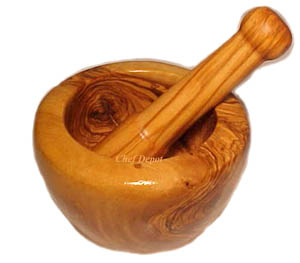
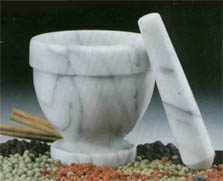
Preparation of the infusion begins by gently bruising the dried herbs with a mortar and pestle. Smaller mortars and pestles made of wood or bamboo work well when preparing one or two servings only, while larger stone mortars and pestles (granite or marble) are usually used when preparing larger amounts of herb for a greater number of servings. Example of each type of mortar and pestle can be seen here:

http://www.fantes.com/images/120840mortar.jpg (bamboo)
http://www.chefdepot.net/graphics23/olivemortar.jpg (olive wood)
http://www.chefdepot.net/graphics23/mortar.jpg (marble)
http://www.templeofthai.com/mortar_and_pestle/mortar_pestle.php (granite)

A sufficient volume of water is then brought to a full, rolling boil. Either a ceramic/porcelain teapot with a lid, or a large ceramic/porcelain teacup with a lid, is pre-heated by swishing a small amount of boiling water around inside the vessel and then pouring it out. Here are examples of traditional teapots and cups, and the individual teacups with their own lids which are so popular among the Chinese:

http://importfood.com/media/cwtp0701b.jpg
http://importfood.com/media/cwtp0701c.jpg
http://img.alibaba.com/photo/11216185/Giant_Chinese_Ceramic_Cup.jpg

Alternately, any ceramic coffee mug can be used instead, with a small saucer or plate placed on top of it as a cover while the tea steeps or infuses.

Next, place the bruised herbs or tea leaves in the bottom of the teapot or cup, pour the remaining boiling water in until the vessel is filled, cover the vessel with its lid, and allow the preparation to steep or infuse until all or most of the ingredients sink to the bottom of the vessel. This may take between 5-20 minutes depending on the ingredients used. In the event that all of the ingredients do not sink to the bottom of the teapot or teacup, the tea should be poured through a non-metal strainer prior to drinking in order to prevent small pieces of ingredients from floating around in the cup when drinking the tea.

When the tea is fully prepared and poured for drinking, it is considered ready for consumption when the cup it is poured into has cooled enough to pick up and hold comfortably in the hand. This is why Asian teacups traditionally are made without handles as in the West. In this way, the tongue and inner mouth are never scalded from drinking the tea while it is still too hot!

Enjoy your teas, and drink to good health!

Doc

Here are a few valuable articles on Chinese methods of preparing tea infusions. Enjoy!

http://www.jcm.co.uk/catalogue.php?catID=271&opener=0-197-271&fe=352bf0c2dadd4f87831776bed3b662aa

http://www.jcm.co.uk/catalogue.php?catID=459&opener=0-197-271-459

http://www.jcm.co.uk/catalogue.php?catID=460&opener=0-197-271-460

http://www.jcm.co.uk/catalogue.php?catID=461&opener=0-197-271-461

http://www.thefragrantleaf.com/teaprepchinb.html

http://www.jadedragon.com/archives/tea/kungfutea.html

Doc