I am posting this here, because I’m not sure where it fits… and also this forums gets the most hits.
Here is my predicament:
I have been waiting to get my first tattoo until I go to China, and meet someone in the Chen family, or a monk at Shaolin, or something completely awesome like that. I have been waiting since I was 18, and everyone got their first tat, and all of the beautiful subsequent work. My desire was to get a master to write something relevant to Shaolin or Taiji and pay them for the work, which I would come back to the states and get permanently placed on my wrist or left pectoral.
Unfortunately, I turned 28 this year, and the future looks less likely to involve a trip to Shaolin or Chen villiage than the past.
SO…
Who has an image of kung fu/tai ji relevant characters, written by a kung fu/tai ji master, which wouldn’t mind them being tattooed on a random kung fu/tai ji practitioner’s body?
You should seek the characters drawn by a calligraphy master first and foremost, if they do taiji, that’s a bonus.
Keep in mind, traditional Chinese culture thinks pretty low of tattoos. Not that that should dissuade you either way, just so you know, most teachers in China would be silently mortified at the idea: they don’t see that as a representation of dedication.
However, really, focus your search to what a calligraphy master has done, not a kung fu one. Search for images of calligraphy.
[QUOTE=KC Elbows;1037840]You should seek the characters drawn by a calligraphy master first and foremost, if they do taiji, that’s a bonus.
Keep in mind, traditional Chinese culture thinks pretty low of tattoos. Not that that should dissuade you either way, just so you know, most teachers in China would be silently mortified at the idea: they don’t see that as a representation of dedication.
However, really, focus your search to what a calligraphy master has done, not a kung fu one. Search for images of calligraphy.
Hopefully someone else may help with some images.[/QUOTE]
Thanks.
I do understand your points.
I however, am culturally American via Sweden, and while calligraphy mastery is important, I really want something done by a master of gong fu/tai ji. A Chinese hand that holds strong kung fu is a hand that I want to write the label that will become a part of me.
Seriously, many kungfu teachers act as if they’re a calligraphy master, and most suck. I leave your decisions to your discretion, but urge you to narrow the field by choosing from only true calligraphy masters, as they better capture the characters.
Just because one can fight well doesn’t mean they have the same fury in their handwriting.
This is writing that is permanently on you, and you are not likely to learn beforehand the subtleties of chinese calligraphy(or you’d just do it yourself), so there’s really nno harm in looking for calligraphy masters’ works in the field.
Past that, hopefully someone here can post a pic of some famous kung fu master’s work for ya.
[QUOTE=Syn7;1037861]zheng manqing aka cheng man ching was a taiji master and great artist… caligrapher extraordinaire apparently… see if u can find any of his work…[/QUOTE]
he’s your sigung and you havent seen any of his work??? im sure theres even some online… google it, look hard, try different words for searches… persistance pays off in google searching alot of the time… so much crap, but gems in there if you dig right…
why not draw up your own?? symbols are powerful tools and upgrades to ones human vehicle… choose and design them wisely… tattoos are spiritual in nature… energy signatures and divine footprints.
one of the most famous caligraphy and martial artists on the est coast is sik yee wong living in Toronto Canada, he has done work for me and my school adn his writingings are incredible he would be the guy you need to contact. hope this helps
One thing that most people don’t think of when getting a tattoo, is that many years later the ink will spread, outlines will get fuzzy and sunlight will make them fade.
I would like to add, that depends on who does it, how deep they go, and what ink they use, however you are partially corect.
If you dont have a steady percise hand and when looking through a magnifying glass the lines are a tad wavey, or they go too deep into the epidermis and or they use a bleeding cheeper ink all that will happen.
The sun fades everything but you must keep it out of sunlight for the first 6 weeks
[QUOTE=KC Elbows;1037840]Keep in mind, traditional Chinese culture thinks pretty low of tattoos.[/QUOTE]
It was traditionally associated with criminals. This has nothing to do with Yakuza-like body tattoos. In ancient China, men found guilty of crimes were often tattooed on the face. These tattoos were made to look similar to military face tattoos so criminals could easily be absorbed into the Chinese army.
I know this sounds weird, but try to get a another person to verify what the tattoo says. Otherwise, you might be in a changing room when a Chinese persons asks you why it says “Cat anus” on your back (no, I’m not speaking from personal experience.)
A lot of people tend to get because it is associated withe Yue Fei. But there is no proof he ever had such a tattoo or that he has any connection to the many styles attributed to him.
I’ve always thought about getting a Maori tattoo myself. Tattoo guns are for pussies. Bone needles, ink, and a hammer are the only way to go.
[QUOTE=ghostexorcist;1038294]It was traditionally associated with criminals. This has nothing to do with Yakuza-like body tattoos. In ancient China, men found guilty of crimes were often tattooed on the face. These tattoos were made to look similar to military face tattoos so criminals could easily be absorbed into the Chinese army.
I know this sounds weird, but try to get a another person to verify what the tattoo says. Otherwise, you might be in a changing room when a Chinese persons asks you why it says “Cat anus” on your back (no, I’m not speaking from personal experience.)
A lot of people tend to get because it is associated withe Yue Fei. But there is no proof he ever had such a tattoo or that he has any connection to the many styles attributed to him.
I’ve always thought about getting a Maori tattoo myself. Tattoo guns are for pussies. Bone needles, ink, and a hammer are the only way to go.[/QUOTE]
yeah, i have heard lots of stories of people getting chinese or japanese words and finding out the hard way that it isnt what they thought it was… i bet some asians do this on purpose for laughs at the stupid whiteboys…
yeah, who needs guns, its all about the hammer…!!!
[QUOTE=kfman5F;1038290]One thing that most people don’t think of when getting a tattoo, is that many years later the ink will spread, outlines will get fuzzy and sunlight will make them fade.[/QUOTE]
if you got your tattoo in 1958 and it was done with pen ink, then yes. lol
these days the pigments are superb and many of the artists are well trained and have good knowledge.
It’s an art form to be sure.
Some people are wrecks, but many have exquisite pieces.
[QUOTE=ghostexorcist;1038294]It was traditionally associated with criminals. This has nothing to do with Yakuza-like body tattoos. [/QUOTE]
its exactly like yakuza tatoos. all the legendary gangsters had tatoos
Go find a Daoist monk and have them paint a Calligraphic charm for you. Then use that as your tattoo.
There’s more to the disdain of Tattoos in Chinese culture than criminality. It has a lot to do with slavery - and acupuncture, in turn, has a lot to do with both.
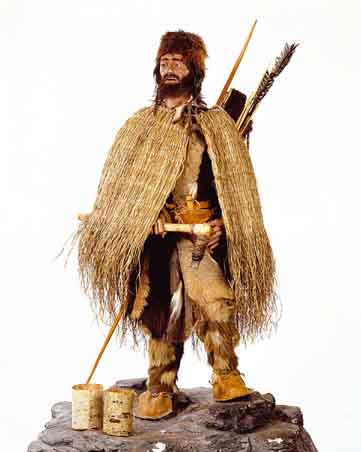
Way back in the day, like around 5,300 years ago or something, lived a tattooed man.
No one knows where he got his tattoos, or why exactly he got them; when they discovered his body in a Alpian glacier in the early 90s
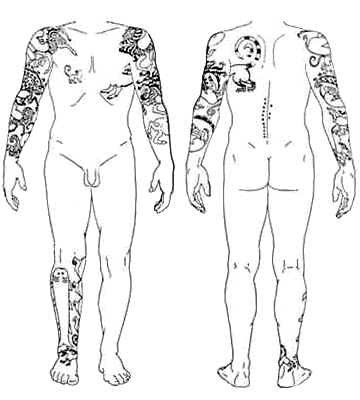
they took note of the tattoos and someone remarked that they were placed in areas that appeared to correspond to acupuncture points in TCM:
Further research indicated that the Tattoos were placed over areas exhibiting pathophysiological signs:
So at some early point there seems to have been a connection between Tattoos and therapy.
Later on, about 700 BC, we find this guy:
He was a Scythian who roamed the Central Eurasian Plains. His Tattoos are much more ornate, and we see what are thought to be “apotropaic” tattoos - charm tattoos for protection, possibly fertility, good hunting, and the like. Still, on his back near his spine we see a series of very simple dot tattoos which are not reflective of the tattoo skills of the time. I propose that they are tattoos which follow the same rationale as Oetzi’s tattoos - namely, they are therapeutic.
Fast forward to the 1920s, to when the last Yupiget natives on St. Lawrence Island received traditional Arctic tribal tattoos. The Tattoo tradition in the arctic spans over 3500 years.
Its practice methods and rationale were recorded before they dissappeared completely - again, they correspond to a therapeutic, apotropaic and ancient Chinese Medical use:
South East Asian tribes also have a history of tattooing, as do the tribes of Japan, such as the Ainu. All of them use Tattooing in much the same manner.
So what happened in China? Several theories exist. Here’s mine.
With the gradual growth of kingdoms, a need arose for keeping track of whether or not the people on your land were friends or foes. Whereas prior identification may have rested with the types of tattoos a person had, the ever-growing alliances made tattoos an unreliable way to distinguish the enemy from an ally. With so many variations, how could one possibly know where the person approaching was from? So some king, at some point, abolished Tattoos. Maybe it was at the recommendation of Confucius in the Zhou dynasty. Maybe it was earlier, and Confucius reframed the idea in a “don’t defile the body” kind of way. At any rate, it meant that Tattoos were no longer regarded as an element of a “civilized” people. It now belonged to “Barbarians” who were often enslaved, causing tattoos to become associated with slaves. Slaves and convicted criminals shared similar predicaments and so Tattooing eventually became associated with Criminals (plus, criminal acts are often described as “barbaric”.)
Here’s the thing: in China, tattoos appear to initially have been therapeutic and associated with ancestral medicine (ie illness was caused by unhappy ancestors / the Inuit “Shade.”) Prior to the Zhou dynasty, Chinese medicine was primarily ancestral. During the Zhou, demonic medicine began replacing ancestral medicine: illness was no longer due to ancestors but to demons. Why the switch? Well, I think it connects back to Slavery. In China, a slave was socially viewed as an ancestorless orphan. As such, ancestral medicine didn’t work - meaning slaves required a different explanatory model for their illness.
So demonic medicine came to the forefront: no longer was the goal to protect against dead spirits by shoring up the gates; now, it was to exorcise malevolent influences that had already entered. In urban village and city spaces, men were hired to shout, run down the roads and thrust spears into the darkened corners and alleyways in a ritualistic “exorcism” either every night or on special days. It is possible that this practice relates to acupuncture emergence as a primary method of “invisible tattooing/point exorcism” among doctors.
Even the Ling Shu, an acupuncture classic from about 300BC, provides technical details which point to “tonification” being linked to the insertion of material into and under the skin and “dispersing” being linked to the removal of material from inside and underneath the dermis, which strongly suggests a link between Tattoo therapy and acupuncture therapy in my mind.
The popularity of Tattooing ebbed and flowed over the centuries after that. During one dynasty, Tattooing was so popular that tattoo shops had stencils made that they would just dip in ink and then tap into the skin all at once - one (or two or three) taps = one complete tattoo.
In the last century, for the most part, Tattoos were associated with gangs and hence crime.
Ok, my rant is done. Now back to your regular programming.
CSP