SF Opera The Monkey King 猴王悟空 by Huang Ruo and David Henry Hwang


Coming November 2025

[URL=“https://www.sfopera.com/monkeyking”]The Monkey King

by Huang Ruo and David Henry Hwang

The World Premiere of The Monkey King is coming November 2025.
Subscribe for tickets. Available February 4, 2025.

Performances

Overview
Music By

Huang Ruo

Libretto

David Henry Hwang

Language

Sung in English and Chinese

Dates

November 2025

Run Time

TBA

Power alone is not enough

Hes arrogant. Hes disobedient. Hes becoming the most powerful being in creation, and hes about to wreak havoc on heaven.

Based on the classic Chinese novel Journey to the West, The Monkey King makes its much-anticipated world premiere at the War Memorial Opera House. This new, action-packed opera combines high-energy music and text with puppetry, dance, Peking opera, and Buddhist sutras to tell the tale of the Monkey Kings beginnings.

The Monkey King is a beloved figure, inspiring countless interpretations in Chinese popular culture. A monkey born from stone, Sun Wukong (the Monkey King) is determined to find immortality for his tribe. Many scoff at his aspirations but, as he learns from a Taoist master, he is set on proving them wrong with his signature cunning and charm. He wins every battle against legendary warriors, but the respect he longs for is always out of reach. What will it take for the gods to recognize him as an equal?

Award-winning director Diane Paulus and puppeteer Basil Twist conjure up a whimsical world of gods, tricksters, superheroes, and rebels. Huang Ruos soaringly beautiful, energized score and David Henry Hwangs incisive libretto blend traditional Chinese and contemporary Western styles into an extraordinary work that gives new voice to this enduring story.

The Monkey King is an artistic experience you do not want to miss. Be a part of the world premiere of this thrilling new opera!

SF Opera The Monkey King by Huang Ruo and David Henry Hwang
Monkey King

San Francisco Opera’s ‘The Monkey King’ ready to premiere with magical Kung Fu and puppetry

The Monkey King, a beloved figure in Chinese mythology, is now the star of an opera

  • By MIKE SILVERMAN - Associated Press

  • 50 mins ago

1 of 2

Opera - The Monkey King

This image released by the San Francisco Opera shows tenor Kang Wang, center, rehearsing for the new opera “The Monkey King,” on Nov. 6, 2025 in San Francisco.

  • Cory Weaver - San Francisco Opera

Opera - The Monkey King

This image released by the San Francisco Opera shows tenor Kang Wang rehearsing for the new opera “The Monkey King,” on Nov. 6, 2025 in San Francisco.

  • Cory Weaver - San Francisco Opera

SAN FRANCISCO (AP) — A rascally superhero born from a stone egg, the Monkey King is beloved in Chinese mythology, appearing in everything from a 16th century epic to modern comics, animated movies and video games — even in poetry by Mao Zedong.

And now he’s the star of an opera.

“The Monkey King,” with music by Huang Ruo and libretto by David Henry Hwang, has its world premiere at the San Francisco Opera on Friday with performances through Nov. 30.

It’s adapted from “Journey to the West,” a 100-chapter novel inspired by the true story of a 7th-century Chinese monk who traveled to India to find Buddhist sutras, or scriptures, and bring them back home.

“It’s essentially an allegory of how Buddhism came to China,” Hwang said.

His libretto, in both English and Mandarin, is based on early chapters of the epic, portraying Monkey King’s birth and daring exploits, as well as the arrogance and pride that lead him to be imprisoned for 500 years until he learns humility, compassion and discipline. At the end of the opera he is finally worthy of accompanying the monk on his journey.

For Hwang, part of the Monkey King’s appeal is the way he undercuts stereotypes.

“Everyone associates the Chinese persona with respect and deference and conformity,” he said. “And Monkey represents this whole other side that doesn’t normally get expressed in terms of being individualistic, being rebellious, being egotistical.

“Also given the fact that Monkey is rebelling against a corrupt administration, people can look at that however they want to see it.”

Creating magic on stage in ‘The Monkey King’

Mounting the opera is an ambitious undertaking for the company, which has a long track record of producing new work but faced unique challenges in bringing Monkey’s fantastical adventures to life.

“He’s flying on clouds, diving underwater, soaring to the heavens,” director Diane Paulus said. “I thought, oh, my gosh, how are we going to do this on the stage? How do we realize this and in what style?”

One answer was to collaborate with puppeteer Basil Twist, who designed the sets as well as puppets, making extensive use of his trademark silks.

“The whole notion of the ephemeral and letting go of things and the power of transformation to me is beautifully expressed by silk that can become water that then disappears and becomes clouds, and then becomes a giant column,” she said.

An opera that gives the tenor a workout

Since Monkey King has to perform supernatural feats, engage in acrobatic fighting, shift his shape at will, and also — this is an opera, after all — perform arias accompanied by full orchestra, the creators represent him by three different figures: a singer, a puppet and a dancer.

“I call it the Holy Trinity of Monkey King,” said Kang Wang, the Chinese-Australian tenor who sings the title role.

While that spares Wang from having to perform backflips or other complicated dance moves, it doesn’t mean he can stand up straight the whole time. Whenever he’s not singing full out, he has to crouch in a semi-squat the way a character would who is half-monkey, half-man.

The company engaged Jamie Guan, a Peking Opera specialist, to train Wang in the proper gestures and body language. And he has to convincingly perform complex tricks twirling a magic staff.

“It’s not easy,” said Wang, who is more used to singing Verdi and Puccini roles. “In rehearsal I’ve been like taking a shower on stage with my own sweat. My colleagues were telling me they could see me losing weight. … It’s like a CrossFit session every day.”

Other characters in the opera include the corrupt Jade Emperor, sung by tenor Konu Kim, and Guanyin, the Goddess of Mercy who guides the Monkey King, sung by soprano Mei Gui Zhang. Carolyn Kuan conducts the orchestra, chorus and soloists.

‘The Monkey King’ mixes East and West in the orchestra

Huang Ruo, who has composed several other operas as well as concertos and chamber music, was born in China and studied music there before moving to the US. He uses a Western orchestra for “The Monkey King” with the addition of a pipa, a Chinese four-stringed lute.

“I said I’m not going to write a Western opera, or a Chinese opera, but I’m going to call it a magical Kung Fu opera,” he said. “Because we have singing, and orchestra, all the good things, story-telling, emotional moments, all this from the operatic art form. But we also have Kung Fu fighting, operatic dance, and puppetry, and mixed media to convey this magical world.”

For Matthew Shilvock, the company’s general director, the score is “incredibly propulsive … but also lyrical.

“We keep going in and out between two different sound worlds,” Shilvock said. “There’s all these hijinks with the Monkey in the battle sequences where he is taking on the gods … and then you have these moments of incredible serenity.”

Shilvock is hopeful the opera will appeal to audiences across cultural lines.

“For people who grew up with the Monkey King there’s a huge sense of nostalgia about it, so it’s tapping into something deep,” he said. “For people who are getting to know it for the first time you’re being introduced to this extraordinary piece of world literature… so there’s a wonderful sense of discovery.”

If Huang Ruo has his way, this may not be his last opera about the Monkey King.

Borrowing inspiration from Richard Wagner whose “Ring” cycle stretches over four operas, the composer said he and Hwang “have this pipe dream to create the Monkey King Cycle.

“When we get to the last opera, they reach the land of bliss, where Buddha and his disciples live,” he said. “The journey didn’t start yet. It’s just the beginning of the story-telling.”

Stay tuned. More to come.

Read World Premiere: The Monkey King by Huang Ruo and David Henry Hwang at San Francisco Opera

By Gene Ching

An early rehearsal for Huang Ruo and David Henry Hwang’s “The Monkey King”
with Kang Wang as the title role.

In World Premiere, ‘The Monkey King’ Is a Dazzling Triumph at SF Opera

Gabe Meline

Nov 16, 2025

Updated Nov 17, 2025

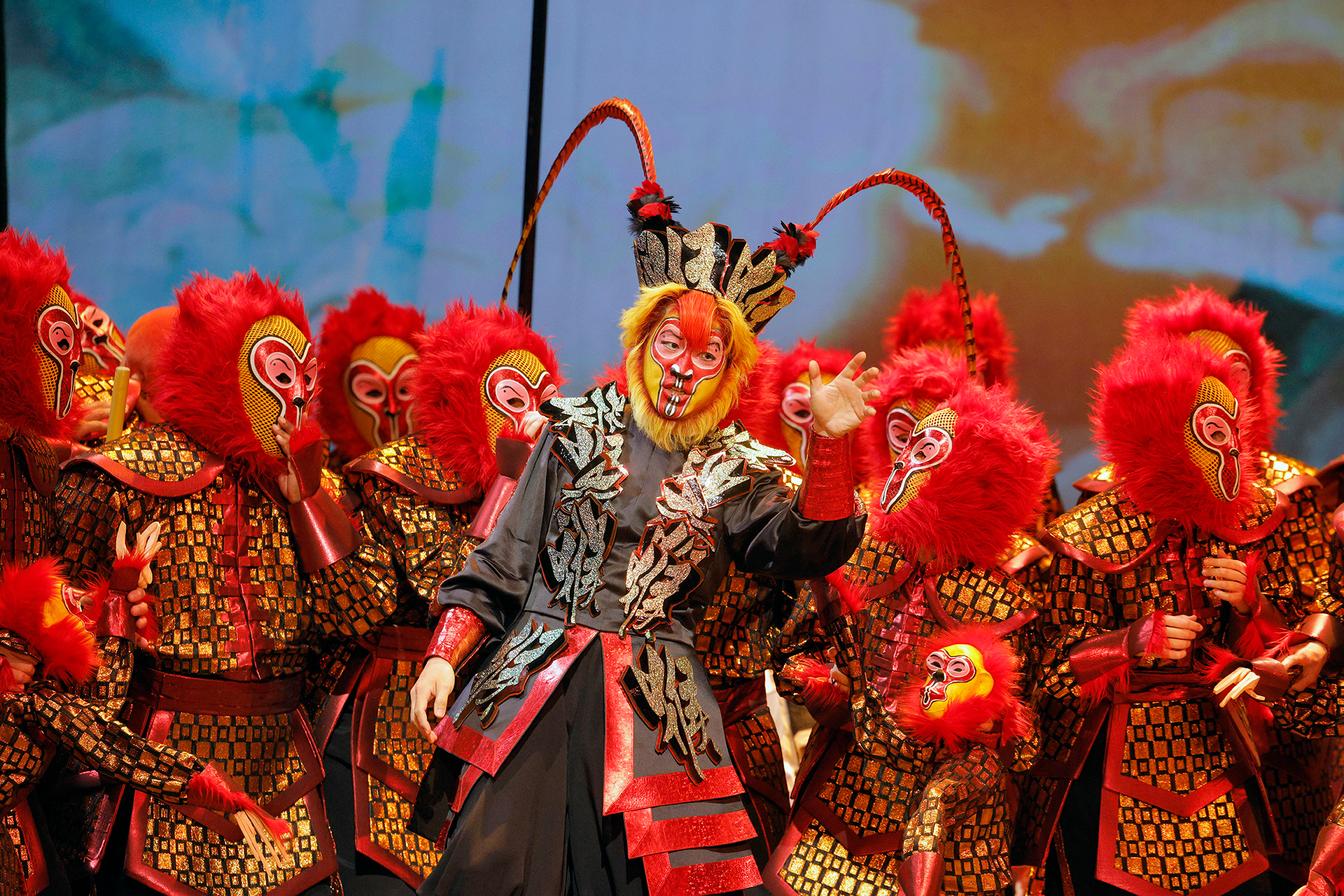
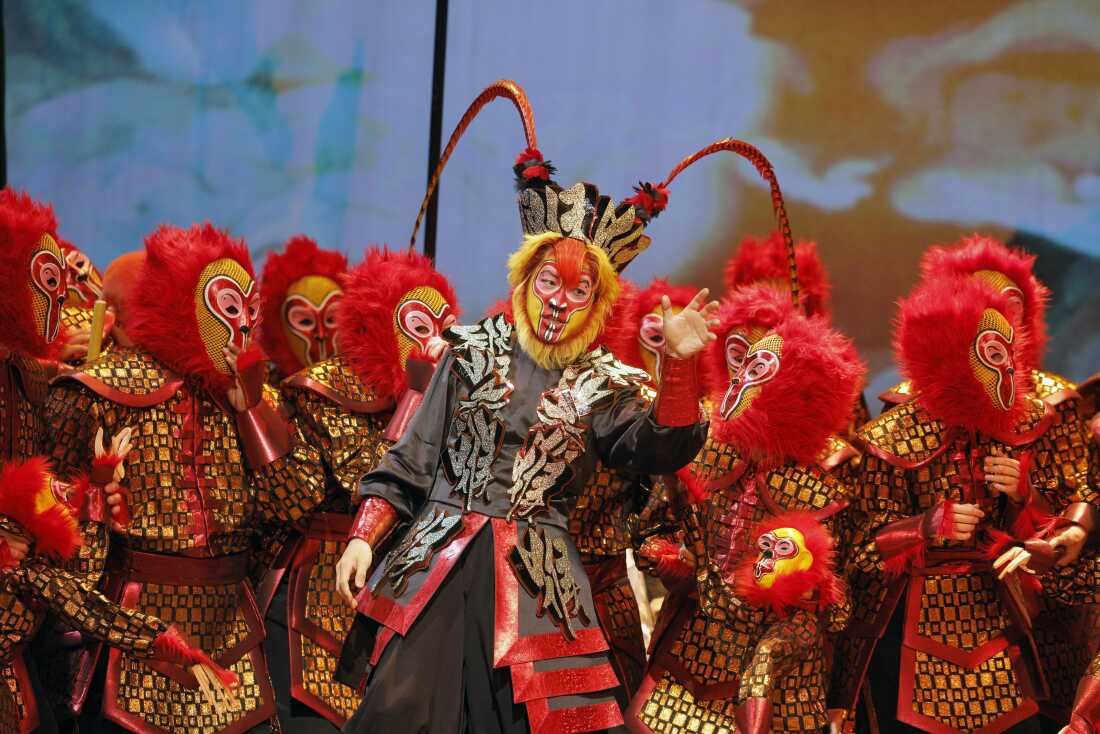
A man in an ornate costume with a feathery headpiece sings in front of a chorus in masks and red-and-gold outfits

Kang Wang as the Monkey King with members of the San Francisco Opera Chorus in Huang Ruo and David Henry Hwang’s ‘The Monkey King.’ (Cory Weaver/San Francisco Opera)

On Friday night, San Francisco got the world’s very first look at an opera destined to become a modern classic.

Huang Ruo and David Henry Hwang’s The Monkey King is a dazzling, gorgeous work of art that balances the joy of young mischievousness with the weight of old wisdom. Its costumes and set pieces are a feast for the eyes, augmented by a rich, meditative score and captivating performances. I cannot say enough good things about it. If you want just the three-word summary, it’s this: go, go, go.

Directed by Diane Paulus, and commissioned jointly by San Francisco Opera and the Chinese Heritage Foundation of Minnesota, this is an opera that’s both invigorating and accessible. Sung almost entirely in English, and based on a portion of the 16th Century Chinese novel Journey to the West, Hwang’s quick-paced libretto for The Monkey King is easy to follow. Huang’s music follows in the modern American tradition, cascading and fluid. The show’s run time is two hours and 23 minutes, the length of your average prestige Hollywood film.

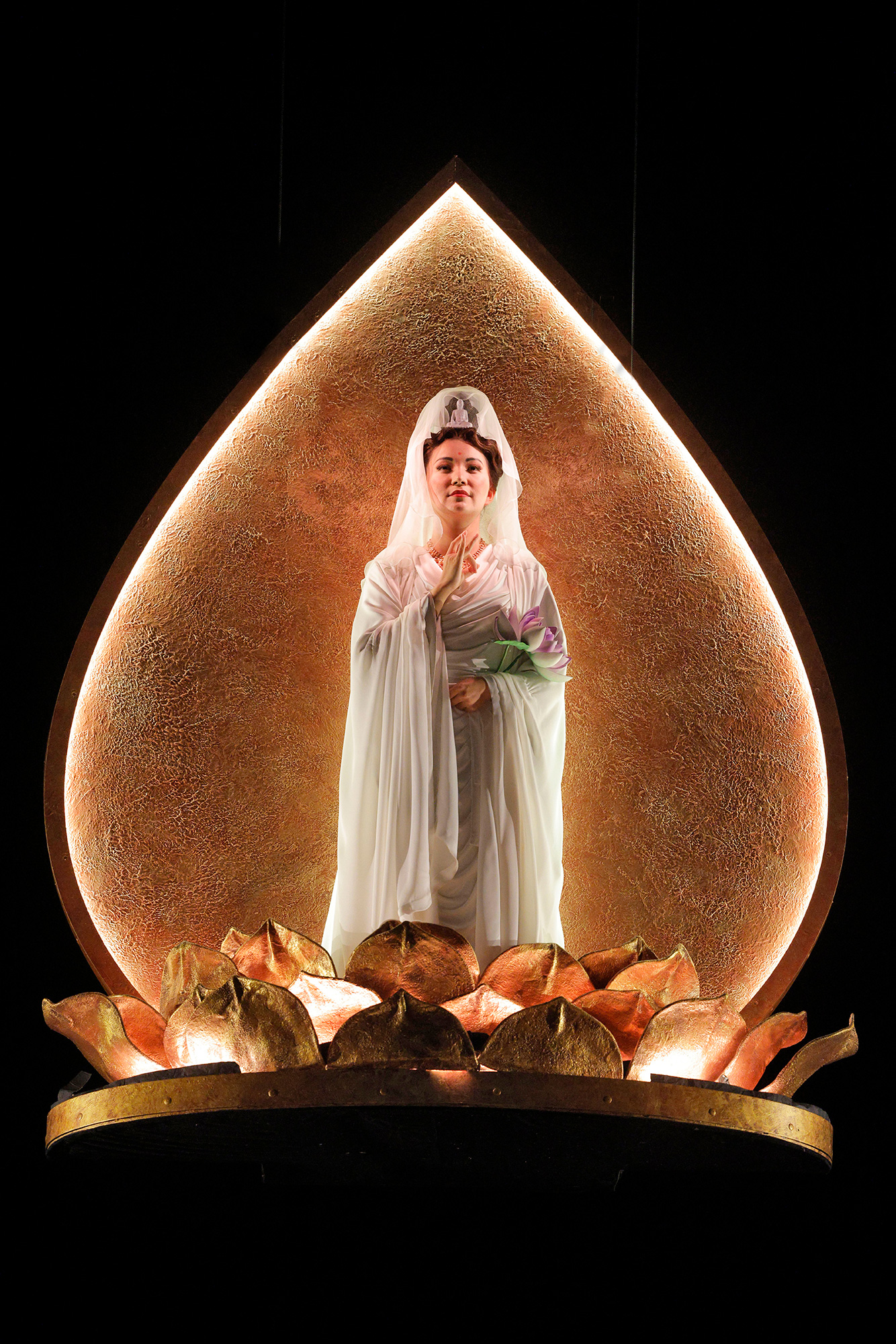
Mei Gui Zhang as Guanyin in Huang Ruo and David Henry Hwang’s ‘The Monkey King.’
(Cory Weaver/San Francisco Opera)

But this is all selling short The Monkey King’s depth. Take the opening: a chorus of low bass tones and higher voices create a tense interval of portent. The angelic figure of Guanyin (beautifully sung by Mei Gui Zhang) slowly appears in the air, ensconced in a teardrop-shaped figure, and sings: All forms are illusions.

Indeed, in the ensuing hours, tall vertical land formations curdle and collapse into a cave. A giant golden column shrinks to become a heavy handheld staff. A green umbrella soars out of view and returns 20 times its normal size. Warring swords and shields, unmanned, fight in mid-air.

Alternately navigating and causing these transformations is Monkey (a thrilling Kang Wang), a young rebel with no formal upbringing. He tries to follow the Buddhist teachings of Master Subhuti (Jusung Gabriel Park), who intones in one of the opera’s repeating melodic motifs that power alone is not enough. He soon meets his match in the Jade Emperor (Konu Kim) and his court, who resent the ego-driven Monkey’s ability to get ahead.

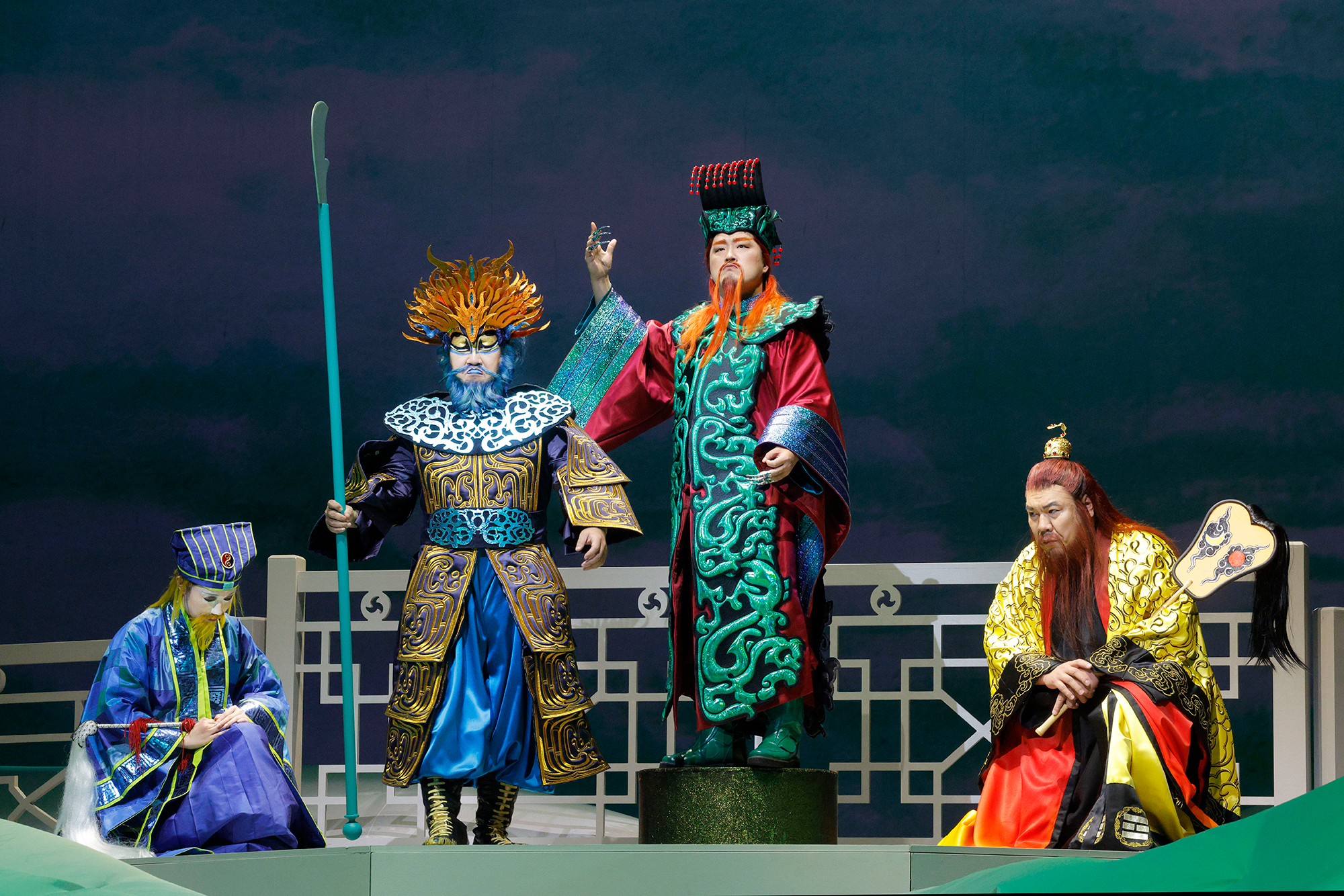
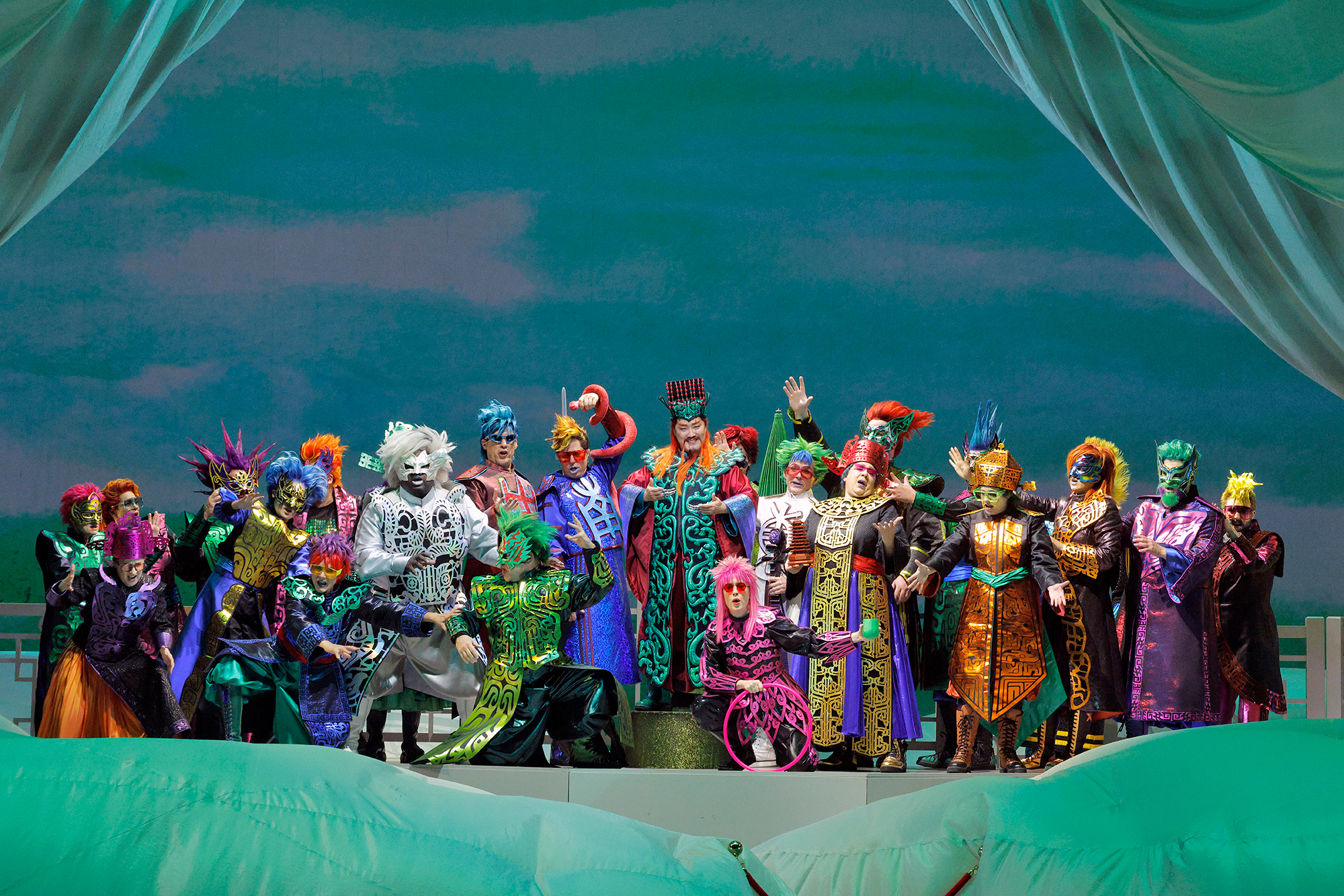
Hongni Wu as Venus Star, Joo Won Kang as Dragon King Ao Guang, Konu Kim as Jade Emperor, and Peixin Chen as Supreme Sage Laojun in Huang Ruo and David Henry Hwang’s ‘The Monkey King.’ (Cory Weaver/San Francisco Opera)

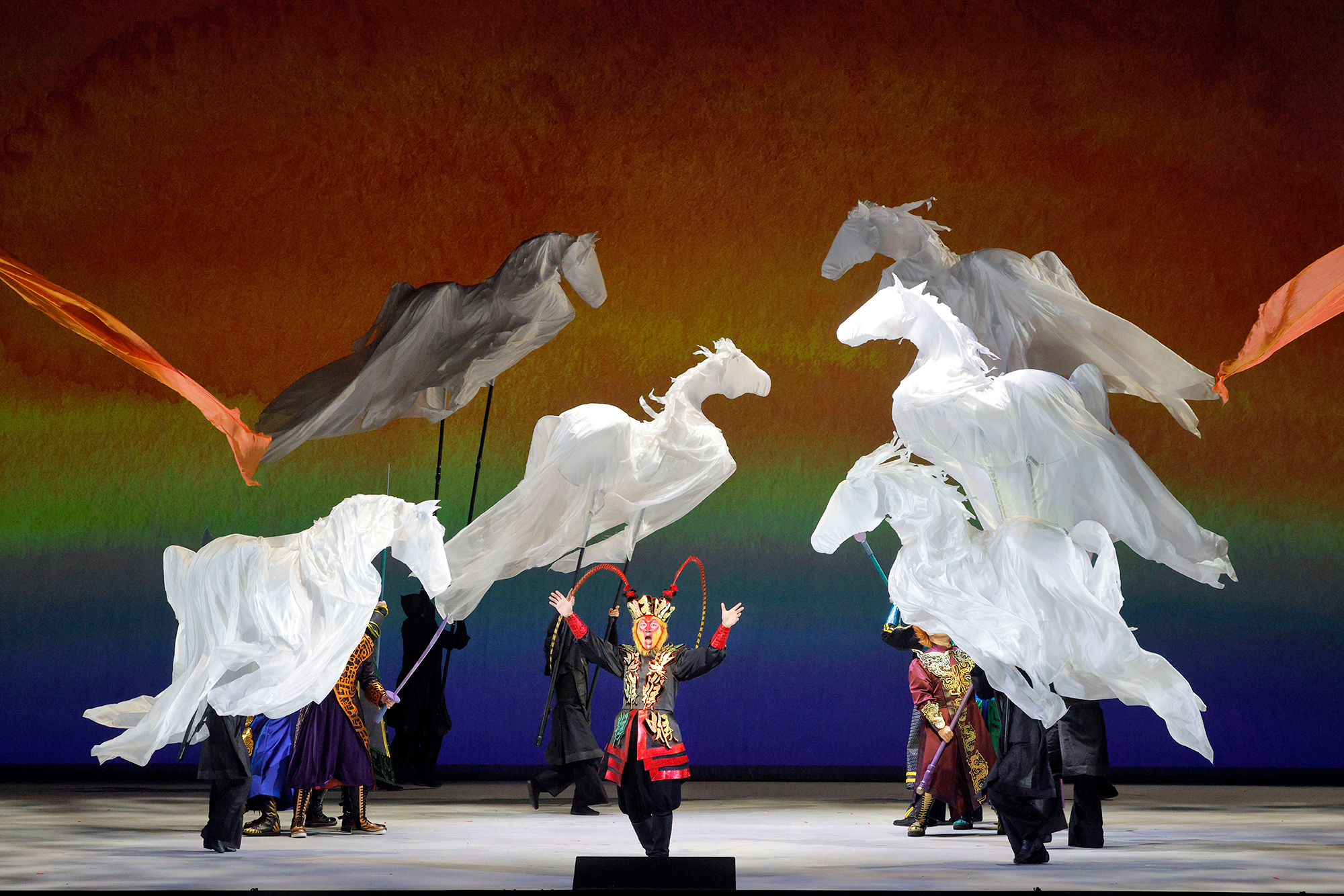
This is an opera you won’t need to bring binoculars to, if only to preserve the magic of the set and puppetry design by Basil Twist (with associate set designer Sara C. Walsh). The silks and fabrics alone are stunning. Hovering jellyfish bubble around an underwater seascape. Six white horses prance through the air. An enormous snake slithers into battle.

The costumes, designed by Anita Yavich, explode with color and texture — especially those of the Jade Emperor’s court, whose self-importance and overconfidence are underscored by a wardrobe befitting a cocaine-addled 1980s New Wave band. Ornate headpieces animate the movements of the Monkey King, along with those of his dancing body double (Huiwang Zhang, with dynamic choreography by Ann Yee; Twist employs a puppet double as well).

Kang Wang as the title role in Huang Ruo and David Henry Hwang’s ‘The Monkey King.’ (Cory Weaver/San Francisco Opera)

While the visuals will understandably get much of the attention, Huang Ruo’s wonderful, singular score (conducted by Carolyn Kuan, and with the occasional use of Chinese gongs and cymbals) is The Monkey King’s understated highlight. It simply would not be as strong a work without it.

Early in Act I, the Monkey King and Guanyin sing a duet — not in harmony or counterpoint, but interwoven nonetheless, while the orchestra tends to a melodic journey of its own. Later, Mei Gui Zhang’s aria “All Dharmas Are Equal” makes time stand still, and Kang Wang’s breathtaking “Land of Bliss” recalls the show-stopping Act II numbers so common to Broadway musicals.

Or take an early scene when, with no other action on stage, a boulder slowly advances for two long minutes. Ordinarily, this would constitute dead air and boredom. Instead, thanks to Huang’s accompanying music, it’s riveting — an extended moment of tension and suspense.

Konu Kim as Jade Emperor (center) with members of the San Francisco Opera Chorus in Huang Ruo and David Henry Hwang’s ‘The Monkey King.’ (Cory Weaver/San Francisco Opera)

Any show about power and ego in the Trump era runs the risk of overplaying its relevance; it’s to Paulus’ credit as a director that The Monkey King doesn’t. While the immortality-seeking Monkey King can’t take criticism, rewards only his inner circle and tells people to go back where they came from, he isn’t portrayed heavy-handedly as our current authoritarian-in-chief. (The Jade Emperor, after all, shares many of the same traits.)

This allows The Monkey King‘s message to reside in the eye of the beholder, along with its delights. At its first-ever public performance, few flaws were evident. Could Kim play the Jade Emperor slightly more diabolically? Sure. Does the ending drag just a little too long? Maybe.

But ultimately, The Monkey King is a triumph, and a hugely enjoyable one. Make plans now, camp out for standing-room tickets, leave work early — do whatever you can to see this current run, or any future production. It will surely last and last.


‘The Monkey King’ runs through Nov. 30 at the War Memorial Opera House in San Francisco. A series of community events, workshops and exhibits accompany the world premiere run. Details and ticket information here.

Can’t wait to see this…

Seen last Saturday.

Yau Kung Moon did an opening lion dance and had a fall off the benches (not a bad one). I hoped to see someone I knew but they were all youngens. The hall had some fun displays. Sold out show. The shows have been selling out and helped elicit a $5M donation.

The production was complex - monkey king alternated between singer, dancer, & puppet - very ambitious. The staging, sets and costuming were fantastic. I liked how there were subtle nods to the original throughout, like one of the background Heavenly host references Nezha because he bears a hoop. The heavenly costumes were like Hunger Games meets disco, very shiny and metallic.

Didn’t care for the music much. Opera in English never quite works for me. When in some Italian or some other euro language, it heightens the surreality. In English, if often hits me like ‘listen to the incredible way I can shout sing these words.’ It was funny to hear the word ‘poop’ sung operatically.

The opera is triumphant - a wonderful retelling of the classic, translated for an American audience, yet retaining its irreverence and magic. It was completely delightful.

Bravo SF Opera!

A 400-year-old kung fu-fighting monkey is finally having his American moment

NOVEMBER 28, 20259:00 AM ET

HEARD ON ALL THINGS CONSIDERED

Chloe Veltman

Kang Wang plays the title role in San Francisco Opera's world premiere production of The Monkey King. Like generations of kids in Asia, the tenor grew up in China obsessed with the superhero.

Kang Wang plays the title role in San Francisco Opera’s world premiere production of The Monkey King. Like generations of kids in Asia, the tenor grew up in China obsessed with the superhero.

Cory Weaver/San Francisco Opera

The Monkey King is having a moment in America — and it’s been centuries in the making.

Wildly popular across Asia for generations as the focus of hundreds of adaptations on page, stage and screen, the Chinese superhero is also the star of a 2023 Netflix animated film, a blockbuster 2024 video game, and right now, a sold-out new opera at San Francisco Opera by composer Huang Ruo and librettist David Henry Hwang. Not bad for a character who made his literary debut in a 16th century Ming Dynasty novel.

The monkey who would be king

The Monkey King — known as Sun Wukong in Chinese — first burst fully-formed out of a rock in the classic 1592 novel Journey to the West, widely attributed to the poet Wu Cheng’en.

Sponsor Message

Steeped in Buddhist teachings and symbols, the story follows Sun Wukong’s epic journey towards enlightenment.

“He wants to be someone,” Frank Djeng, a cultural historian who has written about the character, said in an interview with NPR. “So he sets out to learn how to become immortal and powerful.”

The ambitious primate acquires remarkable superpowers. He can ride clouds like they’re skateboards, clone himself, and bash his enemies with a magic, telescoping stick.

But despite these skills, the gods reject him.

“He’s an outcast. He’s a rebel,” Djeng said. “He decides to go up to the heavens and kind of wreaks havoc there.”

Drawn to chaos

The Monkey King isn’t your typical square-jawed, noble superhero. Though he’s on a quest for enlightenment, Monkey is also a loud-mouthed mischief-maker, whose antics include stealing magical peaches from a sacred garden that grant immortality to the person who eats them – and then gobbling them down.

“I think we loved the monkey because of his courage, his longing for freedom, and his defiance against the gods,” said Chinese-Australian tenor Kang Wang, who plays the title role in the world premiere San Francisco Opera production and grew up obsessed with a 1980s live-action Chinese TV adaptation of the Monkey King story. “Also, he’s very playful. He’s always super happy and never sad.”

A still from the 2023 Netflix animated series, The Monkey King — one among several major adaptations of the classic Chinese tale to break into the U.S. mainstream in recent years.

A still from the 2023 Netflix animated series The Monkey King — one among several major adaptations of the classic Chinese tale to break into the U.S. mainstream in recent years.

This many-sidedness is key to understanding the character’s wide appeal. In Asia, the Monkey King has been reimagined as everything from a Communist-style proletarian hero fighting an oppressive bourgeoisie in the 1960s Chinese animated film Havoc in Heaven, to a cyborg in Sci-Fi West Saga Starzinger, a 1970s Japanese sci-fi anime series.

American Monkey

Some 20th-century versions gained popularity beyond Asia. But American audiences have been slower to embrace the simian superhero — until now.

“It’s really stunning how the Monkey King is finally pushing through into the American consciousness,” said Gene Luen Yang, a cartoonist whose acclaimed 2006 graphic novel American Born Chinese weaves together the Monkey King legend with a contemporary story about the struggles of being an Asian American teen. Disney adapted the book into a TV series in 2023.

Yang said the character may until recently have seemed “too Asian” for most American audiences. But cultural shifts have changed that calculation, and Yang said he expects more American artists and producers will be monkeying around with the Monkey King in the years ahead.

“We all read manga, and we all watch anime,” Yang said. “As Americans, we’re much more used to that intersection between East and West.”

San Francisco Opera has a hit with Huang Ruo’s spectacular ‘Monkey King’

Jusung Gabriel Park as Buddha, Mei Gui Zhang as Guanyin and Kang Wang as Monkey King

Jusung Gabriel Park as Buddha (upper left), Mei Gui Zhang as Guanyin (upper right) and Kang Wang as Monkey King (center) in the finale to San Francisco Opera’s premiere of Huang Ruo’s “The Monkey King” at War Memorial Opera House.

(Cory Weaver / San Francisco Opera)

Los Angeles Times critic Mark Swed

By Mark Swed

Classical Music Critic

Dec. 1, 2025 11:54 AM PT

San Francisco — San Francisco Opera’s hit new opera, Huang Ruo’s “The Monkey King,” which had its final performance Sunday at War Memorial Opera House, quickly became the hottest show in town, all its performances sold out. It was the talk of the town, an opera with a little something for everyone, an opera that that stands for something culturally, spiritually and ethically. It operates at the intersections of pop art and high-ish art, of the sacred and profane, of radicalism and die-hardism. It is fittingly multicultural for a multicultural city. It invites you to leave the theater feeling better about the world.

Yet what makes this potentially the most important new opera of the year is not Huang’s agreeably efficient — and once in a while inspired — score, which incorporates Western and traditional music. Nor is it David Henry Hwang’s user-friendly libretto based on the late Ming Dynasty Chinese classic, “Journey to the West.” The potential this opera signals is for a major cultural change for San Francisco.

In the green room of the opera house at the Nov. 20 performance, founder and CEO of Nvidia, Jensen Huang, and his wife, Lori Huang, announced a $5-million gift to San Francisco Opera to help fund the production of the “Monkey King,” which the company commissioned, and a commitment to continue an annual $5 million contribution to the company. That may seem like pocket change for Nvidia, having three weeks earlier became the first company in the world valued at $5 trillion (which is 1 million times $5 million). But one small step for a chip maker is a big leap for opera and Silicon Valley, where arts philanthropy has not been a meaningful priority.

Dragon Palace of the Eastern Sea in the San Francisco Opera premiere of Huang Ruo's 'The Monkey King'

Dragon Palace of the Eastern Sea in the San Francisco Opera premiere of Huang Ruo’s “The Monkey King” at War Memorial Opera House.

(Cory Weaver / San Francisco Opera)

San Francisco Opera well set the stage for this by going all out in connecting “Monkey King” with the city’s large Chinese community through various outreach programs while also tapping into the way Chinese culture has long been a pervasive influence, and especially through music, in San Francisco life.

Early in the century the composers Henry Cowell and Lou Harrison regularly visited productions of Peking Opera, which is — like “Journey to West” — an innovation of 17th century China and still regularly revived. It was thanks in significant part to Cowell that we came to have the genre we call world music. Harrison then made California a principal originator of the hybridization of Eastern and Western music.

San Francisco Opera was late to the game (it has yet to stage a Harrison opera) but the company was a pioneer in the fusing of jazz and opera with Gunther Schuller’s “The Visitation” in 1967. In 2016, the company gave the premiere of Bright Sheng’s “Dream of the Red Chamber,” which is, like “Monkey,” based on a classic Chinese novel and has a libretto by Hwang.

“Red Chamber” proved successful enough for a rare revival in 2022, but it never became the kind of sensation that “Monkey” boasts. “Monkey” forgoes the more integral hybridization, finding sensation in piling on as much on as possible.

Kang Wang as Monkey King with Basil Twist's puppet horses in the SFO premiere of Huang Ruo's 'The Monkey King'

Kang Wang as Monkey King with Basil Twist’s puppet horses in the San Francisco Opera premiere of Huang Ruo’s “The Monkey King” at War Memorial Opera House.

(Cory Weaver / San Francisco Opera)

The plot basically sticks to the first seven chapters of the 100-chapter novel, which concerns an engagingly impulsive monkey who obtains superpowers and, to protect his monkey community, enjoys one wily adventure after another. But by getting away with anything, Monkey’s ego grows. He often doesn’t think of others and does what he wants, often without caring about consequences. After going through endless battles and conflicts in his journeys with a Buddhist monk (fodder for animated series, comics, films, television serials, Chinese operas and a celebrated rock opera by Damon Albarn), Monkey ultimately finds enlightenment.

In Diane Paulus’ production for San Francisco, Monkey is portrayed by an opera singer, an acrobatic dancer and a puppet. The stars of the show become more than the performers, who are all capable of spectacle, but also Basil Twist, he of the puppetry and fantastical sets, and choreographer Ann Yee. Huang’s previous chamber opera, “Book of Mountain and Seas,” which L.A. Opera, in collaboration with Beth Morrison Productions, staged last year, was also made magical by Twist.

Each of the new opera’s five scenes in Act 1 and three in Act 2 are wondrous worlds of their own. Monkey is born from a stone. Seeking eternal life, he learns the secret of 72 Transformations from a venerated Buddhist teacher and then becomes an irreverent show-off. After tricking a Dragon King, Monkey heads to Heaven, where he wreaks havoc with the Jade Emperor, gobbles down precious 9,000-year-old magical peaches and gives himself the title, as vainglorious leader of the Monkey kingdom, of “The Great Sage, Equal to Heaven.”

Buddha steps in, imprisoning Monkey under a mountain and forcing him to study sutras for 500 years. In the novel, the journey then begins. In the opera, Monkey goes straight to the Land of the Bliss in a scene of operatic magnificence.

Huiwang Zhang as the dancer Monkey King in the San Francisco Opera premiere of Huang Ruo's 'The Monkey King'

Huiwang Zhang as the dancer Monkey King in the San Francisco Opera premiere of Huang Ruo’s “The Monkey King” at War Memorial Opera House.

(Cory Weaver / San Francisco Opera)

That magnificence overpowers everything that went before it, which includes fabulous dance, arresting puppetry and outstanding singing actors, including Kang Wang, as Monkey, an impressive juggler in his own right.

Huang’s score is all over the map. The libretto is mostly in vernacular English, except for choral interjections of the Buddhist “Diamond Sutra,” sung in Chinese. Those chants are beauteous, as is the music for the Goddess of Mercy, Guanyin (soprano Mei Gui Zhang) and, making his appearance at opera’s end, Buddha (bass-baritone Jusung Gabriel Park).

Most of Huang’s vocal writing, to suit the text, is conversational; half the time he has prepared you to predict what note comes next. The orchestra, adroitly conducted by Carolyn Kuan, includes Chinese instruments as well Western, but it is the Chinese ones that bring life to the score. Monkey’s capture comes about by his being believably beguiled by the sound of the lute-like pipa.

The scene of Bliss that comes out of nowhere, with Buddha and Guanyin in Heaven above a sutra-chastened Monkey, is where Huang’s music becomes inspired. Power alone is not enough, Monkey has learned. Only having given up ego and all attachments has he obtained the heart of compassion. Joy emanates in sight, sound and movement.

On a transformational opera stage, Huang and Hwang send a message to another Huang, and one of the most powerful people in the world: “Power is not enough.”

Mark Swed

Mark Swed has been the classical music critic of the Los Angeles Times since 1996.