Northerners favor noodles, Southerners favor rice. But..Mein is also very southern. So is there a blending of north and south? Choy Li Fut comes to mind. Wu Dip jeung from Hung-Ga as well, so which is better? Noodles or Rice?
Zha Jiang Mian- Black Bean Noodle
I live in a Korean neighborhood, and it’s one of the best and cheapest things around. Yellow noodles swimming in a black bean sauce, with shredded cucumbers on top and kimchi on the side. I went to Beijing too, and tried a bowl at Lao Beijing Zha Jiang Mian- it was pretty good, a little on the salty side, but I liked it because it had more good tasting vegetables.
I heard that in Japan, Morioka prefecture, there is also a version called jajamen. I’ve seen some pictures of it on the internet and it seems that they use way less sauce than the Chinese and Korean versions. It doesn’t even seem like they have any meat in their sauce either. Has anyone tried the Japanese version before?
One more thing- does anyone know how to make this dish? I’ve tried at least a dozen times this summer, and it comes out different everytime. It’s not TOTALLY bad tasting, but it’s unlike any of the versions I tasted. I guess it’s just different. Does anyone here have a recipe?
…and yes, I know this is a kung fu forum.
okay, I started this thread as a kind of joke from another thread, but…seeing where it’s going…and I’m gettin kinda hungry…
I love chow fun, and ngau yuk chow mein-not LaChoy American Chow Mein, but the real McCoy-pan fried noodles, and speaking of rice dishes, siyao gai fon-soy sauce-chicken over rice.There’s a great rice shop in Flushing where you can order tonnage of great food-siyao gai, duck, roast pig, cha siew, for about 4 bucks a plate!
Also I love lop cheung (those red sausages) and lop yuk-which is a dried pork something-I can’t identify it but it’s amazing-anyone know recipies which use them? yes, I have broken the cardinal rule never to eat anything I can’t identify, but face it, nobody can really identify gumbo either.
Depends on what kind of noodles. So many varieties:
la mian (wheat noodles)
dan dan mian (dan dan noodles)
mi fen (rice vermicelli)
shanghai mian (the fat round style of noodles)
lao si fen (brunei style of noodles)
he fen (broad rice noodles)
etc…
and the all time best, gong zi mian (gong jai mien) the instant MSG death noodles.
hey, for rice, would you include mi zhou (mai juk / congee) ?
I like
Shou La Mien (North) & Fukien Chao Fan(South)

You want to try the noodles for texture and variety and the rice to fill you up and nurture you.
peace
kung Lek,
why don’t you eat more noodles and that too would fill you up.
Unlike northern kung fu vs southern kung fu, where the north is better than the south, the same analogy cannot be applied to noodles and rice!
rice is a type of grass (plant) whereas noodles are a manufactured product. There isn’t such as thing as noodle plant. on the otherhand, noodles can be made from wheat, rice, potato or other types of starch. The Italians learned to make noodles from wheat through the chinese.
Ego Maximus is always right.
ttt 4 2016!
Noodles or rice? Depends on what kind of noodles…or hot pots, or dumplings… 
China Busts 35 Restaurants for Using Opium Poppies as Seasoning
Associated Press 3:01 AM ET
Mark Schiefelbein—AP

A man walks past a branch of the Hu Da hot pot restaurant chain in Beijing, Jan. 22, 2016.
Five restaurants are being prosecuted while 30 others are under investigation
(BEIJING) — China’s Food and Drug Administration says it found opium poppies used as illegal seasoning in 35 restaurants across the country, including a popular Beijing hot pot chain.
Five restaurants are being prosecuted while 30 others, ranging from Shanghai dumpling joints to noodle shops in southwestern Chongqing, are under investigation.
Cases of cooks sprinkling ground poppy powder, which contains low amounts of opiates like morphine and codeine, in soup and seafood are not new in China, though it is unclear whether they can hook a customer or deliver a noticeable buzz.
Shaanxi Province police busted a noodle seller in 2014 after being tipped off by a failed drug test. Seven restaurants were closed in Ningxia Province in 2012 for using the additive and Guizhou Province shut down 215 restaurants in 2004.
Why is this in the Southern Chinese Kung Fu forum again?
NOODLES NANGUAN : https://www.youtube.com/watch?v=yvgerxieSpo
[QUOTE=GeneChing;1290194]Noodles or rice? Depends on what kind of noodles…or hot pots, or dumplings… ;)[/QUOTE]
I kill two birds with one stone. Since I have a gluten sensitivity/intolerance, I now eat noodles made of brown rice. Tastes the same as wheat noodles, and better for you.
And since I do my own cooking, sometimes I eat noodles WITH rice. Depends on the noodle dish I make.
 Of course, I could eat rice every day… just like noodles ! https://www.google.com/search?q=chinese+rice+dishes&biw=1440&bih=739&tbm=isch&tbo=u&source=univ&sa=X&sqi=2&ved=0ahUKEwi_hOCf38bKAhVCqh4KHfREALAQsAQIKQ
Noodles for Buddha : https://www.google.com/search?q=Noodles+for+Buddha&biw=1440&bih=739&tbm=isch&tbo=u&source=univ&sa=X&ved=0ahUKEwjg9L2s4cbKAhVrk4MKHd1WCwsQsAQIMg
[QUOTE=bawang;1290582]hello everyone in the meric. i hear the white in the north eat potatos while the in the south eat the corn. so mysterious. which do you like?[/QUOTE]
Nope. both north and south tend to eat both and at the same time. We also like to eat noodles and rice. We call it spaghetti . It was the reason we sent Marco Polo to China. We wanted their spaghetti. We already had the rice.
Have you ever had Scottish corn?
So this amazing restaurant opens up in Flushing
Called Biang! I think there’s also one in NYC.
Their specialty is Xian style cuisine.
Hand pulled noodles with hot oil is awesome. So is the oxtail and lamb burgrrs.
Recently changed hands..now it is xian fast food..take out and counter eating..still good.
If you sre in the srea you should check it out.
NOODLE MASTER : https://www.youtube.com/watch?v=IxdGYoAQVZU
Longtaitou Festival
LOOK: 2,000 Henan villagers slurp up noodles cooked in a single massive pot

To mark the annual Longtaitou Festival () yesterday, some 2,000 villagers attended a temple fair to eat noodles served in a massive pot at the Bailong Temple in Anyang county, Henan province.

The traditional Chinese agricultural festival, held annually on the second day of the second month of the Chinese lunar calendar, marks the start of spring and the farming season.

The villagers in attendance believed that the celebration would help to avoid mishaps and prevent illness over the year. Hopefully the noodles tasted alright as well.


On this special day, besides eating noodles, people from across China also eat Chinese pancakes, light up dragon lanterns, pray for luck and, of course, get their (children’s) hair cut.

Remember to mark your calendars next year!
By Lucy Liu
[Images via NetEase]
2000 Henanese can eat a lot of noodles.
[QUOTE=Cataphract;1294722]Anyone ever tried to make Ramen or Lamian? The secret ingredient are the alkaline salts aka Kansui. Much like pretzels. But people seem to disagree whether baking soda, baked baking soda or even lyme could be used instead of original Kansui.[/QUOTE]
I experimented a few times.
It depends on the gluten level of the flour and the type of alkaline component. I used baking soda, but the elasticity wasn’t quite right. And also I needed a lot of practice on stretching the noodles.
I got some gan sui from the asian market a while back, but haven’t tried it out yet. It’s on my list of things to do this year.
I’ve been eating way more rice than noodles over the last few weeks, a major craving. Must be some logical explanation besides the way rice can be more filling and last longer to curb hunger. Of course the taste is unique. Rice stands alone in that way.
Slightly OT
Granted, this is an ad, for Japanese noodles no less, but it’s cool.
copied into an indie Noodles thread
All the posts above I copied off the Noodles-or-Rice thread. I’ve been poaching that thread for all my rice and noodles news pieces. Noodles really need their own thread here.
DOWN AND OUT.
PHOTOGRAPHER: NELSON CHING/BLOOMBERG
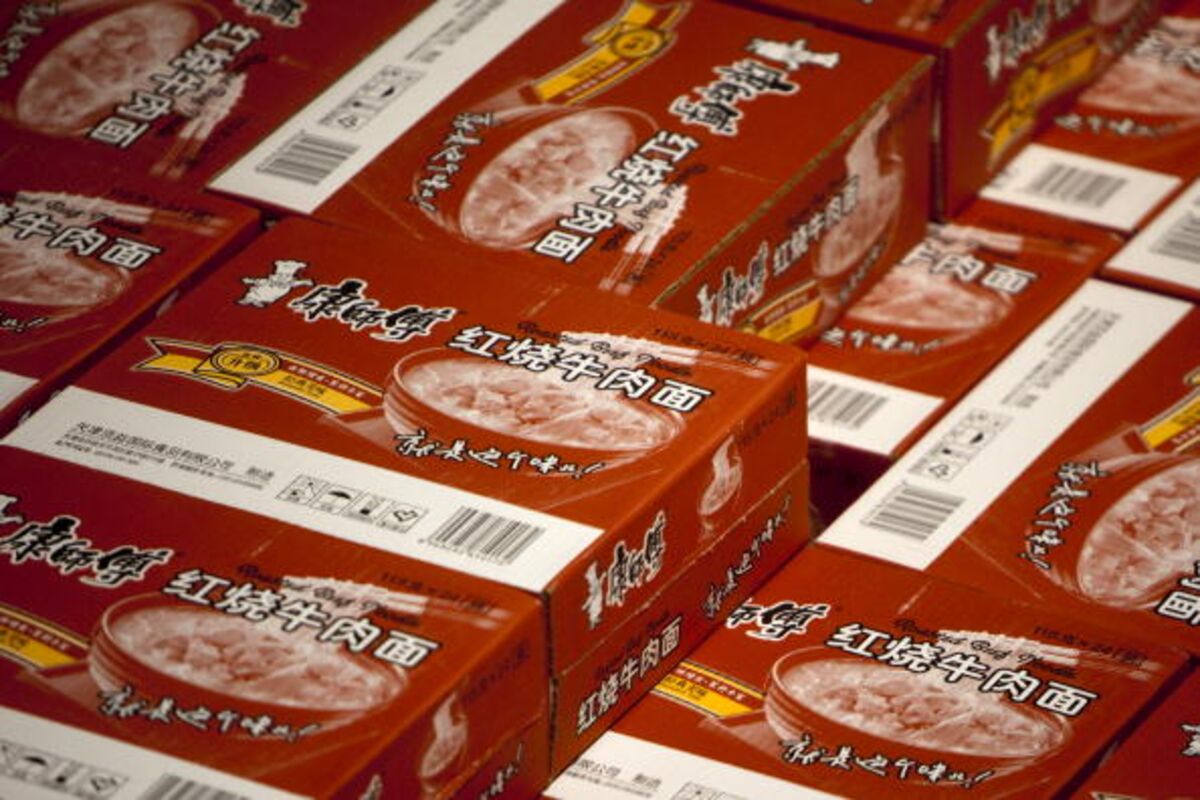
China’s Progress Is Killing the Instant Noodle
SEP 28, 2016 8:00 PM EDT By Adam Minter
Adam Minter is a Bloomberg View columnist. He is the author of Junkyard Planet: Travels in the Billion-Dollar Trash Trade.
A crumpled instant-noodle bowl ground into the mud is an unlikely symbol of economic vitality. But during China’s boom years those bowls were as ubiquitous around Chinese construction sites as the high-rise cranes above them.
That was no accident. For millions of Chinese workers, instant noodles were the convenient meal of choice, available for a few cents in every commissary and convenience store. And China’s instant-noodle makers prospered. Between 2003 and 2008, annual instant-noodle sales expanded to $7.1 billion from $4.2 billion.
But just as China’s economy has slowed, so too has its appetite for instant noodles. Earlier this month, Tingyi, China’s biggest noodle maker, was removed as a component of Hong Kong’s Hang Seng Index after seeing its noodle profits drop 60 percent. China’s instant-noodle sales are down 6.75 percent this year, the fourth consecutive year of decline.
The first problem is demographics. China’s instant-noodle makers grew in parallel with an economic boom that was fueled by the migration of low-cost workers from the countryside. But China’s working-age population has been in decline since 2010, and in 2015 the migrant population fell for the first time in 30 years. With more workers staying home, the incentive - and desire - to eat a prepackaged bowl of noodles was likely to decline, and it has.
There’s also the matter of the slowing economy. In 2015, sales growth of inexpensive food and consumer products hit a five-year low, according to a June study from Bain. Declines were particularly steep in products that cater to blue-collar workers, such as cheap beer (down 3.5 percent) and instant noodles - a phenomenon that Bain partly blames on Chinese jobs migrating to lower-wage countries.
What’s bad for noodle makers is great for many others. Rising wages have improved living standards and expectations for millions of Chinese workers. Pay a visit to a southern Chinese factory these days, and the food options are much improved. With employees becoming more scarce, benefits like better food are becoming increasingly important.
China’s workers are also able and willing to pay more for their day-to-day needs. According to one recent Chinese consumer survey, half of China’s consumers now seek out the “best and most expensive” product. A 25-cent bowl of instant noodles doesn’t make the grade.
Then there are health concerns. Instant noodles have developed a nasty reputation in China thanks to scandals and rumors and a 2012 food-poisoning incident. There are long-standing allegations that noodles are contaminated with plasticizers. Legitimate or not, scandals don’t help the reputation of a down-market product that’s loaded with salt and preservatives.
Even with these problems, instant noodles had the advantage of convenience. Now even that edge is being dulled. The streets of Chinese cities are swarmed by motorcycle and bicycle food-delivery men and women racing to deliver orders that are competitive in price with Chinese fast food. In 2015, the value of those deliveries was $20 billion - up 55 percent from 2014. Fast, healthier options are just an app away, even for students and factory workers.
China’s instant-noodle makers and importers are struggling to re-start growth. But these days there’s competition from South Korea, with its far superior food-safety reputation. One option is to sell noodles to other emerging Asian economies such as Vietnam, where consumption is still growing along with the manufacturing sector. That won’t make up for China’s shrinking market, but China’s new class of consumers don’t offer more enticing options.
This column does not necessarily reflect the opinion of the editorial board or Bloomberg LP and its owners.
To contact the author of this story:
Adam Minter at aminter@bloomberg.net
To contact the editor responsible for this story:
Jonathan Landman at jlandman4@bloomberg.net