MMA lawsuits

Mixed Martial Arts: A Massive Lawsuit Waiting to Happen?
By Bernice Napach | Daily Ticker – Tue, Nov 26, 2013 10:04 AM EST

Earlier this year the NFL agreed to pay $765 million to settle a lawsuit brought by more than 4,500 players and their families to compensate for chronic illnesses including degenerative brain diseases, due to concussions from play. On Monday 10 former National Hockey League players filed suit in Washington seeking damages caused by concussions suffered during their careers. Will Mixed Martial Arts the next sport to pay?

Mixed martial arts (MMA) is among the fastest growing spectator sports in the country. Though less known than boxing or wrestling, MMA combines aspects of both as well techniques from kickboxing, judo, and karate. Fighters compete in an octagon, rather than a ring, and punch and kick and tackle with gloves much smaller than the bulky mitts in boxing and often without shoes.

It looks brutal, but according to Lorenzo Fertitta, the CEO and Chairman of UFC (or Ultimate Fighting Championship), the primary company promoting these fights, MMA is relatively safe.

“Johns Hopkins University came in and did a study for a number of years and … came to the conclusion that our sport is unequivocally safer than boxing, safer than most other combat sports and…even had a lower injury rate than cheerleading,” Fertitta tells The Daily Ticker.

He explains in the video above that the UFC uses a “preventative process” doing baseline MRIs and CAT scans that they can refer to when athletes are injured, helping them to “immediately respond” when necessary.

In addition, says Fertitta, "Our athletes don’t have to perform on any given time frame so if someone gets a concussion or they’re hurt, they’re automatically suspended for 90 days until a doctor releases them to go back into training.”

But others aren’t as confident as Fertitta about the safety of the sport.

An investigative special report in The Ledger newspaper, which included interviews with current and former fighters and medical researchers found that mixed martial arts is a violent, dangerous sport. Charles Bernick, associate medical director of the Cleveland Clinic who studied the brains of boxers and MMA fighters told reporters, “No matter how you’re getting hit, you’re going to have damage.”

So is the MMA concerned that it could end up like the NFL, culpable for the injuries of its athletes?

“You don’t know what is going to happen in the future," says Fertitta. " All you can do is take the precautions that are reasonable and we are doing that right now to make sure our athletes are safe.”

The NFL was founded in 1920. It has years of history and research to fuel the lawsuit. I can’t imagine MMA having that much evidence against it for decades to come.

Mark Hunt’s civil suit

Will this go to court or will UFC just settle?

Mark Hunt files civil suit in wake of Brock Lesnar’s positive tests
12:24 AM PT
Brett Okamoto
ESPN Staff Writer

Heavyweight Mark Hunt has filed a civil suit against the UFC, its president Dana White, and Hunt’s former opponent and WWE star Brock Lesnar.

The suit, which was filed in Nevada District Court on Tuesday, alleges the defendants “affirmatively circumvented and obstructed fair competition for their own benefit.” It accuses the parties of racketeering, which carries the potential weight of treble damages, and fraud, among other allegations. Hunt is seeking financial relief for damages, both physical and to his overall brand.

The case stems from a heavyweight bout between Hunt and Lesnar, which served as the UFC 200 co-main event July 9 in Las Vegas.

Hunt, 42, has been publicly upset ever since it was revealed Lesnar failed multiple drug tests surrounding the event. He has advocated harsher penalties for doping violations and demanded a clause in future fight contracts that would fine an opponent his entire purse in the event of a failed test.

“I want the UFC to understand it’s not OK to keep doing what they’re doing,” Hunt told ESPN.com. "They’re allowing guys to do this. They had a chance to take all the money from this guy, because he’s a cheater, and they didn’t.

“What message is that sending to the boys and girls who want to be a fighter someday? The message is, ‘You just have to cheat like this and it’s OK.’ In society, if you commit a crime, you pay. Why is it different in MMA? It’s hurt the business, so it’s even worse. They need to be held accountable for this.”

The UFC was not immediately available for comment.

Lesnar (5-3) came out of a near five-year retirement for UFC 200. The UFC and WWE, which Lesnar remains under contract with, described it as a “one-off.”

Under the UFC’s anti-doping program, a retired fighter must undergo four months of random drug testing prior to resuming competition. The UFC exercised its right to waive that window for Lesnar, however, citing exceptional circumstances.

Shortly after Lesnar defeated Hunt at UFC 200, it was revealed he had failed a prefight drug test administered on June 28. He also failed a second test taken on fight night. Lesnar tested positive for clomiphene, an anti-estrogen agent.

In December, the Nevada State Athletic Commission fined Lesnar $250,000 – 10 percent of his $2.5 million purse – and suspended him one year. The United States Anti-Doping Agency (USADA) also suspended Lesnar one year. He is eligible to return to MMA on July 15. Neither suspension affects his WWE career. Lesnar is also believed to have made an additional, undisclosed amount in pay-per-view bonuses.

Hunt’s disclosed purse was $700,000.
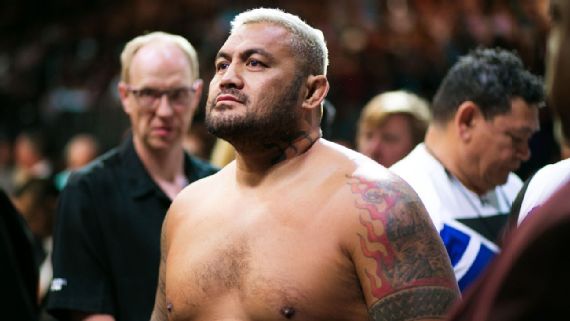

Mark Hunt has filed a civil suit against the UFC, Dana White and former opponent Brock Lesnar. Hunt’s grievance stems from a fight he lost to Lesnar, after which it was determined Lesnar failed multiple drug tests. Rey Del Rio/Getty Images
Hunt’s legal complaint points to an article in the UFC’s anti-doping program, which authorizes the promotion to pull an athlete’s “title, ranking, [and] purse or other compensation” in the event of a violation.

Christina Denning, Hunt’s lead attorney, told ESPN.com she met with UFC officials prior to filing the lawsuit in an effort to discuss Hunt’s contractual demands regarding future doping violations and “make the UFC 200 situation right.” According to Denning, the UFC declined to penalize Lesnar beyond the NSAC sanctions.

“Once we found out the penalty was only 10 percent of his purse, we went back to the UFC and offered to accept [Lesnar’s] purse amount, less than the $250,000 penalty,” Denning said. "We also wanted them to accept the clause moving forward.

“Mark says the penalties aren’t harsh enough. What’s interesting is that the penalties are harsh enough on paper, they’re just not being enforced by the UFC.”

Denning said Hunt is seeking damages “in the millions,” in the suit.

The lawsuit alleges the UFC granted Lesnar an exemption on the four-month testing window with “knowledge or willful indifference to the fact that Lesnar was using banned substances.” Lesnar, for his part, has denied knowingly using any banned substance prior to UFC 200.

The lawsuit also alleges the UFC and Lesnar knew about his comeback fight well before it was officially announced in June, and asserts Lesnar could have entered a testing pool four months before UFC 200.

Lesnar’s first failed test was administered on June 28, but he was able to still compete on July 9 because the results of that test were not made available to the UFC or NSAC prior to the fight.

“The UFC and USADA were aware of the option to expedite samples for a nominal fee but failed to do so,” the lawsuit states.

Hunt (12-10-1), who fights out of Australia, has fought three consecutive opponents who have later been tied up in doping allegations. He fought Antonio Silva to a draw in 2015, after which Silva tested positive for elevated testosterone. He defeated Frank Mir in March 2016. Mir failed his fight night drug test for oral turinabol metabolites.

Hunt is currently scheduled to fight Alistair Overeem at UFC 209 on March 4 in Las Vegas. Overeem also failed a drug test in 2012. Hunt says he turned down two fights since UFC 200 because the UFC did not meet his demand for an additional clause in his contract, but that he couldn’t refuse any more.

“I didn’t want to be in this position,” Hunt said. "It puts me in a weird spot because I’m still under contract. Fans say, ‘Mark, you knew he was juicing.’ I didn’t know. You look at him and think, ‘Yeah, he’s on the gear,’ but don’t judge a book by its cover and all that.

“This was the last straw. I lost that fight, it ruined it for my fans. It wasn’t good. I asked to get out of my contract but I can’t. I need to work like everyone else.”

What is the Muhammad Ali Revival Act and how will it affect boxing and fighters?

Story by
[IMG2=JSON]{“alt”:“The Independent”,“data-align”:“none”,“data-size”:“full”,“height”:“24”,“width”:“114”,“src”:“https://s.yimg.com/ny/api/res/1.2/wCP25Olbj9EhoDHsSl7g.g–/YXBwaWQ9aGlnaGxhbmRlcjt3PTIyODtoPTQ4O2NmPXdlYnA-/https://s.yimg.com/os/creatr-uploaded-images/2023-07/c07edac0-3532-11ee-9f3d-9b3a3cc7fbbb”}[/IMG2]
Alex Pattle
July 24, 2025 at 5:02 AM PDT·
5 min read

On Wednesday evening, the boxing world became gripped by conversations about a new bill that could change the sport and the way fighters are paid. Purportedly for the better. Potentially for the worse.

The bill, named the Muhammad Ali American Boxing Revival Act, was introduced to the US Congress by Representatives Brian Jack and Sharice Davids, with the intention of altering federal regulations around the sport. It is a bill that has been backed by TKO, the UFC ownership group that is crossing into boxing, with UFC president Dana White co-promoting September’s seismic Canelo vs Crawford fight in tandem with Saudi adviser Turki Alalshikh.

The name of the bill comes from the Muhammad Ali Boxing Reform Act of 2000 (widely referred to as the ‘Ali Act’). The key aims of that act were: “(1) to protect the rights and welfare of professional boxers on an interstate basis, by preventing certain exploitative, oppressive, and unethical business practices; (2) to assist State boxing commissions in their efforts to provide more effective public oversight of the sport; and (3) to promote honorable competition in professional boxing and enhance the overall integrity of the industry.”

Just as the Ali Act sought to amend the 1996 Professional Boxing Safety Act, so does the Revival Act. On the face of it, the intentions of both acts are noble, so why were there qualms with the former, and why has the latter proven so controversial? Why is the Revival Act controversial, and what criticisms did the original Ali Act face?

Well, at the time of the Ali Act’s introduction, some questioned what right Congress had to regulate boxing, given it regulates no other sports. There was also the criticism that the Act had laid out a series of rules for Congress to enforce, but without clear methods of how to enforce them.

But to a more pertinent point: on Wednesday evening (23 July), there were altogether different criticisms being aimed at the Revival Act, the main one being that it could see UFC’s widely derided style of fighter pay cross into boxing, harming the earning ability of athletes while claiming to do the opposite. Why does the UFC receive criticism over fighter pay?

[IMG2=JSON]{“data-align”:“none”,“data-size”:“full”,“src”:“https://s.yimg.com/ny/api/res/1.2/sW031GlZLeg27iNUDth6hQ–/YXBwaWQ9aGlnaGxhbmRlcjt3PTk2MDtoPTY0MDtjZj13ZWJw/https://media.zenfs.com/en/the_independent_us_sports_articles_270/ef6d91054cc8eff7a604f7bcffaa491f”}[/IMG2] UFC president Dana White (left) with his friend Donald Trump, the US president (Getty Images)
The UFC recently settled an antitrust lawsuit, which claimed the mixed martial arts (MMA) promotion suppressed fighters’ ability to negotiate; it was suggested that the UFC had essentially forged a monopoly in MMA.

In October, the UFC agreed to pay $380m to a group of former fighters who had competed under its banner between 2010 and 2017, with approximately 1,100 deemed as affected and 97 per cent of them applying to receive funds. The fighters in question received compensation payments between $100,000 and $1m, according to the firm that handled the lawsuit.

In general, average fighter pay in the UFC is believed to be much lower than in boxing, though UFC president White has continuously insisted that the media does not know the real numbers. The Independent understands that many fighters enter the promotion on a contract where they earn $12,000 to fight and another $12,000 if they win – with those figures increasing after three bouts, and with $50,000 bonuses available (Fight of the Night, Performance of the Night).

The UFC antitrust lawsuit also confirmed numerous reports that, in 2010, the UFC took home approximately 80 per cent of its overall earnings, with fighters left with less than 20 per cent. In comparison, basketball’s NBA and its players received around 50 per cent each at the time, and they still do. Currently, players in the WNBA (Women’s NBA) are pushing the league for a similar pay system.

But how does the UFC’s track record on fighter pay relate to the Revival Act, beyond the fact that its parent company (as of 2023) is backing the new bill? [IMG2=JSON]{“data-align”:“none”,“data-size”:“full”,“src”:“https://s.yimg.com/ny/api/res/1.2/JD5TGBkL5lXaByy18LBTAg–/YXBwaWQ9aGlnaGxhbmRlcjt3PTk2MDtoPTY0MDtjZj13ZWJw/https://media.zenfs.com/en/the_independent_us_sports_articles_270/0dec758e54519864c23944da8f60e8e0”}[/IMG2] The new act takes its name from boxing icon Muhammad Ali, and a 2000 act in his name (PA Archive) What specific changes does the Revival Act seek to make?

The Revival Act seeks to allow the creation of Unified Boxing Organisations (UBOs), which would serve as alternatives to boxing’s current sanctioning bodies: chiefly the World Boxing Council, World Boxing Association, World Boxing Organization, International Boxing Federation, and International Boxing Organization. Just as those bodies have their own champions, so would UBOs. One UBO would be Zuffa Boxing, likely overseen by UFC president White and Saudi adviser Alalshikh.

The UBOs would also pay a minimum national compensation of $150 per round for professional boxers, a figure that might be seen as substantial by very low-level boxers but pitiful by anyone else. The new system would also bid to improve the minimum health insurance available to boxers and access to anti-doping programmes – which can be costly for promoters. As it stands, the minimums in those aspects are controlled by individual states in the US.

Many undercard boxers compete in six-round fights, meaning – if they went the distance – they would be expected to earn $900 under the new system. That is understood to be less than a boxer would earn on most shows now, and the sum would struggle to cover the costs of coaching, sparring partners, travel and/or accommodation. These are expenses that fighters are often expected to pay during camp.

So, what now?

It is worth stressing that this act has not yet been passed. It is likely to be referred to the House Committee on Energy and Commerce, the same House that received the 1996 and 2000 acts, with a vote in the House of Representatives being the next step. Thereafter, it would be sent to the US Senate.

Boxing
MMA Lawsuits