Mastering Chinese Medicine

What does it take to actually master Chinese medicine? For me, language has become a key. I have been working through the book Classical Chinese Medical Texts by Richard Goodman. Before, I had thought that knowing a few Chinese characters and being able to talk about them in English was good enough. Now, I am seeing how much I was missing by not having direct access to the Chinese texts.

I had always wanted to continue the tradition of the scholar-physician, but wondered how we in the West could do this. I have always felt that language is a huge part of the scholar-physician tradition. Goodman’s textbook seems to give those of us who are interested in continuing that tradition a tool to finally do so.

What do you think it takes to master Chinese medicine? Has anyone else been working with the book?

In the words of Sun Si Miao (Translated by Heiner Fruehauf):

I think if SSM was alive today he’d include Western Medicine into his list. I think most Western practitioners today are lucky if they’ve completed a run through of, let alone mastered, the first paragraph. Acupuncturists will have seen maybe half of what’s in the first paragraph, and herbologists the other half. Practitioners and doctors should have seen the whole thing.

That’s one paragraph down, 4 more to go!

Re: Mastering Chinese Medicine

Your post brings me back to language. How can a modern practitioner master all of these things without access to the texts? Are we to rely on the translations of others? Most of what SSM says is textually based, after all.

What I like about Goodman’s Classical Chinese Medical Texts is that it teaches people to read the texts mentioned above. It covers grammar, vocabulary, and has plenty of example sentences and explanations. I have seen a few other books that attempt to teach medical language, but none of them come close to teaching it the way CCMT does.

So, I guess the question is…is it possible to master Chinese medicine without learning to read the classics? And is there any other book out there besides Goodman’s? I know there are at least two graduate programs in the US that focus on language (NCNM and SIOM). But what are the thousands of other practitioners to do? I suppose I’m arguing that for practitioners who haven’t graduated from the two schools above, Goodman’s book is an essential piece for mastering Chinese medicine.

Perhaps we should begin with what it really means to be a ‘Master’ of Chinese medicine.

Mastery as an end result breeds stagnation if growth stops once you achieve the desired level of education.

Sun Si Miao’s guidelines are appropriate, but merely guidelines. There are many I would consider Masters who have not read all the classics as listed. Yet, there are those who have read them all, but who are unable to humble themselves - I can’t consider you a master if you haven’t mastered your ego.

So, what’s SSM getting at - maybe its not about being a Master, but always perfecting your technique.

in health

herb ox

[QUOTE=herb ox;932849]Perhaps we should begin with what it really means to be a ‘Master’ of Chinese medicine.

Mastery as an end result breeds stagnation if growth stops once you achieve the desired level of education.

So, what’s SSM getting at - maybe its not about being a Master, but always perfecting your technique.

in health

herb ox[/QUOTE]

I agree, which is why I used the term ‘mastering’ as a continuation. Being “a master,” as you put it, certainly sounds limiting and arrogant. Mastering to me means, in part, being a perpetual student. This is why I’m advocating language studies, as it seems without this, we are stuck reading poor translations that are often steeped in misinterpretation. There is not much of a way forward without it. Until I started learning to read the classics, something Goodman’s book helped me become much more proficient at, I felt stuck. I keep trying to guide the conversation back to language studies, but no one is addressing it! :o

My TCM school actually offered two Chinese language courses where both written Chinese and oral Mandarin were taught. I did well with the Mandarin, ok with the Chinese characters… the thing is, I ended up not using them and have forgotten many of them. I need to refresh for sure.

So there ARE schools that try to give their students a set of language skills to help them along their journey. The school I’m at right now offers terminology courses, but no Chinese language classes.

Learning the language is definitely advantageous in learning the material. The best way I can think of to do this is to move to a country that uses Chinese characters. Otherwise, private classes or University courses.

I’ve never read Goodman’s book. I’ll definitely take a look at it now, though.

EDIT:

The language which TCM gets translated INTO matters as well. French translation contain certain subtleties that English translations don’t, and vice versa. In an attempt to standardize TCM definitions and concepts throughout the greek/latin-derived languages, Manfred Porkert has been translating TCM knowledge into greek - a Western root language which allows for the subtlety of concept and regional translation necessary for the effective application of TCM. Time will tell if he is successful.

[QUOTE=AcuGeek;932832]Your post brings me back to language. How can a modern practitioner master all of these things without access to the texts? Are we to rely on the translations of others? Most of what SSM says is textually based, after all.

is it possible to master Chinese medicine without learning to read the classics? And is there any other book out there besides Goodman’s? I know there are at least two graduate programs in the US that focus on language (NCNM and SIOM). But what are the thousands of other practitioners to do? I suppose I’m arguing that for practitioners who haven’t graduated from the two schools above, Goodman’s book is an essential piece for mastering Chinese medicine.[/QUOTE]

One does not need to master every single text per SSM but as long as one know where to find said texts, then that is the real crux. Additionally there is a big difference between the language through the ages (back then) and presently.
The language basically means different things depending on the social milieu (my favourite word) of the individual.
One of my teachers was skilled in at least 5 schools/variations of calligraphy and it differed alot from the modern version thoe same characters that I can understand how 10 people defining qi can all know different version of that same understanding!
My own preference is Giovanni Maccioca and a chap from the UK with his Five Element Acupuncture. ANother person who is a good representative is Felix Mann, somewhat of an iconoclastic interpretor but instead of regurgigating alot of what the Classics may say, he is often right on with a template of understanding.

30 new recognized masters

First time I’ve seen this, but I’m sure it’s been going on for some time.

Award ceremony recognizes 30 new masters of TCM
China Daily, June 30, 2017
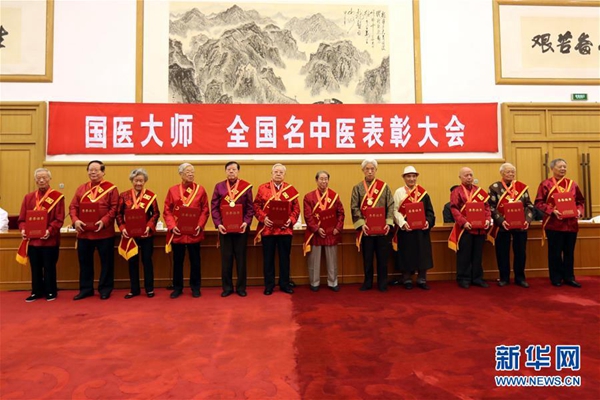

China recognized 30 new national masters of traditional Chinese medicine during a ceremony in Beijing on Thursday. [Photo/Xinhua]

Of the new masters, 25 are men and five are women, and all have practiced TCM for at least 50 years, according to the State Administration of Traditional Chinese Medicine.

They range in age from 66 to 96.

The award ceremony was held by the administration, the National Health and Family Planning Commission, and Ministry of Human Resources and Social Security.

“The masters should serve as role models for the country’s TCM practitioners to wholeheartedly serve their patients, promote TCM, and help pass down the oriental medical science via education and training,” Wang Guoqiang, head of the administration, said while addressing the ceremony.

According to Wang, it is the third time the Chinese government has recognized national TCM masters, bringing the total to 90.

Together with the 30 masters, another 99 TCM practitioners from across the country were awarded the title of “famous veteran TCM doctor”.

Qi Xuan, a division director of human resources at the China-Japan Friendship Hospital, said that such high-level recognition encourages young TCM doctors.

Xu Runsan, 91, a TCM doctor at the hospital who specializes in gynecology, is one of the newly recognized masters.

“He’s in good health and still sees patients every week,” Qi said.

TCM is a medical science largely based on clinical experience and it requires lifelong dedication to become a good TCM doctor, she added.

Nationwide, Western medicine has become the mainstream and shoulders the lion’s share of the overall supply of medical care services.

But the government has introduced a slew of measures and policies to facilitate TCM development.

China’s top legislature late last year adopted a law on TCM, allowing it a bigger role in the country’s medical system.