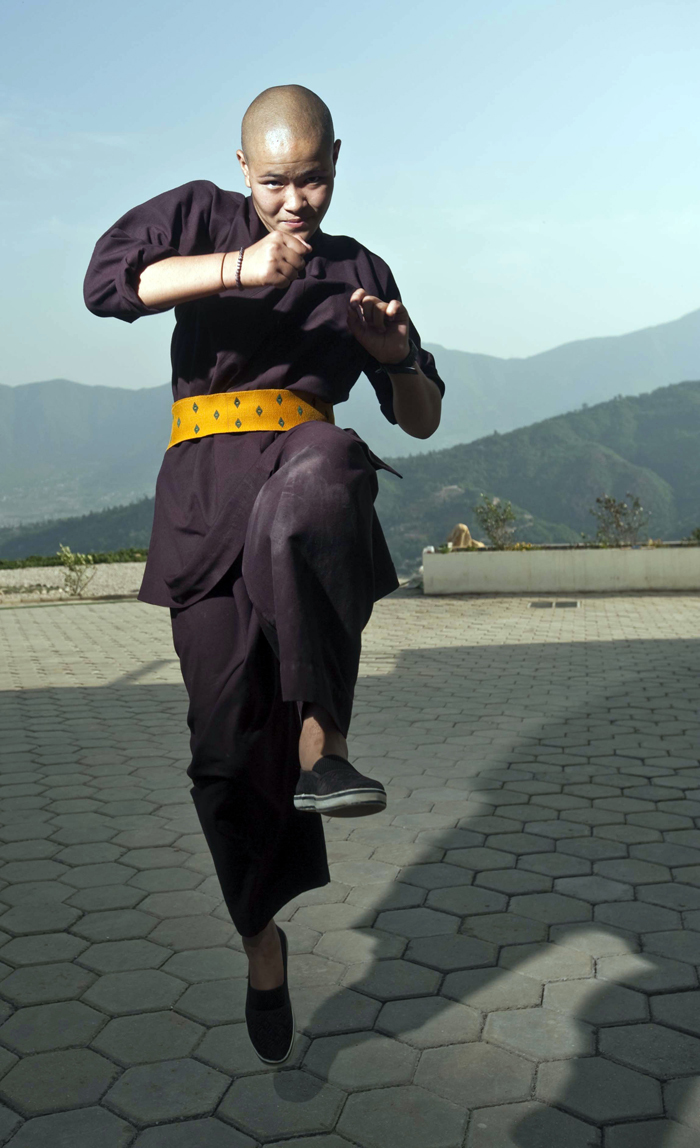
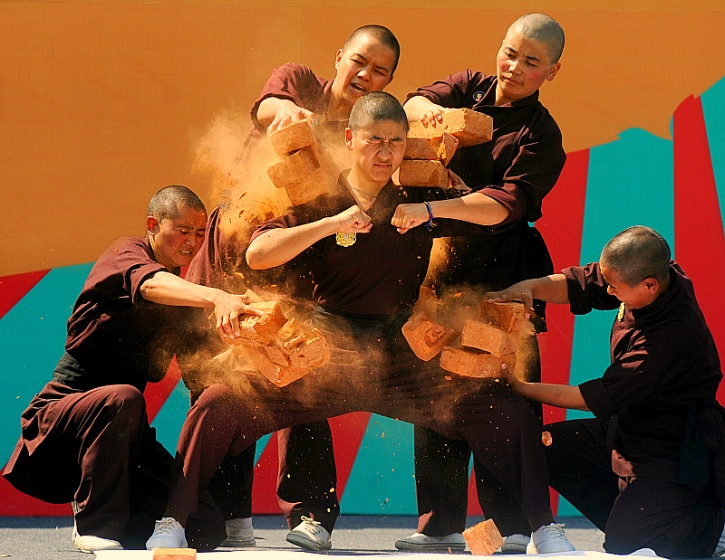
Kung Fu Nuns of the Drupka Order

…but the best story of the day. It even beat out Kingdom of the Little People doing Shaolin kung fu.

Page last updated at 14:58 GMT, Wednesday, 14 April 2010 15:58 UK
Kung fu empowers Nepal nuns
By Jo Jolly
BBC News, Kathmandu

Interest in becoming a nun has grown dramatically since Kung Fu classes began at the Amitabha Drukpa Nunnery

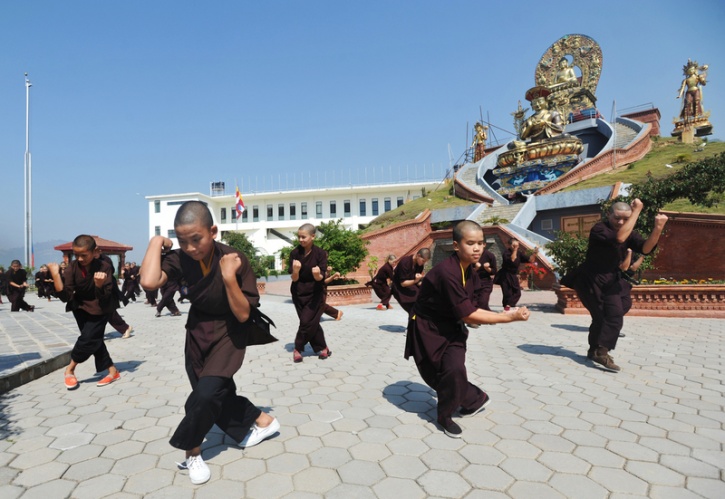
It is early in the morning at the Amitabha Drukpa Nunnery on a hillside just outside Kathmandu and hundreds of devotees are walking clockwise around a golden statue of Buddha.

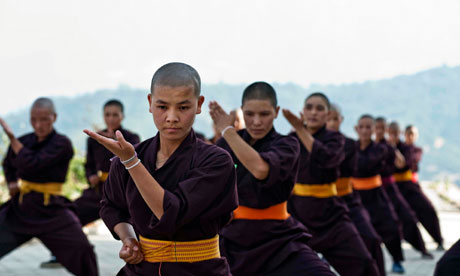
But rather than being immersed in prayer, up on the roof something different is happening - they are practising the same kung fu fighting made famous by the Bruce Lee films of the 1970s.

Young Buddhist nuns from the 800-year-old Drukpa Buddhist sect are being taught by their Vietnamese master.

The martial art was introduced to the nunnery two years ago and the nuns practise up to two hours a day.

‘More powerful’

Rupa Lama, a 16-year-old nun from India, says kung fu helps her concentrate.

“It’s good for our health. Meditation is very difficult and if we do kung fu, then afterwards meditation becomes much easier,” she says.

Another nun, Konchok, also from India, says she likes kung fu because it gives her strength.

“It’s very helpful for our safety. If somebody teases us or something, then we can hit them and be more powerful,” she says.

The confidence shown by these young nuns is unusual. Buddhist nuns in the Himalayas are normally seen as inferior to monks.

Jetsunma Tenzin Palmo, an Englishwoman who became a Drukpa Buddhist nun more than 30 years ago, says traditionally nuns have been neglected and overlooked.

"The main problem for nuns has always been that they have not normally had a good situation in which to live, they have not received the support from lay people that monks receive and they have not been educated.

“So often nuns became basically just household servants for their families or working in the kitchens and the gardens in the monasteries,” she says.

Kung fu was introduced into the Amitabha Drukpa Nunnery by the leader of the Drukpa spiritual sect, His Holiness The Gyalwang Drukpa.

‘Well-equipped’

The Gyalwang Drukpa is the 12th incarnation of the leader of the Drukpa - or dragon - sect of Buddhism, which is the main religion of Bhutan and is widely practised in countries across the Himalayas.

He says that he felt that previous spiritual leaders had not done enough to advance the rights of women.

“When I was very small, I was already thinking that it was not right to suppress women in our society,” he says.

“But then when I grew up, I started to think what can I do for them? Then I thought what I can do is to build a nunnery and then give them an opportunity to study and practise spiritually,” he says.

The nunnery built by The Gyalwang Drukpa, the Amitabha Drukpa Nunnery, is a modern, well-funded and a well-equipped place of worship and study.

“Not only [is it] just beautiful to look at, but it is a nunnery with the guidelines and the full support from their master, me,” he says.

He says he encouraged the nuns to take up kung fu when he saw nuns from Vietnam practising it.

Emphasis on meditation

For the past week, the nuns have been giving demonstrations of their new skill to thousands of pilgrims who are attending the Second Annual Drukpa Conference.

The Drukpa sect, which places an emphasis on meditation, is popular throughout the Himalayas and also with Westerners.

Jan Duin, who is attending the conference from the Netherlands, says he has been impressed by the kung fu practice.

“I think it is very helpful physically and also psychologically because they do a lot of sitting practice,” he says.

“In meditation you practise concentration and you also practise concentration with kung fu.”

Buddhist nun Jetsunma Tenzin Palmo says that she’ll be introducing kung fu into her own nunnery which is based in the Indian state of Himachal Pradesh.

“It’s excellent exercise, secondly it’s very good for discipline and concentration, thirdly it arouses a sense of self-confidence which is very important for nuns, and fourthly when any young men in the area know nuns are kung fu experts, they keep away,” she says.

Jetsunma says since nunneries have begun to offer better education and physical programmes like kung fu, the number of young women who want to become nuns has grown dramatically.

“Many of them say, wow, if I become a nun I can study, I can practise, I can do these rituals, I can live together with all these other lovely nuns and lamas will visit us and give us teaching,” she says.

"It’s a beautiful life option to getting married, having a baby every year, working in the fields, doing the cooking, doing the cleaning.

“You know for them this is a huge opening up in a whole world that had previously been closed to them.”

K-k-k-k-k-Katmandu

If I ever get out of here,
I’m going to Katmandu. :wink:

The kung-fu nun of Kathmandu

Druk Amitabha Nunnery 9 May, 2010 - She appears sheepish and timid as she makes her way up to the concrete roof of the giant four-storied assembly hall from the courtyard.

Once on the roof, 12-year old Jigme Wangchuk Lhamo is anything but gentle and compassionate.

Changing into loose maroon cotton pants and a long sleeved shirt, belted around the waist, Jigme throws quick jabs and punches and kicks higher than an average person. She is among 400 other nuns of the Druk Amitabha nunnery in Kathmandu, Nepal, who reminds visitors of a scene from a Shaolin kung-fu flick.

Everyday, the nuns wake up at 4 am and begin reciting and memorising Buddhist texts for about an hour, following which they engage in an hour-long practice of the martial art. The devote another hour towards the evening.

Jigme from Nganglam Dechenling in Pemagatshel is the most energetic and enthusiastic of the group.

She enrolled in the nunnery last year, after completing class five from Lungtenphu primary school in Thimphu.

Although she was among the top ten position holders in her class at Thimphu, Jigme said her faith in dharma and interest to become a nun caused her to discontinue studies.

“It’s my sixth month running here at the nunnery,” she said. Within that short span of time, Jigme can fluently speak Nepali, Hindi, Tibetan and Ladhaki languages, which are widely spoken at the nunnery.

Her Vietnamese master said that, although kung-fu was new to her, Jigme was able to attained the sixth of the 16 basic levels of the art.

“When I practise, I visualise I’m in a real combat,” Jigme said.

Besides learning to defend themselves from a handful of troublemakers in the vicinity of the monastery, kung-fu, Jigme said, made one capable of sitting straight-backed for many hours during meditations, ceremonies and teachings.

“It keeps me physically fit, mentally sound and helps me focus better,” she said.

The idea and the story resonates with those of the Shaolin monks in China, who learnt the martial art to defend themselves from passing bandits, besides the real concept of introducing it for health reasons by an Indian Buddhist priest named Bodhidharma (Tamo in Chinese), who visited a Shaolin temple.

Tamo, who joined the Chinese monks, observed that they were not in good physical condition. They spent hours each day hunched over tables where they transcribed handwritten texts.

The Shaolin monks lacked physical and mental stamina needed to perform even the most basic of Buddhist meditation practices. Tamo countered this weakness by teaching them moving exercises, modified from Indian yoga, which were based on the movements of the 18 main animals in Indo-Chinese iconography like tiger, leopard, snake and dragon, to name but a few.

He did not, however, introduce kung-fu, which existed in China much before his arrival. The ancient martial art is popular even in big Mahayana Buddhist monasteries. They believe that sound mind comes from sound body.

“Even Buddha Shakyamuni had said that, if you are sick, take medicine, even if a medicine is fish. Otherwise without body, practice is impossible,” His Eminence Khamtrul rinpoche said.

Jigme said the art taught the nuns to channel their energy and be positive about everything they attempted to do in their daily lives.

The founder of the nunnery, H.H the 12th Gyalwang Drukpa rinpoche, the spiritual head of the drukpa lineage introduced kung-fu class two years ago after watching nuns practising kung-fu in Vietnam.

He was told that it helped the nuns concentrate better and made them self-reliant.

Rinpoche said that was true because, ever since kung-fu was introduced in the nunnery, nuns rarely fell ill, which was a frequent occurrence otherwise.

On the contradiction of Buddhist principles of non-violence against learning martial arts, rinpoche explained that it all depended on motivation.

“If you are aggressive out of good motivation, you are an angry bodhisattva,” he said. Jetsunma Tenzin Palmo, an English lady, who became a nun more than 30 years ago, said if one knows how to defend oneself, one can stop an opponent without necessarily doing tremendous amount of damage.

“You’ll know which part of a body to disarm without hurting,” she said.

Apart from training the mind, keeping fit and improving concentration, kung-fu, she added, gave them a sense of confidence to protect themselves.

“When young men in our locality know the nuns practise kung-fu, they keep away,” Jetsunma Tenzin Palmo said.

Meanwhile, Jigme Wangchuk Lhamo hopes to, one day, introduce the ancient martial art in Bhutan. “My dream is to become the first Bhutanese kung-fu master, even if I can’t master Buddhist scripts,” she said.

By Tenzin Namgyel

The nuns made TIME


Only under 25?

Bad Karma Beware: Meet the Kung Fu Nuns of Nepal
By Hillary Brenhouse Monday, Jul. 12, 2010

The word out of central Nepal is so startling that it sounds almost mythical. Every day at 4 a.m. in the Kathmandu Valley, far from the birthplace of kung fu, 200 nuns of the Tibetan Buddhist Drukpa sect — a school not associated with the Chinese martial art — are said to assemble to throw punches. Weather permitting, the young women have been seen practicing on the roof of the Naro Assembly Hall of the Druk Gawa Khilwa Nunnery, set against forested mountain and the open sky. The nuns describe their hour-long routines: spreading apart their feet and planting them down decidedly in the so-called horse stance, bringing thumb together with forefinger to form a crane’s beak with their hands, striking down and then back again, lunging forward and taking off with soaring kicks. “We all like it very much,” 17-year-old Jigme Konchok Lhamo says in a phone interview. “Everyone does it, except those nuns who are very old.” In other words, morning kung fu sessions are only open to nuns under 25.

Kung fu came to the nunnery in 2008, after His Holiness the 12th Gyalwang Drukpa, head of the Drukpa school, saw nuns in combat training while he was on a visit to his followers based in northern Vietnam. “I was inspired because these Vietnamese nuns exhibited tremendous self-confidence and strength, not only in their movements but also in their attitude toward people outside their own enclosed community,” he says. Kung fu has long been established in the country, having moved south from traditional martial-arts centers in China, including the famous Shaolin Temple, which was founded by a separate Buddhist sect, Chan (or Zen, as most Westerners know it).

His Holiness took back to Kathmandu not just the idea of introducing martial arts, but also four experienced Vietnamese Drukpa nuns to serve as teachers. The Buddhist leader was keen on keeping the program all female, insisting that bringing in learned monks as instructors would only reinforce gender stereotypes. The physical and spiritual empowerment of women is high on his list. “Before coming here,” he says, “girls who had become nuns in different parts of the Himalayas in search of independence mostly ended up doing household chores in the monasteries and sometimes in their own gurus’ family homes.”

That the young Vietnamese women, all of them in their early 20s and themselves trained by men, are passing their new expertise forward is a testament to how far Buddhist nuns have come. Martial-arts historians agree that there were almost certainly nuns in the Shaolin Temple but that it’s unlikely they received martial-arts training due to their lesser status. In any case, they would not have gone on to coach. But after just two years of instruction, a handful of quick-learning Nepalese nuns are said to have begun trying their hand at teaching and now reportedly help lead morning lessons.

Martial-arts training is great exercise, supplementing the nuns’ yoga classes. But it was also introduced to help with their Buddhist practice. “Our meditation gets easy with the kung fu,” says the young nun Konchok Lhamo. “It helps us to sit up straight, to learn how to concentrate.” The continual repetition of moves builds control and focus, thought to be an asset to any discipline requiring intense concentration — all things useful for young women who are expected to sit in the same position for hours and sometimes undertake retreats during which they cannot speak for months at a time.(Comment on this story.)

The Vietnamese Drukpa nuns only began their own martial-arts training in 1992, when their local religious head, the Most Venerable Thich Vien Thanh, initiated the practice at the Tay Thien nunnery. There were only three nuns then. Now all 80 of the nuns there are said to spend sunup sparring. Many of them are eager to join their four sisters in Nepal, so they can be closer to the Gyalwang Drukpa and also try teaching. Initially, the nuns were trained in combat techniques by soldiers from the Vietnamese military. But in the past few years the program has become more formal, and male students of kung fu grandmasters have gone from the cities to teach the women a mixture of Shaolin methods and specifically Vietnamese martial arts. Tay Thien’s head nun Jigme Samten Wangmo, who is Vietnamese but goes by her Tibetan religious name, says that one of these indigenous styles, Kinh Thuat, “was created by the generals and warriors of the Tran Dynasty who defeated the invader Genghis Khan.” Her nuns have never had to fight off intruders themselves. Says Samten Wangmo: “Perhaps that’s because hearing that we have kung fu, strangers are afraid of getting close to our place.”

In other times, it might have been odd for kung fu practitioners in Nepal to be learning Chinese or Vietnamese fighting forms. Thomas Green, editor of the just published Martial Arts of the World: An Encyclopedia of History and Innovation, calls it “an adventure in globalism,” noting that knocking down boundaries in this way is now commonplace. “In a very nationalistic period, for instance, Taekwondo was the Korean martial art,” he says. “But with the Buddhist nuns, what you have is a community that crosses national lines.” Regardless of the particular type of kung fu being disseminated there, “this effort at pride, strength, self-actualization is something that is certainly filling a need with these women.”

And the nuns’ effort is likely to go even more global in the coming year. Once they are prepared, several of the more skilled Kathmandu nuns may be asked to pass on their abilities at a third Drukpa nunnery, the Dongyu Gatsa Ling in the north Indian state of Himachal Pradesh. Jetsunma Tenzin Palmo, a former librarian from London who established the nunnery in the late 1990s, caught the Nepal nuns demonstrating their newfound knowledge one evening during the annual Drukpa Council last year. The presentation stunned the crowd. “Frankly, it brought the house down,” says Tenzin Palmo. “I think the monks and lamas were very envious.”

Tenzin Palmo says taking kung fu to her own nunnery “would help the nuns build self-esteem, which is one of the things, on the whole, young nuns lack. They’re not trained to have confidence. They’re trained to be deferential, especially in the presence of males.” Learning martial arts would also give them the means to defend themselves should local men ever get any ideas. “You just need one group of young guys at a wedding or something to get drunk and suddenly remember that there’s a whole community of young women in the vicinity,” says Tenzin Palmo.

She is currently in negotiations with the other nunneries to invite girls over, but is concerned that her own nuns — whose days already are heavy with yoga classes, Buddhist philosophy and Tibetan- and English-language lessons — will not be able to fit anything else in. But the nuns couldn’t be more enthusiastic. Says Tenzin Palmo: “They just see themselves as kung fu heroines.”

Not quite Shaolin…

…nevertheless, Tibetan nuns doing dragon dancing sounds like fodder for a decent half hour doc.

BBC World News to air Kung Fu Nuns documentary
Avantika Gaikwad
September 1st, 2011

New Delhi: “Kung Fu Nuns” is the intriguing title of a documentary film which will be telecast on BBC World News on Saturday, 3rd September at 10:00 am and 11:00 PM with repeat telecasts on Sunday 4th of September at 4 p.m and 11 p.m. Directed by Indian documentary film director Chandramouli Basu, this 22 minute film by 24 Frames is produced by Arjun Pandey and Ambica Kapoor. The documentary is a part of the TVE (Television for the Environment) Life series on the BBC World News.

This is the story of an incredible transformation taking place among Buddhist nuns in some Himalayan communities. The film shows the struggle of a group of nuns of the Drukpa lineage who break centuries of tradition to cross barriers of male dominance which have excluded them from some practices and learning, and kept them secondary to the monks.

Their cause has been decisively pushed by one man - His Holiness the Gyalwang Drukpa, the spiritual head of the Drukpas. No other master of Tibetan Buddhism has done what he has - given nuns a status equal to monks in his order– through training them personally in higher scriptures and a range of secular skills, including Kung Fu. While Kung Fu may be a familiar sight in China or in martial arts movies, it was never before a part of the practice of Buddhist nuns. His Holiness has encouraged the nuns to perform ceremonies that have been the exclusive domain of men so far including the ‘Dance of the Dragons’. This dance has typically been performed only by all-male teams in the Himalayan traditions.

The film is told through the eyes of Kunzang, a 29 year old nun. They are rehearsing to perform a spectacular Dragon Dance. For the 10 nuns who have to move each unwieldy, tubular dragon in coordination with the beating drums, the task requires technique, concentration and determination. For the Drukpas, the Dragon Dance is more than just an auspicious dance. It is a way to showcase their commitment to women’s empowerment.

Talking about the film, Arjun Pandey, Producer and CEO, Twenty Four Frames said, “Women have always been the neglected lot across the globe. But the scenario is now fast changing. There is a rapid transformation taking place. This transformation of the Nuns in Ladakh is history in the making. The hitherto male bastion is fast witnessing a positive change and we are glad to be the ones bringing it to the entire world.” Speaking further on the film Arjun said, “it’s a poignant story through Kunzang, the protagonist brought alive by the amazing colors and visuals of Buddhist culture and tradition.”

Besides this, the nuns must paint and prepare their nunnery to receive thousands of visitors who would be coming in just a few weeks for a huge event – the Annual Drukpa Council. People from all over the world and top masters of the Drukpa Lineage attend the Council. The nuns have to show all the visitors that despite the held belief that women cannot achieve this, they are more than equal to the task.

Set against the starkly beautiful Ladakh mountains, in the crown of Indian’s Himalayan state of Jammu & Kashmir, the film follows Kunzang and her friends as they count down the four days they have to do a full performance for their teacher. They need to convince him that they can pull it off; otherwise this just might be the last Dragon Dance that they perform! Will they be able to do it?

To find out, watch Kung Fu Nuns on BBC World News at 10:00 am and 11:00 PM India time on Saturday, 3rd of September or 4:00 pm and 11:00 PM on Sunday, 4th of September 2011.

The nuns of DGK

Buddhist nuns embrace the power of kung fu

Nepalese monastery is enjoying a surge in popularity after spiritual leader introduces martial arts classes
Syed Zain al-Mahmood in Kathmandu
guardian.co.uk, Monday 26 September 2011 08.56 EDT


Kung fu nuns
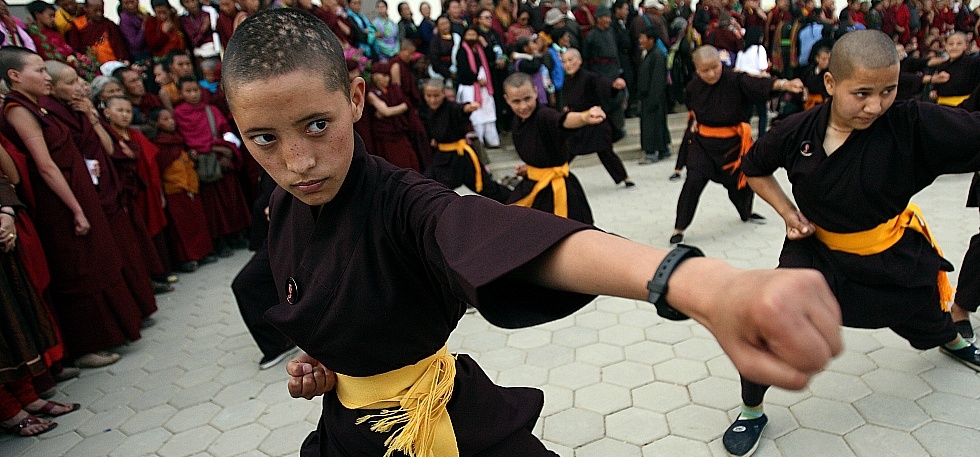
Nuns practising kung fu at the Druk Gawa Khilwa Buddhist nunnery in Ramkot, Nepal. Photograph: Simon De Trey-White/Eyevine

A Buddhist monastery near Kathmandu is enjoying a surge in popularity after its spiritual leader directed its 300 nuns to use martial arts techniques.

Enrolment is rising and Buddhist nuns as far afield as the Himachal Pradesh in India want to become kung fu instructors.

The Druk Gawa Khilwa (DGK) nunnery near the Nepalese capital teaches its nuns a mixture of martial arts and meditation as a means of empowering the young women. In Buddhism, like many religions, the voices of women have traditionally been muted. But the leader of the 800-year-old Drukpa – or Dragon – order, to which DGK belongs, is determined to change all that.

“As a young boy growing up in India and Tibet I observed the pitiful condition in which nuns lived,” says His Holiness the Gyalwang Drukpa, the spiritual head of the Drukpas.

“They were considered second-class while all the privileges went to monks. I wanted to change this.”

Although nuns have usually carried out only household chores in Buddhist monasteries, the nuns of DGK, who come from places as far apart as Assam, Tibet and Kashmir, are taught to lead prayers and given basic business skills. Nuns run the guest house and coffee shop at the abbey and drive DGK’s 4X4s to Kathmandu to get supplies.

But for many, the breakthrough was the introduction of kung fu three years ago, shortly after the Gyalwang Drukpa visited Vietnam and observed female martial arts practitioners there.

“Spiritual and physical wellbeing are equally important for our nuns,” says the leader.

Sister Karuna, a soft-spoken young nun from Ladakh in the north of India, says kung fu has given the nuns self confidence and also helps in meditation. “We love kung fu,” said Karuna, as she prepared to swap her maroon prayer robe for a martial arts suit with a bright yellow sash. “Now we know we can defend ourselves. We also have the fitness for long spells of meditation.”

Jigme Thubtem Palmo, 32, who left her family and a career as a police officer in Kashmir six years ago to join the monastery, says young women in the region are now more interested in becoming nuns than before. “We will soon build facilities for 500 nuns,” she said.

The shaven-headed DGK nuns recently stunned an audience with a colourful martial arts display at the third annual Drukpa council summit held in Ladakh.

Jetsunma Tenzin Palmo, a former librarian at the School of Oriental and African Studies in London, says she will introduce kung fu at the nunnery she has set up in the Indian state of Himachal Pradesh.

“It’s excellent exercise, good for discipline, concentration and self-confidence,” says Palmo. “Also, when any young men in the area know nuns are kung fu experts, they stay away.”

There’s an amazing documentary or at least a decent kung fu film in this story…:wink:

More on Ladakh

Interesting how this story gains traction every once in a while.

The Kung Fu nuns of Ladakh
Published: Sunday, Oct 2, 2011, 8:45 IST
By Apoorva Dutt | Place: Mumbai | Agency: DNA


The Drukpa nunnery in Ladakh is home to a self-empowered branch of feminist Buddhism

The early-morning peace of Ladakh, says Tenzin, a local shopkeeper, is broken every morning by them. I follow the wave of his arm. You would expect perhaps a noisy neighbourhood, a boisterous bunch of hoodlums, or a gaggle of over-enthusiastic tourists. Tenzin is, in fact, waving towards the Buddhist nunnery of His Holiness the Gyalwang Drukpa, a majestic array of buildings with thousands of prayer flags fluttering around it. The culprit?

“The nuns,” he says vehemently.

Every day at 4am in the Drukpa nunnery, the thin, tinny silence of Ladakh is shattered by the shrill haee-yas and huuus of the nuns practicing their kung fu. Over a hundred under-25 Buddhist nuns, far from the fabled birthplaces of kung fu, spring kick and punch into the thin mountain air. They are taught by Jigmet Gendum, a surly Vietnamese monk who barks orders and walks amongst the ranks, straightening legs and correcting postures along the way.

The fact that they are Buddhist nuns — a religion known less for its acceptance of violence and physical combat, and rather more for its relentless misogyny in limiting women to only a certain level of enlightenment, makes these nuns an unusual sight: like something Hollywood might dream up. But the kung fu nuns — as they are known throughout the world — are only the most public manifestation of the Drukpa leader’s attempts at female emancipation.

‘I wanted to be like Jackie Chan’
Migyur Palmo, 20, has been at the Drukpa nunnery for four years. She loves kung fu, Jackie Chan movies, has her own email id, but doesn’t understand the appeal of Facebook. “It’s a waste of time,” she says, crinkling her forehead disapprovingly.

It has taken me an hour to get her to open up: for the first forty minutes, she answered questions with the rehearsed ease of a beauty contestant. Migyur is attractive, well-spoken, and unfailingly devoted to the life she has chosen. No, she never wanted to be anything other than a nun. No, she was never persuaded to become a nun. No, she doesn’t miss her old life. All she wants is enlightenment. So does she want to become a Buddhist guru herself one day? No, no, she corrects me quickly. She means in the next life. In this life, serving the Drukpa and helping people are her goals.

It is when I ask her about kung fu that she opens up. “I saw Jackie Chan movies when I was younger,” she giggles. “I wanted to fight like him, and do all the fancy moves. I love that the most. Of course,” she adds quickly, “Kung fu for us is just exercise, not for fighting. It makes us healthy and we even meditate better.”

She occasionally misses her family, Migyur finally admits. “I can’t leave the nunnery for longer than a week per year. But they had also felt that it was important for every family to have a nun, as a sort of representative.”

Ayee Wangmo, a good friend of Migyur’s, is an 18-year-old nun who ran away from home to the nunnery after the Drukpa gave a speech at her Ladakhi village. “I had never heard anyone talk about such things,” she says wonderingly. “It changed me, from the inside, you know?” Ayee says that in her first year, she was desperately homesick. “I missed my sisters. I would get distracted and my mind would wander. I was too talkative. But the other nuns mentored me.” Ayee concludes, “Coming here was the best decision I ever made.”

‘My father didn’t understand’
Carrie Lee, the president of Live to Love NGO, which works with the Drukpa in the Ladakh region, believes that the Drukpa is not exactly progressive, but in fact, returning Buddhist women to the stature that was given to them many centuries ago. “I call the Drukpa lineage the ‘get-off-your-ass-and-do-something lineage,’” she laughs. “Most Buddhist nuns are treated as servants. At the Drukpa’s nunnery, they consider themselves to be mentally and physically stronger than the men. I remember one occasion when the nuns and monks were on a trek together, and the nuns complained the monks would slow them down as they don’t work as much as the nuns do!”

The Drukpa nunnery might be the only instance in the world where there is a waiting list to get in. Kanchok Wangmo, 19, had to fight her family to come to the nunnery. “I wanted to help people. They told me to stay at home and become a teacher. But anyone can become a teacher, only a few can study under guruji’s tutelage,” she explains. Kanchok, who is from a small Himachal village, is more forthcoming about her transition from layperson to nun. “I was a little disappointed when I came here, because I expected there to be a college,” she says sadly. “But it’s basic education, which I’ve already had.” She talks freely about how her father, a rice farmer, was unable to accept her as a nun and cut off ties with her for two years. “Oh, he just missed me,” she says affectionately. “He didn’t understand.”

Despite the time I had spent with these nuns, I too, didn’t understand. From a city-bred atheist’s point of view, I questioned them persistently: but why? Why, when you could help people as a doctor, a teacher, or as a good mother does? Kanchok answered patiently. “I wanted to be a doctor once, like my elder sister is now. But why fix the body, which only manifests symptoms of the sickness, when you can fix the source of the problem — a fault with the soul?” But you must miss something? Kanchok hesitates, and it is clear she has thought of something, or someone, before she answers: “In this life, we have no money or power. By becoming a nun, I hope to achieve a better spiritual status in my next life [that is, be reborn as a man] and help more people.”

Feminist Buddhism
“Seeing nuns doing kung fu is a beautiful thing,” says His Holiness the Gyalwang Drukpa. “I want to help women, and my own nunnery is the best place to start. I also make sure that I teach texts to the nuns directly. Then, if the monks want to know these teachings, they have to learn from the nuns.” The Drukpa explains that these women have faced a lot of oppression. “They suffered with their families and a backward lifestyle. Now, after centuries, they are being trusted with ancient secrets and texts.”

Many of the nuns who come to the nunnery are orphaned or homeless. But many others have chosen this life, despite having all the opportunities the ‘other’ world had to offer. “One nun used to be a J&K counter-terrorism agent. Another one was a week from leaving for Canada for a marketing job when she joined the Drukpa nunnery,” points out Mary Dorea, a volunteer with Live to Love. “An increasingly self-empowered branch of feminist Buddhism is emerging.”

Chandramouli Basu is the director of the BBC documentary Kung Fu Nuns, and he was in Ladakh to show the film to the Drukpa nunnery on the occasion of the Annual Drukpa Council 2011, a meeting of religious leaders and followers from across the globe. The movie tells the story of Kunzang, a 29-year-old nun, as she and her fellow nuns prepare to perform the ritual of the Dragon Dance, which was previously only meant for monks to perform.

Anxious to prove themselves, the nuns sweat it out in preparation.

“The rapid transformation at the nunnery is inspiring,” says Basu. “Especially seeing it happen against the setting of religion, which is perceived as being the last pillar of conservatism,is a source of hope.”

The film was screened in the same courtyard at the nunnery where the nuns practice their kung fu every morning. Thousands of nuns sat on the stone floor, cross-legged, cheering wildly under the clear, starlit Ladakhi sky, whooping when they recognised a nun on the screen, oohing sympathetically as one broke her ankle during rehearsals. Kanchok, sitting next to me, squeezed my hand happily as the movie ended with the successful performance of the Dragon Dance. “Isn’t it beautiful?”

Nepal’s kung fu nuns practise karma with a kick

“The Amitabha Drukpa Nunnery in Kathmandu, Nepal, houses the world’s first order of kung fu nuns.”

http://news.yahoo.com/video/world-15749633/nepal-s-kung-fu-nuns-practise-karma-with-a-kick-29224499.html

I guess Yongtai doesn’t count? :confused:

The Tibetan nuns strike again

I know, I know…needs pix. :rolleyes:

Kung fu nuns teach cosmic energy to CERN scientists
By Robert Evans
GENEVA | Fri Nov 16, 2012 11:28am EST

Nov 16 (Reuters) - A dozen kung fu nuns from an Asian Buddhist order displayed their martial arts prowess to bemused scientists at CERN this week as their spiritual leader explained how their energy was like that of the cosmos.

The nuns, all from the Himalayan region, struck poses of hand-chops, high-kicks and punches on Thursday while touring the research centre where physicists at the frontiers of science are probing the origins of the universe.

“Men and women carry different energy,” said His Holiness Gyalwang Drukpa, a monk who ranks only slightly below the Dalai Lama in the global Buddhist hierarchy. “Both male and female energies are needed to better the world.”

This, he said, was a scientific principle “as fundamental as the relationship between the sun and the moon” and its importance was similar to that of the particle collisions in CERN’s vast “Big Bang” machine, the Large Hadron Collider (LHC).

The nuns, mostly slim and fit-looking teenagers with shaven heads and clad in flowing burgundy robes, nodded sagely.

But the 49-year-old Gyalwang Drukpa, head since the age of four of one of the new independent schools of Tibetan Buddhism centred in India and Nepal, stressed that their visit to CERN was not just scientific in purpose.

GENDER EQUALITY

By taking the nuns around the world and letting people of other countries enjoy their martial displays, he told physicists and reporters: “I hope to raise awareness about gender equality and the need for the empowerment of women.”

The nuns themselves – who star on Youtube videos – have benefited from this outlook, he said.

For centuries in Tibet – incorporated into communist China since 1951 – and its surrounds, women were strictly barred from practising any form of martial art.

In his homeland Himalayan region of Ladakh, the Gyalwang Drukpa said, women were mainly servants, cooks and cleaners to monks.

About three years ago he decided to break out of this pattern and improve the health and spiritual well-being of women by training them in kung fu and even allowing them to perform sacred rites once also restricted to men.

“And a very good thing too,” declared CERN physicist Pauline Gagnon, who recently wrote a blog study pointing to the low, although growing, proportion of women in scientific research around the world.

The visit to CERN, whose director general Rolf Heuer recently sponsored a conference of scientists, theologians and philosophers to discuss the tense relationship between science and religion, was not the first by a top religious leader.

In 1983 the sprawling campus on the border of France and Switzerland hosted the Dalai Lama, Buddhism’s most revered figure, who argues that most scientific discoveries prove the truth of the view of the cosmos expounded by his faith – sometimes dubbed by outsiders an “atheistic religion.”

Pope John-Paul II preceded him in 1982 and the present Pope Benedict has a standing invitation from Heuer. (Reported by Robert Evans, edited by Paul Casciato)

pix

Luv the berets…

Everybody likes Kung Fu Fighting, including nuns

The 12th Gyalwang Drukpa, Jigme Pema Wangchen, (L) poses with Kung-Fu trained nuns accompanying him at the European Organization for Nuclear Research (CERN) in Meyrin near Geneva.
Reuters
Tuesday, Nov 20, 2012

SWITZERLAND - A dozen kung fu nuns from an Asian Buddhist order displayed their martial arts prowess to bemused scientists at The European Organisation for Nuclear Research (Cern) this week as their spiritual leader explained how their energy was like that of the cosmos.

The nuns, all from the Himalayan region, struck poses of hand-chops, high-kicks and punches on Thursday while touring the research centre where physicists at the frontiers of science are probing the origins of the universe.

“Men and women carry different energy,” said His Holiness Gyalwang Drukpa, a monk who ranks only slightly below the Dalai Lama in the global Buddhist hierarchy. “Both male and female energies are needed to better the world.”

This, he said, was a scientific principle “as fundamental as the relationship between the sun and the moon” and its importance was similar to that of the particle collisions in Cern’s vast “Big Bang” machine, the Large Hadron Collider (LHC).

The nuns, mostly slim and fit-looking teenagers with shaven heads and clad in flowing burgundy robes, nodded sagely.

But the 49-year-old Gyalwang Drukpa, head since the age of four of one of the new independent schools of Tibetan Buddhism centred in India and Nepal, stressed that their visit to Cern was not just scientific in purpose.

By taking the nuns around the world and letting people of other countries enjoy their martial displays, he told physicists and reporters: “I hope to raise awareness about gender equality and the need for the empowerment of women.”

The nuns themselves, who star on Youtube videos, have benefited from this outlook, he said.

For centuries in Tibet , incorporated into communist China since 1951, and its surrounds, women were strictly barred from practicing any form of martial art.

In his homeland Himalayan region of Ladakh, the Gyalwang Drukpa said, women were mainly servants, cooks and cleaners to monks.

About three years ago he decided to break out of this pattern and improve the health and spiritual well-being of women by training them in kung fu and even allowing them to perform sacred rites once also restricted to men.

“And a very good thing too,” declared Cern physicist Pauline Gagnon, who recently wrote a blog study pointing to the low, although growing, proportion of women in scientific research around the world.

The visit to Cern, whose director general Rolf Heuer recently sponsored a conference of scientists, theologians and philosophers to discuss the tense relationship between science and religion, was not the first by a top religious leader.

In 1983 the sprawling campus on the border of France and Switzerland hosted the Dalai Lama, Buddhism’s most revered figure, who argues that most scientific discoveries prove the truth of the view of the cosmos expounded by his faith.

Pope John-Paul II preceded him in 1982 and the present Pope Benedict has a standing invitation from Heuer.

More in the wake…

What I love about this article? In the end, the The Bachelor: Shaolin link comes right back here. Thanks for that, Mr. Campbell! :slight_smile:

Physicists And Kung Fu Nuns
By Hank Campbell | November 22nd 2012 10:35 AM

What can Kung Fu Nuns teach CERN scientists about cosmic energy?

To start with, they would have to convince CERN scientists that ‘cosmic energy’ actually exists, and they recently got a chance to do that when the European Organization for Nuclear Research (CERN) hosted Drukpa Buddhist’s Spiritual Head, His Holiness the Gyalwang Drukpa.

In western academic culture, we always see people call Buddhist leaders ‘His Holiness’ because that is the title but referring to a Catholic Pope as Bishop of Rome, Vicar of Christ, Successor of the Prince of the Apostles, Supreme Pontiff of the Universal Church and Primate of Italy is frowned upon - instead we just see griping about Galileo and gay pederasts whenever a Roman Catholic is mentioned. Contrast that to the Being Human conference I went to earlier this year, which had zero western religious speakers though you could have created a drinking game built around how many times the psychologists and sociologists there mentioned meeting His Holiness The Dalai Lama - and they even had some Buddhist speakers. It sucks being a Buddhist in actual Tibet but since these guys are instead all over the West meeting and greeting the social sciences, it seems to be a pretty sweet life.

Anyway, CERN, WHO, WWF, the Green Cross and others invited His Holiness The Gyalwang Drukpa to talk about how scientists and spiritual leaders can play together nicely in promoting global well-being. That means encouraging eastern religion to accept some science so invoking cosmic energy was odd.

Global well being is nice and all but what is really cool is that His Holiness The Gyalwang Drukpa brought along a group called The Kung Fu Nuns. Sort of cool, anyway. They sound like they should be starring in a Quentin Tarantino movie but it seems they mostly work in hospital clinics and hold the world record for tree planting rather than ass-kicking, which seems rather tame for a sect whose name means ‘Dragon’.

His Holiness The Gyalwang Drukpa said,“The spiritual community should be working with the scientific community to tackle today’s global problems instead of resisting science. While we may use a different language, we are talking about the same thing and heading in the same direction.”

That seems obvious and he is doing his part for gender equality, since the Kung Fu Nuns are women and Asian culture is generally still in the 19th century regarding treatment of women. In an American society that worries if math classes are only 48% women and calls an invitation for coffee in an elevator a rape threat, it’s difficult to see why so many in academia embrace Eastern religious leaders, but His Holiness The Gyalwang Drukpa has bucked tradition and is a proponent of gender equality and that is to be applauded. Four years ago he brought Kung Fu to their nunnery and doesn’t make them just wash the dishes and stuff any more.

Expecting a hot Nunja? You will be disappointed. But unlike the Western military, Kung Fu nuns don’t get their own special self-esteem-based scoring system for physical tests. They still have to shave their heads just like the men too. Credit: Drukpa sect

We’re a science site and we want to learn new things, so if you are a Kung Fu Nun in training and have learned to do that Chöd-Dance, please send a video.

If they really want to be embraced by the West, they should create a television show called The Bachelor: Shaolin:

ttt 4 2013

Look Who is Kung Fu Fighting
Geeta Gupta : New Delhi, Sun Sep 15 2013, 05:48 hrs


Under an elemental blue sky, with rugged mountains framing them, a group of 20-odd Buddhist nuns, clad in maroon robes and with their heads shaven, punched the air with clenched fists. They were practising kung fu. Even three years ago, that would have been a sight unseen at Naro Photang nunnery in Shey, near the Ladakh capital Leh. It was a privilege reserved for men, for the monks.

Among the women was Jigme Wangchuk, a 15-year-old Buddhist nun from a monastery in Kathmandu, who was in India to attend the annual Drukpa Council that concluded last week at the Hemis monastery in Ladakh. Before she stepped out for kung fu practice, Wangchuk spoke about how she was barely six, a Class II student in Bhutan, when she realised she wanted to be a nun and practise “dharma”. Her mind, she said, was firmly made up to give up the “material” life — even against the wishes of her parents. While it is common for some Buddhist families to “give away” children born after their second child to “dharma”, Wangchuk insisted her parents loved her too much to agree. “They were sad and told me I was too young to lead the tough life of a nun. But I was sure,” said the young girl, who is fluent in English, Hindi, Nepali and the Bhutanese Drukpa language, and showed a remarkable confidence for her age. “It is very difficult to be a nun. We have to prove ourselves. For me, it was difficult to concentrate while meditating; but then it got better, and I found meaning,” she said.

The perfection of a nun would be attained if she achieved the highest levels of “concentration” and when she knew “everything about dharma”, she said. She was equally kicked about mastering the ancient martial art. “I love kung fu. It makes me feel healthier and it helps in improving my concentration,” Wangchuk said. The morning after the kung fu session, she led the dragon dance at the Hemis monastery — which too, till 2009, was a male preserve.

Like her, other nuns have benefited from a new line of thinking in the Drukpa sect. Consigned so far to the domestic chores of washing and cleaning, and told to live with the belief that they were meant to serve the men so that they could be reborn as monks and gain “enlightenment”, women had little avenue for growth in the spiritual hierarchy. “Women, even nuns, have always been considered secondary and it needs to change now. There is an improvement in the nuns’ life with promoting gender equality, and that gives me great encouragement,” said the 12th Gyalwang Drukpa, spiritual head of the nearly 1000-year-old Drukpa lineage, which follows the Mahayana Buddhist philosophy. The sect was established in 1206 and has followers across Tibet, Bhutan, China, Nepal and India.

The Gyalwang Drukpa visited Vietnam in 2008, and was inspired by Vietnamese nuns engaged in combat training. He decided to introduce the martial art and invited a Vietnamese master to the Druk Gawa Khilwa monastery in Kathmandu. At the nunnery in Leh, the martial art was introduced in 2010, and about 400 nuns learn kung fu at the two monasteries now. While training and practice will soon turn them into instructors, for now the nuns are trained by Dang Dinh Hai, a third generation Vietnamese kung fu master.

Over the last five years, in Ladakh and Kathmandu, nuns have been encouraged to step out of the nunnery and the confines of a wholly domestic life. They were a part of the massive tree plantation drive initiated after the flash floods of 2010 washed away several villages in Ladakh. They also work as volunteers at the SNM district hospital in Leh.

Jigme Rigme Lhamo, 36, who came to the order in 1999, said kung fu training has made the nuns more confident, though the many moves to ensure gender equity in the order faced staunch resistance. “A lot of people complained before they reached an understanding and got helpful. When we first performed the dragon dance, the keepers of dharma did say the world was coming to an end,” she said.

Lahmo studied till Class IX “in one of the best schools in Ladakh”. She lived with her family in Nubra Valley before becoming a nun. While her parents wanted her to become an engineer, Lahmo was inspired by Mother Teresa and wanted to “help people”. “My parents didn’t want me to become a nun; they were very unhappy with my decision. But I am happy being a nun. If I had stayed back with my parents, I would have been able to only help them. Now I can help more people,” she said. The nuns, who start their day at 3 am with a dose of kung fu and two hours of meditation, said that the tough physical exercise sustained them through the day’s routine, which, besides cleaning and cooking, includes meditation, prayers, learning Tibetan grammar, Buddhist philosophy, English and computer classes.

While it was discomfiting to see a 15-year-old lead the life of an ascetic when girls her age are occupied with ambitions, games, and toys of a different order, Wangchuk was dismissive of such concerns. She chuckled and said she loved her “dharma friends”. “There is nothing lacking in this life. I get to learn the scriptures and I will only get better. I play cricket and football too. I watch a lot of movies. I have seen all the kung fu movies,” she said.
This thread is like the Shaolin Soccer for real thread - it keeps coming back. And given the last quote, maybe they will combine someday. :wink:

More nuns

This is one of those stories that just pops up again every once in a while…

Kathmandu’s sweet but deadly kung fu nuns
December 9, 2013

10Kathmandu, Dec 9 (IANS) Their smiling faces and calm demeanour mask a roaring sea of immense energy and strength. These inmates of the Druk Amitabha nunnery in Kathmandu are also deadly kung fu fighters, being trained in the martial art as part of a strict regime, which also includes yoga and meditation, to promote gender equality.

“We do it as part of meditation and also to remain physically fit. Your spiritual well being depends a lot on your physical well being,” says Wangmo, 28, who trains the kung fu nuns.

Hailing from a small village in Lahul-Spiti in northern India’s Himachal Pradesh state, Wangmo has been in the nunnery for the last seven years and has been practising kung fu for four years. “I enjoy it very much,” she says as she wipes the sweat off her brow after a demonstration of her skills.

The nuns are allowed to visit their parents and home only once in about four years.

The nunnery was established by the Gyalwang Drukpa – the highest spiritual leader of the Drukpa lineage of Buddhists across the world – more than a decade ago to honour the will of his late guru. The objective was to train nuns at par with men – and that’s exactly what happens here.

“The uplift of women and gender equality are the causes close to my heart,” says the Gyalwang Drukpa. “I introduced kung fu as part of their training regime to give them strength, both inner and outward, as martial arts are also about meditation,” he added.

“Recently, a Saudi Arabian princess asked me about the kung fu nuns and their training regime. She was interested in it because they are also trying to bring in gender equality in their society,” Drukpa added.

“The kung fu nuns are my idea of gender equality… it’s interesting,” Drukpa smiled.

A kung fu nun’s work starts at 3 a.m. and ends at 10 p.m. First on the list is meditation till 4.30 p.m., followed by prayers at 5 a.m. And breakfast at 8 a.m.

After a half-hour break, it’s again time for meditation till 10 a.m., followed by classes to learn the Tibetan language.

Lunch – strictly vegetarian – is served at 12.30 p.m., after which the nuns are allowed an hour’s to rest before they troop in for an English class.

At 4 p.m., it’s tea time followed by recreation. Evening prayers are at 5 p.m and between 8 p.m. and 10 p.m. the nuns practise kung fu.

“It’s a life that we have chosen for ourselves and I am quite happy with it,” says Wangmo.

More from the Druk Gawa Khilwa Nunnery

Kung Fu nuns wow all at performance in the capital
Alisa Schubert Yuasa, TNN | Mar 15, 2014, 11.30PM IST

NEW DELHI: A woman screams as a sledgehammer arcs down on the 25kg slab kept on a nun’s maroon-clad knees. The stubble-headed nun, still in her teens, doesn’t wince. She’s a kung fu trainee from the Druk Gawa Khilwa Nunnery in Tia, Ladakh, and part of a movement towards gender equality and self-empowerment.

The Kung Fu Nuns, so named by His Holiness the Gyalwang Drukpa, who heads the Drukpa Buddhists and established the monastery in 1992, put up a spectacular performance of martial arts at the Indira Gandhi National Centre for the Arts on Saturday. They were a group of 100, all aged 15-21 years, petite, and mostly five-foot-nothing, but their moves were electric.

None of them has trained for more than five years. “I introduced kung fu to my nuns five years ago to give them strength, both inner and outward,” said the Gyalwang Drukpa. “Kung Fu Nuns is my little action and contribution to support women and gender equality.”

Before the performance, the nuns gathered under a tree’s shade, whispering among themselves. Daechen, 21, whose hazel eyes crinkle in the corners as she grins with guileless charm, said she loves kung fu. She has been training since she was 18, practising 2-4 times a day.

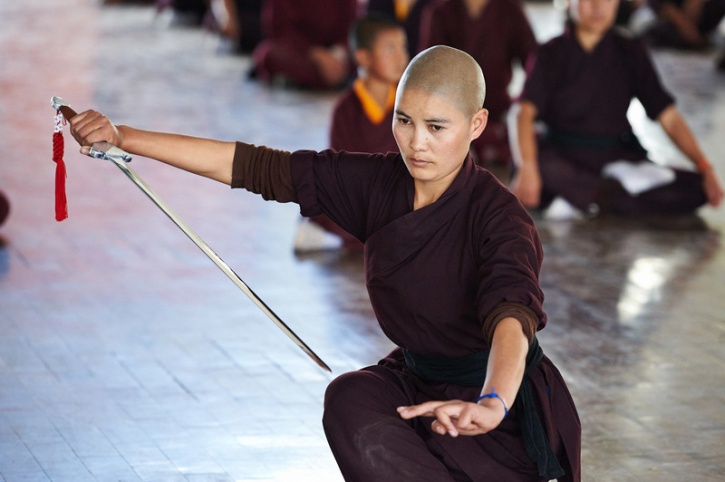
The sweet and bashful facade melted the instant they took the stage. Jogging into formation with military precision, the nuns settled into the first stance with grace, confidence and concentration. Clean swipes and high kicks were executed in total unison. Each routine used different props-swords, flags, spears. The effortless flow of their routine masked the lethality of each move. The nuns also performed the dragon dance, which is not only immensely difficult but has been traditionally reserved for Buddhist monks.

The Druk Gawa Khilwa Nunnery has grown over two decades from a strength of 15 to more than 500, of whom more than 200 learn kung fu. They are trained in spiritual development, higher Tantric yoga as well as humanitarian work. The nuns come from all backgrounds, from affluence to orphanages, but have chosen to take ordination vows with the Gyalwang Drukpa. Why? They do not give a straight answer, but the pride and grace with which they perform says more than words: it shows a tranquility and happiness with their choices in life.
petite + sweet + bashful = gender equality?

Okay, wassup with the sledgehammers?

Kung fu nuns teach city women self-defence moves
Yogesh Kumar,TNN | Dec 1, 2014, 03.56 AM IST

GURGAON: Appearances can be deceptive. Which is why when a group of eight nuns took the stage at Raahgiri on Sunday, not many Gurgaonites would have expected them to put on a demonstration of martial arts they would not forget soon.

Equally adept with swords and sticks, the women all belonging in the 18-23 age-group, are part of the Kung Fu Nuns, so named by His Holiness the Gyalwang Drukpa, who heads the Drukpa Buddhists.

The movement, which aims to spread the message of gender equality and self-empowerment, has been touring across the country to conduct kung fu demonstrations and teach women self-defence.

A 20-year-old soft-spoken nun from Himachal Pradesh, who did not wish to be named, said she has been practising for the last two years. “Our goal is to spread the message of women empowerment. We want to teach some important tricks to women so that they can protect themselves in case of an emergency,” she said.

Wielding swords, sledgehammers and sticks, the nuns left onlookers in awe with their strength, agility and grace. Himani Chawla, a 19-year-old visitor said it was an unusual sight. “I did not expect high kicks and clean swipes to be demonstrated by nuns,” she said.

A 21-year-old nun, who was one of the performers, said that kung fu is significant not only for self-defense, but it also helps develop physical, mental and emotional strength needed for meditation.

She said platforms like Raahgiri were essential to bring about a change. “It is hard to get such platform in cities, where people come not only to enjoy activities, but to learn about social causes. Our experience at Raahgiri has been very good,” she said.

…because wielding sledgehammers is one of the most important tricks for women’s self defense…:wink:

What? No mention of sledgehammers?

Meet the ‘Kung Fu Nuns’ who can break bones and chant with equal ease


They are trained in stunts such as breaking wooden planks and bricks They are trained in stunts such as breaking wooden planks and bricks
Written by Debesh Banerjee | New Delhi | Posted: November 27, 2014 12:00 am | Updated: November 27, 2014 11:59 am

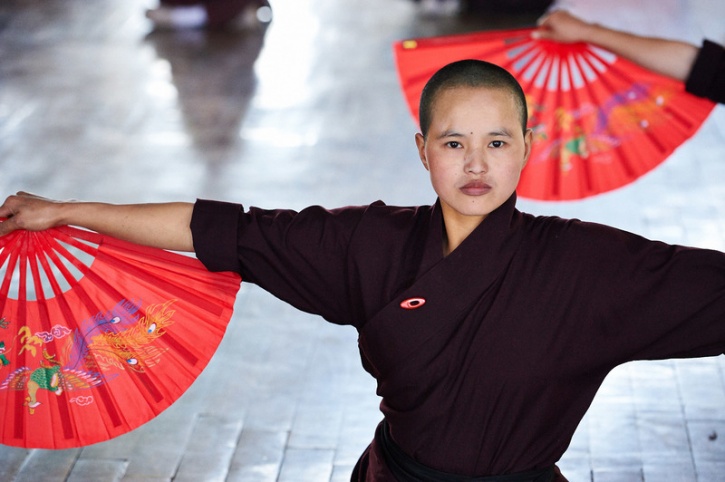
Appearances can be deceptive which is why Jigme Konchok Lhamo’s angelic smile should not be taken at face value. She walks calmly on to the stage with her hands folded in meditation, and breaks out into a wide stance in a flash. A Buddhist nun from Ladakh, Lhamo is adept at kung fu and breaking bones comes naturally to her. Her smartest trick is with the Chinese hand fan. On Monday evening, she performed stunts with her hand fan accompanied by six other girls from the nunnery at the closing of the Inner Path Festival in Delhi. “I usually like to perform with more girls but this was a smaller demonstration,” she says. At the Alliance Francaise, the girls performed with sticks, swords and hand fans to the background music of Buddhist hymns and chants.

The “Kung Fu Nuns”, a term coined by the international media, from the the Drukpa lineage of Buddhism, were initiated into Chinese martial arts by the Holiness the 12th Gyalwang Drukpa Jigme Pema Wangchen in 2011. Wangchen began teaching girls martial arts at various centres of the nunnery to prove that they were at par with monks. “Kung fu empowers us. It gives us confidence and makes us feel independent,” says Lhamo, who is from Keylong, Himachal Pradesh and shuttles between the nunneries in Ladakh and Himachal, where she learnt martial arts for five years.

At the nunnery, girls between the ages of 15 to 26 are taught kung fu, even as they cook, clean, meditate and study. “We wake up at 3 am every day. We devote two hours to learning kung fu,” says Lhamo. Their free time is spent watching martial arts films, usually Jackie Chan re-runs on TV. “He has the most authentic kung fu,” she says.

They have been on a 800 km pad yatra since November 1, from Varanasi to Lumbini, which involves walking 8 to 10km daily and cleaning up villages along their route.

I hope they come to the U.S. someday. I’d love to feature them.

Nice first person account

I like the approach of this site’s reporting.

First Person: ‘I set up kung fu classes for nuns’
As told to Jeremy Taylor by Gyalwang Drukpa


His Holiness the Gyalwang Drukpa and kung fu nuns: “Their routine is quite spectacular”©Tereza Cerveová

I am the spiritual leader of the Drukpa school of Buddhism, the 12th reincarnation in a lineage that dates back more than 1,000 years. We approach modern-day problems using ancient Buddhist philosophy. I believe most people think nuns spend their lives in learning and quiet contemplation. In the region of the Himalayas where I live, their traditional role was always subservient. For centuries, they simply cooked and cleaned for their monk colleagues.

They were also barred from taking part in martial arts but now I’ve helped change that. In 1992, I established the Druk Gawa Khilwa Abbey in Ladakh, India, and then six years ago I decided the time was right for the nuns there to start learning kung fu.

When I first broached the idea of teaching nuns kung fu, my advisers didn’t like it at all. I had a difficult time persuading them because it was a break from tradition. They didn’t understand.

Finally they agreed and one day in 2009 I put the word out that we were going to have kung fu lessons. I was in my mid-forties then and I hadn’t practised martial arts since I was a boy. However, as we didn’t have a proper teacher at the time, it was down to me to train them.

I remember that day very well. I was extremely nervous and quite scared because I didn’t want my project to fail. Suddenly I found myself standing in front of 102 nuns, all of them dressed in their robes and waiting for me to show them what to do.

I think we had a lot of fun. There was stretching and many arm movements but I soon realised that if the nuns were going to progress, they needed a proper kung fu master instead of me.

Now we have a core group of 70 nuns practising four times a day. They get up at 3am and have their first lesson an hour later. It’s often still dark and you can hear their yelps as they kick and punch through their exercises together in the courtyard.

It wasn’t long before word of the kung fu nuns got out and people wanted to come and see them train. We decided it would be good to send the nuns out into the world, to give displays and spread the message to other women.

Their routine is quite spectacular to watch and has drawn large crowds. They swirl flags and spears, making their high kicks in unison. They also perform the dragon dance, which is extremely difficult and usually reserved for monks.

Some of the nuns can break several bricks with a single strike from their hand or head. Another part of the show involves a nun sitting with a 25kg slab of concrete on her knees. It is then broken in half with the swing of a sledgehammer.

In the past few years the nuns have visited Hong Kong, Malaysia, London and most of Europe. They were invited to America but it was cancelled because we couldn’t get them visas.

I think it is marvellous for them because some of the nuns come from very difficult backgrounds. Some of them were orphans and others were homeless. They had very low self-esteem but kung fu has helped boost their confidence. Their spiritual practice is obviously very important but physical exercise like this can only do good.

Some of the nuns left good careers to join the nunnery in Ladakh. One was about to start a job in marketing and another was a counter-terrorism agent. The nunnery is so popular now that we actually have a waiting list.

I’m hoping that this is just the start for the Drukpa nuns. I have a lot of innovative ideas, including setting up a tennis team. Who knows where that will lead? Maybe one day you will have a nun as Wimbledon champion too.

Photograph: Tereza Cerveová

The Nepal Nuns are standing firm

These nuns kick ASS.

Kathmandu’s Kung Fu Nuns Have Refused To Be Evacuated - They’re Staying Back To Help Victims
Kunal Anand
April 30, 2015

300 women have refused to be flown by plane and chopper out of an earthquake ravaged Nepal. Clearly, they aren’t ordinary women - they are nuns of the Ladakh-based Drupka order.


buddistdoor

Or, as the world calls them, ‘Kung-Fu Nuns’. These women have grown up learning kung fu and meditation their entire life from a Kathmandu nunnery, and now they’re planning to stay back and use their strength to help earthquake victims here.


buddhistdoor

In fact, their leader, the 12th Gyalwang Drukpa expected them to be shaken, like the rest of Nepal. He told the Daily Mail: “I was expecting the nuns over there to be under trauma. Many people were saying that they should be evacuated but they decided to stay back and help others."


balticreview

"It’s raining continuously, earthquakes are repeatedly happening, the walls are falling and none of them can go back to their rooms so they have had to camp in the garden.


huffpost

Despite all these problems, they are willing to help.”


simondetreywhite

According to him, these disasters show nature’s unhappiness with mankind’s greed.: “From a spiritual point of view, we should not blame God but, instead, work with nature and respect it. Some people say that the earth is a mother. I don’t necessarily say that one should worship.


bccl

Respect, instead, means not being destructive. Scientists also say that,” he says.

//youtu.be/hsiBRVxh3qc

What he says is correct - Nepal has been built like a dangerous maze of poorly constructed buildings without concern for earthquakes.

Yet more on the nuns

These ladies are truly my heroines.

Meet the Kung Fu Nuns Fixing Nepal After Its Devastating Earthquakes
By Natasha Noman May 12, 2015

Nepal has been devastated in the past few weeks. More than 8,000 people died after the country was rocked on April 25 by a magnitude-7.9 earthquake, and on Tuesday it endured yet another major earthquake, this one of magnitude 7.3, resulting in more than a thousand injuries and dozens of deaths confirmed so far. Between the two quakes, aftershocks and heavy rainfall made recovery efforts difficult.

But amid this tragedy, some unlikely heroes have emerged: the so-called “kung fu nuns.” These Buddhist nuns of the Drukpa order live on the outskirts of Kathmandu at the Druk Amitabha Mountain nunnery, where they have incorporated the martial art into their Buddhist practice. Three hundred of these nuns refused to be evacuated after the April quake in order to stay and help with recovery efforts.

When their nunnery began to crumble during that first earthquake, “the nuns jumped through shattered glass windows, smashed open rattling doors and dived over a collapsing staircase,” the Washington Post reported. “They have been training for about four years to react with just such speed and agility.”

After tending to their monastery, the nuns have dedicated their time to helping others in nearby villages. They do everything from removing rubble to clearing paths. They distribute food, too, and help erect tents to provide shelter for the millions of Nepalis who are now homeless.


Source: Prakash Mathema/Getty Images

Wait… where did they come from? Traditionally, Buddhist nuns are trained in simplicity and expected to perform domestic chores in nunneries and monasteries. Roughly 26 years ago, taking issue with the inherently patriarchal and sexist Buddhist monastic framework, members of the 800-year-old Drukpa order rebelled to form the more feminist Druk Amitabha Mountain nunnery. They took that goal a step further in 2008, when their leader, Gyalwang Drukpa, introduced kung fu to the nunnery after being inspired by female martial arts in Vietnam.


Source: Mic/YouTube
In addition to martial arts, the Guardian reports, the Drukpa order teaches its nuns rudimentary business skills and how to lead prayers.

The nuns have said the kung fu has both improved their self-confidence and made them better at meditation. They have used it for campaigns promoting community work and against toxic waste, not to mention women’s empowerment, the Washington Post reports. Not only are these nuns helping their community, but they are also defying gender norms in a larger way, challenging what it means to be a woman in Nepal.


Source: AFP/Getty Images

To be a woman in Nepal: Nepal is not the worst country when it comes to gender parity, but it’s by no means exemplary. Strides have been made in education, and enrollment rates for boys and girls in primary and secondary school are practically the same, according to the World Economic Forum’s 2014 Gender Gap Index. But there remains a legacy of inequality, with only 47% of women literate, compared to 71% of men.

And, as is often the case in poor countries, women and girls suffer in a multitude of other ways. Women have had to bear the brunt of earthquake damages, keeping families together and participating in recovery efforts, as a substantial number of men are abroad earning remittances, Public Radio International notes. Women and girls are also particularly vulnerable to exploitation by human traffickers, who may target Nepal in the chaos.

This makes populations like the Druk Amitabha Mountain nunnery particularly important. Their ethos of female empowerment, and their role in recovery efforts, offers a symbol of hope for women and girls across the country.


Source: Prakash Mathema/Getty Images

Natasha Noman
Natasha is a Live News Staff Writer who focuses on global politics. Before joining Mic she reported on regional affairs from Pakistan, where in reality she spent the majority of her time there exhaustively researching the avant-garde online dating scene. She studied at School of Oriental and African Studies (SOAS) in London and Columbia University. It dawned on her recently that she may be the subject of Chapter Four of Edward Said’s “Orientalism.”

In Newsweek Europe

Crouching tiger, hidden nun: the kung fu sisters of Nepal training to help their country
By Christine Toomey 6/12/15 at 11:45 AM


Gawa Khilwa and its nuns: “Love is not failing to defend against attack,” says the head of their Buddhist order
Christine Toomey

Filed Under: Culture

At the Druk Gawa Khilwa nunnery in Nepal, nestled in mountains an hour’s drive from Kathmandu, each day begins at 3am with the sound of a bell. Dawn will not seep across the highest Himalayan peaks for several more hours. As the young nuns stir from sleep, only a dim glow filters through the dormitory windows from lit pathways beyond.

No words are spoken and no glances exchanged as the young women slip from their beds and wrap their slender frames in burgundy and saffron robes. First, an underskirt and shirt without sleeves, worn even on the coldest of days. Over this, a wide lower robe is folded and tucked at the waist. Finally, a long shawl, a zen, is tossed around the shoulders to keep out the chill.

After smoothing out sheets and blankets, each woman steps up onto the firm mattress of her bed and sits cross-legged facing the wall against which her pillow rests. Each then turns within, entering the realm of meditation.

While most of the sisters spend the next two hours treading their own inner path, repeating secret mantras and recitations, alternating groups of nuns follow a very different form of practice. Instead of monastic robes, they lift a quite other set of clothes from the storage boxes under their beds: loose brown trousers and long-sleeved martial-arts jackets cinched at the waist with a cloth sash. Tying the laces of white canvas shoes, they pass quietly from their dormitories into the night air.

It is mid-October when I join them and together we snake up a stairway that leads along a steep incline, bordered on either side by scented flowers and shrubs. Today, it is warm enough to practise outside, so I follow the women as they climb three further flights of stairs onto the roof and space themselves out with a few low whispers. As their instructor brings the group to order they draw their feet together, pull two clenched fists back towards their waists and stand waiting.

At the opening command they raise their arms to shoulder height, thrust their right fist into their left palm and spring into such sharp action that it seems a temporary affront to the calm devotions of those meditating below. In the background, the only sound is a gentle symphony of cicadas, but high on the nunnery roof the peace is now pierced by shouted instructions in the practice of kung fu.


Christine Toomey

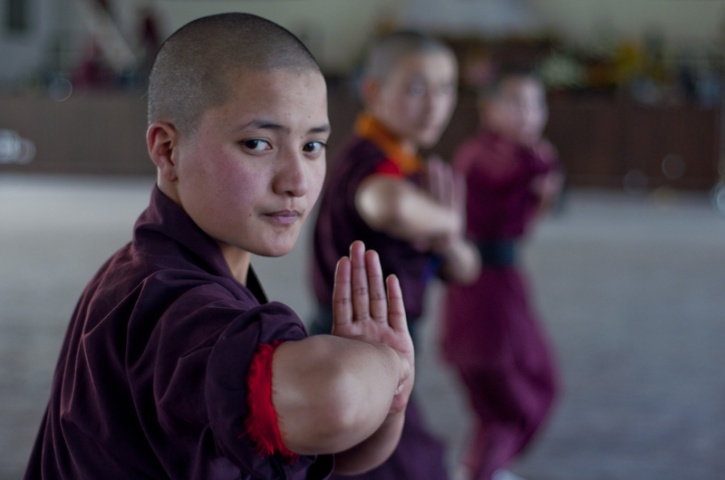
With each position counted out, the nuns move through a series of steps that flow from graceful hand gestures through fierce air punches and swinging chops to soaring kicks and acts of fighting.

Most of the exercises are carried out individually, either with bare hands or the long fighting sticks known as bo staffs. The most startlingly beautiful are performed with blood-red fans swirled above the head and around the waist. At times the fans are spun open, at others flipped closed, the effect more dance than martial art. Other exercises involve two nuns sparring, circling each other with clenched fists, thrusting, shoving, grabbing the other’s neck in the crook of their arms and pushing their opponent to the ground.

What I am witnessing in this striking pre-dawn display is more than 1,000 years of tradition being turned on its head. For more than a millennium this kung fu was reserved only for monks, its roots lying far to the north in the legendary Chinese monastery of Shaolin.

It was there in the fifth century that kung fu was said to have originated, after Bodhidarma, an Indian prince turned Buddhist monk, set out to take the teachings of the Buddha to China. On finding temples there vulnerable to attack by thieves, and many monks struggling with the rigours of monastic life, Bodhidarma devised a system of fitness and defence that drew heavily on the ancient traditions of Indian yoga.

Like yoga, Shaolin kung fu developed from observation of the way animals move. Over the centuries the Shaolin monks incorporated many different animal postures into their practice until eventually the mastery of many styles developed into a form represented by the Chinese dragon, a powerful spiritual creature.

It is telling, then, that the nuns of Gawa Khilwa belong to the Drukpa order of Tibetan Buddhism, druk being the Tibetan word for both “dragon” and “thunder”. Each day that passes, I make a request to meet the head of the Drukpa order, the Gyalwang Drukpa, whose introduction of the nuns to kung fu is only one aspect of a highly unusual degree of support he shows the women in his care. On the morning of my sixth day, I am granted an audience.

The décor inside the room in which he receives me is full of established Buddhist imagery. But as we begin to speak I quickly gain an impression of a man whose robes mask a forward thinker impatient with some of the constraints of tradition. Early on, he shows me a picture of his mother and I come to understand that her absence when he was a boy perhaps provides some key to his unorthodox views. After being recognised as a reincarnation of a previous holder of the title, at the age of four he was taken from the care of his Tibetan parents to a monastery near Darjeeling, in India. He admits openly to the hardship involved.

During his training, the Gyalwang Drukpa rarely saw his parents and enjoyed little female influence. The few nuns he encountered were regarded as inferior to monks and were invariably treated badly.

“By nature women embody the wisdom of the Buddhist teachings. They are more loving and compassionate than men because of their mothering instinct,” he says. It seems quite a leap from this nurturing vision of womanhood to introducing his nuns to kung fu – a move that has been criticised in more conservative Buddhist circles.

The idea came to him, he explains, after seeing nuns in Vietnam being taught the martial art by police officers who had learned combat skills to fight the Vietcong. “Some people say kung fu, knocking somebody down, is the opposite of love. And I too wondered if I was doing the right thing, introducing my nuns to the practice,” he says. "But love comes in many forms. Love is not accepting failure and it is not failing to defend against attack.

“I want the nuns that I teach to be strong and confident. Becoming a monk or a nun is not a comfortable experience, but it is good training for the skills they will need in life.”

The essence of Buddhism, he continues, is a process for improving the quality of one’s own life and that of others.

“Buddhism is not a religion. It is not an ‘ism’ at all,” he says. “You can call it a philosophy of life. But there are many people who misunderstand this term too, thinking of it as something academic. I’m talking about a philosophy of how you stand, sit, drink tea and do everything in life with awareness.”

Far from envisioning his nunneries as sanctuaries from everyday reality, his intention is that they should act as training grounds for spiritual warriors. And there are now more women queuing up for the privilege of this training than any of his nunneries are able to accommodate.

Gawa Khilwa, for instance, at the time of my visit, has a waiting list of between 50 and 60 women. “We need women now more than ever,” says the Gyalwang Drukpa, as our meeting concludes. “The answer to many questions being asked in modern society is that more empowerment of women is needed.”

His intention is that the nuns at Gawa Khilwa, and other nunneries over which he presides in India, will eventually go out into society to carry out practical work. “The nuns must see these nunneries as schools from which they will one day emerge, putting their strong female energy to good use.”

Since Christine visited Nepal, the country was struck by the terrible earthquake of 25 April. The nuns of Gawa Khilwa refused to be airlifted to safety and used the strength derived from kung fu to help their community, administering medical treatment, constructing shelters and carrying more than 100,000 sacks of food to remote villages. This piece was excerpted from The Saffron Road: A Journey with Buddha’s Daughters (€20, Portobello).

Field Guide

How to get there: Gawa Khilwa nunnery is generally open to visitors on Saturday. The nunnery is part of the Druk Amitabha Mountain monastic complex of His Holiness the 12th Gyalwang Drukpa. It is an hour’s taxi ride north-west of the capital. Access is via a narrow mountain road with ever more hairpin bends and increasingly perpendicular inclines. Druk Amitabha has limited guest quarters but overnight stays can be arranged in advance with the nunnery’s office.

What to read: The Gyalwang Drukpa’s most recent publications are Everyday Enlightenment and Happiness Is a State of Mind.

Might have to check out both of these books.

The ‘Kung Fu Nuns’ Of Kathmandu

Luv these ladies. Some day, I hope we can do an in-depth story on them.

The ‘Kung Fu Nuns’ Of Kathmandu Are The Most Badass Women On The Planet
Kung Fu Nuns Of Kathmandu

By Shantanu Prasher, Wednesday, 23 Sep 2015

It’s a widely known fact that Buddhist nuns across the world are considered inferior to the monks. But at the Amitabha Drukpa Nunnery in Kathmandu, Nepal, these nuns do things a little differently. They throw punches and kick just as hard as their monk brothers. Meet the world’s first order of ‘Kung Fu nuns’ of Kathmandu.

Atop the Amitabha Mountain on the outskirts of Kathmandu, sits a silent abode of nuns called the Amitabha Drukpa Nunnery.
Kung Fu Nuns Of Kathmandu

Every day after completing their lessons of religious studies and saying their prayers, these nuns aged between 9-52 undergo a more than an hour-long session of hand chops, punches, shrieks and soaring high kicks. In short, they train in Kung Fu.

Going against the grain, these nuns are the world’s first to ever step into learning Kung-fu. Traditionally, Buddhist nuns in the Himalayas are kept away from physically demanding exercises like martial arts, and their role is limited to doing menial household tasks. Like the scarce facilities provided to monks, Himalayan nuns have been kept away from even basic education for long.


But the leader of the Amitabha Drukpa Nunnery, His Holiness The Gyalwang Drukpa, impressed with the fighting skills of the nuns in Vietnam, dared to go against the tide and invited female Vietnamese fighters to teach them. In addition to this, nuns are also taught to lead prayers and given knowledge of basic business skills. They run and maintain a guest house and coffee shop, and also drive jeeps to Kathmandu to get supplies. All this is forbidden for Himalayan nuns.

Kung Fu was inducted as part of the nuns’ yoga routine in late 2011, and today, they are demonstrating their skills to thousands of pilgrims in Nepal and are actively touring India and Britain.

Widely unknown, these ‘Kung Fu’ nuns refused to evacuate when a devastating earthquake struck Nepal earlier this year. Instead, they used their training to help the affected people, in search and rescue operations, and in food distribution and moving dead bodies. They consider community duty as a spiritual exercise. These nuns defy the rules of the rarefied male-governed world of monastic life, and are only growing better and stronger while they sculpt a better future. Salute!