Our newest exclusive web article
Lara is back! READ TOMB RAIDER: Lara Crofts Globetrotting Treasure Hunt by Gene Ching

Thread: Tomb Raider reboot
Thread: Into The Badlands
Our newest exclusive web article
Lara is back! READ TOMB RAIDER: Lara Crofts Globetrotting Treasure Hunt by Gene Ching
Thread: Tomb Raider reboot
Thread: Into The Badlands
Al Gough on S3
There’s a dozen pix in the gallery but I’m only posting the lead one.
MARCH 20, 2018 10:00AM PT
‘Into the Badlands’ Showrunner Previews Season 3
By Maureen Ryan @moryan
Chief TV Critic

The very enjoyable second season of “Into the Badlands” hits Netflix on March 21, where that wonderful concoction joins the show’s frisky six-episode first season.
As I’ve said a few times, you should seek out this post-apocalyptic adventure drama out if you’re a fan of gorgeous visuals, memorable action and ferocious characters engaged in a hard-fought battle to survive in a semi-feudal society where resources are scarce, but friendship, hope and love are always possible. (If you’re intrigued, check out this primer on the show.)
Newcomers to the series have a month, then, to get caught up before Season Three of “Into the Badlands” arrives on AMC April 22. To whet the appetites of fans who’ve already been won over, Variety has a preview of the new season from executive producer/co-showrunner Alfred Gough, as well as a number of exclusive pictures of key returning and new characters (see slide show).
This season, Lorraine Toussaint (“Orange Is the New Black”) plays Cressida, a canny prophet who is a skilled player in both spiritual and political realms. Cressida is a key adviser to Pilgrim, a religious zealot who is on a quest to find an artifact from Azra, a legendary place in the show’s mythology.
Ella-Rae Smith is Nix, a teenager who possesses special powers that Pilgrim uses to his advantage, and Sherman Augustus returns as Nathaniel Moon, a former regent who lost his hand to Sunny in the second season. Moon ends up taking sides in the war between the Widow and Baron Chau, which is one of the core conflicts in the new season.
“The most exciting thing about this season is that everything in the Badlands is bigger,” Gough tells Variety. “The world gets more expansive, the stakes for all of our characters are higher and the martial arts fights are bloodier and more bat**** crazy than ever. We also introduce some amazing new characters, most notably Pilgrim, a cult-like religious leader, and his priestess, Cressida. They are the wild cards who come into the war-torn badlands and cross paths and swords with both the Widow and Baron Chau.”
As fans of the show recall, at the end of the second season, Sunny (Daniel Wu) is off the grid, protecting his baby son, Henry. But soon enough he needs to reunite with Bajie (Nick Frost), where the Widow (Emily Beecham) and Baron Chau (Eleanor Matsuura) are locked in a battle for control of the Badlands.
The the fact that the Widow and Baron Chau at still at loggerheads is great news, given that their physical conflicts in Season Two — expertly attempting to kill one another while clad in to-die-for clothes — were incredibly fun to watch.

Emily Beecham as The Widow - Into the Badlands _ Season 3, Episode 4 - Photo Credit: Aidan Monaghan/AMC
“Have you ever seen a badass redhead have a martial arts sword fight with a one handed former regent on the top of a stone tower overlooking the ocean? And that’s only the first fight of the season,” Gough says. “You’re welcome, America!”
“Into the Badlands” returns April 22 on AMC.
 WOW ! I was only able to see the first season one of the series a month ago on Netflix, I wasn’t aware that season two is now just released on Netflix. BINGE !
More on Daniel Wu
Asia megastar Daniel Wu on his supporting turn in ‘Tomb Raider’ and his journey back home — to Hollywood
By JEN YAMATO
MAR 17, 2018 | 3:00 AM

California-born Daniel Wu became a megastar in Asia and only now is getting traction in Hollywood, appearing in the “Tomb Raider” reboot and starring on AMC’s “Into the Badlands.” (Genaro Molina / Los Angeles Times)
Twenty years ago, with a University of Oregon architecture degree under his belt, Bay Area kid Daniel Wu took a serendipitous trip to Hong Kong as his graduation present. He wanted to witness the handover, stay a few months, then go home and figure out what to do with his life.
But a chance scouting in a bar led to a commercial gig, then some modeling. Chinese director Yonfan saw the commercial and approached Wu with an offer he couldn’t refuse — although he tried.
“He asked me to play the lead in his movie,” said Wu, revisiting the moment his accidental career as one of China’s biggest movie stars began. “I was like, ‘What are you talking about? I’ve never acted before and you want me to be the lead in your movie? That’s crazy!’”
Born and raised in Northern California to Shanghainese parents, and discovered in Asia, the details of Wu’s unlikely origin story are well known to his massive Chinese fan base overseas, where the 43-year-old actor and producer is now a superfamous A-lister who gets swarmed by paparazzi whenever he leaves the house.
The all-new Yamaha Wolverine X4 offers four times the proven off-road capability, comfort & confidence… to deliver four times the fun & excitement on your next…
Despite having never acted before, not to mention the fact that his Cantonese wasn’t great, Wu took the role in that first film, “Bishonen,” playing a closeted gay cop opposite fellow future star Stephen Fung. A few weeks after finishing that film, he landed his second role. By his first year in Hong Kong, he’d made three films. In his second year, he made six.
He’s now acted in 60 feature films in Hong Kong and China — including crime thrillers, action comedies and historical epics, movies like “New Police Story,” “The Banquet,” and “Shinjuku Incident,” and roles opposite Chinese superstars Jackie Chan, Donnie Yen, and Zhang Ziyi.
Yet in his native America, where Wu appears this weekend opposite Alicia Vikander in video game adaptation “Tomb Raider,” audiences are still learning his name, in spite of the fact that he’s four times as Google-searched as his Swedish Oscar-winning costar.
“Not a lot of people know about the 20 years I spent in Hong Kong. To a lot of people I’m just this new actor, but I’ve been around for a long time,” he said with a chuckle on a brief press stop in Los Angeles.

Daniel Wu as Lu Ren, a newly created character for the “Tomb Raider” reboot. (Warner Bros.)
He’d had roles in the recent disaster pic “Geostorm,” “Warcraft” (a motion-capture turn as a CG orc), and the little-seen sci-fi “Europa Report.” But here, Wu is still best known for starring as the fierce warrior Sunny on the popular AMC series “Into the Badlands,” the martial arts-steampunk hybrid now entering its third season, which he also produces.
Wu was already a huge star overseas when he and Fung linked up with show runners Alfred Gough and Miles Millar and fellow executive producers Stacey Sher and Michael Shamberg on “Badlands,” which he was initially only going to produce. Well into their search for an Asian lead who could speak fluent English and perform martial arts action, producers turned to the perfect candidate already in their ranks: Wu.
“He took some convincing!” said Gough. “What I love about the show is people watch it, even executives watching dailies, and they’re like, ‘He’s amazing!’ And I say, ‘Guys — he’s the Brad Pitt of China.’ He’s a movie star. He’s been doing this for years. Of course he’s amazing!”
The movie star charisma honed over two decades as a leading man can’t help but seep out in “Tomb Raider,” in which he plays Lu Ren, a Hong Kong boat captain whose habit of drinking away his sorrows is interrupted when Vikander’s scrappy Lara Croft arrives on his ship in search of her missing father.
“Lu Ren is a character that we created for this film — he is someone who has gone through similar experiences to Lara and goes on the journey with her because he too has questions that need to be answered,” said director Roar Uthaug via email. "I wanted to find an actor who could stand up to the punishing physical stuff but also could warm audiences. Daniel is just so **** charismatic.
“Directors want to find actors that audiences can connect with and I believe this is just as important in an action movie,” added Uthaug, whose previous film “The Wave” combined large scale action with human stakes. “I put the characters through all this stuff, and none of it really matters unless we care about them. And I think the audience will really care about Daniel.”
“It was this very intimate story packaged as a big action movie,” said Wu of the “Tomb Raider” script by Geneva Robertson-Dworet and Alastair Siddons. “Honestly speaking, I was thinking [my character] was going to be a flat, stereotypical, 2D character who just kind of helps [Croft] along the way, but he ended up being a really three-dimensional character.”
Embarking on a dangerous mission together in search of their missing fathers, Lara and Lu Ren forge a bond while surviving treacherous seas and sinister villains. “I think his father was always in and out of his life, so when he walked out he just thought he disappeared, had finally walked out… and good riddance. But people in denial really want to know the truth, and eventually that’s what motivates him to go on this dangerous journey with Lara.”
As a bonus “Tomb Raider” was partly shot in South Africa, where Wu and his wife, actress and model Lisa S., own a home. Stepping onto a realistic boating village set recreating the Hong Kong he knew with startling accuracy added something unexpectedly personal to the experience.
“It made me miss Hong Kong,” he smiled. “It made me want to go back and get something to eat!”
continued next post
Continued from previous post
[B]
I didn’t see people like me on American screens, or if I did they were bad representations …
DANIEL WU[/B]

Daniel Wu grew up in California before becoming a major movie star in Hong Kong and China. (Genaro Molina / Los Angeles Times)
It was devouring the films of Bruce Lee, Jet Li and Jackie Chan as a child in the San Francisco East Bay, where he watched Grandmaster Tat Mau Wong host “Kung Fu Theater” on local TV every weekend, that first sparked his lifelong interest in martial arts.
“I distinctly remember when I was 7, my grandfather took me to the Great Star Theater in Chinatown. He said, ‘You want to see real wushu, real kung fu?’ We went to see ‘Shaolin Temple’ together, which was Jet Li’s first movie.”
Wu, like many Asian Americans and youth from communities underrepresented in Hollywood, found inspiration and cultural connection in the movies. A few years later, he began training in earnest, developing the skills and adopting the discipline that would later come to be valuable assets in his own career.
“I didn’t see people like me on American screens, or if I did they were bad representations of Asians like Long Duk Dong in ‘Sixteen Candles’ or David Carradine in yellowface on ‘Kung Fu.’ When I saw Jet Li and Jackie and all these cool guys doing cool stuff onscreen, I actively searched it out.”
Wu first arrived in Hong Kong an outsider who spoke Shanghai dialect Chinese at home but only rusty American-accented Cantonese. But he knew the city from the movies. He describes his first “Wong Kar-Wai moment” when, late one night, he found himself caught in a rainstorm eating dumplings inside a 7-11.
“I was eating microwaved xiaolongbao waiting for the rain to stop, and I thought, ‘This is a real Hong Kong experience.’ It reminded me of ‘Chungking Express,’ and I was like, ‘I’m here now, in Hong Kong,’” he said.
Wu, who now splits his time living in Oakland with his family, expresses a firm belief that fate lead him to this point in his life and career — or, at least, a belief in the opportunities that fate presents, at which point one must make their own luck.
How else could one explain how at a chance meeting, only a few weeks after filming that first movie role, Wu was introduced by a friend to his longtime idol Jackie Chan and within days was signed to a management deal with Chan’s company?
“The biggest dream I ever had as a martial artist in the Bay Area was, ‘I hope one day I can be a stunt guy in a Jackie Chan movie and have him kick me down a flight of stairs,’” said Wu, grinning. “That’s all I ever wanted.”
Perhaps it all had to happen exactly that way, anyway. Stardom in Hollywood hardly seemed an option for any Asian American actors when he first started out.
Years ago, as his career took off in Hong Kong and then China, shifting to the mainland as the film industry there exploded, Wu returned home to take meetings, hoping to land acting roles stateside. But the doors remained closed, even to a homegrown Asian star with dramatic acting chops and a sizable international following.
“I came out to Hollywood to see if there was any interest — and there wasn’t, so I just gave up,” Wu said. “I went back. I would take meetings and nothing would come of it. Quite frankly speaking, nothing came of it until recently, in the last few years, when there’s been such a focus on the Chinese box office.”
He continued, finding the balance in that hard lesson. “It sucks that it was money that motivated that move, but at the same time it’s a good opportunity for everybody. You started to see more Chinese actors appear in Hollywood movies. I could see that that was about to happen, and then it happened.”
He did bigger roles in small films such as “Europa Report” and small roles in bigger films such as RZA’s “Man with the Iron Fist” (“I did it just because of RZA — I was a huge fan of Wu Tang Clan.”) then landed a succession of higher profile gigs including “Badlands.” “It was this slow progression of people starting to know who I was and then being educated on my influence back in Asia, and realizing, ‘Oh, he speaks perfect English — that’s a major plus.’”
[B]
In a world where we’re trying to expand what a leading man looks like … I keep telling people, ‘He’s done it in Asia. You guys are late to the party.’
“INTO THE BADLANDS” SHOWRUNNER ALFRED GOUGH[/B]
 Daniel Wu in season three of AMC’s “Into the Badlands” (Aidan Monaghan/AMC)
He directed a film once, 2006’s “The Heavenly Kings,” which caused a stir when it was revealed to be a mockumentary satire of the Hong Kong pop music industry, for which he formed a fake boy band with fellow actors. But directing requires too much dedicated time for Wu right now, at a busy new juncture in his career.
Preparing to head back to Ireland to finish filming and producing an even more ambitious season of “Into the Badlands” — and set to do a second season of Chinese reality show “Dream House,” in which he brings modern architecture to rural villages across China — he pondered his future in Hollywood.
“My favorite genre of filmmaking is crime drama, which I did a lot of in Hong Kong,” he said. “One thing we can’t do in China is heist movies because people doing bad things can’t get away with them; the censorship you have to deal with is the challenge of working in Asia. But I would love to do an ‘Italian Job’ type heist film… or a comedy.”
“He’s got the charisma, he’s got the chops, and he just really is the full package,” said Gough. “And in a world where we’re trying to expand what a leading man looks like in movies — you look at ‘Black Panther’ and movies like that — I keep telling people, ‘You don’t understand. He’s done it in Asia. You guys are late to the party.’”
Wu laughs at the irony of having had to travel all the way across the world just to have a career at home. But San Francisco-born Bruce Lee did it too, so he’s in good company.
“I think the difference now is the audience is different,” he mused. “The audience is more diverse now not just culturally, but the white kids growing up today are eating Asian food. When I was growing up white kids were like, ‘Hey, what are you eating?’ And that was only 20 years ago.”
Studio executives just have to take cues from today’s culture-crossing youth and start thinking that way. “Once an opportunity is presented, we run with it — but at the same time it’s [the people in charge] that have to give us those opportunities.”
@jenyamato
THREADS:
Tomb Raider 2018
Into The Badlands
S3 promos are coming
Indiewire released a ‘first look’ gallery of 14 pix. I’m only c&ping the two new martial artists* on the cast, the ones to watch. Follow the link for the rest.
03.20.18 | 01:00PM PT[URL=“http://www.indiewire.com/gallery/into-the-badlands-season-3-photos/#!1/itb_303_am_0927_0013-rt/”]
‘Into the Badlands’ Season 3 Photos: TV’s Best Martial Arts Drama Leaps Back Into Action — Exclusive
BY LIZ SHANNON MILLER


A FIRST LOOK AT THE RETURN OF THE AMC MARTIAL ARTS DRAMA
“Into the Badlands” has always stood out in the television landscape for many reasons. For one thing, the cast is a truly inclusive ensemble, featuring Daniel Wu, Nick Frost, Orla Brady, Emily Beecham, and new cast members Babou Ceesay, Ella-Rae Smith, and Lorraine Toussaint.
Then there’s the way its premise — about a post-apocalyptic world centuries after the fall of our civilization, where superpowers and sword-fights are commonplace — blends a number of genres for a truly unique experience. Plus, there’s its epic production design, which rejects typical post-apocalyptic visuals by emphasizing vivid colors and beautiful landscapes.
And most notably, there are the incredible wuxia-inspired martial arts scenes, which use wires and the genius of martial arts coordinator Huan-Chiu Ku (who trained with the legendary Yuen Woo-ping and whose credits include the “Kill Bill” films, “Once Upon a Time in China II” and “Crouching Tiger, Hidden Dragon”) to elevate the battles for power in the Badlands to truly epic heights.
All of these factors are showcased in the following photos from Season 3. The official description of what’s to come, as described by AMC:
Season 3 of “Into the Badlands” finds Sunny (Daniel Wu of “Tomb Raider”) living off the grid, doing his best to provide for his infant son, Henry, in the wake of Veil’s death. It is only when Henry contracts a mysterious illness that Sunny must join forces with Bajie (Nick Frost of “Shaun of the Dead”) and journey back into the Badlands, where The Widow (Emily Beecham of “Daphne”) and Baron Chau (Eleanor Matsuura of “Wonder Woman”) are entrenched in a drawn-out war that has destabilized the entire region.
Check out IndieWire’s previous coverage of the series here. “Into the Badlands” Season 3 premieres Sunday, April 22 on AMC.
[QUOTE=PalmStriker;1308023] WOW ! I was only able to see the first season one of the series a month ago on Netflix, I wasn’t aware that season two is now just released on Netflix. BINGE ![/QUOTE]
I started my binge too, PalmStriker. I forgot how colorful this show is - the lushness of Ireland, the gorgeous costumes, and the continues splashes of brilliant sanguineous red. AMC has sent me a screener for S3E1 but of course, I’m under NDA for it. I was hoping to binge the whole of S2 before tapping into S3 but I might not make it. I might just watch it as soon as I get a free hour…
*actually Sherman Augustus isn’t completely new to the show, as you’ll see in S2E3 PalmStriker. 
Into the Badlands Season 3: ‘Join Us or Die’ Official Trailer
In the wake of Wondercon
[#WonderCon] What We Learned About ‘Into the Badlands’ Season 3
Posted by Mary Anne Butler March 27, 2018
[Editor’s Note: This Into the Badlands piece from WonderCon comes to us from Bleeding Cool contributor Dana Han-Klein.]
Based on the trailer for the third season of AMC’s Into the Badlands, it looks like we’re going to get some Game of Thrones-esque politicking. Though unlike Westeros, the world of Badlands is populated by a cast (and extras) who are more diversely reflective of the world we actually live in.

Into the Badlands season 3 cast at WonderCon. Nick Frost, Lorraine Toussaint, Daniel Wu, and series co-creator Alfred Gough.
During their WonderCon panel, we found out that this season’s big bad is revealed to be a warlord named Pilgrim (Babou Ceesay), and his hand of the king — I mean… powerful right hand — is Cressida (Lorraine Toussaint). Toussaint described their relationship as complicated and “quite Greek” — which leads me to believe we’re going to get some Lannister-level parallels between Pilgrim and Cressida.
We find Sunny (Daniel Wu) on his own as a “samurai single father.” Having a baby as a device for constant peril can go over well, or it can become rather annoying (I’m looking at you, Judith from The Walking Dead), but given how many storylines are actually being woven together on the show, it’s possible we’ll only have palatable doses of infant screen time.
Show co-creator Alfred Gough also addressed the lack of guns on the show (particularly in light of the current conversation about gun control):
[QUOTE]
“It’s a martial arts drama, and sort of when we were conceiving it we knew we didn’t want to do something historical. Guns were always going to be an issue in that.
Look, I’ve done these things as well with Shanghai Noon and whatnot. Somebody has a gun, the guns get kicked out of their hands, and then they fight. And that’s not what we wanted to do, we wanted something where the martial arts was integral to the storytelling.
Given the introduction of Pilgrim and Cressida, and their Azra roots (Azran?) it sounds like we’re going to see a shift from fighting warlords, to fighting gods. Now that we’ve got people with powers we can expect more comedic fights… more brutal hand on hand close action fights… Because of the dark energy type thing — that opens up the Super Saiyan type stuff.”
Gough pointed out the extra care they enjoy taking with representing diversity on the show — how the women (in this season in particular) will be the power players to look out for. He talked about how they’ve had strong characters of many races as well as those with disabilities, and how martial arts is a great equalizer when it comes to fighting.
On other shows, according to Gough, every vision of the future you see looks like 18th Century England, whereas Into the Badlands understands that “the future isn’t going to be a bunch of white people.”
Gough said, “You can walk into any movie studio in town and say, ‘I want to have a diverse cast and I want to be inclusive.’ And they will absolutely go ‘Yes, nobody’s standing in your way.’” Toussaint chimed in with, “That is bull****.” Gough continued, “Because then you actually have to do it from the ground up. You have to say, ‘I’m casting these roles a certain way.’”
If Cressida is half as charming (and imposing) as Toussaint is in person, we’re in for quite the clash between her and The Widow. She expressed how excited she was to “play dress up and wield swords.” We found out we can look forward to dead octopi nunchucks, Bajie (Nick Frost) to have to face his Azra associations, the return of Nathaniel Moon (who’s back with an upgraded Steampunk meets Klaw of Black Panther style hand), and M.K. to face questions of loyalty. Characters who’ve not interacted to this point will suddenly come face to face as the past two seasons converge.
And of course, we’ll some see some badass fights.
Into the Badlands returns to AMC on April 22nd.
(Last Updated March 27, 2018 4:42 pm )[/QUOTE]
I remember talking to Alfred Gough in 2016 about the possibility of guns coming into the show, and he said flat out that it would ‘kill it’ or something to that effect.
Into the Badlands Season 3: ‘New Characters: Pilgrim & Cressida’ Behind the Scenes
Into the Badlands: ‘The World of Season 3’ Official Teaser
Into the Badlands: ‘A Look at the Season 3’ Behind the Scenes
Into the Badlands Season 3: ‘Sunny’ Official Teaser
Into the Badlands Season 3: ‘Pilgrim’ Official Teaser
‘Iron Rabbit’ Season 3 Premiere Sneak Peek | Into the Badlands
Into the Badlands Season 3: ‘A Bigger World: New Locations’ Behind the Scenes
Guest Blog from Daniel
Season 3 premieres this Sunday!
I’ll have the first of my exclusive BTS coverage up this Friday. Stay tuned.
I’m an Asian American Actor Who Went to China Before Hollywood Would Cast Me as a Lead (Guest Blog)
“Growing up a Chinese-American kid in 1970s and 1980s California, I saw no possibility for me to become an actor,” “Into the Badlands” star Daniel Wu writes
Daniel Wu | April 17, 2018 @ 1:09 PM

AMC
Producing and starring in AMC’s “Into the Badlands” is a professional experience that I never thought I would see. It’s not just because drama and martial arts done together with a diverse cast is an American television first. Or because joining its cast was an unexpected homecoming for me.
For the 20 years before “Into the Badlands,” I spent my career working largely in Hong Kong and China. In 1997, while traveling in Hong Kong just after graduating from the University of Oregon with a degree in architecture, I was spotted by director Yonfan. He asked me to take the lead role in his film “Bishonen.” Without either acting experience or a full grasp of the Cantonese language (Shanghai dialect was spoken at home), I turned down the role at first. He relentlessly pressed me to change my mind, and after a month I gave in.
It was a decision that changed my life and put me on a path that I never dared dream for myself. Two weeks after the film wrapped, I was on the set of my second film. Within two years I had done six films. By 2000, I was playing lead roles in everything from romantic comedies to big-budget action films. Now, 70 films later, my work has been embraced all over Chinese-speaking Asia.
Would any of this happened to me if I’d decided to start a career in acting at home? I really don’t think so.
Growing up a Chinese-American kid in 1970s and 1980s California, I saw no possibility for me to become an actor, especially one playing lead roles. There were many characters I loved on television — white, black and Latino — but I rarely saw people like myself represented. When I did see an Asian man appear on the screen, he was either a gross stereotype or something even worse.
I grew up watching “Kung Fu,” a TV series starring a white man (David Carradine) in yellow face playing a Chinese man. Legend has it that Bruce Lee had developed the concept for the show, hoping to creating an opportunity for himself. The studio loved the idea but cast a white man. While Bruce Lee eventually became a global icon, it was only after his untimely death — and after he first found opportunity in Hong Kong.
Almost two decades before “Kung Fu” aired, my parents immigrated to the U.S. Escaping war and political unrest, they came in pursuit of their idea of the American Dream. Both earned advanced degrees in the U.S. and worked to establish themselves professionally.
Arriving in Berkeley, Calif., as newlyweds in 1961, my parents were barred from purchasing the house they wanted when the realtor told them it was in a “Whites Only” neighborhood. Undeterred, they went on to buy a house in a neighborhood nearby. From that house they could see up into the Berkeley Hills where the most beautiful and coveted homes in town were.
My mom would often tell my dad, “One day we will have a house there. ” And less than 10 years later they did it. And from that point on, they set their sights on making sure that their three kids received every opportunity to achieve their own dreams.
My mother had lofty goals for us. I remember a period when my mother kept planting a seed in my head, telling me that I could be the first Chinese-American president of the United States.
So it is kind of ironic that I had to leave the country for 20 years and become known to an audience of 1 billion Chinese before I would have the opportunity to come back to the U.S. and live my American Dream. And it’s also ironic that my Shanghai-born parents were immigrants to the U.S. and that I went the opposite way, to Hong Kong. But the root of my parents’ journeys and my own was the same — the pursuit of opportunity.
In retrospect, I feel very fortunate to have begun my career the way I did. Living and working in Asia insulated me from the race issue that is all-pervasive in entertainment in the U.S., especially now. When I won a part in Hong Kong, it was because I was right for it and not just because I fit the bill racially. Conversely, if I was rejected, it was because of my ability, which was something I could work on and not because of my race, which I couldn’t. So instead of being an angry Asian American actor lamenting about limited roles, being in Asia allowed me to focus on the craft of acting and to choose roles that helped broaden me as an actor.
My time in Asia not only insulated me from spirit-breaking casting situations that my fellow Asian American actor friends endured, but it allowed me to become a better actor. It also brought me closer to my culture, and made me who I am today. When I did enter Hollywood, knowing that my peeps had my back gave me a lot of confidence. If I had spent years in U.S. casting rooms getting rejected because I wasn’t the right skin color, or turning down one stereotypical role after another, or taking said roles because I needed to pay rent, I would have quit a long time ago.
After the first season of “Into the Badlands” debuted, I was reluctant to be a racial role model. I just wanted to focus on the work and make great television. During my 20 years in Asia I never needed to talk about these topics, let alone be the center of attention about them.
But after the second season premiered, and we learned about the impact the show was having, I started to understand the importance of stepping up. I’ve accepted the fact that I am one of the very few Asian men in the American entertainment and that by default people were going to look to me symbol of change. So as people have embraced me I have learned to embrace that new role.
Am I going to run for president? Hell no. But I think my parents’ dream for me was to find my place in this country, to be successful at what I do and most importantly, to be happy. I am proud to know that I might have some part in righting what happened to Bruce Lee over 40 years ago. And I am proud that some kid might watch “Into the Badlands” and think, “I want to be like him!”
HOLLYBLOGS

Daniel Wu is an actor, director and producer who has been featured in over 60 films, with his breakout role in Benny Chan’s “Gen-X Cops.” He received two more Hong Kong Film Award nominations in 2005: for Best Actor in “One Night in Mongkok” and Best Supporting Actor (alongside boyhood idol Jackie Chan) in “New Police Story,” a role that also brought him Taiwan’s Golden Horse Award as Best Supporting Actor. He also won the prestigious Hong Kong Film Award for Best Director for his 2006 feature, “The Heavenly Kings.” His string of international film hits includes “Night Corridor” (2003, Best Actor nomination at Taiwan’s 40th Golden Horse Awards), Frank Coraci’s 2004 remake of “Around the World in 80 Days,” Quentin Tarantino’s presentation of “The Man With the Iron Fists” (2012), “Europa Report” (2013), Jackie Chan’s “Chinese Zodiac” (2012) and Dean Devlin’s “Geostorm” (2017). Wu also starred in Duncan Jones’ epic sci-fi adventure “Warcraft” (2016) and opposite Alicia Vikander in “Tomb Raider” (2018). In April 2018, he returns for his third season as Sunny in AMC’s “Into the Badlands.”
Season 3 premieres this Sunday!
READ INTO THE BADLANDS Season 3: Journey to the West – Sunny, M.K. and Bajie by Gene Ching

‘Man-Cub’ Season 3 Premiere Sneak Peek | Into the Badlands
Check out Part 2 of Gene’s coverage.
[URL=“http://www.kungfumagazine.com/ezine/article.php?article=1417”]INTO THE BADLANDS Season 3: Everybody Was Kung Fu Fighting
by Gene Ching
Our newest exclusive web article
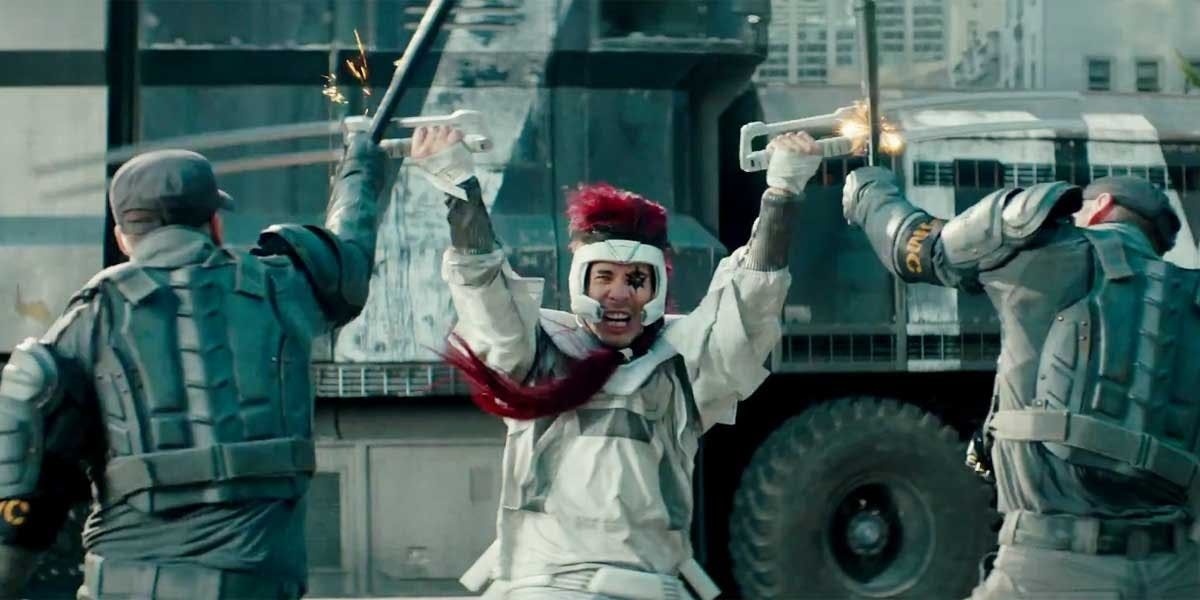
Lewis Tan is on FIRE! READ Lewis Tan on DEADPOOL 2’s Shatterstar and INTO THE BADLANDS by Gene Ching and Patrick Lugo
THREADS
Deadpool 2
Into the Badlands
