Screen Anarchy interview
Friday, 3:00 pm
Daniel Wu Talks INTO THE BADLANDS Season Two
Timothy Tau
CONTRIBUTOR

Season 2 of AMC’s “Into The Badlands” premiered on March 19th, and if the first three episodes are any indication, viewers are in store for the same stellar martial arts action, mythical characters (with the addition of Nick Frost’s “Bajie”) and dramatic, near Shakespearean-like storylines of the first season, but taken to an unprecedented new level of badassery. I got the chance to sit down and chat with the show’s star and Executive Producer, Daniel Wu, about a number of different topics, including the direction Season 2 is headed in, his contributions to the writer’s room, Iron Fist, how the fact that the cast is now well-trained in martial arts leads to a greater variety of fight scenes (e.g. Krav Maga, Jiu-Jitsu, Jackie-Chan-esque fights), how an abandoned spa resort in Dublin, Ireland served as the perfect, anachronistic sound stage for multiple interior sets, the Ghost in the Shell casting controversy, Sunny’s seven different wardrobe changes this season, Mr. Wu’s upcoming roles in the new Tomb Raider and Geostorm films, and much more.
Tau: First of all, congrats on Season 2! I saw the first three episodes, and to me, the series is probably the best show on AMC. The most action-packed and thrilling one at least.
Wu: Cool, thanks man. I’m proud of this season because I feel we’ve stepped it up from last season.
Tau: Definitely, I really got that sense too. As far as the genre of martial arts shows, or shows involving fighting, you’re show is probably the only one out there right now: there is Iron Fist, however, but I saw that several critics were saying that Into The Badlands is a cure for how bad Iron Fist is.
Wu: (laughing) yeah, at first I was nervous about the competition. But now I kind of feel bad for them, because they are getting slammed so hard. It’s one thing to be bad or whatever about the martial arts, it is still something that a lot of people put a lot of effort into, so to get slammed like that – I’ve definitely worked on projects where I’ve been on that end of the stick before and so it kind of sucks. I’m happy for us but at the same time kind of feel bad for them, but [simultaneously] it’s like if you’re going to do a martial arts show, then you’ve got to step the **** up.
Tau: And also the controversy or cultural appropriation issue of how they could have went with an Asian American lead –
Wu: Yeah but you know what, I think that’s people going a little too precocious on that because originally the character was written white – it wasn’t like it was a whitewashing thing. It’s not like you are talking about a “Ghost in the Shell issue,” right? And I still don’t actually buy the Ghost in the Shell whitewashing issue either, and I certainly don’t buy into the cultural appropriation bull**** because that’s saying [for Iron Fist] that “only Asians are allowed to do martial arts” then that means only black people can play basketball and rap? That means Jeremy Lin shouldn’t be playing basketball? And Eminem shouldn’t be rapping? That’s bull****, you know. So I know Asian Americans are angry, but they should calm down and choose the correct fight in that case – I agree that Marvel missed the chance of doing something interesting and casting against the race – they could have done that – and that would have given them some credit, but they didn’t, so what are you going to do about it? I think the important thing is that everyone learned a lesson from that – including people that weren’t involved, so I think we just need to move forward, that’s all.
Tau: That’s one great aspect about your show – that its centered by an Asian American lead and just historically, there probably hasn’t been too many action/drama shows like that – I’m just thinking of Russell Wong in Vanishing Son and that’s the only example I can think of off the top of my head. So I think that’s really exciting I’m sure to many Asian American viewers.
Wu: What I’m most proud about is that we’re not waving the Asian American flag around – we’re not going “this is an Asian American show” – it’s just a cool show, that just so happens to have an Asian American lead, you know? And I think that is kind of more interesting to me than [saying] “we’re going to make a show that puts Asian Americans out there.” I’m not sure if I really want to be involved in [something like] that. Going back to when I was in college, I was part of the Asian American Student Union, I remember that there was a lecture one day about Asian American art, there were a couple of artists and a couple of gallery people and they were talking about how they needed to create an Asian American community for Asian American artists and blah, blah, blah and I actually raised my hand and I go – I was studying architecture at the time – “look, I’m studying architecture, I want to be known as a good architect, not just a good Chinese American architect,” you know what I mean? So that puts us in a corner. To be able to be truly successful Asian American [artists] I feel that you have to be successful to the mainstream audience and not just a niche. Of course we want the Asian American audience to back us up on this, but we also want a larger audience, we want Black America, we want Latin America, we want White America, we want everybody to like this show.
Tau: It’s clear that it’s a high-quality show first and foremost, that doesn’t necessarily have a cultural or political agenda – and that’s part of its success.
Wu: Yeah, there’s no agenda. Our agenda is just to create a show that kicks a lot of ass on TV and I think we’re doing that.
Tau: I think the same goes for a lot of shows like Fresh Off the Boat, Dr. Ken, etc. – they are funny and well-written and it just so happens that they portray this aspect of America, from the different perspectives of these characters.
Wu: It’s interesting to see on ABC that they have Blackish (about an African American family), The Goldbergs (a Jewish American family) and Fresh Off The Boat (about a Taiwanese American family) because all three are pretty similar shows, the premises are similar, just about different types of families in the white suburbs. I think all three are successful because whatever race you are, you’ve felt that experience before, being a fish out of water.
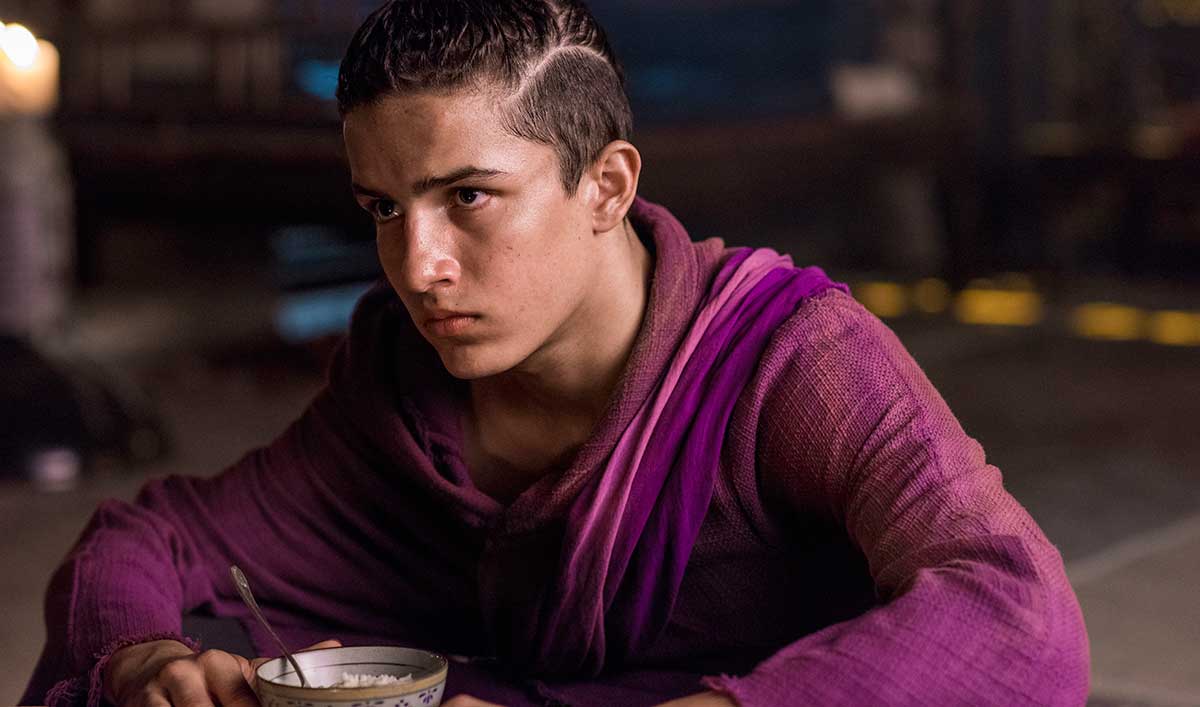
Tau: I feel one of the reasons why your show is so successful is the quality of the writing – there are so many things going on with Season 2, and reviewing Season 1 – I thought that there was a lot of overarching, almost Shakespearean themes with the family of Quinn [Martin Csokas] and Lydia [Orla Brady] and Ryder [Oliver Stark] as well as Jade [Sarah Bolger] and how Lydia went back to her father – and an interesting arc with MK [Aramis Knight] where he is confronting his dark side which reminded me of an arc in the Naruto manga/anime, a similar trope.
Wu: Actually that idea came from somewhere else, these books I read when I was learning martial arts – written by Carlos Castaneda, called The Teachings of Don Juan: A Yaqui Way of Knowledge and its actually about (laughing) hallucinogenic drugs and spiritual awakening, using mescaline and peyote and all those things – so the character was led by a Shaman and he would take these drugs and go into a trance and he would meet his darker side. And peyote and all these drugs were meant for the warrior class of Native Americans, and what they would do is at 13 or 14 they would make [boys] take this stuff and they would get high, and they would go into this other trance state and they would fight their darker selves, and when they won that self, they became a man. And once you were able to battle [and beat] that demon, you finally were a real man, and a true warrior. So I gave that idea to the writer’s room in the beginning.
Tau: That’s actually my question – to the extent that you are an EP, the writing is really strong, what can we look forward to Season 2 for the writing and how much are you involved in that?
Wu: This season we are going to get back to what we really wanted to write the story about – that it’s a spiritual journey for all the characters, especially Sunny, especially MK, it’s all about a spiritual transformation – so everyone is going through something different in their lives but they are all going through a change. And so Sunny’s transformation is that in Season 1, his backstory is that he’s only killed his whole life, he’s killed all these people, 444 people, and suddenly, with the realization that he’s created a life, everything changed for him at that point – and it almost threw him into a whirlwind where he couldn’t function, saying he really did not want to kill anymore, I don’t understand that this is the right thing, etc., and he is realizing that he has been brainwashed. So suddenly, he’s trying to get out of that situation. Now, he’s focused on how his girl (Veil [Madeleine Mantock]) is pregnant, she probably had the baby, and he’s dead-set on trying to find her, so he’s on a quest to reunite with his family and get revenge on Quinn. Whereas last season he wasn’t sure if he was going to take out Quinn or not because he owed him loyalty, I mean this guy raised him, provided his life and gave him everything that he has – so it wasn’t easy for Sunny to stab him, so a lot of people are saying with that stab (at Season 1’s end) why didn’t Sunny really kill Quinn and it is like Sunny just couldn’t do it. Now, Sunny wishes he ****ing did it. This whole season he is in a regret not doing it, so he’s on a rampage to get his girl and the baby back.
continued next post




 Nevertheless, both shows were clearly built on the same framework, the same formula. Again, point taken.