Some people do their horse stance with their feet pointing the same direction as their knees. They do so because it reduces torque and lateral stress placed on the knees.

And you are told to always have your feet pointing the same direction as your knees
Other people however choose the horse stance as an exception to that rule, pointing their feet forward. I cannot figure out why they do this.
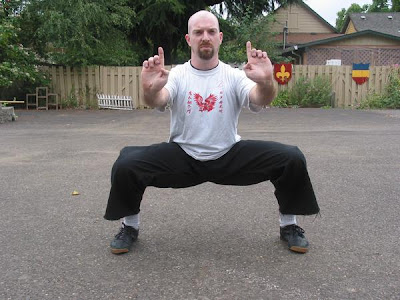
I searched the back log of threads and this was the only clear answer I could find.
From 2001 :eek:
[QUOTE=Wongsifu;11630]okay technically the reason your toes point forwards is to lock the tendons of the legs, the horse stance is not supposed to be a muscular exercise, thus if you have your toes pointing outwards you use your thigh muscles not your tendons, pan qin fu calls this the toilet stance, because when you take a nice long dump in the toilet your legs are outwards not straight at 90 degrees. [/QUOTE]
Can anyone tell me why you should point your toes forward?
many of these so-called “rules,” are to correct poor training. The problem is that the student takes this to an extreme..then of course he becomes a “Sifu,” and passes it on.
Ever see some people do a horse with their butt tucked so much that they look like a dog with his tail between his legs? Ridiculous. Tuck yuor sacrum, sure, to a degree, and so as not to arch your sacrunm the other way. Feet forward is the same thing, otherwise students sit like a duck.
everything in moderation.
For static training, feet forward doesn’t seem to make too much structural sense. But if you practice in motion (at least in CLF, where we emphasize transitioning stances more than static), the foot will turn to that position for power generation.
For example going from Cat Stance (right leg forward), and lunging into Horse Stance with a straight punch (like Tsop Tsui), you’ll want to turn that right foot to about 90 degrees with the hip/waist/torso/shoulders turning in the same direction at the same time for maximum power generation.
But again, that is from a moving stance for synergistic power generation. As an isolated static stance drill, to do so is training more aesthetics than good structure.
Just my coupla cents.
-123
In moving, from the foot out position, the transition is already facilitated, making the transition faster, and thus, increasing the one part of the speed x mass that we tend to have the most control of. Of itself, how does pivoting the foot to move effect power at all except because, in square stance, if you don’t pivot, you are closed to the side when you transition weight.
This is not an argument for or against either type of horse stance, just in regards to the transition discussion.
[QUOTE=KC Elbows;1023347]In moving, from the foot out position, the transition is already facilitated, making the transition faster, and thus, increasing the one part of the speed x mass that we tend to have the most control of. Of itself, how does pivoting the foot to move effect power at all except because, in square stance, if you don’t pivot, you are closed to the side when you transition weight.
This is not an argument for or against either type of horse stance, just in regards to the transition discussion.[/QUOTE]
Fair question. Try it from a front stance, right leg forward - throw a straight punch with your right hand. If you don’t turn your foot, but you turn everything else, you can get some power. But if you turn your foot a little with the punch, it actually facilitates the entire body turning at the point of impact with the punch.
I dunno if I’m explaining adequately. Boxers do it too, not the horse stance, but pivoting that front foot with lead hand punches. It’s essentially the same concept.
Apologies if this doesn’t make sense.
-123
[QUOTE=yutyeesam;1023350]Fair question. Try it from a front stance, right leg forward - throw a straight punch with your right hand. If you don’t turn your foot, but you turn everything else, you can get some power. But if you turn your foot a little with the punch, it actually facilitates the entire body turning at the point of impact with the punch.
I dunno if I’m explaining adequately. Boxers do it too, not the horse stance, but pivoting that front foot with lead hand punches. It’s essentially the same concept.
Apologies if this doesn’t make sense.
-123[/QUOTE]
Makes perfect sense.
However, if the horse stance has the feet out, then the lead foot doesn’t need to be pivoting to the same extent, if at all, but the mass behind the punch is the same. My point is the pivot does not add power, but instead facillitates the power being expressed in that direction, opening the stance to express the power; but, in a more open stance, this pivot is unnecessary or much smaller, and possibly faster. If the horse stance is not unnecessarily wide, and the feet natural as opposed to pointing far to the outside, this might be even better, in some views of it.
Back straight, but not straight.
Thighs Paralell
Shins Perpindicular
Feet facing forward
[QUOTE=KC Elbows;1023351]Makes perfect sense.
However, if the horse stance has the feet out, then the lead foot doesn’t need to be pivoting to the same extent, if at all, but the mass behind the punch is the same. My point is the pivot does not add power, but instead facillitates the power being expressed in that direction, opening the stance to express the power; but, in a more open stance, this pivot is unnecessary or much smaller, and possibly faster. If the horse stance is not unnecessarily wide, and the feet natural as opposed to pointing far to the outside, this might be even better, in some views of it.[/QUOTE]
Could be, I’ve never tried w/o the pivot to try to generate the power. Been doing with the pivot for so long that w/o it, my punches aren’t as strong. Guess that’s just what my body’s used to doing for 25 years, that anything different, my creaky old body goes, “huh?!” lol
But I believe you and am always open to trying new things. Is there a visual example on the youtubes of the concept you’re describing? If it works, I’ll totally try it.
-123
[QUOTE=yutyeesam;1023355]Could be, I’ve never tried w/o the pivot to try to generate the power. Been doing with the pivot for so long that w/o it, my punches aren’t as strong. Guess that’s just what my body’s used to doing for 25 years, that anything different, my creaky old body goes, “huh?!” lol
But I believe you and am always open to trying new things. Is there a visual example on the youtubes of the concept you’re describing? If it works, I’ll totally try it.
-123[/QUOTE]
I’ve seen some Chen stylists who do a similar approach. I’m not advocating a particular approach, just discussing for the fun of it, as the pivot is good to know.
Possibly a relevant point is what one’s bow stance is like. If it is like David describes, with toes obliquely forward, then the method you describe for horse stance is likely appropriate. If it is rear foot closer to straight out more than forward, and lead foot straight forward, possibly what I described is more appropriate. Different horse should imply completely different general stance work.
This thread is more specific in focus.
I do agree with what you said on there, some throws, in combat, you need to be doing a deep horse at a point.
That said, the wideness of horse stance in many approaches is not my taste, though it once was.
[QUOTE=SanHeChuan;1023330]Can anyone tell me why you should point your toes forward?[/QUOTE]
I have seen a CMA demo in Ohio. The teacher had 20 students on the stage. Each student all had different horse stance. Some were narrow, some were wide, some were parallel, some pointed in, and some pointed out. Are they all correct?
If you touch your feet together, your balance is weak. When you move your feet apart, your balance will get better. When you have reached to a point that if you keep moving your feet apart, your balance will get worse.
If you have your toes all point inward, you will have poor balance. When you move your toes outward, your balance will get better. When you have reached to a point that if you keep moving your toes outward, your balance will get worse.
It’s like the normal distribution (bell curve). There is only one highest point in that distribution curve. In other words, there is only one horse stance that will give you the maximum balance.
http://img143.imageshack.us/img143/4995/bellcurve.gif
- A narrow horse stance is weak to resist a foot sweep from outside in.
- A wide horse stance is weak to resist a foot spring from inside out.
Your knee should point to the direction that your body is going to “spring” into. If your knees do not point to the same direction, when you straight your knees, your body will “spring” into different directions too. You will find difficulty to execute your hip throw (O Goshi), shoulder throw (Ippon Seoinage), embracing throw (Ushiro Goshi), … with your “inward horse stance” or “outward horse stance”.
http://www.judoinfo.com/images/animations/blue/ogoshi.htm
http://www.judoinfo.com/images/animations/blue/ipponseoi.htm
http://www.judoinfo.com/images/animations/blue/ushirogoshi.htm
On a ski slope, an “inward horse stance” will slow you down. and an “outward horse stance” will make your legs to split apart. Only a parallel horse stance will give you a smooth slide on the snow surface.
[QUOTE=yutyeesam;1023345]
For example going from Cat Stance (right leg forward), and lunging into Horse Stance with a straight punch (like Tsop Tsui), you’ll want to turn that right foot to about 90 degrees with the hip/waist/torso/shoulders turning in the same direction at the same time for maximum power generation.
[/QUOTE]
Ok I get what you’re putting down…
When I just move my front leg it does seem to give the hip a little more room to turn, but when I go into the full stance it doesn’t seem to give more. I’ll work on it.
[QUOTE=David Jamieson;1023354]
Back straight, but not straight.
Thighs Parallel
Shins Perpendicular
Feet facing forward[/QUOTE]
But the question was WHY feet forward.
[QUOTE=YouKnowWho;1023387]
Your knee should point to the direction that your body is going to “spring” into. [/QUOTE]
With the wider low horse used to say sink into a punch, you’d be springing to the side, so would that mean point the feet out?
[QUOTE=SanHeChuan;1023396]With the wider low horse used to say sink into a punch, youd be springing to the side, so would that mean point the feet out?[/QUOTE]
In the striking art, the horse stance should be modified into 4-6 stance (40% weight in front and 60% weight in back) with body learning forward. Your front foot will point forward to your opponent (N), and your back foot will point 45 degree forward (NW). This way when you “spring”, you will shoot yourself “toward” your opponent.
http://img337.imageshack.us/img337/1559/70866947.jpg
Promotes balanced strength development at the low end of the posterior chain.
By keeping the feet straight you keep the tendons ligaments and other structures at the heels and up the calves in an even position on teh posterior chain.
So, lets say you are doing work on your calves doing raises. you turn your feet in and you work the outside, turn them out you work the inside, keep the straight you work the back.
By turning the feet out, you start to over engage the anterior chain at it’s lower points at the quadraceps. for purpose of developing a good root and stable base in full sit to standing, you want a good strong posterior chain to build from.
I hope that is a western enough explanation. 
ps yes the anus tucking is taken to ridiculous extremes at times. It is amplified when someone is assless to begin with. 
[QUOTE=YouKnowWho;1023407]In the striking art, the horse stance should be modified into 4-6 stance (40% weight in front and 60% weight in back) with body learning forward. Your front foot will point forward to your opponent (N), and your back foot will point 45 degree forward (NW). This way when you “spring”, you will shoot yourself “toward” your opponent.
http://img337.imageshack.us/img337/1559/70866947.jpg[/QUOTE]
And if they block your punch or what have you, you can grab pull and punch again, pivoting, shifting your weight back to facilitate the pull from the 4-6 to the 5-5 horse stance. Pulling them off balance, and stretching them out to expose the ribs for the strike. Why then would it be better to point the feet one way or the other?
[QUOTE=David Jamieson;1023412]ps yes the anus tucking is taken to ridiculous extremes at times. It is amplified when someone is assless to begin with. :D[/QUOTE]
I think the “ass tucking” is for those who train “CMA for health” only. Our ass can perform 5 different functions such as:
- (Tan) - spring
- (Gong) - arch
- (Zuo) - sit
- (Po) - force
- (Fan) - flit
If we tuck our ass in, we have just given up all those 5 different hip functions.
[QUOTE=SanHeChuan;1023417]Why then would it be better to point the feet one way or the other?[/QUOTE]
When your point your foot to your opponent, it will be harder for your opponent to “sweep” you. The best angle to sweep is the direction that your foot is pointing to. If your foot point forward, your opponent have to turn 180 degree in order to sweep you. If you point your foot side way, your opponent only need to turn 90 degree to sweep you. Besides a forward foot position can prevent your opponent to step on your knee joint (side way). Also a side way foot position will give your opponent a chance to use his shin to “bite” onto the outside of your leg. If your foot is pointing forward, his shin will meet your shin and he won’t have any advantage.
[QUOTE=David Jamieson;1023412]
So, lets say you are doing work on your calves doing raises. you turn your feet in and you work the outside, turn them out you work the inside, keep the straight you work the back.
By turning the feet out, you start to over engage the anterior chain at it’s lower points at the quadraceps. for purpose of developing a good root and stable base in full sit to standing, you want a good strong posterior chain to build from.
[/QUOTE]
Well, since your knees are pointing out at an approximate 45 degree angle, turning your feet forward would make them in compared to your knees so youd be working the outside.
Are you saying the point is to disconnect your anterior and posterior chain so that more stress is placed on the posterior? For training purposes I could buy that, but for fighting?
[QUOTE=YouKnowWho;1023421]When your point your foot to your opponent, it will be harder for your opponent to “sweep” you. The best angle to sweep is the direction that your foot is pointing to. If your foot point forward, your opponent have to turn 180 degree in order to sweep you. If you point your foot side way, your opponent only need to turn side 90 degree to sweep you. Besides a forward foot can prevent your opponent to step on your knee joint (side way). Also a side way foot position will give your opponent a chance to use his shin to “bite” onto the outside of your leg. If your foot is pointing forward, his shin will meet your shin and he won’t have any advantage.[/QUOTE]
So, pointing your feet outward would be more towards the opponent in a side stance, than feet forward, and would be slightly less conducive to sweeping?
[QUOTE=SanHeChuan;1023433]So, pointing your feet outward would be more towards the opponent in a side stance, than feet forward, and would be slightly less conducive to sweeping?[/QUOTE]
The 4-6 stance (/ —) is not a outward horse. Your right foot may be outward but your left foot is inward. Also your body is facing to your opponent instead of side way.
If you have no threaten for kick, sweep, bite, and if you don’t intend to “spring” forward, side way foot position may give you the ability to control your opponent’s leg. You can make your opponent to feel that he can sit on your upper leg as a bench. If you pull his upper body back, he will fall back from that bench.
In both striking and throwing, I can see the usage of parallel horse (| |) for throws, and inward horse (/ ) for “shin bite”, but I don’t see the usage of outward horse (\ /).
[QUOTE=YouKnowWho;1023435]The 4-6 stance (/ —) is not a outward horse. Your right foot may be outward but your left foot is inward. Also your body is facing to your opponent instead of side way.
If you have no threaten for kick, sweep, bite, and if you don’t intend to “spring” forward, side way foot position may give you the ability to control your opponent’s leg. You can make your opponent to feel that he can sit on your upper leg as a bench. If you pull his upper body back, he will fall back from that bench.
In both striking and throwing, I can see the usage of parallel horse (| |) for throws, and inward horse (/ ) for “shin bite”, but I don’t see the usage of outward horse (\ /).[/QUOTE]
Your feet don’t need to be (l l) to get under thier legs with your horse, or to throw them over your horse.
I don’t see using (/ ) for shin biting. Wouldn’t that be the Wing Chun goat riding stance? Maybe if you could provide a visual?
In wing Chun we use (\ )> against <(_ ) and in mantis we use or (_ )> against <(_ ) to force their knee out of position. Which I think you are referring with Shin biting, yes?
Is there a use for (l l) other than for throws?