Hi; Moon we are back!!!

http://www.space.com/news/ap_060126_russia_moon.html

http://www.wired.com/news/technology/0,61905-0.html

http://www.wired.com/news/technology/0,61915-0.html

http://www.astronautix.com/craft/chirbase.htm

http://news.bbc.co.uk/1/hi/magazine/4177064.stm

there is a Chinese legend.

Hou Yi shot down 8 or 9 sun’s.

Chang Er ate the never old never perish tablet and flew to the moon.

The moon palace is called widespread coldness or Guan Han Gong.

there is also a jade bunny rabbit.

–

fairy Chang will not be alone for too long.

lots of companies coming your way.

:smiley:

http://www.moonfestival.org/overview.htm

http://www.chinesefortunecalendar.com/midfallstory.htm

http://www.newton.mec.edu/Angier/DimSum/china__dim_sum__moon_festi.html

http://china.tyfo.com/int/art/festival/middle-autumn/mid-tale.htm

A 5 day trip to a lunar casion or hotel.

–

http://antwrp.gsfc.nasa.gov/apod/ap010713.html

http://www.space.com/businesstechnology/technology/lunar_hotel_010719-1.html

:eek:

I think the question is not about money or technology.

the space ethics Q would be that should we visit or habitate and mine the moon or another planet?

or even move to live on another star as colonies?


:confused:

I always wonder what it would be like to practice Tai Chi or Long fist on the moon.

It was my childhood quest in the late 60’s.

SO I was among the millions’ other watching neil armstrong to step on the moon live on a TV.

“I wonder what it would be like to practice Tai Chi on the moon”.

If there is a chance by 2015, I may visit the moon.

my life long quest is completed.

–

http://www.youtube.com/watch?v=tpPPVvm9WAU

http://www.youtube.com/watch?v=5QX3mE6N-2c&mode=related&search=

http://www.youtube.com/watch?v=YT_TyqPFJoA&NR

http://www.youtube.com/watch?v=hcFT56tZ6L4&NR

:smiley: :cool:

it takes 5 days to get there. :frowning: imagine th cost of a ticket :frowning:

hmmmmn…we can’t resolve our own problems here with any amount of civility and we want to spread out into the galaxy…starting with the moon…

Einstein was right was right when he said: “There are two things that are infinite, the universe, and human stupidity and I’m not sure about the former”.

:stuck_out_tongue:

I think I was and still am very romantic about the moon thing.

If we can do it on the moon then the next “adventure” will be mars etc.

My bro said that why all the fuss. The moon is only a ice cold rock smattered by million’s meteors.

we do so much better on the planet earth.

–

:smiley:

well there is the whole matter of breathing and what not…planting vegetables, you know, that sort of thing. :stuck_out_tongue:

Supermoon!

It’ll be the flower moon and Cinco de Mayo (a day for nachos!)

May 2, 2012
The Biggest Supermoon in Years is Coming Saturday Night

This Saturday evening, take a look at the night sky and you might see something special. The moon will make its largest, most stunning appearance of the year—an event known to scientists as “the perigee-syzygy of the Earth-Moon-Sun system” and to the popular skywatching public simply as the “supermoon.” As one of the most spectacular supermoons in years, the moon will appear 14 percent bigger and 30 percent brighter than when it is on the far side of its orbit.

Why does the moon sometimes appear larger, and sometimes smaller? The answer lies in the fact that its orbit around Earth is elliptical, so its distance from us varies—it ranges from roughly 222,000 to 252,000 miles away each month. On Saturday, the moon will reach what is known as the perigee, coming as close as it ever does to the Earth, just 221,802 miles away. At the same time, it will be a full moon, with the entirety of its Earth-facing surface illuminated by the light of the sun.

This supermoon will appear especially large because the exact moment of perigee will neatly coincide with the appearance of a perfectly full moon. The full moon will occur at 11:34 p.m. EST, and the perigee will occur at 11:35. During last year’s supermoon on March 19, 2011, for comparison, the perigee and full moon were 50 minutes apart.

“The timing is almost perfect,” says NASA, according to the Washington Post. AccuWeather’s astronomy blogger Daniel Vogler notes that a look through recent data reveals no more closely-timed (and therefore bigger) supermoons.

Apart from providing a sight to behold in the night sky, the moon’s perigee also has a tangible effect on Earth: It causes higher than normal tides. Because tides are driven by the moon’s gravitational effects, a closer moon means that the oceans will be pulled more than usual towards the satellite. In most places, this will mean a tide that is an inch or so higher than usual, but geographical factors can multiply the effect up to around six inches.

There has long been speculation that the moon’s gravitational effect during its perigee could be the cause of natural disasters, including earthquakes and volcanic activity. In particular, many suggested this link following the earthquake and subsequent tsunami off the coast of Japan in March of 2011. However, the devastating quake occurred over a week before the supermoon, and studies have shown no strong evidence for increased frequency of high-intensity seismic activity during the moon’s perigee.

There are more concrete examples, though, in which supermoons may cause problems. In particular, flooding during storms may be made more severe because of the higher tides. In 1962, the coincidental arrival of a powerful storm with the moon’s perigee inundated the entire Atlantic coast of Cape Cod, causing 40 deaths and $500 million in property damage.

On Saturday, assuming no damaging storms or floods are at your doorstep, just hope for a clear night and take a look outside. The moon will appear larger and brighter than usual all night, but for the most striking views, try to catch it just after it rises above the horizon, when an optical illusion causes it to look larger than it really is, and viewing it through the gases of the earth’s atmosphere can cause the moon to appear yellow, orange or red in color.

Blood Moon

So tempted to make an indie Blood Moon thread, just because I love the title ‘Blood Moon’

Blood moon will bring about the end of the world on FRIDAY, claim Doomsdayers
Biblical prophecy suggests the end of the world is just days away - doomsday preachers have claimed
By Grace Witherden
12:25, 22 JUL 2018 UPDATED 12:08, 26 JUL 2018

On Friday, a blood moon is set to light up the sky with an orange glow - but some believe this could be the end of the world.

Doomsday preachers insist some sort of tragic event is set to hit the earth and possibly wipe it out on Friday after the blood moon.

The blood moon prophecy purports to reveal hidden messages in the Christian Bible about the end times approaching.

Christian ministers John Hagee and Mark Biltz first made the theory which suggests the ongoing ‘tetrad’ - four consecutive lunary eclipses, is the indicator of the end of earth as described in the Bible in Acts 2:20 and Revelation 6:12.


Experts have dismissed the blood moon prophecy as myth (Image: REUTERS)

The first eclipse in the prophesied tetrad took place on April 15, 2014, and was followed by Blood Moons on October 8, 2014, April 4, 2015 and September 28, 2015.

On Friday the total lunar eclipse - when the moon passes behind Earth and into its shadow - will last one hour and 43 minutes.

The “blood moon” theory is interpreted from the Book of Joel, which says: “The sun will turn into darkness, and the moon into blood, before the great and terrible day of the Lord comes.”

A similar passage in the Book of Revelations reads: “And I beheld when he had opened the sixth seal, and, lo, there was a great earthquake; and the sun became black as sackcloth of hair, and the moon became as blood.”


The lunar eclipse will last for almost two hours (Image: Paul Gillis / SWNS.com)

But the prophecy has been routinely dismissed by astronomers and other experts as nonsense.

Scientists say the red tinge is due to Rayleigh scattering of sunlight through the Earth’s atmosphere.

It also causes the reddening of the sun at sunset.


The eclipse will create a red glow in the sky (Image: Splash News)


A supermoon rises behind St. Paul’s Cathedral in January (Image: Getty Images Europe)

Endtime Ministries’ Irvin Baxter, who has made a number of spectacularly inaccurate predictions since the mid-1980s, is among those who point to passages in the Book of Joel

He has said: “The Bible teaches that end event is coming just ahead of us now and that will be the greatest prophetic fulfilment in the last 2,000 years.”

Even though the myth has been debunked, YouTube is full of videos from doomsdayers predicting the end of the world in just a few days time.

THREADS:
Hi; Moon we are back!!!
The Apocalypse is Upon Us

Super Blood Moon JAN 21 2019

And on a Monday. A ‘moon’ day. How appropo.

SUPERMOON AND TOTAL LUNAR ECLIPSE ‘BLOOD MOON’ TO COINCIDE IN RARE CELESTIAL EVENT
BY HANNAH OSBORNE ON 12/1/18 AT 5:00 AM

A supermoon is set to coincide with a total lunar eclipse in January—and the rare event will be visible across the U.S.

This is the only total lunar eclipse—also known as a blood moon—of 2019. The last one was on July 27 of this year, and there won’t be another until 2021.

Total lunar eclipses are when the Earth is directly between the Sun and the Moon. This means the Moon is lying in the shadow of Earth. “During a total lunar eclipse, the Moon usually turns a deep, dark red because it is illuminated by light that has passed through the Earth’s atmosphere and has been bent back towards the Moon by refraction,” the U.K.’s Royal Museums Greenwich explains. “Dust in the atmosphere blocks out the higher frequency blue light waves, but the longer wavelength of red light comes through.”

The total lunar eclipse, which takes place in the early hours of January 21, is special as it will also be a “supermoon”—a phenomenon where a full moon coincides with its closest approach to Earth, known as the perigee. This makes the Moon appear bigger than normal.

These two events mean stargazers in January will see a “super blood moon.” There was another super blood moon in January 2018. In an interview with Time in July, NASA planetary scientist Rick Elphic said it was unusual to have a total solar eclipse and supermoon fall so closely together: “It’s usually years between lunar eclipses that have supermoons in them,” he told the magazine. “We just happen to be in a seasonal cycle where last year there was one and then this year, there is one and I don’t think there will be another supermoon eclipse for a while.”


A super blood moon viewed from Istanbul, Turkey.
CHRIS MCGRATH/GETTY IMAGES

According to timeanddate.com, the total lunar eclipse will be visible from North and South America and western parts of Europe and Africa.

Elphic said the best way to see the eclipse is through binoculars: “Telescopes can be useful but overpowering; if you’re using a telescope, you get a close-up view of the moon, but it’s really a much more dramatic thing to see against the night sky with binoculars. That’s your best bet.”

January’s full moon is also known as the Full Wolf Moon, according to The Old Farmer’s Alama. This name as given by Native American and early Colonials as wolves would howl outside villages at night from hunger.

January will be the first of three supermoons. The next two will take place on February 19 and March 21, with February’s being the largest and closest of the trio.

This article has been updated to include more details of the time and date of the total lunar eclipse.

Chang’e-4

This weekend, China embarks on a historic mission to land on the far side of the Moon
If successful, it will be a world’s first
By Loren Grush@lorengrush Dec 6, 2018, 2:39pm EST


The far side of the Moon as seen from Apollo 16 Image: NASA

Early Saturday morning in China, a rocket will launch, carrying a lander and a rover bound for the Moon. It will mark the beginning of China’s ambitious lunar mission known as Chang’e-4, which will attempt to land spacecraft on the Moon’s far side — the region that always faces away from Earth. No other nation has ever attempted such a feat — which means the mission could catapult China into spaceflight history.

So far, China is among an elite group of three countries that have landed a spacecraft softly on the surface of the Moon. Apart from America’s notable Apollo missions, the former Soviet Union also landed robotic spacecraft on the lunar surface, with the last mission occurring in 1976. In 2013, China entered the fray, putting a lander and a rover on the Moon. That mission, known as Chang’e-3, was part of a decades-long campaign that China devised to study the Moon with robotic spacecraft. Prior to Chang’e-3, the country had put a spacecraft in lunar orbit and had also crashed a vehicle into the lunar dirt. Now, the next step is to visit a part of the Moon that’s never been fully explored.

LANDING ON THE FAR SIDE OF THE MOON IS AN INCREDIBLY CHALLENGING TASK

It’s a significant step because landing on the far side of the Moon is an incredibly challenging task. The Moon is tidally locked with Earth, meaning it rotates around its axis at about the same time it takes to complete one full orbit around our planet. The result: we only see one half of the Moon at all times. This near side of the Moon is the only region that we’ve landed on gently, because there’s a direct line of sight with Earth, enabling easier communication with ground control. To land on the far side of the Moon, you must have multiple spacecraft working in tandem. In addition to the lander itself, you need some kind of probe near the Moon that can relay communications from your lander to Earth.

And that’s exactly what China has. In May, the China National Space Administration launched a satellite called Queqiao, specifically for the purpose of aiding with communications for the upcoming Chang’e-4 mission. After about a month in space, Queqiao settled into a spot facing the far side of the Moon, more than 37,000 miles away from the lunar surface. The satellite is doing circles around a point in space known as the second Earth-Moon Lagrange point. It’s a place akin to a parking spot for spacecraft. At a Lagrange point, the gravitational forces of two bodies (stars, planets, etc) equal out in such a way that a spacecraft stays put in relation to the two entities. At this particular Lagrange point, Queqiao will stay facing the far side of the Moon, allowing communication between the spacecraft and Earth using a large curved antenna.

“Demonstrating that you can communicate and perform roving on the lunar far side using a relay satellite is going to be quite a technological feat, and it’s going to bring a lot of prestige,” Andrew Jones, a freelance journalist covering China’s spaceflight program, tells The Verge.


A Long March-4C rocket lifts off from the southwestern Xichang launch center carrying the Queqiao (“Magpie Bridge”) satellite in Xichang, China’s southwestern Sichuan province on May 21st, 2018. Photo by AFP/Getty Images

If it all works, China will be getting an up-close view of one of the most tantalizing areas of the lunar surface: the South Pole-Aitken basin. It’s believed that the Chang’e-4 lander and rover will touch down in the Von Kármán crater inside this region, according to Jones, though the exact landing site hasn’t been confirmed. The South Pole-Aitken basin is a large impact crater on the far side of the Moon that’s roughly 1,550 miles in diameter and 7.5 miles deep. It’s thought to be one of the oldest impact sites on the lunar surface, but we don’t know exactly how old it is — and its true age could tell scientists a lot about the early Solar System.

“THE SOUTH POLE-AITKEN BASIN IS EXCEEDINGLY IMPORTANT.”

Most of the craters on the Moon are thought to have formed around 3.9 billion years ago, based on analysis of the lunar rocks collected during NASA’s Apollo missions. Many scientists think these holes occurred during a period of the Solar System known as the Late Heavy Bombardment — a period when a huge number of asteroids smacked into the inner planets. It’s thought this time occurred after most of the planets in our cosmic neighborhood had formed, which is why it’s considered “late” in our Solar System’s development. If the South Pole-Aitken basin is also 3.9 billion years old, it supports the idea that this bombardment happened. If it’s much older than that, it puts a dent in that theory. “This actually helps us understand not just about the Moon, but the whole Solar System,” Clive Neal, an engineering professor at the University of Notre Dame and emeritus chair of the Lunar Exploration Analysis Group, or LEAG, tells The Verge. “That’s why it’s important; it’s bigger than the Moon.”

Because of its potential to tell us about our history, the South Pole-Aitken basin has long been a priority target of study. Scientists have proposed sending spacecraft to this region in order to collect samples and return them to Earth for in-depth analysis. “The South Pole-Aitken basin is exceedingly important, and we still haven’t done it because it’s too difficult,” says Neal.

continued next post

Continued from previous post


The South Pole-Aitken basin on the Moon Image: NASA/GSFC/University of Arizona

Unfortunately, Chang’e-4 won’t be returning anything to Earth, so it probably won’t be able to tell us the exact age of the basin. But it should learn a few interesting tidbits. The Chang’e-4 rover will be carrying ground-penetrating radar to figure out what the structure of the Moon is like underneath the surface of the basin, which could tell us more about how this area formed. It will also have an instrument designed to figure out what the surface is made of in this region. And it’s carrying a Swedish instrument designed to figure out how particles streaming from the Sun interact with the lunar rocks.

Meanwhile, the lander, which is tasked with carrying the rover to the Moon’s surface, will also be doing science from its landing spot, taking advantage of its location on the Moon. Since these vehicles will be on the Moon’s far side, they’ll be shielded from much of the electromagnetic interference from Earth and don’t have to deal with our planet’s atmosphere. The lander will be studying the space environment and the Universe in low frequencies — something we can’t do from our planet.

“CHANG’E-4 IS A FIRST STEP, AND I’M SURE IT WILL RAISE MORE QUESTIONS THAN IT ANSWERS”

And of course, both the lander and the rover will carry cameras to take detailed images of the lunar surface, just as Chang’e-4’s predecessor, Chang’e-3, did. Much of the Chang’e-4 design is modeled after Chang’e-3, which landed on the nearside of the Moon and told scientists a great deal about an area known as the Imbrium basin. Hopefully, Chang’e-4’s rover will move ****her than the rover on Chang’e-3, called Yutu, which stopped being able to travel after about a month.

While it’s definitely unique, Chang’e-4 is just one step in the ladder of China’s decade-long Chang’e mission plan (Chang’e is a goddess of the Moon in Chinese mythology). Following this mission, China plans to launch another robotic mission to the Moon next year called Chang’e-5, which is designed to return samples from the nearside of the Moon. If successful, it’ll be the first time lunar material has been brought back to Earth since 1976. Beyond that, Neal thinks that a sample return from the far side of the Moon is on the horizon. “Chang’e-4 is a first step, and I’m sure it will raise more questions than it answers,” says Neal. “But showing the capability is there to land on the far side and rove, that tells us what’s the next step, and, as I say, robotic sample return would be the logical next step.”


A rendering of the Chang’e-4 rover Image: Chinese Academy of Sciences

In the more distant future, it’s possible that China hopes to put people on the Moon, though it hasn’t been open about those plans. Jones says that it looks like China is working toward crewed flight, by developing a new huge launch vehicle and concepts for a rocket that can carry people. “There’s no officially government-approved plan to put Chinese astronauts on the moon, however you can see that they are working on the various components that you need,” he says.

Any human missions are still years away, and for now China is focused on Chang’e-4. But as is the case with many of China’s missions, the details surrounding this flight have been hard to come by. We know that the mission is set to launch on top of one of China’s Long March 3B rockets from the country’s Xichang Satellite Launch Center. And thanks to air closure notices, takeoff time is estimated to occur around 1:30PM ET on Friday, December 7th. China may only announce that the mission was a success after the spacecraft is on its way to the Moon, though Jones says we might hear earlier than that from other sources.

“It might be that the first indication we have of launch is that some poor soul near Xichang launch center is woken up thinking there’s an earthquake and complaining about it on social media.” Jones says.

If Chang’e-4 does make it to space, it will spend less than a month traveling to the Moon, likely touching down sometime in the first week of January. If that happens, China will have officially moved into its own elite group, as the only country to visit the side of the Moon we cannot see from Earth.

I hope they have the wherewithal to play some Floyd during the mission. :cool:

2019 Celestial events

Gotta luv something called the ‘super blood wolf moon’ :smiley:

A ‘super blood wolf moon’ and five eclipses are among 2019’s major astronomy events
By Andrea Diaz, CNN

Updated 7:27 PM ET, Thu December 27, 2018

(CNN)Stargazers around the world, rejoice! The universe is about to give you an exciting astronomical year.

2019 is featuring five eclipses, a rare planet transit, one of the best meteor showers and a super blood wolf moon, but the fun doesn’t stop there.
The new year will also bring three supermoons, a blue moon, multiple meteor showers, close approach by the moon and Jupiter and several rocket launches.
Although we would love to talk about all of the extraordinary occurrences, these are our top events to watch for in the sky in 2019:

January 6: Partial Solar Eclipse

The new year kicks off with an impressive bang, and no, we don’t mean fireworks.

In the first week of 2019, the moon will pass between the Earth and sun to stage a partial solar eclipse, NASA reports. Unfortunately, it will be visible only from northeast Asia and the North Pacific, as it will happen around 8:42 p.m. ET in the United States. Sky & Telescope predicts people will see 20% of the sun covered from Beijing, 30% from Tokyo and 37% from Vladivostok, Russia.

January 21: Super Blood Wolf Moon Eclipse

For the first time in three years, the United States will be able to experience a total lunar eclipse. According to NASA, it will be one of the sky’s “most dazzling shows,” as the moon will be at its closest point to Earth, making the moon appear slightly bigger and a lot brighter, an event that is often referred to as a “supermoon.”
But that’s not the only thing that will make this eclipse stand out. Total lunar eclipses are often call “blood moons” because when the sun, Earth and moon align, the sunlight that passes through the Earth’s atmosphere will appear to turn the moon red. And because lunar eclipses can occur only during a full moon – and the first full moon in January is known as a “wolf moon” – many are calling this spectacular event a “Super Blood Wolf Moon Eclipse.”
At around 12:12 a.m. ET, people in North and South America, as well as those in western parts of Europe and Africa, will have front-row seats to this show.

May 6: Eta Aquarids Meteor Shower

Although we will see multiple meteor showers through the year, the Eta Aquarids meteor shower will be one of the best ones we will be able to witness, Sky & Telescope reports.
The Eta Aquarids was created by the dusty debris left behind by Halley’s Comet, which flew by Earth in 1986, and although the famous comet won’t be entering our solar system again until 2061, its remnants appear in our skies each year. This year is expected to put on quite a show.
According to NASA, we can expect a new moon two days before the meteor shower. The new moon will mean darker skies, which will make it possible for the human eye to appreciate the Eta Aquarids’ dazzling show.
Although the Eta Aquarids will be active April 19 through May 26, its peak night will begin around 3 a.m. ET until dawn on May 6, and it’s expected to produce as many as 20 to 40 meteors or more per hour.

July 2: Total Solar Eclipse

Were you able to witness the cool solar eclipse in North America in 2017? Well, now South Asia and South America will enjoy a day of no sun.
In the late afternoon of July 2, a total solar eclipse will occur over southern parts of Chile and Argentina, and parts of the South Pacific. The entire event will take place from 12:55 to 5:50 p.m. ET, with the maximum eclipse occurring at 3:23 p.m., Sky & Telescope reports.

July 16: Partial Lunar Eclipse

We begin 2019 with a partial solar eclipse, so it’s only fair we also get a lunar one. Unfortunately, the United States will not be witnessing this one, either.
South America, Europe, Africa, Asia and Australia will be able to see the full moon dive about two-thirds of the way into the Earth’s umbral shadow beginning at 9:31 p.m. UT , Sky & Telescope reports.

November 11: Rare Transit of Mercury

For the second time in two years, Mercury will make rare pass in front of the sun, NASA reports.
Mercury, the smallest planet in our solar system, passes between Earth and the sun about 13 times a century. The last trek took place in 2016, and for the first time in 10 years, the small planet was visible from Earth.
This year, the transit will begin at 7:34 a.m. ET and last around 5 1/2 hours. It will appear as a black dot across the the face of the sun, and stargazers will be able to see it with the help of a telescope and solar filters.
December 26: Annular Solar Eclipse

2019 closes on a high note with a rare and glorious “ring of fire.”

The annular eclipse occurs when the circumference of the sun shines brightly from behind the moon. This year, the eclipse will begin right at dawn and pass over the Arabian Peninsula and arc over areas of South Asia.
We hope you enjoy these amazing events to the fullest, but remember, NEVER look at the sun during any type of solar eclipse, as it could cause damage to your eyes.

THREADS
Hi; Moon we are back!!!
Happy New Year!

Chang’e-4

The ironic thing here is that I’m not confident that the PRC knows Pink Floyd at all. :o

Chang’e-4: China mission primed for landing on Moon’s far side
By Paul Rincon
Science editor, BBC News website
3 hours ago


GETTY IMAGES
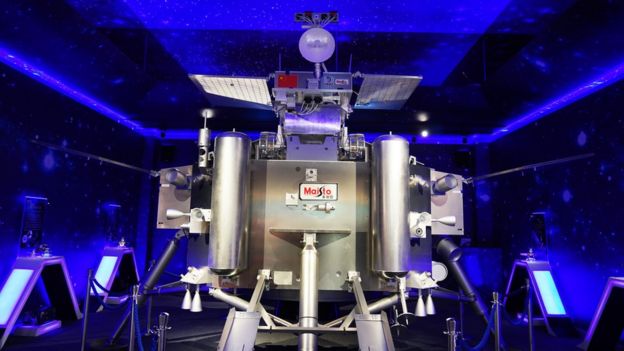
An employee inspects a 1:8 scale model of the Chang’e-4 lunar probe

China is preparing to make the first attempt at landing robotic spacecraft on the Moon’s far side.

A static lander and rover are expected to be deployed to the surface in the next day, state media reports.

The vehicles are carrying a suite of instruments designed to characterise the region’s geology, as well as a biological experiment.

In recent days, the Chang’e-4 spacecraft had lowered its orbit in preparation for landing.

At the weekend, Chinese state media said the probe had entered an elliptical path around the Moon, bringing the vehicles to within 15km (9 miles) of the lunar surface at its closest point.

Authorities have not specified the exact time of the attempt to touch down in the Von Kármán crater. But a report in the state-run China Daily newspaper suggests Chang’e-4 could begin descending on its thrusters sometime from 2-3 January.

Targeting the far side turns this mission into a riskier and more complex venture than its predecessor, Chang’e-3 - which touched down in the Moon’s Mare Imbrium region in 2013. But China’s latest moon shot will pave the way for the country to deliver samples of lunar rock and dust to Earth.

Andrew Coates, professor of physics at UCL’s Mullard Space Science Laboratory in Surrey, told BBC News: “This daring mission will land nearly 50 years on from the historic Apollo landings and will be followed in late 2019 by a Chinese sample return mission.”


NASA
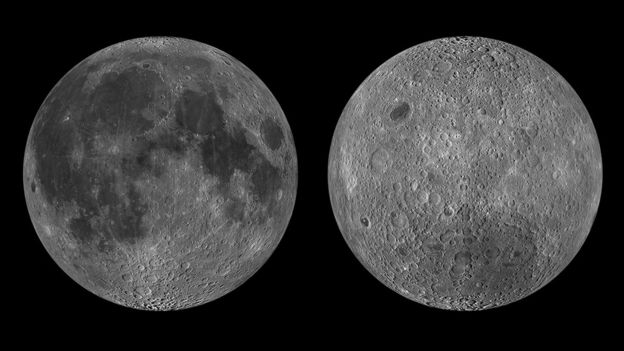
The near side (L) and far side (R) of the Moon have some key differences

Because of a phenomenon called “tidal locking”, we see only one “face” of the Moon from Earth. This is because the Moon takes just as long to rotate on its own axis as it takes to complete one orbit of Earth.

The lunar far side is often referred to as the “dark side”, though “dark” in this case means “unseen” rather than “lacking light”. In fact, both the near and far sides of the Moon experience daytime and night-time.

But the far side has a thicker, older crust that is pocked with more craters. There are also very few of the “mare” - dark basaltic “seas” created by lava flows - that are evident on the near side.

The Von Kármán crater is located within a much larger feature - the South Pole-Aitken (SPA) Basin - thought to have been formed by a giant impact early in the Moon’s history.

“This huge structure is over 2,500km in diameter and 13km deep, one of the largest impact craters in the Solar System and the largest, deepest and oldest basin on the Moon,” Prof Coates told me.

And therein lies the scientific interest. The event responsible for carving out the SPA basin is thought to have been so powerful, it punched through the outer layer of the Moon, known as the crust, and down into the zone called the mantle. Researchers will want to train the instruments on any mantle rocks exposed by the calamity.


CNSA
Artwork: The Chang’e-4 rover will explore a huge impact basin on the far side


CNSA
Artwork: The lander and the rover were originally built as back-ups for a previous Moon mission

The science team also hopes to study parts of the sheet of melted rock that would have filled the newly formed South Pole-Aitken Basin, allowing them to identify variations in its composition.

A third objective is to study the far side regolith, the broken up rocks and dust that make up the surface.

“The in-situ composition information in particular will be hugely valuable in understanding the formation of the Moon,” Andrew Coates commented.

Landing challenge

Up until now, China has followed in the footsteps of US and Soviet missions, carefully building up its capabilities. But this mission marks a first for any space agency.

The rugged character of the far side, with its undulating topography, poses particular challenges for landing the vehicles safely.

Touching down on a jagged outcrop would spell instant mission failure - and be a significant setback for the Chinese exploration programme.


GETTY IMAGES
A mock-up of the Chang’e-4 lander and rover, on display in Dongguan, China

The selection of the Von Kármán crater as the landing site owes much to the fact that it’s flatter than any spot in the South Pole-Aitken basin, according to Chinese scientists.

The descent to the lunar surface is split into six phases. The first three - initial deceleration, quick attitude and reorientation adjustment, and approach - will be controlled from Earth.

For the final three - hovering, hazard avoidance, and slow descent - the lander will take over, assuming autonomous control.

Seeds and eggs

The lander and rover were originally built as back-ups for 2013’s Chang’e-3 mission. However, they have received important modifications for the ambitious touchdown on the far side.

Chang’e-4’s static lander is carrying two cameras; a German-built radiation experiment called LND; and a spectrometer that will perform low-frequency radio astronomy observations.

Scientists believe the far side could be an excellent place to perform radio astronomy, because it is shielded from the radio noise of Earth. The spectrometer work will aim to test this idea.

The lander will also carry a 3kg (6.6lb) container with potato and arabidopsis plant seeds - as well as silkworm eggs - to perform biological studies. The “lunar mini biosphere” experiment was designed by 28 Chinese universities.

The rover will carry a panoramic camera; a radar to probe beneath the lunar surface; an imaging spectrometer to identify minerals; and an experiment to examine the interaction of the solar wind (a stream of energised particles from the Sun) with the lunar surface.

In an article for the US-based Planetary Society in September, Dr Long Xiao from the China University of Geosciences (Wuhan), said: “Chang’e-4 will be humanity’s first landed exploration of the lunar far side. The challenge faced by a far side mission is communications. With no view of Earth, there is no way to establish a direct radio link.”

Thus, the landers must communicate with Earth using a relay satellite named Queqiao, launched by China in May this year.

Queqiao orbits 65,000km (40,000mi) beyond the Moon, around a Lagrange point - a kind of gravitational parking spot in space where it will remain visible to ground stations in China and other countries such as Argentina.

The lander and rover was launched from Xichang Satellite Launch Center in China on 7 December; the vehicles arrived in lunar orbit on 12 December.

The mission is part of a larger Chinese programme of lunar exploration. The first and second Chang’e missions were designed to gather data from orbit, while the third and fourth were built for surface operations.

Chang’e-5 and 6 are sample return missions, delivering lunar rock and soil to laboratories on Earth.

The dragon has landed

‘New Chapter’ in Space Exploration as China Reaches Far Side of the Moon


The Chang’e-4 lunar probe being launched from Xichang, China, last month. CreditReuters
By Steven Lee Myers and Zoe Mou
Jan. 2, 2019

27

BEIJING — China reached a milestone in space exploration on Thursday, landing a vehicle on the far side of the moon for the first time in history, the country’s space agency announced.

The landing of the probe, called Chang’e-4 after the moon goddess in Chinese mythology, is one in a coming series of missions that underscore the country’s ambitions to join — and even lead — the space race.

China landed another rover on the moon in 2013, joining the United States and the Soviet Union as the only nations to have carried out a “soft landing” there, but the Chang’e-4 is the first to touch down on the side of the moon that perpetually faces away from the Earth.

The mission “has opened a new chapter in humanity’s exploration of the moon,” the China National Space Administration said in an announcement on its website. The agency said the spacecraft landed at 10:26 a.m. Beijing time at its target on the far side of the moon.

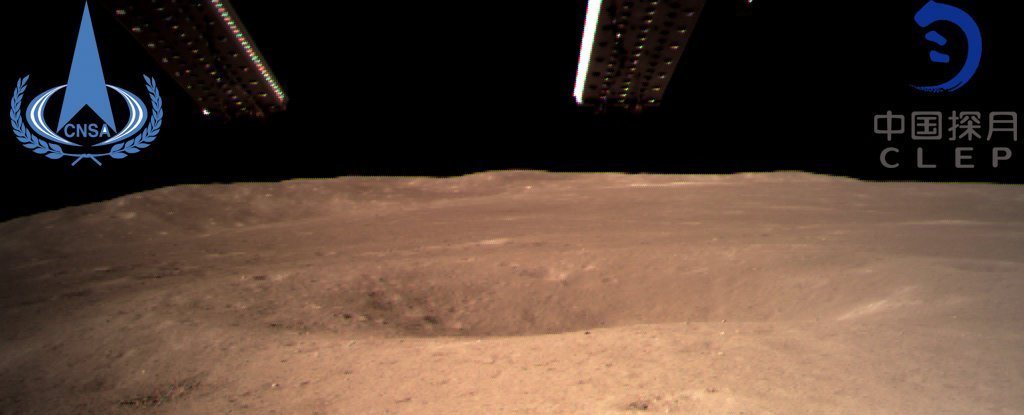
The probe sent back to the earth the first close-up image of the moon’s far side using a relay satellite China calls “Queqiao,” or “Magpie Bridge,” the space agency said in a notice that included images it said were taken by the probe.

Although a latecomer by decades to space exploration, China is quickly catching up, experts say, and could challenge the United States for supremacy in artificial intelligence, quantum computing and other fields.

China landed a probe called Chang’e-4 on the far side of the moon for the first time on Thursday. The probe captured never-before-seen images of the moon’s far side.Published OnJan. 3, 2019CreditCreditChina National Space Administration
“This space mission shows that China has reached the advanced world-class level in deep space exploration,” said Zhu Menghua, a professor at the Macau University of Science and Technology who has worked closely with the Chinese space agency. “We Chinese people have done something that the Americans have not dared try.”

China now plans to begin fully operating its third space station by 2022, to put astronauts in a lunar base by later in that decade, and to send probes to Mars, including ones that could return samples of the Martian surface back to Earth.

Though the moon is hardly untrodden ground after decades of exploration, a new landing is far more than just a propaganda coup, experts say.

The crater where the Chinese landed is the oldest and deepest on the moon, so the probe’s discoveries may offer insights into the moon’s origins and evolution. And some scientists suspect that the surrounding basin may be rich in minerals. If exploiting the moon’s resources is the next step in space development, a successful mission could leave the Chinese better positioned.

“This is a major achievement technically and symbolically,” said Namrata Goswami, an independent analyst who wrote about space for the Defense Department’s Minerva Research Institute. “China views this landing as just a steppingstone, as it also views its future manned lunar landing, since its long-term goal is to colonize the moon and use it as a vast supply of energy.”

The place the probe is exploring, Dr. Goswami said, could become a future refueling base for missions deeper into space in the way “navies viewed coaling stations, for purposes of refueling and resupply.”

The Chang’e-4 was launched from Xichang, in southwestern China, early on the morning of Dec. 8 (still midday Dec. 7 in the United States), and it glided into a final, lower orbit around the moon on Sunday, 22 days later.

It landed in the Von Kármán, a flat feature about 110 miles wide that sits inside a larger basin near the moon’s south pole. The main lander will release a 300-pound rover that, barring mishap, will roam the crater. (The rover’s name, the subject of a public contest and vote, has not yet been revealed.)

The instruments aboard the lander and the rover include cameras, ground-penetrating radar and spectrometers to help identify the composition of the area, which was formed by a meteorite. Scientists hope the rocks and dirt in the area will add to the understanding of the moon’s geology.

The lander will also conduct a biology experiment to see if plant seeds will germinate and silkworm eggs will hatch in the moon’s low gravity.

Since the moon prevents direct communications from the far side, China launched a satellite to act as a relay, allowing the rover to bounce signals off it first before they continue back to earthbound scientists.

China’s first lunar lander, the Chang’e-3, completed a journey to the near side of the moon five years ago. Its rover was plagued with problems, though. Within a month, the rover stopped moving after zigzagging 374 feet, though it continued intermittently to transmit photographs and other information, according to Chinese officials, until March 2015.

The fear of losing face over failures, as well as the sensitivity of the technology involved, has made the Chinese government reluctant to discuss its programs in detail, compared with the relative openness of NASA and other space programs. Last April, a Chinese space station, the Tiangong-1, fell to earth after officials lost communication with it.

Ahead of the landing, reports about the Chang’e-4 were fairly sparse — leaving astronomy experts and amateurs scouring for clues.

By contrast, in recent days, American space officials were openly exulting over the success of a NASA spacecraft, New Horizons, in capturing photos of Ultima Thule, a small, icy world four billion miles from Earth.

Some people might ask, “So what?” said John M. Logsdon, an emeritus professor at the Space Policy Institute at George Washington University, but scientists take a different view.

“We learn more about the moon,” Dr. Logsdon said. “It’s going to a place that no spacecraft has ever visited, so it’s true exploration.”


A model of the Chang’e-4 probe at an exhibition in Zhuhai, China. China’s goal is not just to join the space race, but to lead it. Credit Reuters

China’s membership in the elite ranks of space nations has unquestionably been a source of national pride, carefully managed to emphasize the Communist Party’s strong and steady leadership.

China is only the third country — it followed the United States and Russia — to send its own astronauts into space aboard its own rockets. The first crewed mission took place in 2003, and the Chinese have since sent a total of 11 astronauts into space. In 2016, two of them spent 30 days in China’s space station.

In 2018, for the first time, China launched more rockets into space — 38 — than any other country; one launch failed in October. Another moon landing, of the Chang’e-5, is planned for later this year.

Many of the launches last year carried satellites for China’s own version of the Global Positioning System, which already covers China and much of Asia. China hopes its system, called Beidou, will cover the entire globe by next year, and become a commercial and political rival to the American one.

If the International Space Station is decommissioned — the Trump administration has proposed ending federal financing for it by 2025 — the Tiangong-2 could become the only space station in orbit. The International Space Station has played host to astronauts from more than a dozen countries, but China has never been among them.

The Chinese space agency has experienced setbacks, including the failed launch in 2017 of a new heavy-lift rocket, the Long March 5. That caused a ripple of delays that is still being felt. The country’s space budget also remains far smaller than NASA’s.

Even so, conquering space remains a national priority. And the country’s political system, dominated by the Communist Party and President Xi Jinping, means that funding and planning are less vulnerable to political mood swings like those that have affected NASA’s budgets over the years.

“Deep-space exploration requires a tremendous amount of time and money,” Mr. Zhu, the Macau professor, said. “This is not something a small country is able to do.”

He said he was confident that “in several years or a decade, China will gradually catch up from behind and take a leading role in this area.”

Follow Steven Lee Myers on Twitter: @stevenleemyers.

Eric Nagourney contributed reporting from New York.
Pink Floyd’s Brain Damage has been playing in my head all day.

Needed an article with a pic

BREAKING: China Just Made History by Landing a Probe on The Far Side of The Moon
DAVID NIELD 3 JAN 2019
It’s another momentous day in the history of space exploration: the China National Space Administration (CNSA) has reportedly just landed its Chang’e-4 rover on the far side of the Moon, marking the first time we’ve been able to explore this hidden side of the lunar surface.

Not only that, the rover has already sent back its first image, and it’s absolutely breathtaking.


(China National Space Administration/Xinhua News Agency)

With the Moon tidally locked with Earth – taking the same amount of time to spin round on its axis as it does to orbit our planet – one half of it is always hidden from view.

Now, we should be able to get a detailed look at it.

As we’ve previously reported, the Chang’e-4 lander will relay messages via the Queqiao satellite, which is now sitting in orbit around the Moon. As Chang’e-4 will never be in a direct line of sight with Earth, that satellite relay is going to be essential.

And the new exploratory probe could return a whole host of valuable data: examining the geological make-up of the surface around the South Pole-Aitken basin, a part of the Moon we currently know very little about.

It’s thought that the basin was created by a huge collision early in the Moon’s history – which means materials from lower down in the Moon’s mantle that we haven’t been able to get to yet could be exposed in this region.

And the more we know about the Moon, the more we can figure out about the history of our planet and our Solar System. The lander should also be able to make some useful observations of deep space, without Earth getting in the way.

China Daily reports that the lunar probe touched down at 10.26am Beijing local time on Thursday the 3rd of January, arriving in the Von Kármán crater (named after Theodore von Kármán, the advisor to the founder of the Chinese space program, Qian Xuesen).

The journey from Earth started on the 8th of December but of course the project as a whole has been years in the making.

We’ve known for a long time about the CNSA’s ambitions to get a probe landed on the far side of the Moon – and it has now made good on its promise.

[QUOTE]View image on Twitter
View image on Twitter

CGTN

@CGTNOfficial
#BREAKING China’s Chang’e-4 probe lands successfully on far side of the moon at 10:26 a.m. BJT Thursday, marking the first ever soft-landing in this uncharted area

2,244
8:12 PM - Jan 2, 2019
1,202 people are talking about this
Twitter Ads info and privacy

Check out this Twitter thread from the China Global Television Network for some awesome shots taken as the Chang’e-4 lander touched down on the far side of the Moon. As yet no hidden alien civilisations have been discovered – but it’s early days.

While spacecraft have been able to take photographs of the far side of the Moon before, this is the first time we’ve ever managed to successfully land something on the surface: NASA’s Ranger 4 probe touched down in 1962, but ended up malfunctioning and didn’t send any data back.

We’re looking forward to the treasure trove of data Chang’e-4 sends back, but the CNSA aren’t stopping here – Chang’e-5 is scheduled to launch by 2020, with the aim of landing on the Moon and then returning to Earth.[/QUOTE]

Positive news is disturbingly refreshing.

I’ll see you on the far side of the moon

The Moon has a far side, not a dark one
Oh hey, Pink Floyd
By Rachel Becker Jan 3, 2019, 5:28pm EST


Photo: China National Space Administration

China now has two history-making robots sending back images from an area of the Moon where humankind has never been before. This side of the Moon is distant and mysterious, but, despite pop culture references to the contrary, it isn’t always dark. In fact, after touching down on the lunar surface, the probe sent back a snapshot of its new home that shows a rocky, cratered, and distinctly lit landscape.

China’s probe — which includes a lander and a rover — landed at 10:26AM Thursday, Beijing time, as part of China’s Chang’e-4 mission to scout out the side of the Moon we can’t see from Earth. Since it takes the Moon roughly the same amount of time to spin around its axis as it does to orbit the Earth, we only see one half of the Moon: its near side. China’s landing on the Moon’s far side was a world first, in part because of the technical difficulties posed by that distance. It’s really difficult to get radio signals from Earth to robots on the far side — or vice versa — when the entire bulk of the Moon is planted in between.

[QUOTE]China’s #Change4 rover is now in action on the far side of the Moon. pic.twitter.com/sZSmR6KCt8

— LunarOrbiter (@LunarOrbiter) January 3, 2019

China bridged the signal gap by sending up a satellite called Queqiao, which communicates with the probe and relays information, including photos, back to Earth. There’s light in the photos because there’s light on the far side of the Moon: in fact, there is no permanently dark side of the Moon. “Half the moon is always lit by the Sun — just like the Earth,” Frederick Walter, a professor of physics and astronomy at Stony Brook University, says in an email to The Verge.


Image: NASA

Our planet experiences daylight and night because Earth spins on its axis as it orbits the Sun. The side pointing toward the Sun is bright, the side pointing away is night. Over the course of 24 hours, the slow spin of the world cycles through both. (Things get weird at the poles, but even they experience both light and darkness.) The Moon goes through a similar cycle, but on a slower schedule: a full lunar day is roughly 29 Earth days long. Walter calculates that when the Chang’e-4 probe touched down on the Moon’s far side, it was roughly 9AM local lunar time.

“Where the Chinese lander came down, it’s daylight,” Walter says. Shots taken by a camera on the Chang’e-4 lander show the rover, called Yutu-2, casting a shadow on the Moon’s surface, the Planetary Society reports. That’s perfect for the mission, which relies on solar power, according to The New York Times.

China Xinhua News

@XHNews
What does the far side of the moon look like?
China’s Chang’e-4 probe gives you the answer.
It landed on the never-visible side of the moon Jan. 3 http://xhne.ws/zPoty

4,870
9:14 PM - Jan 2, 2019
2,444 people are talking about this
Twitter Ads info and privacy

Even though you won’t be able to see their landing site, you’ll be able to tell when the Chang’e-4 lander and Yutu-2 are bathed in light or cloaked in darkness just by looking up at the sky on a cloudless night. When the Sun is shining fully on the side of the Moon facing Earth, we see a bright, full Moon — but the far side of the Moon is dark. And when the Sun lights up the far side of the Moon, the near side is dark and we see a new Moon. In between, the waxing and waning Moon will mark whether the robots are entering dusk or dawn.

In the meantime, astronomers and space enthusiasts will await any news from the mission. We’ve seen distant glimpses of the far side of the Moon before. The first time was in 1959, when the Soviet Luna 3 spacecraft took a grainy photo of the far side’s crater-covered landscape. Since then, NASA’s Lunar Reconnaissance Orbiter has captured photos and mapped the surface, so we can see the far side in crisp, composite images.

But those images were all still taken from a distance. Now that China’s probe has touched down, we’re getting a closer look than ever before. The spacecraft landed on target in the Von Kármán crater in the South Pole-Aitken basin, according to China’s state media. The basin is a massive, 1,550-mile-wide impact site that’s miles deep and billions of years old. The Yutu-2 rover is equipped with ground-penetrating radar to investigate beneath the Moon’s surface. And while we wait for it to collect its scientific data, we can enjoy the views it sends back of the far side of the Moon — which, right now, is sunlit.[/QUOTE]

Fair enough. But the terms ‘dark side’ and ‘far side’ evoke very different things for me. It’s like Darth vs. Larsen, right? :rolleyes:

Moon mustard & silk

Imagine what moon mustard/cabbage and moon silk might be worth…

There Are Plants and Animals on the Moon Now (Because of China)
By Rafi Letzter, Staff Writer | January 3, 2019 03:05pm ET


Credit: World Perspectives/Getty Images

China’s Chang’e-4 lander touched down on the far side of the moon (Jan. 3 Beijing time, Jan. 2 US), and it’s got some living things on board.

A small “tin” in the lander contains seeds of potatoes and rockcress (Arabidopsis thaliana, a flowering plant related to cabbage and mustard, as well as a model organism for plant biology), as well as silkworm eggs. The idea, according to a report in The Telegraph earlier this year, is that the plants will support the silkworms with oxygen, and the silkworms will in turn provide the plants with necessary carbon dioxide and nutrients through their waste. The researchers will watch the plants carefully to see whether the plants successfully perform photosynthesis, and grow and bloom in the lunar environment.

“We want to study the respiration of the seeds and the photosynthesis on the moon,” Xie Gengxin, chief designer of the experiment, told Xinhua, a Chinese state-run news agency. [See Spectacular Lunar Mission Images in 3D (Photos)]

The “biosphere” experiment was the product of a collaboration between 28 Chinese universities, led by southwest China’s Chongqing University, according to Xinhua. The experiment, which is tucked inside a 1.4-pint (0.8 liters) aluminum alloy cylinder, weighs about 7 lbs. (3 kilograms) and includes dirt, nutrients and water. Sunlight will filter into the container through a “tube,” and small cameras will watch the little environment. That data will beam back to Earth by means of the complicated relay system China has set up to communicate with an experiment that has no direct line of sight to Earth.

“Why potato and Arabidopsis? Because the growth period of Arabidopsis is short and convenient to observe. And potato could become a major source of food for future space travelers,” said Liu Hanlong, chief director of the experiment and vice president of Chongqing University, as reported by Xinhua. “Our experiment might help accumulate knowledge for building a lunar base and long-term residence on the moon.”

Rockcress has been grown in space before, including in one experiment on the International Space Station that showed the plants’ leaves appearing to rise and fall as they detected the moon’s gravity. But whether the flowering plant will flourish in the environment of the far side of the moon remains an open question.

For now, though, this means that there’s life in at least one other place in the solar system (even if it’s only because we put it there).

Originally published on Live Science.