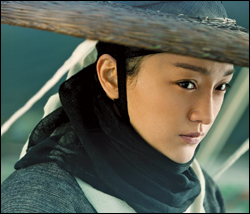
Flying Swords of Dragon Gate

hip hip hoo raaay.

wu xia in 3 D

must see.

but need to buy 3 D TV and 3 D dvd player

to be able to watch it at home.

talking about production of many 3 D films or 3 D DVD ahead of consumer’s having the 3 D thingy to play and watch.

yah, jet li early film was with big smile and happy go easy figures

then he was protrayed as avenger or cold blooded cop (kiss of dragon), bad guy (the one) or cold blooded fighter (leash)

once you are set in the mind of audience, it is hard to play other type of figures

john wayen is a cowbody

clint eastwood is dirty harry

charles brownson is –

jet li is like fight them all and kill them all as in “romeo must die”

:smiley:

Asian Filmmaker of the Year

Asian Filmmaker of the Year: Tsui Hark
9:19 AM PDT 10/7/2011 by Karen Chu

As he readies his next blockbuster, Tsui Hark talks about his respect for Korean cinema, looking to the past for inspiration and why he won’t be retiring any time soon.

The most commercially successful filmmaker to come out of the late 1970s cinema movement known as the Hong Kong New Wave, Tsui Hark has established himself as that rare auteur who can deliver at the box office. Lauded for revolutionizing the martial arts genre in hits like Zu Warriors from the Magic Mountain (1983) and the Once Upon a Time In China series(1991-7),Tsui kept his winning streak alive with last year’s Detective Dee and the Mystery of the Phantom Flame, an effects-heavy period epic that grossed 300 million yuan ($46.9 million) in China. Named Asian Filmmaker of the Year by the Busan International Film Festival for 2011, Tsui recently took time out from post-production on his upcoming 3D release, The Flying Swords of Dragon Gate, to discuss his career.

Q&A: Tsui Hark

The Hollywood Reporter (THR): How do you feel about being named Asian Filmmaker of the Year by BIFF?

Tsui Hark (Tsui): Three years ago BIFF asked me to come and teach a master class, to share my experience in filmmaking. Since then we’ve established a relationship with the festival organizers. I’ve stayed in Korea for longer periods of time and got to know more about the film industry, the historical background and development of the film culture here. My impression of Busan is quite different from the other places I’ve been to. I also talked to Korean filmmakers during the post-produc- tion process of Detective Dee and the Mystery of the Phantom Flame. I appreciate the Korean filmmakers’ discipline, working style, and fighting spirit, all of which are qualities that not only I share, but are valuable factors when I consider future collaborations.

For BIFF to give me this award, I’m very honored and delighted. I feel it draws me closer to the Korean film industry and establishes between us a closer relationship as friends.

THR: Why are you so attracted to new technology?

Tsui: Part of my motivation at the beginning was affected by the historical factors of Hong Kong filmmaking. Because of the circumstantial constraints in Hong Kong, when we wanted to pursue stories set in a historical context or related to the geographic environment in China, we had little choice but to film in the few studio sets available. If there were problems during filming, we had to fix them during post-production. So I’ve established a closer relationship with the technical departments. But in view of the technological advancement of the international film industry, there has been a great deal of research and development that gave us a new approach to design, subject matter and mode of expression, which I find interesting. To me, film and technology are indivisibly entangled — film is an experiment of telling a story through technological means.

THR: What, specifically, has technology allowed you accomplish?

Tsui: If I want to shoot a dangerous action sequence, I can achieve it through visual effects technology without putting people in harm’s way. That’s one of the main reasons we use technology in filmmaking. The other way it inspires me is the information we can get through technological means. The internet helps us know more about the world, beyond the confines of our geographical existence. In the long run, that affects our worldview. In other words, ourworldview is now different from before. For instance, we weren’t as familiar with Asian cinema in the past, but now we make films with an Asian crew, and deal with subject matter relevant or familiar to Asia. In this sense, technol- ogy obviously enhances development. It not only gives us convenience, but also provides uswithreferencesandcomparisons. Inthe past, there were many instances of copying or replicating foreign films; nowadays with the international distribution network, there is less chance of copying, so that we can focus more on expanding our creativity.

THR: Your recent films are set in specific historical periods. What do they reveal about the times we live in now?

Tsui: I believe that period dramas have a special significance to the Chinese people. For instance, when I did Once Upon a Time in China, the central character, Wong Fei-hung, was my childhood hero. By the time I was 30, I realized times had changed and people had forgotten about or overlooked this heroic figure. I began to wonder whether it was worthy to retell his stories, and to see

if the younger generation would appreciate him as much as we did. So out of curiosity, I tried to project the sense of excitement of my childhood on screen. I always want to know how I relate to the present time, to the young generation. The period setting was only a means; it represents mypersonal likes and dislikes when I was growing up. To the Chinese people, history, or the idea of ancient China, is something that we would encounter since childhood. I wanted to see if we could find ourselves in that world of history or historical fiction; to find the link between that world and our world today.

THR: What kind of challenges have you encoun- tered while making your first 3D film, The Flying Swords of Dragon Gate?

Tsui: The 3D filmmaking that I know now is simpler than I imagined. I’ve heard a lot of people with technical expertise telling me all kinds of stories about 3D filmmaking. But now I know only some of them are true. Working on it dispelled a lot of my worries. I used to hear that there needs to be a digital expert onset to do calcula- tions, but now I know that’s not necessary.

THR: How excited are you to fulfill your childhood dream of making a 3D film??

Tsui: (Laughs) The feeling is more than a sense of excitement – I’ve also learned something new about myself. Before, my enthusiasm was based on my susceptibility to 3D as an audience member.

Now that I’ve learned about the technology behind 3D, I feel that I’ve gotten to know another side of me — someone who might have a lot of opinions about the technology. I think it’s worthwhile for me.

THR: What was it like to witness how Hong Kong cinema influenced global cinema in the 90s?

Tsui: In the history of cinema, there had never been so many Chinese filmmakers working in foreign countries as it was in the late 1990s to early 2000s. For a time, there was a strong influence of Hong Kong cinema in foreign films. HongKong is a place highly susceptible to foreign cultures, and in turn the filmmakers, including directors and action choreographers, were in demand in the international film industry. We’re very fortunate that we had the opportunities to work on an international stage, then go to China to explore a new world. When the Chinese market opened, we realized we could make films in China. But since there’s not a rating system in China, everyone, regardless of age, sees the same films, there is a limitation on the subject matter and content. We’d experienced something similar in Hong Kong in the 1980s and 1990s, when investors posed certain control on subject and content. There is still a lot of to be improved in the Chinese film industry in order to fulfill its full potential, but in the long run, I hope it would grow to be a counterpart of comparable influence as Hollywood in the international marketplace.

THR: You’re reuniting with your Once Upon a Time in China lead Jet Li on Flying Swords. How is it different this time?

Tsui: It’s been so long since Jet Li and I worked together, he brought along a lot of new perspectives, whether it was for the film itself or for his character. We have a deeper exchange of ideas in terms of choices.

After more than three decades, how do you view the present stage of your career? At this stage I’m still looking for opportunities to make more films. I love making films; it’s not as if there’s something else I want to do and I’d have to wait until I retire to do it. Even if I retire, I’d still want to make movies.

Tsui Hark’s Top 5 Box Office Hits

Aces Go Places 3 (1984)

The Aces Go Places series first landed in Hong Kong cinemas during the Chinese New Year of 1982, but Tsui took the helm in 1984 for the series’ third installment, which raked in HK$29.3 million ($3.8 million) to become the highest-grossing film of the year.

A Better Tomorrow trilogy (1986-9) Tsui produced the iconic John Woo-directed 1980s film series of the golden age of Hong Kong cinema, which took in a combined gross of HK$76.2 million.

Once Upon a Time in China (1991-7) Tsui turned Jet Li into a superstar with this franchise about his child- hood hero, martial arts master Wong Fei-hung. The six installments grossed HK$133.7 million in Hong Kong.

Seven Swords (2005) Tsui’s first major release in China grossed a respectable 87 million yuan in 2005, coming in third at the Chinese box office for the year.

Detective Dee and the Mystery of the Phantom Flame (2010) The 300 million yuan-grossing blockbuster won Tsui his third best director award at the 30th Hong Kong Film Awards.
Should I change this thread title to The Flying Swords of Dragon Gate?

Changing the thread title now

‘New Dragon Gate Inn’ to ‘Flying Swords of the Dragon Gate’

Jet Li and Tsui Hark Reunite for Their New Wuxia Drama
2011-10-21 10:00:09 Chinese Films

Kongfu megastar Jet Li and renowned Hong Kong director Tsui Hark reunited at Peking University for their upcoming 3D Wuxia blockbuster “Flying Swords of the Dragon Gate” yesterday. [Photo: Mtime.com]

Kongfu megastar Jet Li and renowned Hong Kong director Tsui Hark reunited at Peking University for their upcoming 3D Wuxia blockbuster “Flying Swords of the Dragon Gate” yesterday.

After their last collaboration 14 years ago, the two old friends got together and reminisced at the event.

Wuxia films are historical martial-arts movies, which usually follow a chivalrous swordsman. For Jet Li and Tsui Hark, the world of Wuxia is dream.

“I like wuxia films, because in the real world, we sometimes can’t express ourselves through words. However, things in the world of Wuxia can be revealed freely and romantically.” Tsui was quoted as saying. “Call me curious or crazy, what I really want is to put my Wuxia fantasies on the big silver screens. With 3D technology, a sense of realism is finally being achieved.”

During their 20-year-long friendship, a series of classic films have been made, including the acclaimed “Once upon a Time in China” series.

“Flying Swords of the Dragon Gate” as the first of a new incarnation of 3D Wuxia drama, will be screened in 2D, 3D and IMAX 3D formats in December.

By Liu Shuai

December 18

There are photos of the leads too, if you follow the link.

Three Leads’ Posters for “Flying Swords of Dragon Gate 3D” Out
2011-11-02 09:02:47

Produced by Bona Film Group, Tsui Hark’s imminent wuxia drama “Flying Swords of Dragon Gate 3D” has had its new posters released. The posters features three leads Jet Li, Zhou Xun and Chen Kun. The film will greet the audiences on 18, December. [Photo: Mtime.com]

posters

Posters out for “Dragon Gate 3D”
2011-11-09 09:20:25 Chinese Films


Produced by Bona Film Group, director Tsui Hark’s imminent action blockbuster “Flying Swords of the Dragon Gate” unveiled a new batch of character posters in the run up of its release in December. Featuring the Kung Fu megastar Jet Li, Zhou Xun, Chen Kun, Gui Lunmei, Li Yuchun and Mavis Fan, the movie plans to steal some thunder from Zhang Yimou’s war epic movie, “The Flowers of War.” [Photo:mtime.com]
five more if you follow the link.

On Dec 16, it’s Tsui Hark vs. Zhang Yimou

Tsui Hark to Compete with Zhang Yimou
2011-11-24 10:50:26 Chinese Films

Tsui Hark, director of the wuxia martial arts flick “Flying Swords of the Dragon Gate”, which is due to hit cinema screens on the same day as Zhang Yimou’s epic war blockbuster “The Flowers of War”, is confident of being able to compete with Zhang’s highly anticipated feature, chinesefilms.cn reports.

Yu Dong, producer of “The Dragon Gate” and CEO of the Bona Film Group announced yesterday at the movie’s premiere ceremony that they will not raise prices and will partake in any form of smear campaign. Dong’s made these comments following the actions of Zhang Weiping, CEO of the production company responsible for “The Flowers of War” who was able to force eight large cinemas to increase the price of their cheapest tickets.

Joining hands for only the second time in 20 years, Jet Li and Tsui’s partnership is a symbol of their desire to present wuxia martial arts on a major stage. With two years of preparation leading up to the project, and with a total investment of over $ 70 million, Tsui put together his own 3D production team for the movie.

“Flying Swords of the Dragon Gate 3D” will be the first home-grown action flick released in 3D/IMAX form.

This year’s fiercest competition for box office revenues will kick off on December 16.

More pix if you follow the link below

Leading Actors Promote “Flying Swords”
2011-11-23 09:28:34 Chinese Films

Bona Film Group, the company behind the film “Flying Swords of the Dragon Gate” held a news conference for its wuxia martial arts blockbuster yeaterday in Beijing. Five of the leading roles including Jet Li, Chen Kun, Li Yuchun, Guey Lun-mei and Mavis Fan made an appearance at the event. [Photo: Mtime.com]

Bona Film Group, the company behind the film “Flying Swords of the Dragon Gate” held a press conference to promote its upcoming wuxia martial arts blockbuster yesterday in Beijing.

Five of the leading roles including Jet Li, Chen Kun, Li Yuchun, Guey Lun-mei and Mavis Fan made an appearance at the event. However, director Tsui Hark and another lead actress Zhou Xun were absent. Tsui is said to be busy with the post-production stages of the film.

Directed by Tsui Hark, the project is dubbed ‘the first global wuxia blockbuster made especially for IMAX 3D’.

The film is slated to hit cinemas nationwide on December 16, the same release date as Zhang Yimou’s war epic “The Flowers of War.”

Recently, tensions between the production company responsible for “The Flowers of War” - New Picture, and domestic cinemas flared, resulting in an increase of the lowest ticket prices available.

Yu Dong, General Manager of Bona Film Group, expressed his hope at the press conference that “Flying Swords of the Dragon Gate” would be able to bag at least 600 million yuan in box office revenues and clearly stated that the company would not attempt to drive ticket prices upwards.

What’s with the MC Hammer pants? I won’t say that they’re back in as i never thought they were in the first time around :smiley:

Golly, a whole $6.29 for a movie ticket

That’s about what we pay here for matinee price. :frowning:

Exhibitors Make Peace with Flowers
2011-11-28 14:59:12 Chinese Films

A still photo of the movie ‘The Flowers of War’ [Photo: chinesefilms.cn]
Going to the cinema in China will become more expensive in December after exhibitors agreed to raise the minimum ticket price of ZHANG Yimou’s war epic ‘The Flowers of War’ to RMB40 ($6.29) in major cities. Previously, the highest minimum price for a local film was RMB35 ($5.50).

December is set to be a crucial month at the Chinese box office after the disappointing National Day Holiday takings two months ago. As budgets soar, Chinese producers are putting increasing pressure on cinemas to return higher box office income to cover their investment risks.

Flowers is one of the year’s most-anticipated films in China. It has an official budget of RMB600 million ($94.4 million), the largest in Chinese film history, and stars Christian BALE as a foreigner who saves Chinese lives in wartime Nanjing in December 1937.

In an interview with web portal sina.com in October, producer ZHANG Weipin stated, “In the past, we had to beg the theaters to play our films. But this is a different time now. I will let them beg me to screen the movie because I can guarantee that their screening rooms will be crowded.”

But local exhibitors balked at Zhang’s demands that they set the minimum ticket price to RMB40 and reduce their after-tax share from 57% to 55%. It was claimed by a media commentator on Weibo, China’s Twitter-like microblog, that the top eight cinema chains had threatened to boycott the film in response to the demands.

After the film was screened to exhibitors last Wednesday, they agreed to the RMB40 minimum ticket price in major cities but maintained their 57% share after tax. It is estimated that tickets to Flowers will cost as much as RMB100 ($15.71), in what is already one of the world’s most expensive cinema-going countries.

Earlier last week, Zhang told sina.com, “First of all, we only raised the minimum ticket price by RMB5, so where is the RMB100 price coming from? Second, in terms of revenue sharing, the distributor is taking 45% and the cinemas are taking 55% after taxes. They’re taking the majority, yet the risk lies with me.”

Zhang argued that audiences should support the ambitions of the local industry with higher ticket prices: “The Flowers of War is the most expensive film in Chinese history. It’s 145 minutes long, 40-50 minutes longer than a typical local film. That means this is an enhanced product, which naturally means a higher ticket price.”

Producers of TSUI Hark’s 3-D action fantasy Flying Swords of Dragon Gate, who have moved its release two days forward to open head-to-head with Flowers, have themselves asked cinemas in China to return a minimum of RMB35 ($5.50) per admission, a precedent set by local blockbuster Aftershock.

Also opening next month is XU Jinglei’s thriller Dear Enemy, currently scheduled on 23 Dec. Xu starred in Eternal Moment, the third highest-grossing local film of the year. Her most recent film as a director, romantic comedy Go! Lala Go!, made RMB124.5 million ($19.6 million).

There has been a series of surprises at the Chinese box office in 2011 that has increased producer uncertainty. The number one film at the box office last week is comedy Love is Not Blind. It has taken US$45 million in 13 days, outperforming Real Steel and The Adventures of Tintin: The Secret of the Unicorn.

Other unexpected hits at the box office this year include drama Buddha Mountain and horror Mysterious Island, starring FAN Bingbing and Mini YANG respectively, that made RMB69.3 million ($10.9 million) and RMB90.0 million ($14.2 million) on release in March and July.

Hark & Li ham it up for GQ

There are 9 pics if you follow the link.

Tsui Hark and Jet Li: Perfect Kung Fu Duo in “GQ”
2011-12-01 16:38:34 Photo:sina.com

The perfect kung fu duo—Tsui Hark and Jet Li—pose for a photo shoot for “GQ” magazine to promote their new wuxia martial arts flick “Flying Swords of the Dragon Gate 3D” slated for release on December 16. The film is the first home-grown action flick to be released in 3D/IMAX format. Yu Dong, the film’s producer and CEO of the Bona Film Group, said he is confident that the movie will steal some thunder from Zhang Yimou’s $100 million project “The Flowers of War” which will be released on the same day. [Photo: sina.com]

Esquire

10 pix total at the other end of the link below.

“Flying Swords of the Dragon Gate” Trio in Esquire Magazine
2011-12-06 10:08:40 Photo:sina.com

Actor Chen Kun, Guey Lunmei and Mavis Fan, cast members of director Tsui Hark’s soon-to-be-released 3D costume action flick “Flying Swords of the Dragon Gate,” posed for a photo shoot for Hong Kong’s Esquire Magazine in promoting their new movie. The film is slated for release on December 16. [Photo: sina.com]

Still hoping for that US3D release

cute title for this article

Film Adds Depth to Wuxia
2011-12-15 09:07:37 Global Times

Jianghu comes alive again in “Flying Swords of Dragon Gate”. [Photo: mtime.com]

The long-anticipated 3D wuxia thriller “Flying Swords of Dragon Gate” (Long Men Fei Jia), directed by Tsui Hark and starring Jet Li, Zhou Xun and Chen Kun, will be released in theaters later on Thursday.

Following Monday’s premiere, the film has received critical acclaim for its skillful use of 3D techniques and dazzling martial arts scenes, setting the stage for the action flick to win a positive public reception.

“We wanted the movie to deliver a 3D experience that differed from that of Western movies,” director Tsui said. He revealed that out of the movie’s total $35 million budget, a quarter was devoted to creating its 3D effects.

And now it seems that Tsui’s vision and the film’s large tech budget will finally pay off.

“The movie will definitely set a standard for future Chinese 3D movies,” said Ma Sheng, an independent film critic. “Its visual effects are impeccable.”

Wei Haijun, another critic who writes film reviews for 40 media companies, also spoke very highly of the movie.

“Not only will it be a milestone for Chinese films, I think it will even stand out on the international stage,” he commented.

The film, which began shooting last year, is based on the story of “New Dragon Gate Inn”, a 1992 Hong Kong wuxia film directed by Raymond Lee and produced by Tsui Hark. But Tsui indicated that the new film isn’t so much a remake of the old classic as it is a “re-imagining.”

“New Dragon Gate Inn” is set during the Ming Dynasty (1368-1644) in a remote desert region of China. The film has come to be regarded as a standard for Chinese wuxia movies, beloved for its fast-paced martial arts scenes, sword fighting and black comedy.

Although “Flying Swords of Dragon Gate” is based on the iconic “New Dragon Gate Inn”, Tsui wanted to ensure originality in the new story while presenting the same characteristic morality and code of honor of those chivalrous men and women from the world of jianghu.

Although Monday’s premiere has drawn generous approval, the critics are not unanimous. Some have pointed out flaws in the movie’s 3D effects. In answer to this, Tsui Hark said the new movie is merely a knock on the door of innovation, a door that will lead China to new arenas in the film industry.

Indeed, combining 3D and Chinese martial arts is certainly a new and difficult challenge to filmmakers. Last year, True Legend, promoted as the first Chinese 3D wuxia movie, directed by Yuan Heping, was poorly received due to disappointing, lackluster 3D effects, resulting in the film’s early retreat from cinemas.

Since the film began shooting, Tsui Hark has been determined to make the best 3D wuxia movie audiences have ever seen.

Because domestic 3D technology isn’t yet mature, Tsui invited Hollywood expert Chuck Comisky, who oversaw the visual effects for James Cameron’s “Avatar”, to manage the film’s special effects and train his technical team.

“Applying 3D technology to the genre of wuxia films is like injecting new life into traditional Chinese martial arts,” said Jet Li, a top Chinese martial artist and leading actor in the movie.

The star expects that the movie’s success will help broaden worldwide appreciation for Chinese wuxia films.

Another blockbuster hopeful, director Zhang Yimou’s red-hot “Flowers of War”, is also being released in theaters on Thursday.

When asked about the competition between the two movies, Tsui said he hopes that both films do well at the box office, noting that foretelling ticket sales is not within a director’s powers.

“What I can do is shoot a good movie,” he added.

Us3d+

Now I’m hoping for that US3DIMAX release. Please Santa.

Jet Li’s ‘Flying Swords of Dragon Gate’ Debut in China Draws $2.5 million on Imax Screens
5:32 AM PST 12/19/2011 by Etan Vlessing

The opening weekend performance of the 3D martial arts picture in 59 theaters included a per-screen average of $42,400.

TORONTO – The Jet Li-starring 3D picture Flying Swords of Dragon Gate pulled in $2.5 million on 59 Imax screens across China during its opening weekend, the giant screen exhibitor said Monday.

Toronto-based Imax and Chinese distributor Bona Film Group reported a per-screen average of $42,400 for the martial arts picture.

Flying Swords of Dragon Gate is the first Chinese-language feature to be released in Imax 3D.

The film reunites director Tsui Hark with his Once Upon a Time in China leading man Li, and also stars Zhou Xun, Aloys Chen Kun, Kwai Lun-Mei, Li Yuchun and Fan Xiaoxuan.

“The results of our network growth in China are bearing fruit with the opening weekend box office success of Flying Swords of Dragon Gate,” Imax CEO Richard Gelfond said Monday in a statement.

Imax currently has around 200 theatres operating or in backlog in China.

The build-out of Imax’s screens in that Asian market continued with recent and separate deals with Sichuan Lumiere Pavilions Company for three new digital screens, and another for four digital screens with Orange Sky Golden Harvest Cinemas.

Alright then…

Who will be first here wit this review? Extra points if it includes 3D.

Posted: Wed., Dec. 21, 2011, 1:47pm PT
New Int’l. Release
Flying Swords of Dragon Gate
Long men fei jia
(China)
By Richard Kuipers
‘Flying Swords of Dragon Gate’

Zhou Xun in “Flying Swords of Dragon Gate”

A Distribution Workshop release of a Bona Film Group, China Film Co., SMG Pictures, Shine Show Interactive Media Co., Bona Entertainment Co. presentation of a Film Workshop production. (International sales: Distribution Workshop, Hong Kong.) Produced by Nansun Shi, Yu Dong, Tsui Hark. Executive producers, Yu Dong, Han Sanping, Li Ruigang, Chen Danian, Jeffrey Chan. Co-producers, Han Xiaoli, Shi Dong-min, Yang Wenhong, James Zhao, Zhu Guofan. Directed, written by Tsui Hark.
With: Jet Li, Zhou Xun, Chen Kun, Gwei Lun-mei, Li Yuchun, Mavis Fan, Fan Su-wong, Gordon Liu, Sheng Chien. (Mandarin dialogue)
The 3D is terrific in “Flying Swords of Dragon Gate,” but helmer Tsui Hark’s costume actioner – the first Chinese-lingo movie shown in the stereoscopic Imax format – is let down by two-dimensional characters. Toplining an underused Jet Li, this reworking of King Hu’s “Dragon Gate Inn” (1966) and the Tsui-produced “New Dragon Gate Inn” (1992) scored an impressive $22 million opening weekend gross following December 15 domestic release. Modest figures in simultaneous Australian rollout suggests biz beyond Asia will be just OK. North American distribution details are yet to be announced.

Flying Swords of Dragon Gate

“Swords” has notched mighty numbers on 59 giantscreens locally; at regular venues, the pic was narrowly beaten for the top B.O. spot by Zhang Yimou’s “The Flowers of War,” launched the same day.

Action centers initially on Zhou Huai’an (Li), a freedom fighter opposing corrupt eunuchs holding power during China’s Ming dynasty. Following a knockout opening sequence in which he and his small band of followers rescue alleged traitors facing certain death at a shipyard, Zhou disappears for long stretches while Tsui introduces a lengthy roster of characters whose paths eventually cross.

Chief among these is Ling Yanqiu (Zhou Xun), a female warrior who has rescued Su Huirong (Mavis Fan), a palace maid marked for death after being impregnated by the emperor. Charged with eliminating Su is Yu Huatian (Chen Kun), a regional boss who tracks the women to Dragon Gate Inn, a rough-and-tumble hostel in the middle of the desert where human flesh is on the menu.

Built over a city of treasures accessible only during a sandstorm that’s about to make its once-every-60-years appearance, the establishment has attracted adventurers including the roughneck crew of Mongol princess Buludu (Gwei Lun-mei), female bandit Gu Shaotang (Li Yuchun), and her partner-in-crime, Wind Blade (also Chen), a dead ringer for Yu. What follows is a sometimes confusing series of deceptions, double-crosses and barroom brawls as Wind Blade and Yu impersonate each other and Zhou re-enters the picture ahead of the climactic CGI sandstorm.

With the assistance of “Avatar’s” 3D visual effects supervisor, Chuck Comisky (credited as supervising stereographer), Tsui stages any number of marvelous action sequences. But what’s glaringly absent is any character depth or significant emotional content for auds to embrace. Some sort of “Crouching Tiger, Hidden Dragon”-style connection is hinted at between warriors Zhou and Ling, but their reunion fails to produce sparks of any kind.

Given little screentime and handed light duties, action-wise, top-billed Li is overshadowed by Zhou Xun’s steely femme fighter and Taiwanese thesp Gwei, who steals the show as the tattoo-faced, tough-talking tribal leader.

With hardly a primary color in his palette, lenser Choi Sung-fai creates splendidly burnished imagery of deserts and atmospheric interiors of the heavily wooded inn. A rousing, old-fashioned orchestral score by Wu Wai-lap, Li Han-chiang and Gu Xin rounds out a topnotch tech package.
Camera (color, widescreen, Imax 3D), Choi Sung-fai; editor, Yau Chi-wan; music, Wu Wai-lap, Li Han-chiang, Gu Xin; music supervisor, Wu; production designer, Yee Chung-man; art director, Ben Lau; costume designer, Lai Hsuan-wu; sound (Dolby Digital), Kim Chang-sub; visual effects supervisor, Kim Wook; visual effects, Digital Idea, Eclipse Studio, Digital Art Design, Crystal CG; action choreographers, Yuen Bun, Lan Ha Han, Sun Jiankui; associate producers, Ding Yilaw, Peng Mingyu, Liu Yong, Zhang Hao, Zhao Haicheng, Su Xiao; supervising stereographer, Chuck Comisky; second unit camera, Saba Mazloum. Reviewed at Event Cinemas George Street, Sydney, Dec. 20, 2011. Running time: 122 MIN.

Flowers bests Swords

Anyone see Flowers of War? Do we need to start a thread on it or can we just mention it here?

Flowers widens lead on Swords
By Stephen Cremin
Tue, 27 December 2011, 13:40 PM (HKT)
Box Office News

ZHANG Yimou 's The Flowers of War made RMB204.4 million ($32.4 million) in China last week. By Sunday night, the war epic had taken RMB356.5 million ($56.4 million) after eleven days in cinemas.

It widened its lead on TSUI Hark 's 3-D action-fantasy Flying Swords of Dragon Gate that made RMB175.4 million ($27.8 million) in the same time frame for a current gross of RMB317.1 million ($50.2 million).

By comparison, in its first eleven days, JIANG Wen 's Let the Bullets Fly had taken RMB382.3 million ($60.5 million), however its second week box office was slightly lower than that of Flowers at RMB200.8 million ($31.8 million).

At RMB674.3 million ($106.7 million), Bullets is China’s highest grossing local film.

New releases included XU Jinglei 's Dear Enemy (pictured) re-teaming her with Taiwan’s Stanley HUANG , her co-star in her previous film as a director, Go! Lala Go! .

Enemy made RMB41.4 million ($6.5 million) in its first three days. The office drama Lala, which ended its theatrical run with RMB131.3 million ($20.8 million), made a comparable RMB46.0 million in its first four days in cinemas.

Another new release, Barbara WONG 's Allure of Tears starring ZHOU Dongyu , Aarif LEE and Shawn DOU , was runner-up to Enemy with RMB24.0 million ($3.8 million) after four days on release.

some more reviews

Flying Swords of Dragon Gate 3D: Film Review
9:37 PM PST 12/29/2011 by Maggie Lee

Jet Li Flying Swords of Dragon Gate Poster - P 2011
The Bottom Line
An effects-infatuated swordplay extravaganza with no down time.

Cast
Jet Li, Zhou Xun, Aloys Chen, Kwai Lun-Mei, Mavis Fan, Li Yuchun

Director-screenwriter-producer
Tsui Hark

Jet Li leads the cast in director-screenwriter Tsui Hark’s extravagant and action-packed ride.

MACAU – Props, instead of top-liner Jet Li, do most of the stunts in Flying Swords of Dragon Gate, Hong Kong director Tsui Hark’s extravagant and berserk 3D swordplay blockbuster which squeezes court intrigue, star-crossed love and a treasure hunt into one over-booked desert inn. Employing Avatar’s Chuck Comisky to supervise the 3D technology, the film is single-minded in its wham bam delivery of stereoscopic stimulation. By contrast, Tsui, who is also writer and producer, appears absent-minded when trying to fit a ragtag bunch of characters into a distended plot teeming with more cross-dressing and mistaken identities than Twelfth Night.

Premiering to compete head-to-head with Zhang Yimou’s historic-epic The Flowers of War, Flying has come up second after Flowers in the box office, passing the $50 million mark in less than 2 weeks. Made as pure mass entertainment with an A-list cast for the China market, Tsui’s target audience won’t feel short-changed. Business should take off in overseas genre-specialist markets.

Flying is supposed to be a sequel to Raymond Lee’s New Dragon Gate (1992), which Tsui wrote and produced. The latter is in turn a remake of King Hu’s classic Dragon Inn (1967). Just as The Legend of Zu, Tsui’s 2011 remake of his own 1983 Zu: Warriors of the Magic Mountain bears little resemblance to the original, the plot development of Flying barely picks up from where it left off. With enviable resources at his disposal, Tsui behaves like a kid in a candy store, bingeing on effect for effect’s sake. No sword strikes without splitting into darting daggers, no human or object moves without levitating or smashing into smithereens. It’s dazzling and more accessible than his last blockbuster, the politically nuanced Detective Dee and the Mystery of the Phantom Flame. Only, it lacks a human touch.

The setting is Ming Dynasty during the reign of Chenghua (1465-1487). The court is controlled by imperial eunuchs who consolidate their power by joining either the East or West Bureaus, organs of oppression and espionage whose in-fighting resembles that of the SA and SS in Nazi Germany. Wan Yulou (Gordon Liu), an enforcer of the East Bureau, is dispatched to execute Can Qianzhi, Minister of Five Armies. His plan is thwarted by Zhao Huai’an (Li), former protege of a noble courtier who fell foul of the East Bureau. Zhao now leads a band of maverick swordsmen in such guerrilla rescue missions. Wan’s humiliating defeat gives Yu Huatian (Aloys Chen), Chief of the West Bureau, an opportunity to flex his muscles. When Su Huirong (Mavis Fan), a palace handmaid escapes after her pregnancy is discovered, the jealous imperial consort Wan Zheng’er orders Yu to kill her. Yu assembles a squad of assassins to round up Zhao’s gang under the pretext of hunting down Su.

While assaulted by Yu’s henchmen, Su is rescued by Ling Yanqiu (Zhou Xun), who for reasons disclosed later, has been cross-dressing to pose as Zhao. Ling takes Su to Dragon Gate Inn, a lone desert outpost from whence she could escape across the westerly border of Shan Hai Guan. Legend has it that for every cycle of 60 years, a massive sandstorm in the region might uncover the treasure-laden lost capital of the Xixia (Tangut) Empire. Before Zhao and Yu arrive for their showdown, a motley crew has already converged at the inn, including thieving partners Gu Shaotang (Li Yuchun) and Yu’s deadringer Pu Cangzhou (also played by Chen), libidinous Tartar bandit queen Bu Ru Du (Kwai Lun-mei), her beefcake entourage and Jade, the inn’s mysterious owner who disappeared three years ago.

Flying feels like three short movies spliced into one, each set in an utterly different, but equally sumptuous mise-en-scene showcasing Hong Kong’s swordplay genre throughout its milestone eras. The open credits channel a melody and illustrated clouds which were fixtures in 1960s Cantonese wuxia films as a homage to the campily low tech animated rendering of flying swords of that period. The charismatic presence and still fearsome fighting skills of Liu reference 70s Shaolin-themed films of which he is a mainstay. The second act is a throwback to 80s and 90s action farces popularized by Wong Jing, while the climactic scenes reflect the recent vogue of setting Chinese blockbusters in desert locations, such as Daniel Lee’s 14 Blades and Kevin Chu’s The Treasure Hunter.

The first 20 minutes exhibits Tsui’s usual command of grand set pieces. Action director Yuen Bun choreographs an exuberant dance between breakneck, 90s-style high-wire action and weapons (especially flying logs) that strike with a graphic impact never seen in 2D films. The ensuing development should consolidate the physical momentum of the first part by easing off the pace to flesh out main characters and intensify the strategic standoff between Yu’s and Zhao’s followers. Instead, the narrative focus splinters as new figures keep popping up. Despite every inch of the inn being fully utilized for various action sequences and every character going through a mini-crisis or plot-counterplot reversal, the effect is only one muddled narrative impasse. After the claustrophobic middle act, the final leg feels liberating, with impressive cavalry battles set against the awesome desert location. The showdown in the lost city reflects an attempt to expose human avarice a la The Treasure of Sierra Madre, but the dramatic treatment is trite and the outcome predictable.

Li and Zhou both look worn out, not least from endlessly dodging things thrown in their way but more from having to run through monotonous roles of upstanding hero and self-sacrificing lover. Chen seems to have the most fun camping up his effeminacy as a eunuch and subverting his Prince Charming image as the wussy Pu. One of the enduring pleasures of watching a Tsui Hark film is the power, intelligence and feistiness he invests in his female protagonists. Though they are drawn with less depth than in Tsui’s earlier works, at least they are initiators of action, and express their desires with pride and openness.

Sets and costumes are loudly exotic but on the money. Cinematography is versatile but is given no room or time for more lyrical images. Visual effects sometimes could do with more delicacy and verisimilitude, especially a climactic fight in the eye of a crudely animated tornado.

Opened: Dec. 22 in Hong Kong
Production companies: Bona Entertainment Company Limited presents a Film Workshop production
Sales: Distribution Workshop
Cast: Jet Li, Zhou Xun, Aloys Chen, Kwai Lun-Mei, Mavis Fan, Li Yuchun, Louis Fan Siu Wong, Gordon Liu
Director-screenwriter-producer-original story by: Tsui Hark
Producers: Jeffrey Chan, Nansun Shi
Executive producer: Yu Dong
Director of photography: Choi Sung Fai
Production designer: Yee Chun Man
Costume designer: Lai Hsuan-wu
Music: Wu Wai Lap
Editor: Yau Chi Wai
No rating, 122 minutes

A new wu xia classic
By Han Wei Chou | Posted: 30 December 2011 1558 hrs

SINGAPORE: “Flying Swords of Dragon Gate”, Hong Kong director Tsui Hark’s spiritual successor to his 1992 wu xia classic “New Dragon Gate Inn”, goes back to the roots of the genre to become one of the very best martial arts flicks this year.

In sharp contrast to Peter Chan’s cerebral martial arts film “Wu Xia”, Tsui’s “Flying Swords of Dragon Gate” is a much more traditional wu xia film that is more boisterous and less melodramatic.

The film revolves around Zhao Huai An (Jet Li), a swordsman who is trying to eliminate the corrupt officials that run the Eastern and Western Bureaus of the Ming government.

While on the trail of the Western Bureau’s leader, the cruel eunuch Yu Hua Tian (Chen Kun), Zhao meets Ling Yan Qiu (Zhou Xun), a woman from his past, and becomes embroiled in a plot by a gang of bandits at the Dragon Gate Inn to uncover a long lost treasure as a sandstorm bears down on the inn.

Like all good wu xia films, “Flying Swords of Dragon Gate” is filled with brilliant fight scenes between the various characters in the film, which are further enhanced by the use of computer-generated special effects.

But unlike a few other recent martial arts flicks, Tsui knows when to stop and tries his best to avoid overdosing on the special effects, though he still goes overboard with it in certain scenes.

Li is perfect in his role as Zhao, not just because he makes all of Zhao’s fight scenes incredibly engaging, but also because he just doesn’t emote very well, which makes him very believable as the stoic hero.

Li’s co-stars Chen and Zhou are excellent in the film, with Chen playing both the despotic Yu and Yu’s lookalike, the cowardly bandit Knife in the Wind, brilliantly.

Despite all the big name stars in the cast, relative newcomers like Mavis Fan and Kwai Lun Mei also manage to shine.

Another draw of “Flying Swords of Dragon Gate” is its intricate plot that contains plot twists which are genuinely surprising, and draws on Tsui’s previous work “New Dragon Gate Inn”.

The film’s great plot, excellent cast and exceptional fight sequences really makes it stand out.

“Flying Swords of Dragon Gate” is a must-watch for all wu xia fans.

“Flying Swords of Dragon Gate” is now showing.

Who’s got that first forum review?

Can’t find any English or Subtitled versions…

kind of busy last few weekends.

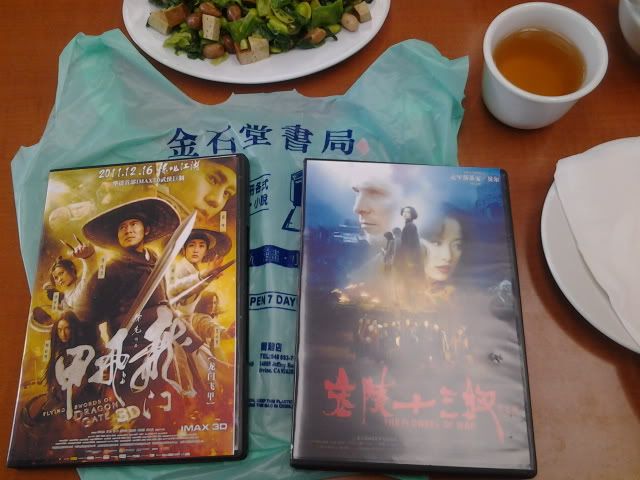
will get the movies dvd


:slight_smile:

saw it.

good.

there are 3 groups of people

  1. Jet Li (zhao huai an) fighting against the east wing and then the west wing.

  2. Chen Kun played the head of west wing that served the queen.

  3. Bands of people looking for the treasure

there is this sand storm that comes every 60 years.

the first one will uncover the buried city with gold.

the second one will arrive in 2 h later and bury the city again.

lots of sands and wind.

lots of things flying including swords, blades, darts, arrows, —

and watch out for the gold silk thread


:slight_smile:

Kudos to SPJ for the first review

SPJ - I take it from your photo that you saw it on DVD. Anyone see it in 3D yet?

Tsui Hark’s ‘Flying Swords of Dragon Gate’ Sets Imax Chinese Exhibition Record
10:40 AM PST 1/24/2012 by Etan Vlessing

Jet Li’s action-packed ride in 3D has passed the $10 million box office milestone in China on 61 giant digital screens.

TORONTO – First Imax’s Aftershock shook the Chinese box office in 2010.
our editor recommends
Imax Sells More Theaters in China to Lark International
Tsui Hark’s ‘Flying Swords of Dragon Gate’ Leads Asian Film Awards Nominations

Now writer/director Tsui Hark’s 3D martial arts epic Flying Swords of Dragon Gate has soared to a new record for the highest-grossing Chinese-produced movie in the Imax format.

Flying Swords, co-produced by Imax with Chinese distributor Bona Film Group, has crossed the $10 million box office mark on 61 digital screens in China since opening on December 15, the Canadian giant screen exhibitor said Tuesday.

That surpasses the previous record for an Imax format film in China set by Aftershock, by Chinese director Feng Xiaogang, and makes Flying Swords the third-highest grossing Imax title in China, behind Avatar and Transformers: Dark of the Moon.

Flying Swords reunites director Hark with Once Upon a Time in China star Jet Li, and stars Zhou Xun, Aloys Chen Kun, Kwai Lun-Mei, Li Yuchun and Fan Xiaoxuan.

Given its box office clout, Flying Swords also leads the Sixth Asian Film Awards nominations with seven nods.

I saw it too

When they say ‘flying swords’, they mean it. This is the anticipated reunion of Tsui Hark and Jet Li in glorious 3D, if only you can go to China and see it in 3D. It’s probably really good in 3D. They got one of the Avatar 3D wizards to work on it and it has no pretensions about the media - a lot of **** flies at you: tea cups, throwing knives, blood, logs, and, of course, swords. It’s got spectacle for sure: fabulously ornate costumes and sets, gorgeous panoramic shots and lots of CGI landscapes. There are a lot of characters including a fine sinister gang of villains, too many for me to keep track of without subtitles. The color schemes are overblown, very retro, almost looks hand-tinted at times; at other times, it’s reminiscent of classic 70s kung fu flicks, which is obviously what the film was going for. A fair amount of sword fights, although it’s all wire work stuff. Jet’s martial skills, along with Gordon Liu’s, are totally wasted.

Is this a good film? It totally depends on the quality of the 3D. If the 3D is good, this film is awesome. The sword fight while chained together in a tornado may beat my all time fav 3D scene, the spaghetti tornado in Cloudy with a Chance of Meatballs. Then again, the 3D might suck and then, this film would be mediocre at best.

Flying Swords lifts Bona Group results
By Patrick Frater
Fri, 02 March 2012, 11:46 AM (HKT)


Chinese studio Bona Film Group Ltd saw net income rise by 70% to $18.8 million in 2011 on revenues that grew 139% to $126 million.

The company received a huge boost from Flying Swords of Dragon Gate , which was China’s fourth biggest domestic film of all time and accounted for nearly a quarter of Bona’s annual turnover. However the high costs of producing the 3-D, IMAX film had a depressing effect on profit margins during the period.

The film’s long-term ancillary value was demonstrated by the RMB22 million ($3.49 million) it achieved in internet rights sales. Total internet rights income for the year was worth over RMB100 million ($15.9 million).

International sales were worth $13 million to the group, with Flying Swords and The Sorcerer and the White Snake together accounting for $7.8 million.

Bona released 15 films in 2011, making it the second biggest distributor after China Film Group. Its other hits included Overheard 2 and Treasure Inn . In the current year it expects to release 16-20 titles, a combination of its own titles, negative pickups and straight acquisitions. These include the upcoming mainland release of award winning A Simple Life .

Group CEO, YU Dong said that Bona’s role in the distribution of imported titles is expected to rise, from just one film in 2011 to perhaps four in 2012. These include The Three Musketeers, which it will release for the May Day holiday in the second quarter. Imports will also flow from China Lion Film Distribution Inc, the overseas distribution company in which Yu confirmed that Bona had taken a 20% investment stake last year.

The group’s theatre business expanded significantly. It ended the year with 11 complexes and 95 screens. But delayed permits for two complexes in Beijing and one in Dongguan mean that three further complexes are completed, but not yet operational. By the end of 2012 Bona aims to have more than 21 multiplexes in operation.

The Chinese film market is expected to grow again in 2012 by a further 30% to some RMB17 billion ($2.69 billion), with forecast theatre numbers expanding from some 9,100 nationwide at the end of 2011 to 12,500 this year.

Bona said that its revenues could grow by 70% this year. It issued guidance that non-GAAP net income could rise from the $18.2 million it reported this time, to $22 million. The forecast figure is held back by a sharply rising tax bill, which finance director Mason XU (who is soon to leave the group) said the company will try to reduce through negotiations with local tax authorities.