Chinglish

Jiayou = add oil

I’ve always translated as “add gas” but now I’m going to start saying “increase lard”. :stuck_out_tongue:

The Chinglish phrase ‘add oil’ now has an entry in the Oxford English Dictionary
Add oil, Oxford English Dictionary! Add oil!
by Alex Linder October 17, 2018 in News

In a major victory for Chinglish speakers everywhere, the phrase “add oil!” has been officially added to the Oxford English Dictionary (OED).

“Add oil” is a direct English translation of the Chinese phrase “jiyóu” (), an exclamation used frequently across China to express encouragement or support for someone else. Despite the phrase being one of the most widely used in the Chinese language, it’s always been difficult to come up with an appropriate way to translate it into English, because of the expression’s versatility, leading some to go with the jokey literal translation.

This happens mostly in Hong Kong. The entry in the online version of the OED says that the phrase originates chiefly from Hong Kong English, giving the definition as “expressing encouragement, incitement, or support: go on! go for it!”

Hong Kong media outlets have widely reported on the phrase’s inclusion in the OED with the city’s net users cheering their contribution to the world’s “most authoritative and comprehensive record of the English language.”

It was Hugo Tseng, an English professor at Taiwan’s Soochow University, who first noticed the entry, penning a gleeful column about his finding in Apple Daily. Tseng said that for more than a decade he had been regularly checking for the phrase following each OED quarterly update, indicating that “add oil!” likely came in the latest batch of new words.

However, the phrase isn’t actually listed in the most recent update of 1,400 new terms, which includes words and phrases like: nothingburger, fam, not in Kansas anymore, eeny-weeny, dunnit, assless, and Pooh-sticks. In a 2016 blog post, OED editors did at least say that they were researching the expression.

THREADS
Chinglish
Wushu Debate Zone

The end of Chinglish?

Noooooooooooooooooooooooooooo!

Beijing is trying to rid city of Chinglish before 2022 Winter Olympics
Enjoy them while you can, folks!
by Alex Linder December 4, 2018 in News

In order to make the city a more foreigner-friendly place, Beijing is in the midst of a colossal crackdown against the hilarious, ubiquitous English mistranslations known as Chinglish.

On December 1st, 2017, a new English translation standard went into effect in China. Since then, Beijing’s foreign affairs office claims to have vetted more than two million Chinese characters on bilingual signs to ensure that they have been properly translated into English.

Back in April, the city even launched a website to allow residents to report Chinglish signs that they spotted around town.

Much like a similar campaign launched a decade ago ahead of the 2008 Beijing Olympics, this crackdown is aimed at cleaning up the city’s signage ahead of foreign visitors arriving en masse for the 2022 Winter Olympics.

Of course, Chinglish signs are part of the charm of living in China and many foreigners here will be sad to see the mistranslations go. So enjoy while you can, folks:


THREADS
Chinglish
Winter Olympics 2022

Hilarious Chinese>English translation fails to make you laugh out loud!

Talking about Chinglish, I definitely get something to share with you people:


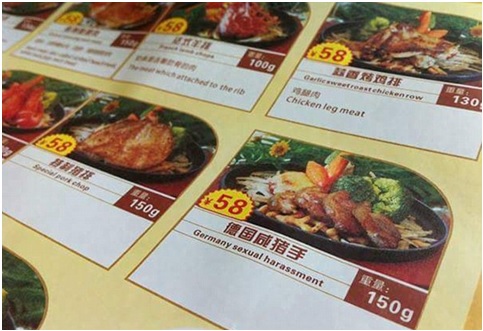
This food must get some special flavor, in a certain way?
[The original Chinese text actually meant: Salty Pork Leg, German Flavor]


You eat this hot dog - at your own risk.
[The original Chinese text actually meant: Hot Dogs & Donuts]


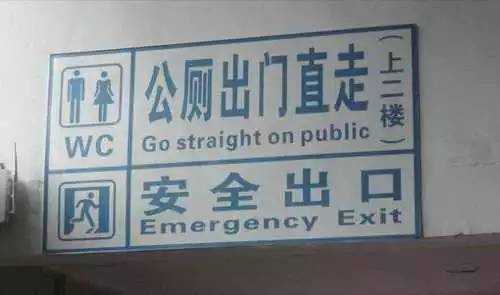
Wait, before I can really relieve “in the public”, let me see if any local guy really does that…
[The original Chinese text actually meant: Public Toliet on Opposite Side]

Quite confusing yet very amusing, aren’t they. Hilarious Chinglish stuff like this always get me burst in laughter…

**** the police

Is it bad that I know several parents that would enjoy this shirt?

Mom orders cute shirt from China for 3-year-old, surprised when it turns up with “f*ck the police” on it
The seller has apologized, explaining that neither he nor his employees knew what the line meant
by Natalie Ma June 3, 2019 in News

While online shopping is extremely convenient, it does have its downsides as one mother from Illinois recently discovered after ordering a T-shirt from a Chinese seller for her 3-year-old daughter.

That young mother, Kelsey Dawn Williamson, had wanted a cute tee for her daughter, Salem, printed with the classic image of children’s book characters Frog and Toad riding a bicycle together. While the image was there, so too were three additional words printed underneath: “**** THE POLICE.”

As you might expect, this sentence was not present on the original product photo on AliExpress. Afterward, Williamson couldn’t help but dress her daughter in the shirt for a picture, declaring “I ****ing love China.” The pic soon went viral, causing Williamson to edit the post to respond to critics on Facebook, noting that Salem cannot read and is seeing specialists about her weight.

“JUST LAUGH AT THE FUNNY SHIRT,” she writes.

[QUOTE]Kelsey Dawn Williamson
Follow · May 28 ·

What I ordered VS what I received.

I ****ing love China. I cannot stop screaming. WHO DOES THIS.

Editing because I’ve seen some nasty attitudes: SALEM IS 3 AND CAN’T READ.
I DID NOT BUY THIS. THIS IS WHAT I WAS SENT.
NO, SHE WONT WEAR IT IN PUBLIC.
“Why would you take a picture??” YOU WOULD TOO, DONT BE A LIAR.

Editing one more time: SHE SEES SPECIALISTS FOR HER WEIGHT. SHE CANT HELP IT. I CANT HELP IT. MY HUSBAND CANT HELP IT. IT IS OUT OF OUR CONTROL. JUST LAUGH AT THE FUNNY SHIRT.

News of the shirt has reached the other side of the Pacific where it was called a “photo processing blunder” by the seller. “My employees didn’t understand that line and failed to take it out,” Huang Sen, the co-owner of a T-shirt company in Fujian province, told Inkstone without actually explaining how the line had appeared in the first place.

“Is what it says radical, negative or anti-government?” he asked the reporter.

Huang added that while he had previously only sold a few of the shirts, after Williamson posted her photo, he had received more than 100 orders.[/QUOTE]

Slightly OT

Didn’t know where else to post this.

China still committed to getting rid of ‘big, foreign and weird’ place names
Civil affairs ministry reaffirms plan to eradicate names that ‘violate the core values of socialism, damage national confidence’
One man says it reminds him of the dark days of the Cultural Revolution
He Huifeng
Published: 3:31pm, 22 Jun, 2019


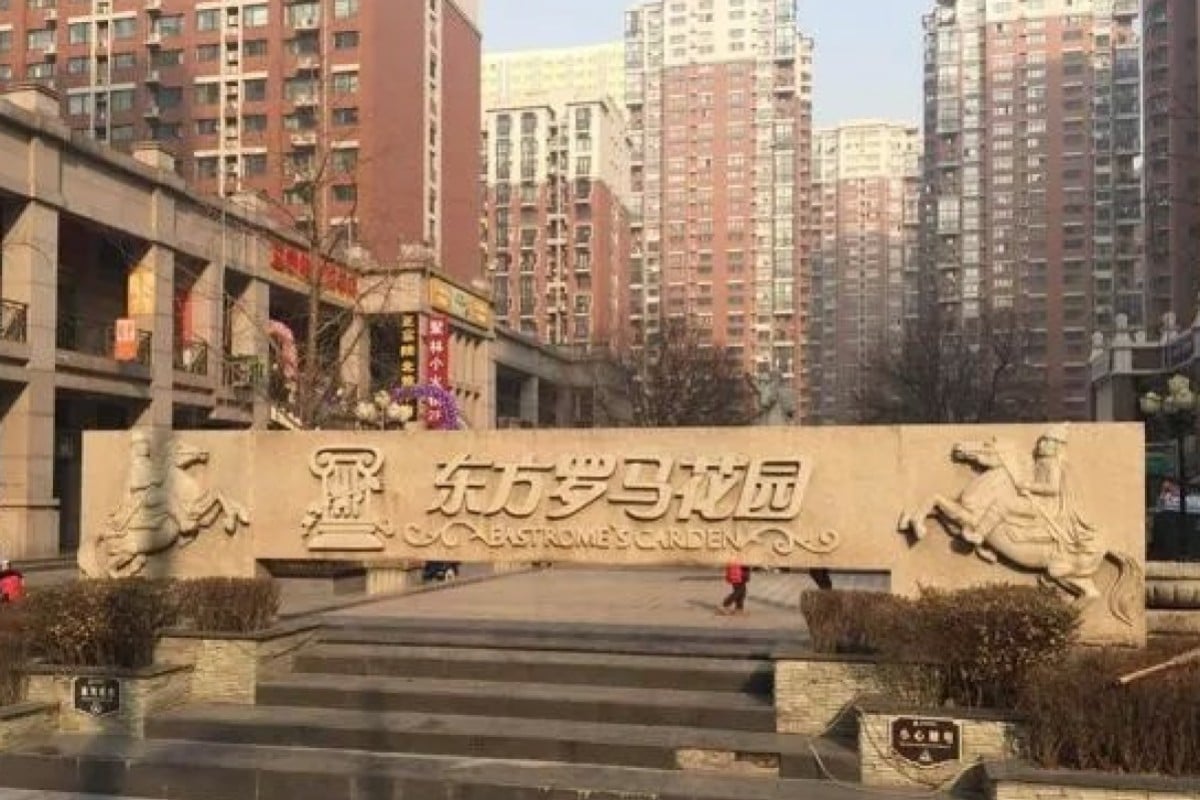
Beijing wants to eradicate place and property names, like “East Rome’s Garden”, that are influenced by foreign or “weird” words. Photo: Weibo

Beijing has reiterated its commitment to rid Chinese cities of “big, foreign and weird” property and place names, sparking a backlash from the public.
The campaign began last year when six government departments introduced a joint policy requiring provincial and county authorities to identify all such properties within their jurisdictions and rename them by the end of March.
On Friday, the Ministry of Civil Affairs reaffirmed its support for the plan, but reminded local governments to implement it “prudently and appropriately”.
Many Chinese properties, especially hotels and apartment buildings, incorporate famous foreign places, like Manhattan, California or Paris, into their names, but under the new rule they all have to go. According to a report by local newspaper Sanqin Metropolis Daily, in one city in Xian, the capital of Shaanxi province, at least 98 apartment projects, hotels, townships, communities and office towers need to be rebranded.


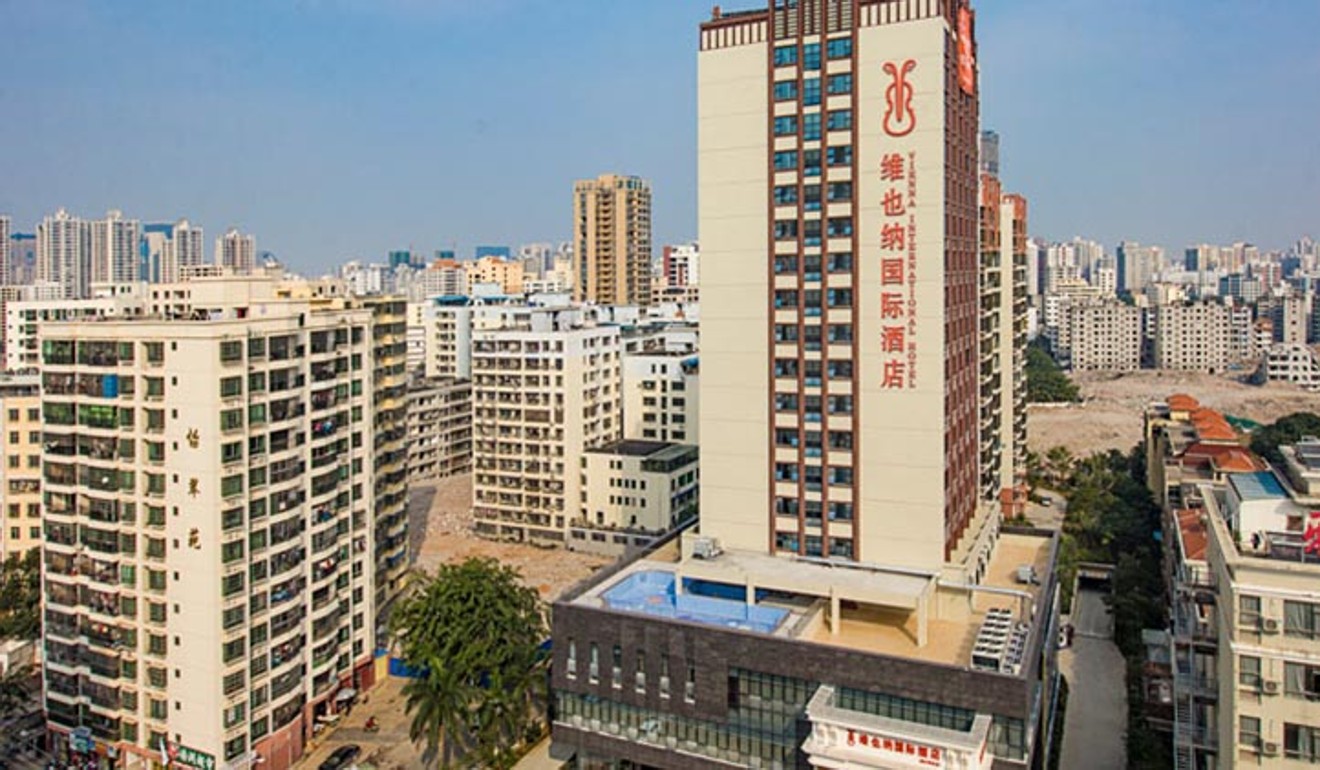
Many Chinese properties, like the Vienna International Hotel, incorporate famous foreign places into their names. Photo: Weibo

But for some people, the plan is nothing more than a waste of time and money.
“If projects are forced to change their names, what about the name on the property certificate, the enterprise licence and tax registration? Do they have to be changed too?” asked Zhu Yun, a woman who lives in Guangzhou, the capital of south China’s Guangdong province.
Hospital’s plan for ‘lucky’ Harvard babies gets poor marks
“And what’s the standard for the new names, and who’s going to do the renaming? It’s just a waste of people’s energy and money, and will do nothing for the national culture or confidence.”
Zhu Min, an octogenarian who also lives in Guangdong, said the scheme had echoes of a darker time in China’s history.
“It reminds me of the bad times of the Cultural Revolution,” he said. “At that time, a great number of streets, roads and stores were forced to rename, because they contained elements of old customs and old culture.”
The debate has also been raging online, with tens of thousands of people airing their views on social media.
“Cultural and national confidence is about respect for multiculturalism,” one person wrote on Weibo, China’s Twitter-like platform.
Tsinghua University sues kindergartens for using its name
Despite the outcry, the civil affairs ministry said the implementation of the scheme was “an important measure … to carry forward the national and local culture”, Xinhua reported.
“The relevant regulations and guidelines of the campaign should be strictly observed to prevent the campaign from being expanded in an arbitrary manner,” it said.
The plan announced last year stated that “big, foreign, weird” place names and those based on ****nyms “violate the core values of socialism, damage national confidence, and affect the production and lives of the people, and must be rectified and cleaned up”.

This article appeared in the South China Morning Post print edition as: Plan to eradicate foreign names triggers backlash

Big **** Hall

Shanghai high school students are on the lookout for Chinglish in public places
Enjoy them while you can, folks!
by Alex Linder October 22, 2019 in News

In its ongoing war against Chinglish, the city of Shanghai has deployed a team of volunteers with a special set of skills.

Local high school students are being used by the city’s language work committee to monitor instances of the English language in public places. Since 2016, around 6,500 high school students have taken part in this effort.

According to Shine.cn, the students have affected change, arguing for the use of “metro” over “subway” and correcting the term “first last train” to “first and last trains.”

The students are now receiving additional training and instruction in more specialized terms as Shanghai is gearing up to host the China International Import Expo next month, which it doesn’t want to be marred by Chinglish.

In December 2017, a new English translation standard went into effect in China with officials vetting millions of bilingual signs across the country since then. The campaign has been especially intense in Beijing which is hoping to clear up the capital’s signage ahead of foreign visitors arriving en masse for the 2022 Winter Olympics.

Honestly, we hope they are less than successful in these efforts as hilarious Chinglish is part of the charm of living in China.

I would’ve taken selfies in front of all of these. Too bad it’s vanishing.

Slightly OT

A font problem but totally needed to be shared here. :smiley:

[URL=“https://www.malaymail.com/news/life/2020/09/15/iqiyi-malaysia-removes-malaysia-day-poster-after-design-blunder/1903354”]
iQIYI Malaysia removes Malaysia Day poster after design blunder
Tuesday, 15 Sep 2020 11:56 AM MYT

BY SYLVIA LOOI


The unfortunate design led to iQIYI Malaysia removing the poster from its social media platforms. — Picture via Twitter
KUALA LUMPUR, Sept 15 — Online movie and video streaming website iQIYI Malaysia has apologised and removed a Malaysia Day poster after the image went viral on social media for all the wrong reasons.

Taking to its social media accounts, the company clarified that the tagline for the campaign was Anak Malaysia and not as widely mistaken due to the poor choice of fonts and design.

Trying to make light of the situation, the company promised it would be more careful and “check at least 50 times” to avoid future blunders.

It also advised those who were confused about the logo not to say it out loud in front of children.

The explanation however did not appease Internet users.

Nazri Liwon urged the company to decide on what language it wants to use on its poster.

“If want to use Bahasa Melayu, use it correctly. If want to use English language, use it properly.”

Ady Adnan said the logo failed as it showed the graphic designer couldn’t care less.

Naomi Saavedra said as someone who studies graphic design, they are required to double-check any design mistake to ensure it does not touch any sensitivity.

The poster was put up on September 9 in conjunction with Malaysia Day tomorrow to promote local shows screened on its platform.