but.. butt…
…tiger balm is so darn cheap. Why would I bother to make my own? That would be like making my own dental floss.
I find tiger balm to be excellent for bug bites. And of course, flatulence. 
but.. butt…
…tiger balm is so darn cheap. Why would I bother to make my own? That would be like making my own dental floss.
I find tiger balm to be excellent for bug bites. And of course, flatulence.
…well, Gene, if you find it effective in reducing sphincter tightness to allow the gas to pass, you should try encasing a dallop of the Balm in a small torpedo of cocoa butter for a more direct approach 
~ox
I agree 100%. Wait, WTF?
WTF is right…
That’s the second post by herb ox on 08-10-2006 in reference to my anal functions. Obviously herb ox has some kind of fixation there and I better beware… :eek:
I was set up!
Wait a minute, Gene… I was only responding to your ‘but… butt’ post hailing TigerBalm as a cure for your flatulence. I simply suggested a more direct approach.
As for the Acai berry article, I was simply commenting on your discovery of the juice keeping you ‘regular’…
Indeed, Gene, it appears you are the bubbling wellspring… let’s rect-ify this situation!
~ox
set up indeed
In fencing, we call that a ‘second intention’ attack.
And I’m sure if you ask anyone in our circle, they will declare you as the ‘bubbler’. There’s no doubt about that, bro. 
I made one in may. I call it Crouching Tiger Hidden Dragon Balm. I made it with Eucalyptus, mint, lemon balm, lemongrass, mugwort, lavender, chamomile, wintergreen, white sage, clove and camphor. Smells very good.
tiger balm is pretty good stuff if you get it in the bottle, this is a hell of a lot stronger and works better on strains/aches than the wax stuff.
I tried ‘siang pure oil’ and this was barely good enough for mosquito bites…
I stick to LKW’s wisest oil and random jows for everything nowdays.
craig
half decade old ttt!
Special thanks to our Platinum sponsor for Tiger Claw’s KungFuMagazine.com Championship III this year, Tiger Balm.
Enter to win a Tiger Balm T-shirt and Cap! Contest ends 6:00 p.m. PST on 06/30/2011.
ttt for 2018!
The Tiger Balm story: how ointment for every ailment was created, fell out of favour, then found new generation of users
Analgesic balm in a hexagonal jar, launched in Rangoon by the Aw brothers in 1924, was a staple of Chinese families’ medicine cabinets for a generation. Today, Tiger Balm products have fans around the world, including Lady Gaga
PUBLISHED : Saturday, 17 February, 2018, 8:31am
UPDATED : Wednesday, 21 March, 2018, 12:25pm
Christopher DeWolf
You get a strong whiff of it before you see it. Approaching the nondescript factory block in a suburban estate on the edge of Singapore, you are hit by the invigorating aroma of menthol and camphor. Your sinuses clear, your eyes tingle.
“Nobody who works here has to worry about getting sick,” Han Ah Kuan jokes as he stands outside the entrance to the factory.
Han is executive director of the Haw Par Corporation, the company responsible for that powerful aroma. He has tousled white hair, an easy-going demeanour, and little hexagonal jars of Tiger Balm in his home, office and car. For nearly a century, people around Asia and ****her afield have been using his company’s product to relieve muscle aches, cold symptoms, headaches and more.
Former Hong Kong resident Andrea Tam remembers how her grandmother kept a tiny red tin of the balm in one of her undershirt pockets. “She literally used it for everything – any type of cuts and aches,” she says.
British-born journalist Vicky Wong has a similar story. “[It] reminds me of my nan,” she says. “No matter what the ailment – sore throat, cold, nosebleeds, mosquito bites – she would just put Tiger Balm on you.”
Han has refused to let Tiger Balm recede into the shadows of nostalgia since he joined the company more than 25 years ago. He wants it to be seen as indispensable by everyone from athletes to Snapchatting teenagers.
“Today, I would say our consumer demographic ranges [across] all ages and classes, male and female,” he says. “That means we’re able to produce products for different users in different generations.”
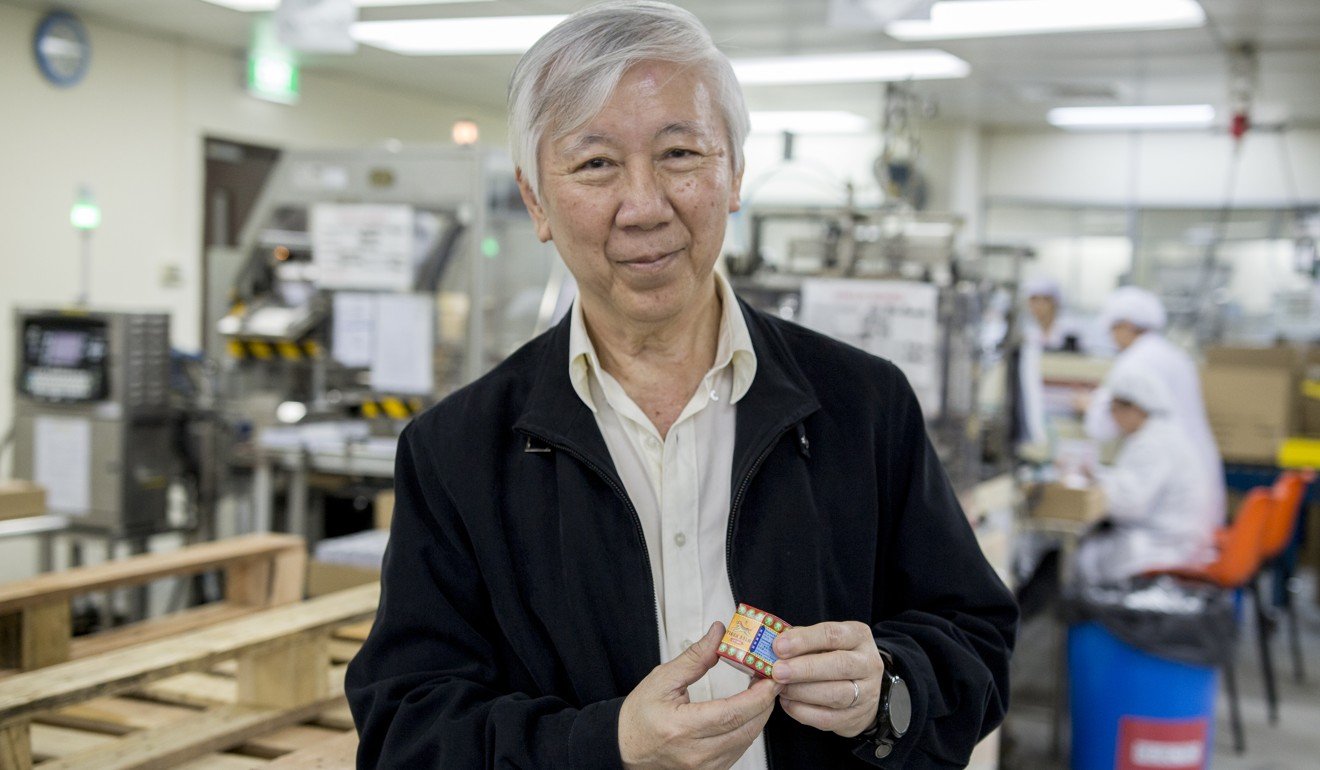
Han Ah Kuan, executive director of the Haw Par Corporation, inside the Tiger Balm factory in Singapore. Photo: Christopher DeWolf
The Tiger Balm story begins several generations ago in rural Fujian province, in southern China. That’s where, in the late 1860s, Aw Chu Kin, the son of a herbalist, set off to join his uncle in the Burmese city of Rangoon.
[QUOTE][It] reminds me of my nan. No matter what the ailment – sore throat, cold, nosebleeds, mosquito bites – she would just put Tiger Balm on you.VICKY WONG
It was a long journey that took him through Singapore and Penang, in Malaya, where he earned more in a day selling herbal remedies to dock workers than he did in a month back home.
By 1870, Aw had made it to Rangoon. He set up an apothecary named Eng Aun Tong (the Hall of Eternal Peace) and had three sons: Aw Boon Leong (“Gentle Dragon”), Aw Boon Haw (“Gentle Tiger”) and Aw Boon Par (“Gentle Leopard”).
Boon Leong died young, and father Aw died in 1908, leaving the family business to Boon Par and Boon Haw. Together, they delved into their father’s recipes and adapted them to produce an analgesic balm to treat any manner of ills. When it launched in 1924, Boon Haw named it after himself: Tiger Balm.
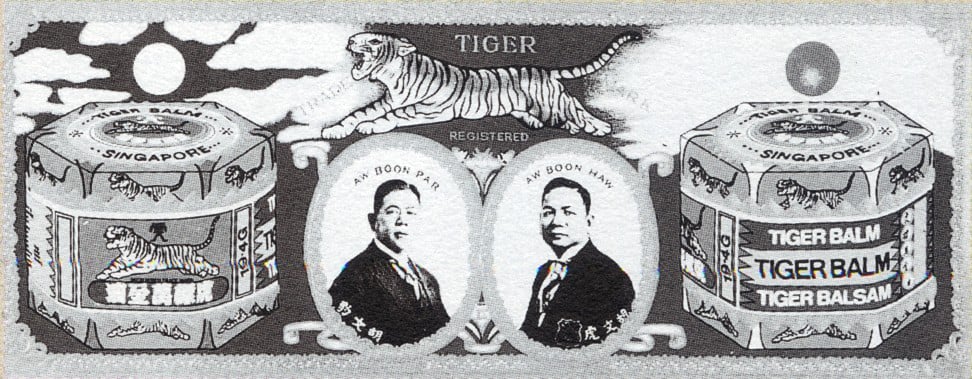
A vintage Tiger Balm advert showing the Aw brothers. Photo: Haw Par Corp
The product spread quickly through the world’s Chinese communities. While Boon Par focused on managing the business, Boon Haw aimed to gain influence. He donated money to charities and schools, and founded a string of newspapers in Singapore, Malaya and Hong Kong, including Sing Tao Daily and the Hong Kong Tiger Standard – which is today known simply as The Standard.
He also built mansions in Singapore, Hong Kong and Fujian, with adjoining theme parks known as Tiger Balm Gardens. Their pathways were lined by bizarre and morbid concrete statues in scenes from Chinese mythology.
The Hong Kong park was torn down in 2004 after it was sold to Li Ka-shing’s Cheung Kong Holdings by Boon Haw’s adopted daughter, Sally Aw Sian. The Singapore park was donated to the city’s government, which maintains it as a historic site.
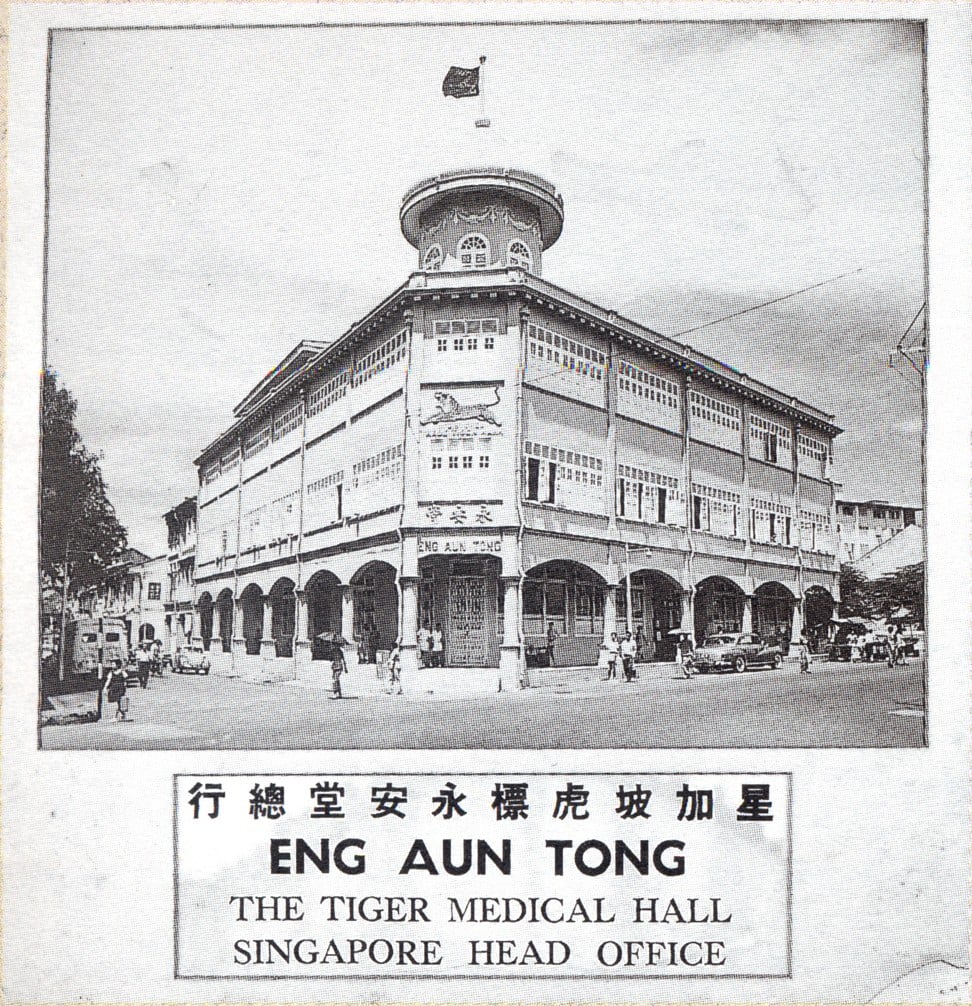
An old picture of the Eng Aun Tong headquarters in Singapore. Photo: Haw Par Corporation
The Tiger Balm business endured a period of struggle after the Aw brothers died; Boon Par in 1944 and Boon Haw in 1954. Not long after it went public on the Singapore stock exchange in 1969, the company was taken over by British conglomerate Slater Walker, which soon afterwards collapsed in a banking crisis.
After a period of uncertainty, Singaporean banker Dr Wee Cho Yaw gained control of Haw Par in 1981 and began rebuilding the company. In 1992, Haw Par took back Tiger Balm, which had been franchised out for 20 years during the Slater Walker period. By that time, the tiger was a shadow of its former self.
“When we took it back, the product had lost almost a generation of users,” says Han. He joined the company in 1992 after being headhunted from Vicks VapoRub, one of Tiger Balm’s direct competitors.
Born in Malaysia, Han grew up in Singapore and, like most people in the city state, he was familiar with Tiger Balm from his youth. But from a professional perspective, he saw how the brand was struggling.
[/QUOTE] continued next post
Continued from previous post
A Tiger Balm logo from the 1930s. Photo: Haw Par Corporation
Han was convinced that the weakness stemmed from the branding, not the product. Tiger Balm works by tricking nerve endings with cooling and heating sensations, interrupting other signals from muscle pain or itchy insect bites.
It is much stronger than most similar products on the market. Vicks contains 8.6 per cent active ingredients: synthetic camphor, eucalyptus oil and menthol. Tiger Balm contains 60 per cent, including natural camphor, mint oil, cajuput oil, menthol and clove oil.
But the ointment had its limits. Some consumers didn’t want to smell like Tiger Balm when they sat in the office; others didn’t like how greasy it was. And a jar of ointment can last for months, if not a year – hardly a recipe for revenue growth.
Han realised Tiger Balm’s main challenge was to improve its reach. So the company’s formula was adapted for a new range of products. The first was a disposable plaster, introduced in 1993. “It’s Tiger Balm you can wear,” Han says.
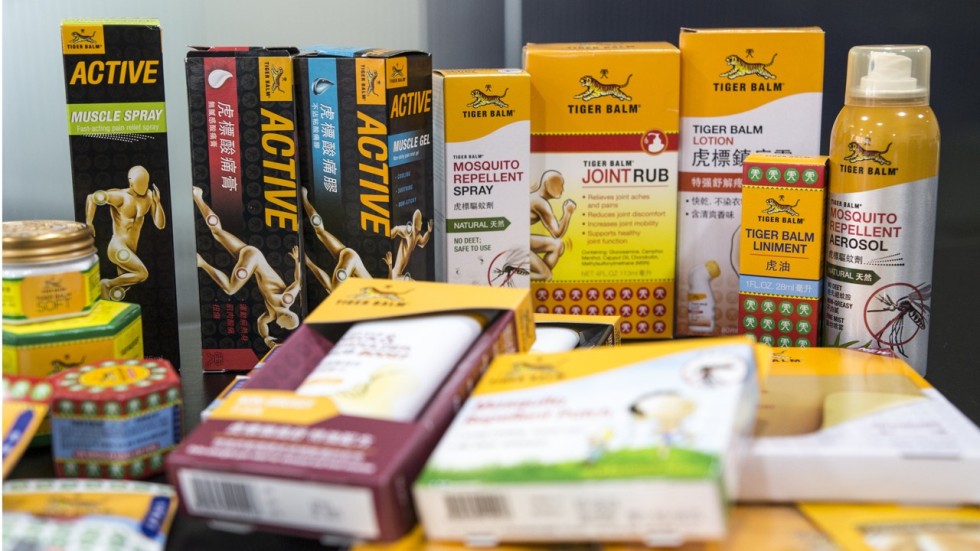
Since then, the company has introduced a line of sports-focused warm-up creams called Tiger Balm Active, mosquito repellent patches and, most recently, a lavender-scented neck and shoulder rub targeted specifically at muscles strained by the posture of smartphone users.
All told, there are now 10 products under the Tiger Balm brand.
Han also pushed the company to expand into new markets. “I think almost every Singapore, Hong Kong and Thai person grew up using Tiger Balm – and that’s where the issue is,” he says.
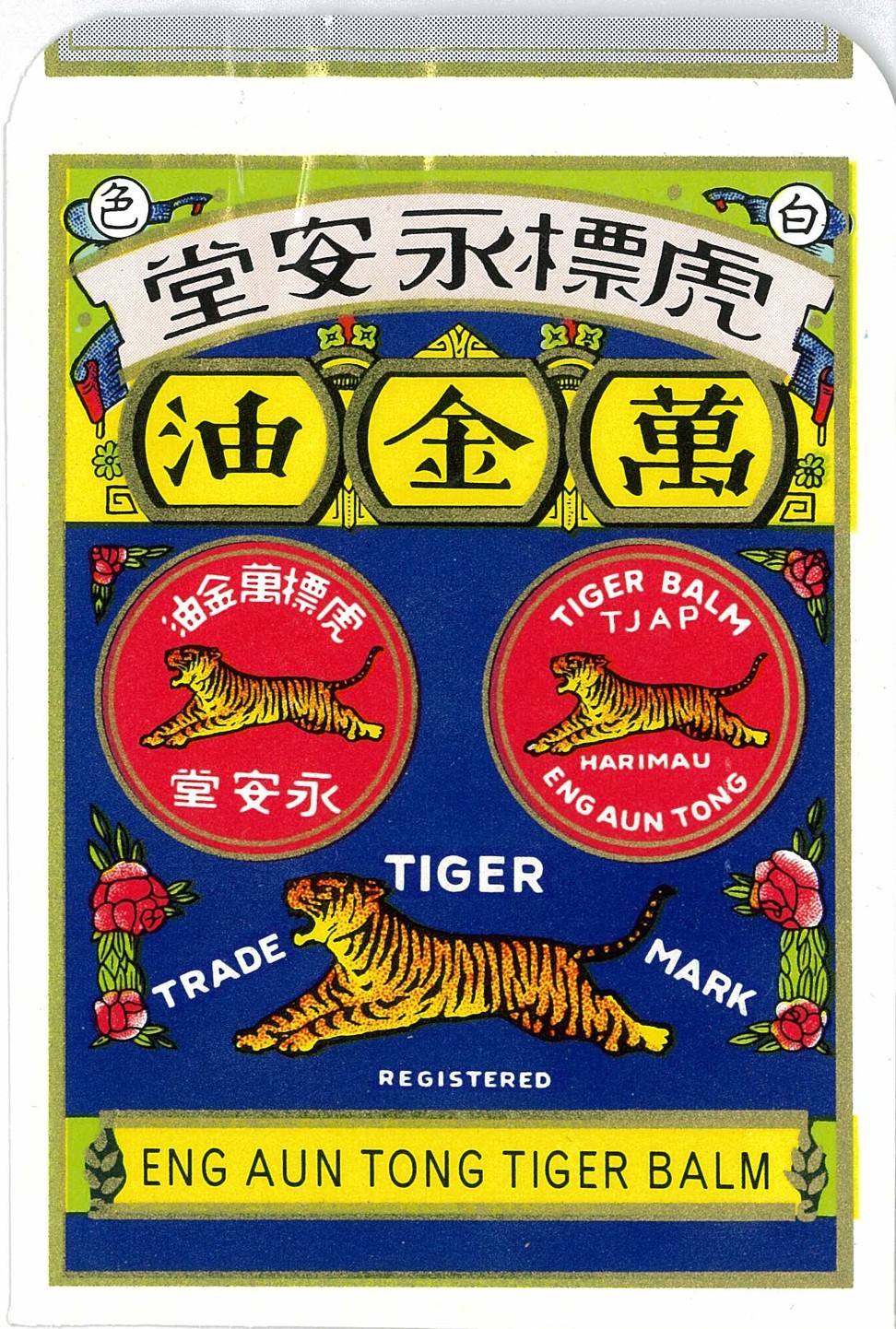
The classic Tiger Balm tins. Photo: Haw Par Corporation
Western markets were a blank slate by comparison. “They don’t have the baggage of it being their grandfather’s product.”
In the 1990s, Tiger Balm enlisted American football stars Joe Montana and Jerry Rice as spokesmen, which helped the ointment become popular among athletes. “Some of them, their arms are bigger than my thigh,” says Han. “They use a lot of Tiger Balm.”
Most recently, the brand has received unsolicited endorsements from Lady Gaga and other celebrities, who have praised it on social media. The company also tweaked its branding, striking a balance between conserving its heritage and refreshing its image.
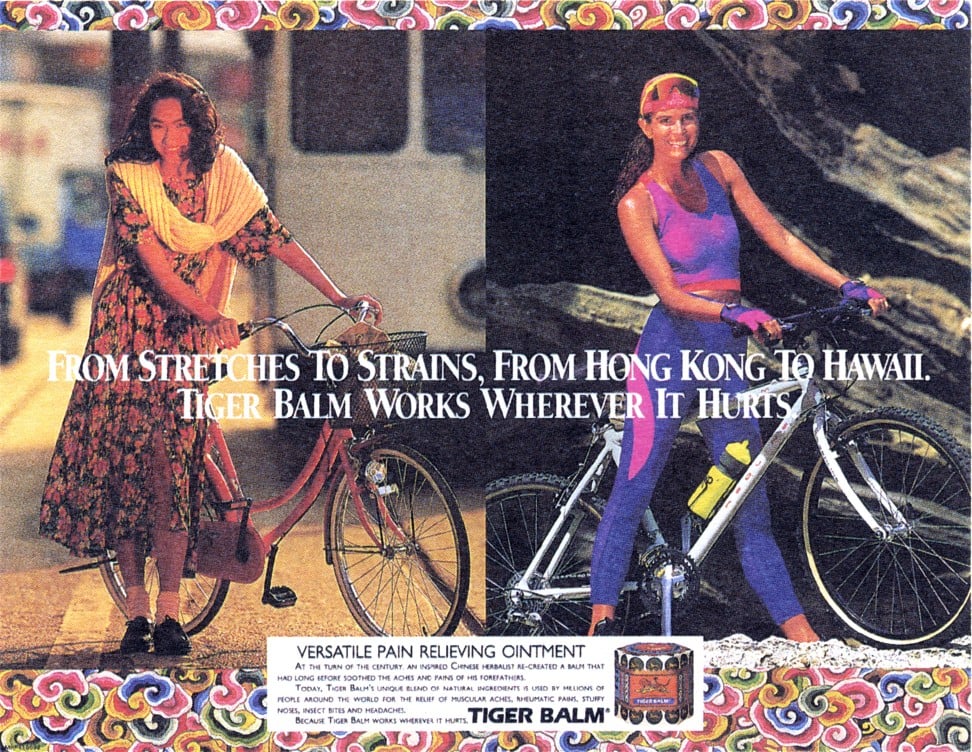
A Tiger Balm advert geared to the US market. Photo: Haw Par Corporation
The proprietary orange colour was preserved, along with the hexagonal-shaped bottle, both of which were introduced by the Aw brothers when the product was first launched. (Han says they chose a hexagon because “it’s a very auspicious shape” – and it’s easier to grip than a round bottle.)
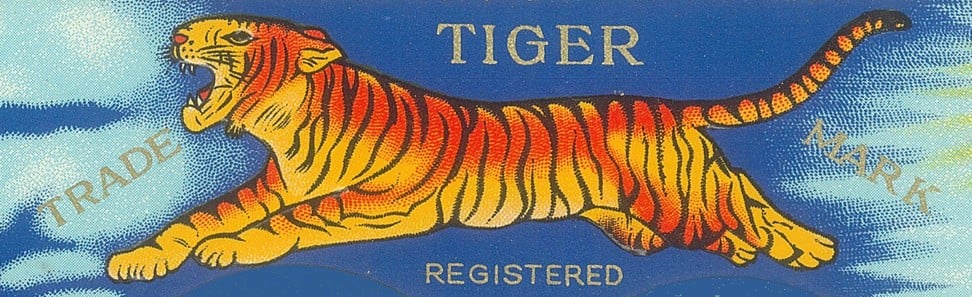
The brand’s main emblem was given a new look, however. “We changed from a resting tiger to a leaping tiger,” Han says.
The changes seem to have worked. Last year, Tiger Balm sold 66 million units of its products, a 16 per cent increase over 2016. It is now available in about 100 countries and trademarked in 145.
Han says the company often fends off imitators – Leopard Balm and the like. “We are paying a lot of legal fees,” he says, laughing.
What hasn’t changed much is the original product, whose two varieties – red for muscle aches, white for cold and flu – are still based on the formula pioneered by the Aw brothers.
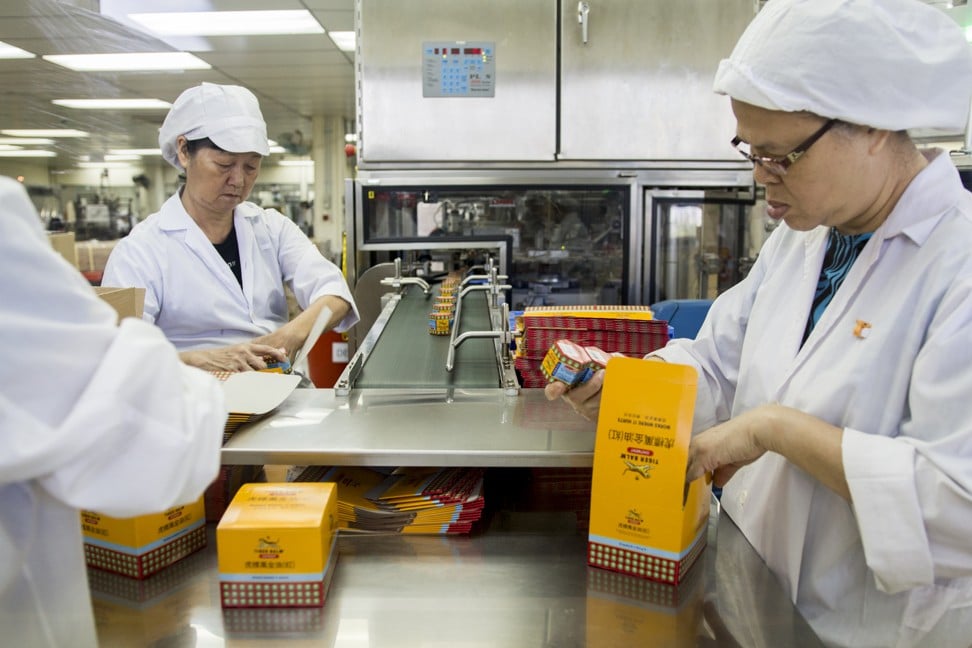
Workers pack Tiger Balm at the Haw Par Corporation’s Tiger Balm factory in Singapore. Photo: Christopher DeWolf
After donning a hairnet, surgical mask, disposable white jacket and protective bootees, Han steps onto the factory floor and explains how the balm is made.
First, essential oils are analysed in a lab to make sure they meet quality standards. They are then blended with paraffin petrolatum – a petroleum by-product that keeps Tiger Balm semi-solid at room temperature and soft when it touches the body – in steel tanks about the size of a large refrigerator.
Next, the hot formula is piped into glass jars, cooled, and packaged using machines custom-designed to handle the balm’s hexagonal paper boxes. It’s a noisy procession of clinking jars controlled almost entirely by machines, though not without human supervision. There are about 100 workers in the Singapore factory, and more in Tiger Balm’s facilities in Malaysia and China.
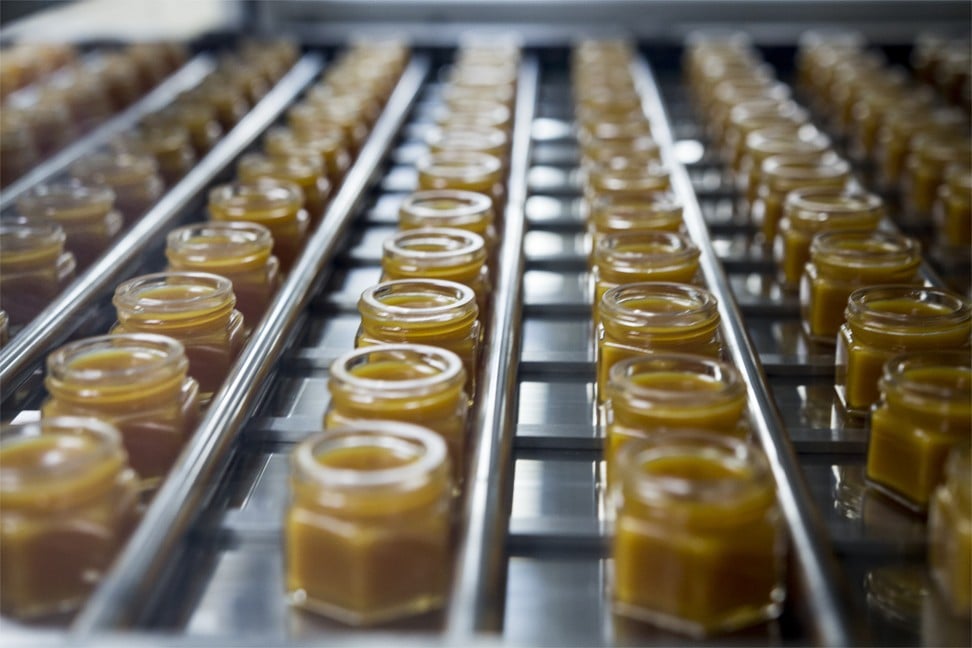
Tiger Balm jars being filled at the Haw Par Corporation’s Tiger Balm factory. Photo: Christopher DeWolf
At the end of the line, little boxes of Tiger Balm are placed by hand into slightly larger boxes, which are in turn placed into even larger cartons that are shipped around the world.
And when they reach their destination, a grandmother or an athlete or a stiff-necked office worker will open up a jar and breathe in that unforgettable aroma.
This article appeared in the South China Morning Post print edition as: The charm of the balm
I don’t think you can even say you train Kung Fu if you’ve never used Tiger Balm. In fact, I’m going to put some on an injury right now.
Nicole Scherzinger, formerly of The *****cat Dolls

Nicole Scherzinger visited various tourist sites in Singapore, including Haw Par Villa.
PHOTO: Screengrab/Instagram/Nicole Scherzinger
Drima Chakraborty
PUBLISHED ON
MAY 03, 2024 9:25 PM
By DRIMA CHAKRABORTY
She’s strutting her stuff and promoting Singapore’s tourism at the same time.
American singer Nicole Scherzinger, formerly of The *****cat Dolls, was in Singapore recently, posting photos and videos of herself at Gardens by the Bay and Marina Bay in collaboration with the Singapore Tourism Board on May 1.
“I can’t wait to show you what I’ve been up to with Visit Singapore. Have you ever been?” the 45-year-old American captioned her sponsored post on Instagram.
The next day Nicole posted an ad via Instagram Reels, showing herself walking through Gardens by the Bay, Haw Par Villa and the Sensoryscape at Sentosa, in four different elaborate outfits.
“Runways made in Singapore,” the ad read.
“Why was I ready for some of your vocals to kick in like this was a new single?” a netizen commented.
Visit Singapore wrote: “You’ve got the best outfits for each of these local spots, Nicole.”
In a following Instagram post, Nicole revealed a behind-the-scenes look at her adventures in Singapore.
At Haw Par Villa, she went up to a sculpture sitting on a rock with a pipe and said: “I wanna know what this guy is smoking.”
“I think this guy is smoking opium,” her cameraman said, laughing.
Nicole approached the camera and whispered: “I thought this was a religious site.”
Though Haw Par Villa draws inspiration from Chinese religions including Taoism and Buddhism, it’s a cultural park full of over 1,000 statues and 150 dioramas of Chinese myth and folklore.
Another video taken by Nicole shows a beach club in Sentosa with The *****cat Dolls’ single Buttons blasting over the speakers.
Nicole’s most recent post from Singapore on May 3 shows her dancing to Beyonce’s new single Texas Hold 'Em at Gardens by the Bay.
A clueless netizen commented, echoing the song’s lyrics: “That’s right this ain’t Texas… it’s Hawaii.”
Others were quick to point out that she was in fact in Singapore.
“Never stop dancing,” another netizen wrote.
Nicole was the lead singer of The *****cat Dolls from 2003 to 2010 and again during their reunion between 2019 and 2021.
She’s also been involved in musical theatre, performing in Cats (2014) and Sunset Boulevard in its recent run at London’s West End. She has also played roles in Moana (2016) and the 2017 remake of Dirty Dancing.
Too funny