well considering this is now called “grandmasters” and not “the grandmaster” and that yip man is just one of the characters and not the main character…there should be a title change. idk…the trailer and all the info point to a martial arts film noir, which could be cool…but again idk. the trailers have been uninspiring to say the least.
Good point, Doug
Title changed.
It’s that Wong Kar Wai factor plus the cast that is giving this film such buzz. Personally, I’ve never been a huge WKW fan, but I know a lot of film people that just go nuts over him. We’ll see. 
Now the bump makes sense
Wong was waiting for an international festival to premiere it at - what better one than one where he’s the president? :rolleyes:
Wong Kar Wai’s The Grandmaster to open Berlin film festival
Matilda Battersby
Wednesday 19 December 2012
The Grandmaster will open next year’s Berlin International Film Festival as its
international premiere.

Directed by Wong Kar Wai, president of this year’s festival jury, the film is set against the tumultuous backdrop of 1930s China.
The film is inspired by Yip Man, legendary grandmaster of the martial art Wing Chun and master to Bruce Lee, about whom at least three films (Wilson Yip’s Ip Man and Ip Man 2, and Herman Yau’s Legend Is Born – Ip Man) have already been made.
The Grandmaster’s title was changed from Grandmaster Ip Man after it was discovered that it and another Ip Man film were being made totally separately at around the same time.
Wong’s film was originally intended for release in 2011 but it was plagued by production issues with three years of film production following almost a decade of preparation.
The film stars Tony Leung Chiu Wai who has appeared in a number of films directed by Wong, including Days of Being Wild and Happy Together. Co-stars include Crouching Tiger, Hidden Dragon actors Ziyi Zhang and Chang Chen, Happy Times’ Zhao Benshan and A Woman, A Gun and A Noodle Shop actor Xiao Shengyang.
“It is a special honour for us to open the 2013 Berlinale with the presentation of the newest film by this year’s jury president, WONG Kar Wai. With The Grandmaster, Kar Wai has added a new and exciting facet to his body of works, and created an artful, visually powerful genre film,” says festival director Dieter Kosslick.
The world premiere of The Grandmaster will be on 8 January 2013 in China, and the film will open at cinemas in numerous countries worldwide in spring 2013.
Matt Damon film Promised Land is set to compete in this year’s Berlin film festival competition. The film, which is also having its international premiere at the festival, will vie against five other movies in Berlin’s official competition next February.
133 minutes
I actually prefer longer movies. It comes from watching too much Bollywood. However, an excessively long Wong Kar Wai flick might do me in. While I respect Ashes of Time, I don’t think I could have sat through it if it was much longer than it already was.
Wong Kar-Wai’s ‘The Grandmaster’ Running Time Will Test Patience For Those Who Think Movies Are Too Long Now
by Kevin Jagernauth
January 2, 2013 5:17 PM
This awards season, certain corners of the internet have been complaining that movies are just too darn long. “Zero Dark Thirty,” “Django Unchained,” “Les Miserables,” “Lincoln,” “Amour” and “This Is 40” all broke the 2 hour mark. And some fidgety reporters who seemingly can’t sit still for more than a couple hours will be disappointed that one of 2013’s most eagerly awaited movies will test their bathroom break-timing.

Over on Twitter, Love HK Film editor Kevin Ma has pointed over to Hong Kong’s Newport Circuit theater site, which reveals the runtime for Wong Kar-Wai’s “The Grandmaster” as 133 minutes. It makes it his second longest film behind “2046,” so don’t order the jumbo soda, guys. The film has been a long time coming, featuring for the past five years on our Most Anticipated Movies list and being delayed each time for a variety of reasons. But it’s coming for real in 2013: opening in China next week on January 8th, and making an international bow in February at the Berlin Film Festival.
As for when it will reach our shores? Who knows. Annapurna Pictures has the rights, but no U.S. distribution deal has been struck yet.
still not quite ready
last minute drama queen. :rolleyes:
Wong Kar-wai in Last-Minute Rush to Finish ‘The Grandmaster’ For World Premiere (Report)
8:33 PM PST 1/3/2013 by Clarence Tsui

The Hong Kong auteur is still putting final touches to his martial arts epic, with the film to be delivered to mainland Chinese censors hours before its first press screening in Beijing on Jan. 5
HONG KONG – Producers of Wong Kar-wai’s The Grandmaster will be transporting the film for clearance with mainland China’s censors on the morning of Jan. 5 – just hours before a scheduled press screening in Beijing in the afternoon.
According to Hong Kong newspaper Apple Daily, Wong is still working on the film’s post-production in Thailand today (Jan. 4) with his production designer William Chang Suk-ping.
The report stated that the film’s financiers and distributors, Sil-Metropole Organisation, will deliver copies of the film to the Film Bureau in Beijing to secure a screening license in the country. The film will also be submitted to the Communications Authority in Hong Kong for a film classification in the city.
The world premiere of The Grandmaster will take place in the Chinese capital on Sunday (Jan. 6), with Wong attending a press conference beforehand with stars Tony Leung Chiu-wai, Zhang Ziyi and Chang Chen. The film will then be released on Jan. 8, and then subsequently opening in Hong Kong, Wong’s hometown, on Jan. 10.
The Grandmaster was originally slated for release in China and Hong Kong in December. While the cast has been doing publicity for more than a month already, Wong has yet to grant interviews to the press. His assistants have responded to media requests saying the filmmaker remains busy at work finishing the movie, which will open the Berlin Film Festival – where Wong will serve as head of the official competition jury – on Feb. 7.
Sil-Metropole has already put in a place a 300-strong team ready to deliver digital prints to theatres across China once the film is green-lit by the authorities, according to the Apple Daily report.
The Grandmaster will be the sole major production to be released in China next week, and is widely expected to have a clear run at the box office before Skyfall opens on Jan. 21. The performance of Wong’s film will challenge the successful runs of festive hits Lost in Thailand and CZ12. The former has already secured 1.1 billion yuan (US$176.5 million) at the box office and is now vying to become the highest-grossing film in Chinese history, a record presently held by Avatar (which took 1.38 billion yuan/US$221.4 million in the country).
Nearly a decade in the making, The Grandmaster is a fictionalized account of the early career of Ip Man, a real-life martial arts expert and the mentor of Bruce Lee. Details of the story have been scarce but the film is understood to revolve around the rivalry and romance between Ip (played by Leung) and specialists from other martial arts schools in northeastern China.
While boasting a stellar cast and action choreography from Yuen Woo-ping (who designed fight scenes for Crouching Tiger, Hidden Dragon and the Matrix trilogy), production of the film has been subjected to a few hiccups, with Leung having broken his arm while training for his role before shooting began.
True to style, Wong has also subsequently conducted additional filming after principal shooting has ended, while also requiring his actors to be on stand-by for possible extra contributions to the film. Interestingly, Chang has spent so much time in practice that he became a real athlete himself, winning a mainland martial arts competition earlier this year.
With his films securing regular critical garlands in the film festival circuit – a Best Cinematography title for Ashes of Time (1994) in Venice, a Best director prize for Happy Together (1997) in Cannes and a Best Non-European Film gong for 2046 (2004) at the European Film Awards – Wong remains one of the most well-known auteurs to come out of Hong Kong in recent years.
The 54-year-old has become such an art-house brand that festival directors have given him much leeway in exchange for his films to take a bow at their events. The most memorable incident took place in 2004, when Cannes announced the inclusion of Wong’s erstwhile untitled (and unfinished) film in its official competition. The festival had to cancel the first screening of the film because Wong was unable to finish the film in time, and reports stated that a copy of the film was transported straight from the processing labs to the Grand Theatre Lumiere in time for its world premiere.
Opens this week. Finally.
January 7, 2013, 2:23 PM
‘The Grandmaster’ Hits Theaters
By Dean Napolitano
After more than a decade in the making, Wong Kar-wai’s ‘The Grandmaster’ finally makes its premiere.

Wait no more.
Hong Kong director Wong Kar-wai’s long-anticipated epic “The Grandmaster,” starring Tony Leung Chiu-wai as the legendary real-life martial-arts master Ip Man, opens this week in China and Hong Kong. The film also stars Zhang Ziyi and Chang Chen.
Mr. Wong — the director of such films as “Days of Being Wild,” “Happy Together” and “In the Mood for Love” — devoted nearly a decade on preparation for “The Grandmaster,” which spent almost three years in production. The famously meticulous filmmaker appeared at a press conference with his cast on Sunday night in Beijing, where the film held its world premiere.
Mr. Wong said the film, which runs well over two hours, “could have last four hours, but I deleted a lot of scenes,” according to a report from Agence France-Presse.
The movie, set during China’s turbulent political and social period of the 1930s, is in both Mandarin and Cantonese.
International audiences will have to wait a bit longer before getting a first peek. “The Grandmaster” will open next month’s 63rd Berlin International Film Festival, where Mr. Wong is this year’s jury president.
I started watching some old WKW flicks on netflix. I’m still underwhelmed by his work. I see the artsy-ness of it all, but it still doesn’t quite work for me personally.
Reviews are coming in
Hong Kong art house director Wong Kar Wai back with kung fu epic
Hong Kong director Wong Kar-Wai removes confetti from his sunglasses after he beats a drum with cast members at the premiere of the movie ‘‘The Grandmaster’’ in Hong Kong January 8, 2013. REUTERS/Tyrone Siu
By Venus Wu
HONG KONG | Tue Jan 8, 2013 11:30pm EST
(Reuters) - Hong Kong art house director Wong Kar Wai, whose slow-paced, pensive films earned him laurels at international festivals such as Cannes, where he won best director, has just come out with “The Grandmaster,” his latest kung fu epic.
The fruit of eight years of labor and selected as the opening movie for February’s Berlin International Film Festival, The Grandmaster tells the legendary tale of Bruce Lee’s master Yip Man, played by Wong’s long-time collaborator and Cannes best actor award winner Tony Leung.
The concept of the movie hit Wong even before he released his most celebrated work, In The Mood for Love, back in 2000, said the director, wearing his trademark sunglasses, at the movie’s Hong Kong premiere on Jan 8.
The idea kept brewing in his head and eventually took him on a three-year journey, knocking on the doors of over 100 kung fu masters across China.
"In the world of martial arts, there’s a saying that goes – ‘the skies outside and inside the door are different,’ he said.
“When you look at it outside the door, it will forever stay a mystery. But when you have a chance to put your head inside and take a peek, you then realize that (the world) inside draws you in,” added Wong, who will also serve as the president of the jury for this year’s Berlinale.
The auteur set his eyes on four martial art clans for his feature film, but stressed that he wanted to convey a common spirit shared by grandmasters and aficionados alike.
“In the world of martial arts, there are many people who are not ‘masters’, but they have a deep affection for martial arts. They always hope to leave something behind for their clan and martial arts during their lifetime,” he said.
“I think this spirit is the spirit that ‘The Grandmaster’ wants to convey – lingering thoughts that are never forgotten, echos that will always come,” Wong said.
Set at the infancy of modern China in the early 1900s, the retirement of a martial arts guru leaves the title of Grandmaster up for grabs.
Among the four top fighters for the position is the feisty Gong Er, played by Zhang Ziyi of Crouching Tiger, Hidden Dragon and Memoirs of a Geisha.
For her role, Zhang trained under the teacher of kung fu star Jet Li, and said the movements were key to expressing the spirit of the characters.
“She (Gong Er) is a combination of almost all the unique features and merits of women of that era,” Zhang said.
“In terms of movements, we trained for such a long time because the director hoped when we went inside the world of the characters, we already carried their spirit in our bodies.”
Wong took the Best Director Award at Cannes in 1997 for “Happy Together,” which depicts a tempestuous romance between two men and was also nominated for the Palme d’Or.
Plagued by delays, The Grandmaster finally made its global premiere in Beijing on Jan 6, and opened across China on Jan 8 before showing in Berlin on February 7.
(Reporting by Venus Wu, editing by Elaine Lies)
The critics are eating this up.
January 9, 2013, 6:54 PM
Wong Kar-wai Scores With ‘The Grandmaster’
By Dean Napolitano

MediAdvertising (HK) Ltd.
Zhang Ziyi, center, stars as Gong Er in Wong Kar-wai’s ‘The Grandmaster.’ More photos
After a decade of preparation and three years of filming, Wong Kar-wai’s “The Grandmaster” opened in China on Tuesday, and any lingering questions over whether the movie would live up to its lofty expectations immediately evaporated.
Mr. Wong has made a martial-arts film for people who typically wouldn’t go to see an action movie, and an art-house film for audiences who resist ambiguity in their cinematic experiences.

Associated Press
Tony Leung, Wong Kar-wai, Zhang Ziyi and Chang Chen at the Hong Kong premiere of ‘The Grandmaster’ on Jan. 8. More photos
Many of the kung-fu scenes are set in beautifully furnished parlor rooms that suggest the quiet intensity of a high-stakes chess game, but one in which the threats could mean life or death. It’s in these moments it becomes clear that Mr. Wong is showing his audience that kung fu is as much an intellectual pursuit as it is a sport of strength and physical superiority.
Fans of Mr. Wong, one of Asia’s most prominent filmmakers and a regular fixture on the international film-festival circuit, have been eagerly anticipating “The Grandmaster.” More than five years have passed since the Hong Kong director released his last full-length feature film, “My Blueberry Nights” starring Norah Jones, and it’s been nearly nine years since his last Chinese-language film, “2046.”
Critics were quick to praise “The Grandmaster.” Variety said the film “exceeds expectations,” while Twitch described it as “an action-packed visual feast.”
The movie follows the life of Ip Man, the real-life instructor of the Wing Chun style of kung fu, who was born in Foshan in 1893 and died in Hong Kong in 1972. (A young Bruce Lee was among his students, although his character doesn’t appear in the new film.)
Tony Leung Chiu-wai plays Ip Man; Zhang Ziyi stars as Gong Er, the daughter of a powerful martial-arts master from northern China and a kung-fu expert herself; and Chang Chen appears as a mysterious character named Razor. All three actors joined Mr. Wong at a press conference in a crowded Hong Kong shopping mall on Tuesday night for the local premiere.

Dean Napolitano/The Wall Street Journal
Mr. Leung said the action part of the movie was ‘really tough.’ More photos
Mr. Leung, who is known primarily for his dramatic roles rather than action, told the Journal that preparing for the role was a challenge.
“The action part was really tough for me,” Mr. Leung said. “We started practicing a year-and-a-half before the movie began shooting. … But we trained during the shooting, so we trained like four years.”
“The character is very much different from what audiences have seen before,” he continued. “With the role this time, we are trying to mix up Bruce Lee and the real man — Ip Man — together.”
“The Grandmaster” takes place mainly from the late 1930s to the mid-1950s — a turbulent time in China’s history, but one that the film doesn’t dwell on — and focuses on Ip Man’s tentative friendship with Gong Er and his rivalry with other kung-fu masters and their followers. The story also explores the deep patience, obedience and discipline that kung fu demands on its teachers and students.
The Ip Man character has become an extremely popular — and profitable — movie character in recent years, most notably with 2008’s “Ip Man” and its 2010 sequel starring Hong Kong action star Donnie Yen.
“The Grandmaster” opens in Hong Kong on Thursday and in Taiwan next week, ahead of its European premiere on Feb. 7 as the opening film at the Berlin International Film Festival, where Mr. Wong is this year’s jury president. The movie will screen out of competition.
Though the film runs two hours and 10 minutes, Mr. Wong said earlier this week that it could have lasted four hours due to all the footage he shot, which suggests that audiences someday could see a longer “director’s cut.”
The Chinese movie industry will now turn its attention to box-office receipts for “The Grandmaster,” which took in 29.8 million yuan ($4.8 million) on its opening day Tuesday, according to media-research firm EntGroup. By comparison, “Lost in Thailand” pulled in 39.4 million on its first day on Dec. 12.
“Lost in Thailand” has earned 1.17 billion yuan as of Tuesday, making it the highest-grossing Chinese film ever in the domestic market, EntGroup said.
Variety gives it a good review
Posted: Tue., Jan. 8, 2013, 6:15pm PT
New Int’l. Release
The Grandmaster
Yidai zhongshi
(Hong Kong-China)
By Maggie Lee
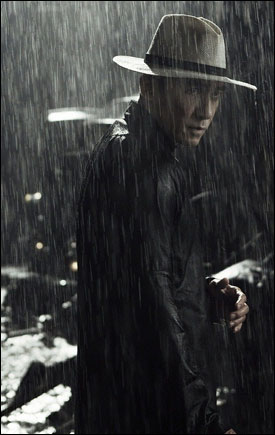
Tony Leung stars in Wong Kar Wai’s actioner ‘The Grandmaster’
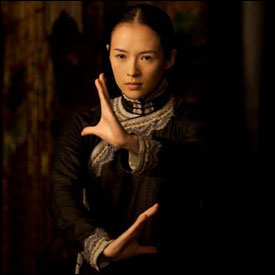
Zhang Ziyi co-stars in the 1930s martial arts pic.
A Sil-Metropole Organization, Jet Tone Prod. (in China/Hong Kong/Macau)/Annapurna Pictures (in North America) release of a Sil-Metropole Organization, Jet Tone Prod., Block 2 Pictures, Bona Intl. Film Group presentation of a Jet Tone Prod., Sil-Metropole Organization production. (International sales: Fortissimo Films, Amsterdam/Wild Bunch, Paris.) Produced by Wong Kar Wai, Jacky Pang. Executive producers, Chan Ye-cheng, Megan Ellison, Ng See-yuen, Song Dai. Directed by Wong Kar Wai. Screenplay, Wong, Xu Haofeng, Zou Jinzhi, based on a story by Wong.
With: Tony Leung Chiu-wai, Zhang Ziyi, Zhang Jin, Song Hye-kyo, Chang Chen, Wang Qingxiang, Cung Le, Lo Hoi-pang, Liu Xun, Leung Siu Lung, Julian Cheung Chi-lam. (Mandarin, Japanese dialogue)
Venturing into fresh creative terrain without relinquishing his familiar themes and stylistic flourishes, Hong Kong auteur Wong Kar Wai exceeds expectations with “The Grandmaster,” fashioning a 1930s action saga into a refined piece of commercial filmmaking. Boasting one of the most propulsive yet ethereal realizations of authentic martial arts onscreen, as well as a merging of physicality and philosophy not attained in Chinese cinema since King Hu’s masterpieces, the hotly anticipated pic is sure to win new converts from the genre camp. Wong’s Eurocentric arthouse disciples, however, may not be completely in tune with the film’s more traditional storytelling and occasionally long-winded technical exposition.
With a first-rate production package and glamorous casting, notably the luminous Zhang Ziyi trumping co-star Tony Leung Chiu-wai, Wong’s 10th feature might be his first to win over a mass Chinese audience. Set to make its international bow as the opening-night entry at the Berlin Film Festival, where Wong will serve as jury president, the film has already sold to key markets through Fortissimo Films and the Wild Bunch. It’s set to be released Stateside through Megan Ellison’s Annapurna Pictures, with Ellison credited as a producer on the film.
Five years in the making and reportedly 16 years in gestation, “The Grandmaster” is the latest in a string of period chopsocky films (“Ip Man,” “Ip Man 2,” “The Legend is Born – Ip Man”) centering on the life of the martial-arts master who taught Bruce Lee and popularized the Wing Chun kung fu style around the world. However, Wong’s interpretation stands apart from its predecessors by taking a less conventional biopic route. Offering an eye-opening pageant of martial-arts schools and their radically different exponents, the multistranded but generally linear narrative never dedicates itself entirely to charting Ip’s achievements. Instead, by focusing on his encounters with other fighters, the film arrives at the enlightened realization that there is no single “grandmaster.”
This idea is demonstrated in the opening sequence, when Ip (Leung) remarks: “Kung fu equals two words: horizontal and vertical. The one lying down is out; only the last man standing counts.” Just turning 40 when the film begins in 1936, Ip is an entitled Cantonese gentleman of leisure who lives in Foshan, a popular hub for martial-arts experts from all over the country. This presents numerous opportunities for duels, and the film’s entire first hour feels like a breathless succession of action sequences, accompanied by one-liners of worldly wisdom couched in kung-fu terminology.
Ip’s most significant duel is with Gong Baosen, who has come from Dongbei (then Manchuria) to choose an opponent for one last fight before retirement. Gong’s real intention is to discover young talent and bring it into the limelight, but his match with Ip is not resolved in a way that satisfies Gong’s daughter, Er (Zhang) who is extremely proud of her family’s invincible track record. She tries to teach Ip a lesson, which only brings them closer together.
Something bordering on mutual attraction develops, but the film leaves it oblique, their feelings merely hinted at by the poems they exchange throughout the story. Rather abruptly, the two are separated for more than a decade by war, and narrative interest shifts almost entirely to Er. Driven by the principles of honor that made her challenge Ip, she pits herself against Ma San (Zhang Jin), her father’s defiant disciple, to defend the reputation of the Gong family. Er’s initial pride is offset by a revelation of inner strength when she makes a great sacrifice in order to defeat Ma.
Years of extensive training for this film have enabled the protags to look extremely convincing as masters of their art. Zhang’s moves combine grace and confidence, raising the bar from her perf in “Crouching Tiger, Hidden Dragon,” but even in the dramatic scenes, she’s the center of attention, limning extreme emotional changes as she undergoes a series of tragic upheavals.
By contrast, Leung, the helmer’s frequent muse, lacks his usual intensity here: His Ip Man reveals few distinct characteristics in the early scenes except humility, and shows little emotional variation even as he falls on hard times. Even less satisfyingly handled is the peripheral character of Razor (Chang Chen), a violent and enigmatic drifter whose purpose in the story is so underexplained that he could easily have been excised, despite figuring into one fabulously shot and fought action scene.
Compared with the typically free-flowing structure of Wong’s films, “The Grandmaster” is more straightforward and coherent, with only one (well-placed) flashback. While the fight scenes ensure there’s hardly a lull in the first half, the second half feels hastily stitched together, rendering Ip’s relations with his wife (South Korean thesp Song Hye-kyo) patchy.
Some of the helmer’s artsy trademarks – introspective soliloquies, the sense that the protags are trapped in stasis – have been replaced by ideas more grounded in practical experience, with characters who don’t hesitate to act. In developing a world of strict decorum that is nonetheless predicated on constant competition, Wong clearly benefited from the collaboration of co-scripter Xu Haofeng, here transplanting such elaborate fighting theories from his own films “The Sword Identity” and “Judge Archer” to less cryptic effect.
Having previously grappled with his personal experience as a Shanghai-to-Hong Kong emigre, the filmmaker here applies that theme to a broad historical canvas that deals with the Chinese diaspora and its impact on national identity and the continuity of cultural heritage. Even as the last quarter is suffused with the languid melancholy and heartbreaking loneliness that recalls “In the Mood for Love” and “Ashes of Time,” unrequited love is represented in the context of two irreconcilable ways of life – to survive by biding one’s time, or to burn out by living in the moment.
Tech credits are aces, reflecting a stately, unified aesthetic with a stark palette dominated by blacks, whites and grays. Lensers Philippe Le Sourd (“7 Pounds”) and Song Xiaofei (“Design of Death”) accentuate balletic movement in the fight scenes by shooting from a dazzling variety of angles and at different speeds. They also contrast the austere beauty and expansiveness of Dongbei’s snowy outdoors with the Western-influenced opulence of the South, as re-created in production designer William Chang’s deliberately flashy interiors and costumes. Shigeru Umebayashi’s sweeping classical score sometimes swells above the action and dwarfs its impact, but the use of regionally specific songs as period markers helps counter that effect.
Camera (color/B&W, widescreen), Philippe Le Sourd; editor, William Chang; music, Shigeru Umebayashi; production designer, Chang; art director, Tony Au; set decorator, Yuan Zi’an; costume designers, Chang, Lv Fengshan; sound (Dolby SRD), Chen Guang; supervising sound editor, Robert McKenzie; visual effects supervisor, Isabelle Perin-Leduc; visual effects, BUF Compagnie; action choreographer, Yuen Woo-ping; chief martial-arts consultant, Wu Bing; Wing Chun consultant, Ip Chun; line producer, Helen Li; associate producer, Michael Werner; second unit camera, Song Xiaofei. Reviewed at UA KK Mall, Shenzhen, China, Jan. 8, 2013. (In Berlin Film Festival – opener, noncompeting.) Running time: 130 MIN.
Despite my dislike of WKW, I’m starting to get really excited for this film.
Twitch likes it too
Review: THE GRANDMASTER Brings Class to the Ip Man Legend
James Marsh, Asian Editor

Wong Kar Wai, Hong Kong Cinema’s most prestigious auteur, finally delivers his long-gestating biopic of Wing Chun pioneer Ip Man, and it proves an action-packed visual feast. Light on narrative, but oozing Wong’s trademark elegance, the film weaves the director’s familiar themes of love, loss and the corrosive nature of time around some of the most gorgeous martial arts sequences ever filmed.
The Grandmaster has been a project so long in the works that for some it may qualify as the most-anticipated film of the new Millennium. It was way back in 2002 that Wong Kar Wai and leading man Tony Leung Chiu Wai called a press conference to declare their intentions. It was more than 18 months ago that the first teaser trailer for the film was released, featuring - as it transpires - footage from the film’s opening scene: a rain-soaked street fight between a trilby-sporting Leung and a dozen faceless assailants. As recently as last month, the film’s release date was pushed back (again) from 18 December to early January and Wong was still putting the final touches to the film mere hours before its world premiere in Beijing on 6 January.
The story begins in Foshan province, where at the age of 40, Ip Man (Tony Leung) is happily married to a beautiful, doting wife (Korean actress Song Hye-kyo), lives off a healthy inheritance, and has continued the family legacy of advocating Wing Chun, a simplified yet remarkably effective form of kung-fu. At the Golden Pavilion, a local brothel patronised by many of the region’s finest martial artists, North-eastern Grandmaster Gong (Wang Qingxiang) challenges the best Southerner to a fight, before he returns North. After seeing off his rivals from the other local martial arts schools, Ip Man comes forward, only to demonstrate that intelligence and restraint can prove as powerful weapons as kung fu. Ip insists that Northern and Southern martial arts can co-exist peacefully, and Gong leaves humbled, yet satisfied.
Master Gong’s daughter, Gong Er (Zhang Ziyi) is less satisfied, however, and returns to challenge Ip Man herself. During their fight, they share the briefest moment of attraction, awakening a forbidden yearning within them both. Gong Er returns home, only to discover that her father’s best student, Ma Shan (Zhang Jin), refuses to accept his master’s defeat, and kills him. Gong’s dying wish is that the two reconcile and marry, as the last remaining practitioners of Gong’s revered 64 Hands technique. However, Gong Er vows to have her revenge.
While it may sound like The Grandmaster features a lot of plot for a Wong Kar Wai film, this really isn’t the case. The film spans many years, including the Japanese occupation and Sino-Japanese War, but in a refreshing break from recent Chinese cinematic trends, the conflict goes largely ignored. As with all Wong’s films, the characters are the primary focus, and how they struggle to interact through the veneer of society, honour, and their own self-imposed need to starve themselves of happiness.
There is clearly a much longer film here. Reports abound that until very recently, Wong had a four-hour cut of the film, while the version that goes on general release in Hong Kong and China this week clocks in at about 130 minutes. Perhaps the biggest victim of this drastic re-editing is Chang Chen. Given third billing, as well as his own character poster, his character probably only manages about ten minutes of screen time and only appears in three scenes. Zhao Benshan’s worldly-wise father figure gets even less screen time to the extent his role in the film proves almost entirely pointless.
Chang’s character, known only as “The Razor”, is first seen on a train, fleeing from the Chinese army. Bleeding, and brandishing a cutthroat razor blade, Gong Er sees him and instinctively shields him from the search party. This moment teases at a possible romance between the two youngsters, not to mention reunites Zhang and Chang onscreen for the first time since Ang Lee’s Crouching Tiger, Hidden Dragon. We anticipate their next encounter, and how it could complicate Gong Er’s relationship with Ip Man, but even after both characters make the move to Hong Kong, The Razor never meets any of the principals again.
Many of the recurring themes that Wong allows to permeate his work resurface in The Grandmaster. Characters have fleeting encounters that are never built upon, but which continue to haunt them for years afterwards. Time proves once again to be everyone’s greatest enemy, not only causing people to grow old, but also to forget the things they held most dear - and in this film particularly, the idea that age makes them weak, and less able to defend themselves plagues them relentlessly. Because, of course, for all its melancholy musing and forlorn contemplation, this is a film about martial artists and The Grandmaster is one hell of a beautiful kung fu movie.
Action choreographer Yuen Woo Ping repeatedly dazzles us with his intensity and imagination, staging a number of standout fight sequences throughout the film that are captured exquisitely by Philippe Le Sourd’s ravishing cinematography. Screen legends like Bruce Leung Siu Lung and Cung Le push Tony Leung to the limits of his newfound prowess, while Zhang Ziyi and Zhang Jin are also thoroughly convincing fighters on screen. But the staging of the action in The Grandmaster is a far cry from the kung fu in Wong’s last martial arts venture, 1994’s Ashes of Time. That film instilled a magical quality into its action, coupled with that blurry slo-mo camerawork Chris Doyle favoured at the time. In The Grandmaster, we see everything, and the fights themselves are shot almost as elegant courtships, dictated by ritual, ceremony and mutual respect, or when Zhang’s character is involved, a breathless sensuality that only heightens the tension between opponents. Frankie Chan’s gorgeous score is another highlight, complemented by an array of songs and classical pieces ranging from 1950s Canto-pop ballads to Ennio Morricone’s theme from Once Upon A Time in America - a film that is evoked on numerous occasions throughout.
While admittedly Wong Kar Wai hasn’t set himself a very difficult target, it seems extremely likely that The Grandmaster will prove to be the most financially successful film of his career. The anticipation alone should ensure enough tickets are pre-sold to take him most of the way, but the fact that the film is actually really good to boot should help see it do healthy box office both here and overseas. That said, audiences primed by the Donnie Yen/Wilson Yip collaborations who approach this film looking for another dose of nationalistic breast-beating and old-school chop socky action stand a good chance of leaving disappointed.
The Grandmaster remains first and foremost a Wong Kar Wai film, employing a very slow, deliberate pace throughout and dedicates long periods of time to watching its characters ponder the great mysteries of life, or more often, wallow in their own regrets and missed opportunities. But this is interspersed by some truly fantastic action, which should delight kung fu fans and arthouse cinephiles alike. In The Grandmaster, Wong Kar Wai has crafted the best-looking martial arts film since Zhang Yimou’s Hero, and the most successful marriage of kung fu and classic romance since Crouching Tiger, Hidden Dragon, and is more than deserving of that film’s measure of international success.
Man, if this hits like CTHD, it’s going to be all about Z as the queen of Kung Fu again. :rolleyes:
All about Z
There’s vid of the premiere on the link below. I dig Z’s space dress.
Wong Kar Wai’s The Grandmaster premieres in Hong Kong
STV 9 January 2013 16:10 GMT
After more than a decade in the making, Hong Kong director Wong Kar Wai’s new film The Grandmaster is finally set to hit theatres in the Far East.
Along with his leading actors Tony Chiu Wai Leung, Zhang Ziyi, and Chang Chen, Wong attended the premiere in Hong Kong on Tuesday January 8 2013.
The Grandmaster is about the story of martial arts legend Ip Man, who is the teacher of Kung Fu superstar Bruce Lee.
Even though there have been several other films about the life of Ip Man, Wong was the first director to announce a film project back in 2002.
The role of Ip Man has been previously portrayed by Kung Fu star Donnie Yen. In Wong’s version, actor Tony Leung plays Ip.
Unlike Yen, Leung has no previous training of Kung Fu, but began intense training for three years and more to prepare for his role.
It was no easy task at all. Leung has said that he suffered multiple injuries during filming and training. However, after he saw the finished product, Leung said that he was very happy with his performance.
Leung said that when filming finally began for The Grandmaster, it couldn’t have come at a better time for him.
"If we had begun shooting 10 years earlier, I couldn’t have portrayed him properly. I won’t be like a master, more like a kid,” he explained. “So a lot of things were meant to be.
“Fate works in wondrous ways. It was at the right timing. We were all very lucky. It was at the right time, and we did the right thing. It wasn’t right to film other times. We filmed at the right time.”
When asked if the strenuous work and long hours he put into this project would prevent Leung from doing another Wong Kar Wai film in the future, Leung replied: “I’ve been acting for 30 years…Three years is nothing.”
Actress Zhang Ziyi had previously said that The Grandmaster would be her last Kung Fu film.
She said that the strain put on her body from the intense Kung Fu training had pushed her to the limit. Still, she defended Wong’s decision to ask the main characters to undergo training.
“We trained for Kung Fu for a very long time, that’s because the director wanted us to embody the spirit of the character. So I think for him (Wong Kar Wai) to ask us to do that, it wasn’t too much to ask,” she said.
The Grandmaster is released in Hong Kong on January 10. It has been selected as the opening film for this year’s Berlin Film Festival, where Wong serves as the president of the jury.
I am beginning to hate kungfu movies more and more and I didn’t like this one either because the story was poor like the rest of them however there were a few good things in the fight scenes and at least the styles looked like what they are supposed to look like to some degree which is a major development.
A less glowing review
So, as I said, I’ve been rewatching some WKW flicks and I think I’ve solved my issues with his work. I recently watched As Tears Go By and am almost through watching Days of Being Wild. WKW is an HK filmmaker that makes French films. All of his stuff mimic French cinema - the moodiness, the lighting, the way the stories moves, the dwelling upon smoking, even the existential outlook. His twist is he’s HK, and gives his films this rich HK atmospheric texture - it’s tropical, yet he used a lot of washed out cool colors, totally rundown settings that really catch the feel of urban HK. On top of that, he got some great actors when they were young, Andy Lau, Leslie Cheung, Jacky Cheung, Brigitte Lin, and had a fine muse in Maggie Cheung, who is just captivating in all the WKW films in which she appears. Given the international esteem of French film (case & point: Cannes) WKW films work with the artsy set really well. Personally, I hate French film. This is my theory. At the very least, it explains Irma Vep.
Film review: The Grandmaster, by Wong Kar-wai
Thursday, 10 January, 2013, 4:50pm
Yvonne Teh

Tony Leung plays wing chun master Ip Man in ‘‘The Grandmaster’’.
Starring: Tony Leung Chiu-wai, Zhang Ziyi, Chang Chen
Director: Wong Kar-wai
Category: IIA (Cantonese and Putonghua)
His first film, As Tears Go By (1988), was a drama about a triad; he also produced The Eagle Shooting Heroes (1993) and directed Ashes of Time (1994), based on characters from the Louis Cha Leung-yung martial arts novel. But Wong Kar-wai is usually looked upon as an auteur whose films feature more talk than action.
So it can make for a shock to discover his much-anticipated The Grandmaster – first mooted in 2002 – features more action than dialogue.
Originally conceived as a biopic about Ip Man, the wing chun martial arts exponent whose students included Bruce Lee, the film starts off as planned. But while Ip (played by Tony Leung Chiu-wai) is the movie’s main man, it soon becomes clear The Grandmaster has another prominent character in Gong Er (Zhang Ziyi), the proud daughter of northern martial arts master Gong Yutian (Wang Qingxiang). The film’s original title was The Grandmasters.
Early on, there is a beautifully choreographed duel between Ip and Gong Er in the gilded confines of a high-class brothel frequented by the martial arts masters of Foshan, Ip’s hometown. The fight pits a “hard”, masculine, northern-style of kung fu against a “soft” martial arts form invented by a nun – all the more intriguing then that it’s Gong Er who’s using the hard system while Ip has the softer wing chun moves.
If only the rest of The Grandmaster matched that level of superlative filmmaking. The cinematography by Philippe Le Sourd does offer some beautiful scenes, notably a funeral in the snow. Too bad then that unlike some of Wong’s earlier works (i.e. pretty much the ones he helmed between 1990 and 2000), the whole is not greater than the sum of its parts here.
Even without reading the news reports that there was a rush to complete the HK$300 million film in time to meet its January release dates in Hong Kong and on the mainland, the viewer can see the haste. As it is, one leaves the cinema feeling there are just too many loose strands and ends.
The Grandmaster is showing now
so basically the film, which was originally concieved biopic is now a complete and utter work of fiction? LAME!! i already had extremely low hope for this movie watching the trailers just made me see the WKW got lost in this film, his frustration with being beat to the punch on making the ip man films is obvious, why would he try to make it all action, instead of playing on his actors strength which is acting…especially when you are going to compete with donnie yen and sammo hung in action..and no offense to yeun woo ping, but when it comes to southern style kung fu choreagraphy sammo is king! im not even going to waste my time…ill watch it online for free.
Ah, well, you know me. I’ll support any and every kung fu flick that I can…
…even if it’s artsy HK wannabe French filmmakers. :rolleyes: That being said, I’m a huge supporter of the theatrical experience. I love the silver screen and can think of many films that I wouldn’t want to see anywhere else. Granted, Doug, there are plenty of films that are best viewed on the small screen, but I still support the martial arts industry when I can.
Meanwhile, back to the topic at hand - Z’s dress. :eek:
Zhang Ziyi Dazzles In Neon Marc Bouwer Dress: Love It Or Leave It? (PHOTOS, POLL)
Posted: 01/09/2013 1:40 pm EST | Updated: 01/09/2013 4:56 pm EST
There’s neon and then there’s neon.
Actress Zhang Ziyi went with the latter on Tuesday, showing up to the Hong Kong premiere of “The Grandmasters” wearing a dazzlingly bright dress by Marc Bouwer. The Spring 2011 frock features peaked shoulders and a high neckline – because really, who needs distracting cleavage and collarbone with a print like that?
Besides being completely dizzying, the print is also an optical illusion: is the fabric cotton? Latex? Jersey? The only thing we can tell is that the colors are utterly blinding. Thank goodness for Zhang Ziyi’s good sense to tone things down with nude Yves Saint Laurent pumps and subtle makeup.

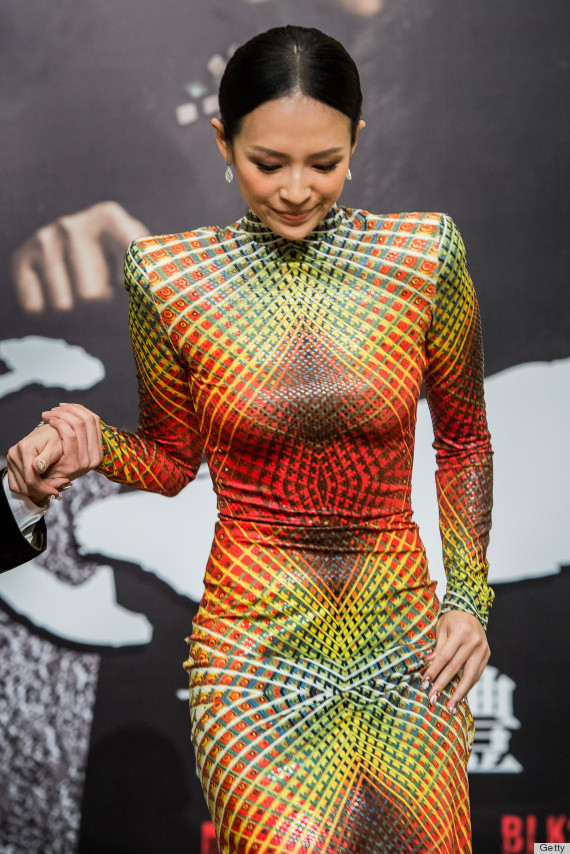
I love it. It looks like a Romulan Dragonlady qipao. 
Good debut - four versions
Grandmaster has masterful BO debut
By Stephen Cremin and Patrick Frater
Tue, 15 January 2013, 12:35 PM (HKT)
Box Office News

WONG Kar-wai 's The Grandmaster secured RMB162 million (US$26.1 million) in Mainland China in its first six days in cinemas last week, a record for the Hong Kong-based director.
The film’s budget is believed to have risen to RMB240 million (US$38.6 million) over its long production period, with Wong finishing the film just 72 hours before its release. Its first press screening was held two days before it opened in China.
The film, starring Tony LEUNG Chiu-wai , also got off to a strong start in Hong Kong, Wong’s home base and the adopted home of Leung’s co-star ZHANG Ziyi .
Playing in four different versions in a mix of different Chinese dialects, with and without English subtitles it notched up US$168,000 (HK$1.3 million) on its opening day for distributor and co-investor Sil-Metropole Organisation Ltd .
By Sunday night, its box office climbed to HK$8.06 million (US$1.04 million), an impressive start for a Chinese-language film of any dialect in Hong Kong.
The film opens in Taiwan on 18 Jan through Warner Bros (Taiwan) Inc () . Shaw Organisation Pte Ltd opens the film in Singapore on 31 Jan.
In China, Grandmaster scored more than double the box office of closest competitor, Jackie CHAN 's CZ12 , on RMB80.7 million (US$13.0 million). The action-comedy has now grossed RMB801 million (US$129 million).
CZ12 is the second most successful Chinese-language release of all time in the Mainland. Still on release, current record-holder, XU Zheng 's road movie comedy Lost in Thailand , is now on RMB1.20 billion (US$194 million).
China’s BO numbers are all screwy now because the market is on this massive rise, so every new release has the advantage of more outlets resulting in a bigger BO take.
Odd piece from Global Times
Kung Fooey
Global Times | 2013-1-22 18:38:02
By Lu Qianwen
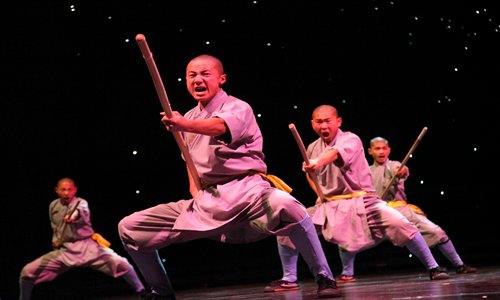
Shaolin Temple monks perform in Macao, January 7, 2013. Photo:CFP
Gap between real kung fu and that seen on screen extremely wide
Kung fu movie-goers must have long ditched the fantasy of real kung fu and those flashy moves presented in the movies. Though there have always been a few films that have tried to approximate the real thing, like Enter the Dragon and The Way of the Dragon starring Bruce Lee, or Ip Man starring Donnie Yen, and the most recent one, The Grandmaster, there are still exaggerations and special effects added in.
By drifting away from real kung fu, these films have on one hand stirred up people’s interest in traditional Chinese martial arts (or wushu), while on the other hand they have wrongly impressed audiences with what they are capable of.
Approximation at best
In 1982, kung fu film Shaolin Temple starring Jet Li swept China with a total box-office tally reaching over 100 million yuan ($16 million), while the ticket price back then was only 0.1 yuan. By impressing so many millions about Shaolin kung fu, the film, in a way, redefined what Chinese kung fu meant among common people.
Now The Grandmaster is marching its way to success both at home and abroad. Its box office in the mainland now has reached 250 million yuan and it will be the opening film for the Berlin Film Festival starting February 7. As the film’s director, Wong Karwai, prepares to serve as president of the jury in Berlin, he has drawn further comparisons with the genre’s standard-bearer made three decades ago.
“This is the one that most authentically presents Chinese wushu since Shaolin Temple,” said Wong, “I believe The Grandmaster opened a door for more audiences to know and love Chinese wushu.”
“I thought [The Grandmaster] mostly reflected Chinese kung fu from the Republic of China period (1912-49),” said Zeng Hairuo, director of Kung Fu, a documentary now in production that is trying to record every existing kung fu style across China.
“However, it is still a film. Besides the special effects applied, it was set in a certain historic period when China was weak and under the invasion of foreign powers. In this case the kung fu expressed in the film was from practitioners with great patriotism and sense of responsibility to save the country,” Zeng told the Global Times.
“Times have changed, and the kung fu styles used in the film are very different from the real ones of today, either in the specific way they are practiced or in the spirit of those practicing them,” he added.
Dose of reality
Real kung fu of course does not look as dazzling and dizzy as in the films. Along with enhancements from computer technology, they usually mix in some other movements that don’t originate from the style. For example, the flip, which is a move often performed by Peking Opera singers, is commonly seen in kung fu movies.
“In early days there were some kung fu practitioners who wanted to try authentic kung fu in films, but the visual effect turned out really bad,” said Zhang Li, author of the book Secrets of Kung Fu Films, which was published last year.
With borrowed movements like the opera’s flip or others from gymnastics or even dance added in to enhance the visual effect of traditional kung fu, it seems many of the new fans like it for the wrong reasons.
“Wushu is dissimilated from its origin. With different and new film technologies emerging, Chinese wushu became well-known, but meanwhile misled people’s recognition about it,” Zhang told the China Newsweek in an interview.
In films, kung fu practitioners are always the first ones to jump toward the center of a room to challenge the skills of a local competitor. But in reality, Chinese kung fu practitioners are seldom seen in any of those competitive fighting events.
“Kung fu actually is not suitable for being part of modern competitive sports since its essence can’t be best displayed within a short match,” said Zeng, “its long history as well as the dozens of years required to practice real kung fu underlines that it is not merely about wining or losing.”
“Instead, it’s more like a long-term self-cultivation both physically and spiritually, in the process of which Chinese ancient philosophy, Buddhism, Taoism, and even the theory of TCM (Traditional Chinese Medicine) integrate into the practitioner’s cultivation,” Zeng explained.
Few true masters
Screen kung fu masters are not strange to audiences, like Wong Feihung, Huo Yuanjia, Chen Zhen and the most famous of all, Ye Wen (1893-1972, grandmaster of wing chun style and Bruce Lee’s mentor). But in real life, how many of us have personally seen a kung fu master? Instead, we see imitators and even swindlers who claim the title “kung fu master.”
Last September the scandal of Yan Fang, a middle-aged woman who claimed to be a master of tai chi aroused many people’s curiosity. People saw her use tai chi to knock a man to the ground without touching him. But it didn’t take long to expose this self-proclaimed “master” as a fraud.
“Real kung fu masters today will not appear in front of people in a high profile situation unless there is some really urgent situation endangering the country or people,” said Zeng, “They are focused on their practice. If Ye Wen were living today, he would also be out of people’s sight.”
According to Zeng, there are around 100 kung fu masters across the country today. Unlike in the films that depict masters of different kung fu schools coming together to a certain place to fight or learn from each other, today’s masters care more about where to find successors who will carry the style forward to future generations.
“But those apprentices do exchange their kung fu skills sometimes,” said Zeng. Perhaps depicting that story is the best way to get real kung fu onto the big screen.
Anyone read Secrets of Kung Fu Films by Zhang Li?
Of course, we discussed Yan Fang here already
The Ye Wen/Ip Man shift is funny to me.
I’m half way through this
So far, it’s a gorgeous film. I’ll finish it tonight.
Ip Man of mystery happy his new role is no enigma
By Yip Wai Yee,The Straits Times/Asia News Network
January 28, 2013, 12:00 am TWN
SINGAPORE – Tony Leung Chiu Wai brushes off the several injuries he suffered, including a broken arm, while filming “The Grandmaster.”
“Getting injured is no big deal because you can get injured doing normal exercises as well,” he says with a shrug while in town this week to promote the martial arts film.
Perhaps, just perhaps, for an actor who is serious about his craft, like Leung is, getting an arm broken accidentally is nothing compared with having no clue about the role that you are playing in a movie. At least the pain he felt was as real as the motivations and character of the man he was portraying in “The Grandmaster.”
After making six movies with director Wong Kar-wai, he almost sounds grateful that he finally had a concrete idea of his character while filming their seventh collaboration, “The Grandmaster.”
In the movie, Leung plays famed martial arts expert Ip Man, Bruce Lee’s teacher in real life, who has been documented in numerous books and films.
Leung, 50, says in Mandarin with a grin: “This was the first time I knew who my character was, and had such a clear notion of the man. When you work with Wong Kar-wai, he won’t really tell you what the story is. He will give you the day’s script, or the script for the scene, and then you just go with that.
“But at least I know who Ip Man is. Both Zhang Ziyi and Chang Chen wouldn’t have really known who they were playing, though. I’m the luckiest actor of the lot.”
In the film, which opens in Singapore this week, China actress Zhang and Taiwanese actor Chang play the fictional characters of Gong Er and Razor, two of the kung-fu experts in China whom Ip Man has encounters with.
Recalling his past movies with Wong, Leung adds with a chuckle: “Sometimes, I wouldn’t even know what some parts of my movies with Wong were about, until journalists pointed them out to me and asked whether some scenes had certain meanings. Then I’d be like, what, really?”
His comments are unsurprising. Wong’s films are hailed for their sumptuous visual aesthetics and mood-setting par excellence, with clear-cut characterization and story line taking a backseat.
In a separate interview, Wong, who was also in Singapore to promote the movie, is quick to say Leung is “only joking” about being relatively clueless while shooting their films before “The Grandmaster.”
But he concedes: “The thing is, what I want from the actors is for them to give me the very best interpretations of their characters, and how do you get the best? You get that if the characters are custom- made for the actors.
“So the way I work is, I give them some general instructions and let them bring something of their own to the roles, and then we meet somewhere in the middle. That is how you will get something really fantastic.”
That way of working — workshopping characters even as filming takes place — is also a reason why Wong’s films often take many years to be completed.
His intricate attention to detail is another reason why his movie projects are often delayed and prolonged, something he has become known for.
“The Grandmaster” took him four years to make, as he filmed additional scenes after principal shooting had long ended. The finished film was reportedly sent to China’s censors for clearance only hours before its first press screening in Beijing.
His movie “2046” (2004), considered a loose sequel to “Days Of Being Wild” and “In The Mood For Love” with time-travel elements, took four years to film, and premiered at Cannes with film reels delivered to the festival straight from the processing lab. There were so many delayed schedules and additional, drawn-out shoots that a running joke among the crew was that the film would be completed only in the year 2046.
“The Grandmaster” was shot all over China over four years in extreme conditions, from freezing blizzards in Shenyang to blistering heat in Guangdong province.
Shooting a lengthy fight scene in torrential rain reportedly took 30 consecutive days, a period during which the cast and crew barely had any time to rest.
Wong, 56, admits that working so long and hard is taking a toll on his health, especially given his age.
“Back then, I was still young. Now, I’m not that young guy anymore. While filming “The Grandmaster,” my back went from a curve of 89 degrees down to 60 degrees,” says Wong, who is married with one 16-year-old son.
According to other reports, actress Zhang had said that the film crew had to design a special chair for Wong just so that he could sit upright properly due to his back pain.
Talk of aging leads Wong to half-joke that Leung, the leading man he has used most often, is also “getting old.”
“Years ago, when Tony could not sleep, he would take walks in the middle of the night, and I would see him holding a bottle of alcohol. But now, when he can’t sleep, I see him walking around with a hot water bottle and a lot of medicine.”
Leung is not the only actor whom Wong likes to cast repeatedly in his films. Maggie Cheung has acted in five of Wong’s works, starting in 1989 with “As Tears Go By.”
The two other starts of “The Grandmaster,” Zhang and Chang, are also repeat collaborators. Zhang starred in 2046, while Chang took part in “Happy Together,” “2046” and short film segment “The Hand” (2004), which was featured in anthology work “Eros.”
Wong enjoys working with these same talents because they are more than just excellent performers — they also bring a little “something extra” in their attitudes.
Leung and Zhang, whom he single out for special mention, are “clear professionals” who are ready to shoot and reshoot a scene as long as the director deems necessary.
“After they finish filming a scene, they go off to the side but they won’t sit down immediately. It’s because they don’t want to wrinkle their costumes. So they stand and check if everything is all right first, before they rest.
“It’s this kind of attitude that is just so admirable. I always tell the younger actors that they must learn from people like Tony and Zhang Ziyi.”
Does the movie accurately depict Ye Wen’s brave and courageous fight against the Japanese dogs?

Actually, although it crosses the 2nd Sino-Japanese war, that’s not emphasized
It’s more about Kung Fu duels of honor.
Grandmasters has a goodly amount of action in the first hour. SPOILER [SIZE=“1”]Cung gets beaten up in the first fight scene (that is how he’s getting typecast in Chinese cinema) in a spectacular fight in the rain with gratuitous slo-mo raindrops, puddle-stomping and water water everywhere. [/SIZE]END SPOILER It’s beautiful filmmaking. The film is just gorgeous, scene-for-scene. Almost every scene is half shadow with tight-framed face shots bathed in warm sumptuous sepia tones. WKW is really working light and shadow, so many shots are tightly-framed glowing faces while the rest of the screen is pitch black. Z and Tony Leung have great faces, so it works. The film glows like a picture-perfect postcard of Canton in the 1930s. Wonderfully ornate sets and costumes, a very classy production, art house quality. And decent fights, amazingly enough. It showcases the character of different Kung Fu styles quite well, very old school in that regard. SPOILER [SIZE=“1”]Amusingly, WKW repeats his bleeding out on the train scene from Days of Being Wild. [/SIZE]END SPOILER It is a gorgeous film, a filmmaker’s film, the kind of film that you can spend hours deconstructing its cinematography if you’re a film nerd.
As a Kung Fu flick, it works until about the hour and a half mark. There are some decent fights, all very artsy with the slo mos and stylistically visionary, yet still convey the action well. But the last half hour is about romantic regret, melancholy over missed chances, the stock and trade of most WKW films. There’s no final climactic fight, or rather, the climax happens with a half hour more film to go, which just feels premature to me, but maybe that will be like cuddling after for the film nerd set.
Will this be the next CTHD? It might. I think the film crowd will love it, but I thought they would embrace Wuxia (aka Dragon) more too. It will surely stand as a ‘must-see’ Kung Fu flick for any fan of the genre because it is a departure from the norm, a truly classy beautiful production. I hope it does well as I hope any film does as it has some great messages and any good film is a boost to the industry. I’m no fan of Z, but she turns in one of her best performances since The Road Home.
I will gladly pay to see this on the big screen if given the chance.
Don’t worry, that was a joke in reference to the first Ip Man movie…at the university I worked at in Wuhan, I got in trouble for suggesting that Yip Man never fought Japanese soldiers as in the movie.
The Chinese take their movies seriously.
This movies sounds interesting, though.