Tai Chi, Veterans & PTSD

More for Veterans week

Topeka woman providing tai chi classes to Kansas veterans
VETERANS VOICES
by: McKenzi Davis
Posted: Nov 8, 2021 / 03:46 PM CST / Updated: Nov 8, 2021 / 03:46 PM CST

TOPEKA (KSNT) – A Topeka woman is taking the martial arts practice of tai chi and bringing it to people who might need help the most, providing them with a space to relieve stress and getting them back to who they used to be.

For just one hour of the day, a small, intimate group of people get the chance to breathe and focus on them. Sixty minutes to get away from the built-up stress they are carrying.

Madon Dailey is a tai chi instructor. Her journey to teaching the form of martial arts is different than others.
A couple of years back, she took her first class after looking to get on her own health journey.

When she turned 64, Dailey said she gained weight and didn’t feel comfortable with herself. She tried everything and every fitness class she could find. However, the classes would cause more injuries making things like walking up the stairs difficult. One day, she saw a sign for a tai chi class at the YMCA. Dailey decided to give the fitness classes one more try. Tai chi happened to be the only class she found success in.

“I want to know what I can do to help make their lives better. Help them get rid of PTSD, stress.”

Her regular attendance then evolved into her wanting to become an instructor. For five years, she taught tai chi as a certified trainer, but she wanted to do more. She wanted to start teaching a specific group of people. One day, what felt like a sign came to her through a social media app.

“I started in 2018 saying, “Dear Lord, God, if there is a way I could teach tai chi full-time and help veterans, please let me know.’ In August of 2019, on a Facebook page for tai chi instructors, there was this little blip post that says, ‘Would you like to teach tai chi full time and help veterans?’ I went, ‘yes! Me! Me!'”

Dailey became an instructor with the Tai Chi Fit for Veterans program. It’s a program that gives those who have served, their spouses, and caregivers a chance to have peace and health either in person or from home.

“It’s just like giving them back the spirit that they had,” Dailey said.

On Tuesdays, she teaches a class at the Topeka North Post 400. Steve Christenberry, the vice commander at the post, learned of Dailey and what she was doing for veterans by word of mouth.

“One of our auxiliary members got a hold of me about a month and a half ago, and said, ‘hey they’re starting a tai chi class in Silver Lake on Sundays,’ and she said you guys might be interested in having something at post 400,” Christenberry said.

That one conversation then turned into this weekly class.

The classes are also inclusive, meaning people who can’t stand for long also have the chance to take the classes. Tai chi can be done from a chair.

“It’s an opportunity for people to get out and be in the community,” Lloyd Price said who attends the Tuesday class. “It also has, I think, some benefits for people. And also, there really is no talking to each other, but the comradery of being around other people rather than being at home by yourself all the time.”

The classes are also free for veterans because it’s supported by the VA.

Why tai chi? It’s a low-impact activity that focuses on teaching people how to concentrate, breathe and relieve stress, stress that could have come from the war or the traumas that happened after.

Dailey shared the story of one of her participants who has seen an immense amount of change since taking the class. He was on prescription medications, couldn’t stand for long, and wasn’t getting out and about.
Once he joined her class, he was able to ditch the meds and go on hikes. He even got a part-time job he was proud of.

Dailey prayed for a chance to make a difference for veterans, combining her love for the Chinese martial art of tai chi while helping the men and women who served get back to who they used to be.

“It’s just exactly what I asked for in my prayers,” Dailey said.

Click here for more information on classes and how to join. Classers are open to anyone, not just veterans.

Thank you Veterans!

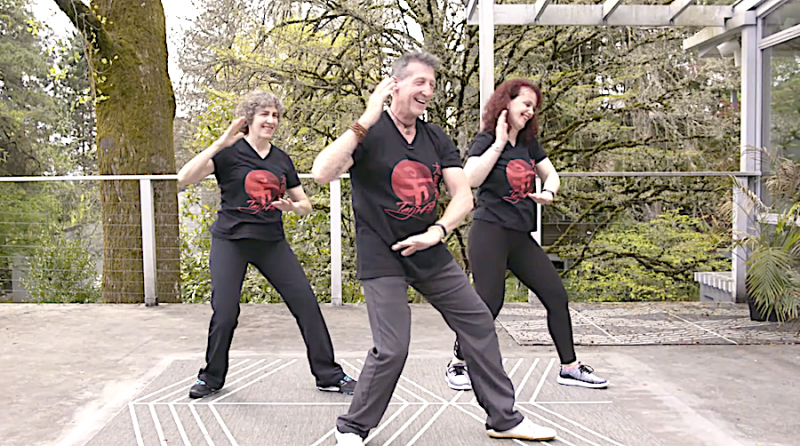
Qigong for Veterans

In Colorado’s backcountry huts, veterans find solace and history

By Stephen Lezak
November 11, 2021

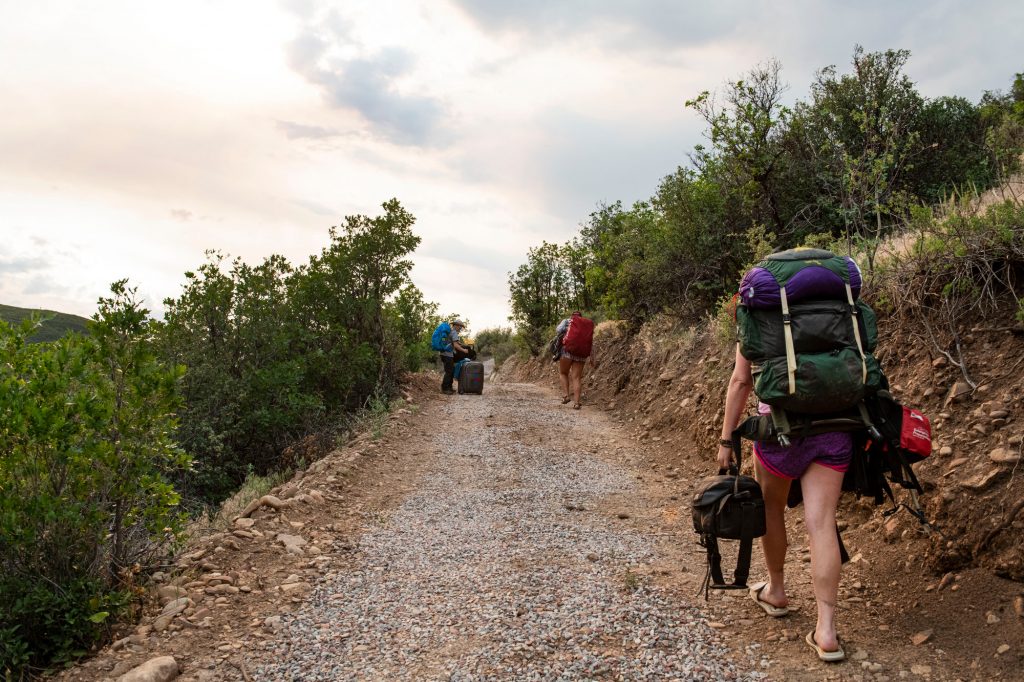
Amanda Ingle, left, and Cathy Drew prepare to hike out of the Gates Hut back to the trailhead after a three-day retreat with Huts for Vets outside of Meredith on Sunday, June 20, 2021. Ingle is the Secretary for Huts for Vets and lives in Rifle. Drew is also a Colorado local, living in Grand Junction, and served in the Air Force for 4 years.
Kelsey Brunner/For CPR News
Amanda Ingle, left, and Cathy Drew prepare to hike out of the Gates Hut back to the trailhead after a three-day retreat with Huts for Vets outside of Meredith on Sunday, June 20, 2021. Ingle is the Secretary for Huts for Vets and lives in Rifle. Drew is also a Colorado local, living in Grand Junction, and served in the Air Force for 4 years.
On a postcard-perfect day outside a backcountry hut in Colorado’s Sawatch Range, a group of five female veterans stands in a circle, learning Qigong and laughing.

It doesn’t show, but these women were strangers until three days ago. They came together for this long weekend with a common purpose: to share their experiences of military trauma and heal. Now, after three emotional days, these veterans are celebrating the completion of what they call “the curriculum.”

To the uninitiated, Qigong looks like a mix of yoga and interpretive dance. One of the veterans, Amanda Williams, jokingly calls it “Dr. Strange.” But everyone participates with gusto.

The exercise is a welcome break from hours spent inside the Harry Gates Hut, gathered around a small wooden table and surrounded by the history of a different group of veterans: the 10th Mountain Division of World War II. Like the women gathered here today, veterans of the 10th Mountain Division also sought solace in the Colorado backcountry —but fewer soldiers of that generation spoke openly about the trauma they endured.


Kelsey Brunner/For CPR News
Veterans Amanda Williams, 37, left, and Natalie Solano, 33, laugh at photos from the three-day retreat with Huts for Vets on Monday, June 21, 2021. Both women travelled from out of state for the retreat. Williams is from Minnesota and Solano is from California. Solano is an ex-marine and worked as a prison guard at Camp Pendleton.
A place of quiet

The retreat is facilitated by Huts for Vets, a Basalt-based nonprofit that organizes free retreats for veterans using the network of backcountry huts built in honor of the 10th Mountain Division.

Unlike some outdoor-oriented veterans’ programs, the vision behind these retreats has little to do with adventure or adrenaline.

“Up here, you get to disconnect from everything,” says Williams, who served in Iraq as a Navy hospital corpsman and later as an intelligence officer in the Army National Guard. “You’re connecting with one another.”

A key vehicle for that connection comes in the form of a hand-bound book given to each participant at the beginning of the retreat.

The books contain an eclectic mix of readings. Essays by American naturalists are interspersed with writings by Chinese philosopher Lao-tzu, Oglala Lakota Chief Luther Standing Bear, and several American war veterans.

In one entry, novelist Cara Hoffman writes, “society may come to understand war differently if people could see it through the eyes of women who’ve experienced both giving birth and taking life.”

Some entries are less literal. “We can live any way we want,” writes Annie Dillard in a short essay entitled, “Living Like Weasels.” “The thing is to stalk your calling in a certain skilled and supple way, to locate the most tender and live spot and plug into that pulse. This is yielding, not fighting.” Huts for Vets’ Executive Director Paul Andersen created the curriculum. In Andersen’s view, the readings are central to the program’s success. “When you marry text with immersion, something positive is going to happen,” he says.


Kelsey Brunner/For CPR News
Huts for Vets participants and board members left handwritten notes in the Gates Hut logbook after the retreat on Sunday, June 20, 2021.
In practice, the curriculum scaffolds the retreat’s central goal: conversations about military trauma. The U.S. Department of Veterans Affairs estimates that between 11 to 20 percent of recent veterans have post-traumatic stress disorder.

For some of the women on this particular trip, their trauma comes from experiences of combat. For others, it comes from sexual assault or harassment that occurred while they were enlisted, which they refer to as MST — military sexual trauma. The VA reports that 23 percent of women veterans experienced sexual assault while enlisted.

Back at the hut, Williams speaks candidly about her experiences with both sorts of trauma. She returned to civilian life in 2010 and became a firefighter in Minnesota. It’s her military background, she says, that taught her how to act quickly and stay calm in dangerous settings. “I thrive when there’s trauma situations.”

Even so, opening up to non-veterans about her experiences in the military remains difficult. “It’s hard to put that in a perspective for someone who’s never been there,” she says.

continued next post

Continued from previous post


Kelsey Brunner/For CPR News
Veterans Laura Albate and Cathy Drew say goodbye at the end of the last group meal for the weekend after a three-day retreat with Huts for Vets on Monday, June 21, 2021.
As a facilitator, Andersen’s presence is equal parts understated and magnetic, with wisps of grey hair sticking out from beneath his hat. Andersen is not a veteran — he protested the Vietnam War — but he seems both comfortable and humbled in the company of the participants. “It’s incommunicable,” he says of their time in the military. “Even for me to be in such close proximity with veterans, I only get a glimpse of what their experience is like.”

For his participants, that glimpse is enough. “You can’t pay us to open up to each other, or to ourselves,” says Natalie Solano, who served in the Marine Corps until last year, working as a correctional officer in a military prison. But something about Andersen’s approach — open, nonjudgmental, patient — made Solano feel unexpectedly safe. “The fact that we all open up to Paul, and then he makes us so comfortable opening up to each other? And that changes lives.”

Solano’s transition away from military service coincided with the height of the COVID-19 pandemic. “We isolate ourselves because it hurts to talk about things,” she says. In her case, the isolation was twofold. Leaving the military, only to enter lockdown at home, was debilitating. This is her second trip with Huts for Vets. “It’s an honor, the hugest honor,” she says. “I’ve been around the block, and this is like, the most valuable thing I’ve ever experienced in my life.”


Kelsey Brunner/For CPR News
Huts for Vets participants walk their belongings up to the off-grid campground off of East Sopris Road in Old Snowmass on Sunday, June 20, 2021.
A hidden history

Beloved by skiers and hikers, the 10th Mountain Division huts have a little known and often romanticized history.

In the years leading up to World War II, American military commanders heard news from Europe of armies suffering brutal defeats in Finland and Albania. The balance of entire wars had tipped because soldiers were unprepared for winter weather.

The United States Army took note. In 1942, the newly-created 10th Mountain Division moved to Camp Hale, near Leadville, to train for combat in the high mountains and extreme cold.

For many months, the troops hiked, skied, and climbed throughout the Sawatch Range in central Colorado. The Trooper Traverse, a harrowing 40-mile ski route from Leadville to Aspen, was first completed in 1944 on a training mission by soldiers carrying 75-pound packs.


Kelsey Brunner/For CPR News
Four of the six Hut for Vets women participants and a board member hike out of the Gates Hut after a three-day retreat outside of Meredith on Sunday, June 20, 2021.
The Division’s first troops arrived in Europe just six months before Germany surrendered. They pushed Hitler’s forces north across Italy, but at a significant cost. Of the Division’s 13,000 soldiers, more than 900 died and 3,000 more were wounded.

By the end of the war, the 10th Mountain Division suffered one of the highest casualty rates among all Allied forces.

Many of those same soldiers returned to the mountains of Colorado. At a time when the psychological trauma of war was rarely discussed openly, some former soldiers found comfort by returning to the same mountains they had recently called home.

In the 1980s, a group of these veterans and their families began building huts in memory of their fellow soldiers. The Harry Gates Hut is one of them.


Kelsey Brunner/For CPR News
The Huts for Vets group eat elk burgers and chat after wrapping up a three-day retreat at the Gates Hut on Sunday, June 20, 2021.
Closing the circle

After a closing discussion, the participants begin packing their bags for the 6-mile walk down the valley. One of the facilitators points me toward a bookshelf.

Memoirs written by veterans of the 10th Mountain Division sit together on a single shelf. Many of their authors were known personally to Andersen.

Relatively few members of the original Division are alive today, but the association they founded continues to manage the huts. They partner closely with Andersen to allow Huts for Vets to run roughly five trips each year at no cost.


Kelsey Brunner/For CPR News
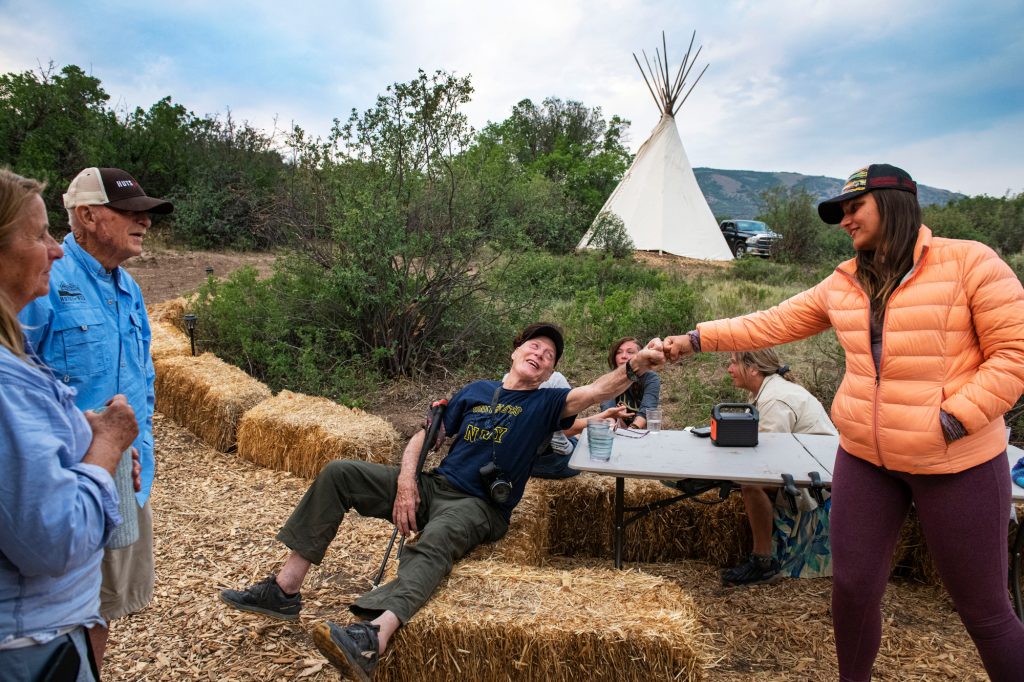
Veterans Dan Glidden, center, and Natalie Solano share a moment at the Huts for Vets off-grid campground outside of Old Snowmass on Sunday, June 20, 2021.
For all involved, including the participants, the feeling of continuity energizes the work. Although these huts no longer serve the 10th Mountain Division as they once did, new generations of veterans are taking their place.

After the trip, Andersen looks out over the Roaring Fork Valley. The wildfire smoke that filled the sky the previous night has vanished with the shifting wind. After the last participant leaves for the airport, he reflects on his work and the 10th Mountain Division:

“Bringing veterans to huts that are dedicated to veterans — it completes their mission in a way that I don’t think they ever thought that they could.”

threads
Tai-Chi-Veterans-amp-PTSD
Qigong for Veterans

Whole Health System of Care and the Tai Chi for Veterans Program

Charleston Veterans learning the art of Tai Chi


Veterans learning the art of Tai Chi for health benefits
By Chad Isom, Public Affairs Specialist
December 17, 2021

IN 2018, the Veterans Health Administration implemented a Whole Health System (WHS) of care to assist Veterans in taking charge of their health and well-being.

This approach focuses on what matters to Veterans when it comes to their health care choices. The program incorporates therapeutic activities into their health care plan, allowing for continued improvements in both physical and mental health for Veteran.

At the Ralph H. Johnson VA Health Care System, one of the most utilized tools is the Tai Chi for Veterans program. Currently, the Charleston program is one of the largest in the country, with over 400 Veterans enrolled across the Lowcountry. Tai Chi is a mind-body exercise regime. The principles of Tai Chi are slow-flowing intentional movements, breathing, awareness, and visualization. This program is available to all Veterans attempting to improve their health. The Veteran’s primary care physician can make a referral to Community Care for Veterans struggling with issues related to chronic pain, depression, Post Traumatic Stress Disorder, mobility, and balance.

A highlight of this program is the ability for Veterans to participate from the comfort of their own homes. Veterans attend sessions virtually, working with instructors located throughout the country. The typical treatment is 30 sessions with the ability to renew the referral for an additionally 30 sessions based on the Veteran’s progress.

“The goal for this program is a better overall outcome with our Veterans wellness goals,” said Shane Hallowell, RHJVHCS Whole Health Program Manager. “In combining therapeutic options with traditional health care offerings, we are able to provide a comprehensive health care plan that evolves as our Veterans evolve.”

As interest continues to grow with the Tai Chi program, Veterans are encouraged to speak with their primary care or specialty care providers to learn more about the Whole Health System and the opportunities available.

Louis Hall is a Veteran that has taken advantage of the Tai Chi program. Hall served in the U.S. Navy from 1968 until 1974, and then enlisted in the U.S. Air Force Reserve in 1981. Hall retired as a Chief Master Sergeant in 2009 from Joint Base Charleston. Since retirement, Hall has experienced issues with mobility and pain. After learning about the Tai Chi program, Hall decided to enroll and begin the therapy.

“Tai Chi sets the tone for the rest of my day,” said Hall. “It helps with my movement and flexibility and relieves much of the daily pains I experience.”

Hall has seen improvements in his joints and flexibility over the previous three months and credits the program with assisting in giving him back some of the freedom of movement he had in earlier times.

“I ran marathons and was very active during my time in the Air Force,” said Hall. “As time went on, I lost some of that mobility. Tai Chi helps me feel like I’m 40, not 72, and I love it. Tai Chi is a worthwhile program for your mental health and physical well-being”

For more information on the Whole Health System of Care and the Tai Chi for Veterans Program, Veterans should contact their physician.

Perhaps Tai Chi has always been used to care for veterans. Only the acronym PTSD is new - it’s been with us as long as there’s been war.

Whole Health at TVHS

Veteran shares experience with tai chi


Whole Health at TVHS is a new way of looking at health care and treating Veterans as a whole. Rater than treating the symptoms, Whole Health aims to address the root cause of health issues and help patients live better through evidence-based practices.
By Hannah McDuffie, Public Affairs Specialist
December 22, 2021
Share on Facebook
Share on Twitter
The Whole Health clinic at Tennessee Valley Healthcare System (TVHS) is a holistic approach to health care that focuses on overall health and well-being through different modalities of care like yoga, mindfulness, chiropractic, complementary and integrative care and much more.

Veterans of all ages and capabilities can participate in Whole Health and reap the many benefits it has to offer. To get involved, patients can speak with their primary care provider to learn how.

One of the many offerings from Whole Health is Tai Chi. Veteran Gerald Meyer shared his enthusiasm and appreciation for the Tai Chi sessions offered at TVHS and recommends other Veterans get involved. Watch what Meyer has to say about the class.

Short for t’ai chi chüan, Tai Chi is rooted in Chinese medicine and is thousands of years old. Tai Chi focuses on slow movements that come from martial arts and meditation. The goal is to calm the mind and body by repeating rhythmic choreography and breath work for about 30 to 60 minutes.

Veterans can expect some of the following benefits when doing Tai Chi:

Relieves stress and anxiety: the meditative aspect of Tai Chi combined with the physical movement can help calm your mind, improve focus, and can even help trigger the release of feel-good endorphins.
Boosts cognitive abilities: In addition to improving your mental well-being, Tai Chi has also been found to boost cognitive abilities. A 2013 meta-analysis published in the Journal of Sport and Health Science stated that physical exercise, in general, improves cognitive function and researchers specifically recommended Tai Chi for elderly people since it’s a gentler and more accessible form of physical exercise that also combines mental exercises via repeated “choreography.”
Increases flexibility and agility: Similar to yoga, Tai Chi often involves extensions of the body that can generally improve upon your flexibility and agility.
Improves balance and coordination skills: In addition to improving flexibility and agility, the intricate “yin and yang” of Tai Chi movements can help you with balance and coordination.
Enhances strength and stamina: As with any form of physical exercise, Tai Chi can build upon your existing strength and stamina. With ongoing practice, you might find you’re leaner, that your muscles are more defined, and that you’re able to exercise for longer periods of time.
More on WHS. It’s gaining traction.

Veterans’ Voices: Tai Chi for Vets
VETERANS VOICES
by: Nick Toma

Posted: Feb 25, 2022 / 05:53 PM EST / Updated: Feb 25, 2022 / 06:08 PM EST

EYEWITNESS NEWS (WBRE/WYOU) — A martial arts expert is using the ancient discipline of Tai chi to bring stress relief to some people who need it most, veterans.

On this week’s Veterans’ Voices we’ll meet a woman who’s helping a group of former soldiers, breathe and focus. Getting them back to who they used to be.

For one hour of the day, this intimate group of veterans gets the chance to get rid of the built-up stress they’re carrying. The woman leading the exercise is Madon Dailey.

The Tai chi instructor’s journey to teaching martial arts is a bit different. A few years ago she took her first class after wanting to improve her own health and for five years she taught Tai chi as a certified trainer, but she wanted to do more.

“In August of 2019, on a Facebook page, for Tai chi instructors, there was this little blip of a post that said, ‘Would you like to teach Tai chi full time and help veterans?’ I went, ‘yes, me, me’,” Dailey explained.

Dailey became an instructor with the Tai Chi Fit for Veterans Program, giving those who have served, their spouses, and caregivers a chance to have peace and health. For vets who can’t stand long, they can do it from a chair. The classes are free and are supported by the VA.

“It’s an opportunity for people to get out and be in the community,” said Lloyd Price, Veteran. “It also has, I think, some benefits for people. And also, there really is no talking to each other, but the comradery of being around other people rather than being at home by yourself all the time.”

Why tai chi? It’s a low-impact activity that focuses on teaching people how to concentrate, breathe and relieve stress, stress that could have come from the war or the traumas that happened after.

Dailey says one of her students credited the class with helping him cut back on prescription medications and go on hikes. He even got a part-time job he was proud of.

“It’s just exactly what I asked for in my prayers,” Dailey said.

Dailey by the way is 64 years old.

threads
Tai-Chi-Veterans-amp-PTSD
Tai-Chi-Fit-by-David-Dorian-Ross

Our latest sweepstakes. Enter to Win!

Enter to win Tai Chi Fit for VETERANS by David-Dorian Ross on DVD!
Contest ends 3/17/2022

threads
Tai-Chi-Veterans-amp-PTSD
Tai-Chi-Fit-by-David-Dorian-Ross

Our winners are announced

See WINNERS-Tai-Chi-Fit-for-VETERANS-by-David-Dorian-Ross-on-DVD

threads
Tai-Chi-Veterans-amp-PTSD
Tai-Chi-Fit-by-David-Dorian-Ross

Tn

Tennessee veterans take part in healing through weekly tai chi class

Every week, a group of veterans meet for a class that focuses on healing. What they’re doing isn’t something you would expect.

By: Forrest Sanders

Posted at 6:57 PM, Sep 29, 2022 and last updated 4:57 PM, Sep 29, 2022
MURFREESBORO, Tenn. (WTVF) — Every week, a group of veterans meet for a class that focuses on healing. What they’re doing isn’t something you would expect.

“I was a National Guard and Army reserves logistics officer. 1980-2001,” said veteran Henry Armstrong.

With that military background, the camaraderie of taking on a challenge as a team still speaks a lot to Armstrong.

“You got Vietnam veterans, Gulf War veterans, veterans from Afghanistan,” he said, looking around an open air pavilion.

Armstrong — like a lot of these veterans — never expected to be at the Alvin C. York VA Medical Center in Murfreesboro for a class in Chinese martial art tai chi.

“Breathe in and breathe out,” said Terry Mahone of Whole Health as he instructed the class. “Relax. Today, we’re going to be doing the four moves for rehab pain.”

“Some of them have PTSD,” Mahone said of his class. “Some of them have anxiety.”

“I have chronic pain, traumatic stress disorder,” said Armstrong.

Mahone said tai chi helps the mind by having veterans learn this new skill. He said it helps the body through slow rounded movements. Focus above any distractions is key.

“We’re not just focusing on how our issue compounds us, beats us down necessarily,” said Armstrong. “We’re thinking about the mindfulness, how to go forward with our issues. The camaraderie is therapy in itself.”
There’s a news vid behind the link

My latest feature for UNESCO

Tai Chi as Therapy for Post-Traumatic Stress Disorder (PTSD) in Veterans

Tai-Chi-Veterans-amp-PTSD
Wheelchair-Taijiquan
UNESCO-International-Centre-of-Martial-Arts-for-Youth-Development-and-Engagement

Zibin Guo

Kennedy: UTC professor teaches tai chi to military veterans
March 12, 2023 at 5:36 p.m.

by Mark Kennedy


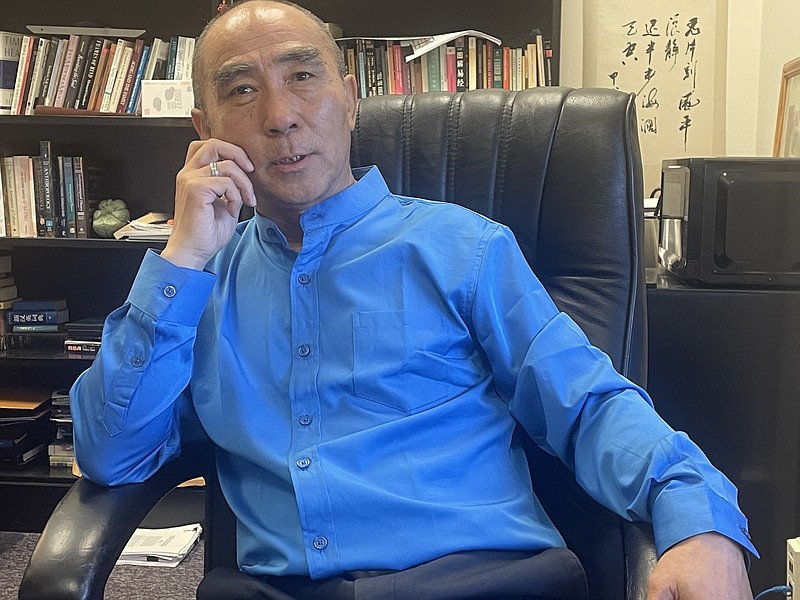
Staff Photo by Mark Kennedy / Zibin Guo, an anthropology professor at the University of Tennessee at Chattanooga, is pictured Tuesday in his office. Guo is the founder of a successful national effort to teach American military veterans the ancient martial art of tai chi.

Zibin Guo, a University of Tennessee at Chattanooga anthropology professor, remembers the moment he knew his work teaching tai chi to military veterans was on target.

Guo, 60, is a native of China who moved to the United States in his 20s. He was teaching the flowing tai chi movementsin. 2016 to vets at the Alvin C. York Veterans’ Administration Medical Center in Murfreesboro, Tennessee, when he noticed something curious. One of the vets broke away from the group and stood in the corner with his face against a wall.

At first, Guo thought he had done something to upset the man. A psychological counselor who was standing by told him not to worry, that the vet was probably having a PTSD episode and had stepped away to compose himself.

PTSD is short for post-traumatic stress disorder.

Later, the man told Guo he had been so excited about coming to the class that day he had forgotten to take his anxiety meds. Two years later, the vet himself was certified as a tai chi instructor.

That’s a good example of the excitement that has been built among vets since Guo started his experiment seven years ago.

“After getting my Ph.D. in medical anthropology, I became interested in application of ancient wisdom to modern life,” Guo explained in an interview at his UTC office last week.

Today, the adaptive tai chi experiment – which continues to earn funding from the U.S. Department of Veterans Affairs – has been responsible for spreading tai chi classes to 75 veterans’ centers in 44 states, Guo said. More than 800 VA health care providers have been trained to teach tai chi as a result, he said. Meanwhile, more than 4,000 vets have/or still are participating in virtual tai chi classes online.

So, what’s the attraction?

Guo, who grew up practicing martial arts, said he always believed tai chi would be a good outlet for both disabled and able-bodied veterans. It’s easy to adapt tai chi movements for people in wheelchairs, he said.

He said the martial art appeals to primal instincts and allows people to experience physical activity and psychological peace. Unlike some forms of martial arts, which are more athletic and rely on force, tai chi is all about bending energy back on an opponent. The concept is to “yield and redirect,” he said.

“It emphasizes the power of the mind,” he said. “It’s very graceful, very gentle. It’s the perfect way to engage people with a disability.”

Guo said one of the vets, who uses a wheelchair, told him that while practicing tai chi he did not feel disabled for the first time in years.

Guo said he thinks the secret sauce is the way a tai chi practice blends elements of the natural world. He said metaphors and similes, along with calming instrumental music, are built into the classes.

Some examples of tai chi similes, which are repeated during classes, are:

– Be still like a mountain.

– Flow like a river.

– Stand like a tree.

Guo said a 50-something Iraqi war veteran who was having PTSD episodes when in heavy highway traffic said he used similes to help contain his feelings.

“When he was stopped in traffic, he tended to have uneasiness and nervousness,” Guo said. “Two years later … he said, 'Now, if I’m stuck in traffic, I look for trees, I look for mountains, I look for water. Then, I begin to feel like I’m practicing tai chi with my brothers and sisters back in the (VA) hospital.”

The “Life Stories” column publishes on Mondays. To suggest a human interest story contact Mark Kennedy at mkennedy@timesfreepress.com or 423-757-6645.

I minored in Anthropology and later thought I should have majored in it - it would have been a better path to academia, which was my original intention in university. I’m just one year younger than Guo. In an alternate multiverse, this could’ve been me…

# Live Whole Health 314 – Moving in Community: World Tai Chi and Qigong Day

April 20, 2026

Alison M. Whitehead, MPH, C-IAYT, RYT-500, NBC-HWC

National Program Lead for the Integrative Health Coordinating Center in the VHA Office of Patient Centered Care and Cultural Transformation

Each year, people in over 80 countries come together on the last Saturday of April to celebrate World Tai Chi and Qigong Day, a global event promoting health through gentle, mindful movement.

Tai Chi and Qigong are gentle practices that connect the mind and body through slow, flowing movements, breathing practices and focused attention. Tai Chi and qigong are non-pharmacologic (non-medication) approaches that have been shown to help with general health and well-being. Research suggests that Tai Chi and Qigong may help individuals manage conditions such as pain, heart disease, arthritis and those with balance challenges, while also supporting mood and recovery from illnesses such as stroke and Parkinson’s disease. One study showed that among participating Veterans with long‑lasting muscle and joint pain, about 4 in 10 reported less pain getting in the way of their daily lives when they used complementary and integrative health therapies such as Tai Chi and Qigong.

Tai Chi and Qigong are adaptable and accessible. They can be done standing or seated, making them suitable for people of all ages and ability levels.

For inspiration, read this story about Veteran Robert Minicucci, who celebrated his 100th birthday with a Tai Chi class at the Coatesville VA Medical Center, surrounded by family and his care team.

Ready to get started? Try this a 14-minute beginner friendly session led by Lori Enloe.

https://www.youtube.com/watch?v=MvYZfm3qMAQ

You can also explore additional Tai Chi and Qigong resources and learn how these practices have supported fellow Veterans.