Shaolin Temple Documentaries

Here’s the SCMP breakdown of Ranton’s debunking…

Real Shaolin disciple Ranton debunks inaccuracies in BBC’s Shaolin Master documentary
Popular YouTuber Ranton, who spent three years training with the monks, points out falsehoods and exaggerations in BBC’s ‘Sacred Wonders’ episode
Film focuses on a Buddhist monk’s final test – but ‘he’s been a master for a long time already, teaching huge groups’
Nick Atkin
Published: 5:21pm, 24 Aug, 2019


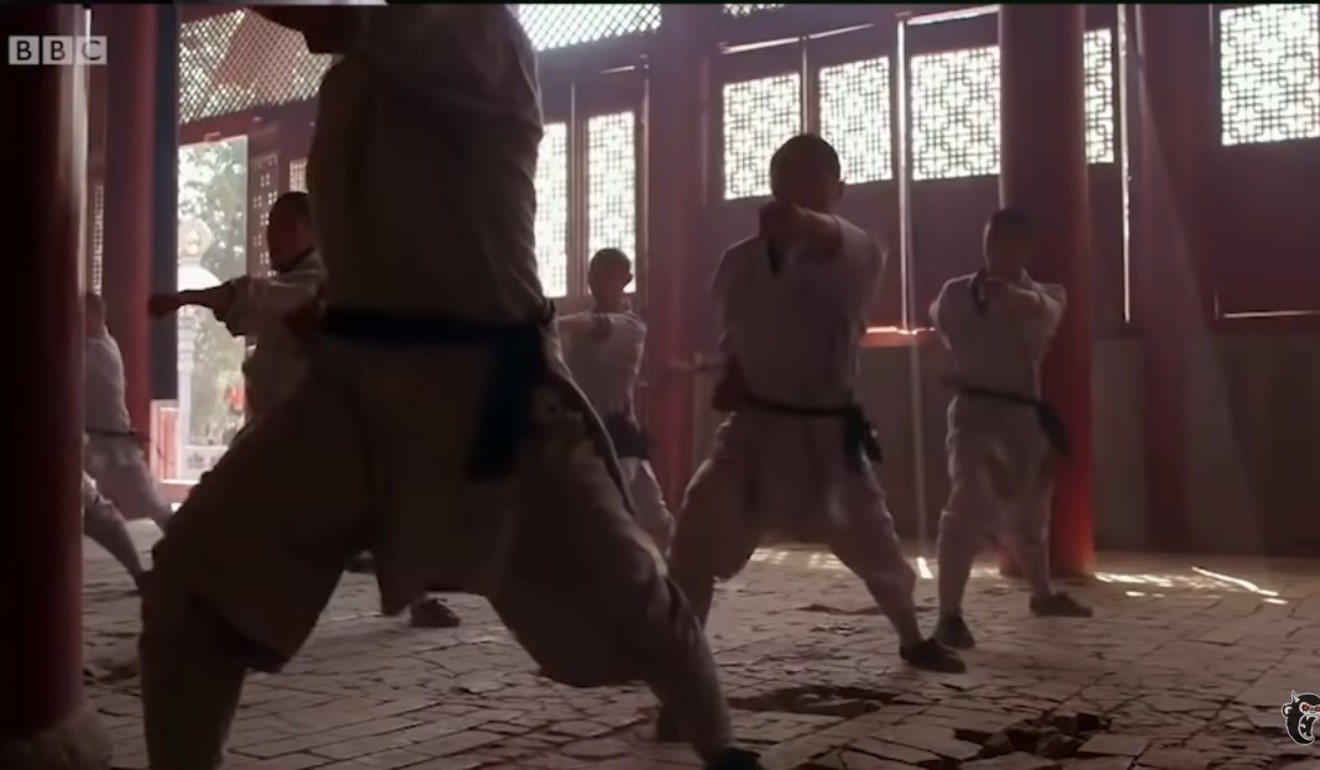
A monk trains on the grounds of the Shaolin Temple in the BBC’s ‘Sacred Wonders’ documentary. Photo: YouTube/BBC

A popular YouTuber who spent three years training with the monks at the Shaolin Temple has debunked several inaccuracies in a BBC documentary that has gone viral.
The BBC travelled to the Shaolin Temple in China for episode one of its new Sacred Wonders series. It also uploaded an eight-and-a-half minute clip to YouTube titled “The extraordinary final test to become a Shaolin Master” focusing on a Buddhist monk named Yandian.
The documentary says Yandian will face a test to qualify as a full warrior monk, with the film following his training. It says he has been practising with the monkey stick weapon for 11 years, but still struggles with one move, the “Monkey Going Up The Tree”.
“When I was at Shaolin he [Yandian] was already a master and teaching huge groups of people. His speciality was the monkey stick,” says YouTuber Ranton, who dissected the documentary in his own video.

//youtu.be/jHUewEWi9SE

Ranton says young monks can decide when they turn 18 whether to become a full-on monk or a full-on warrior monk.
“But I’ve never seen a test like this,” he says. “And this guy [Yandian] has been a warrior monk for a long time already. Everybody knows how good he is in the Temple. This might just be a narrative for the camera.”
Yandian tells the camera he will feel he has let himself down badly if he does not pass his test.
“The monks do have a lot of media experience. Camera teams are there at least every month,” Ranton says. “I’m not saying they told them word for word what to say. but if you speak Chinese you can clearly see he is saying what he is supposed to be saying.
“Everyone who’s involved with the temple to a deeper degree knows what to say to the cameras, to sell it. They’re great people, but again nobody talks like that.”

continued next post

Continued from previous post

//youtu.be/Zbow21FKJS4

The narrator says Yandian will have to prove himself before a panel of senior monks. If he fails it will be 13 years before he can try again. “Shaolin in China is all about who knows who. That guy does not have to wait for anything,” Ranton says.
In one scene, Yandian receives words of advice from his supposed mentor, Yancen.
“Mentor? What? So obviously in Shaolin Temple and in China in general, age is very important. So senior people tell you what to do and how to behave. So he does have to listen to him, but he is not his personal mentor, there’s no such thing. He’s just a senior monk but they’re both already masters. They’re brothers essentially, they’re warrior monk brothers,” Ranton says.


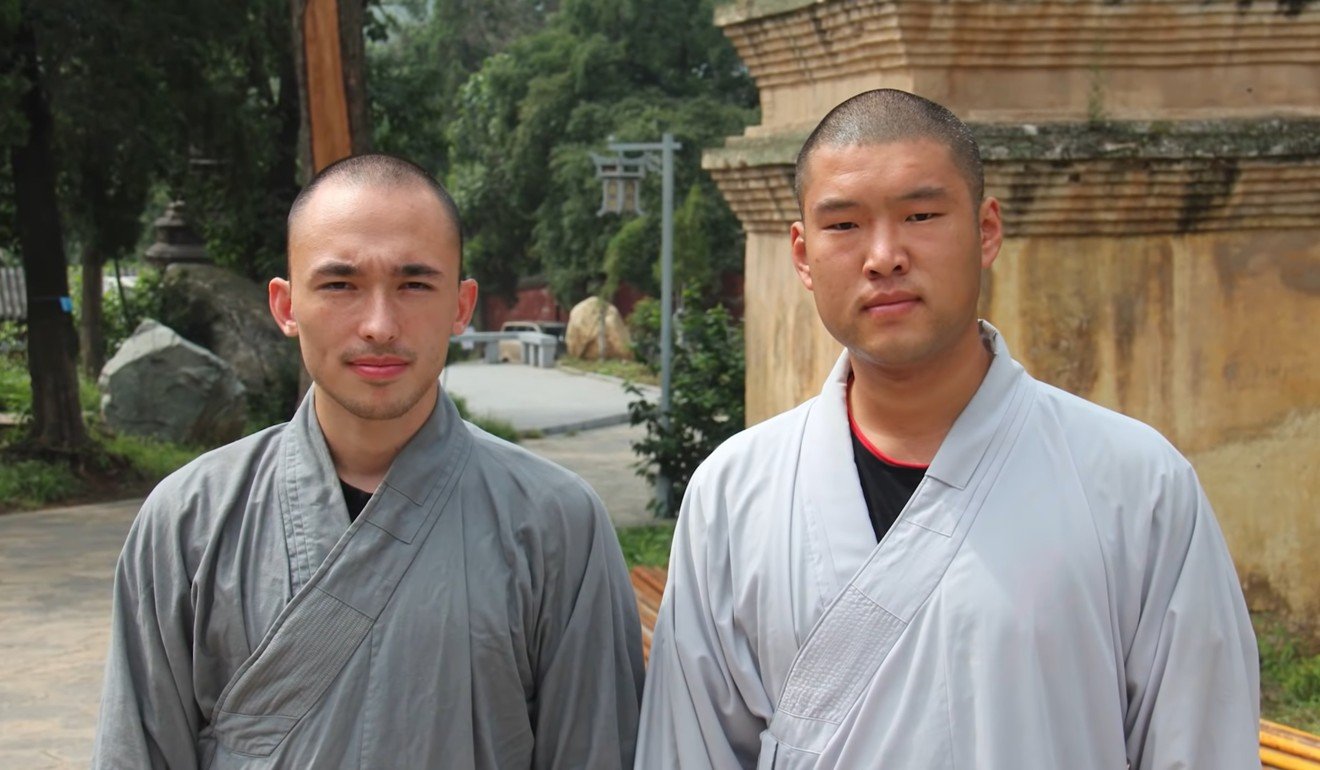
Ranton (left) poses with Yandian, the subject of the ‘Sacred Wonders’ documentary, during his time training at the Shaolin Temple. Photo: YouTube/Ranton

Yancen tells Yandian he is struggling to do the move well because of “what is inside – your mind is not at peace”.
“Real talk again, most warrior monks rarely ever meditate. Sorry,” Ranton says.
“This is not how kung fu is ever taught when the cameras are off. There’s only beatings and yelling. Talking about what’s in your heart and mind, you might have that after your training when you sit down with your master and you drink some tea, then they tell you this, but not during your training.”


Ranton says this training hall from the ‘Sacred Wonders’ documentary is never actually used for training – only when the cameras are there. Photo: YouTube/Ranton

The narrator says that the abbot, who is the head of the temple, will be judging Yandian along with three senior monks. Yancen is allowed to watch from the sidelines. “This makes no sense. Yancen is just like the other guys. They are senior warrior monks. One of them was my master for 4 months,” Ranton says.
“This is a very cool scene but I’ve never heard or seen anything this formal take place. Why would they test his skill when everybody knows how good he is, and why is the abbot there? He has plenty of other things to do. If somebody from outside wants to join the warrior monks, there’s one senior monk who comes and checks it out, in the training hall, no need for all these formalities.
“It’s a very beautiful, cathartic scene at the end here but no one sits in this hall, no one chills there. This is just for the camera.”


Ranton (left) with Yancen, the supposed mentor of Yandian in the BBC’s ‘Sacred Wonders’ documentary. Photo: YouTube/Ranton

The documentary also claims that the Shaolin Temple became world famous as the home of kung fu after being discovered by Hollywood 50 years ago.
But, as Ranton points out, it was Hong Kong cinema that made Shaolin big again, not Hollywood, in particular Shaolin Temple (1981) starring Jet Li and The 36th Chamber of Shaolin (1978).
The YouTuber also disagreed with the film’s statement that kung fu is not just a martial art, but a spiritual practice.


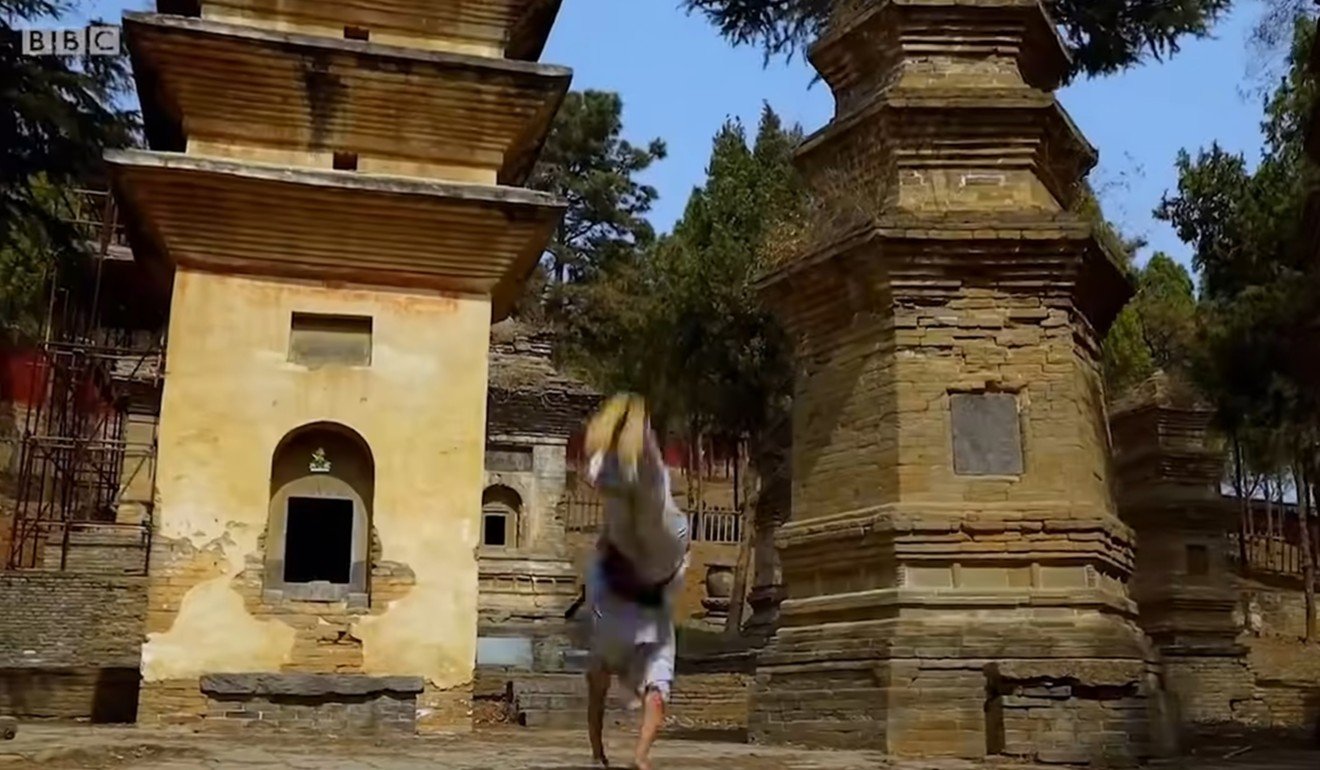
A monk performs a series of flips in the Pagoda Forest area outside the Shaolin Temple. But Ranton says monks never train there. Photo: YouTube/BBC

“That highly depends on the person practising it,” he says. “I have met plenty of people at Shaolin who train like crazy and actually separate it from the spiritual aspects. Even monks. One of my masters would never talk about anything spiritual. He would always say Shaolin for him meant war.
“Shaolin means so many different things to so many people. Some monks really go heavy on that spirituality stuff, and some are just like, if you’re not actually learning how to fight, then you’re not learning kung fu.
“The whole aspect of spirituality happens right here [in your mind], you don’t talk about it.”


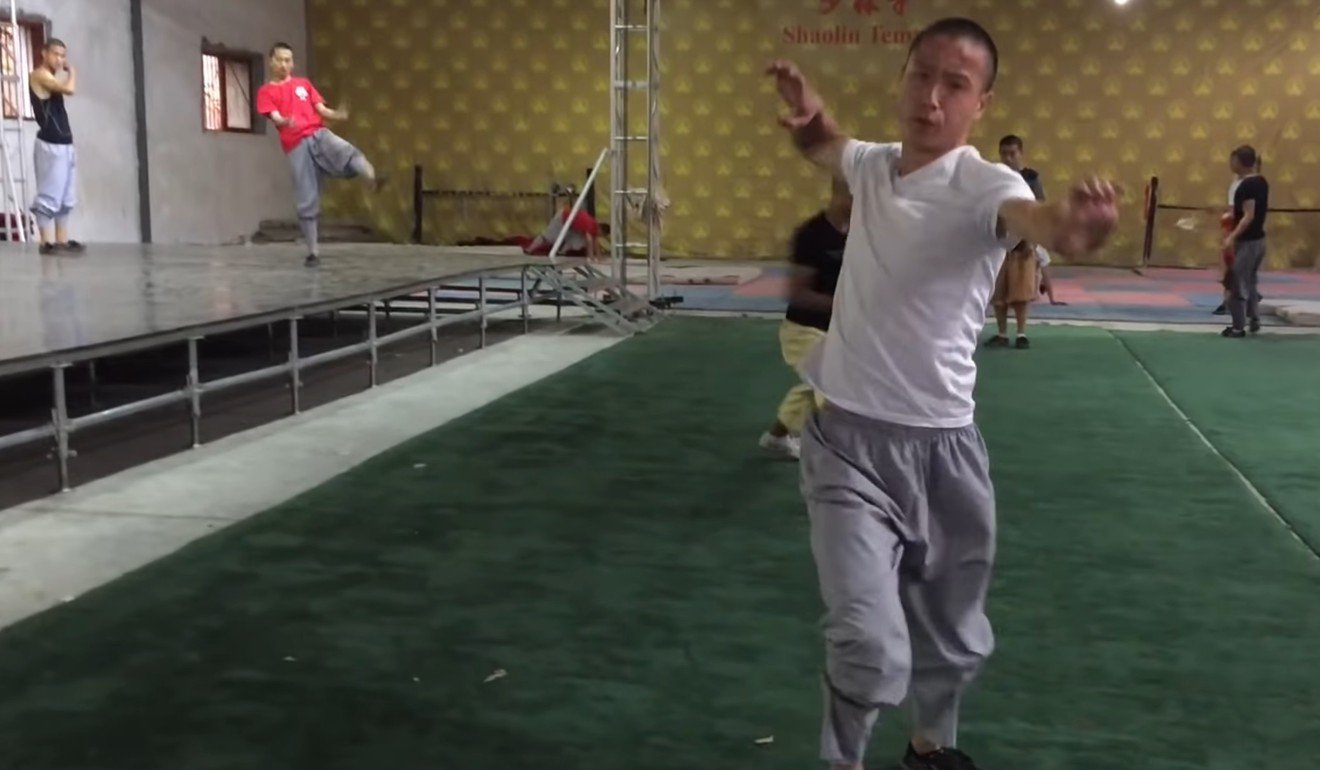
One of the actual training halls where monks practise at the Shaolin Temple when the cameras are not around. Photo: YouTube/Ranton

The documentary says that the Shaolin Temple is a sacred place in Buddhism. Ranton agrees in that it is the origin of Zen Buddhism but says that the vast majority of warrior monks are not that well-read or even interested in Buddhist scripture.
He also points out that the monks would never actually train in some of the areas that the film shows them practising in.
“We would never train there,” he says about one area. “This is in the middle of the Temple, this is part of the area that is sprawling with tourists throughout the day so you can’t really walk there. This was locked down for the camera team. We trained in the training halls which are outside the tourist areas. But, it looks cool.”

Anyone know Ranton? I haven’t been able to keep up with the Shaolin Laowai over the last decade…:o

His videos are all I know of him, and he seems genuine, yet a little too rash with some things. For instance, a lot goes without saying. We know BBC will film a certain way, and we know there will be scripting, and honestly, when I first saw the documentary, I had the thought of a test reenactment, based on the fact that the its known the Temple as been form fitted for teaching and hosting foreign students, so some formalities wont be in effect openly, or at all.
So the monk who was tested, was likely just showing what it was like to be tested IN THAT WAY. doesnt mean that was his test at that time, yet and still, I accepted it in its essence as if it was.
I understand Ranton was respond to critics, something dont need highlighting tho, and still I took his so-called evaluation as a positive, because he didnt leave room for the people in his comments to bash Shaolin in any shape or form. I respect him for that.

With Shaolin in the media, I have my own opinions.
the jist of it is, I’m in favor of spreading Shaolin ChanWuYi, in any form, as the result is only always good.

Im not so in favor of pointing out every time Shaolin puts on its "show"m for the reason that nowadays, thats just how things are spread through the popular culture and media.
so to jump up at Shaolin every time an appearance is made in the media and say “hey thats for show” or “its not really that ancient anymore” or “thats not real zen” or “thats not real fighting” etc…is so lame to me, especially when you dont see MMA fighters beatin down the doors at every WWE event/filming to “expose” its abuse of true wrestling/grappling culture.
pffffttttt…

it almost seems purposely pessimistic and overly cynical like people have some inherent fear of Vajrapani (Jingang Shou) lol, like they got smacked generations ago by the hand of Buddha personally and wont loose the grudge lol …either way I take any appearance made by Shaolin on major media platforms, especially those appearances that glorify its mysitque and bring out that certain nostalgia that only Shaolin can express , as a big ol fat win for Shaolin.

in reflection, what do people want anyway?
why would Shaolin or BBC allow a show of a poor performing monk, or failing student anyhow? like what do the people in the comments want to see, a student get beat, yelled at and told they have to study for a decade before thinking about becoming wuseng? ..then they should go apply for the experience.
and then once theyre ready, tell them you have to pass through mighty dashanmen without a bruise, or wait 5 years to be tested again lol…they dont heave the heart or patience for it obviously, not even in speculation or observation can they perceive that reality… so I dont know why they bother bashing or questioning every glimpse they get of the Shaolin culture, scripted or spontaneous.

I’m looking forward to more good looks for Shaolin in cinema and in documentaries as the growth is needed for the world and is inevitable.

Amituofo!

the “warrior monk exam” topic has been covered in KFTCM in Shaolin volumes from 2004 and 2012 , at least those two Im familiar with.

I have seen Ranton’s videos on you tube and just know of him through that. Seems like a personable guy. He has videos up about his time at Shaolin. He was lucky enough to live there for 3 years (and I am just hoping to visit Shaolin one time lol). Luckily, there are a few songshan shaolin schools were I live.

Tons of documentaries are out there about Shaolin. I think this one is a little staged for entertainment but it also gives Shaolin a spotlight. The Shaolin scene has been a little quiet as of late.

[QUOTE=Songshan;1315450]I have seen Ranton’s videos on you tube and just know of him through that. Seems like a personable guy. He has videos up about his time at Shaolin. He was lucky enough to live there for 3 years (and I am just hoping to visit Shaolin one time lol). Luckily, there are a few songshan shaolin schools were I live.

Tons of documentaries are out there about Shaolin. I think this one is a little staged for entertainment but it also gives Shaolin a spotlight. The Shaolin scene has been a little quiet as of late.[/QUOTE]

Indeed, I agree with the spotlight, I really like the BBC documentary because it give new light to Shaolin, and someone will be inspired forever from that. Also Ranton seems very cool, outside of youtube it looks like hes a genuine dude. Anyone who can commit to a few years at Shaolin, has my salute for obvious reasons.
We can really judge people, especially from youtube lol, however, the subscribers and commenters force your hand sometimes with certain topics, which is what I think he was dealing with.

about the monk’s exam, again, plenty of real monks have spoken up about what tests go on off camera, between different classes of warrior monks, for example like the scene in Jet Li’s , Tai Chi Master …or even Martial Arts Of Shaolin (Shaolin Temple 2). My take on “the nature” of the BBC exam, only because I’ve seen those monks in other docuseries, especially the senior brother, is that it could represent a promoting test within the temple. Just because one hasnt seen this type of test doesnt mean there are no grounds for it.
You might test for a position to teach new students, where all your are required to know is Xiao Hong, Da Hong, Qi Xing, 18 Luohan Shou, Tong Bi, Yin shou gun, Ji ben Gong (perfected) some qi gong etc, and one part of a sutra. so you go for it and get the spot.
now 5 or ten years later, its possible you will have another test, of greater difficulty, like much longer taolu or many roads of a specific hand, and more difficult weapons, in depth yi jin jing and now quoting sutra from various sources, on demand, which is very difficult. I know for a fact promotion happens this way, and the test is probably a bit more intimate and random. You’d be selected for this test to be able to teach a more advanced level of student.

thats the only thing Ranton didnt say, is just because he didnt see tests of this type (of BBC docu variation) , doesnt mean they dont happen…And there are more, less tourist/camera crew visited temples in the area where a more intimate situation can be cultivated. Plus you have the “non business hours” Shaolin Temple, that no one sees ever, who knows what goes on lol aside from the real monks there :stuck_out_tongue:

Amituofo

Human Playground

//youtu.be/oiFwZ-6ODbU

There’s a segment on Shaolin Temple on Ep 3: Rite of Passage. It’s followed by a segment on Sumo.

Shaolin-Temple-Documentaries
Sumo

Into the Shaolin

Documentary director delves into Zen Buddhism, martial arts at Shaolin Temple
Taking action
By Lou Kang
Published: Jun 18, 2023 11:07 PM

The Shaolin Temple in Dengfeng, Central China’s Henan Province Photo: VCG

For decades, the Shaolin Temple in Central *China’s Henan Province has been *attracting tourists from around the world who long to discover the secrets of its peerless martial arts and explore more about the birthplace of Zen, a school of Mahayana Buddhism that originated in China, where it is called Chan in Chinese.

This World Heritage Site has also captured the attention of Sun Hongyun, an associate professor at the Beijing Film Academy and documentary director, who traveled high upon into the Songshan Mountain around three years ago with her film crew to uncover the real face of Shaolin culture.

“There are a lot trendy buzzwords among young Chinese people, such as Foxi, or ‘Buddha-like mind-set,’ which means letting nature take its course or working in accordance with a situation’s natural tendency. But what does it really look like to have a Buddha-like mind-set? As far as I understand it, it’s definitely not ‘taking no action.’ So I came here to see what they do,” Sun told the Global Times in a recent interview.

In her documentary film Into the Shaolin, she observes the life and mental journey of several Shaolin monks and a young Serbian female *anthropologist who lived at the Shaolin Temple for research.

The documentary takes a rather plain perspective: Just like ordinary people, monks at the Shaolin Temple have their everyday homework to finish, and they also have their own questions about as well as longing for the future.

“Many tourists say that this temple has become a commercial place crammed with businesses and performances, but I don’t think that way. The people who live here have been here since they were very little. They live a life that many people don’t see and that’s what my documentary focuses on,” Sun said.

The documentary has been earning a good reputation for itself. It was *shortlisted in the Doc Edge Film Festival and the San Francisco International Film Festival. And in April it won the Russian Documentary Film and Television Association Award at the Moscow International Film Festival, where judges called it “a symphony of art.”

Complicated yet simple

As early as 1982, the *movie Shaolin Temple starring Jet Li made the Songshan Mountain famous overnight.

It also brought the image of Shaolin martial arts into the minds of audiences all over the world, *equating the name Shaolin with *unmatched martial arts.

Sun told the Global Times that countless people now come to the Shaolin Temple to make movies every year. She joked that if a bird lays an egg inside the temple, more than 100 cameras from all over the place will cram together just to get a shot.

“Unlike the mysterious vibe seen in the movies, when you come to the Shaolin Temple you will find it as a very open space where there are various activities, filming and seminars all day long. But it also means a mix of people,” Sun said.

Promotional material for Into the Shaolin Photo: Courtesy of Sun Hongyun

Talking about why she wanted to make the film, Sun said that she has had her own inner struggles in life. She once went to Longquan Temple deep in the Fenghuang Mountain in Beijing to do volunteer work. During her time there, she had a chat with one of the monks - a master who graduated from Tsinghua University with a PhD before becoming a monk.

What is the real attraction in the temple? Can the monks find peace of mind and end suffering here? Sun decided to go into the birthplace of Zen Buddhism, Shaolin Temple.

“People here have been educated in another system, where most of them can *compose poems and understand the philosophy of life from a completely different angle.”

Sun pointed to an elderly Zen master named Yan Yong as an example.

“Yan Yong didn’t go to school nor has a diploma. He is the only person I have ever seen who lives as much as possible like ancient romantic poets,” Sun said.

At the same time, the young monks here also have their own concerns about the future and life. Foreigners are another main group shown in the documentary.

“I wanted to show the multi-faceted and rich nature of the Shaolin Temple. There are quite a lot of foreigners with stories as well.”

Sun noted that there was one foreign student who suffered from depression and had attempted suicide before coming to Shaolin Temple to study Zen and kung fu in an attempt to find himself.

As for Serbian anthropologist Marta, Sun helped her find some opportunities to meet and communicate with the local monks so that she could better carry out research. As an outsider, Marta’s experience at Shaolin also brings the audience into the story with her.

An artistic touch

Although there are some young people from wealthy families at the temple, the fact is that there are more people from poor families who come to live a different life.

Heng Kun, the attendant of the master Yan Yong, is only 18 years old. His father died when he was 5.

Sun told the Global Times that they once went to Heng’s home to film. It was a very remote and poor mountain village with harsh living conditions in Nanyang, Henan Province, where he lived with his grandparents.

“Though they sent him to Shaolin at a very young age, Heng Kun’s grandparents clearly didn’t want him to become a real monk, so the visit finally turned into a fight,” Sun recalled.

It was not easy to film a confrontation like that, but part of the job is to film reality.

Still, as a documentary director, Sun tries to bring in a certain aesthetic sense to her documentaries.

Sun co-created the China documentary Ivens on China from Dutch director Joris Ivens. Her cinematographic style was quite influenced by his artistry.

Under her lens, the Shaolin Temple is a place with four distinct seasons. It shows the monks *practicing martial arts in the early morning, the harvesting of wheat in the fields, *conversations between masters and disciples in the mountains, as well as the close bond between people and the wild animals in the area.

Unfortunately I can’t cut&paste the poster…
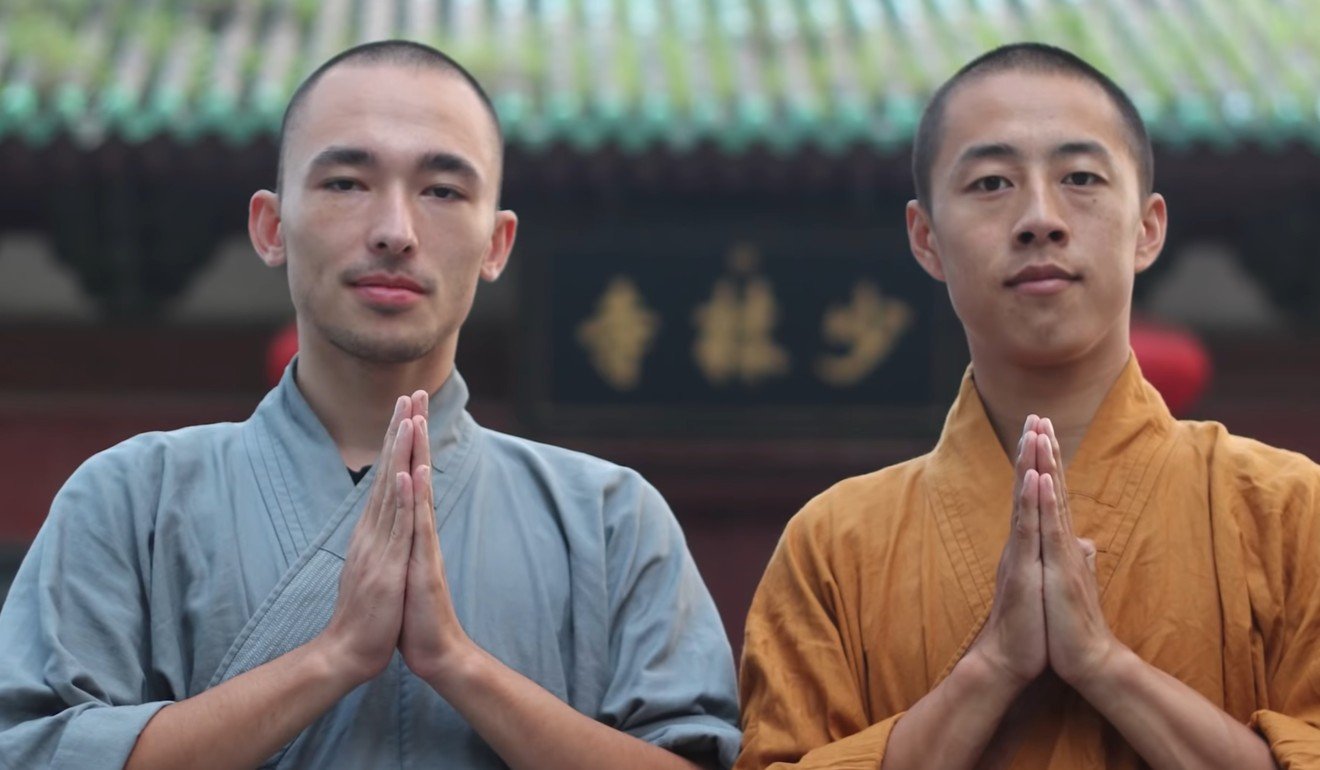
Whispers of Masters: A Night at Shaolin

Slightly OT because it’s not really a documentary but I didn’t know where else to put this. Follow the link to watch.

Whispers of Masters: A Night at Shaolin

Culture
18:12, 27-Jan-2025
Zhao Ying
, Updated 14:35, 02-Feb-2025
06:27
The Guanyin Hall at the Shaolin Temple holds a secret. Its walls are adorned with two precious murals, one depicting ancient monks engaging in martial arts duels with weapons, the other showcasing them performing the legendary “Six Harmonies Fist,” a style rooted in the principle of mind-body-spirit unity. But as dusk settles, a mysterious revelation unfolds: three masters, their images seemingly etched into the very fabric of the mural, have vanished without a trace.

A young monk, yearning for enlightenment beyond mere technique, finds himself drawn into a quest to unravel this mystery. What secrets will he uncover? What truths will he learn about himself and the true essence of Shaolin Kung Fu?

Witness the magic unfold in “Whispers of Masters: A Night at Shaolin.”

The Spirit of Shaolin | A CGTN Documentary

It’s interesting that CGTN (a news agency supported by the PRC) put out this documentary in the wake of the Abbot scandal.