Shaolin Journeys

This one is all about the pics

Follow the link. You won’t be sorry.

Miss Tourism Queen International 2009 Visits Shaolin Temple
August 24th, 2009 by Key »

Miss Tourism Queen International 2009 is held in Zhengzhou, Henan province in China from August 7th to August 30th. 110 beauties around the world traveled to China, where they compete as tourism ambassadresses for their respective countries. On August 23rd, 2009 Miss Tourism Queen International came to Shaolin Temple in Henan, beauties around the world praised the wonderful Shaolin martial art performance and the profound cultural heritage.

[URL=“http://www.misstqi.com/contestants_2009.php”]
Here’s the contestant pics on the official site.

Wow

I haven’t visited the forums in a very long time, and I am happy to have come across this thread. Very cool.

After Miss Tourism Queen International…

…I can’t think of a more pathetic follow up.

Halter Meets With Chinese Commerce Officials
posted 08/26/09 3:21 pm

Beijing, China - With a population nearly eight times that of the state of Arkansas, the Chinese capital of Beijing alone offers “tremendous economic opportunities” for Arkansas businesses provided they can access the market, Lieutenant Governor Bill Halter said Wednesday.

Halter is in China this week as part of economic development mission arranged by the National Lieutenant Governors Association (NLGA). He has spent Sunday through Wednesday in Beijing, a city of an estimated 20 million residents.

On Thursday, the NLGA contingent will fly to Zhengzhou, a city of more than 7 million south of the Yellow River in east-Central China. (Arkansas’ population is an estimated 2.86 million.)

“Today was a very busy day in Beijing,” Halter said, speaking from a hotel room overlooking just a portion of the Beijing skyline. “We started with a meeting at the Ministry of Commerce, which is the equivalent of our federal Department of Commerce. We met with the assistant minister (Wang Chao), who is responsible for the U.S.-China economic relationship.

“I expressed my concerns about the current ban on poultry produced in Arkansas in China as well as our desire to export rice to China, the world’s largest consumer of rice.”

The Lieutenant Governor raised this same concern Tuesday, while speaking with the Chinese vice minister of foreign affairs.

Halter and six other lieutenant governors also visited Beijing’s Dashanzi Art District, a bustling artist community situated among decommissioned military factory buildings. Later, they toured Tiananmen Square and the Forbidden City.

On Thursday, the lieutenant governors are schedule to visit the Industrial Zone of Zhengzhou, formerly a regional agricultural center whose industrial base has expanded considerably over the past 60 years. Also planned is a visit to the Shaolin Temple, a Buddhist monastery best known to the Western world for its association with Chinese martial arts, particularly Shaolin Kung Fu.

Still in the wake of Miss Tourism Queen International

Living like a monk means eating coleslaw in silence before sunrise?

Manalapan High School students make ‘indescribable’ journey to China
By Joshua Riley • FREEHOLD BUREAU • August 31, 2009

MANALAPAN — A Manalapan High School teacher had two days before spring break to find four student adventurers to take along on a trip to China.
Advertisement

“Hi. You don’t know me, and I don’t know you, but can I take your kid to China?” was her rendition of the calls she made to parents.

And on Aug. 1, teacher Heather Sullivan and students Cory Bolotsky, Kim Gennaro, Caitlin Silk and Drew Regino, all rising seniors, were whisked away to Beijing.

Following their recent return, the students said they had still had difficulty describing the journey that took them to the Olympic Bird’s Nest Stadium and Water Cube, hiking along the Great Wall and visiting the home of the warrior monks, the Shaolin Temple.

But Bolotsky gave it his best shot.

“(It was) an indescribable, unique, once-in-a-lifetime adventure, and every day was filled with infinite cultural paradigm shifts and remarkable experiences,” he said.

The experiences were as daring as eating duck brains and as culturally eye-opening as visiting a Chinese home where design and customs are tied to feng shui beliefs.

Being chosen for the trip was a tremendous stroke of luck. Ten teachers choosing four students each were selected from schools across the country to pilot Discovery Student Adventures, run by the Discovery Communications’ education division. The Discovery Channel is one of its products.

The trips sent students and teachers to Australia, South Africa and China free of charge to help promote the paid trips in the future.

Every minute of every day they spent in China was packed with learning experiences, the students said.

They visited the Urban Planning Center that contains models of cityscapes. Each building has symbolic meaning, they learned. One building is shaped like a dragon, and another, a microchip.

While in Beijing, they learned to cook Chinese dishes with a chef and visited the Forbidden City and campus of last summer’s Olympic games. They camped out next to the Great Wall and hiked it for six hours the next day.

Before returning home, the group spent four days in the Shaolin Temple kung fu school and spent a day living like a monk, waking up before sunrise to eat a silent, coleslaw-like breakfast.

Along the way, adventurers blogged and used Twitter to log their experiences. The writings are still available on http://dsachina.blogspot.com, and more information about the pilot trips and organization is available at http://discoverystudentadventures.com.

I didn’t chase down the blogs.

More on the Manalapan students

Still haven’t got to those blogs

Adventures in China remain with students
BY DEVIN ALESSIO Staff Writer
Four Manalapan High School students and science teacher Heather Sullivan have returned from a 15-day trip to China, where they studied kung fu at a martial arts school, rode in rickshaws, and scaled the Great Wall of China.

CORY KEY Science teacher Heather Sullivan (l) was joined on a trip to China by Manalapan High School students (l-r) Cory Bolotsky, Caitlyn Silk, Kim Gennaro and Drew Regino.

The all-expense paid trip was organized by Discovery Student Adventures, the Discovery Channel’s new division that coordinates international travel for students in grades 5-12.

Sullivan and two other teachers were chosen from more than 170 educator applicants nationwide to pilot the program’s excursion to China. Each teacher was asked to select four students to experience the adventure as well.

Sullivan chose students Cory Bolotsky, 17, Kim Gennaro, 17, Caitlyn Silk, 17, and Drew Regino, 16. The other two teachers and eight students were from Wisconsin and California.

The Manalapan students are all starting their senior year of high school this week.

Sullivan applied for the trip because of her involvement in the Discovery Educator Network, which connects teachers who are passionate about integrating technology into the classroom to other educators.

“I never believed I would get picked to go abroad,” Sullivan said. “I didn’t tell anyone else that I applied for the trip either. Once I found out we were picked in March, things started happening very quickly. I had to choose which students I wanted to bring, ask their parents’ permission, and secure our passports and visas.”

Sullivan said Bolotsky, Gennaro, Silk and Regino were selected because they are good ambassadors for Manalapan and for America. They are confident, well-spoken, and able to absorb and communicate their cultural experiences with others, she said.

As part of the pilot program, the students were required to use the Internet to write daily about their activities, using blogs and Twitter, a microblogging service.

Silk blogged, " … We made dumplings in different shapes … I can’t wait to show everyone my cooking skills when I get home!"

The students’ blogs and tweets can still be read at http://dsachina.blogspot.com.

Bolotsky concurred, saying, “Chinese food in China is nothing like Chinese food in America.”

The students said their most memorable moments including sampling duck brain and scorpion.

“Scorpion tastes like a crunchy french fry,” Regino reminisced.

Other culturally enlightening experiences included visiting the “Bird’s Nest,” which was the Olympic Stadium that played host to the 2008 Summer Olympics in Beijing; experiencing a day in the life of a Shaolin monk; and visiting the home of a Chinese family to learn about culture and calligraphy.

The students also learned how to sing the song “Shaolin, Shaolin” in Chinese and presented it to their kung fu instructors and warrior monks.

The guests from the United States were surprised as to how different the Chinese education system is from the American education system. After visiting a school, the Americans learned that most Chinese students attend boarding school year-round and only return home for a spring holiday.

“I feel really grateful for my education … that I get such a good education,” Silk said.

Bags have been unpacked and passports have been put away, but the students said their experiences in the Far East will stay with them forever.

Their teacher, Sullivan, said, “I have much more legitimacy when teaching 21st century skills in my classes. Anywhere you can go outside of your own comfort zone helps you. When you understand more, you can share better.”

Gennaro agreed with Sullivan, saying, “I appreciate everything I have more now. I’m much more culturally aware.”

The students want to share their enthusiasm about their trip and Chinese culture with others. They encourage any school or group that is interested in hearing about their trip to contact Sullivan at hsullivan@frhsd.com to schedule a presentation.

Sullivan said, “We want people to know that if you keep connections with others who are excited about the same things you are, you can go far.”

So this isnt a travel article, more of a petition for advice/tips, etc. But I figured as this involves traveling to Shaolin, this is a good place for it.

I’ve confirmed ill be traveling throughout Northern China next year, and of course I have to visit Shaolin. Giving myself a year to beef up my rough basic language skills is about all I have planned other than Beijing, Shanghai and Shaolin/Songshan Mountains.

This will be my first trip, so any tips or must see/do advice would be great as I set about to have a rough frame work of a plan for travel.

Such as, in someones opinion/experience, is there and if so where is the best city to visit the Great Wall? Other famous must see tourist spots, as well as some must see nonfamous nontourist spots.

thanks!

An interesting read on several levels…

Abbot Shi Yan Zhang?

Shaolin disciple dreams up a kung fu school
Central News Agency
2009-10-07 10:37 AM
By Flor Wang CNA staff writer

When Chang Ching-kuo dropped out of school and occasionally ran away from home at the age of nine, his future looked bleak.

Then, inspired by the films of Ashton Chen, a child kung fu star of the early 1990s, the Keelung native successfully begged his father to send him to the Songshan Shaolin Temple Film and TV Kungfu Academy in China’s Henan province.

The move saved Chang’s life, and now he harbors the dream of using martial arts training to help troubled youths, just as the Shaolin academy helped him.

“My biggest dream is to set up a nine-year martial arts school to help kids and teenagers who have lost their way to lead normal lives and build up their moral integrity,” Chang says.

The idea crosses the 27-year-old’s mind every time he sees children or teenage wasting their times in the streets or in Internet cafes.

"Seeing this always makes me feel that a kung fu school would be good for helping those kids get back on the right life path, " he says.

“Learning martial arts such as kung fu is really tiring and requires single-mindedness, but my personal experience is that kids like to spend some time studying after completing their kung fu practice for the day.” Chang speaks from experience. His parents were divorced when he was only two years old, leaving his grandmother to look after him.

But she was too old to properly care for him, and he started running away from home and regularly missing classes after entering elementary school.

"Every member of my family thought I was hopeless, " he recalls ruefully.

In 1990, he entered the Songshan Shaolin Temple Film and TV Kungfu Academy – an umbrella facility authorized by the Chinese government to teach children basic martial arts. There, Chang studied kung fu for five years.

“Those days were beset with difficulties, and it took me several years to adapt to the extremely restrictive and disciplined environment,” he recalls.

“Apart from getting only bland meals, we had to get up at 4: 50 a.m. every day and start our training routine by running around the base of two nearby mountains. With senior students chasing us with whips, we had to run faster than rabbits,” Chang says.

The students were also subjected to physical discipline by older students when their kung fu movements did not measure up.

"Our thighs often bore bruises, " Chang remembers, and resting in the dormitory often provided little respite from the daily hardships.

"During the night, more than 20 people would sleep on a two-level bed in a dormitory of about 100 square meters, " Chang says. “During the summer, we had to endure temperatures of 40 degrees Celsius without air conditioners or fans, while in the winter, we faced temperatures below zero while meditating.” After five years of basic training at the academy, it was recommended that Chang attend the Songshan Shaolin Temple Monks Training Base Mission in 1994 and he became the first disciple from Taiwan of the Shaolin Temple at a time when relations across the Taiwan Strait were still sensitive.

He then was allowed to take part in a warrior monk group and performed around China in the following years until he returned to Taiwan in 2000 to serve his mandatory military service.

That, however, marked the start of a fresh setback in his private life. With just an elementary school education, he had trouble finding a well-paid job in Taiwan despite his martial arts mastery and ended up working in odd jobs as a construction worker, private security guard and waiter.

Not until he appeared on a local TV show in 2007 did he achieve some level of recognition, but even then, he was criticized for “fishing for fame.” In the face of the mounting criticism, Hua Lin, secretary-general of the Taiwan Zen Buddhist Association, came to Chang’s defense, praising his martial arts skills as a genuine accomplishment.

“Chang’s hard qigong, such as punching, flying kicks, swordplay, iron head and weapon wielding, is really amazing and is evidence that Chang has mastered the techniques of the so-called 18 types of Chinese martial arts,” Hua said.

The association now frequently invites Chang to teach Shaolin martial arts in different regions of the country. He also returns to the Songshan Shaolin Temple every year or two to perfect his techniques.

Speaking of the years he spent mastering kung fu in China, Chang attributes everything to destiny.

“I do not regret all the years I spent learning kung fu in China, even if I missed the chance to go to college in Taiwan, because it taught me to be a righteous man.” Passionate about contributing to society, Chang regularly shows his concern for the underprivileged, visiting the Taichung Drug Abuse Treatment Center in central Taiwan to help addicts with their rehabilitation.

He also stages qigong performances for charity at nursery schools and institutions for the mentally challenged.

Establishing a kung fu school, though, remains Chang’s major pursuit.

“Learning kung fu can help kids achieve a healthy state, both mentally and physically,” he says. “As Abbot Shi Yan Zhang told me, a kung fu practitioner is nothing without a strong sense of morals. The main tenet of kung fu is to cultivate one’s moral character.” Hearing that the Miaoli County government is planning to establish a kung fu school next year, Chang wonders when his chance will come, acknowledging that his goal remains no more than a distant dream hindered by stiff challenges.

“Lacking support from the government or the private sector, it is a very difficult task,” he laments.

Chang says, however, that he will not be deterred from his goal because he really wants to do something for troubled and temperamental children.

“My experience in Shaolin Temple made me aware that adults must find an appropriate method to educate this kind of hyperactive child, who can easily become a good for nothing by missing school or running away from home.”

a CCTV human-interest piece

Love the ‘foreign student’ pic.

Kungfu and animal attraction
2009-10-12 14:56 BJT

Master Zhang Shengli believes kungfu frees the body and mind - and could eventually bring world peace.

To find the true heart of traditional kungfu, you need only look as far as the secluded hutongs behind the ever-crowded Wangfujing shopping area.

Here can be found a dozen teachers and students all displaying varying techniques and styles: from the energetic art of Shaolin kungfu to the explosive attacking xingyiquan, which imitates the various movement of animals.

Movements of the monkey, snake, hawk, dragon, **** and bear can be copied and have a powerful impact on your opponent. There is also the peaceful taijiquan, which is centered on breathing contol and internal strength.

“Martial arts are not just for the Chinese people to enjoy, but everyone in the world,” said master Zhang, who started learning kungfu more than 30 years ago. He has studied at the famous Shaolin Temple in Songshan Mountain and performed for the United Nations.

In 2002, he founded the Beijing Milun School of Traditional Kungfu and, today, it has more than 30 students and five teachers. “Here, everyone is welcome,” said Sabrina, a student of Zhang’s since 1997. “It is very difficult to find a good martial arts teacher if you are a foreigner and do not speak Chinese. It is very limited for outsiders, so the focus here has been to give more foreign students the opportunity to learn traditional kungfu.”

Students from beginner to advanced levels can start at any time.

“Students come and go, especially if they are traveling a lot between Beijing and their home countries, but we want them to feel they learn something here that they would not learn anywhere else,” he said.

Kungfu does not just offer strength, concentration and coordination, it also holds the key to many facets of Chinese culture and history, and the costumes and ancient weaponry that decorate the school help to give students a more rounded education of martial arts, he said.

Zhang wants his top students to take the skills and messages of kungfu around the globe, and believes teaching is not just a job, but his duty. Kungfu, after all, could bring world peace.

“Martial arts is not just about kicking and punching, or being big and strong. It is about changing your thought process,” said Zhang. "What’s the point of practicing martial arts if your mind is not right?

“Martial makes you become a more beautiful person from the inside and makes bad energy disappear.”

Nice photo essay

This is part of Global News Day for Children. Click for 10 pics.

Kung Fu child and his Shaolin dream
www.chinaview.cn 2009-11-13 14:51:47

He Minxian, a 9-year-old kid, bellows to lend impetus and strength during a team training class in the Shaolin Tagou Kung Fu (Martial Art) Institute at the foot of Mountain Song in Dengfeng, a city of central China’s Henan Province, Oct. 12, 2009.
Little He Minxian, a common student of this private-running school, renowned as the “No.1 Shaolin Kung Fu Institute of China”, was sent here 5 years ago due to his awkward temper by his parents, who run clothing business in Shanghai. After being separated with his parents, He Minxian devoted his whole childhood to the exercise room of this school.
It was a long and harsh period of time for little He Minxian. Some 5 years passed, this unbending and lovely boy, by means of his great interest, strong comprehension and huge willpower, has become a skilled “kid of Shaolin”, performing an outstanding martial art. He ever took part in the performance of some crucial activities like the opening ceremony for the 2008 Paralympics and the celebrations for the 60th anniversary of the founding of the People’s Republic of China last October.In the Shaolin Tagou Kung Fu Institute, around 24,000 students like He Minxian learn Chinese Kung Fu. The school opened courses including Kung Fu patterns, free boxing, boxing, taekwondo, and Kung Fu performance. Besides, an integrated education system has been formed at the institute, containing full-time nursery, primary school, secondary school and college. A large number of children presented themselves an enriched and happy childhood. (Xinhua/Wang Song)

Nice CCTV article

Shi Yonghan celebrates his 80th!

Former martial monk recalls his Kungfu days at Shaolin Temple
2010-01-11 15:37 BJT

He left home at 6 years old to become a monk and returned to a secular life at the age of 20. Having participated in a lot of national competitions and performances and received a number of awards, he is famous as “one of 18 Shaolin boxers”. He set up the first martial arts school in Dengfeng, and has cultivated batches of martial arts and professional talents. He has gone abroad many times and helped promote the Shaolin martial arts in the world. He is Shi Yonghan, one of thirty third-generation monks who had resumed a secular life. On January 7, he shared stories of his early life as a monk with our reporter and revealed his wish to reunite with the monks who underwent the training with him at his 80th birthday celebration.

Many years of habit

Up at dawn to exercise and recite scripture

Shi Yonghan’s secular name is Mao Wenhua, and is also known as Mao Yonghan. He was born on January 26, 1930 and he lives in Xindian Village, Zhongyue Sub-district in Dengfeng. On January 7, our reporters got a glance of Shi at the Ganlutai in the west of the Shaolin Temple doing exercises, which included large flood boxing, small flood boxing, cannon boxing, long and broad sword, long spear, and tree stump training (using breathing techniques to hit the stump with every part of the body).

He squatted and stretched his fists horizontally while holding his breath in his stomach before suddenly pushing himself onto a big poplar, which shook drastically, with branches rustling and leaves falling. Shi remained calm and was at peace before he concluded with an easy countenance, and nothing revealed that he was 80.

Shi told our reporter that the secret of his health was that he still follows the habits he developed when he was at the Shaolin Temple. He would get up at 4:00 am, run a lap around the village road, and then go into the forest of poplars to do basic exercises.

After the exercises, our reporter followed him to his house. There was a hall for worshipping the Buddha on the second floor, and just like the monks in the temple, he burned incenses, read scripture and tapped the wooden fish lightly. After all was done, he shared with the reporter the memories deeply-embedded in his heart.

Left home to become a monk

He was “sold” to the Temple because of family poverty

According to Shi, he was the third eldest of 6 children in his very poor family. His parents called him Wenhua (Chinese for “culture”). In 1936, when he was 6 years old, a great drought hit Dengfeng between summer and autumn, leaving no harvest. His family decided to flee from the famine to Shaanxi and with their fates uncertain, his parents, baring the pain, reluctantly sold him to Xuantian Temple which was affiliated with the Shaolin Temple to be a monk. Holding him in her arms, his mother cried, “Wenhua, you must be strong. If we cannot return home in the future, you must learn wisdom and martial arts.” His family received some corn from the temple as traveling expense in exchange and headed for Shaanxi.

He was picked among many to become an elite martial monk

After converting to a monk, his name was changed to Shi Yonghan. He became a disciple of Master Shi Hangchao in the Xuntian Temple. Later due to his hard work and martial arts talent, he was taken in by Master Shen Gen as a disciple, before becoming the last disciple of Master Ke Zhu.

“At that time, there were 109 monks in Shaolin Temple altogether. Although most monks took training exercises, there were only 18 temple protection monks, which were referred to as Eighteen Disciples of the Buddha. During that time, the warrior monks were called temple protection monks, and not all monks in the Shaolin Temple could become warrior monks.” In recollection, Shi said that, whether a monk would be chosen as a warrior monk depended on the identification of his master and his talent in martial arts. It was a very strict process, almost one out of a hundred.

Once a monk became a warrior monk, his top priority was to train and his second priority was studying scripture.

Shi at 6 years-old, bore in mind his mother’s instructions. Every day he would get up at 3:00 am, run to the mountain behind the Shaolin Temple and back, before doing body exercises in a quiet place. According to Shi, this was called"meng gong," meaning exercising Kung fu in solitude. Almost everybody was engaged in this kind of exercises then.

The time came for group training, and his peers gathered in Ganlutai to the west of the Shaolin Temple to do exercises.

Shi stayed at the Shaolin Temple for 14 years, and became a master of all kinds of martial arts, such as light skills, mastery skills, Shaolin boxing and apparatus. He was referred to as “fleet feet,” and his skills with a double-bladed sword were an especially special skill in Shaolin martial arts. When he was training with double blades, he was so proficient that not even water would penetrate through the blades.

Shi was also good at bell lifting. In refection, the bell in the Shaolin Temple was 200 kilograms in weight. In the beginning, he could only lift the bell slightly from the earth, but he gradually lifted it higher and higher, and in the end, he could lift it to the chest. He lifted the bell 50 times daily. He had immense arm power, and was claimed as an iron-armed monk.

After he had made some achievement, just as other warrior monks, he advanced to the Temple of One Thousand Buddha to do set pattern at first. “one of the swales made on the earth of the temple was made by me.” According to him, with the skill enhanced everyday, he start to learn stump beating and lifting in order to make himself an iron body.

continued..

..from above

The pictures of training when he was a child are still vivid for Shi, just as if it happened yesterday.

Shi said that in training, three layers of sweat needed to be shed. The first layer was called sweat of confusion, the second was sticky sweat, and the third was cool sweat. Sweat of confusion came out earlier during the training that was of no use. The second layer came out when the training was improved and the third layer was between sweat and oil could only be shed by people who had achieved a high enough level of kung fu and was entitled the right to sleep.

Then monks usually slept in a shared bed, and the temple protection monks slept on benches that were a little bit wider than the current benches. It was about 40 centimeters wide, fit for one body and one turn would result in falling to the ground.

Things were better in summer. In winter, the Shaolin Temple was extremely cold. According to him, he shared a thin quilt with three little monks, and they slept on the benches with mats on it. It was too cold for the little monks to fall asleep and they went to the depositary of Buddhist texts to train, and the sounds sometimes woke the master, who would come and give instructions.

Shi said at that time, the method and postures adopted in training were primitive and dangerous. Because of this, quite a few temple protection monks quit.

Regulations and commandments

When going out, monks must wear a long gown and a hat

The temple is very strict with warrior monks. For instance, when going out for a fair, all the monks are required to wear a long gown and hat, and monks clothing is forbidden. This regulation is not only to prevent the outside worlds interference with the monks, but also to stop outsiders from coming to the Shaolin Temple in case a monk stirs up trouble.

At the age of 16, Shi missed his family very much, so he begged his master to let him visit his relatives who left for Shaanxi province. Only after giving him several strict rules to observe during his journey did his Master allow Shi to go.

Shi said that he still clearly remembers his master’s instructions. First, stay at an inn for the night after dark, and set out late in the morning. Second, do not disturb others and stay out of trouble. Third, never mention that he is from the Shaolin Temple or who his master is. Fourth, never show off his martial arts and fifth, be cautious and alert.

While recalling the story, Shi said he arrived in Lingbao Country by noon on the third day of his travels. When he was about to eat lunch at a restaurant, he suddenly heard a lot of people crying behind him, “Watch out! That horse is startled. Get away!”

Looking over his shoulders, Shi saw a big black horse running frantically while dragging a plough behind. In a blink, the horse dashed towards Shi and with no time for thinking, Shi turned around and jumped to the sky. Grabbing the horse’s neck, he leaped on its back, and held the startled horse down tightly to the ground with his martial arts. Instantly, the plough flew over his head.

The startled horse was finally subdued, yet the crowd had not yet recovered from astonishment. Shi stood up, dusted his clothes, and strode away, leaving the amazed audience behind, which were saying, “He must be from the Shaolin Temple.”

Practice Kung fu even on the Chinese New Year Day

The sun was already well up in the sky after the monks finished practicing Kung fu. They began to eat their breakfast of steamed millet and sweet potatoes. The lunch is relatively richer. Six monks sat around a table occupied by three dishes and one bowl of soup, namely radish, Chinese cabbage, bean curd, and a bowl of millet soup. Every monk had corn cake as their staple food and they ate noodles for supper.

A monk named Yong Han said that the temple provides relatively better food on the first and fifteenth days of every month, allowing monks a meal of bean curd, vermicelli and flour slices. In addition, on August 15, the temple provides cakes made from Chinese dates taking the place of moon cakes.

On New Years Eve, monks will read Buddhist scriptures from 6:00 pm to 8:00 pm. On the first day of the Chinese New Year, monks will first set off firecrackers and then read Buddhist scripture. At 7:00 am, they eat dumplings filled with bean curd, vermicelli and radish. After breakfast, they begin to read Buddhist scriptures and they present tributes to every sacred statue and do not stop reading Buddhist scriptures until noon. In the afternoon, they will be free and some young monks will go play in the mountains. However, they must still practice Kung fu in the evening. All monks will go to bed at 10:00 pm.

Those who doze off during schooling were slapped on the hand

Apart from martial arts, Shi said that little monks who just entered the Shaolin Temple also received regular schooling, mainly learning four courses, Chinese, common knowledge, math and history. At that time, the little monks always had classes in the Temple together with the neighborhood children.

Because Shi had to get up in the early morning to practice martial arts, he always dozed off during afternoon classes. As a result, Shi was always punished physically by the teacher. After the punishment, the teacher would asked him what he would do in the future, and of course he answered that he would correct himself next time. Then he followed the teacher and read aloud, “Watch new books that include both text and pictures.”

New Year’s wish

Spend his 80th birthday with his fellow monks

In 1949, the Peoples Republic of China (PRC) was founded. At that time, the government required that all monks who were sold to the Shaolin Temple before the PRC was founded to be allowed to resume secular life and go home. Consequently, Shi left the Shaolin Temple, and returned home to farm. He named himself Mao Yonghan, and was given a job as a cook in a state-owned forest farm within Dengfeng. He spent his spare time teaching others martial arts. In the 1980s, the film “Shaolin Temple” was widely broadcasted, and Shaolin Kung fu became famous both at home and abroad. Shi was always invited to attend competitions and give performances and won many awards at home and abroad, thus becoming one of the 18 renowned Shaolin boxing masters. After Shi retired, he opened the first martial arts school in Dengfeng, the Shaolin Martial Arts School.

In 1987, Henan TV broadcasted the feature “Shaolin Monk Mao Yonghan” during primetime. The feature was the first to deal with Shaolin martial arts since the reform and opening-up policy was launched, which played an important role in passing down and promoting the Shaolin martial arts.

With time elapsing, 60 years have passed. The place where the monks lived has been changed into a vegetarian restaurant, the guest room into the abbots room, the place where the abbot lived into the place where Buddhism is practiced, and the classroom into storage for books and pictures.

Shi recalled that at that time, half of the monks who protected the temple were locals, and half were people from other places. Senior and junior fellow apprentices included Chang Qing, Su Lai, Xing Dao, Ying Fang, and Ying Chang. Chang Qing and Su Lai joined the army and went to Beijing after PRC was founded in 1949. Now 60 years have passed, and monks who protected the temple at that time are already in their eighties or nineties. Maybe only a few are still alive.

Shi said that elderly people always want to recall things that happened in the past, and he now misses his senior and junior fellow apprentices very much. “Dozens of years have passed, and I do not know how they are. I am eager to see them again.” Shi’s 80th birthday is coming, and seeing his senior and junior fellow apprentices is the gift that will make him the happiest.

I’ve never met Mao Yonghan, but I’d love to now.

best Indian Shaolin Monk?

I almost put this in our Bollywood Kung-Fu!! thread, but had a last minute change of heart.

Gong-fu with Kanishka Sharma
Soumyadipta Banerjee / DNA
Wednesday, March 31, 2010 10:59 IST

Mumbai: Remember the 36 Chambers of Shaolin? The Hollywood blockbuster showed what rigorous disciplines the monks of the Shaolin Temple go through to become a warrior monk. Well, now Mumbai will soon have its own Shaolin Monk to teach them the ancient art of Gong Fu. And who else can better do it than the first and the best Indian Shaolin Monk? Meet Kanishka Sharma, who is always on call for top Bollywood stars like John Abraham, Shah Rukh Khan, Priyanka Chopra et al whenever they have to get kicking on the screen.

“I am working towards opening an academy in Mumbai where I can teach martial arts to the citizens of Mumbai. I haven’t finalised the location yet but in all probability, it will come up in Andheri west,” says Kanishka Sharma, the first Indian graduate of the original Shaolin Temple in Beijing.

“My teacher Xian Ji is the disciple of the first main guru of the Shaolin temple. I also had to go through numerous rigorous exercises to graduate from the temple. For example, I had to squat on a horse for hours together. At the end of the programme, I got a Chinese name too, it was Shiyong Xin. I want to impart the same quality of education in India,” says Kanishka, who also taught Akshay Kumar the Seven Deadly Arts in an international television reality show.

Sources also say that the school might also be used as training ground for Army commandoes though Kanishka remains mum for it. “All I can tell you is that I’m already a consultant with the Indian army and the patramilitary forces and I teach them martial arts. I also specialise in Pekidi-tirsia-kali, (a high-risk combat art that aims at killing your opponent),” he says, adding that he has also joined the special Indian Government cell that aims at countering terrorist attacks.

36 Chambers of Shaolin a Hollywood blockbuster?
Original Shaolin Temple in Beijing?
Shiyong Xin?
:rolleyes:

[QUOTE=GeneChing;1002780]I almost put this in our Bollywood Kung-Fu!! thread, but had a last minute change of heart.

36 Chambers of Shaolin a Hollywood blockbuster?
Original Shaolin Temple in Beijing?
Shiyong Xin?
:rolleyes:[/QUOTE]

Maybe he should call the Order of Chan and get them to help him with that…:rolleyes:

:smiley:

From Shaolin Temple, Quangzhou

My dentist is a kung fu guy - an eagle claw specialist - good for pulling teeth.

Kung fu gold for Castle Hill dentist
05 Apr 10 @ 03:43pm by BRIAN KARLOVSKY

CASTLE Hill resident Michael Fong is not your average dentist.

Take one look at him performing his spinning-thunder-kick and you will understand why.

The former world martial arts champion (2000) is an expert in kung fu and recently won two gold medals at the legendary Shaolin temple in Quangzhou, China.

He won first place in the weapons category (using a broad sword) and a first prize in the Mens Wu Chu open Form.

Fong, 37, who was first taught by his father when he was four years old said: “Kung fu just runs in the blood for my family.”

Fong teaches a class of 50 every Friday at Baulkam Hills Community Hall and has won over 35 international, national and state martial arts tournaments.

He claims to be able hold down an opponent with only two fingers, using inner energy called “fung” and said his sifu, or teacher James Chee,50, could make a person faint without even touching them using the next level of energy called “chee”.

“It might sound incredible,” he said. “When I first started I thought this can’t be real but it is, if you find a genuine master.”

Fong told The Hills Shire Times he was personally selected by the late Grandmaster Chee Kim Thong to teach the “Open Mountain” kung fu form back to the chief instructor of the southern Shaolin Temple in Quanzhou, China. Originally from Shaolin, the “Open Mountain” form was one of many disciplines lost when the southern Shaolin temple was razed by Qing dynasty warlords.

After practising a traditional sytle of kung fu called Shaolin Wu Chuan for over 20-years, Fong hopes to one day be able to move his opponent by “chee” alone - like his master. Fong said disciples of kung fu get stronger as they get older and he said he looks forward to moving an opponent without touching him.

Check out our ezine

New on our ezine: A Shaolin Summer by Leila Dehghan, just in time for our Shaolin Special 2010.

Evander Holyfield

Now there’s a great pic.

TSS Q n A: Evander Holyfield, Part III
By Zhenyu Li

“God give you the opportunity. You can’t choose your beginning, but you can choose the end on how you want to end.” —— Evander Holyfield

In the previous two episode of this interview, Holyfield talked with me about his seemingly endless inspiration, how he was influenced by the world-renowned Chinese Kung Fu master Bruce Lee, his perspective on China, and his bond with this oriental nation.

Putting the last stroke on Holyfield’s “China Journey” in this episode, the ring legend revealed how he benefited from the legendary Chinese Shaolin training program, his take on the connection between Kung Fu and boxing, and some secrets of his training regimen.

Zhenyu Li: So you came down here for the purpose of scouting some fighters. What’ve you gotten so far?

Holyfield: I got the opportunity to meet the head monk (of Shaolin Temple). He taught me about what he teaches young people. You know, he got 60 million followers. And I’d like to say, wow, what people have in common. I think the same way! I learned that, for the winner, winning a competition is more than just ego. It’s about how you’ve been taught. You learned it. You didn’t forget it and you passed it on. You keep passing it on and this is how this country (China, with a 5000-year history) keeps getting better and better and better. Then, I complimented his program.

And you know, being taught is different from being trained. At this school (Shaolin Temple), they train people. What they do in training is that you speak and you make sure that they do it. So this is training. I am a fighter, so I know what it means to be trained. They tell you what to do and make sure you do it. And they know you can do it.

When you teach a person, you don’t know whether he can apply (it or not). You just give him the knowledge and he goes home and says I know it, then you’ll wonder why is it that person doesn’t prosper in life, 'cause that person didn’t apply what he knew. He can take it in, but he is lazy, he is not accustomed to applying it. You know, people got different attitudes and all that.

When you do get disappointment, what are you going to do? In this same program, they teach these kids to be able to concentrate, in a time of difficulty. What they were teaching these kids was to be able to concentrate when things were hard, and be willing to stand up and counter. I was VERY impressed.

So I kinda felt that this program will change a LOT of lives. All my life as a kid, we were taught that Kung Fu is the best thing you can do. All the kids, they started young and they all wanted to do Kung Fu. The reason is that Kung Fu is structured; it’s technically-sound; you have to be good to go through a lot of different tests.

To be a street fighter, you just go out and do what you do. But for Kung Fu guys, you have to get the techniques, and you have to be judged in your forms.

Zhenyu Li: You’ve been such a great achiever in boxing and in the addition learned something from the Chinese Shaolin training program. From a professional’s prospective, what do you see in the traditional art of Chinese Kung Fu, and the connection between the Mixed Martial Art and boxing?

Holyfield: Boxing is not self-defense. You have to be aggressive. You have to attack all the time. So in that sense, it allows you to have a different attitude than in Kung Fu.

So unless you want both of them to be successful, if you always defend yourself all the time and not to attack, finally you’ll find yourself get knocked out. If you’re just being passive, your opponent will push you back and you’ll end up losing your ground.

You got this big old country, if you are too passive, then somebody will move to your country, and then push you out of the country. So, you know, you cannot be too passive. You gotta have both and to stand strong.

Zhenyu Li: MMA is becoming huge in America and some top-tier pro boxers have expressed their interest in MMA. What’s your opinion about it?

Holyfield: I’ve never fought with a Kung Fu guy. My whole experience is in boxing. For Kung Fu, you have to be a lot more dedicated, flexible and all that. (It requires) a LOT of discipline and patience. It takes time to do it. As a young kid, I just wanted to do something; I didn’t want to take pains and time to grasp a complicated technique, you know, because at the time I didn’t understand what that was for. All I wanted to do is to be better than somebody else. So when you get into martial art, you have to be able to concentrate and do all of those great things, but when I was a kid, I didn’t understand all these. I just wanted to make it work on somebody; I wanted to do it on somebody; I wanted to do the things that really work.

I learned that Kung Fu is not meant to take advantage of somebody, but to protect oneself.

Zhenyu Li: One of the advantages that some Chinese boxers have is that they were once Kung Fu practitioners, which is good for their balance, dexterity and so forth. Shiming Zou is a good example. He is a two-time world champion and a hot favorite for an Olympic gold. Have you ever heard of him?

Holyfield: He’s a lightweight.

Zhenyu Li: Yeah, light flyweight.

Holyfield: Yeah, yeah, yeah, and I was once trying to sign him. But you know, there are about four or five people out of America trying to get him. Hehehe, oh, my. who wouldn’t want to have him?

Realistically, you know, I’d LOVE to have him. Because people (here in China with a number of over 1.3 billion) would love me.

People would think, if I am great, whom I am with is supposed to be great too. With him, he has already done this by himself. So there will be a bigger promotion and all this, which would be good for him. It won’t depend on who his manager is and how they want to do it.

I have a game plan to take advantage of… you know, people like me. Then I could help promote somebody’s product here. You know, this country will be the number one power in the future. You know, America is going down like this. It’s gonna be China that will be the high power.

Zhenyu Li: I’ve been curious about the fact that you look fabulous for your age, both inside and outside the ring. Are there any hidden secrets in your training regimen? What’s your typical day like, when you are in training?

Holyfield: You know, that depends. When I am at home, I train like five days a week. You are not supposed to get out of shape. But it’s not the shape you build up that leads you to winning a fight. When I prepare for a fight, I train six days a week; twice a day.

When I was younger, I used to train a lot harder. I always wanted to do more than my opponent. I could remind myself that, you know what, I do some that he doesn’t do. That should be the driving force. But when I got older, I found that, you know what, your body couldn’t do that, 'cause your body easily got tired. Now instead of running everyday, I run every other day.

When your body gets too tired, you have to pull back, because when you are older, your body takes a little more time to recover, so you can’t do the things that will burn yourself out. It’ll wear your body out, like this. So when I was young, I was able to recover my body in ten minutes, like, I am ready to go again. But when you get older, when your body gets tired, it takes time to recuperate, and you don’t have much time to recuperate when you are in a fight.

You know, I learned a LOT of things when I reached the age of 30. When you want to do something physically, your body will say OK do it, but you’ll pay afterwards. So I had to learn to make adjustments.

So that’s what I found that I was doing. At the last phase of my career, I was just… you know, my body is trying to make me lazy.

Zhenyu Li: I heard that you were planning to claim the world heavyweight title for the fifth time, right?

Holyfield: One more time, one more time. I need to finish it.

Life is about how you finish. Regardless of how much money you earned in your life time, if you die broke, you are a broke man. It’s how you end that defines you, not how you came up. God gave you the opportunity. You can’t choose your beginning, but you can choose how you want to end.

Zhenyu Li: Perfect. I truly wish you success. Thank you very much for your time, Evander.

Holyfield: Thank you. Any time.

Kung Fu Kids - that’s kind of catchy. It would make a good movie title…

Shi Yan…haaaaaa, like that tells you who it is…:rolleyes:

Kung Fu Kids
Posted: Sat Jun 19 2010, 05:32 hrs

City children return from China with training in martial art

Their classmates may be making most of the summer holidays watching remake of the 80s classic ‘The Karate Kids’ running successfully in theatres, but this group of seven middle school students are back from China with lessons in Kung Fu from the Shaolin school. “It was a three-day training in the martial art and we learned some wonderful things,” chirps an excited Samyak Jain, class VII student of The Millennium School. “The Kung Fu discipline is based on the characteristics of five animals—monkey, crane, snake, tiger and mantis an insect that hops,” he adds.

“We went to Dang Feng, where Epo College of the famous Shaolin chambers is located and trained under Shi Yan, the shifu, or the master, who was with us for three days, teaching us the finer points,” said Sami Chowdhry of Class VIII, adding that they were all awarded certificates at the end of the programme stating that they were eligible now to graduate from the college.

And would they give it a serious thought in future? “Of course,” says Sami.

“Kung Fu was developed by Buddhist monks for self-defence and it is a practice that requires deep concentration. In that respect, the experience was extremely enriching and we would be applying the rules in everything we do,” says Swati Kulkarni, who was promoted to class VII this year. The students volunteered for a trip organised by Terra, a Delhi-based agency, to go to China for the crash course and also do some sight seeing. Good, they had been prepared beforehand with a practical knowledge of Cantonese to take care of the communication.

“Besides Dang Feng (it means ‘small forest’) where we were trained, we also went to Beijing and Shanghai…the buildings, infrastructure, etc were amazing,” gushes Vriddhi Jhunjhunwala. The kids were impressed by the practice of riding bicycles and habit of taking public transport among the Chinese citizens, instead of moving in private petrol/diesel-driven vehicles. “It contributes majorly to curbing pollution, despite the largest population in the world,” says Suyash Tiwari. “The children had given a Kung Fu performance during our annual day and that is where we got the idea to send them for hands on training in the martial art to China,” says sports teacher of the school, Deepak Rajput. “Good to see, they are all kicked about the trip.”

More India

Kalari seems on the rise. Remember Holy Mountain?

India-China martial arts meet at Shaolin temple
2010-06-21 06:10:00

Martial arts experts from China and India met at the Shaolin Temple, famous as one of the holy sites of the art of Kung fu, to commemorate the 60th anniversary of diplomatic relations between the two countries.

Twelve Indian martial arts experts from the Nithya Chaithanya Kalari Indian martial arts training centre, founded in 1993 by Murugan Gurakal, performed Kalaripayattu Sunday alongside monks of the Shaolin Temple, who performed Kung fu.

‘Shaolin Kung fu is the father of Chinese martial arts and Kalari is the mother of Indian martial arts,’ Murugan Gurakal, was quoted as saying by Xinhua.

Gurakal hoped his countrymen could learn a lot from Shaolin Kung fu.

The Indian experts performed Kalarippayattu styles like long stick fighting, knife fighting, sword, shield and flexible swords, while the Shaolin monks performed Kung fu including Tung Chi Gong, Er-zhi-zen and Eighteen Weapons.

Shi Yanhao, a monk who performed Tiger Fist, said he was ‘happy to see the mysterious Indian martial arts’.

Kung Fu Camp

It beats camp rock, I suppose

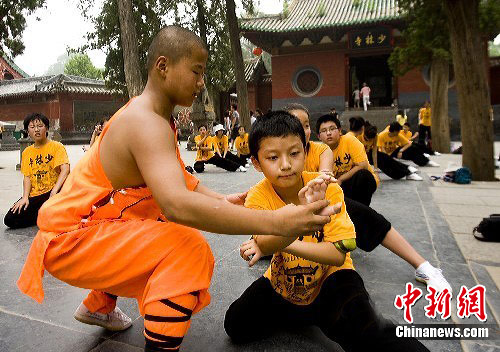
Overseas Chinese youth learn Kung Fu in Shaolin Temple
16:43, July 30, 2010

A group of foreign youth of Chinese origin learned Chinese Kung Fu from monks in Shaolin Temple in China’s Henan Province on July 29, according to Chinanews.com.

As a part of their trip to seek roots in China, the 50 youths from seven countries, including America, Canada, Britain, Ireland, Germany, Switzerland and Sweden, participated in the “Kung Fu Camp.”

The summer camp for foreign youths of Chinese origin was co-organized by the Overseas Chinese Affairs Office of the State Council and the Overseas Chinese Affairs Office of the Shanghai Municipal Government, enabling a total of 2,100 youngsters of Chinese ancestry to seek their roots in China.

By Ye Xin,People’s Daily Online

Good for Dave

I’m glad he had a good time. :cool:

Local Trains At Shaolin Temple
Tuesday, 12 October 2010

Photo provided: Dave Weaver, far right, recently returned from a trip to China to study different forms of martial arts. Weaver is the co-owner of Iron Bear Martial Arts in Celina.

By MICHELLE STEIN
Staff Writer
CELINA — Martial arts instructor Dave Weaver recently returned from the trip of a lifetime. Weaver spent six days training at the Shaolin Temple in Henan province, China. The trip lasted from Sept. 3-17, which included seven days of training, as well as time for sight seeing.
“A guy I train with had been urging me to go with him — he had made several trips to China — so I finally told him I would,” Weaver said.
Weaver said he trained each day with eight other students between 9 a.m. and 11 a.m., took a break for lunch, and then went back for more training from 2 p.m. to 4 p.m.
“The training was extremely rigorous,“ he said. “It was pretty incredible, the area where we were staying was about a mile, maybe a mile and a half down a real steep hill.”
The group learned two traditional Shaolin Shou Gong forms as well as kung fu exercises, he said. On the seventh and last day of training, the nine students took and passed a test over the skills they had learned. All of them received a certificate from the Shaolin Temple. In the general area, Weaver said there are 45,000 kung fu students. What struck Weaver the most about the people he encountered in Henan province was their dedication to the martial arts, he said.
“They are the most dedicated trained people I’ve ever seen and I’ve been in the martial arts since 1981,” Weaver said. “They start training at sun-up and you’ll see them training at 10 at night. They train all day. I’ve never seen anything like it. They are unbelievable. I’m 48 now, so I still work out hard, but it’s just truly amazing that they’re just always training. That explains why they’re able to do just some incredible feats.”
During his seven days of training, Weaver said he roomed with a well-known tae kwan do master, Phil Cunningham.
“My roommate was basically a tae kwan do legend,” Weaver said. “He actually is considered the founder of tae kwan do in Afghanistan. My initial martial art that I started in was tae kwan do, so it was really cool to be with him. He’s an incredible fighter. It was sure an honor to room with him and train with him.”
Cunningham has trained and promoted over 900 black belts, Weaver said. He was a well-known tournament fighter in the 1970s.
“The other really incredible thing was we actually met the head abbot of the Shaolin Temple,“ Weaver said. “The abbot is equivalent to basically the pope, or the Dalai Llama.”
Weaver stressed how rare this opportunity was to meet Head Abbot Shi Yongxin as typically people such as presidents or prime ministers have this honor.
“People that go there to train, really, don’t get a chance to meet the abbot,“ he said. “We actually sat down in his chambers and talked about the history of martial arts. So it was a real opportunity and it was so nice to meet him. We spoke through a translator, but the translator was very fluent in English.”
In addition to meeting a couple of well-known figures in the world of martial arts, Weaver said he was able to experience Chinese cuisine while in Henan province.
“The food was rather unique, to say the least,” he said. “They had some strange dishes. One they kept bringing to us was this chicken soup, but it had like the whole rooster head in it, and like the talons would be sticking out of the soup.”
Despite being apprehensive about the food, Weaver said he would take the opportunity to train at the Shaolin Temple again in a heartbeat.
“Without a doubt, I would definitely like to try to do that again,” he said. “It was incredible, you know. It was a trip of a lifetime and I saw some wild things. I do know one thing, I’ll probably try to pack my own food when I go.”
Weaver is a co-owner of Iron Bear Martial Arts, which holds classes on Monday and Wednesday evenings at the YMCA in Celina. Among the martial arts taught by Iron Bear are tae kwon do, ryu kyu kempo and jujitsu.