Funny People
I caught RZA in the trailer. He’s not on the credits but he makes an appearance, enough so to make the trailer.
Funny People
I caught RZA in the trailer. He’s not on the credits but he makes an appearance, enough so to make the trailer.
Victory or Death
RZA crosses the Delaware: For that one special chamber
The rapper RZA inserts himself into the heroic march of U.S. history
Mark Medley, National Post Published: Tuesday, January 12, 2010
Pretend you’re a multi-platinum rapper and producer, the de facto leader of one of hip hop’s most influential musical groups, a bestselling author, an award-winning film composer and a sought-after actor, and you were about to direct your first-ever feature film with the blessing of your mentor, Quentin Tarantino. What could you possibly do next? Well, if you’re the RZA-- ne Robert Diggs – you set your sights on the finicky world of fine art.
Yes, Bobby Digital himself is going up against the Hirsts, Koons and Murakamis of the world with his first-ever painting, Victory or Death.
Described as a “highly limited fine art piece conceptualized and starring the RZA,” the piece is a reimagining of Emanuel Leutze’s famous painting Washington Crossing the Delaware. While Leutze’s original, painted in 1851, captures George Washington leading his soldiers across the Delaware River during America’s Revolutionary War, the new version casts RZA in the leading role, with his late cousin Ol’ Dirty ******* and fellow Wu-Tang member GZA holding the flag. New York magazine’s Vulture blog describes the painting as “epic, Napoleonstyle battle scenes filled [with] Wu-Tang symbols.”
“It’s kind of like sampling on canvas,” says Cory Danziger, co-owner of the Los Angeles design firm SceneFour. Danziger and his partner Ravi Dosaj teamed up with hip-hop radio hosts Sway and King Tech to create a company called When Art Imitates Life (WAIL), which will release fine art projects from a number of musicians in the coming months. “WAIL is really about inviting music visionaries, who are not traditionally working in fine art, and essentially allowing them to direct their own visuals onto canvas. We put in place the means to do that.”
So far, the accolades have been nothing short of tremendous. The painting caused Pitchfork writer Ryan Dombal to wonder “Is there anything RZA can’t do?” while The Village Voice crowned Victory or Death “the greatest painting of 2010.”
The painting comes in two formats: The 300 prints in the “Legacy Series” measure 40" x 30" and cost US$500, while the 60 prints produced for the “Monument Series” measure 80" x 60" and will set collectors back US$1,000. All prints are signed and numbered by the RZA and feature his handprints, applied in red acrylic paint, on the canvas. In addition, the painting features a number of “hidden elements” (36 or 50, depending on the size) – ninja oarsmen, for instance, or Wu-Tang symbols in the waves – sure to confound art historians for decades to come.
Victory or Death, which went on sale Jan. 1, is already WAIL’s bestselling work ever, Danziger says.
“I know there’s a lot of people that understand that this piece is going to be worth a lot of money,” Tech says. “If you were to do this 35, 40 years ago with Jimi Hendrix, and you would have got a painting from him with his hand prints and his autograph on it, for $500, what would it be worth today? It would probably be worth $25,000, $30,000. And to me, RZA and the characters we’re trying to assemble are the Jimi Hendrix of our generation. They’re like the rebels, they’re the guys who changed music and changed history.”
Those who’ve followed RZA’s career, which began in the early 1990s when he was composing gritty, kung fu-inspired beats for the Wu-Tang Clan, should not be surprised the producer is branching out to a new medium. He’s composed music for film ( Kill Bill; Ghost Dog: The Way of the Samurai; Blade: Trinity), been cast in such films as Funny People, Coffee and Cigarettes and American Gangster, published a book ( The Tao of Wu), and is preparing to direct his first movie, The Man with the Iron Hand.
“It didn’t really begin 20 years ago, it’s more like 200 years ago,” RZA says in a short promotional clip for the painting. “And when you see this piece we’re making right here, you’re going to know what I’m talking about. We’re about to rewrite and change history. We’re working on something special. … When art imitates life is when, sometimes, we see things that we do in an artistic nature revealed to us in life. But also sometimes we see things in our life revealed through art. You can look at a picture or something that somehow had nothing to do with you, but yet describes everything you’re about. That’s when you see a true revolution.”
“It’s an old ploy at this point to appropriate and redo classic works of art (many feminists have done this since the 1970s) – but Wu-Tang Clan is interesting, and RZA’s website on the project is cutting and funny,” says Amelia Jones, a professor of modern and contemporary art and theory at McGill University, in an email to the Post. “As long as it’s not presented as a brand new idea, I’m all for it.”
• You can order your own copy of Victory or Death at whenartimitateslife.com.
http://network.nationalpost.com/np/blogs/theampersand/rzameda.jpg
I never threw a link up to my last interview with RZA on this thread: RZA on the Tao of Wu
RZA on Parks and Recreation
OK, you GOT to click this link for the vid clip. It’s hysterical.
Jan 14th 2010 By Asylum Staff
RZA Brings the Shaolin Style to ‘Parks and Recreation’
We’ve often wondered what it would’ve been like to see Ol’ Dirty ******* do community service on “Extreme Home Makeover.” Alas, the late Big Baby Jesus never made that appearance, leading us to fear that the worlds of Wu-Tang and network TV may never come together.
Fortunately, our hopes have been realized thanks to Funny or Die’s recent offering, which imagines RZA auditioning for Amy Poehler’s spot in NBC’s “Parks and Recreation.” (NSFW due to language.) If this becomes a hit, we recommend casting Ghostface Killah to try to revive the pathetic carcass of a show ABC trots out as “Scrubs.” Yes, it’s still on the air.
Wu-Tang in S.F. tonight
I’m not going however as I’m headed to a screening of Warrior’s Way tonight. Besides, RZA isn’t with them and I don’t really know the other members well.
Tonight @ Mezzanine: The mighty Wu-Tang seems to perform in the Bay Area with increasing regularity; the legendary hip-hop group, including Method Man, shown, appeared at Rock the Bells in August. This time, they’re building momentum for “Shaolin vs. Wu-Tang,” which is scheduled to drop next year. Also, expect to hear tracks from Ghostface Killah’s Apollo Kids, which drops Dec. 14. Don’t look for the RZA, though, since he’s skipping this tour to work on personal projects. 9 p.m., $40-$55, 21+. 444 Jessie St., S.F. (415) 625-8880. www.mezzaninesf.com. (M.R.)
let me know how that screening goes man, that movie looks sick from the preview i saw.
Any SF forum members going to the show this Sunday?
I’ll be there. 
The Eight Most Memorable Pop Culture References on Enter the Wu-Tang (36 Chambers)
By Reyan Ali Fri., Jan. 20 2012 at 4:00 AM
wu-tang-clan-regency.jpg
The rap game – well, any game – could use more people with the ambition of the RZA and the ability to make good on it. The man born Robert Diggs is more than an MC, a producer, and an actor. His resume also includes “DICTATOR” in big, bold letters: When the Wu-Tang Clan was just a bunch of young bucks with no focus or discipline back in the early '90s, RZA concocted a five-year plan as a stepping stone to achieve the status and stability they have today. The five-year plan involved RZA having full authority and creative control over the entire group and its side projects for its first half-decade – a move that ultimately paid off very well. If Wu-Tang somehow upped and dissolved for good tomorrow, it will have left quite the legacy behind: the main Wu group albums, solo records such as GZA’s Liquid Swords and Raekwon’s Only Built 4 Cuban Linx…, a clothing line bearing its famous logo, a PlayStation game, and wise financial advice such as “You need to diversify your bonds, nigga.”
Most importantly, it gave the world 1993’s Enter the Wu-Tang (36 Chambers), a debut that’s easily in the running for being the best hip-hop record of all time. Not only is 36 Chambers full of insightful social commentary and brilliant rhymes, but it also has scads of intriguing pop culture references. Seeing as His Highness Prince Rakeem and company stop by the Regency Ballroom (with Moe Green) this Sunday, Jan. 22, let’s look back at eight of the most memorable pop culture shout-outs on the Wu-Tang Clan’s very first album.
“Shaolin shadowboxing and the Wu-Tang sword style. If what you say is true, the Shaolin and the Wu Tang could be dangerous. Do you think your Wu Tang sword can defeat me?” “En garde, I’ll let you try my Wu Tang style.”
36 Chambers doesn’t begin with a boast or a beat, but rather a snippet of dialogue ripped from the 1981 kung fu film Shaolin & Wu Tang, and then a separate snippet from the 1979 movie Ten Tigers from Kwangtung. Kung fu films have been instrumental to shaping the group’s personality. The Clan itself takes its name from the former film (just last year, Raekwon released a record called Shaolin vs. Wu-Tang), and references to swords and daggers have repeatedly popped up over the group’s discography. Pieces of dialogue from other kung fu films are sprinkled all over 36 Chambers, and it’s to the Clan’s (or at least RZA’s) credit that everything flows so well.
“However, I master the trick just like Nixon/ Causin’ terror, quick damage ya whole era/ Hard rocks is locked the **** up, or found shot/ PLO style, hazardous, cause I wreck this, dangerous/ I blow sparks like Waco, Texas”
During his very first verse on a Wu-Tang record, Ghostface Killah debuts one of the lesser-known motifs in Wu mythology: “PLO style.” Aside from “Bring Da Ruckus,” the phrase is mentioned in 36 Chambers’ “Wu-Tang: 7th Chamber,” and Method Man titles a song after it on his solo album Tical. The acronym is a nod to the Palestine Liberation Organization, which is one of the diciest groups you could throw your support behind. In a passage from The Wu-Tang Manual, RZA’s 2005 analysis of all things Wu, he clarifies, “We weren’t supporting terrorism, we just felt their guerrilla style: machine guns, ski masks, bandanas.” The explanation is the kind of cop-out that doesn’t reflect well on Wu-Tang Clan. Sometimes, the members come off as if they’re above empty visual concepts and operate on an higher ideological level; at other times, they make statements or write verses that are disappointingly shallow.
“I grew up on the crime side/ The New York Times side/ Staying alive was no jive/ Had secondhands, moms bounced on old man/ So then we moved to Shaolin land/ A young youth, yo rockin’ the gold tooth, 'Lo goose/ Only way I begin to G off was drug loot”
Then again, Wu-Tang can break out the blunt reality when they feel up to it. Raekwon’s verse on “C.R.E.A.M.” is among the album’s darkest, and using a reference to a Polo Ralph Lauren goose down jackets (“'Lo goose”) as a symbol of his difficult, crime-filled times is a provocative decision. The clothing brand pops up again just a few lines later, emphasizing the idea from before: “My life got no better, same **** 'Lo sweater.” On the whole, Raekwon can be materialistic as hell (his references to Land Cruisers, Lexuses, and Champion gear on 36 Chambers rarely serve any deeper purpose), but when the Chef’s firing on all cylinders, he can be incisive in ways you’re not anticipating.
“Here I go/Deep-type flow/Jacques Cousteau could never get this low”
Ol’ Dirty ******* was several things: a strangely lovable hound dog of man; an idiosyncratic lyricist; a speech interrupter long before Kanye came along; a would-be target of the FBI; an abuser of food stamps; and a man whose death encouraged one of his collaborators to develop a “fetish for loose ladies and baby mommas.” A great thinker he was not, which is what makes his signature opening line on “Da Mystery of Chessboxin’” so amusing. Perhaps it was irony (likely not), or maybe it referred to how it was difficult to understand his songs (which is way more believable). For as random and brilliant the Cousteau name-drop is, it’s about par for the course for ODB on 36 Chambers, as he somehow finds a way to fit cartoon character Beetle Bailey, martial artist Jim Kelly, and Roots author Alex Haley into “Chessboxin’,” too.
“There’s no place to hide once I step inside the room/ Dr. Doom, prepare for the boom/ Bam/ Aw, man/ I slam/ Jam/ Now scream like Tarzan”
Wu-Tang’s love for comic books is so serious that RZA dedicated a whole chapter in The Wu-Tang Manual to it. “Growing up, I used to read comics like a movie,” he writes. “I don’t know if you get comics more growing up in the projects or not, but I know you can relate to a lot of the main stories. Marvel heroes especially: they’re always tragic.” Aside from the reference to the ruler of Latveria in “Wu-Tang Clan Ain’t Nuthing Ta **** Wit,” Method Man wrote a song about The Riddler for the Batman Forever soundtrack and Ghostface Killah also goes by the nicknames Tony Starks and Ironman. The repeated homages to the real deal paid off for the Iron Man fan, as Ghostface scored a cameo in the first Iron Man film. (It was cut from the final edit, but still.) Even though he wasn’t invited back to appear in the sequel, he seems content with whatever experiences he did have. “I got paid last time, though,” he amiably told MTV around the release of Iron Man 2. “I got 30 Gs last time.”
“I be tossin’, enforcin’, my style is awesome/ I’m causin’ more family feuds than Richard Dawson/ And the survey said, ‘You’re dead’/ Fatal flying guillotine chops off your ****in’ head”
It’s not difficult to imagine the whole Wu crew just sitting around enjoying the Game Show Network as they light up blunts and down 40s. 36 Chambers evidences this in two ways: You’ve got RZA mentioning that eternally creepy Family Feud host in “Wu-Tang Clan Ain’t Nuthing Ta **** Wit,” and then Ghostface using a simile involving Press Your Luck on “Tearz” while relating a story of someone catching AIDS. Plus, the last line in the above segment references the 1977 flick Fatal Flying Guillotine, further emphasizing RZA’s obsession with old martial arts movies.
“Cause I don’t know ya therefore show me what you know/ I come sharp as a blade and I cut you slow/ You become so pat as my style increases/ What’s that in your pants? Aww, human feces!/ Throw your ****ty drawers in the hamper/ Next time come strapped with a ****in Pamper”
GZA is Wu-Tang’s resident master of extended metaphors. On “Labels,” off his solo album Liquid Swords, he manages to fit the names of about two dozen record imprints into one song, admonishing the business all the way. The song didn’t turn out half as contrived as it could been. His zenith of extended metaphors on 36 Chambers arrives when he talks baseball during “Clan in Da Front,” but another pops up earlier in the same track, which leads to the funniest line delivery on the whole record. As GZA talks about his lyrical opponent soiling himself out of fear of the Genius’ skills, he says, “Awww, human feces!” with such righteous disgust, it sounds as if someone was actually ****ting in the studio when the song was recorded. GZA’s mention of Pampers at the end isn’t just a great punchline – it’s also a potential spokesman pitch. We’d totally choose GZA-endorsed Pampers over whatever dumb baby is on a Huggies box.
All of “M.E.T.H.O.D. Man.”
Method Man is the most personable and accessible member of the Wu-Tang Clan – the guy’s down to shill for Right Guard and Sour Patch Kids, for Pete’s sake – but he sure didn’t make a whole lot of sense on 36 Chambers. He has killer flow and energy, but if you try to read what’s coming out of his mouth as a narrative, little of it makes sense. It’s no biggie, really, as “M.E.T.H.O.D. Man” has enough entertaining nods to children-associated items to excuse his storytelling skills. The song, which cribs its idea for a spelled-out chorus from Hall & Oates’ “Method of Modern Love,” works in allusions to “Pattycake,” Green Eggs and Ham, Tweety, Fat Albert, The Three Little Pigs, Superman, “Chim Chim Cher-ee” from Mary Poppins, and Tootsie Rolls. Really, the whole thing is pretty subversive when you consider the actual track is about appreciating weed, women, and malt liquor, but its party-friendly flow makes the song impossible to denigrate.
RZA screens Five Elements Ninjas
I was contacted by a Celestial rep about a month ago about a potential national tour of RZA screening select Shaw Brothers films. I hope it happens.
JUNE 16, 2016
BY NICOLE DISSER
REEL PSYCHED
RZA Screens Kung-Fu Selects
RZA’s Dream Double Feature: Five Element Ninjas
Saturday, June 25, 7:15 pm at the Metrograph: $15
Classic kung fu with a member of the Wu-Tang Clan? Yes plz. RZA will be on hand to present this 1982 feature out of Hong Kong. Five Element Ninjas among other movies directed by Chang Cheh, including Five Shaolin Masters (1974) (he’s sometimes called the “godfather of Hong Kong cinema”), was clearly a huge inspiration to RZA and the rest of Wu-Tang. Cheh, in turn, took careful notes from Japanese Samurai films in addition to the Western movies of Sergio Leone.
If you’re all eye-rolly about ninja movies– don’t be, yo. This one’s regarded not only as a cult classic, but as a classic classic of the genre. And again, RZA will be there.
More shows added!
Hoping for that SF show…
Trailer Exclusive: RZA Will Live-Score ‘The 36th Chamber of Shaolin’
BY KRISTEN YOONSOO KIM
staff writer & resident horror creep. @kristenyoonsoo.
SEP 15, 2016
ATTENTION, here’s something not to be missed: RZA will be live-scoring the 1978 martial arts film The 36th Chamber of Shaolin—namesake to Wu-Tang Clan and their iconic 1993 album Enter the Wu-Tang (36 Chambers)—in Austin and L.A. RZA grew up obsessing over films from Shaw Brothers, the Hong Kong production studio that birthed many famous martial arts movies; most notably, The 36th Chamber of Shaolin, from director Chia-Liang Liu, was particularly influential on the musician, who created his own clan in Staten Island using the movie to weave their own mythology with Enter the Wu-Tang.
Finally, RZA will have a creative input in the film most seminal to bringing up his iconic rap group. The rapper/producer/director is re-scoring the entire movie from start to finish, re-purposing Wu-Tang music, which includes 40 instrumental tracks, beats, and vocals.
Regarding why the movie was so impactful to him, RZA said, “Beyond the kung-fu, it was the reality of the situation that hit me. Growing up as a black kid in America, I didn’t know that that kind of story had existed anywhere else.” He worked on the new score for a year and a half and is finally ready to bring the mother****in’ ruckus at the following screenings (don’t miss it):
Thursday, Sept. 29 @ 10:45 a.m.
Austin, TX
Fantastic Fest at Alamo Drafthouse S. Lamar – festival attendees
Thursday, Sept. 29 @ 7:00 p.m.
Austin, TX
Stateside Theatre at the Paramount – open to the public (Tickets)
Wednesday, Oct. 12
Los Angeles, CA
Egyptian Theatre – open to the public (Tickets on sale soon)
Word is a national tour is coming together
It all depends on how this does in L.A. & Austin. Hope you peeps from there come out and support so the rest of us can experience this.
Thursday, September 29, 2016
Gabz 36th Chamber of Shaolin Poster Release From Mondo

Award-winning musician and film director RZA (founder of the Wu-Tang Clan) is unleashing his hip hop genius on the mother of all martial arts masterpieces, Lau Kar-leung’s THE 36th CHAMBER OF SHAOLIN, in a live re-score for the ages.
Now touring in the US, RZA: LIVE FROM THE 36th CHAMBER OF SHAOLIN features RZA re-scoring the film from opening sequence to closing credit. Every frame of the original film has been revisited and will be re scored by RZA utilizing a Wu-Tang catalog over two decades deep. This new score features a vast array of over forty instrumental tracks, beats and vocals individually crafted and placed to amplify the narrative and electrifying action of Kar-leung’s enduring classic. A true, redefining assault on the senses, this is an experience not to be missed.
Mondo are excited to be a part of the event with a new poster by Gabz, available in multiple versions: Online, Austin and Los Angeles (Beyond Fest). Check out each poster variant here.
The 36th Chamber of Shaolin (Online Version) by Gabz. 24"x36" screen print. Hand numbered. Edition of 250.
Additionally, Mondo will have two awesome t-shirts designed by Jay Shaw. The online version of the poster and both t-shirts will be available online at a random time Thursday (9/29) via mondotees.com.
Austin show review
RZA’s Live Score Of ‘The 36th Chamber of Shaolin’ Reveals An Artist In His Element
BY: CHRISTIAN LONG 10.03.16

GETTY IMAGE
Since their inception, Kung Fu movies have played an integral part in the sound and culture of The Wu-Tang Clan. While the film genre has had an impact on hip hop since the 1970s, The Wu-Tang Clan were the first to make it central to their group’s philosophy. The Wu-Tang’s de facto leader, RZA, cites The 36th Chamber of Shaolin as a particularly strong influence on him growing up. “Beyond the Kung-Fu, it was the reality of the situation that hit me,” he said. “Growing up as a black kid in America, I didn’t know that kind of story had existed anywhere else.”
One night, roughly 18 months ago, the idea came about to have RZA re-score all the music for the movie that had so much of a formative impact on him, while leaving the original dialogue and sound effects intact. After a year-and-a-half of meticulous planning, the Alamo Drafthouse helped make it a reality with RZA: Live From The 36th Chamber Of Shaolin, which made its debut at the Stateside Theater in Austin, Texas, last Thursday night. For two uninterrupted hours, RZA used his 20-plus years of sound archives like an arsenal, while meticulously composing an all-new soundtrack for the film, from the first frame all the way to the last.
RZA walked onto the stage to a round of applause from a packed house of about 300 people, and took some time to explain how important the Kung Fu genre was to him, and how it was central to the inspiration for the Wu-Tang Clan. Then, just before the lights were dimmed, he declared that tonight he would give “[his] sound back to the Kung Fu movies.”
Right from the opening credits, RZA’s take on the film was apparent, as star Chia Hui-Liu’s iconic, choreographed fight sequence, which had been accompanied by a much more conventional orchestration was now adorned with a fairly sparse, infectious bass-heavy backbeat and slight, wandering piano riff that set the tone for what was to come.
While the movie began to unfold, RZA’s score was perfectly measured, weaving its way in and out of scenes, pausing on occasion just long enough to let the dialogue help punctuate the importance — or humor — of the moment, before dropping back in-step with the movie. At times the score would be so prominent it swallowed up the ambient sound of the movie, piling on layer after layer that, when stopped, would leave an almost deafening silence.
RZA himself is no stranger to music in film — he’s composed soundtracks on movies like Kill Bill Vol. 1 and Ghost Dog, along with directing and scoring his own Kung Fu odyssey, Man With The Iron Fists, and its sequel. But there’s something about seeing and hearing) the man piece together a soundtrack live on stage that helped give real insight into where his own sound came from. The movie’s natural rhythm seemed to effortlessly complement the music, while RZA would alternate between new compositions and familiar hooks from Wu-Tang classics like “Bring Da Ruckus,” “C.R.E.A.M.,” and “M.E.T.H.O.D. Man” throughout.
Most of RZA’s sonic landscape came from his personal archives, but he wasn’t afraid to throw an occasional curveball into the mix, including clips of old ’70s-era soul songs and, most surprisingly, a sizable excerpt from an old Ronettes tune, though he never left anything without an accompanying breakbeat. He’d also also throw in a handful of modern sounds, like the ****ing of a gun barrel or the blaring of a police siren, echoing his sentiments bout his connection to the story, further casting his long shadow over a film that had been so formative for him.
A few surprises aside, RZA’s score was overall pretty conventional, revisiting familiar melodies, giving characters and settings their own distinctive themes, and relying on moments within the film for cues, like quick edits or the gesture of a particular character. While most played off without a hitch, there where a few transitions that would awkwardly overlap, though as an artist who seems to embrace the untidy, it was hard to tell if this was a minor misstep, or something that he’d done intentionally.
By the time the movie reached its climactic final sequence, he was letting in fragments of the original score creep through the margins, which he would then work into the music he was making on stage. It reminded viewers of the stark contrast between the original soundtrack and the one that was being assembled onstage, even giving a sense of completion to the now-38-year-old Kung Fu classic.
After the credits began to role and the crowd stoop up in a round of enthusiastic applause, RZA said a few words about the experience.
“I’ve seen that movie about 300 times, and it never loses its magic,” he began. “Like I said, it was a privilege for me to have the Wu-Tang soundtrack as the backdrop of this film, a film which inspired us. You know, many days we cut school to smoke weed and was watching this mother****er. I hope you learned something from it. I hope you guys picked up not just the martial arts aspect of pressing things and hard training, [but] to me it was like a man with a determination, you know what I mean? He had to come back and take care of some business. This film was made in 1978, and I think it still holds its weight. Thank you gods for helping me spread the 36 chambers. I want to thank the Shaw brothers, and I look forward to coming back and get to play again. Thank you, Austin. Thank you. WU-TANG!”
RZA will be performing RZA: Live From The 36th Chamber Of Shaolin live again on October 10th at the Beyond Fest in Los Angeles.
Still hoping for more shows.
New York
RZA live-scoring Shaw Brothers kung fu classic ‘The 36th Chamber of Shaolin’ at Town Hall (tix on sale)
By BrooklynVegan Staff October 6, 2016 11:49 AM

Wu-Tang Clan, who just played The Roots Picnic, have kung fu films in their blood, particularly those of famed producers The Shaw Brothers. So it will be a special treat to see Shaw Brothers classic The 36th Chamber of Shoalin — a film intrinsic to the Staten Island crew’s debut album and mythology — on the big screen at Town Hall on November 10 with RZA providing a live score. “The influence of Shaw Brothers films on my work has been profound,” says RZA. “From the first time I saw their movies as a kid in Times Square I knew that this was something I had to do. For decades I’ve been dreaming of stepping into the 36th Chamber.” He’ll intertwine Wu-Tang’s catalogue with the film’s original audio track for a unique audiovisual experience. A Q&A with RZA will follow the screening.
Tickets for this The 36th Chamber of Shoalin live score screening, which is being presented by Alamo Drafthouse, are on sale now.
You can also catch GZA performing his classic solo LP Liquid Swords at two City Winery Shows.
RZA is currently wrapping up his tour with Banks and Steelz, his project with Interpol’s Paul Banks. There may be more of these live-score screening events to come in other cities. Stay tuned. In the meantime, check out the trailer for The 36th Chamber of Shoalin and listen to Enter the Wu-Tang: 36 Chambers (at the same time if you want), below.
Still hoping for that SF show.
36 Chambers
THE GOLDEN DRAGON RISES
10.19.16
Rising from the ashes, the Golden Dragon is ready to take flight.
This will be more interesting tomorrow.
The The Town Hall show
RZA Live-Scores Legendary Kung Fu Film ‘The 36th Chamber of Shaolin’
Nathaniel Ainley — Nov 10 2016

RZA. Courtesy The Town Hall
RZA, the legendary co-founder of Wu-Tang Clan, is coming from a beat-making workshop at Williamsburg’s new Apple Store. He sounds upbeat as he describes how far music production technology has evolved since he started out. But in a throwback to the late 70s, a halcyon era for kung fu cinema more than a decade before Wu-Tang was formed, RZA is traveling the country performing a live re-scoring of classic Shaw Brothers martial arts film, The 36th Chamber of Shaolin.
During a live screening of the film, RZA constructs his own score from a collection of custom audio files. Growing up in Brooklyn, RZA became a sort of expert on martial arts films from the 70s and 80s. This infatuation eventually leaked into his work as a music producer where he would construct beats that incorporated movie music and dialogue. Now, armed with a Wu-Tang catalog over two decades in the making, RZA is reimagining the film’s score in real time, creating a composite audio-visual experience blending genres, cultures, and eras.
The Creators Project talked to RZA about his relationship to the film, his production process, and how he got into scoring cinema:
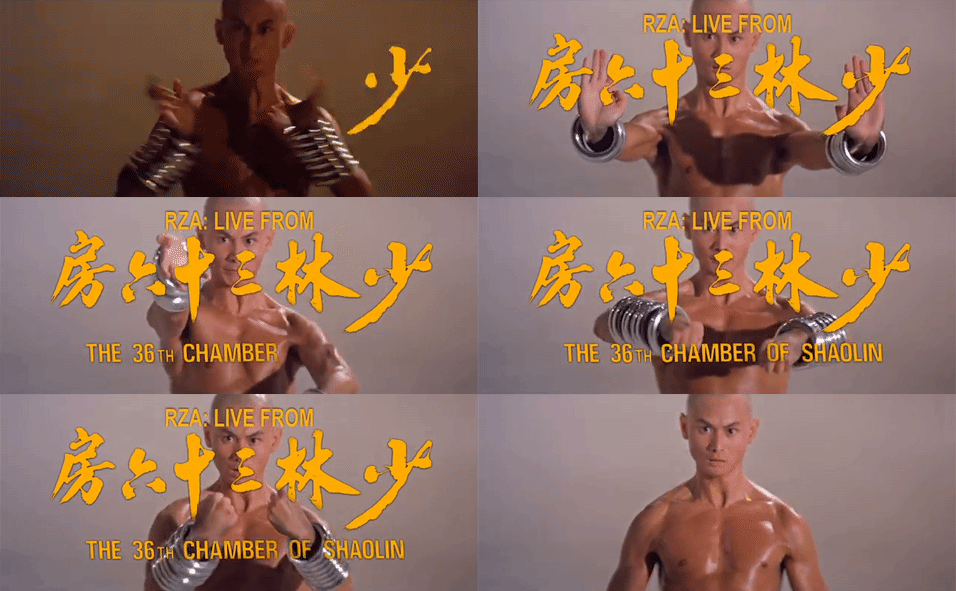
Screenshots via
The Creators Project: What’s your live-scoring setup like? Are you playing Wu-Tang samples over the original score?
RZA: Well, check it out [on tour]. I’ve been hooked up the Shaw Brothers. They gave me the film and let me strip it down.
They let you strip down the audio?
Yeah, instead of using the original score. I mean, there’s a few pieces that I liked and kept, but the majority of it is me. There’s about 90 sound cues in the film, and I’ll be manipulating those cues in real time.
Wow, that sounds like a lot to manage.
It took a minute to get it to where we got it. I had some good buddies help me on the technical side when we were putting it all together. But you know, when I was in about ninth grade, we were all DJing, battling each other, and trying to be the best. There was this one kid who couldn’t really DJ. He had the turntables, he had a system, he could mix, but he couldn’t scratch. He was cool—he ran with us—but what he used to do was plug into a VCR and then dub the VCR to another tape. So, for example, you’d see Wile E. Coyote chasing The Road Runner, and then they’d fall off a cliff, and he would pause it and rewind it, like a pause tape. He was the first kid I ever seen do that. But when DVDs came out, I was like, “Wow, now we can really do the **** that he was doing.” It could physically be done.
So I started practicing that, and I was probably one of the first guys to do that. Of course, I’ll say I learned it from my man Tom Shannon when I was a kid. I saw him do it. But now technology has caught up to where they got it all inside the software. When the time came for me to do this, I called Tom and had him come help me. He helped me break it down, decide on certain things, and help me get to a point where I could sit there and just do it. It’s crazy how full circle it is: from seeing this movie as a kid, to becoming a young adult and using it as the title for my first album. You never know what part of your childhood, or of your life, will inspire something else.
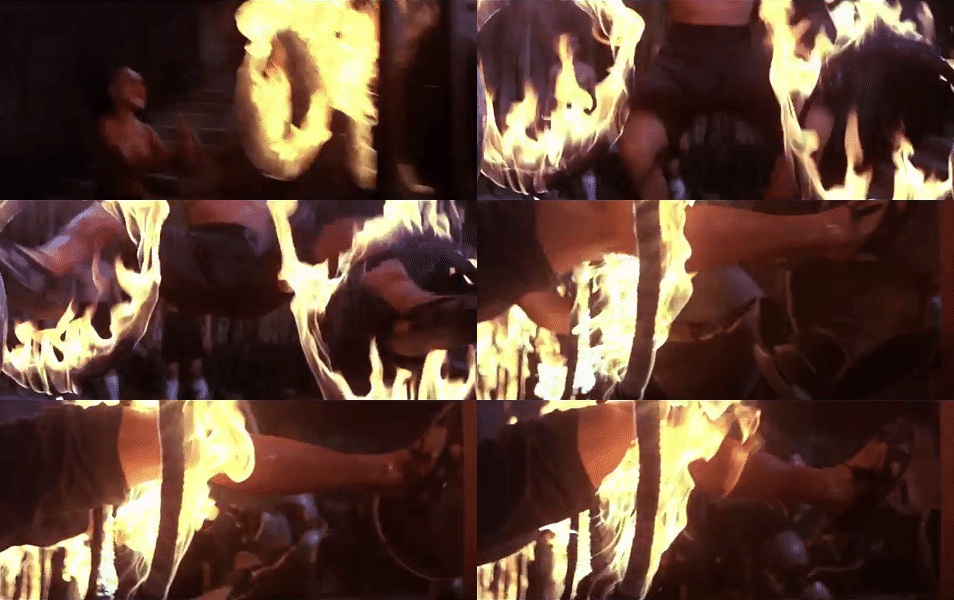
What aspect of martial arts films inspires you musically? The writing, cinematography, or the action?
The action was the first attraction. That’s a rhythm within itself. I became aware of the cinematography later on. 36th Chamber is one of the films that opened my eyes to cinematography and the vastness of what it could be. Take Into The Dragon, for example: Bruce Lee was great, and all that. But it was set way in the past, and the director happened to be considered one of the best directors of Asian cinema—of any cinema. But then the music happened. The emotions of the music started resonating with me. And for me, with hip-hop, I have to take that music and pin it to a groove—my drum pulse.
So that’s what I started doing, started plugging my VCR into my sampler. I could sample a strange part, with a vibe-heavy rhythm. Or I could just take an intro, like in the song “Da Mystery Of Chessboxin,” where he’s like, “Toad style is immensely strong and immune to nearly any weapon. When it’s properly used it’s almost invincible.” That felt dangerous, deadly, and that’s what Wu-Tang was bringing: rugged, raw, deadly hip hop. And thinking about martial arts movies and the ideas of swordsmen, there was no better way to make the analogy of how deadly we are than through martial arts films.
continued next post
Continued from previous post
What was your relationship to 36th Chamber when you were growing up in New York?
Well, I grew up in the 70s, you know. When this movie came out and I saw it, at the top ot the 80s, I was becoming conscious of oppression and the black man’s struggle in the world. It seemed similar; it felt like, “Why us?”
In the film, these people are being oppressed and are struggling. They came and killed [the main character’s] father for nothing—just stabbing people. He had to run for his life, and he was just a student, a college student, who wanted to make a change, you know? It made me think about college students in the 60s who tried to march and change the world and got fire hosed down and attacked, you know what I mean? At the time, I thought that stuff only happened in America, in this time period. But the film was one of the things that opened my mind to the fact that this happens around the world. I related to that ****. I was like, “Wow, I feel him. I understand his struggle.” I also wished there was something I could learn to help my people.

Still from ‘36th Chamber.’ Courtesy the Alamo Drafthouse Cinema
How is producing a song in the studio different from producing a score for a film?
Let’s say I’m doing something for Wu-Tang: I’ll pick the music because I know the talent. When I did my first score with Jim Jarmusch for Ghost Dog: The Way of the Samurai, I didn’t really know what I was doing. I studied Peter and the Wolf, and I understood that I could pick different instruments to represent different characters, but I didn’t really understand the whole post-production process. Jim didn’t force me to sit there and go through that. But on Kill Bill, Quentin Tarantino did make me sit there. I had to sit in the editing room for probably 60 days. It was cool, it was a great experience; you couldn’t beat me and Quentin in the editing room together. But at the same time, the amount of stuff I learned was wild. Instead of being the producer and the leader, I had to be more subservient to the director’s wishes.
But it still took time, you know, for me to understand that I have to deliver that vision. Now, as a person who has the capability—who has proven himself—I can approach the production of songs like I approached the score for my own film, The Man with the Iron Fist. Now, I strive to make sure the artists are embellished, and when I’m scoring a film, I also strive to make sure the emotions of my characters are being embellished.
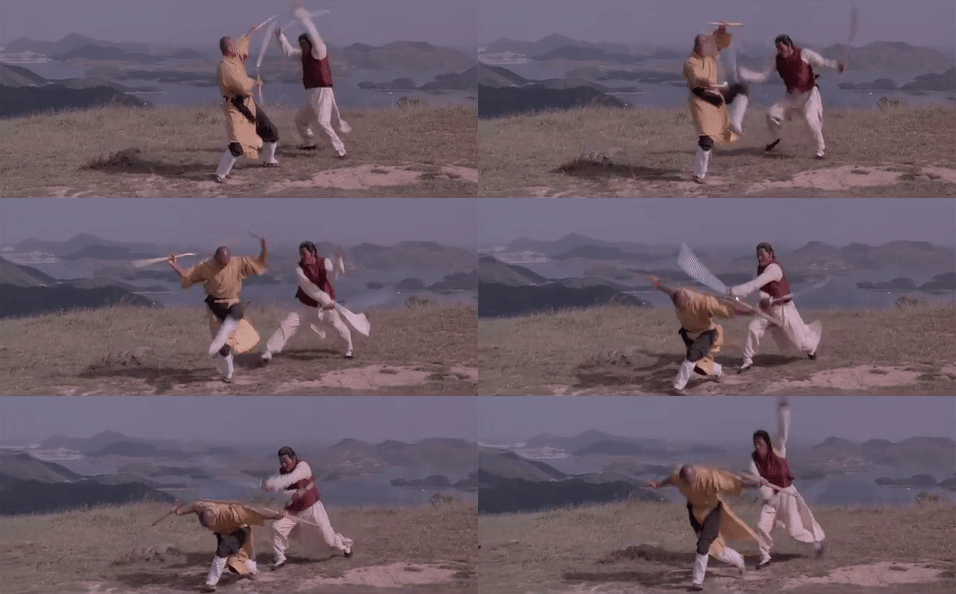
How does the process change when you’re doing it live, as opposed to spending, for example, 60 days in the editing room ensuring everything is perfect?
Well, it’s live in the sense that I’m doing it live, but it’s rehearsed. We’ve combed through what we think will work. This will be my fifth time doing this performance, and I think it only gets better every time, because I’ve learned what doesn’t work.
I learned that 110 cues was too much. I was overkilling it. I’ve got to let it breathe. At one moment I’m just doing me, and then I’m like, “Wait a minute, I forgot about the film.” That happened in Austin, and even though the crowd gave a standing ovation, I felt like I forgot about the film. By the time I got to LA, I kind of had a better format, I let it breathe, and I think it performed better. I think in New York, it’s going to be even better.
RZA: Live From The 36th Chamber plays at The Town Hall Thursday, November 10 at 8pm. Visit the Alamo Drafthouse Cinema website for future performance dates.
Still hoping for more shows. Someone here has got to see this.
RZA directed episode 6 of Iron Fist
Wu-Tang Clan’s RZA Directed An Episode of Netflix’s Iron Fist
Jay Jayson- 01/28/2017
K’un-Lun ain’t nuttin ta f–k with!
Most of the titles and directors for Marvel’s Iron Fist series were revealed recently when the British Board of Film Classification (BBFC) released their ratings for each of the episodes. The sixth episode, which is titled “Immortal Emerges From Cave,” didn’t have a director listed, but now, thanks to the show’s star Finn Jones, we know that RZA helmed it.
“So before I started the role, I actually made a playlist on my iPod of songs that Danny Rand would listen to,” Jones explained during an Extra live Q&A (via MCU Exchange). “It’s a lot of kind of '90s hip-hop like De La Soul, Jurassic 5, A Tribe Called Quest, Wu Tang Clan. Like that kind of music is really what Danny’s jamming to. And we actually feature that in the series. And actually, one of our episodes was directed by the RZA himself. Episode 6. So, yeah, there’s very close ties to hip-hop music and the Iron Fist series.”
What was it like working with RZA? “Oh, he’s a dude,” Jones said. “He’s a complete dude. Actually really sweet but chill. He has a really good vision of what he wants. He understands that martial arts genre.”
The former hip-hop producer and the frontman for the Wu-Tang Clan entered the film community in 1999, making his acting debut in Ghost Dog: Way of the Samurai. He went on to land small roles in some high-profile films like American Gangster, Funny People, and G.I. Joe: Retaliation. Inspired by his love for kung-fu movies, RZA made his directorial debut with The Man with the Iron Fists (2012)—which he also starred in and co-wrote.

Danny Rand returns to New York City after being missing for years, trying to reconnect with his past and his family legacy. He fights against the criminal element corrupting his world around him with his incredible kung-fu mastery and ability to summon the awesome power of the fiery Iron Fist.
The cast features Finn Jones (Game of Thrones) as Daniel Rand/Iron Fist, Jessica Henwick (Game of Thrones) as Colleen Wing, David Wenham (The Lord of the Rings: The Two Towers) as Harold Meachum, Jessica Stroup (The Following) as Joy Meachum, Tom Pelphrey (Banshee) as Ward Meachum, and Carrie-Anne Moss (The Matrix) will be reprising her role as Jeri Hogarth for a guest appearance.
Uncover the secrets of the mystical K’un-Lun when Season 1 of Marvel’s Iron Fist premieres with 13 one-hour episodes on March 17, 2017 at 12:01 am PT globally on Netflix.
Well this will be a little confusing given Man with the Iron Fists.
Coming to Montreal
POP Montreal books the Dears, RZA, the Besnard Lakes
BY MONTREAL GAZETTE, MONTREAL GAZETTE MAY 3, 2017 10:15 AM

Montreal’s the Besnard Lakes will perform their album The Besnard Lakes Are the Dark Horse as part of the POP Montreal festival’s 16th edition.
Photograph by: John Kenney , Montreal Gazette
POP Montreal has revealed the first wave of acts scheduled to perform at the festivals 16th edition, taking place from Sept. 13 to 17.
They include:
Tickets for the above shows are on sale now.
POP Montreal has also announced that the festival will feature performances by Wu-Tang Clans RZA, who will present a live score of the kung-fu film The 36th Chamber of Shaolin, and reactivated Montreal dance-pop band Think About Life.
More than 350 other acts are expected to be confirmed for POP Montreal. For more information, visit popmontreal.com.
I couldn’t find the direct link on the popmontreal site - that site was too artsy to be navigable and the search function wasn’t working for me.
Time to split this into an indie thread - been posting it on the RZA thread and the The 36th Chamber of Shaolin (a.k.a. Master Killer) thread but now will only post on the The 36th Chamber of Shaolin RZA live score thread.
Super Off-Topic
Gene, which issue was it that RZA went (with yall?) to Wudan Mountain? I know I have it, but muh stacks are mostly boxed for a move.
Why do you ask?
[QUOTE=Vash;1302830]Gene, which issue was it that RZA went (with yall?) to Wudan Mountain? [/QUOTE]
The print report was inn our 2000 Shaolin Special, which is sold out.
My blog-style account is online free access: Wu-Tang Enters Wudang
My cover story was SEP 99: Hip Hop Fist: Wu-Tang Chan’s RZA and his Sifu, Shaolin Monk Shi Yan Ming
[QUOTE=GeneChing;1302831]The print report was inn our 2000 Shaolin Special, which is sold out.
My blog-style account is online free access: Wu-Tang Enters Wudang
My cover story was SEP 99: Hip Hop Fist: Wu-Tang Chan’s RZA and his Sifu, Shaolin Monk Shi Yan Ming[/QUOTE]
Awesome, thanks.
Because I had a vivid memory of reading of RZA free-flowing to the delight of a monk on Wudang, and I was really hoping that wasn’t my Beautiful Mind moment.
Beautiful moment
RZA was free rapping, spitting his observations and feelings out in rapid-fire improvised rhythm and rhyme. His lyrical skill is truly astounding. How he can free-associate those lighting-fast rhymes on the spot, assembled in a spontaneous driving beat, is nearly incomprehensible.
[URL=“http://www.kungfumagazine.com/ezine/article.php?article=10”]WU-TANG ENTERS WUDANG (6 OF 7)
THE LEGACY
That was one of my greatest ‘missed recording it’ moments. It was '99. I didn’t have a smart phone or my trusty cassette tape recorder. I just had my ears, my attention and the moment. And I’m grateful to having been a witness to that.
