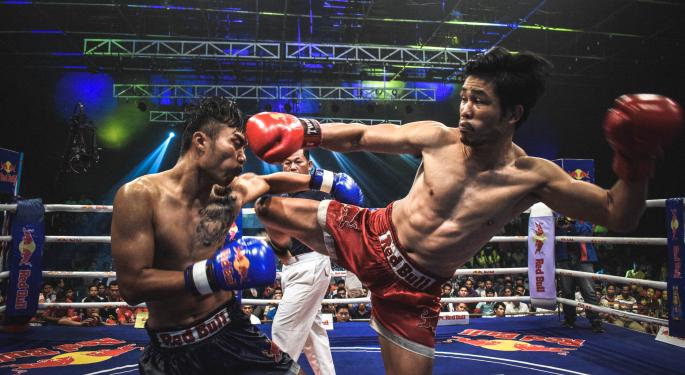
Marijuana & MMA

CbdMD & Bellator sent me a press release…

…but no samples. :rolleyes:

I was at our local Hallmark store yesterday because they have a postal outlet and I needed stamps. On the front door, there was a huge ad promoting their cbd products. Hallmark & cbd. How times have changed…

Cannabis Treatments Are Finding a Home in the MMA Fighting Ring
By Kristine Owram
June 25, 2019, 6:43 AM PDT
CbdMD partners with mixed martial arts organization Bellator
Cannabidiol company also sponsors golfer Bubba Watson


A Bellator match in St. Louis in 2016. Photographer: Scott Kane/Getty Images

Cannabis companies are increasingly finding a good fit in mixed martial arts, the tough, anything-goes combat sport.

CbdMD Inc., which makes topicals, tinctures and other CBD-based consumer products, is extending its reach into the cage through a partnership with Bellator MMA, a mixed martial arts organization owned by Viacom Inc. CBD, or cannabidiol, is a wildly popular non-intoxicating cannabis compound that’s said by its proponents to help with pain, inflammation and exercise recovery. The U.S. legalized CBD derived from hemp last year.

If anything, Charlotte, North Carolina-based cbdMD is late to the game. Aurora Cannabis Inc. announced last month an exclusive partnership with the Ultimate Fighting Championship to conduct research into the relationship between CBD products and athlete health. And the issuer of the ETFMG Alternative Harvest ETF, the largest pot exchange-traded fund, is the official training sponsor of UFC heavyweight Alexey Oleynik.

Read more: Cage-Fighter Sponsored by Pot ETF Issuer in Rare Marketing Move

Bellator’s multiyear partnership with cbdMD will include category-exclusive branding inside the cage where the fighting takes place. Shares of the CBD company, which already sponsors golfer Bubba Watson, have nearly doubled since the beginning of the year.

“We’re excited to have our company represented in the cage alongside some of the fiercest competitors on the planet,” cbdMD President Caryn Dunayer said in a statement.

I have a business with cannabinoids and a lot of people that are related to sport come to the stores to buy weed, for example on days Zlatan Ibrahimovic entered in the shop and said: hey is this Global Cannabinoids, give me some pills, I am stressed and want to chill. He is a funny man.

In about 25 years nobody will be in a tizzy over the plant anymore.

Liquor is more harmful, but that doesn’t stop people from drinking themselves stupid. lol

Smoke em if you got em and sorry if your laws are messed up so you can’t partake if you choose to do so.

Happy to live in a country that has some dang common sense on the subject as opposed to a bunch of emotionally charged hyperbole mixed with speculation, conjecture and “cool story bro” stuff. lol

CBD - it’s time has come…

I did start that CBD thread by copying a few posts off the Marijuana & MMA and marijuana tcm?!?!?!?!!? threads.

How CBD Got Into The World Of Mixed Martial Arts (MMA)
January 04, 2020 7:41pm

By WeedMaps News’ Adam Woodhead, provided exclusively to Benzinga Cannabis.

Roman Mironenko’s story as a professional mixed martial artist is a familiar one. After some career-high points, including a stint on the Russian reality show Mixfighter, he retired to train and teach Brazilian jiu-jitsu (BJJ) in Marseille, France. But due to the intense pain from a disc herniation from his competing days, his training was sidelined for months. He eventually found relief in a CBD oil he took sublingually twice a day. In time, he was able to return to BJJ training.

Mironenko’s story is just one of many where professional and amaeteur fighters use CBD to help recover and protect their bodies from the physical and psychological toll of mixed martial arts (MMA).

It’s a trend that MMA fighters find themselves ahead on compared to the rest of the sports world. Writing for the Telegraph, longtime fight sports journalist Gareth Davies argued that MMA athletes looking for pain management and neuro-protective plusses to protect against traumatic brain injuries had anticipated the CBD trend ahead of most other athletes and sports organizations.

The trend became all the more evident when major MMA organizations began endorsing CBD wholeheartedly. In June of 2019, Bellator MMA, one of the largest MMA promotion companies, announced it had partnered with cbdMD, a CBD products brand that also sponsors professional fighters Chael Sonnen, Jorge Masvidal, and Daniel Cormier.

A month later, the Ultimate Fighting Championship (UFC), the largest and most successful MMA promotion company in the world, got into the mix when the UFC Performance Institute and publicly traded Canadian giant Aurora Cannabis announced they would be partnering up to clinically study whether CBD can treat the aches and pains of UFC fighters. The findings will be used to develop a line of hemp-derived CBD topicals.

Leslie Smith, a veteran MMA fighter and one of the first female fighters in the UFC, told Weedmaps News she can’t quite remember when she first encountered CBD.

Cannabis has always been such a big part of my life and my training, Smith said. I don’t know if it’s a shared love and appreciation for cannabis and healthy living that brought me to San Francisco and [Cesar Gracie] team, or if it just happened to work out that way.

CBD enters the UFC with the Nate Diaz rule.
While Smith doesn’t recall when she first encountered CBD, she does remember when CBD broke to the larger UFC public. The conversation around CBD began with a fighter who, like Smith, was part of the team at Cesar Gracie Academy: Nate Diaz.

I think it was when Nate Diaz vaporized CBD right after his fight at the press conference, Smith said. I feel like that was the time that it really meshed the use of CBD in the fighting community … and the general public.

In August of 2016, following his rematch with Conor McGregor at UFC 202, Diaz was seen using a vape cartridge at the post-fight Press Conference. Dosing with CBD after a fight or sparring session is something that Smith practiced as well, using a 5,000-milligram full-spectrum tincture from Alpha Cannax.

I definitely take it after any sparring session. Any time that I’m sparring and my head is getting hit, she said. I take it immediately after the practice, and then I take it again at night time. Basically, for as long as I’m feeling fuzzy.

//youtu.be/1u3rf92rAgw

At the time, however, all cannabinoids, including CBD, were banned during competition and the incident was flagged by the media as a potential doping violation. Debate about whether Diaz had violated a rule ensued. This resulted in the creation of the so-called Nate Diaz Rule in 2018, under which CBD is allowed during competition even if other cannabinoids are not.

At open workouts before his match up with Anthony Pettis at UFC 241, Diaz found himself the subject of media scrutiny once again when he lit a joint and passed it to fans in the crowd. Diaz claimed it was CBD flower, but either way, the use of cannabinoids was well outside the bounds of the in-competition period.

[QUOTE]ESPN MMA

@espnmma
@NateDiaz209 #UFC241

Embedded video
8,941
4:22 PM - Aug 14, 2019
Twitter Ads info and privacy
2,315 people are talking about this

MMA fighters are still cautious about using CBD
While CBD is gaining in popularity among fighter athletes, they are still cautious about how and when they use it when training and recovering. CBD’s emergence has come at a time when concern over tainted supplements, false positives, retroactive sanctions, and potentially canceled events is at an all-time high.

The Diaz brothers’ regular conflict with, and sanctions from, officials have been noted by their fellow athletes. In the run-up to a recent bout in Oklahoma, Smith switched her CBD supplement as a precaution.

The commission there in Thackerville does not allow you to have any metabolites in your system at all, she said. Even the small amount that would show up inside of the [Alpha Cannax] full-spectrum CBD would have cost me some money and gotten me some bad publicity. So I was taking Game Up Nutrition as I was getting ready for that fight.

The fear of testing positive for THC from taking a CBD product is a sentiment echoed to Weedmaps News by John Kelly, the head coach and owner of Live Free Crossfit, and the fighter he trains, UFC heavyweight Jairzinho Rozenstruik.

These guys work really hard, Kelly said. If for some reason they get popped for THC when they were trying to take a supplement, then it’s going to destroy everything that they worked towards.

Finding trust in a CBD product that will both work and not cause a fighter to run afoul of the rules is paramount to fighters interested in using CBD. After some research, Kelly opted for Cannafornia CBD for Rozenstruik’s training. I looked into the company pretty deeply and I saw all the third party testing, and I saw that there were very low levels of THC, Kelly said. So that was one of the deciding factors that made us go with [Cannafornia], was how clean the product was.

Rozenstruik is also one of the top tier UFC athletes sponsored by Cannafornia CBD. Others have included Derrick Lewis and until a falling out in December Colby Covington, who Cannafornia CEO Paul King told Weedmaps News was the first fighter he decided to work with after the pair met in Miami. King said that Kelly works as the strength and conditioning coach for three of six fighters sponsored by the company.

Rozenstruik uses CBD as a topical rub before and after training, and orally before bed. His dosage is approximately 33 milligrams, which is doubled after intense training sessions.

It helps, especially when you do strength training and your body gets sore, Rozenstruik said. I use the cream on my body and it really helps me recover really fast."

One of the most productive ways to use CBD is as a way to find balance in a fighter’s training, according to Kelly. Using CBD to find the range between not being overtrained or undertrained is what allows athletes to optimally perform on fight night.

It’s all about homeostasis, Kelly said.

Image by Unspash[/QUOTE]

Love Hemp signs transformative 5 year partnership deal with UFC

//youtu.be/AZVur5y6m3M

RIP Elias Theodorou

Elias Theodorou, Pioneer of Medical Marijuana in Sports, Dies at 34
A Canadian mixed martial artist, he brought cerebral flair to the ring and a dogged determination to his campaign for changing the sport’s drug rules.


Elias Theodorou, right, in 2018 in a middleweight mixed martial arts bout with Eryk Anders of the United States in Toronto. He was already a widely admired sports figure when he took up the cause of medical marijuana.Credit…Vaughn Ridley/Getty Images

By Clay Risen
Published Oct. 2, 2022
Updated Oct. 3, 2022, 4:12 a.m. ET

Elias Theodorou, a cerebral, charismatic mixed martial arts fighter who campaigned to change his sport’s drug rules and is widely believed to be the first professional athlete to receive a therapeutic exemption to use marijuana, died on Sept. 11 at his home in Woodbridge, Ontario, a suburb of Toronto. He was 34.

His brother, Michael, said the cause was colon cancer that had metastasized to his liver.

Countless pro athletes are said to use marijuana — for pain, for anxiety, to focus — but most sports prohibit or heavily regulate its use. In 2019 the PGA suspended the golfer Matt Every for three months after he tested positive for THC, the active ingredient in marijuana, and in 2021 the American sprinter Sha’Carri Richardson was effectively disqualified from the Tokyo Olympics after THC was found in her bloodstream.

Theodorou, who suffered from bilateral neuropathy, which caused tingling pain in his hands and arms, didn’t want to be next. Known for his thoughtful, deliberative fighting style, he applied that same approach to his campaign to win permission to use marijuana during training and preparation for a fight.

He built his case meticulously, collecting research and statements from doctors and lawyers and documenting his own fruitless efforts to find an already permitted alternative, like opioids.

“What I’m trying to strive for is an even playing field,” he told Forbes in 2021. “Anyone with the same kind of injury would be able to take a handful of Vicodin to go and fight and it wouldn’t be an issue.”

Drug rules for sports like mixed martial arts are largely set at the state and provincial level, so he had to tailor his pitch over and over to address different regulations. He won approval from the British Columbia Athletic Commission in 2020, and a year later from a similar body in Colorado. He fought in both jurisdictions, and was planning to seek further exemptions when he was diagnosed with cancer in January.

According to his lawyer, Eric Magraken, he was the first professional athlete in North America to receive such an exemption, and very likely the first in the world.

Theodorou was already a widely admired sports figure when he took up the cause of medical marijuana.

He exploded onto the mixed martial arts scene in 2011, going undefeated for his first four years and signing a contract with the Ultimate Fighting Championship, the sport’s premier promotion company, in 2014.

His fighting style was slow, grinding, even a bit boring. But fans loved him for the charisma and humility he brought to a sport often stereotyped as violent and humorless.

“His personality just stood out, and he brought that into the fight,” Sarah Kaufman, a retired mixed martial arts fighter, said in a phone interview. “He would just be really smart. He was strategic and thoughtful.”

He made much of his long hair, which he wore in cornrows during fights but otherwise let flow down his shoulders. He called himself “the Mane Event,” ran a Twitter account dedicated to his locks and signed a sponsorship deal with Pert Plus, the shampoo brand.

As a model and actor, Theodorou appeared on the cover of 11 Harlequin romance novels (he joked that he was “your mom’s favorite romance cover and your son’s favorite fighter”), had small roles on Canadian television shows like “The Listener” and “Played,” and was a contestant on the Canadian version of “The Greatest Race.”

He also crossed boundaries. He spoke openly about his struggles with dyslexia. In place of the usual scantily clad ring girl who holds a sign announcing the next round in a match, he did the same by moonlighting as a “ring boy” at several events held by Invicta, an all-female mixed martial arts circuit.

“It was a beautiful subversion of this archaic institution,” Geoff Girvitz, owner of Bang Personal Training in Toronto, where Theodorou often worked out, said in a phone interview.

A true happy warrior, Theodorou mixed with fans, palled around with other fighters and generally seemed in gleeful awe of his own success.
“It’s the coolest thing,” he told The Province, a newspaper in Vancouver, British Columbia, in 2014. “Me being me and people wanting to see that is cool. I’m just rolling with the punches — metaphorically speaking and literally inside the cage, too.”

Theodorou during a weigh-in before a fight in 2018. Losing a sidewalk fight as a freshman in college that was captured on video inspired him to take up mixed martial arts.Credit…Tom Szczerbowski/USA Today Sports, via Reuters

Elias Michael Theodorou was born on May 31, 1988, in Mississauga, a suburb of Toronto, to Gary Theodorou, a computer engineer for Ricoh, the camera manufacturer, and Mimi (Bouloukou) Theodorou, a vice president of operations for Bank of America. His parents and his brother survive him.

Unlike most mixed martial artists, Elias didn’t grow up fighting; instead, he skateboarded. It was only in his first year at Humber College, in Toronto, that he took up the sport — and then only after a video of him losing a sidewalk fight went viral, and he started looking for a way to defend himself.

“I’ve said this before, if I ever saw the guy I fought with, even though he sucker-punched me, I’d buy him dinner,” he told The Ottawa Sun in 2019. “It was a catalyst to a healthy career.”

He graduated with a bachelor’s degree in creative advertising in 2010 and fought his first professional match the next year.

Without a background in any particular discipline, Theodorou developed a unique style, one that even two of his coaches called “awkwardly effective,” blending techniques from martial arts like Brazilian jiu-jitsu and Muay Thai as well as wrestling and boxing.

“He was coming into mixed martial arts as a blank slate,” Chad Pearson, his wrestling coach, said in an interview, “and getting pieces from wrestling, getting pieces from jujitsu, getting pieces from striking, and he was literally creating his own set of techniques.”

At 6-foot-1 and about 185 pounds, Theodorou competed as a middleweight, with the nickname the Spartan. He appeared on “The Ultimate Fighter Nations: Canada vs. Australia,” a reality TV competition, in 2013, a year before he joined the Ultimate Fighting Championship.

Theodorou went 8-3 during his five years in the U.F.C., and 19-3 for his career. But over time it became apparent that his measured style was not the right fit for a circuit that emphasized pyrotechnic aggression. After a loss to the American fighter Derek Brunson in 2019, the U.F.C. released him from his contract.

It was a lesson, and a mixed blessing. Theodorou developed a more aggressive style and went undefeated the rest of his career. But the U.F.C. can be all-consuming, and without it he had the freedom to pursue other interests, including his acting and his medical-marijuana advocacy — and, he said, to plan for a time when he would no longer be stepping into the ring.

“No one wants to get hit in the head forever,” he told The Chronicle Herald of Halifax, Nova Scotia, in 2016, “and I still want to find a life after fighting.”
Clay Risen is an obituaries reporter for The Times. Previously, he was a senior editor on the Politics desk and a deputy op-ed editor on the Opinion desk. He is the author, most recently, of “Bourbon: The Story of Kentucky Whiskey.” @risenc

A version of this article appears in print on Oct. 3, 2022, Section A, Page 21 of the New York edition with the headline: Elias Theodorou, 34, a Pioneer Of Medical Marijuana in Sports.

marijuana-tcm-!-!-!-!!
Marijuana-amp-MMA
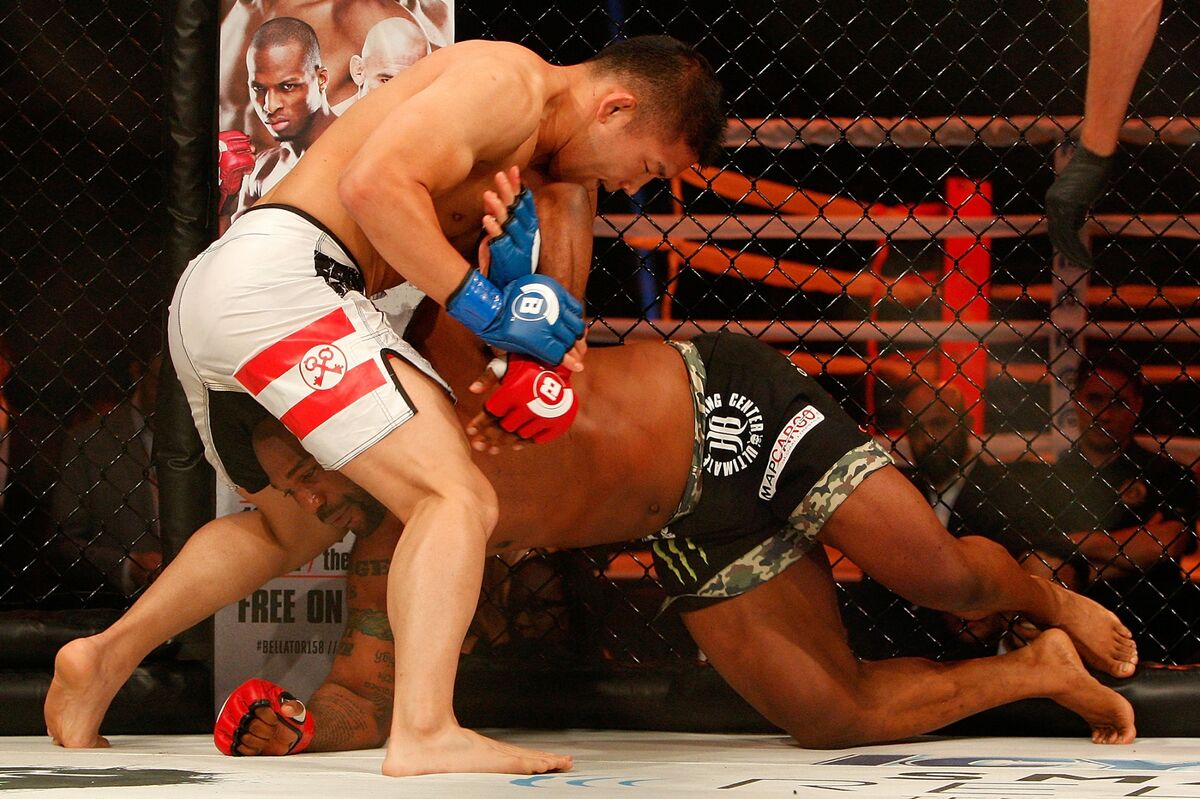
**

Cannabix Technologies Targets Combat Sports with Marijuana Breath Test**

Fiona Craig

Tue, August 4, 2026 at 6:44 AM PDT 2 min read

cannabix logo ©Cannabix Technologies

cannabix logo ©Cannabix Technologies

Cannabix Technologies (CSE:BLO) (USOTC:BLOZF) has taken another step in the commercialisation of its Marijuana Breath Test (MBT), announcing a strategic move into the combat sports market through its participation at the Association of Boxing Commissions (ABC) 38th Annual Conference. The development highlights the company’s growing focus on real-world deployment in safety-critical industries where rapid, objective testing has the potential to transform decision-making.

The ABC Conference brings together athletic commissioners, regulators, medical professionals, referees and industry leaders responsible for overseeing professional boxing, mixed martial arts (MMA) and other combat sports. For Cannabix, it represents direct access to organisations actively seeking more effective methods of assessing recent cannabis use among athletes before competition, following incidents and during regulatory reviews.

Unlike traditional urine or hair testing, which can detect cannabis long after any potential effects have passed, Cannabix’s Marijuana Breath Test is designed to identify recent THC use through a fast, non-invasive breath sample. This makes the technology particularly relevant in environments where reaction time, balance, coordination and split-second decision making are essential for athlete safety. The company emphasises that the MBT is intended to detect recent use rather than determine impairment itself.

The conference appearance also reinforces Cannabix’s expanding commercial strategy. Following the phased commercial launch of the MBT earlier this year, the company has steadily targeted industries where recent-use detection provides a clear operational advantage. Workplace safety, transportation, law enforcement and now regulated sports all represent markets with growing demand for modern testing solutions as cannabis legislation continues to evolve.

An important part of this strategy is Cannabix’s collaboration with Omega Laboratories, one of North America’s leading forensic drug testing laboratories. Omega will support presentations at the conference, demonstrating how laboratory confirmation can be integrated with Cannabix’s breath collection technology to provide regulators with a practical and defensible testing workflow.

The company also sees significant long-term potential beyond cannabis detection alone. Development is already underway on a broader five-panel breath-testing platform capable of screening multiple drug classes. If successfully commercialised, this could substantially expand Cannabix’s addressable market across public safety, corrections, workplace compliance and other safety-sensitive sectors.

Chief Executive Officer Rav Mlait believes engaging directly with combat sports regulators represents an important milestone in bringing the technology closer to end users. Rather than remaining in the development phase, Cannabix is increasingly focused on demonstrating practical applications in environments where accurate, time-relevant information can support better decisions and improved safety.

For investors, the announcement demonstrates continued execution of Cannabix’s commercial roadmap. With growing industry engagement, established laboratory partnerships and a technology designed to address a long-recognised gap in cannabis testing, the company continues to build momentum as it expands into high-value markets where objective, recent-use detection could become an increasingly important component of safety and regulatory programmes.

For more information visit – https://cannabixtechnologies.com/