Pgct
Hermosa Beach police train in martial arts to protect public, arrestees and themselves
KEVIN CODY|NOVEMBER 16, 2023
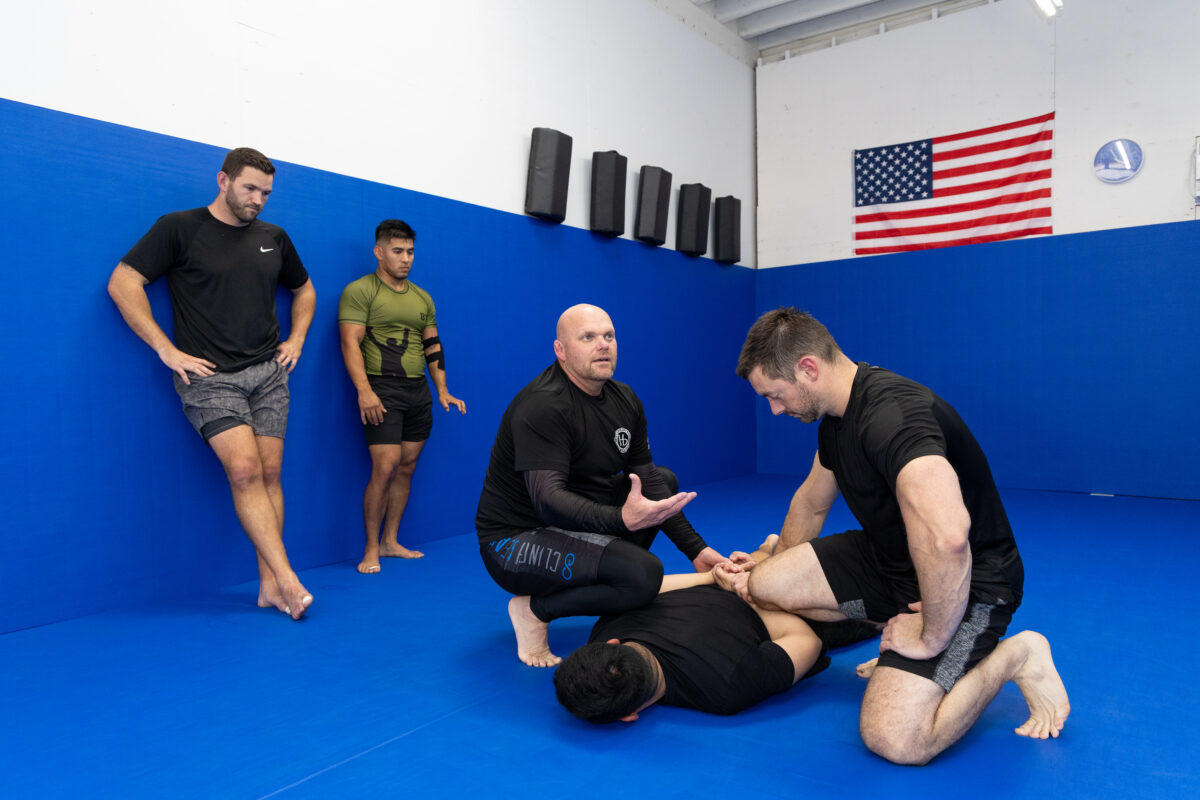
Sgt. Jon Sibbald leading a PGCT class with (left to right) Detective Dalton Blumenfeld, Officer Ivan Reyes, Officer Joshua Nakamoto, and Detective Brent Zuber. Photo by JP Codero
Shortly after Jon Sibbald joined the Hermosa Beach Police Department in 2002, the six-foot-tall, 200 pound officer found himself drawing on his martial arts training in situations where other officers used pepper spray, Tasers and batons.
Sibbald trained in hapkido while at Redondo High, and subsequently trained in Brazilian Jiu Jitsu. He earned black belts in both disciplines.
During a typically raucous Hermosa July 4th in 2003, Sibbald stopped a brawl on The Strand with an “outside leg” takedown of the instigator. A passerby’s video of the takedown went viral. A newscaster who aired the video wondered aloud why Sibbald didn’t just Mace the brawler (who was not injured in the fall). A second newscaster speculated police elsewhere might have shot the brawler.
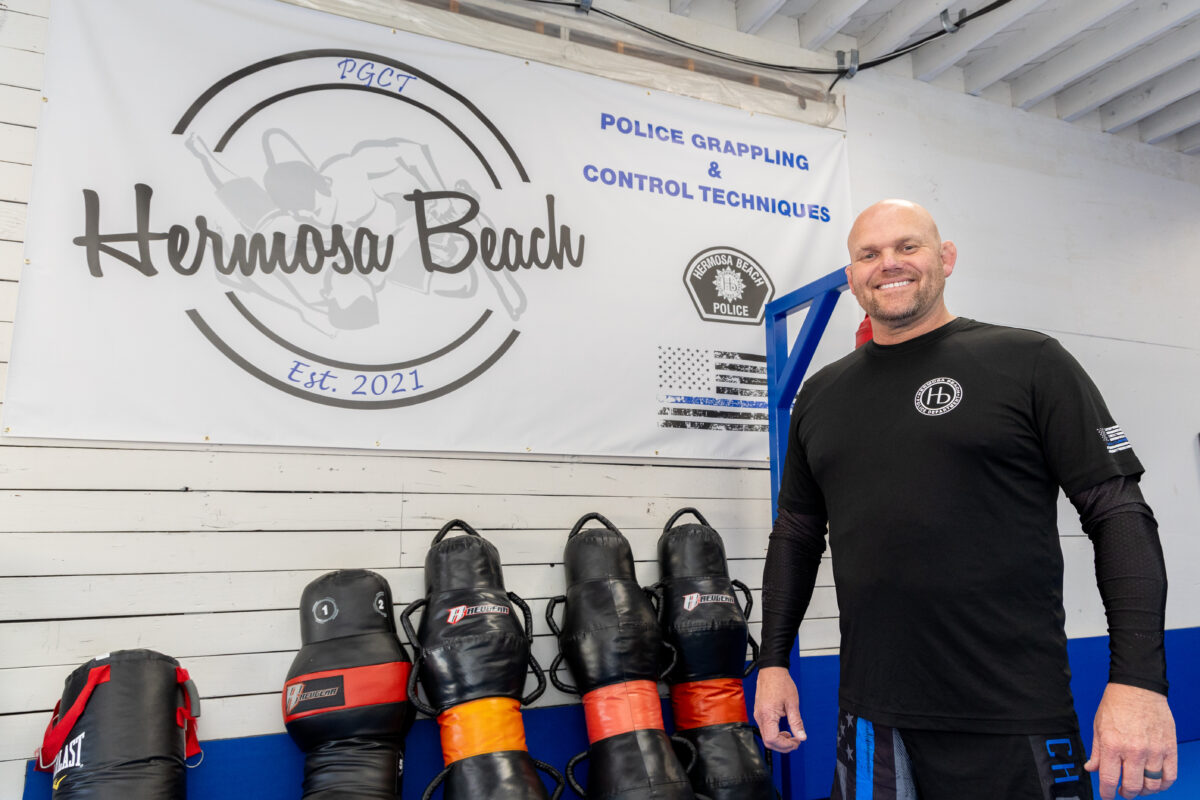
PGCT founder and chief instructor Sgt. Jon Sibbald. Photo by JP Cordero
Police arrest videos became a television news staple following the Rodney King baton beating by four Los Angeles Police Officers a decade earlier. Locally, attorney Thomas Beck built a practice filing lawsuits alleging police brutality. In 2011, Beck won a $130,000 settlement from Hermosa on behalf of a client who suffered a face fracture after a Hermosa police officer allegedly Tasered him and struck him with a baton.
When Sibbald joined the department, Landon Phillips, now a lieutenant, was the only other Hermosa officer trained in jiu jitsu, which translates from Japanese as “gentle art.” Today, over half of the department’s 39 officers train in the Hermosa Beach Police Grappling Control Techniques (PGCT) program. The program is led by Sibbald, who describes PGCT as “blending the punch blocks of Hapkido, and Krav Maga, and transitioning (on the ground) to grappling and jiu jitsu.”
Sibbald earned State certification as a law enforcement use-of-force instructor in 2005. But for nearly 20 years, a succession of Hermosa police chiefs declined his offer to teach martial arts to fellow officers.
“The chiefs worried officers would get injured making arrests, or training. Finally, in 2020, I found a chief who would listen,” Sibbald said.
Chief Paul Lebaron came to Hermosa Beach in April, 2020, one month before Minneapolis police officer Derek Chavin killed George Floyd with a knee to the neck, held for over nine minutes.
Lebaron rose through the ranks of the Long Beach Police Department over 27 years in positions that included field training officer, public information officer, and internal affairs investigator. He also held less conventional positions, such as cultural diversity instructor at the Long Beach Police Academy, and adjunct staff member at the Simon Wiesenthal Museum of Tolerance.
Lebaron subscribes to a 21st Century school of policing that utilizes data analysis to proactively address crime. He recently implemented a program in Hermosa that predicts future crime locations based on previous crime data.
Sibbald approached the new chief with what little data existed related to law enforcement use of martial arts to arrest uncooperative suspects.
The data was from the Marietta, Georgia, Police Department, the first police department in the nation to require its officers, and to pay them, to train in Brazilian Jiu Jitsu.
In an address to fellow police chiefs shortly after the program began in 2018, Marietta Police Chief Dan Flynn described the jiu jitsu training as an alternative to police use of “pain compliance.” “Striking and blunt force techniques never look good, particularly on camera,” he told fellow chiefs.
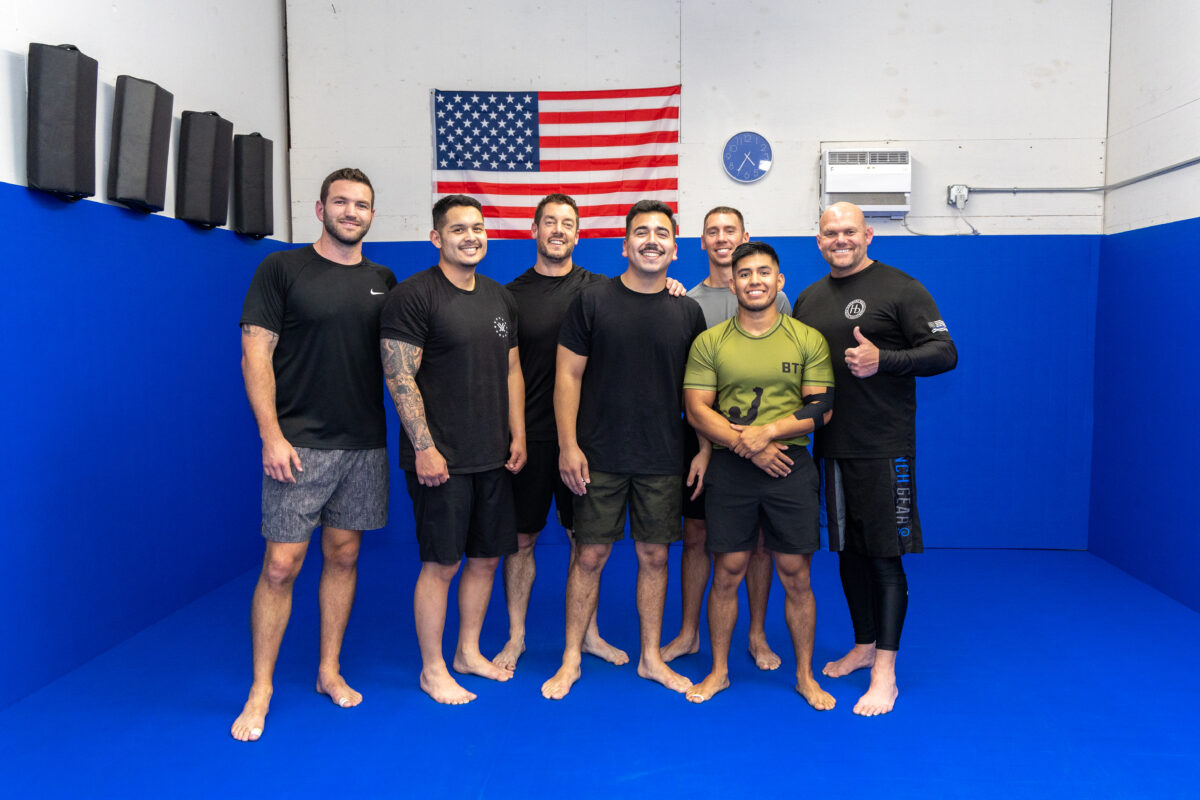
Taking a break during training at the Hermosa Beach Police Grappling Control Techniques (PGCT) gym are Detective Dalton Blumenfeld, Officer Joshua Nakamoto, Detective Brent Zuber, Officer Ivan Reyes, Detective Kurt Mateko, Officer Fabian Reyes and Sgt. Jon Sibbald. Photo by JP Cordero
His department’s data showed fears that martial arts would lead to more law enforcement injuries were unfounded. Two years after implementing the training the Marietta department reported a 48 percent reduction in officer use-of-force injuries, a 53 percent reduction in arrestee injuries, and a 23 percent reduction in the department’s Taser use.
The Marietta chief ascribed another benefit to martial arts training.
“It increases their self confidence and calmness when they are confronted with the need to use physical force,” he said.
Sibbald supported that argument in his proposal to Lebaron with body cam video of fellow officers Josh Nakamoto and Kurt Mateko arresting a suspect pulled over during a traffic stop. Nakamoto and Mateko trained with Sibbald at Triton Gym in Redondo Beach. After the officers found a gun in the suspect’s trunk, the suspect started to drive off. Most police department use-of-force policies would have sanctioned officers shooting at the car. Instead, one of the Hermosa officers leapt into the moving car, and shifted it into park. The other officer used jiu jitsu to free the driver’s death grip on the steering wheel, and pulled him from the car.
“It was the mindset they had from their training that I saw as the game changer,” Lebaron recalled, in seeing the video.
“At the police academy, we were taught control techniques. But conditions had to be perfect for them to work, and there’s no such thing as perfect on the street. You have to be able to think on your feet, or on your back. We need to give officers the tools to adapt to situations that they may not have trained for,” he said.
The State requires four hours every two years of POST (Peace Officer Standards and Training). It covers use-of-force, but inadequately for a “perishable” skill like martial arts, Lebaron noted.
“So we gave Jon a small budget for equipment and mats, which public works installed.”
The gym is on Bard Street, across from the police station, in a city-owned building formerly occupied by the Friends of the Library bookstore. Sibbald insisted the gym be close to the station to make participation convenient.
The program began in November 2021, with the chief as one of the trainees.
Officers train a minimum of twice monthly for two hours in classes taught by Sibbald and fellow officers Sgt. Guy Dove, Det. Kurt Mateko, Det. Brent Zuber, Det. Dalton Blumenfeld and Officer Fabian Reyes. The classes include the department’s two female officers. New recruits are required to attend the classes throughout their 18 month probation.
After their initial training, officers test at the Gracie Academy in Torrance for their GST (Gracie Survival Tactics) certification.
“The GST is for 15 submission techniques. We teach hundreds,” Sibbald said.
Hermosa officers aren’t taught the traditional police “pain compliance” holds, such as wrist and arm locks,
“‘Pain compliance’ doesn’t work on a drunk or a person on drugs who doesn’t feel pain,” Sibbald said.
Nor are they taught punches and kicks.
“You can hurt yourself throwing punches. And it looks bad on TV. An old sergeant told me, ‘I don’t want to see you on the 5 o’clock news,’” Sibbald said.
Chokeholds aren’t taught either. California banned law enforcement’s use of chokeholds in 2020, following George Floyd’s death.
“We stay away from the neck, and commonly use the seat belt hold to restrain a suspect,” Sibbald said.
The seat belt hold, as the name suggests, involves an officer locking his hands together after reaching over one of the suspect’s shoulders with one arm, and under the suspect’s other shoulder with the other arm. If being immobilized standing up doesn’t convince the suspect to cooperate, the officer can easily push the suspect to the ground, and pin him until backup arrives.
“All the time we’re talking to the suspect, trying to calm him down until he says he’s done fighting, or he runs out of gas,” Sibbald said.
“The goal is to teach officers to be comfortable in uncomfortable situations. If our female, or any officer is ‘bum rushed’ we don’t want them to panic, and reach for their baton, or gun,” Sibbald said.
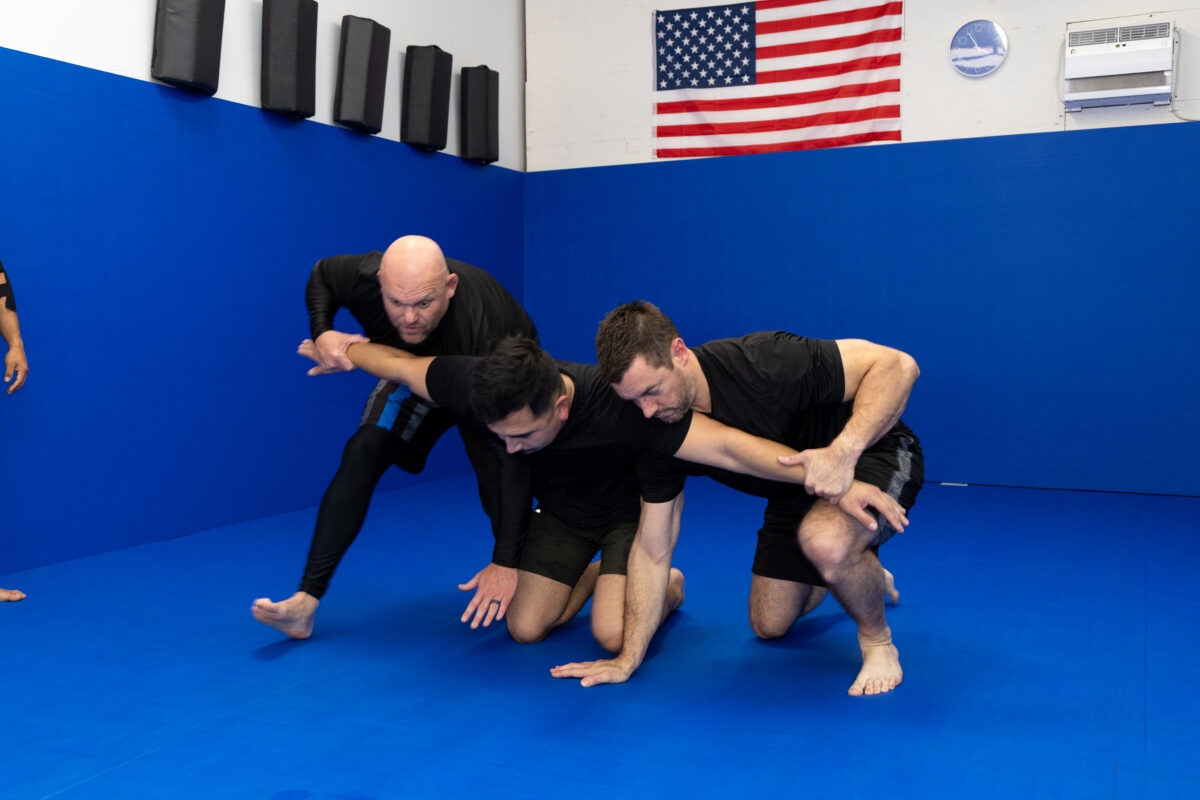
Sgt.Jon Sibbald and Detective Brent Zuber “walk” Officer Ivan Reyes to the ground. Photo by JP Cordero
At the October 10 city council meeting, Sibbald reported the results of PGCT’s first year by comparing statistics to the two previous years.
In 2020, and 2021 combined, the police department reported 35 officer injuries during use-of-force incidents. The related workman’s compensation payments totaled over $300,000.
In 2022, PGCT’s first full year, there were no officer injuries during use-of-force incidents, and no use-of-force related workers comp claims.
During that first year, 44 use-of-force arrests were made, involving 94 officer responses.
During those arrests, none of the officers used pepper spray, Tasers, batons, punches or kicks, Sibbald said. ER
That “walk” looks exactly like what I teach when I lead restraint and takedown in-services at concerts and events for medics and security.