Surviving?
Sounds intense Boss…
It’s deadlines week here…
Deadlines week is like a menstrual period but it only comes here every other month…:o Almost there however. There’s light at the end of the tunnel. We’ll be done by Friday, and then I can go home and watch this over a few tall cold ones. 
‘Crouching Tiger, Hidden Dragon’ Sequel to Play in 15 or Fewer Imax Theaters in U.S.
2:23 PM PST 2/22/2016 by Pamela McClintock

‘Crouching Tiger, Hidden Dragon: Sword of Destiny’
Courtesy Pegasus Pictures
Theater owners in the U.S. balked at the bold plan to debut the movie simultaneously on Netflix and in Imax; China is a different story, where the sequel opened to a strong $21.3 million on the big screen.
Crouching Tiger, Hidden Dragon: Sword of Destiny will play in only 10 to 15 Imax theaters in North America when it debuts Feb. 26, a year after Netflix and Imax left cinema operators furious when partnering on the release of the long-awaited follow-up to Ang Lee’s 2000 martial-arts blockbuster.
At the time, most theater owners who operate Imax screens said they would not carry the film since it is debuting simultaneously on Netflix and on the big screen. They haven’t softened, resulting in a very limited Imax footprint.
Nor did it help matters when Sword of Destiny was pushed from Aug. 28, 2015 — a relatively quiet corridor for Imax after the summer crush of tentpoles — to February, when Imax is committed to playing other titles, including Deadpool.
The Weinstein Co. produced the film with a number of partners, including the China Film Group and Netflix.
There are roughly 400 Imax theaters in the U.S.; Imax itself owns only four or five, while the rest are joint ventures. It’s not clear how many screens Netflix and Imax originally had intended to play Sword of Destiny on; Netflix insiders say it was always going to be a limited number. However, other sources say it was originally intended to be far more than just 10 to 15 locations.
Over the weekend, Sword of Destiny debuted at the box office in China to a pleasing $21.3 million, coming in No. 2 behind Chinese sensation The Mermaid. However, as Netflix isn’t available in China, Imax didn’t face the same issues in the country that it does in the U.S., and is carrying the movie on hundreds of screens in the Middle Kingdom. Sword of Destiny is playing in regular 3D theaters as well.
Produced by TWC, Crouching Tiger, Hidden Dragon 2 was directed by Yuen Wo-Ping, also a martial-arts master. Michelle Yeoh reprises her role as Yu Shu-Lien, while Donnie Yen also stars.
Harry Shum Jr. interview
February 23, 2016 Laura Sirikul
Crouching Tiger Hidden Dragon’s Harry Shum Jr on martial arts and his passion projects (Exclusive)

You may recognize Harry Shum Jr. from the hit show Glee or as the badass wizard Magnus in Freeform’s new series Shadowhunters. Now, audiences around the world will now know him as Tiefang in Netflix’s Crouching Tiger Hidden Dragon: Sword of Destiny, the 2001 sequel to the Academy Award-winning film Crouching Tiger Hidden Dragon.
Directed by legendary fight choreographer Yuen Woo-Ping, Crouching Tiger Hidden Dragon: Sword of Destiny is a film filled with the beautiful fight styles of classic martial arts films. Shum himself has never had any formal martial arts training, but his background as a professional dancer allowed him to easily transform into a graceful fighting machine. Nerd Reactor sat down with Shum during the press day for the film and chatted about his role in the film, martial arts, and his passion projects.
Nerd Reactor: Congratulations on the film’s opening this week and all of your projects you’re currently on, including Crouching Tiger Hidden Dragon: Sword of Destiny. So tell me, how did you get involved in this project?
Harry Shum Jr (HSJ): Well, this project, I auditioned. I auditioned for the role and it’s crazy. You go on a bunch of auditions and you never know which one is going to lead towards something becoming real. This one, in particular, I was hoping to get. I worked really hard on it and at the same time, it happened so fast. I auditioned on Friday and [was] on a plane on Sunday to New Zealand for four months. So it was a crazy start and it has been an incredible journey.
NR: This is a huge film with legendary martial artists Donnie Yen, Michelle Yeoh, and fight choreographer Yuen Woo-Ping. What was the experience of working with such legends?
HSJ: Like you said, they are legends. How do you prepare to work with legends? Someone that you grew up watching their films and are so influential in martial arts films and Asian cinema. I really enjoy the fact that I was able to come in and be a fan. I think everyone wants to work with people that they look up to. I was able to do that. There was really no way to prepare for that outside of making sure you don’t fanboy over them when you first see them. The first person I met was Yuen Woo-ping and he was very quiet. I walked in just off the plane. I had just got off an 11-14 hour flight and landed and with my backpack, jet-lagged already. The first thing he said to me, he started showing me choreography fighting against five guys and I didn’t know he wanted me to do it right away. I had my backpack on, so I took off my backpack and started learning choreography. He showed me twice and put camera around the corner and said, ‘Okay, go!’ So he’s putting me to the test! I’m here fighting all these guys with the choreography as best as I can. Mind you, I don’t have martial arts experience. I’m literally just doing what I see him doing – mimicking him. All the stunt guys run away and come back with pads because I was really hitting them too hard. And, I had to pull back. I had to learn that. I mean, that was my first experience and I did it. He said okay and walks away. It was incredible and I wanted to make him proud.
NR: Did you do a lot of research in this genre – especially his films?
HSJ: Yeah, the fun part is I already watched most of his films already. I went back and watched the ones that I missed and whether it be Drunken Master to Taichi Master to the fight choreography in Crouching Tiger and even the stuff he did with Matrix and Kill Bill. I wanted to make sure that I got the spirit and understanding of the movement in general. I think with the character, we got to do a lot of development together as opposed to studying it on my own. So it was great to have that, to be able to study without trying to figure it out on set.
NR: Woo-Ping is known for his strict choreography and workout. What was the most challenging part working on this film?
HSJ: To get it right the first time. It was really challenging. You want to get it right the first time. A lot of times we learn the choreography right before and some things would change. Coming from someone that is not completely an expert in it, it’s challenging. That was really challenging because you want to get it right, get it perfect. The beauty of it is that he doesn’t move on until he gets it exactly the way he wants it, which can take a lot of takes sometimes. The wire work was challenging as well. He expects once you land on set to be professional and to get it. He hired us for a reason. He wants us to be wushu/wuxia warriors when we’re on set.
NR: Did you feel you learned a lot about martial arts and plan on continuing it?
HSJ: Yeah, I learned a lot about the discipline. Outside of that, just the fluidity. There is a way of making it look believable and at the same time, there is a beauty. It’s that saying, it’s really the journey of the movement. Whether it’s for a punch, it’s not just going straight into the punch, you have to still make it elegant and graceful. There is a journey towards the impact. I learned a lot about that and it says a lot about life whether it be acting or dance or just life in general. Just enjoy the journey and focus on that as well. I learned a lot and I learned how to spar and fight choreography for films. So now I just have to learn how to defend myself in real-life situations.
NR: There are no wires in real life.
HSJ: There are no wires. No swords.
NR: Your character Tiefang and Natasha [Liu Bordizzo]’s character Snow Vase have a very similar story to Lo and Jen from the previous film. I feel like this is a rebirth of their love story. Did they plan to do a parallel into both love stories?
HSJ: I see there are a lot of parallels to that. It is written from the five-book series. This wasn’t a sequel made out to be a sequel just because they wanted to make it. It is following the books and adaptation of that. For us, the parallels of the love story, I think, there are a lot of similarities, but there are a lot of differences as well. From the way they are connected, it’s very powerful of a story how you always go full circle. You know, it just matters on how you look at it. With that love story particularly, it’s really powerful how they come around full circle with the mentor and the possible connection between Snow Vase and Tiefang.
NR: Since the film debuted in China last week and it’ll be debuting on Netflix this week, what were the biggest similarities and differences in the two industries – China and Hollywood – and their audiences?
HSJ: I think it’s cultural. It’s like if you go anywhere. You make a movie in Brazil. You make a movie in France. The cultures are going to be different. They are used to a different culture and language. Not even the language but the nuances, the jokes, and the slang are going to read differently. Luckily, I grew up watching a lot of Chinese films, but even then it has progressed a lot to where I watch it now, sometimes I really have to figure out where the jokes are coming from or where the code of honor is. I think with Chinese films, it’s about honor and respect and honesty. We have that in America as well but in a different way. It’s told differently. I think those are the biggest differences when you have that. I think we achieve that with this film. There is a Western influence and there is also an Eastern influence as well. So when you watch it, you’re going to take away from both. What I love about this Sword of Destiny is that there is this western kind of feel to it, not in a Western in movies, but kind of like the cowboys coming in and trying to grab the green destiny back and obviously, we see the Eastern side, the Eastern culture, that influenced where it came from – the origins.
NR: You have a lot of projects going on – Fake Off, Shadowhunters, this film, and your many passion projects. It’s amazing how you have time for all of it. Is there a passion project or any project that you’re interested in working in? Or any genre?
HSJ: I get asked this question. There are passion projects that are in the works right now. Obviously, I’m a big fan of dance. It’s a big passion of mine. What I’ve been very happy about is that I’ve been able to utilize that movement in different ways, not just musical dancing. It’s being able to do the physicality of Magnus Bane of Shadowhunters or Tiefang in martial arts in Crouching Tiger. To me, people have to move at the end of the day. People aren’t stoic or completely frozen. It can be a mannerism that you use when you’re talking that is part of the physicality that I connect to dance, without it seeming like it’s a full-on musical dance. In the upcoming projects, I just hope to utilize it, not just in a dance aspect, but in characters and really interesting characters and stories.
NR: Any chance of you being a superhero?
HSJ: Yeah, I would love to. It’s pretty cool that I’m playing somewhat of a superhero in this movie. I get to fly and fight evil beings. I don’t think it’s about being a superhero. What I’m interested in, what are the flaws of these superheroes. To me, you could find a good superhero that has a flaw that you could connect with. That makes it interesting because it’s not their super power that is interesting. It’s why they can rule the world. You know, you have all tragic stories of superheroes. That’s why the Greek mythology is so interesting because they are all flawed.
continued next post
Continued from previous post
NR: If you could go back in time and be in any martial arts film, what would it be and which character would you play?
HSJ: Hm, you know I loved Mr. Canton and Lady Rose – Jackie Chan film with Anita Mui. I used to watch that movie over and over again. I would be one of the stunt guys, to be honest with you. I would watch that film over and over just because I love that influence of the 1950s genre because I know Jackie Chan was a big fan of Busby Berkeley and Gene Kelly and also back to the silent films, Buster Keaton. He really loved that. His influence on the musicals and with the fight and action choreography was incredible. I would definitely be in that movie.
NR: Here is a fan question. Would you do another dance series or dance off with anyone, maybe Kevin Wu?
HSJ: I don’t know. You’re going to have to ask Kevin. I don’t know where he’s at. If you could bring him out, you could ask him.
NR: Another fan question. Shows are now doing reunion shows with Full House, Girl Meets World, and many more. Even though Glee has come off the air last year, would you consider eventually being part of a reunion show if they had one?
HSJ: That’s interesting. If it ever happens. I love the Glee family. It’s given me so many opportunities and I love Ryan Murphy, so I would love to see them again.
NR: Thank you so much for answering out questions.
HSJ: Of course.
Crouching Tiger Hidden Dragon: Sword of Destiny released on Netflix on February 26th.
I’ve thought Harry Shum Jr. had good potential as an Asian American male in Hollywood. I figured he’d eventually get roped into a martial arts film as that’s what Asian American males in Hollywood do. Since Glee, he did Revenge-Of-The-Green-Dragons, the Mortal-Kombat web series, and there was that Already-Gone teaser.
Michelle Yeoh interview

Rico Torres/Netflix
JEN YAMATO
BADASS02.24.16 1:42 AM ET
Michelle Yeoh on ‘Crouching Tiger 2,’ Girl Power, and Anti-China Trump
The star of Netflix’s ‘Couching Tiger, Hidden Dragon: Sword of Destiny,’ out Feb. 26, opens up about the high-flying sequel, Chinese censorship, and American politics.
Sixteen years after introducing Western audiences to the wire-flying martial arts operatics of Chinese wuxia, Malaysian-born superstar Michelle Yeoh is the sole warrior making her way back to the screen for more Crouching Tiger, Hidden Dragon.
A lot’s changed in the decade and a half since Ang Lee’s Mandarin language co-production scored an Oscar and $213 million at the global box office, becoming the biggest foreign language crossover hit of all-time.
When the long-awaited sequel Crouching Tiger, Hidden Dragon: Sword of Destiny debuts this Friday on Netflix, it arrives at a peculiar period in Hollywood, when streaming is disrupting the studios’ traditional distribution infrastructure and studios are scrambling to harness the potential of China’s massive, content-hungry consumers.
Crouching Tiger, Hidden Dragon 2 still tells a very Chinese tale. It just tells it in English, the better to sell it to U.S. audiences.
“There was always talk [of a sequel], right from the beginning,” recalled Yeoh, speaking with The Daily Beast in Netflix’s Beverly Hills HQ. “You know when a movie becomes very successful, it’s automatic that people will start thinking a sequel, a prequel, a quel-quel,” she laughed, “and suddenly, it’s 16 years later.”
Yeoh reprises her BAFTA-nominated role of Yu Shu Lien, the Wudang master warrior whom fate again calls upon to protect a powerful sword known as the Green Destiny. Twenty years have passed since she lost her unrequited love, Li Mu Bai, and although co-stars Chow Yun Fat and Zhang Ziyi are absent this time around, Yeoh is now joined by Donnie Yen—arguably the biggest martial arts star working today—who plays a long-lost lover only mentioned in the first film.
“I always knew that Ziyi and Chow would not be there,” Yeoh said. “The biggest thing people would ask is, ‘How could you do it without Ang Lee?’ But I know Ang! He would never do the same thing twice, and why would he?”
“If you look at his repertoire of films you never know from one subject to the next subject where he’s going to take you, and that’s the beauty and the glory of Ang,” she continued. “So I knew there was no way that if ever we did Crouching Tiger 2 that Ang would be the director. Maybe he would produce, or have a little part to play, but that’s not really him.”
Supermogul Harvey Weinstein, who produced the sequel and will distribute it theatrically through his Weinstein Company, enticed her to return to the Crouching Tiger world two decades later. So did the prospect of reteaming with legendary martial arts choreographer and director Yuen Woo-ping, who had crafted the first film’s sensational action and fight scenes.
“I was very curious to see how Harvey would make it exciting,” Yeoh said, revving up an all-too brief Weinstein impersonation. “He said to me, [growling] ‘I can’t make this movie without you!’ Then when Master Yuen Woo-ping came on… I’ve always been the biggest fan of his work and I truly believe he is the grandmaster of the wuxia world.”
The new Crouching Tiger also reflects a post-millennial world that is far more globalized than it was back in 2000. China is still a major target market—the film opened there before releasing stateside, and has already made $20.8 million in its first weekend—but the English-language sequel stars an international cast that hails from all over the world, reflecting a diverse pan-Asian representation from Glee’s Harry Shum, Jr. to Jason Scott Lee to Aussie newcomer Natasha Liu Bordizzo. “It’s a little United Nations, behind the camera and in front of the camera,” she beamed.
Yeoh had carved out a career as a Hong Kong action star working with the likes of Sammo Hung and Jackie Chan before taking transitional stabs at Hollywood in the late ‘90s, first as an ass-kicking Bond girl in Tomorrow Never Dies. The enormous success of Crouching Tiger made her an international star. She produced her first movie two years later and made a run of Western films like Memoirs of a Geisha, Sunshine, Kung Fu Panda 2, and the third installment of The Mummy franchise.
“As a producer, what you want to do is make the next hit. But you also want to lead the audience into wanting to watch different movies,” she mused. “You have to vary your content. There is no guaranteed formula. And that’s one of the interesting things about filmmaking. You could put $115 million in and it doesn’t guarantee success.”
Making a Chinese historical epic for an international audience these days requires a careful balance of interests. “You have to have integrity. You have to protect certain cultural [elements] otherwise it’s just *******ized, and you don’t want that. But it depends on the kind of film that you’re making because there will be the much more artistic films and there will be the ones that are just complete comedy, where you have no responsibility but to make people go stupid from laughing.”

Rico Torres/Netflix
Yeoh considered reports from last year that the Chinese government’s State Administration of Press, Publication, Radio, Film, and Television (SAPPRFT) had passed on a bill of censorship instructing the filmmakers to tone down the gore and violence and diminishing an element of anti-Qing dynasty sentiment in the film.
“I think when you go into any country they have their own censorship requirements,” she said. “And if you want to play in somebody’s playground, you have to play by their rules. But at least they’re very clear about telling you, ‘If you’re going to film in my country, you will have to respect certain boundaries’—and I think that’s very fair.”
“If you [say] I don’t like your ideas, then you will go film somewhere else,” Yeoh continued. “Then you will just not be able to have the privilege of going into that market.”
Crouching Tiger 2 needn’t worry about being read as overly political. It opts instead for broad stroke themes familiar to the genre: honor, loyalty, honoring the past while protecting the future.
“In the first one you met only two warriors, and it was more about unrequited love,” said Yeoh. “It was about love, really. In this one, Master Yuen Woo-Ping, who is the grandmaster of the genre, shows you the depths of what the martial arts world is about. People are laying down their lives for a code of honor, for loyalty, for a promise. And you’re thinking, what are these people thinking? It’s not for money or fame or glory.”
Yeoh giggles at the mention of her 1985 film Yes, Madam, in which she played a cop alongside American action heroine Cynthia Rothrock. “Oh my god, that was my first action-kick-ass film! That was thirty years ago, when I first started in Hong Kong,” she marveled. There was no thrill quite like making that first action pic, she remembered. Directed by Corey Yuen, it earned her a Best New Performer nomination at the Hong Kong Film Awards and spawned several sequels. It was also the start of the previously untrained Yeoh’s reputation for performing her own stunts.
“I can’t even begin to explain to you… only when you’re doing that and you’re on set kicking ass and beating down like five guys…”
continued next post
Continued from previous post

Nowadays Yeoh splits time between Paris and Geneva, where her fiancé lives, and her home country of Malaysia. She used to keep her own home base in Hong Kong, until the film business slowed down so now, she says with a smile, “I’m based on the plane. It’s awful!”
Globetrotting has given her some outside perspective on the 2016 American Presidential race. Despite living and breathing the life of Burmese activist Aung San Suu Kyi in 2011’s biographical drama The Lady, Yeoh admits, “I’m not a political person.”
But some things are inescapable no matter where you are in the world. Yeoh weighed in on the anti-Chinese policy of GOP Presidential candidate Donald Trump.
“Oh god! I hear there’s a very outspoken one who would say ban Muslims and don’t let China in, but I don’t think you can isolate yourself like that,” she laughed. “It doesn’t sound right. I think all the superpowers have to work together for a peaceful world and when you have someone who’s so radical, I find that kind of … strange that that would happen.”
“I think that everybody, when you’re on the outside looking in [on American politics] you go, ‘What the heck…? Is that reality TV? Maybe it’s a joke!’ Because you look at it and go, I can’t believe this…”
She sighs over the ongoing debate in Hollywood about the lack of diversity seen onscreen. “Maybe the Asian community should complain as well,” she said. “It’s very unfortunate and it’s very sad when certain groups of us feel forgotten, or not given the attention… so we have to keep fighting the battle and make things change.”
Unlike most mainstream action movies, Crouching Tiger, Hidden Dragon 2 happens to boast an unusually large number of female characters who not only pass the Bechdel Test, they do so while battling with their hands, feet, and swords. Like the first film, it’s the rare female-led action movie with several distinct female characters, both heroic and villainous. Yeoh’s Shu Lien and Bordizzo’s Snow Vase also share a kind of relationship that is seldom seen in the wuxia genre— one between a female teacher and student.
“I think when you look at the number of roles that are out there… we fight valiantly for better roles for women,” praised Yeoh, one of the most prominent Asian female stars on the planet. “We constantly do that. I think in Asia we seem to have stronger female roles, or at least I’ve had the privilege of playing them. It’s something that we have not stopped fighting for.”
Yeoh, who turned 53 last August, once again did her own stunts—and plenty of them, including several intricately choreographed sword battles and lots of spectacular wire work. “I love it!” she exclaimed. “I hike, I’m in relatively good—I’m in very good shape, actually. Because I work hard at it. I sometimes sit there and go, ‘Whoa—Hang on, I’m fifty-something. Am I not supposed to be doing this?’ And you think, what the hell. I’m just going to keep doing this because I’m having fun.”
I still hold a candle for Michelle…
Our latest ezine offering
John Fusco on CROUCHING TIGER, HIDDEN DRAGON: SWORD OF DESTINY by me. 
And from John himself…
…a HuffPost blog.
Crouching Tiger, Hidden Origins
02/23/2016 01:19 pm ET | Updated 1 day ago
John Fusco
Writer-producer of Young Guns, Thunderheart, Hidalgo, The Forbidden Kingdom, and creator of Original Netflix Series Marco Polo
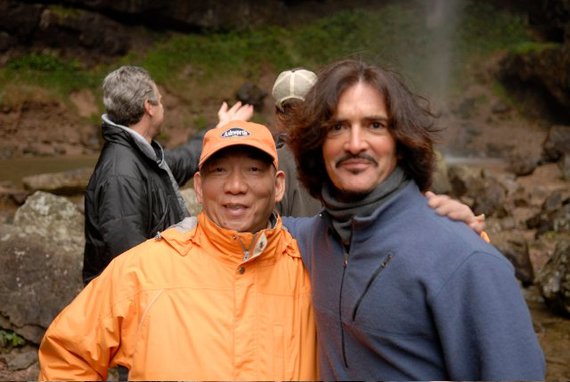
As both a filmmaker and martial artist, there are few modern movies that I regard as highly as Ang Lee’s masterful Crouching Tiger, Hidden Dragon. So when Harvey Weinstein first proposed the idea of revisiting the franchise, I said that I had no interest in writing a straight-up sequel to such a beloved and groundbreaking classic. As it turned out, neither did Harvey.
What Harvey wished to explore – and what I soon found to be a captivating idea – was to return to the obscure literary source that inspired the 2000 film: The work of Chinese writer Wang Dulu and his Crane-Iron pentalogy. Little-known outside of China, and mostly forgotten in its homeland, the Crane-Iron stories are a five-part fantasy series that chronicle four generations of martial heroes.
With titles such as Precious Sword, Golden Hairpin (Book Two) and Sword Force, Pearl Shine (Book three), the fourth book, Crouching Tiger, Hidden Dragon, was the basis for the Ang Lee film, although Lee also drew key elements from the first three. The fifth and final book, Iron Knight, Silver Vase had never been adapted and stood as a forgotten final chapter to a pentalogy that introduced a new generation of star-crossed lovers and Wuxia heroes.
Although few know the name Wang Dulu, he well deserves to be remembered as a writer who perfected the Wuxia genre, paving the way for the fantasy literature that would inspire martial arts cinema as we know it. The opportunity to revisit Wang’s epic story-world and create more of a stand-alone treatment of the final book rather than a sequel to the classic film was intriguing – not just to Harvey and myself, but to Master Yuen Woo-Ping.
Master Yuen, the legendary fight choreographer and director of many of the classic Hong Kong films that inspired Ang Lee to create Crouching Tiger, viewed it as an opportunity to direct his own Crane-Iron tale. While Lee’s film has been deservedly hailed as an artistic drama with kung fu – “Sense and Sensibility with martial arts” some have called it – Master Yuen embraced the opportunity to adapt the final Crane-Iron book in the pure, Wuxia action style he is known for.
With over 70 film credits, Yuen Woo-Ping began as a fight choreographer in the early '70s and directed his first actioners in '78, helming two movies with the young Jackie Chan: Snake in the Eagle’s Shadow and Drunken Master. He would go on to direct and influence the careers of such action stars as Sammo Hung, Yuen Biao, Jet Li, and Michelle Yeoh. This venerated lineage was not lost on the Wachowski’s who sought out Yuen in 1999 for The Matrix, or on Quentin Tarantino who would enlist the master’s choreography for his Kill Bill films.
As a director, Yuen Woo-Ping knows the Wuxia vernacular like few others. He essentially created the dance-like, gravity-defying, fighting-in-tree-tops style that has become synonymous with Crouching Tiger. Yet it’s a traditional language that found its form in the written works of modern Wuxia writers like Jin Yong, Liang Yusheng, and Wang Dulu.
For me, Sword of Destiny has been a journey back to the source. Not just to the unsung literary roots of martial arts cinema, but into the workshop of one of the genre’s pioneers, an iconic action directer who is comfortably at home honoring and celebrating those roots, even as he continually ups his game. I think the late Wang Dulu would have been pleased to see his final Crane-Iron story, the lost chapter, come to life in the hands of a director who truly lives and breathes the world of pure Wuxia.
Follow John Fusco on Twitter: www.twitter.com/JohnFusco12
Now playing where?
Why so many theater chains are refusing to screen Netflix’s ‘Crouching Tiger’ sequel
Netflix
“Crouching Tiger, Hidden Dragon: Sword of Destiny” will be available for streaming on Netflix on Friday, when it hits theaters. (Rico Torres / Netflix)
Yvonne Villarreal
Netflix’s latest movie release, “Crouching Tiger, Hidden Dragon: Sword of Destiny,” will hit theaters Friday, but it won’t pack much of a punch at the U.S. box office.
That’s because the follow-up to the Oscar-winning martial arts epic will only play in about a dozen IMAX theaters around the country — a far cry from the original film, which was released in more than 2,000 theaters and became the most successful foreign language film.
The nation’s largest theater chains have balked at Netflix’s plans to release the movie in the home on the same day it appears in cinemas.
Netflix views so-called day-and-date releases as the wave of the future, giving consumers what they want when they want it across platforms. But theater owners say collapsing traditional theatrical release windows undermines their business. A similar dispute erupted last year when Netflix announced simultaneous release plans for the critically acclaimed “Beasts of No Nation,” which opened in October and was deemed a box office flop.
The conflict has renewed long-standing tensions in Hollywood over when movies are released into the home. It also underscores the challenges Netflix confronts as it seeks to change the conventions of the film industry.
“It’s going to be very, very difficult for Netflix to get the major theater chains to carry its movies,” said FBR Capital Markets analyst Barton Crockett. “It’s really not going to make much money from playing these movies in movie theaters in the United States.”
Netflix’s rising Hollywood profile was on display recently at the recent Sundance Film Festival in Utah. The Los Gatos, Calif., company, along with rival Amazon.com, made a splash by paying more than $30 million to buy movie titles at the festival. Amazon also recently bought the rights to Woody Allen’s next film. The size of such deals and the star power associated with the movies put the industry on notice that streaming companies are serious about their film aspirations.
Original movies can bring cachet and prestige to their services, especially if they win awards, and provide another way to attract subscribers.
“It was kind of a no-brainer that the streaming services would try to exploit their movie ambitions this way,” said Michael Nathanson, a media analyst with Moffett Nathanson Research. “It all goes to branding. The more exclusivity you can offer, it helps build brand support.”
Netflix, which changed how consumers watch television, offers something powerful to filmmakers: a vast global audience with some 75 million subscribers. But most filmmakers still want their movies to be seen on the big screen, and Netflix has had strained relations with the nation’s largest theater chains. They bristle at the idea that the streaming giant is giving consumers more choices to watch movies.
“Netflix’s commitment to consumer choice only extends as far as it benefits Netflix,” said Patrick Corcoran, spokesman for the National Assn. of Theatre Owners.
Representatives of Netflix declined to comment.
Netflix executives have argued that making movies available in the home and theaters at the same time is simply a matter of giving consumers what they want in an on-demand world.
“When people hear about things in the Internet world, they expect to be able to have access to it right then,” Netflix Chief Content Officer Ted Sarandos told The Times when it announced its movie ambitions in 2014.
Theater owners, however, have been fiercely protective of the traditional theatrical release window — the time between when a movie premieres in cinemas and when it is available for home viewing on DVD or video on demand. They argue that dismantling the current window (typically about 90 days) gives consumers less incentive to trek to the multiplex, thereby undermining their business.
In 2011, several major chains vowed not to screen the Ben Stiller-Eddie Murphy comedy “Tower Heist” after Universal Pictures planned to make the movie available at a premium price to consumers just three weeks after its launch in theaters.
Netflix found itself the target of the exhibition industry’s wrath in 2014 when it announced plans for a day-and-date release of the sequel to ‘Crouching Tiger’ in select Imax theaters.
“We will not participate in an experiment where you can see the same product on screens varying from three stories tall to 3 [inches] wide on a smart phone,” said a statement from Regal, the nation’s largest theater chain. “We believe the choice for enjoying a magnificent movie is clear.”
Other chains also refused to screen the film.
Locally, the only cinema showing the movie is an AMC multiplex in the San Gabriel Valley, which has a large Chinese community.
Corcoran said cinema owners had the right to refuse to screen movies released simultaneously in the home.
“They’re dedicating their screen time, and they want to maximize the audience they can get, and if a company is releasing a movie in which there isn’t a commitment to supporting the theater, theater owners are going to take that into account,” he said.
“Sword of Destiny’s” modest theatrical rollout stands in contrast to the original film in 2000 and directed by Ang Lee. “Crouching Tiger” drew record crowds in Los Angeles and New York and became an indie sensation, grossing more than $128 million domestically.
Ticket sales for the sequel, which has Michelle Yeoh and Donnie Yen reprising their roles, are expected to be well below that level.
But Sarandos contends that global streaming views and credibility for its original content are more important to its bottom line than ticket sales. He also expects the movie to do well globally.
Imax is releasing the film in 287 theaters in China, where the film opened last week with a modest $21 million over the weekend, according to industry consulting firm Artisan Gateway.
“It’s a fantastic piece of Chinese storytelling that will travel around the world in a way that Chinese movies don’t,” Sarandos told The Times last month. “It will be a global sensation the way China would like to see themselves in the media landscape.”
Netflix is not alone in its desire to be a player in the film business. Amazon has also been aggressively trying to broaden its programming beyond television. But Amazon is taking a different approach to distribution by making films available on the Amazon Prime streaming platform only after they’re released in theaters.
The Seattle e-commerce giant, known in the TV world for such series as “Transparent” and “Mozart in the Jungle,” recently partnered with Roadside Attractions to release Spike Lee’s “Chi-Raq” exclusively in 305 theaters in December before putting it up on its streaming service less than a month later.
At Sundance, Amazon acquired six film titles, including “Manchester by the Sea,” a family drama starring Casey Affleck that it purchased for $10 million — the second-largest deal at this year’s indie movie festival. And Amazon last week acquired the North American rights to Woody Allen’s upcoming but as-yet-untitled feature.
“I think it’s good for customers and good for filmmakers to have the movies get into theaters and have a robust theatrical run,” Amazon Studios’ chief Roy Price told the Times. “Obviously, [the big screen] is the best way to see a movie… I think preserving the theatrical experience and the theatrical window makes sense for everybody and we support that — it’s an important part of our approach.”
On a cursory search, I only see it playing at one nearby house, AMC Cupertino Square 16 - it’s in IMAX 3D there. Coincidentally, The Mermaid is also playing there, with half the showings in 3D.
Natasha Liu Bordizzo
She’s unknown to me until now, but she made Vogue.
Meet Natasha Liu Bordizzo, Hollywood’s Next Action Supernova
FEBRUARY 25, 2016 3:22 PM
by LAURA REGENSDORF

Photo: Courtesy of Natasha Liu Bordizzo / @natashaliubordizzo
When Natasha Liu Bordizzo makes her wide-screen debut on Friday in Crouching Tiger, Hidden Dragon: Sword of Destiny, premiering in IMAX theaters and on Netflix, she will have a much smaller screen to thank. “My agent in Sydney, she found me on Instagram,” the Australian beauty explained by phone this week from Los Angeles, where she is just setting down roots. If Liu Bordizzo’s career beginnings have a fairy-tale ring, so does the story of her first-ever audition. After reading for a supporting role in the follow-up to the 2000 film Crouching Tiger, Hidden Dragon, she got a surprise call the next day announcing that she’d landed the lead. “I flew to New Zealand [to the set] a week later, I dropped out of university, and here I am,” she said, still a bit incredulous two years later.
With her finely modeled features, calligraphy-stroke eyebrows, and dimpled chin, Liu Bordizzo cuts a striking figure as Snow Vase, the free-spirited ingenue who trains under Yu Shu Lien (played by the regal Michelle Yeoh, reprising her role). Though certain aspects of the sequel are quite a departure from Ang Lee’s Oscar-winning original—the unconventional distribution; a new director (the respected martial arts choreographer Woo-Ping Yuen; and dialogue in English, not Mandarin—the fight scenes still reveal an impressive technical mastery. And Liu Bordizzo accepted the challenge: Already a black belt in Tae Kwon Do, she underwent intensive training in Wudang sword-fighting. Here, the 21-year-old talks about the rigors of the two martial arts disciplines, what saves her skin on long-haul flights, and why breakfast rules the day.
You’re part Chinese and part Italian—did you grow up with any traditional Chinese notions of beauty?
It’s like that stereotype that Asians will carry umbrellas—now I’m one of them because it’s so necessary, especially in Sydney. The best way to avoid sun aging is just prevention. CosMedix has a great hydrating sun mist—that’s my go-to.
How did you first get interested in martial arts?
When I was about 9 or 10, my parents told me I’d either have to start martial arts or dance. I was always a tomboy, so of course I was like, “Martial arts, definitely. I’m not a ballerina—come on!” And I stuck with it. Through my teenage years it really became an outlet for me to let out any frustration. I think it transfers into your life as well: You just become more disciplined and more focused.

Photo: Courtesy of Natasha Liu Bordizzo / @natashaliubordizzo
Both the original Crouching Tiger and the sequel center on master-student relationships. Who did you study with to learn Wudang sword-fighting, and what was that process like?
It was kind of terrifying because Master [Woo-Ping] Yuen is, like, legendary. He choreographed Kill Bill, the first Crouching Tiger, [and] The Matrix. I had Tae Kwon Do, but that was just so different from Wudang that it was like starting from day one again with the best choreographer in the world. It was pretty intense. I was in the dojang from about 9:00 a.m. to 6:00 p.m., five days a week. We definitely got there in the end.
What part of your body was most affected by Wudang?
Funnily enough, it was probably my arms. Everything else hurt, of course, but twirling that sword and holding it out—it’s not something you usually ever do. I had one scene with Harry Shum, Jr. where we don’t use weapons. It’s the only scene in the movie that’s just us—body on body, fist on fist—and that was really hard because he’s a professional dancer. He’s like a stone! [laughs] I would hit him, and then my hand would be, like, broken, so that was definitely the most challenging fight in the movie.
You’re no stranger to long-haul flying. Do you have an in-flight skin-care routine?
Now I do! I use this amazing black rose mask by Sisley. I just slather that on. And there’s a hydrating mist from CosMedix that’s great as well. I try to sleep on the plane, but I remember to wake up and quickly cleanse and apply moisturizer because the plane definitely gets to your skin.
Healthy living seems to be the norm in Australia, starting with a solid brekkie. Are you much of a breakfast person?
Oh, my God, yes! It’s my favorite meal of the day. Right now I’m eating Farmer Jo [muesli] from Sydney, and then I just add different things every morning to keep it interesting, like cinnamon, blueberries, bananas, [and] coconut milk. [In Los Angeles] I love Blu Jam and Earthbar—the smoothies there. It’s so easy to be healthy in L.A.!

Photo: Courtesy of Natasha Liu Bordizzo / @natashaliubordizzo
And she’ll make our sword hotties page for sure. I just found this great shot below.
Michelle Yeoh Reprises Her Role in ‘Crouching Tiger’ Sequel
December 16, 2015 Associated Press
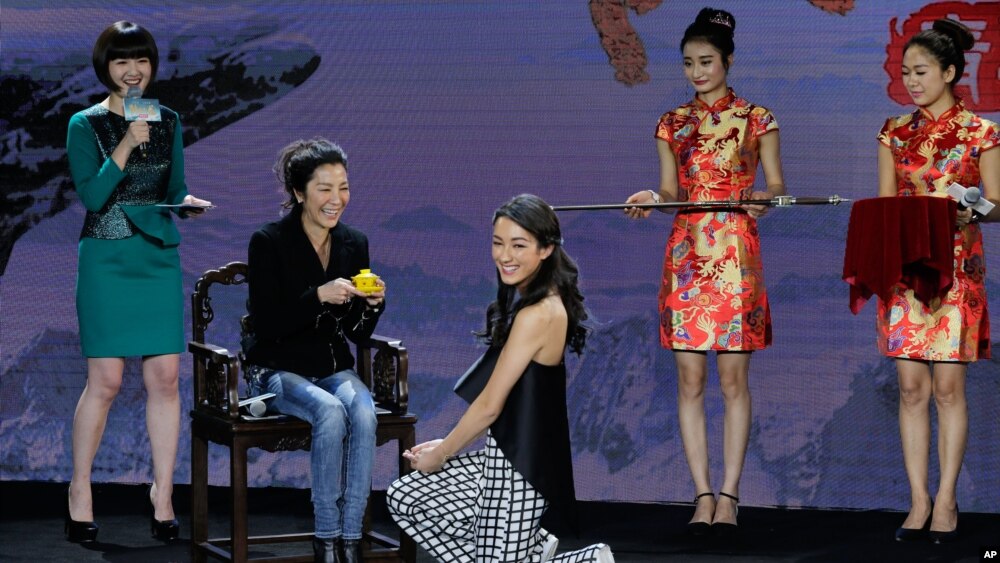
Malaysian actress Michelle Yeoh, second left, and Australian actress Natasha Liu Bordizzo, center, react as they act on stage during a press conference for the movie “Crouching Tiger, Hidden Dragon: Sword of Destiny” in Beijing, China, Dec. 15, 2015.
BEIJING, CHINA —
Malaysian actress Michelle Yeoh said Tuesday that she has been waiting many years to reprise her role in “Crouching Tiger, Hidden Dragon” in an upcoming sequel to the supernatural martial arts movie.
“Crouching Tiger, Hidden Dragon: Sword of Destiny,” centers around the protection of a legendary sword.
It also stars Donnie Yen of the “Ip Man” martial arts films and “The Monkey King” as “Silent Wolf,” Harry Shum Jr., who played Mike Chang in the TV series “Glee,” and Jason Scott Lee.
“We’ve been waiting for this film for many, many years,” Yeoh said at an event in Beijing marking the new movie, which will be released on Feb. 8 in theaters in China and on Feb. 26 in the U.S. on Netflix and in selected theaters.
In her first movie appearance, Australian actress Natasha Liu Bordizzo plays Yeoh’s apprentice. Liu Bordizzo, also at the event in Beijing, said she thought the sequel had the potential to replicate the 2000 movie’s success.
“I think the first story is known so much for a beautiful story and not just the martial arts and I think our film definitely also has that element - we have a beautiful story as well as so many layers,” she said.
The original was filmed in Mandarin. The sequel is in English and will be dubbed into Mandarin for its release in China.
$32 mil in China already
This film is just like KFP3. It’s all about the China box office - Hollywood, not so much.
‘Crouching Tiger, Hidden Dragon: Sword Of Destiny’ Tops $32M In China As Netflix Begins International Rollout
by Nancy Tartaglione
February 26, 2016 7:16am

Netflix
Sixteen years after Crouching Tiger, Hidden Dragon became a worldwide phenomenon, the sequel was unsheathed last Friday in China. After a week of play in a very competitive market, Crouching Tiger, Hidden Dragon: Sword Of Destiny has grossed $32M. That’s more than double the Middle Kingdom lifetime of the previous film and sets up the international rollout as Netflix makes it available today in the U.S. and elsewhere abroad.
Sword Of Destiny is a co-production between The Weinstein Co, Netflix and China Film Group and gives the movie local Chinese status meaning TWC and Netflix recoup a higher percentage of the box office than if this had gone in under the quota system. The PROC release of the Yuen Woo-ping-helmed sort-of-sequel was handled by The Weinstein Co, Netflix and local partners Pegasus and CFG. Harvey Weinstein has called it “a summation of my lifelong passion for Chinese culture in general and wuxia cinema in specific.” He details his experience making the film here.

The China release came near the tail end of the Lunar New Year holiday period, opening with about $10M last Friday and landing No. 2 behind now all-time box office champ The Mermaid ($450M+). Sword Of Destiny held well during the past week even as folks returned to work and school. It’s stayed in the Top 3 throughout the frame which saw The Mermaid maintain the bulk of the territory’s screens during its third week. On Thursday, for example, there were a reported 63K showings of The Mermaid versus 32K of Sword Of Destiny which is running ahead of New Year hit The Man From Macau 3. That film incidentally stars Chow Yun-fat whose character died in the first Crouching Tiger.

Michelle Yeoh returns from the 2000 wuxia film alongside Hong Kong action star Donnie Yen (who’s next up in Rogue One: A Star Wars Story and xXx), Harry Shum Jr and Jason Scott Lee. Talent came out to promote the film in the PROC well ahead of the release.
Yeoh reprises her role as Yu Shu-Lien, the renowned and lovelorn warrior who must protect the legendary Green Destiny sword against evil warlord Hades (Lee). Yen plays Silent Wolf, Shu-Lien’s former fiancé, who she thought had been killed by Hades years earlier.
Netflix’s global rollout began today in over 190 countries. This was born of a deal between the streaming giant and The Weinstein Co that was hatched in the fall of 2014. Sword Of Destiny is also hitting about a dozen IMAX screens today in North America.
There’s that pic of Natasha again…
Can’t wait to watch this movie on Netflix this weekend ! Excellentia !
[QUOTE=GeneChing;1291138]I’m looking forward to watching this on Netflix this Friday. That’ll be my reward for surviving this week.[/QUOTE]
Watching it right now.
Looks and sounds like a made for tv movie. And the English dialogue doesn’t help.
A tough act to follow
CTHD2 reminded me of the film 2010 (1984 ironically, starring John Lithgow, Helen Mirren and Roy Scheider) - It wasn’t a bad film if you could overlook the original, but the original was such a game changer that it’s impossible to overlook. In both cases, the second installment is completely overshadowed and dwarfed by the original.
On the plus side: lots of sword fights. Michelle & Donnie squeezed a little acting in. Harry and newcomer Natasha were good. It had some cinematic panoramic moments that might have been good on the big screen. But a pretty standard Kung fu flick overall. Yuen Woo Ping’s fights are so physics-defying wire work that it has become his signature style, and I didn’t feel he brought anything that fresh to his work
It has already made decent box in PRC. Again, it’s about all about China, something I’ve been watching closely for years now and am just too dumb to figure out how to cash in on the trending shift. The ironic thing is that the original never played in PRC, which is probably why 2 is doing well there. Chinese speakers rejected the original because everyone’s accent was off, which I’ve likened to doing Shakespeare with a Texan drawl. When Netflix said they’d release it simultaneous to the theatrical premiere, many U.S. theater chains boycotted. But it’s just as well because I doubt it could stand up to Deadpool right now. There’s a timely big-picture commentary I might publish about this, but I’ll probably refrain beyond a mention in my print column.
More on Natasha…
…she was one of the best parts of CTHD2 for sure… a breakout martial ingénue.
Natasha Liu Bordizzo’s Career Takes Flight With ‘Crouching Tiger, Hidden Dragon: Sword of Destiny’
Friday, February 26th, 2016 at 8:55am PST - by Scott Huver

Natasha Liu Bordizzo’s story may end up being the envy of fledgling actors everywhere.
With a background in martial arts but virtually no experience in entertainment, the 19-year-old Australian college student responded to an open casting call for “Crouching Tiger, Hidden Dragon: Sword of Destiny” in her native Sydney, bringing to a halt the worldwide search conducted by the film’s director Yuen Woo-ping, the wuxia wireworks maestro for Ang Lee’s 2000 original.
Bordizzo was instantly cast as Snow Vase, a new young character trying to understand her place in the epic world.
Mere days after moving to Hollywood to see if her good fortune will continue, the now 21-year-old Bordizzo joined Spinoff Online in the Beverly Hills offices of Netflix, which debuts the film today, to talk about her extraordinary career path.
Spinoff Online: So, instant movie star …
Natasha Liu Bordizzo: Uh, no – not yet! [Laughs]
This had to feel like a pretty crazy experience for you, to just kind of step in and say. “Hey, how about me?” And they say, “Sure!”
Yeah, that was my first audition. I mean, I don’t even know how to say that to actors’ faces. I’m like, “Yeah, ‘Crouching Tiger’ was my first audition. You hate me now, don’t you?” Especially now that I’m auditioning and doing pilot season, I’m like, “Holy crap! That was insane!” But that was my first audition. Yeah.

Tell me, what was the thing that pushed you to do something like that? To say “I’m going to go audition for this thing.”
To be honest, I was pushed. I was just studying, and I was in university in Sydney, which is where I’m from. Then, my agent – my now-agent – she is a boutique model/actor agent in Sydney, and she scouted me for modeling. And I was like, “I’m very busy, I’m studying, I don’t think I have time for that.” And I just didn’t have much interest in it.
Then she said, “OK, well, how about acting?” And she put me forward for this audition, and I went out of curiosity because I’ve never liked drama very much. I have stage fright and I’m a little bit of an introvert. I just don’t like those situations in high school where it’s drama class and everyone’s just trying to be really loud and everything. So I found this strange thing about film is that it’s so intimate and it’s not about being big or dramatic, it’s just an imitation of life. So I just fell into it because it just felt really right.
How nervous were you on that first day of shooting?
Pretty nervous. But you know what helped, though? My first week of shooting was actually action scenes with no dialogue. So I wasn’t as nervous as I would have been if it was a dialogue scene. So I think I was just trying to go through the motions and not get killed by Harry in that scene. We filmed that nighttime scene where we’re trying to steal the sword, was our first week filming.

Give me a little bit of your history with martial arts. How early on did you take an interest in it and show some real skill for it?
I started taekwondo when I was 9 or 10. My parents basically said to me, “You can do martial arts or you can do dance – choose.” And I was always a tomboy, so I said of course I’d rather do martial arts. I was like, “Please, I’m not doing ballet.”
There was a dojo near my house, and I started going and I just found that it was like an outlet in my teenage years, just maybe to vent frustration. It was a space where there was a lot of respect of discipline, and it was just really formative for me as a teenager to have that space away from high school and everything that is growing up to where you’re just really treated with respect and you treat others with respect.
It was more like that affected my life that I loved as well. I think first and foremost, I’m still an actor, though. If martial arts adds to the story, I’m very happy to take that on board as well.
How much did your real discipline in martial arts come into play? Or did you have to say, “Oh, you want movie martial arts.”
Well, I think with nontraditional Wushu, just general action, like a general TV show, it’s a lot more faking it because you can just do something that looks flashy but it’s not actually. But with our movie, we had to really do most of the movements. It’s really hard to fake it. There’s a certain grace to Wushu that it’s almost between dance and martial arts. So we really did do most of what is in the movie. I’d say I did, like, 80 percent of my stunts. So it was a crash course.
And very little of that helps you when you’re on a wire rig and spinning around, as Harry Shum was just telling me. All his dance discipline really didn’t –
No, nothing helps you.
It doesn’t help you with gravity.
Nothing helps you with gravity, apart from practice. The wirework, it looks easy, it looks like you’re feather-light, and you’re just flying around. It’s not. It’s, like, you have to tense your entire body to just stay straight. For some reason, you always want to be doing this. So the wirework is very challenging, actually. I have double the amount of respect for watching the action sequences that I have of actors on wires, because now I realize how hard it is.
What’s the craziest situation you found yourself in while dangling from cables?
Oh, my God. There was one scene at the pagoda, which is where I fight the villain Hades Dai. I had to be doing backflips and every other thing in front of a crowd of like 100 soldier extras. And there was just so much … Jason Scott Lee, who plays Hades Dai, he’s terrifying in character. He runs at you like a full muscle train and does not stop. The fear was real. There was no acting in that scene. So that was a pretty crazy whole sequence there.
Of all the other physical things that you had to get familiar with to do the role, what did you take to right away – like, “Hey, I’m good at this?” And what was the most tricky to master?
I think, predictably, I was better at the scene that doesn’t involve weapons, which is the one with Harry where we’re at night just kind of wrestling and punching. Just fighting. But I think possibly, I’m trying to think of the exact scene that I struggled the most with. Weapons in general was new to me.
So I think honing my skills to be to the point of approval of Master Yuen [Woo-ping], who’s a legend, that was a daily task for me. Yeah. His approval is not easy. If he does this to you [flashes a low-key “OK” gesture], you know that you’ve done amazingly well. That’s all he’ll give you.

Tell me about, physicality aside, what intrigued you about the character? What did you find yourself loving about walking around in her shoes?
When I first read the script, I was really amazed at the fact that it’s this young, impulsive female warrior who kind of is pivotal to a lot of the story. I think that she comes from a lonely kind of upbringing, because she was raised very much like a warrior, a student, instead of a daughter. She feels kind of misplaced a lot of the time.
She’s kind of guarded, but she’s seeking love and guidance, which is kind of what she gets from Yu Shu Lien, Michelle Yeoh’s character. I just love there’s so many layers involved. She’s secretive. She’s got this past. She’s sneaky, but she wants guidance, but she’s guarded, but she’s fiery and temperamental. She’s got flaws and she’s a real person.
Where did the original movie come into your life? Was it something from childhood or did you recently discover it?
No, I was 5, I think, when the original came out, and I never saw it. I think I watched bits of it when my parents were watching it in the living room maybe, sometimes. But I watched it for the first time as preparation for this movie. Ever since then, I’ve dived a lot more into the Chinese side of my culture and just Wushu and Hong Kong cinema in general.
I think that because my generation’s a little bit cut off from that film in the sense, where we’re just too young to have seen it when it came out and was a big thing, I think that makes us see this movie more as a standalone because of that. I think my friends haven’t really seen the first one either. We just kind of missed it because of that gap. They’re excited about this as a new, fresh project.
How’s university looking now? You going to go back?
That’s long gone. I quit; I just dropped out. There’s a period where I was trying to do both for a few months, and it just didn’t work. You have to kind of do a hundred or nothing with acting. Yeah, maybe later in life, but I’m very focused.
Are you hooked? Do you feel like “This is my thing I should have been doing all along”?
Definitely. Yeah, it was weird. I never thought … you know, it’s one of those things. Fate, I don’t know. Is that too strong a word? Everything that I enjoyed is kind of melded into acting. I love photography, I love writing, I love film as well. But I never thought I’d actually be in the films. But yeah, I’m very passionate.
The magic of Ang Lee’s rapturous 2000 Oscar winner is nowhere to be found in this cynical cash grab of a sequel.
What a lousy year for long-delayed sequels: It may not be a stink bomb of Zoolander 2 proportions, but in many ways Crouching Tiger, Hidden Dragon: Sword of Destiny feels like an even more cynical cash grab. Trading on the pedigree of Ang Lees 2000 Oscar winner but capturing none of its soulful poetry, this martial-arts mediocrity has airborne warriors aplenty but remains a dispiritingly leaden affair with its mechanical storytelling, purely functional action sequences and clunky English-language performances. The result has grossed a healthy $32 million in China so far and began its Stateside streaming release on Friday (while opening on about a dozen Imax screens), but regardless of how it fares, exec producer Harvey Weinsteins latest dubious non-contribution to Asian cinema will add some quick coin but no luster to Netflixs library.
The singular magic that made Lees film such a boundary-breaking triumph it won four Oscars and is still the highest-grossing foreign-language film in North America is nowhere to be found in a production that seems predicated entirely on cost-effectiveness and compromise. Although Sword of Destiny has similar roots in the Chinese novelist Wang Dulus Iron Crane pentalogy and features a return appearance by Michelle Yeoh as the wise and formidable fighter Yu Shu Lien, its a work that feels dispiritingly cut off from its predecessor; not even the ascension to the directors chair of Yuen Wo-ping (the veteran action choreographer behind much of the original films kung fu wizardry) can ensure much in the way of visual or dramatic continuity. And thanks to the filmmakers decision to shoot in English (with dubbed versions playing in Chinese territories) and to shoot primarily in New Zealand, with Grant Major (The Lord of the Rings) enlisted as production designer, the result is a sequel often feels less Middle Kingdom than Middle-earth. […]
Spot on. I was wondering why the movie had such a Lord of the Rings feel too.
I had little interest in seeing this before, and now I have even less. The fact that it’s a movie set in old China but filmed in English(!) is a big factor. Who cares if the Mandarin accents were “wrong” in the original? It’s still more accurate than having them speaking English.
CTHD2 still made bank…in China
[QUOTE=GeneChing;1291523]
Crouching Tiger Hidden Dragon II: The Green Destiny, which has grossed a healthy $36.8 million in the Chinese market, despite withering local reviews.[/QUOTE]
[QUOTE=Jimbo;1291512]I had little interest in seeing this before, and now I have even less. The fact that it’s a movie set in old China but filmed in English(!) is a big factor. Who cares if the Mandarin accents were “wrong” in the original? It’s still more accurate than having them speaking English.[/QUOTE]
Actually, it’s all about the accent. CTHD was very poorly received because of the accents and many critics at the time said it was a manipulative move on behalf of Ang Lee. CTHD wasn’t a Kung Fu movie made for the Taiwanese/Asian market at all. The accents betray that. It was always Hollywood bound. Now, over a decade and a half later, the tables have turned. Let’s make a Kung Fu movie for China in English. It’s not for the U.S. theatrical market at all. It didn’t even chart on Box Office Mojo for Domestic, only for China and Hong Kong. In my area, the SF Bay Area, which is a fat market for ‘Asian’ films, I can only find it playing in one IMAX house (there may be more, but I’m not going to search that aggressively as the point is made). It was really all about Netflix here.
All that being said, it’s still worth a view on Netflix if you have it, mostly for Natasha. And of course, more grist for the mill here. 
[QUOTE=Jimbo;1291512]The fact that it’s a movie set in old China but filmed in English(!) is a big factor. Who cares if the Mandarin accents were “wrong” in the original? It’s still more accurate than having them speaking English.[/QUOTE]
Not just the accuracy, but without the Chinese language idioms, the movie looked and sounded like a medieval sword movie with people that randomly happened to look Asian pretending to be Caucasian.
Way too much dialogue and exposition too. It’s an art to tell a story with few words.