Our latest exclusive interview
Bruce and the Academy - READ Jeff Chinn on the Academy Museum of Motion Pictures Bruce Lee Exhibit by Gene Ching

threads
Bruce-Lee-Museums-and-Gallery-Exhibits
We-Are-Bruce-Lee-at-CHSA
Our latest exclusive interview
Bruce and the Academy - READ Jeff Chinn on the Academy Museum of Motion Pictures Bruce Lee Exhibit by Gene Ching
threads
Bruce-Lee-Museums-and-Gallery-Exhibits
We-Are-Bruce-Lee-at-CHSA
Our latest exclusive interview
The Return of the Dragon. READ Jeff Chinn on WE ARE BRUCE LEE: Under the Sky, One Family by Gene Ching

threads
Bruce-Lee-Museums-and-Gallery-Exhibits
We-Are-Bruce-Lee-at-CHSA
“Be Water, My Friend: The Teachings of Bruce Lee at the Wing Luke Museum
Wing Luke Museum’s new Bruce Lee exhibit shows another side of the martial artist
July 12, 2022 at 6:00 am Updated July 12, 2022 at 4:04 pm
1 of 8 | Shannon Lee leads a tour of the exhibit about her father, Bruce Lee, at the Wing Luke Museum. Titled “Be Water, My Friend: The Teachings of Bruce Lee,” it tells a story of his learnings, philosophical approaches and the symbolism of water. “As hard as he… (Alan Berner / The Seattle Times)
By Jayce Carral
Seattle Times staff reporter
Deep in grief after the sudden death of her brother, actor Brandon Lee, in 1993, Shannon Lee started flipping through her father’s writings — photocopied pages of book annotations stacked 2 feet high. She came by a note that she did not recognize, which was odd because she, along with a lot of other people, knew the majority of her father’s famous quotes — he was, after all, Bruce Lee.
“’The medicine for my suffering I had within me from the very beginning, but I did not take it,’ ” Shannon Lee recited from memory. “’My ailment came from within myself, but I did not observe it until this moment. Now I see, I will never find the light, unless like the candle, I am my own fuel.’ ”
The passage opened something in her, and she realized her suffering was not going to erase itself. Delving back into the knowledge her father left behind helped her cope. Within seven years, she said, she was the happiest she had ever been.
“As hard as he worked on his body, he worked on his mind and worked on his energy, and that is what made the difference,” she said. “That is why we’re still talking about Bruce Lee 50 years later.”
While he was most well-known for his movies and martial arts, Bruce Lee (1940-1973) was also strong in his own philosophy. After taking the helm of the Bruce Lee Foundation, Shannon Lee has made it her mission to tie her father’s image to his teachings as part of his legacy.
Seattle’s Wing Luke Museum, in partnership with the foundation, launched an interactive exhibit July 9 dedicated to Bruce Lee’s philosophy titled “Be Water, My Friend: The Teachings of Bruce Lee.” The exhibit, which is becoming a permanent part of the museum, is based on the martial artist’s 2,800-book collection. It opens with a glass cutout of his famous flying side kick embedded in a wall with books from his collection filling the image. Immersive storytellers Jessica Kantor and Eve Weston, the exhibit’s creative team, found knowledge in Bruce Lee’s work as they transposed the annotations hidden among his books into the exhibit’s works.
“He is a pioneer. He’s an entrepreneur. He’s an innovator. He’s an athlete. He’s an intellectual,” Weston said. “He’s incredibly hardworking and driven and thoughtful.”
The exhibit’s story is told on blue-colored walls. From his writing, Bruce Lee described losing his “theory of gentleness” once he entered a fight. He would remember the teachings from his only formal instructor, Yip Man, but was unable to put them it into practice. He spent an afternoon on a boat, realizing he wanted to be like water — going with his nature, instead of against it.
Between the story are stacks of books, black-and-white photos and a glass case of some of Bruce Lee’s possessions surrounded by plaques dedicated to his philosophy behind learning, known as the three stages of cultivation: partiality, fluidity and emptiness.

1 of 3 | Bruce Lee meditates on a pier on Lake Washington. (Courtesy of the Bruce Lee Foundation)
The exhibit continues into a dimly lit room hosting three circles — representing the mind, body and spirit — on the floor with projected images of lily pads. When patrons stand on the lily pads, a bell will ring and a quote once highlighted by Bruce Lee will appear at their feet. Moments later, a screen in front of them will show photos, videos or more quotes. There are about 30 different pairings for the three circles.

The interactive exhibit displays quotes important to Bruce Lee when the visitor steps into the circle of “water.” (Alan Berner / The Seattle Times)
The exhibit ends with a large image of Bruce Lee accompanied by a quote written across the wall in a font designed after his handwriting.
Exhibiting and celebrating stories of people like Bruce Lee and Wing Chong Luke — who is not only the museum’s namesake but also the first Asian American elected into public office in the Pacific Northwest — is vital in the current political climate, said museum executive director Joël Barraquiel Tan.
“This is the time to really bring our communities together to experience the kind of teachings and inspiration of someone as integral to Seattle as Bruce Lee, to remind us that we can actualize something bigger than we could have ever imagined,” Barraquiel Tan said.
The exhibit marks the permanent partnership between the museum and the Bruce Lee Foundation. The museum will host the Bruce Lee Gallery and several future exhibits dedicated to the martial artist and his legacy.

Bruce Lee was an avid reader with a book collection approaching 3,000 on a cross-section of subjects. (Alan Berner / The Seattle Times)
“Be Water, My Friend: The Teachings of Bruce Lee”
10 a.m. to 5 p.m. Wednesdays-Sundays; Wing Luke Museum, 719 S. King St.; $10-$17, free for children under 5; wingluke.org
Jayce Carral: jcarral@seattletimes.com; on Twitter: @jaycecarral.
Another Wing Luke exhibit.
Fans recreate kung fu star Bruce Lee’s demolished Hong Kong mansion in metaverse
There’s a special place in hell for people who vandalize museums
Man charged with hate crime after vandalism at Wing Luke Museum
Sep. 18, 2023 at 3:33 pm
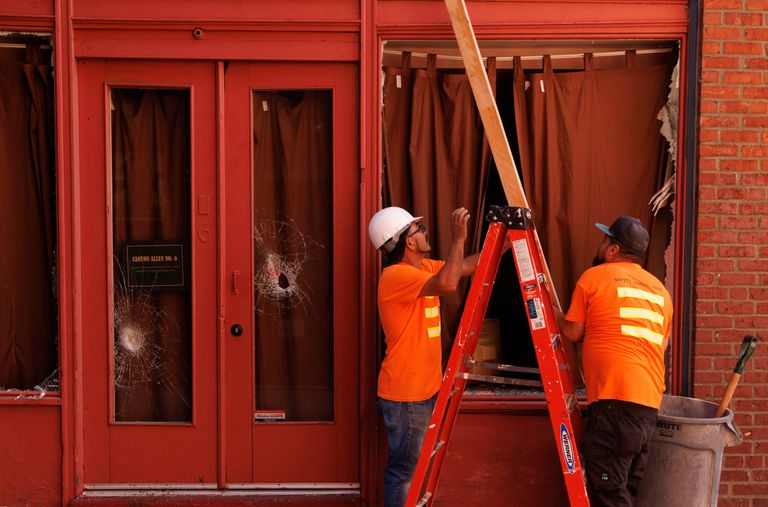
Adrien Fonseca, with Marpac Construction, works to remove glass from the Wing Luke Museums broken windows on Canton Alley South on Sept. 15. (Erika Schultz / The Seattle Times)
By Alexandra Yoon-Hendricks
Seattle Times staff reporter
A man was charged Monday with a hate crime after he smashed the windows of the Wing Luke Museum, King County prosecutors say.
According to the charges, Craig Milne, 76, used a sledgehammer to break the windows of the museum along Canton Alley South in Seattle on Thursday night, as dozens of patrons inside were touring an exhibit.
Milne, who is white, also was charged with first-degree malicious mischief for causing more than $100,000 worth of property damage, charging papers say.
After smashing the windows, Milne remained outside the building, and was heard saying he had come to the Chinatown International District to cause damage and that “the Chinese ruined my life,” according to witnesses.
Almost an hour later, when Seattle Police Department officers arrived and arrested Milne, he “continued making racially biased statements and expressed no remorse,” the charging documents stated, with Milne telling officers, “The Chinese have tortured and tormented me for 14 years. I don’t regret anything I did here.”
“The blatant racist motivations behind the defendant’s actions, the extreme nature of this property destruction, the disregard for individuals who were inside the building, and the lack of remorse gives the State significant community safety concerns,” prosecutors wrote.
Milne first appeared in court Friday, when a judge set his bail at $30,000. He remained in King County Jail on Monday.
The Wing Luke Museum is a major educational and cultural institution in Seattle and an anchor in the neighborhood. It is the only pan-Asian Pacific American community-based museum in the country.
“The attack and the damage, beyond the physical, was in part symbolic,” museum Executive Director Joël Barraquiel Tan previously told The Seattle Times. “It was targeted. It was planned.”
This is not the first time Milne has been accused of a hate crime. In October 2013, Milne was arrested for allegedly attacking and repeatedly punching an Asian man in the locker room at the Spartan Recreation Center in Shoreline.
King County Sheriff’s Office deputies reported they heard Milne shouting racial slurs against Asian people, saying “they ruined my life.” When he was arrested, Milne fought the deputies and called an Asian officer racial slurs, according to charging documents.
Milne was charged with fourth-degree assault and resisting arrest, according to court documents. The charges were dismissed in 2015, prosecutors said.
Community leaders said the attack Thursday ratcheted up already elevated concerns about public safety among some Asian American and Pacific Islander residents in Seattle. Several criticized the police response time, saying the 52 minutes it took for officers to arrive reflected local law enforcement and city leaders’ disregard for their well-being.
Hate crimes targeting Asians and Asian Americans increased dramatically during the COVID-19 pandemic, rising more than 73 percent in 2020, according to FBI data. Since 2020, the King County Prosecuting Attorney’s Office has filed 130 cases involving hate crimes, with 20 filed this year so far.
Milne’s arraignment is scheduled for 8:30 a.m. Oct. 2 at the King County Courthouse.
Times researcher Miyoko Wolf contributed to this report.
Alexandra Yoon-Hendricks: 206-464-2246 or ayoonhendricks@seattletimes.com; on Twitter: @ayoonhendricks. Staff reporter Alexandra Yoon-Hendricks covers race and equity for The Seattle Times.
Craig Milne unrepentant, earns Wing Luke $100K
Wing Luke Museum gets $100K from city, state for repairs after vandal smashes windows
By KIRO 7 News Staff
September 29, 2023 at 5:01 pm PDT

SEATTLE — Seattle’s Wing Luke Museum will be getting $100,000 in funds to help in its recovery efforts after several of its windows were smashed by a vandal in early-September.
Seventy-six-year-old Craig Milne was charged in the incident, after smashing the museum’s windows with a sledgehammer while saying that “the Chinese have ruined my life.”
When officers arrived, he allegedly told them that “the Chinese have tortured and tormented me for 14 years.”
“I don’t regret anything I did here,” he added.
On Friday, the City of Seattle and the Washington State Department of Commerce announced that they would be giving the Wing Luke Museum $100,000 for repairs.
“I’m proud our state could step in alongside the City of Seattle to help the Wing Luke Museum recover from the violence of hate,” said Gov. Jay Inslee in a news release. “The museum is a local treasure honoring Washington’s global diversity. I encourage folks to visit and learn more about the history and culture of Asian Americans, Native Hawaiians and Pacific Islanders.”
Milne was charged with two felonies, one for a hate crime and another for first degree malicious mischief.
“(Lee) helped build the image of the Chinese and overseas Chinese in the Western world,” visitor and martial arts coach Andy Tong said.
by AFP19:23, 2 JULY 2025
ruce Lee aficionados gathered at a Hong Kong mini-museum dedicated to the legendary martial artist to bid farewell to the site on Tuesday, as operating expenses forced the itinerant archive to close once again.
The Bruce Lee Club, which was founded by the Lee family, had put a collection of about 2,000 artefacts, including decades-old magazines and a large sculpture showing the superstar’s iconic moves, on display in the bustling Yau Ma Tei neighbourhood in 2001. But a rent increase shut the project in 2016. [IMG2=JSON]{“data-align”:“none”,“data-size”:“full”,“src”:“https://hongkongfp.com/wp-content/uploads/2025/07/AFP__20250701__64FB4T4__v2__HighRes__TopshotHongKongChinaCultureBruceLee-1050x700.jpg”}[/IMG2]
A bust of Bruce Lee at the Bruce Lee Club in Hong Kong. Bruce Lee aficionados gathered at a Hong Kong mini-museum dedicated to the legendary martial artist to bid farewell to the site on July 1, as operating expenses forced the itinerant archive to once again close its doors. Photo: Tommy Wang/AFP.
Three years and a move to industrial Kwun Tong later, the club began welcoming visitors to see the collection again just before democracy protests roiled the city, dampening tourism.
In a statement, the club wrote that the social movement followed by the Covid-19 pandemic had “severely disrupted” plans for the archive.
“We anticipated a recovery, yet reality fell short,” it said. “The accumulated expenses over these six years have compelled us to rethink how to most effectively utilise our resources to sustain the flame of Bruce Lee’s spirit.”
It added that it will “explore new ways” to engage with the public, but for now, ahead of what would have been Lee’s 85th birthday, it is shutting shop.
At least temporarily, all the assorted ephemera related to the Hong Kong icon will be boxed up and stored.
Born in San Francisco in 1940, Bruce Lee was raised in British-run Hong Kong and had an early brush with fame as a child actor. He later became one of the first Asian men to achieve Hollywood stardom before his death at the age of 32.
‘Never give up’
At the unassuming Kwun Tong archive on Tuesday, visitor and martial arts coach Andy Tong called it a “great pity” to lose the place.
“(Lee) helped build the image of the Chinese and overseas Chinese in the Western world,” Tong, 46, said.
While the superstar is widely beloved and celebrated in the city, with frequent retrospectives and exhibitions staged, fans have struggled to ensure organised and systematic preservation. [IMG2=JSON]{“data-align”:“none”,“data-size”:“full”,“src”:“https://hongkongfp.com/wp-content/uploads/2018/03/bruce-lee-2644599_1280.jpg”}[/IMG2]
A Bruce Lee Statue at Tsim Sha Tsui. Photo: Pixabay.
In 2004, petitioners successfully managed to get a bronze statue of Lee installed on Hong Kong’s famed harbourfront, but a campaign to revitalise his former residence failed to spare it from demolition in 2019.
Bruce Lee Club’s chairman W Wong said the Hong Kong government lacks long-term and continuous planning for preserving Lee’s legacy.
But he added the Club “will never give up” their dedication to championing Lee’s spirit.
“Although Bruce has passed away, his spirit continues to inspire people of all kinds,” Lee’s 76-year-old brother Robert Lee told AFP.
“I believe, rather than hope, the spirit of Bruce Lee will forever remain here (in Hong Kong).”
Sad. Anyone here ever make it out to this?

> # Hong Kong marks 85th anniversary of Bruce Lee’s arrival with statue and exhibition
Life-size bronze statue unveiled at former site of Lee family home on Nathan Road, alongside exhibition of rare photos and posters
2-MIN READ
Published: 5:46pm, 27 Apr 2026Updated: 7:47pm, 27 Apr 2026
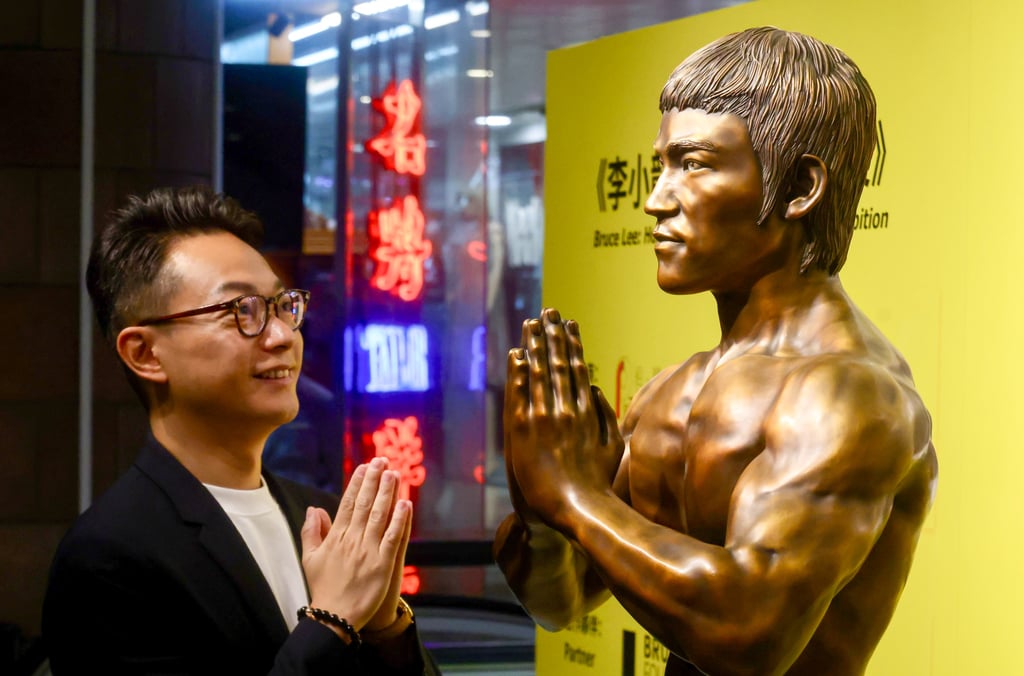
An entertainment company and an arts curator have unveiled a life-size statue of late kung fu legend Bruce Lee at his childhood home in Hong Kong to mark the 85th anniversary of his arrival in the city.
Organisers hmvod and curator Heiman Ng said the statue, unveiled on Monday, had been permanently installed at the Prudential Centre on Nathan Road, where the Lee family lived after returning to Hong Kong in 1941 not long after he was born.
An exhibition titled “Bruce Lee: Homecoming – 85th Anniversary Exhibition” will run until the end of May, showcasing a collection of previously unseen photographs and rare posters.
The event will coincide with mainland China’s Labour Day “golden week” holiday that runs from May 1 to 5.
“Apart from the statue on the Avenue of Stars, we have installed this sculpture at his childhood doorstep to reflect his more philosophical ‘be like water’ side,” Ng said. “This is a timely reminder for us to stay calm in the turbulent time of Hong Kong.”
The bronze statue depicts a shirtless Lee with his hands folded in front of his chest, themed around his signature saying: “be like water.”
The phrase originates from a scene in the 1971 television series Longstreet, which highlights the adaptability and fluid nature of water in overcoming life’s obstacles.
The monument, which was announced last year, forms part of the “Bruce Lee Way” memorial trail, joining six other locations established in 2013 to commemorate the star’s local roots.
Prudential Centre stands on the site of the former Katherine Building, a residential block where Lee lived for the longest period of his life after his family returned from San Francisco in 1941.
The life-size statue forms part of the “Bruce Lee Way” memorial trail, joining six other locations established in 2013 to commemorate the star’s local roots. Photo: Jonathan Wong
The new installation offers fans a rare glimpse into Lee’s childhood before he moved back to the United States at age 18.
The photo gallery features previously unseen images of Lee as a child actor, before his fame in the US, including stills from The Kid (1950) and The Orphan (1960), as well as a photograph of him as a pupil at La Salle Primary School.
“We hope to attract tourists from the nearby West Kowloon high-speed rail terminus and promote in-depth travel through this exhibition, which forms part of the neighbouring cultural district,” lawmaker Yiu Pak-leung said.
Shannon Lee, daughter of the martial artist and chair of the Bruce Lee Foundation, shared a message to mark the event.
“I love that this exhibition inhabits the place where my father’s journey began in Hong Kong and offers visitors the opportunity to connect with his legacy where his roots first took hold,” she said.
In addition to the mall exhibition, a red 1972 Mercedes-Benz 350SL Roadster – the same model Lee owned in Hong Kong – will be displayed for a week in the driveway outside the centre, on loan from a local collector.
The star spent his last years living in a Kowloon Tong mansion before his sudden death on July 20, 1973, at the age of 32.
Kristen Cheung previously interned at Initium Media and holds an MPhil in Cultural Studies from the Chinese University of Hong Kong, where her research focused on historical cross-border labor movements.
> # Op-Ed: Bruce Lee, birthright citizen
Photo by Thomas Lee
MAY 13, 2026
by Thomas Lee
Over the past month or two, I started to receive excited texts from friends across the country. They all contained the same image: the new United States Postal Service Forever Stamp featuring Bruce Lee.
“Big celebration on Wednesday for him in Chinatown,” a friend in Seattle wrote me. “First time an Asian American has been on a Forever Stamp if u can frigging believe what they said.”
In a very small way, I felt a sense of validation. I had curated an exhibit and written a book about the martial arts legend called The Bruce Lee Code. And despite his fame and popular films, people are often most surprised about the most basic part of his biography: where he was born.
Bruce Lee was born in the United States of America, a native American citizen. That’s apparently not common knowledge.
In 2024, The Asian American Foundation released a survey that asked Americans to name famous Asian Americans. Only 5% named Bruce Lee.
History is not without a sense of irony. America has been historically quick to claim something as its own. Yet it took the country more than 50 years after Lee’s death in 1973 to put the face of a global icon on a stamp.
And the timing is remarkable. The Supreme Court is deliberating on a case that could invalidate the very legal precedents that made Bruce Lee an American citizen.
The case concerns efforts by the Trump Administration to overturn birthright citizenship, in which people physically born in the United States, regardless of their parents’ legal status, are automatically granted U.S. citizenship. A decision is expected in June.
We Are Bruce Lee exhibit in San Francisco Chinatown // Photo by Thomas Lee
Bruce Lee was born in San Francisco Chinatown on November 27, 1940. His parents, Lee Hoi-chuen and Grace Ho, happened to be in the U.S. on one-year cultural workers visas. Lee’s father was the star of a traveling Chinese opera company touring the country. In 1942, Lee’s parents returned to Hong Kong with their infant son.
Even Lee’s upbringing defied simple national categories. He grew up in British-controlled Hong Kong, shaped by war, colonialism, Chinese tradition, and Western influence all at once.
After a troubled life in Hong Kong, Lee’s parents sent him back to the United States in 1959. By this point, most fans of Bruce Lee are familiar with his story: he attended the University of Washington in Seattle, opened martial arts schools, and moved to Hollywood where he starred as Kato in the television series The Green Hornet. Lee moved back to Hong Kong, where he made famous films like Enter the Dragon and Fists of Fury. He died at age 33 and is buried in Seattle.
It would be tempting to consider how Lee’s life would have turned out had he not been granted U.S. citizenship. He formed most of the ideas and connections in America that proved crucial to his global success.
But the most useful exercise, and one that has largely been absent from the debate over birthright citizenship and immigration in general, is to consider what makes a person an actual American.
Is it simply where you were born? The current debate inevitably reopens old questions about ancestry, belonging, and who gets imagined as fully American in the first place.
Consider a white man born in America who never finishes school, never holds a steady job, never votes, and never pays taxes. Few people would question whether he is truly American.
But what if we instead consider what someone actually does with the opportunities citizenship provides?
We Are Bruce Lee exhibit in San Francisco Chinatown // Photo by Thomas Lee
When Lee returned to the United States as a young man in his early 20s, he was poor, unemployed, and barely knew anyone. But he already intuitively grasped the entrepreneurial energy of his birth country.
“Fortune, in the sense of wealth, is the reward of the man who can think of something that hasn’t been thought of before,” Lee wrote to a family friend. “In every industry, in every profession, ideas are what America is looking for. Ideas have made America what she is, a good idea will make a man what he wants to be.”
“I feel I have this great creative and spiritual force within me that is greater than faith, greater than ambition, greater than vision. It is all these combined. My brain becomes magnetized with this dominating force which I hold in my hand.”
“I feel this great force, this untapped power, this dynamic something within me. This feeling defies description, and [there is] no experience with which this feeling may be compared. It is something like a strong emotion mixed with faith, but a lot stronger.”
This is a person who at the very least says the very things that we normally ascribe to ideal Americans. The energy and drive to better himself, to build something of note with his brains, work ethic, and resilience.
Thomas Lee with Shannon Lee, daughter of Bruce Lee, in Los Angeles // Photo courtesy of Thomas Lee
“My father had a very interesting blend of East and West,” his daughter Shannon Lee once told me. “He was very much a Chinese man and identified culturally as a Chinese man. At the same time, one of the core principles of his life was that he took what was useful from wherever he encountered it.”
“So, he very much saw that there was this entrepreneurial spirit in the West. He could feel the energy within his body. He had created ideas. He knew how to work hard, and he wanted to create something in the world. He wanted to have some kind of impact. He grabbed that by the reins.”
Lee ultimately helped popularize martial arts in the United States, helping lay cultural groundwork for the later popularity of MMA. His films blended the kinetic nature of Hong Kong martial arts action movies with Hollywood storytelling and character development, influencing blockbuster films and television shows like Star Wars, The Matrix, Warrior, John Wick, and Kill Bill. His focus on discipline and self-improvement particularly appealed to African Americans and greatly influenced hip hop culture.
Bruce Lee wasn’t content just to be a U.S. citizen.
He absorbed America. He reshaped America. And he exported parts of America back to the world, often without people fully realizing his American origins.
His birth certificate wasn’t just a legal document. It was a matter of purpose and opportunity. He wanted to use his citizenship to realize the best possible version of himself.
And stamp or no stamp, there’s nothing more American than that.