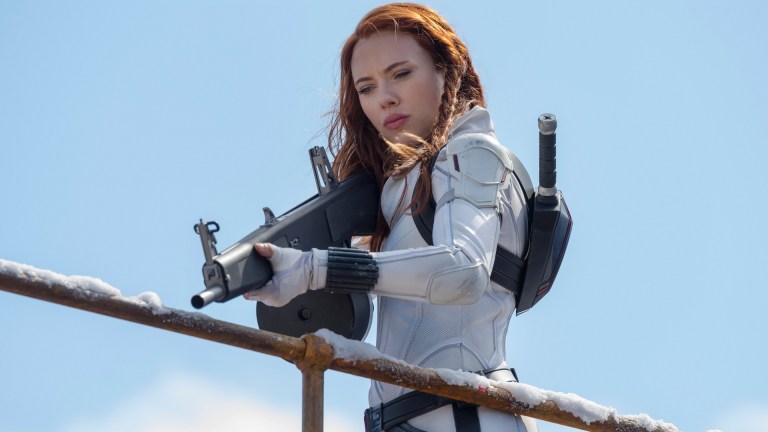
Black Widow

continued from previous post

What does this mean for Marvel, DC, and other superhero franchises?
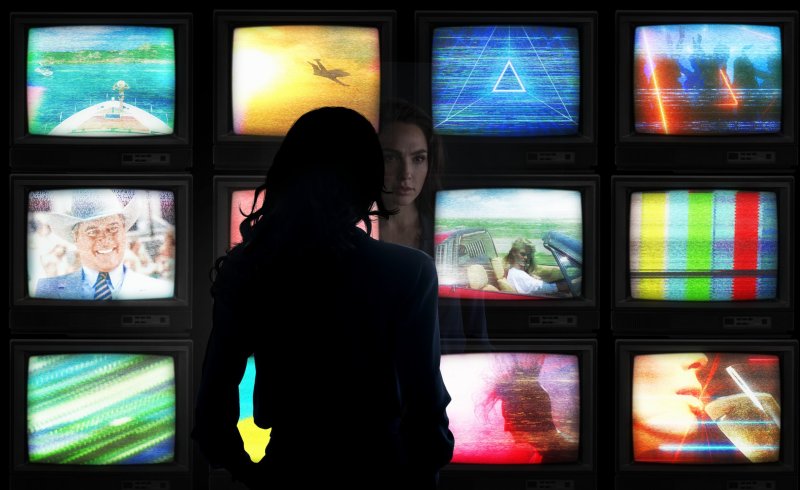
Gal Gadot as Diana in Wonder Woman 1984 Clay Enos—Warner Bros. & DC Comics

The state of superhero movies is a little more complicated. The genius of the Marvel Cinematic Universe, up until this point, has been how all the movies are connected to one another. The post-credits scene from, say, a Captain America movie, will set up Black Panther: the Black Panther post-credits scene previews the next Avengers installment, and so on. In order to get the full story, you need to watch all 23 MCU movies.

Unfortunately, that means Disney doesn’t have much flexibility when it comes to releasing the superhero movies it currently has in the can. In all likelihood, the plot of Black Widow somehow ties in to future movies like Eternals or even Disney+ MCU TV series like Falcon and the Winter Soldier. If Disney were to release any of the movies or shows out of order, it would spoil the entire story. Delays for Black Widow and The Eternals mean that Doctor Strange: Multiverse of Madness, Shang-Chi and the Legend of the Ten Rings and Spider-Man 3 will inevitably need to be pushed back as well. That delay also means we likely won’t get to see the X-Men or Fantastic Four characters—whom Marvel Studios acquired when Disney bought 20th Century Fox last year—in any MCU movie for a long time.

The other studios are a little less dependent on a strict schedule: Warner Bros. has established that Wonder Woman 1984 does not exist in the same universe as The Joker and is only tangentially related to the Harley Quinn movie that premiered earlier this year. Nor does she have anything to do with the Batman movie or the Suicide Squad reboot that are both currently filming. So Warner Bros. can release those movies whenever the studio feels they will be able to turn a profit.

What does this mean for movie theaters and the moviegoing experience?

Tenet was supposed to save the movies. It didn’t. No one movie ever could have. It’s made just $45 million domestically. This past weekend, Hocus Pocus, the Bette Midler Halloween film about witches that debuted 27 years ago, beat it at the box office.

It’s unclear when people will want to go to movie theaters again. Only 17% of Americans feel comfortable attending the movies, according to a mid-August Morning Consult poll. Some health experts have called the movie theater experience during COVID-19 “Russian roulette,” pointing out that theaters make most of their money from concession, but people necessarily have to take off their masks to eat popcorn and slurp their soda. As the weather gets colder and people spend more time indoors in general, experts say we’re likely to see another wave of the virus. If people aren’t willing to attend the movies now, it’s unlikely they’ll be eager to catch the latest flick in the dead of winter if we’re seeing a spike in COVID-19 cases.

That leaves cinemas in a precarious position, to say nothing of indies and arthouse theaters. Even once there is a vaccine, it’s unclear how long it will take theatergoers to venture out of their homes again: streaming services like Netflix threaten studios’ profits by offering alternative entertainment at home. Cinephiles fear that watching movies at home will become the norm.

What does this mean for streaming services?

One thing is certain: streaming is having a banner year. Disney+ and Apple TV+ both launched last fall, and HBO Max and Peacock joined the streaming arms’ race this year. As a result, audiences have more content than ever to choose from at home. This fall is no exception: Amazon Prime has scooped up several Oscar hopefuls, including Steve McQueen’s anthology of films titled Small Axe, Regina King’s directorial feature debut One Night in Miami. Apple TV+ will debut Sofia Coppola’s On the Rocks with Bill Murray and Rashida Jones as well as one of this year’s most raved-about animated films, Wolfwalkers. Disney+’s biggest releases will be television series, namely the second season of The Mandalorian and the MCU series WandaVision.

But all those new services are just playing catchup to Netflix. Netflix has had more time to build up a massive library, and had already filmed most of its 2020 content before the virus hit and thus had to delay few releases. In Q2 of 2020, Netflix generated $6.14 billion in revenue, up from $4.9 billion at the same time last year. And Netflix has begun to experiment with bigger-budget productions made just for the small screen. Recent hits like The Old Guard, Spenser Confidential and Enola Holmes have proven, at least according to Netflix’s own analysis, that mid- to big-budget movies can succeed on streaming. Netflix releases a buzzy new movie or show every week—if not more often. In the coming months, they’ll release the Adam Sandler comedy Hubie Halloween, Aaron Sorkin’s Oscar hopeful Trial of the Chicago 7 and David Fincher’s latest, Mank.

Streaming probably won’t supplant moviegoing. The movie date will always have a place in American culture. But the pandemic has, for now, accelerated the trend towards watching more content at home—and the timing of the movie date’s return is as uncertain as ever.

Threads
Dune
No Time to Die
Black Widow
covid

Will we have a Summer rush this year?

Feb 12, 2021 6:36am PT[URL=“https://variety.com/2021/film/news/black-widow-f9-release-dates-summer-1234905246/”]
‘Black Widow’ vs. ‘F9’: Which Summer Blockbuster Will Blink First?

By Rebecca Rubin


Courtesy of Marvel
Disney’s “Black Widow” and Universal’s “F9” are poised to kick off summer moviegoing season. Yet it’s unlikely either blockbuster will actually arrive on schedule.

While neither film has been postponed, industry experts and insiders have been speculating that Hollywood’s next round of release date delays will begin to impact the middle of 2021.

At this point, it’s almost expected that movies due out in the first half of the year will be moved yet again. With coronavirus cases rampant and the vaccine rollout going more slowly than many hoped, studios and by extension, cinema operators, are essentially in the same situation they were 10 months ago: audiences aren’t going to the movies.

Even with President Joe Biden’s recent announcement that the U.S. will be able to vaccinate 300 million people by July, it’s still too soon to tell how quickly Americans will be able to resume everyday activities.

In the interim, however, ticket sales aren’t doing much to encourage studios. With 60% of U.S. theaters closed, the top 10 movies combined have brought in between $7 million to $12 million each weekend, according to Box Office Mojo. Compounding matters, conversations around reopening theaters in major markets like New York and Los Angeles have seemingly come to a standstill, and Hollywood players have been pretty clear that they don’t intend to open a buzzy tentpole without theaters on the coasts welcoming patrons.

After MGM announced in January that “No Time to Die,” Daniel Craig’s final outing as James Bond, will no longer hit theaters in April (it’s now slated for Oct. 8), it set off a small ripple. Universal pushed the Bob Odenkirk thriller “Nobody” to April, Paramount bounced “A Quiet Place Part II” to September and Sony bumped “Ghostbusters: Afterlife and “Cinderella” to November and July, respectively. (Meanwhile Warner Bros., seemingly operating in another universe due to its hybrid HBO Max agreement, moved “Godzilla vs. Kong” up two months from May to March).

Yet the two biggest movies positioned to open in the next few months, Scarlett Johansson-led Marvel adventure “Black Widow” (set for May 7) and “Fast and Furious” sequel “F9” (set for May 28), have not wavered. And it’s not because their respective studios are optimistic that they’ll be able to open them in theaters as planned. The decision isn’t if these titles should move, it’s more likely a matter of assessing where to move them.

However, it’s an especially significant decision because postponing “Black Widow” and “F9” signals to the rest of the film industry that moviegoing may be absent another summer season.

There have been frequent rumors that “Black Widow” may keep its May release date and take a route similar to “Raya and the Last Dragon,” meaning it would premiere simultaneously in theaters and on Disney Plus for a premium price. On Disney’s quarterly earnings call on Thursday, Disney CEO Bob Chapek debunked that theory and stressed that the studio is “still intending [‘Black Widow’] to be a theatrical release.”

According to insiders, that’s partially because Marvel Studios chief Kevin Feige, the lead architect behind the meticulously constructed Marvel Cinematic Universe, was opposed to a hybrid rollout. Having produced many of the studio’s highest-grossing movies, including “Avengers: Infinity War” and “Avengers: Endgame,” Feige’s opinion certainly carries considerable weight at Disney. But that doesn’t mean the powers that be can’t eventually convince Feige to change his mind — or overrule him completely.

Sources suggest Disney has three to four weeks before having to make a decision about “Black Widow” and Universal has slightly more time for “F9” because it’s not expected to debut until three weeks after the Marvel film. “Black Widow,” in particular, represents its own set of complications because of the interconnected nature of the Marvel Cinematic Universe, which now spans both feature films meant for theatrical distribution, and limited and ongoing TV series created for Disney Plus. Bumping “Black Widow” means that “Shang-Chi and the Legend of the Ten Rings” (July 9) and “Eternals” (Nov. 5) would almost certainly be shuffled around as well. It could also throw Marvel’s carefully planned roll-out of its Disney Plus shows into disarray as well — after “The Falcon and the Winter Solider” in March, at least four other titles are set to premiere on the streamer this year.

Meanwhile, Universal plans to keep a traditional theatrical release for “F9” because “Fast & Furious” is among the studio’s most lucrative properties. Prior to the pandemic, the upcoming entry would have easily generated more than $1 billion worldwide. Under the current circumstances, getting ticket sales anywhere near that number would be a feat as unrealistic as any of the gravity-defying stunts performed in a “Fast” movie. Though Universal last year forged an agreement with major theater chains, including AMC and Cinemark, to put its movies on demand sooner than usual, even the most optimistic outcome would result in a money-losing proposition given the impaired theatrical marketplace. Too few countries have reopened movie theaters, and too few people are going in the areas where moviegoing has returned.

For now, Universal is waiting to see how the box office recovers in China, where the “Fast” movies are enormously popular. Hinging upon Asian countries, “F9” could end up opening later in summer, possibly in July or August, or down the line in 2021. There’s even a world in which it is delayed another year.

“Black Widow” and “F9” are no small propositions; they each carry nine-figure marketing campaigns on top of $200 million-plus production budgets. Christopher Nolan’s “Tenet,” which attempted to restart moviegoing last September and grossed $363 million globally, has fielded the strongest result yet for a coronavirus-era release. Months later, “Wonder Woman 1984” tapped out with a meager $154 million worldwide. If “Black Widow” and “F9” replicated those results, they would stand to lose millions upon millions.

One positive: “Black Widow” and “F9” both benefit from brand awareness, meaning the general public is already familiar with these franchises. Their respective studios don’t need to reintroduce the characters to audiences the same way they would have to with an original property. And, unlike James Bond, who has lucrative partnerships with Heineken and Audi, among others, neither “Fast” nor “Black Widow” have significant consumer product tie-ins, which makes it easier and less costly for them to pick up and move to a new date.

The eventual retreat of “Black Widow” and “F9” may have serious implications for the movie business. Several titles, including Ryan Reynolds’ sci-fi adventure “Free Guy” (May 21), Paramount’s “Infinite” starring Mark Wahlberg (May 28), Sony’s “Venom” sequel (June 25) and “Top Gun: Maverick” (July 2), remain on the calendar. But plans could be amended should “Black Widow” and “F9” wave the white flag on summer.

What’s tricky is the back half of the year has become so stacked, there’s hardly any room to slot in new titles without pushing others back. Starting in fall, blockbuster-hopefuls are scheduled nearly every single week: “A Quiet Place” (Sept. 17), “Many Saints of Newark” (Sept. 24), “Dune” (Oct. 1), “Halloween Kills” (Oct. 15), “Eternals” (Nov. 5), “Ghostbusters: Afterlife” (Nov. 11), “Mission: Impossible” (Nov. 19), “West Side Story” (Dec. 10) and “The Matrix 4” (Dec. 22).

At a closer glance, it appears that nobody told the holiday season that there’s still a pandemic raging.

threads
Fast-amp-Furious-9
Black-Widow

July 9 & Sep 3

Mar 23, 2021 11:30am PT[URL=“https://variety.com/2021/film/news/disney-postpones-black-widow-shang-chi-1234935874/”]
‘Black Widow,’ ‘Cruella’ to Debut on Disney Plus and in Theaters as Disney Shifts Dates for Seven Films

By Rebecca Rubin

Black Widow Trailer
Courtesy of Marvel
As moviegoing slowly begins to rebound in the U.S., it appears Hollywood studios aren’t yet ready to release their biggest blockbuster hopefuls on the big screen.

All that is to say Disney has massively overhauled its upcoming slate and amended release plans for “Black Widow,” Emma Stone’s “Cruella,” “Shang-Chi and the Legend of the Ten Rings,” Pixar’s “Luca” and several others.

Notably, “Black Widow” and “Cruella” will now premiere on Disney Plus at the same time they open in theaters. “Cruella” is arriving as scheduled on May 28, while “Black Widow” has been pushed back two months and will debut on July 9 instead of May 7. Both titles will be offered on Premier Access, which comes with a $30 rental fee.

“Black Widow’s” move means that Marvel’s “Shang-Chi and the Legend of the Ten Rings,” which was previously set for early July, was bumped back to Sept. 3. It’s expected to have a traditional theatrical release.

Meanwhile, Pixar’s animated coming-of-age adventure “Luca” won’t play in theaters and instead is launching exclusively on Disney Plus, at no extra cost, on June 18.

Despite the massive refocus on streaming, Disney doesn’t plan to entirely ditch theaters. Numerous smaller titles, mostly those inherited from 20th Century, have been postponed but will bow solely on the big screen, including “Free Guy” (Aug. 13), “The King’s Man”(Dec. 22), “Deep Water” (Jan. 14, 2022) and “Death on the Nile” (Feb. 11, 2022).

Kareem Daniel, the chairman of Disney Media and Entertainment distribution, says the announcement “reflects our focus on providing consumer choice and serving the evolving preferences of audiences.”

“By leveraging a flexible distribution strategy in a dynamic marketplace that is beginning to recover from the global pandemic, we will continue to employ the best options to deliver The Walt Disney Company’s unparalleled storytelling to fans and families around the world,” he said.

Earlier in the pandemic, Disney’s “Mulan” remake skipped theaters and launched on Disney Plus for a premium fee. Disney hasn’t released viewership numbers on any streaming offerings, but the company’s CEO Bob Chapek has hinted that the studio will continue to experiment with release plans as the global theatrical market remains impaired. The announcement comes days after Disney touted record (though entirely vague) viewership for the Marvel Studios TV series “Falcon and the Winter Soldier” on Disney Plus.

Among film exhibitors and some studio executives, optimism has been mounting in recent weeks as movie theaters in Los Angeles and New York City have started to reopen. However, capacity is being capped 25% (or 100 people per auditorium in L.A. and 50 per auditorium in NYC). That’s notably restricted ticket sales, making it virtually impossible for big-budgeted films to turn a profit in theaters alone. Marvel films, for one, regularly cost over $200 million to produce.

Disney has postponed much of its slate, including several Marvel titles, numerous times amid the pandemic. The studio has been able to witness firsthand how the U.S. market is recovering, as it recently released “Raya and the Last Dragon,” an animated adventure geared toward family audiences, in theaters and on Disney Plus for a premium fee. The film has made $23.4 million in the U.S. and $71 million globally, which is modest by pandemic standards. But it would be financially detrimental for “Black Widow,” “Shang-Chi” or any other tentpoles to replicated those results.

Still, Hollywood studios aren’t betting against the summer movie season entirely. Disney and rivals are hoping the general public will feel more comfortable returning to recreational activities, like going to the movies, as more and more people get the COVID-19 vaccine. To that end, Paramount has moved up the release of “A Quiet Place Part II” from September to May 28, while Universal marginally bumped “F9” from May to June 25.

“Black Widow” stars Scarlett Johansson and takes place after the events of 2016’s “Captain America: Civil War.” It was originally slated for May 2020 but was delayed three times amid the pandemic. As Black Widow, aka Natasha Romanoff, finds herself alone, she is forced to confront a dangerous conspiracy with ties to her former life as a spy, long before she became an Avenger. Cate Shortland directed the film, the 24th installment in the Marvel Cinematic Universe. Florence Pugh and David Harbour round out the cast.

“Shang-Chi and the Legend of the Ten Rings” puts the spotlight on Simu Liu as the eponymous superhero, who grapples with his past after he is drawn into the Ten Rings organization. The movie, which has also been bounced back a few times in the past year, features Awkwafina, Tony Leung, Ronny Chieng and Michelle Yeoh.

In the last 12 months, studios have made some bold moves to compensate for the near closure of indoor movie theaters. Perhaps the most notable has been the sledgehammer that was taken to the theatrical window, which is the industry term for the amount of time that new movies play exclusively in theaters. It was traditionally about 90 days, and cinema chains had long resisted studio’s attempts to shorten that timeframe.

But the pandemic has accelerated those changes, with Warner Bros. releasing its entire 2021 theatrical slate on HBO Max on the same day the films launch in theaters. Starting next year, the studio will keep its movies in theaters for 45 days ahead of putting them on home entertainment. Paramount similarly plans to keep its new releases on the big screen for 45 days before moving them to the newly relaunched Paramount Plus streaming service. Meanwhile, Universal has forged its own model that enables the studio to offer its films on premium video-on-demand platforms after 17 days in theaters. In return, theater chains are getting a cut of the digital profits.

threads
Black-Widow
Shang-Chi-and-the-Legend-of-the-Ten-Rings

Bw & prc

Jul 9, 2021 4:35pm PT
‘Black Widow’s’ China Delay Rings Alarm Bells for Hollywood

By Rebecca Davis


Jay Maidment / Courtesy of Marvel Studios
The U.S. film industry is heaving a sigh of relief that “Black Widow” is poised to become the highest grossing domestic debut of the post-pandemic era, marking America’s return to moviegoing in force.

The Scarlett Johansson-starrer is projected to earn around $80 million in its North American opening weekend, beating out “F9” last month. It will also premiere in 46 overseas markets, bringing in an expected $50 million.

China, however, isn’t on the roster.

The picture for “Black Widow” is far from rosy in the world’s largest film market, where politics are proving once again to trump profit, and piracy may destroy its box office odds before it manages to reach Chinese shores.

Although China’s censorship authorities approved “Black Widow” for release back in March, Marvel has yet to offer any indication of a release date for the key territory. (Hong Kong, meanwhile, was actually one of the first territories in the world to release it on July 7, thanks to its Asia time zone.)

A belated China release could spell trouble. Disney Plus does not operate in China. When the streaming service released the film online for a $30 fee in other territories Friday, it unleashed an easily pirated, high-definition version of the film that reached Chinese consumers within hours.

Popular on Variety
“From today on, all kinds of pirated versions of ‘Black Widow’ will begin to spread rapidly,” one film blogger wrote in resignation. “Even if it is released theatrically later, this will undoubtedly have a significant impact on the box office.”

As of Friday morning, Variety found scores of pirated videos and torrents already available on unauthorized Chinese file sharing and streaming sites, although their initial origins are unclear. On certain illegal sites powered by online gaming ads, many are available to stream for free without any registration or download procedures via a single click.

Many pirated copies are listed as 1080p HD or 4K quality, or equipped with Dolby Atmos sound. Most come already outfitted with Chinese subtitles, which are often created by groups of fast-acting volunteers or fans before the official translation is released.

On one of the major fan-generated subtitle websites, at least nine different versions of Chinese “Black Widow” subtitles were available on the front page alone. They can be downloaded separately to pair with different versions of the pirated film. The site declares that “subtitles are only used for language learning purposes; the copyright belongs to the film production.”

The same piracy issue plagued Disney’s $200 million live-action “Mulan” in China, tanking hopes that the China-set retelling of a classic Chinese folk tale with an Asian cast would become a breakout hit there. It garnered a lackluster $23 million opening weekend and $41 million cume, albeit with significant capacity restrictions on cinemas due to COVID-19.

Death Sentence for ‘Black Widow’ in China?
From a purely economic point of view, China’s delay of surefire commercial hit “Black Widow” makes little sense, particularly since its box office has been on the downswing since June, when it hit a record monthly low.

The country notched a number of box office records earlier this year off local holiday blockbuster hits, but rescheduled Hollywood tentpoles and a diminishing pool of moneymaking local productions have slowed business down. The film industry’s political obligations for July are slowing it further.

Generally, Beijing tends to program Hollywood blockbusters sparingly in the key moviegoing month of July to carve out space for local productions. This year, its resistance to scheduling foreign films has been exacerbated by the critical 100th anniversary of the ruling Communist Party’s founding on July 1. The occasion has been accompanied by an ongoing, months-long period of militant censorship across all media that will last through the end of the month and likely into fall.

With those factors in mind, local reports have long been predicting a death sentence for “Black Widow’s” China prospects.

“The possibility of a simultaneous release is approaching zero. In this special [July] tribute month, even ‘main melody’ [propagandistic] movies like ‘Chinese Doctors’ are facing strict censorship, let alone Hollywood films,” a blogger wrote pessimistically in June.

Beijing considers it politically paramount for the Party’s propaganda tribute films to reign over their competitors this month. Though the melodramatic titles were widely promoted, they have unsurprisingly not proved popular enough to drive Marvel-level ticket sales.

China’s major July titles are the political history films “1921” and “The Pioneer,” which have grossed just $58 million (RMB376 million) and $15.4 million (RMB100 million) so far, respectively, since their July 1 debut. The most commercial blockbuster of the bunch is the Bona Film-backed pandemic blockbuster “Chinese Doctors.” It had a muted $14.4 million opening Friday, taking what would have been “Black Widow’s” slot had it opened day-and-date with the U.S. and emerging a poor substitute.

Unverifiable local reports speculate the “Black Widow” may not release in China until mid-August, when there may be a sudden influx of Hollywood films that could end up cannibalizing each other’s box office.

Disney did not respond to a request for comment on the movie’s release date circumstances or piracy concerns.

Release Date Limbo
The “Black Widow” situation highlights the growing challenges Hollywood is facing in the post-pandemic era, as Beijing and Washington view each other with growing suspicion and new digital distribution models upend decades-old practices.

Increasingly, foreign films are finding themselves in release date limbo or unexpectedly pulled due to China’s ever-changing political winds and local programming priorities. (For instance, censors approved Pixar’s “Luca” in late May, but it has yet to set a debut.)

When theatrical windows of at least three months were still observed, digital or Blu-ray releases did not heavily impact a film’s China box office, since imports are only allowed to play in Chinese theaters for one to two months anyway, no matter how successful.

If Hollywood’s pandemic-era embrace of previously unthinkable modes of online distribution are here to stay, piracy will be a growing problem. It will become increasingly important for films seeking to guarantee the strongest possible China sales to release there before other territories or open simultaneously with their streaming debut.

A growing number of tentpoles with guaranteed Chinese audiences have already taken this approach, such as “Avengers: Endgame,” which gave China a two-day head start on the U.S., or “F9,” which was prompted by the pandemic to premiere an unprecedented full month ahead of domestic.

Locking in a China date has grown increasingly difficult as bureaucratic processes and priorities grow stricter and more opaque, meaning that companies may have to initiate censorship review processes even earlier.

Warner Bros.’ “Dune” may avoid a “Black Widow”-esque conundrum. Had the film debuted Oct. 1 as originally planned, it would have run into China’s highly political National Day holiday that same day, when it would have been elbowed out of a day-and-date release and put off for perhaps the next two weeks in order to give new nationalistic blockbusters time to sell.

Whether or not the decision to move it to Oct. 22 was intentionally made with the China market in mind, it bodes well.

“Maintaining good relations to secure release dates, combatting piracy, and deploying strong tactics to shore up word of mouth will be the most critical tasks for Hollywood revenue-share films going forward, particularly for films planning to release simultaneous both in theaters and online,” a well-regarded local film industry outlet said. “Otherwise, more and more revenue-share films will repeat the mistakes of ‘Mulan’ and ‘Black Widow,’ bringing down Hollywood’s China profits.”

threads
Black-Widow
Chollywood-rising

Box office collapse

Been wondering when this shoe might drop…

[URL=“https://variety.com/2021/film/news/movie-theater-owners-black-widow-disney-plus-1235022524/”]Movie Theater Owners Blame Marvel’s ‘Black Widow’ Box Office ‘Collapse’ on Disney Plus Launch

By Rebecca Rubin


Courtesy of Marvel Studios
Movie theater operators did not mince words in asserting that Disney left money on the table by putting Marvel’s “Black Widow” on Disney Plus on the same day as its theatrical debut.

Disney announced in March that “Black Widow,” among several of its 2021 films, would premiere simultaneously on the studio’s subscription-based streaming service — for a premium $30 price — and on the big screen while the struggling movie theater industry regained its footing. On July 9, “Black Widow” opened to $80 million in the U.S. and Canada, setting a COVID-era box office record. Disney padded the film’s final weekend tally by reporting the Scarlett Johansson-led comic book adventure collected an additional $60 million worldwide on Disney Plus. That pushed its global haul past $200 million.

Ten days after its domestic debut, the National Association of Theatre Owners, the industry’s main lobbying arm, released a fiery statement that takes aim at “Black Widow’s” rollout. For measure, NATO seemed to like “Black Widow,” calling it “such a well-made, well-received, highly anticipated movie.” Still, the group says the $200-million budgeted “Black Widow” underperformed at the box office and on Disney Plus.

“Despite assertions that this pandemic-era improvised release strategy was a success for Disney and the simultaneous release model, it demonstrates that an exclusive theatrical release means more revenue for all stakeholders in every cycle of the movie’s life,” the statement said.

Of course, cinema operators have a vested interest in preserving some sort of theatrical window. The pushback from NATO comes at a time when the movie business is still struggling to recover from the pandemic. Crippling efforts, film exhibitors say, is the fact that Hollywood studios are no longer putting their movies exclusively on the big screen. Prior to COVID, new releases had to play in theaters for at least 75 days before moving to premium video-on-demand. Now, that’s no longer the case. Many buzzy titles to premiere in the past 18 months, including “Wonder Woman 1984,” “Godzilla vs. Kong” and “Cruella,” were also available concurrently on various streaming services. The two highest-grossing movies of the year, “A Quiet Place Part II” and “F9,” were initially only available to watch at multiplexes.

Hollywood studios and movie theater operators have a historically contentious relationship, with the pandemic shifting the power overwhelmingly in favor of film distributors. Yes, studios need movie theaters to generate profits on mega-budgeted tentpoles, but COVID proved that without compelling content to show on the big screen, movie theaters don’t have as much to offer. The hot-and-cold factions recently got in a public spat when several theater chains, including AMC and Regal, threatened to boycott Universal’s movies after the studio flirted with the idea of day-and-date releases. They finally set aside that particular feud in the name of money. Theater owners were similarly miffed when Warner Bros. announced its entire 2021 film slate would premiere on HBO Max and in theaters on the same day.

Without a hybrid release, NATO predicts that “Black Widow” would have secured a much larger opening weekend, somewhere north of $92 to $100 million. And while the film soared past the opening weekends of recent releases like “A Quiet Place 2” and “F9,” its ticket sales quickly dropped off. In its sop****re outing, “Black Widow” collected $26 million, a huge 69% decline. Or, as NATO put it, a “stunning second weekend collapse in theatrical revenues.”

Disney declined to comment. However, insiders say the company is attempting to reach customers at every comfort level while the world emerges from COVID. It’s also worth noting the pandemic hasn’t entirely abated, and even vaccinated people have expressed hesitations about returning to the movies. Adding to anxieties, the highly contagious Delta variant has driven a spike in infections and forced Los Angeles, the largest moviegoing market in the country, to reinstate its mask mandate. Despite actor Vin Diesel’s loud proclamation, cinema isn’t entirely back just yet.

In the case of “Black Widow,” NATO claims its financial upside isn’t as robust as some initially perceived. When it comes to box office grosses, studios have to split the profits 50-50 with movie theater owners. (Disney tends to get a more favorable split due to its box office dominance.) It gets an even larger chunk of change from digital transactions. However, NATO highlights, the studio doesn’t get to keep all of the money from online rentals. Approximately 15% of revenue goes to the various platforms, like Roku and Apple TV, through which consumers can access Disney Plus. Per NATO, early analysis of the film also failed to consider that its release on Disney Plus cuts into downstream revenues.

“It ignores that Premier Access revenue is not new-found money, but was pulled forward from a more traditional PVOD window, which is no longer an option,” the statement reads. “Combined with the lost theatrical revenue and forgone traditional PVOD revenue, the answer to these questions will show that simultaneous release costs Disney money in revenue per viewer over the life of the film.”

NATO adds, “Piracy no doubt further affected Black Widow’s performance, and will affect its future performance in international markets where it has yet to open.” According to the website TorrentFreak, “Black Widow” was the most pirated movie of the week. All the while, Disney Plus subscribers have the ability to share their password with other households, potentially limiting the number of individual transactions. NATO says Disney isn’t alone in these particular threats. It was also the case for other day-and-date releases, such as “Godzilla vs. Kong” and “Mortal Kombat,” two Warner Bros. titles that premiered on HBO Max. “How much money did everyone lose to simultaneous release piracy?” NATO asks. It’s one of many pressing inquiries that may remain unanswered.

“The many questions raised by Disney’s limited release of streaming data opening weekend are being rapidly answered by ‘Black Widow’s’ disappointing and anomalous performance,” NATO said. “The most important answer is that simultaneous release is a pandemic-era artifact that should be left to history with the pandemic itself.”

Didn’t see that one coming…

Last nail in the coffin for ScarJo as Natasha?

Scarlett Johansson Sues Disney Over Black Widow
Black Widow star Scarlett Johansson has sued Marvel parent company Disney for breach of contract regarding the film’s streaming release.

By Alec Bojalad
|
July 29, 2021
|

Photo: Marvel
And just like that the blockbuster streaming era got a lot more complicated.

Black Widow star and longtime Marvel Cinematic Universe actress Scarlett Johansson filed a lawsuit against Disney on Thursday in Los Angeles Superior Court. The claim alleges that her contract was breached when Disney released Black Widow on Disney+ in addition to its theatrical release.

According to Johansson’s representation, her contract guaranteed an exclusive theatrical release for Black Widow, which would be advantageous to the star given that she was set to receive a certain percentage of the film’s theatrical gross. The suit argues that by making the film available on Disney+, Disney was cutting her out of that opportunity.

“Disney intentionally induced Marvel’s breach of the agreement, without justification, in order to prevent Ms. Johansson from realizing the full benefit of her bargain with Marvel,” the suit reads, in part.

Black Widow is the first Marvel film to receive a simultaneous streaming and theatrical release. The Natasha Romanoff-centered movie was first slated for a May 1, 2020 debut before being delayed to July 9, 2021 due to the coronavirus pandemic. The film’s availability in two different mediums combined with lingering COVID-19 concerns in North America did seem to have an appreciable effect on its box office performance.

While Black Widow opened to a pandemic era record $80 million during its first weekend of release, it quickly sank in its second, dropping a staggering 70%. As of now, it appears to be in line to match the grosses of early Marvel films like Captain America: The First Avenger and Thor rather than the studio’s more recent hits like Spider-Man: Far From Home.

As far as streaming numbers go, most data is provided by the streamer or studios themselves and should therefore be taken with a grain of salt. But per Disney, the film earned around $60 million in Disney+ “Premier Access” purchases. If Johansson’s contract didn’t factor in streaming income, then that is indeed a big chunk of money to miss out on. In fact, a source close to Johansson reportedly told the Wall Street Journal that Disney’s decision to launch the film on streaming cost Johansson more than $50 million. The complaint indicates that Johansson’s representatives reached out to Disney to amend the contract after learning of the dual release strategy, but received no response.

This lawsuit is the first bit of major litigation to arise from studio’s dipping their toes into the streaming waters but it almost certainly won’t be the last. The pandemic hastened a move to dual releases on streaming that was likely on its way anyway. Some studios, however, seem a bit better prepared than others. When WarnerMedia (at the time owned by AT&T, now on its way to combining with Discovery, Inc.) announced its intentions to release Warner Bros. entire 2021 slate of movies on streaming service HBO Max, they re-negotiated deals with its actors to cut them in on the new stream of income. Ultimately, WarnerMedia paid more than $200 million to talent as part of the new deals. While Disney didn’t endeavor to do the same is anyone’s guess.

Currently Disney does not have plans to release future Marvel Phase 4 films on Disney+ at the same time as theatrical. September 3’s Shang-Chi and the Legend of the Ten Rings is slated for 45-day exclusive theatrical access. By the time Eternals rolls around on November 5, however, the Marvel Studios may have to face the decision to launch on Disney+ again if infection rates continue to rise.

As for Scarlett Johansson’s relationship with the MCU – this is likely the bitter conclusion to it. The actress has been a major part of Marvel’s Avengers team since Iron Man 2 in 2010. Though Natasha Romanoff died in 2019’s Avengers: Endgame, the character was able to return just two films later as part of a prequel. The events of Disney+ series Loki also introduced the multiversal possibilities of Marvel character variants, so no actor is ever truly ruled out for a future film. Until now probably…depending on how the Mouse Empire feels about being sued.

Written by

Alec Bojalad | @alecbojalad

TV Editor at Den of Geek and Television Critics Association member. Based in Cleveland, Ohio. Very upset about various sporting events.

The MCU rules

Sep 25, 2021 8:32am PT[URL=“https://variety.com/2021/film/box-office/shang-chi-box-office-black-widow-highest-grossing-film-2021-1235074112/”]
Box Office: ‘Shang-Chi’ Surpasses ‘Black Widow’ as Highest-Grossing Film of 2021
New release ‘Dear Evan Hansen’ is expected to take the No. 2 spot with $7.3 million.

By Ellise Shafer

Courtesy of Marvel Studios
It’s official: “Shang-Chi and the Legend of the Ten Rings” has surpassed fellow Marvel film “Black Widow” as the highest-grossing film of 2021 — and the pandemic — at the domestic box office.

On Friday, the superhero adventure starring Simu Liu captured $3.59 million from 3,952 theaters, which was enough to push it past “Black Widow” with a total gross of $186.7 million. “Black Widow,” which premiered in July, has earned roughly $183.5 million in theaters since its release. It has earned at least $125 million more on Disney Plus.

“Shang-Chi” breaking this record is a significant landmark for the movie theater business, as it was released solely in theaters with 45 days of exclusivity — as opposed to “Black Widow” and many other new releases, which have opted for a hybrid model.

This weekend, “Shang-Chi” is poised to top the domestic box office charts for the fourth weekend straight, adding an expected $12 million to $14 million to its haul. The film should end the weekend just shy of the $200 million mark.

New release “Dear Evan Hansen” is expected to come in second place with a subdued $7.3 million from 3,364 theaters. The Universal Pictures movie musical, starring Ben Platt as an isolated teenage boy who struggles to belong in the age of social media, took in $3.2 million on Friday.

Ryan Reynolds’ box office hit “Free Guy” is set to move down a spot to No. 3, but is still holding on with a three-day estimate of $4 million from 3,175 theaters. Meanwhile, slasher film “Candyman” and Clint Eastwood’s newest movie “Cry Macho” are poised to round out the box office chart in fourth and fifth place, respectively. “Candyman” should earn another $2.4 million this weekend for a cume of $56.79 million, and “Cry Macho” is expected to add $2 million for a total gross of $8.2 million.

threads
Shang-Chi-and-the-Legend-of-the-Ten-Rings
Black-Widow

ScarJo wins

See the post above.

Disney & Scarlett Johansson Resolve Bitter ‘Black Widow’ Profits Lawsuit; Big $$$ Win For Oscar Nominee
Dominic Patten 3 days ago

UPDATED with more details: Just days after the first court hearing in Scarlett Johansson’s Black Widow profits mega-bite lawsuit on Disney was pushed back to March 2022, the Oscar nominee and the House of Mouse have made peace — and it was pricey for the latter.

“I am happy to have resolved our differences with Disney,” said Johansson in a statement released Thursday. “I’m incredibly proud of the work we’ve done together over the years and have greatly enjoyed my creative relationship with the team. I look forward to continuing our collaboration in years to come.”

More from Deadline
Hero Nation Podcast: ‘Venom: Let There Be Carnage’ Director Andy Serkis On Extending To MCU, Another Sequel & Ian Dury
Disney Studios Basketball Feature ‘Chang Can Dunk’ Adds Chase Liefeld
Second Disney Exec Lands At Airbnb; Imagineering’s Bruce Vaughn To Lead Hosting Giant’s “Experiential” Team
Unlike in their vitriolic filings and their shaming PR statements over the past few, Marvel-owner Disney had nothing but love today for the actor who brought Natasha Romanoff to life for them in nearly 10 separate films.

I’m very pleased that we have been able to come to a mutual agreement with Scarlett Johansson regarding Black Widow, said Alan Bergman, Chairman, Disney Studios Content. “We appreciate her contributions to the Marvel Cinematic Universe and look forward to working together on a number of upcoming projects, including Disney’s Tower of Terror,” the exec added without any comment from Disney CEO Bob Chapek, as one would have expected.

As is almost always the case in cases like this, neither side gave any indication of how much money was involved in the settlement. However, when all is said and done, the deal will run to more than $40 million, sources tell me. Accordingly, the funds will not be paid by Disney in a single lump sum, if you pick up the creative accounting I’m putting down.

In case you forgot, Black Widow came out in cinemas across a Delta variant suffering America and on Disney+ for a premium fee on July 9

With the Covid-19 pandemic, a shift to hybrid releases and the sentimentality free economics of back-end payouts at the heart of Johansson’s July 29 filed suit, the actor declared that she was promised “a release that is exclusive to movie theatres” on the much-delayed Cate Shortland-directed film and Disney broke its word.

Then things got real messy.

Disney incurred the wrath of many, including Johansson’s CAA main man Bryan Lourd, for not only telling the world that the actor got paid $20 million upfront for the film, but also tried to make their longtime collaborator look out and out cruel for standing up for herself. “The lawsuit is especially sad and distressing in its callous disregard for the horrific and prolonged global effects of the Covid-19 pandemic,” said a Disney spokesperson hours after Johansson’s suit became public.

Then, as the toxic PR blast radius continued to spread, late on August 20, Disney’s outside counsel Daniel Petrocelli, Leah Godesky and Tim Heafner of O’Melveny & Myers LLP put the company’ response in the Los Angeles Superior Court docket.

Seeking to enforce the “confidential, binding arbitration” aspects of Black Widow star and executive producer Johansson’s contract, the trio doubled down on the actor and her shingle. “In a futile effort to evade this unavoidable result (and generate publicity through a public filing), Periwinkle excluded Marvel as a party to this lawsuit––substituting instead its parent company Disney under contract-interference theories,” they said of the mega-star plaintiff. “But longstanding principles do not permit such gamesmanship.”

Notwithstanding the hyperboles, the fact is Disney likely would have prevailed in getting the whole thing moved behind closed doors.

In their August 20 throwback, they also contest that there was any cinema only clause in the contract and that Johansson had lost out of any cash because fans decided to watch the flick at home as opposed to the multiplex. “As of August 15, 2021, the Picture has grossed more than $367 million in worldwide box-office receipts and more than $125 million in streaming and download retail receipts,” Disney’s sharp elbowed filing of August 20 noted.

Yet, also, with terms like “misogynistic attack” fired off by the actor’s lawyer main lawyer John Berlinski back at Disney and the revealing of Johansson’s Black Widow pay check by Disney in the days and hours following the filing of the explosive suit, both sides were clearly looking for a solution ASAP – especially as the Bob Chapek-led media giant faced the prospect of extensive discovery in the legal face-off.

Amidst the claims of Tinseltown wags that there was a black cloud between the current CEO and his predecessor Bob Iger, as well as Marvel chief Kevin Feige, about how the Johansson matter was being so roughly handled in and out of the public eye, Chapek made a point of addressing the spider in the room on an August 12 earnings call.

“Bob Iger and I, along with the distribution team, determined this was the right strategy to enable us to reach the broadest possible audience,” the new-ish CEO said, aware that both he and Iger’s financial windfall from the success of Disney+ was a big part of the initial Johansson lawsuit. Talking tough for the tough Wall Street crowd listening in, Chapek added: “Disney will always do “what we believe is in the best interest of the film and the best interest of our constituents.”

Of course, as never one to withstand a less than sunny public face, Disney also moved fast to lock up other potential blow-outs with the likes of Cruella star Emma Stone. On August 13, it was announced Disney had struck a seemingly lucrative deal with the WME-repped Oscar winner to star in a sequel to the May 26 hybrid released movie.

Which is, without a sequel, what Disney had essentially done now with Scarlett Johansson – the Black Widow who took on Goliath and won. A scent of where this was all going to end wafted by on September 21 when Chapek spoke to Goldman Sachs’ 30th annual Communacopia Conference

“Right now we have this sort of middle position, where we’re trying to do right by the talent, I think the talent is trying to do right by us, and we’re just figuring out our way to bridge the gap,” the exec said of figuring out how to avoid dust-ups like the legal one with Johansson. “Ultimately we believe our talent is our most important asset, and we’ll continue to believe that, and as we always have, we’ll compensate them fairly per the terms of the contract that they agreed to us with.”

But you also don’t want your marquee assets to depreciate either, on or off screen.

For those who like to keep score, this is the another win for Kasowitz Benson Torres LLP’s Berlinski and his co-lead counsel Daniel Saunders over Petrocelli is just over as many years.

Back in 2019, the two attorneys were pitted against each other in the four year battle by Bones executive producers and stars Emily Deschanel and David Boreanaz to get Fox and then Disney, after the then Iger-run company gobbled up most of the Murdoch’s Hollywood holdings, to come clean on some serious profit participation trickery. There were a lot of hard words back then and some slippery shifts by arbitrator and a judge, who rejected a ruling awarding $128 million in punitive damages to the plaintiffs. In the end, Berlinski and Saunders, along with a team from Kinsella Weitzman Iser Kump & Aldisert, made the Bones EPs and actors some serious bones with a big pay-off and a dismissal of the case on September 11, 2019.

It should also be noted that Black Widow for a time was the highest grossing movie of the pandemic at the domestic box office with $183.6M. The film was recently pushed to second by Disney/Marvel’s Shang-Chi and the Legend of the Ten Rings which has now grossed over $200M.

Worldwide Black Widow has made $378.8M.

It’s believed by many in the industry that the film could have made more on a theatrical window instead of going day and date on Disney+ Premier where the streamers subscribers had to fork over $29.99 to watch the film. The movie saw one of the biggest drops for a Disney Marvel movie in its second weekend of -68%. The only extent that Disney reported in regards to how much Black Widow made on Disney+ Premier was $60M WW in the movie’s first weekend. No other updated details were provided by the studio, through Samba TV clocked 2M U.S. households that had tuned into the film over its first 10 days. Also eating into Black Widow’s theatrical day-and-date plan, and stealing money away from Disney was piracy: Industry sources tells us that Black Widow was illegally streamed over 20M times.

Anthony D’Alessandro contributed to this report.