Birth of the Dragon

TIFF Pre-Buys

Toronto 2016: Pre-Buys Prized As Festival Gets Underway
by Mike Fleming Jr
September 8, 2016 11:08am


Groundswell Productions

The fact that the first major deal at the 2016 Toronto Film Festival is for a film that isn’t here — Focus Features won the untitled ’50s London fashion industry drama that Paul Thomas Anderson will direct with Daniel Day-Lewis — underscores how profoundly the independent theatrical acquisitions has turned toward pre-buys of film packages. Toronto has always been viewed as a terrific place for distributors to launch Oscar-season films, and to supplement their slates with acquisitions of finished films. Deals were sluggish last Toronto: STX made the splashiest deal for Hardcore Henry, Bleecker Street got the top earner in Eye In The Sky and Michael Moore’s docu Where To Invade Next was done in by his insistence on bypassing Netflix for a theatrical release and then being walloped by pneumonia and unable to promote it.

I am getting the impression that buyers are ready to be wowed, and that there will be several large deals either during the festival or right after. If I had any advice, it would be for buyers to consider extending their return trip if it means missing Birth Of The Dragon, which won’t be screened until 3 PM Tuesday at the Ryerson, and probably won’t last until subsequent screenings are set for L.A. I saw the picture, part fact and part fable about a legendary brawl that Bruce Lee fought against Shaolin master Wong Jack Man. The George Nolfi-directed film from Groundswell is a throwback to the spirit of Lee’s ’70s martial arts hits and has real breakout mainstream potential even if the most recognizable stars are the characters of Lee and Steve McQueen.


Pablo Larrain

There will also likely be a quick deal for the Pablo Larrain-directed Jackie, the drama that stars Natalie Portman as Jackie Kennedy as she secures her husband’s legacy in the week following his assassination. The picture got exquisite reviews in its debut at the Venice Film Festival and offers are coming in. Buyers have been primed for the picture since Cannes when promo footage was shown, even though they didn’t bite back then.

That pre-buy restraint is changing. There are plenty of finished films here that are high on buyer lists, but don’t be surprised if some of the biggest sales come in unexpected places. All of the major agents — who preface festival conversations by counting all the pictures launching here that they packaged in pre-buy deals — tell me they’ve got a few plum projects in their pockets. Strong sales candidates not on the Toronto slate include The Leisure Seeker, the Paolo Virzi-directed romp that stars Helen Mirren and Donald Sutherland as a couple that takes an adventure in a Winnebago. Another is We Do Not Forget, the Zach Helm-directed drama that stars Daniel Radcliffe and Zachary Quinto in a fictionalized showdown between hacker activists and a ruthless Mexican drug cartel. Other promos buyers will see include the Danny Strong-directed JD Salinger drama Rebel In The Rye with Nicholas Hoult, Kevin Spacey and Laura Dern starring. Others I’m hearing rumors of include the Fernando Trueba-directed The Queen Of Spain with Penelope Cruz.


Rex/Shutterstock/Associated Press

Other possible surprises could include packages like I, Tonya, the drama that will have Margot Robbie playing disgraced Olympic figure skater Tonya Harding, with Craig Gillespie directing. That picture is looking like a real thing with financier Len Blavatnik circling, with shooting likely to start early next year. There are plenty more where that one came from.

Some reports have painted a picture of caution caused by the hardships facing the record-setting Sundance film The Birth of A Nation following Deadline’s revelation of a 17-year-old rape charge against filmmaker-star Nate Parker (he was acquitted). Buyers and agents don’t expect it to be a factor as they look for slate-filling films. The glare on Parker because of the circumstances of the incident and the subsequent suicide of the woman 12 years later certainly tarnishes the charmed Oscar track the picture was on, but it is a total anomaly. Distributors need quality product and seem willing to pay for it, as evidenced by the way Focus stepped up on the PTA-Day-Lewis film which constitutes roughly twice the financial outlay of Parker’s Sundance film.

The other area worth watching is Midnight Madness, where some of the most profitable genre titles are hatched. Sony Pictures Worldwide Acquisitions president Steven Bersch reminds that finding those frightful gems isn’t easy. Bersch is riding high on the genre thriller Don’t Breathe, but the title of his Toronto experience ought to be Don’t Sleep.

“I remember when we bought Insidious,” he said. “It was my second or third Toronto, so I still had the energy, but this was my fifth midnight movie in a row, on a Tuesday night. The reason we got it is, everybody sent junior executives, but I dragged myself there. While everybody was sleeping, we were making a deal, with FilmDistrict doing domestic, and we closed at 6:10 in the morning. Everybody woke up hearing it was pretty good, but by then it was gone. We just announced Insidious 4, so it was worth it, but it isn’t easy.”

continued next post

Continued from previous post

Here are the titles that buyers and sellers are most high on:

BIRTH OF THE DRAGON Director: George Nolfi. Cast: Billy Magnussen, Xia Yu, Philip Ng. Set against the backdrop of San Franciscos Chinatown in 1964, this cross-cultural biopic chronicles Bruce Lees emergence as a martial arts superstar after his legendary secret showdown with Shaolin master Wong Jack Man. Details of the fight staged in front of a handful of witnesses are still disputed, but it launched Lees star and cemented his legacy as the man who brought kung fu to the world.
1st Screening: Tuesday, September 13, 3 PM Ryerson Theatre


TIFF

COLOSSAL Director: Nacho Vigalondo. Cast: Anne Hathaway, Jason Sudeikis, Dan Stevens, Austin Stowell, Tim Blake Nelson. An aimless party girl discovers a mysterious connection between herself and a giant monster wreaking havoc on the other side of the globe.
1st Screening: Friday, September 9, 9 PM Ryerson Theatre

JACKIE Director: Pablo Larraín. Cast: Natalie Portman, Peter Sarsgaard, Greta Gerwig, Billy Crudup, John Hurt. After JFK is murdered, First Lady Jacqueline Kennedy fights through grief and trauma to regain her faith, console her children, and define her husbands historic legacy.
1st Screening: Sunday, September 11th, 8:30 PM- Winter Garden Theatre

MAUDIE Director: Aisling Walsh. Cast: Sally Hawkins, Ethan Hawke. Fact-based tale of Maude Lewis, who overcame the physical challenge of juvenile rheumatoid arthritis to become one of Canadas premier folk artists.
1st Screening: Monday, September 12, 5:30 PM Visa Screening Room (Elgin)

MESSAGE FROM THE KING Director: Fabrice Du Welz. Cast: Chadwick Boseman, Teresa Palmer, Luke Evans, Alfred Molina. Mysterious traveler from South Africa combs the Los Angeles underworld for those responsible for the death of his sister.
1st Screening: Thursday, September 8, 6 PM Visa Screening Room (Elgin)

BRIMSTONE Director: Martin Koolhoven. Cast: Dakota Fanning, Guy Pearce, Kit Harington. A woman running from her past meets a zealot preacher and an outlaw along the way.

PARIS CAN WAIT Director: Eleanor Coppola. Cast: Diane Lane, Arnaud Viard, Alec Baldwin. An American woman in a tired marriage finds herself on an unforeseen road trip from Cannes to Paris with a dashing Frenchman. A seven-hour drive unexpectedly becomes a whirlwind two-day road trip.
1st Screening: Monday, September 12, 1:45 PM Winter Garden Theatre
Second Screening: Tuesday, September 13, 9:45 AM Scotiabank 4


TIFF

THE PROMISE Director: Terry George. Cast: Oscar Isaac, Charlotte Le Bon, Christian Bale. Armenian medical student, an artist and an American journalist form a love triangle amid the genocide of Armenia perpetrated by Turkey during WWI.
1st Screening: Sunday, September 11, 9:30 PM Roy Thomson Hall

THEIR FINEST Director: Lone Scherfig. Cast: Gemma Arterton, Sam Claflin, Bill Nighy, Jack Huston. Period comedy-drama follows a group of filmmakers struggling to make an inspirational film to boost morale and inspire America to join the war during the London Blitz in World War II.
1st Screening: Sunday, September 11, 3:30 PM Roy Thomson Hall

WAKEFIELD Director: Robin Swicord. Cast: Bryan Cranston, Jennifer Garner. A successful lawyer and family man disappears from his own life and observes his baffled loved ones from a hiding place in the attic.
1st Screening: Friday, September 9, 9 AM Scotiabank 4

ALL I SEE IS YOU Director: Marc Forster. Cast: Blake Lively, Jason Clarke. Return to Monsters Ball form for Forster. After a blind woman regains her sight, she and her husband begin discovering uncomfortable details about their marriage and their lives.
1st Screening: Saturday, September 10, 11 AM Scotiabank 2

CHASING TRANE: THE JOHN COLTRANE DOCUMENTARY
Director: John Scheinfeld.
1st Screening: Friday, September 9, 12:30pm Tiff Bell Lightbox, Cinema 2

BARRY Director: Vikram Ghandi. Cast: Devon Terrell, Anya Taylor-Joy, Ellar Coltrane. Set in the backdrop of a true story in 1981 New York City, young Barack Obama tries to find his way as a college student in a new city as he is faced with questions about race, culture, and identity in this inspiring drama centered on a crucial year in the future Presidents life.
1st Screening: Saturday, September 10, 6 PM Ryerson Theatre

CARRIE PILBY Director: Susan Johnson. Cast: Bel Powley, Nathan Lane, Gabriel Byrne, Vanessa Bayer, Jason Ritter. A brilliant young woman graduates Harvard at 18 but has no street sense and struggles in areas of morality, relationships, sex and leaving her New York City apartment.
1st Screening: Friday, September 9, 2 PM Ryerson Theatre

CATFIGHTDirector: Onur Tukel. Cast: Sandra Oh, Anne Heche, Alicia Silverstone, Craig Bierko, Dylan Baker. A reunion between two old school friends sparks a no-holds-barred war of attrition
1st Screening: Friday, September 9, 6:15 PM Ryerson Theatre

GOON: THE LAST OF THE ENFORCERS Director: Jay Baruchel. Cast: Seann William Scott, Liev Schreiber. The original hockey brawler pic was a gem. Why not a sequel with Doug The Thug Glatt?
1st Screening: Sunday, September 11, 3 PM, Location TBD

THE HEADHUNTERS CALLING Director: Mark Williams. Cast: Gerard Butler, Alison Brie, Willem Dafoe, Gretchen Mol, Alfred Molina. Ruthless corporate headhunter in Chicago battles his rival for control of their job-placement firm, until a family tragedy brings his personal and professional lives into conflict.
1st Screening: Tuesday, September 13, 2:15 PM Scotiabank 3

THE BLEEDER Director: Philippe Falardeau. Cast: Liev Schreiber, Naomi Watts, Elisabeth Moss, Jim Gaffigan, Ron Perlman. Story of the rise, fall and rise of Chuck Wepner, who decked Muhammad Ali and was an inspiration for Rocky.

Distribution will come down to this.

And there’s more

It’s all about T.I.F.F. now for this project.

Toronto: Bruce Lee Pic Birth of the Dragon Eyes Global Theaters

James Rainey
Senior Film Reporter
@RaineyTime


COURTESY OF TIFF

SEPTEMBER 8, 2016 | 10:22PM PT
Birth of the Dragon a story about Bruce Lees emergence as a martial arts superstar and his epic showdown with another Kung Fu master has its world premiere Tuesday afternoon in Toronto. Producer Michael London (Trumbo) and director George Nolfi (The Adjustment Bureau) talked to Variety about the enduring popularity of Lee and the reasons they believe their film, featuring a cast laden with Chinese stars, could become a cross-cultural phenomenon.

Bruce Lee died in 1973 at the age of 32. Why will audiences in 2016 respond to a character from the last century?

London: Bruce Lee is this iconic figure who represents a sort of meeting of East and West. We are at this really extraordinary moment in history right now, with China opening up to the West and the West becoming fascinated with China. Bruce Lees myth endures and it feels like the world will be really open to learning about how he became the mythic figure that he did.

How did you know that passion for Lee remained high?

Nolfi: There is not a single place in China, or the U.S., or Canada or the rest of the world that people dont know his name or have an enormous affection for him and for his story. He did something that was thought impossible in the early 1960s to be an Asian man who became this major star in the West. And I would say that he remains the most famous martial artist of all time and, at the same time, the most famous Asian person in the West.

The film centers on a fight between Lee and Wong Jack Man, which occurred in the mid-1960s in the San Francisco Bay Area. Why is this fight, held before just a handful of witnesses, so legendary to kung fu aficionados?

Nolfi: Its a fight that is still disputed, as to how and why it happened and even as to the outcome. It was because of this fight that Bruce Lee reinvented his style and arguably invented the whole concept of mixed martial arts. So the reaction of anyone who knows martial arts is strong and instantaneous. And even many people who are less familiar know that Bruce Lee brought martial arts and kung fu to the West.

Images of Bruce Lee still appear on T-shirts and posters around the world. With such an indelible impression, it must have been hard to cast the role.

Nolfi: Probably my single biggest fear in taking on job of directing this film was, How the hell am I going to find somebody with incredible charisma, great martial arts ability, the pure physicality of Bruce Lee and someone who is also fluent enough in English to be able to be funny and compelling. After months of searching, it became clear that [Hong Kong born, Chicago-raised] Philip Ng was unquestionably our guy. He stepped up to the plate in a way that went beyond anything I imagined. I think Bruce Lee fans will look at this film and say Oh my gosh, that must be what Bruce Lee was like when he was 24.

Hoping for a bump in monk robe sales. :wink:

Poster reveal

Birth of the Dragon Poster Reveals Legendary Bruce Lee
BYBRIAN GALLAGHER | 2 days ago

The Toronto International Film Festival is currently in full swing, and one of the films making its world premiere next week is director George Nolfi’s Birth of the Dragon, which centers on martial arts legend Bruce Lee. The film will have its premiere on September 13, but while we wait for this first ever screening, the first poster has surfaced, featuring Philip Ng as Bruce Lee. While there have been Bruce Lee biopics in the past, this film focuses on a little-known fight that helped him become a world-renowned legend.

Set against the backdrop of San Francisco’s Chinatown, this cross-cultural film chronicles {Bruce Lee’s emergence as a martial-arts superstar after his legendary secret showdown with fellow martial artist Wong Jack Man, a Shaolin master who had been sent from China to stop Bruce Lee. The film is based on the real-life no holds barred fight took place 1965, a time when San Francisco’s Chinatown district was controlled by the Chinese Triad gangs. The script will begin with this martial arts battle, then follow both men as they team up to take on a horde of gangsters. The poster debuted on Deadline ahead of the Toronto world premiere.

Christopher Wilkinson and Stephen J. Rivele wrote the script, continuing their tradition as biopic specialists. They have previously written the scripts for Nixon, Ali, Copying Beethoven, Pawn Sacrifice and this year’s Miles Ahead. They are also writing the upcoming remake of A Star Is Born, which Bradley Cooper will direct and star in alongside Lady Gaga, and an upcoming Freddie Mercury Biopic.

Bill Block is producing for QED International, alongside Groundswell’s Michael London and writers Christopher Wilkinson and Stephen J. Rivele. George Nolfi directs, marking the follow-up to his 2011 directorial debut, The Adjustment Bureau, starring Matt Damon and Emily Blunt. George Nolfi has also written screenplays for The Bourne Ultimatum, Ocean’s Twelve, Timeline, The Sentinel and the upcoming Spectral.

The supporting cast includes Billy Magnussen, Terry Chen, Ron Yuan, Vanessa Ross, Darren E. Scott, Darryl Quon and Yu Xia as Wong Jack Man. Birth of the Dragon doesn’t have a distributor yet, but that could change after Birth of the Dragon has its world premiere in Toronto. Take a look at the first poster for Birth of the Dragon below.

Premieres tomorrow. :cool:

Variety review

A poor review. We’ll probably see who picks this up soon.

Toronto Film Review: ‘Birth of the Dragon’
Owen Gleiberman
Chief Film Critic
@OwenGleiberman


COURTESY OF TIFF
SEPTEMBER 13, 2016 | 09:41PM PT
A Bruce Lee biopic re-enacts a legendary fight Lee had in 1964, before he was a martial-arts superstar. But why did it matter?

Was Bruce Lee actually a good fighter? The question sounds insane, because no one in the history of martial-arts cinema has ever been half as mesmerizing to watch. Plenty of martial-arts stars have speed, but Lee wasn’t just faster than any of then; he had the demonic charisma of speed, a ferocity that charged every jagged movement with expression. His limbs were jackknives on lightning, and his quivering, coal-eyed glower told you how committed he was to every cut and thrust. At the same time, right in the middle of a scene, a part of him hung back and observed it all. That’s why he was the rock star of kung fu, at once in the moment and soaring above it.

But, of course, every time we saw Bruce Lee fighting, he wasn’t really fighting; he was acting. How were his skills in genuine hand-to-hand bloodsport combat? The question is raised — even if it’s not truly answered — in “Birth of the Dragon,” a Bruce Lee biopic set in 1964, two years before “The Green Hornet,” when Lee was an expatriate martial-arts instructor in San Francisco already trying to market himself as a star. (He was born in San Francisco but raised in Hong Kong.) That year, he had a duel — not a fight for show but a real knockdown, no-holds-barred knuckle-bender. His foe was Wong Jack Man, a Chinese master who showed up to challenge Lee. Lee, at that point, was a strict practitioner of the Wing Chun school, but after the bout in question he began to change his method and philosophy of fighting. According to the opening title of “Birth of the Dragon,” this single clash would alter the entire history of martial arts.

That sounds momentous, yet “Birth of the Dragon” is a strange film: It huffs and puffs about what a mythic fight this was, yet it bumbles and stumbles when it comes to showing us what happened, and why it mattered. The director, George Nolfi (a co-screenwriter of “The Bourne Ultimatum” and “Ocean’s Twelve”), treats Lee as a coolly stylized character, a kind of laidback Elvis-in-Chinatown version of the invincible warrior he played on TV and in the movies. But, of course, Bruce Lee wasn’t that character — he was actually a real person! — and “Birth of the Dragon,” which merges a fudged version of the facts with lazy whirling iconography, is neither a compelling biographical drama nor an exciting martial-arts bash. It slips right between the cracks of what a good Bruce Lee biopic should be.

You might assume that the film’s central character would be, you know, Bruce Lee. But you’d be wrong. It’s Steve McKee (Billy Magnussen), a rube from Indiana who travels to San Francisco, tries the Beat scene and the free-love hippie scene (really? In 1964?), and then winds up passing out, drunk, in front of the studio where Lee presides over his martial-arts classes. Lee takes him in and signs him up, and the two become friendly. It’s Steve who makes himself into the liaison between Lee and Wong Jack Man (Xia Yu), a disgraced monk from a Shaolin monastery who shows up in a fedora and fuddy-duddy suit and lands a job in Chinatown washing dishes, which is supposed to be his Buddhist penance for a mysterious sin that he doesn’t reveal until much later.

What Wong is quite open about, on the other hand, is his hostility to the fact that Lee’s students include Caucasians. And that’s a potentially fascinating conflict. When Lee became a superstar, he kicked off an international kung fu craze that had a seismic impact. From that moment on, the Chinese no longer owned this discipline, and the notion that they might have been possessive about it is understandable. But “Birth of the Dragon,” having introduced the issue, barely scratches the surface of it. It’s just a signifier of an idea, a way to set up Lee and Wong as adversaries.

Philip Ng, the Hong Kong-born American actor who plays Lee, has the right face, the right haircut, the right physique — and he’s got a puckish gleam of confidence that’s winning in the way that Lee’s was. Yet unlike “Dragon: The Bruce Lee Story,” the compelling 1993 Lee biopic, “Birth of the Dragon” keeps hitting you with the Lee “mystique” — which is to say, there’s something benignly patronizing about its refusal to allow Lee to become a three-dimensional character. You wouldn’t even know that he was married, and though we see him shooting a low-budget film, and he references the possibility of starring in “The Green Hornet,” what he did to get his showbiz career off the ground remains vague.

Finally, he and Wong have their fight, which didn’t take place in public. In the film, it happens in a warehouse, and it’s as stylized — though not as good — as any fight in a real Lee film. Wong, in orange robes, does the whole flying twirling dancing-on-air Shaolin thing, while Lee, in his bare chest and black pants, meets him with pure Wing Chun force. Who wins? The historical record is a muddle: Some say that the fight lasted for three minutes, others say for 40, and most say that Lee won, though that isn’t definitive. The trouble with the staging is that Nolfi makes the fight “larger than life,” but the whole hook of the movie is that we want to see what Bruce Lee looked — and fought — like before he was larger than life.

There’s a crime plot (more concoction), a fatal romance between Steve — yes, him again! — and the indentured beauty (Melody Peng) he tries to rescue from the San Francisco Chinese underworld, and Lee and Wong become teammates in this endeavor. But what the enlightened martial-arts fan really wants to know is: Why, and how, did the legendary 1964 fight between Bruce Lee and Wong Jack Man change Bruce Lee’s fighting style? Other than asserting that it did, “Birth of the Dragon” doesn’t give a clue.

Toronto Film Review: ‘Birth of the Dragon’
Reviewed at Toronto Film Festival, September 13, 2016. Running time: 103 MIN.
Production
A Groundswell Productions, Kylin Films presentation. Produced by Michael London, Janice Williams, Christopher Wilkinson, Stephen J. Rivele, James Hong Pang, Leo Shi Young. Executive producers: Helen Ye Zhong, Kelly Mullen, David Nicksay.
Crew
Director: George Nolfi. Screenplay: Christopher Wilkinson, Stephen J. Rivele. Camera (color, widescreen): Amir Mokri. Editor: Joel Viertel.
With
Billy Magnussen, Philip Ng, Xia Yu, Qu Jinging, Jin Xing, Simon Yin, Van Ness Wu, Ron Yuan, Terry Chen.

First promo

Follow the link to Deadline.com to see their exclusive link to the first promo. It’s a full trailer.

‘Birth Of The Dragon’s George Nolfi On The Legend Of Bruce Lee: First Promo
by Mike Fleming Jr
September 14, 2016 12:32pm

EXCLUSIVE: The acquisitions titles at Toronto’s first weekend was largely prestige films. The festival film with real breakout mainstream potential didn’t premiere until yesterday, and buyers are now figuring out what to do with a throwback martial arts movie built around the iconic Bruce Lee, with worldwide rights available. Birth Of The Dragon uses a still-disputed private brawl between martial arts masters Bruce Lee (Philip Ng) and Wong Jack Man (Yu Xia) in 1964 as the fuel for a San Francisco-set coming-of-age story involving a rough and tumble young white man [Billy Magnussen doing his best Steve McQueen] who matches the feuding fighting legends in the brawl as he pursues a Romeo and Juliet romance with a young Chinese immigrant [JingJing Qu] under the control of the Chinese mob. This mashup of fact and fable was financed by China-based Kylin Pictures, produced by Groundswell’s Michael London and Janice Williams, and written by Christopher Wilkinson and Steven J. Rivele. It is the sop****re directing effort of George Nolfi, the Adjustment Bureau writer-director whose past scripts include Ocean’s Twelve and The Bourne Ultimatum. Here, Nolfi explains why the outcome of the brawl isn’t as important as how it influenced the legend Bruce Lee became, and how Chinese funding could be a salvation for movie heroes not suited up in spandex.

RelatedBruce Lee Pic ‘Birth Of The Dragon’ Debuts Poster
DEADLINE: You have made a movie about an Asian icon, financed by a Chinese company, on a martial arts legend still relevant in Asia. Is this Chinese infiltration into Hollywood movies a good thing?

NOLFI: I got involved just as Kylin Pictures said they wanted to buy it outright. From a filmmaker’s standpoint and from a future business standpoint, I got to be a very interested observer in a financing company being willing to make a movie that is both about something in a real sense, and not about a brand. Bruce Lee is well known, but that’s not a brand project and it’s in a genre Hollywood hasn’t made movies in for years. When was the last major Kung-Fu movie?


Groundswell Productions

DEADLINE: 45 years ago?

NOLFI: Exactly. So I’m watching this and thinking that if, in the next 10 years of our business, there are Chinese companies willing to support movies like this, made in the Hollywood format and style, with a Hollywood director given creative controls, that’s very good for our business. You enter with a certain degree of cautious optimism but the result has been everything I’d hoped for. When you do business with a foreign company, with a different language, you have learn their customs. But they let me make exactly the movie I wanted to, with zero interference. If this is the future of movies for the next five, 10 years than you can just say unequivocally that this is a godsend to Hollywood because it’s very hard for studios to make movies that aren’t sequels or branded material now. I was very excited to see that Sully was doing well this weekend. There’s a movie that’s about something real, based on a real figure. By all accounts from the reception at Telluride, it was a crowd-pleaser. It’s clearly going to be successful movie.

DEADLINE: Tom Hanks has managed to carve out a career without going the superhero route.

NOLFI: There aren’t very many people like that. Leo, there’s Matt Damon, there’s Tom Hanks. Superhero movies are good for the business up to a point, but when they’re all branded superheroes up to the exclusion of….you know…Sully is a kind of superhero, Bruce Lee is a kind of superhero. If they’re all Marvel and DC superheroes….

DEADLINE: Desmond Doss in Mel Gibson’s movie Hacksaw Ridge, a WWII hero who never picks up a gun.

NOLFI: I think most readers of Deadline are silently hoping for Hollywood to be able, whether with outside financing and studio distribution, or studio financing, to see a return to where a portion of their movies are taking shots on a quality film and seeing if an audience will find it. I just hope that the breadth of moviemaking is supported by whatever happens in the industry in the next 5-10 years. Because it does seem like it’s become narrower and narrower in the last decade.


Associated Press

DEADLINE: You have been a writer on big studio films. I always hear things are terrible for writers. The strike happened, it felt like a punitive period followed where studios played hardball with writer quotes, and that was institutionalized following the 2008 crash. How are things now for writers?

NOLFI: It’s really hard for me to generalize about the making a living aspect of it because you only have your own experience. My assessment from conversations with my many friends and the time I spent at the guild is that the middle has dropped out. You have studios looking for the next new writer’s guild minimum quote level writer, or they’re looking for somebody with credits on major films to be the last writer in to push things across the finish line. And that’s kind of it, plus the people transitioning from the first category to the second.

DEADLINE: How has that impacted quality? Summer was criticized for so many derivative sequels, and films like Deadpool thrived because they are different.

NOLFI: Let me answer this in a roundabout way. Because I had a real stark experience coming out the other side of The Adjustment Bureau. I wrote a draft before the strike and because I owned it, I rewrote it during the strike. But I had worked pretty consistently as a writer from 2004 to 2007 on The Sentinel, Oceans Twelve, Bourne Ultimatum. I was on set for all three of those movies. When I would say to my agents, tell me what writing jobs are out there, in 2003, there were all kinds of projects like the ones I did. Cool ideas studio executives said they liked and wanted to get a star and a start date. Then I come out the other side of Bourne Ultimatum, and I bring this Adjustment Bureau script to Matt Damon. He says, I’m interested and we end up getting the money and I go make that in 2009, and that’s two years of my life. After, I say to my agents, let’s see what assignments are out there. I just want to write on a script now and pay my bills. The stark difference between 2003 and 2011 was mind-boggling.

DEADLINE: How?

NOLFI: There used to be a hundred open projects that were based on a cool book or partial manuscript, or a lot of things like Sully, or Hunt For Red October or Lethal Weapon, things with great characters but not rooted in a huge international brands. And by 2011, a huge, huge number of the slots where they were hiring writers were sequels, remakes, superhero movies, giant books. So many fewer were movies that just had that cool spec script we bought, or that newspaper article somebody found. Now, it has become amazing to see something like a film on Sully Sullenberger, or telling the story of the Navy SEALs that killed Osama bin Laden. So many fewer of those. From the snapshot in 2003 to the snapshot in 2011, from an individual fresh new movie point of view, the bottom had dropped out of Hollywood.

I don’t blame any big studio or their corporate bosses for saying, Hey we need to earn 15% or whatever because we’re a public company and we need to make a return. They are reacting to a world marketplace that seems to be demanding this. My hope is, and I think it’s actually incumbent on filmmakers and writers and producers, is to figure out what that new model is, and I hope and think that Dragon fits into that. Which is to say, something that has an individualistic quality, something that is not just driven by marketing and brand concerns. Something that can capture a worldwide audience at a price point that isn’t too risky for major studios to get involved.

DEADLINE: Your movie doesn’t have big stars, but we certainly know the legend of Bruce Lee, and your narrator and the bridge between Lee and Wong Jack Man is a composite of young Steve McQueen. Anyone who tied a white belt across the waist of those white pajamas remembers Lee’s great ’70s karate movies. You have those touchstones audiences seem to want, but this somehow feels fresh, and familiar.

NOLFI: I think about that, a lot. I know a lot of the people that run studios and they’re very intelligent and if you said to them, Hey is your desire here to regurgitate? The answer would be no. But they are in an extraordinarily competitive world with big stakes and other factors. I got my first paycheck as a writer in ’96. There was no vibrant Internet then. People’s eyeballs were not pulled to YouTube and every movie and TV show that is now available to them, along with the latest short video somebody made. The competition for people’s leisure hours has increased a thousand fold. It’s very hard in that environment to make something that can have an all-out reaction of, I’m going to go out this weekend and pay for a babysitter. I’m as desperate as anyone in Hollywood to find that new model that gets past this. I suspect Sully is a perfect example of it, any Coen Brothers or Soderbergh or Paul Greengrass movie would be. They’re trying to be about something, trying desperately not to be a regurgitation.
continued next post

continued from previous post

DEADLINE: Ever took karate?

NOLFI: In third grade, but not in a serious way. I don’t want to dwell on my age, but let’s just say that Jean Claude Van Damme and those other guys came later. It’s cliché but, Bruce Lee movies stuck in my head as a kid, like Star Wars and others, in giving you a sense of what was possible in cinema.

DEADLINE: How did you become the director of this when your first film, Adjustment Bureau, was one you crafted for yourself on the page?

NOLFI: Michael London and I were working on another project, and he mentioned this script coming in by Rivele and Wilkinson, and asked could I look at it and tell him what I thought. Somewhere between page 12 and 15, I dashed off an email saying this is incredible. Thanks for letting me read it. I want to direct it.

DEADLINE: What specifically in those pages would prompt a reaction that strong?

NOLFI: Three things. There was some text up front that said this fight had taken place in 1964, that it was one of the most storied fights in all of martial arts history, that it took place in front of a dozen witnesses, no two of whom had the same account of the fight. I thought that was awesome; something that disputed with strong opinions on all sides, means there’s inherent drama. The second thing is the clear sketching of two masters who had very different understandings of what Kung-Fu was.

DEADLINE: And differing philosophies about whether it should be shared with Caucasians?

NOLFI: Right. You had a scene that introduced Wong Jack Man as a Buddhist monk at the Shaolin Temple, which is a fictionalization of who he is. He was a northern Shaolin trained master but he wasn’t a Buddhist monk. Bruce Lee was introduced, making a 16mm film, and it was such a fun and unexpected portrayal of him, not the flow-like-water Buddhist-influenced philosopher martial artist. He was only 24. I liked the notion of Bruce Lee, different than I had seen him before. Still in a very favorable light but not the fully matured Bruce Lee with a clear desire to break the glass ceiling, become a star, and bring Kung Fu to the wider Western world with a belief that it should be shared with white people and not just be kept in China. Here, he had a self-confidence bordering on ****iness that I found really endearing and hysterical. It was obvious this guy was going to go through the transformation from what he was in that first 16mm scene to the end of this movie and something closer to the Bruce Lee that I knew. It was obvious that Wong Jack Man was a total traditionalist, and what I read in those first 15 pages made it clear that it would be antithetical to him to have Kung-Fu taught to white people. He was going to go through a transformation, also. So there were two men, both total masters of this deep important core aspect of Chinese culture, Kung-Fu, with totally different views on it. Who are going to clash in this epic fight that happened in real life that I didn’t know anything about and that everybody disputed. Both men were going to grow from that. It just had all the elements of a great movie.
continued next post

continued from previous post


Warner Bros

DEADLINE: To say yes at page 15 without even knowing who won that fight? And what if the writers had introduced a serial killer with a hockey mask on page 20?

NOLFI: I knew the work of the writers. They had done Nixon, Ali, and they are the gold standard for writing about historical figures, even though this is a much more mythologized version of a historical figure than Ali or Nixon. I had confidence in Michael London. But if these writers can get me this invested in two characters, about to take off into a fictionalized journey from this historical underpinning, yeah, I was in.

DEADLINE: What about the narrator played by Billy Magnusson, who is clearly a composite of a young Steve McQueen, the actor who trained with Lee later on in life?

NOLFI: That was an invention of the writers. Because I come from writing, it seemed to me to be a very smart decision. The depiction of one fight is hard to make into a satisfying feature film in 2016. The audience needs more plot and more character development. The reality is, Bruce Lee and Wong Jack Man did not know each other for a long period before the fight and they weren’t heavily involved with each other after the fight. From a narrative standpoint, you needed eyes on the story that would allow you to have a run up to the fight and…I don’t want to spoil what happens after the fight..but you needed that to get to our third act.

DEADLINE: A third act that invokes the spirit of the fights in those Bruce Lee movies?

NOLFI: Yes, and when I got to that part of the script, I was joyous. But to get there you needed Steve McKee’s eyes on the story. He’s like the narrator in The Great Gatsby. Which is to say, while he has his own story, the largest part of the audience is coming to see what Gatsby’s doing. Here, the audience is coming to see how Bruce Lee evolves, and who is this guy fighting him? But you have to have a narrator who captures your interest on some level. It becomes this triangle of men. They created a character who was naïve, an American Midwestern guy whose own family life had not put him in a position to become a fully formed man. To be able to watch this white guy become a fully formed man, with Bruce Lee and Wong Jack Man becoming these surrogate father figures to him, even though they were about the same age…I thought that was very unusual in Hollywood filmmaking. And given the conflict in the U.S. now over immigration, I think it’s important to remind ourselves that people who are not born in America — Bruce Lee was but he was raised in Chinese culture and his family was Chinese — they really enrich our country.

DEADLINE: So your second thought after committing on page 15 had to be, how the heck do I find Bruce Lee?

NOLFI: That was exactly the thing that scared the hell out of me. Some of my closer friends and advisors in the business looked at me going, who’s going to play Bruce Lee? They said, are you sure you want to go down this path? What if you can’t find somebody? By now, I’m like a dog with a bone, though. So it became this six-month-plus long search. I made a decision early that it was important to me to make a movie that felt authentic to serious martial arts fans and to martial artists themselves. I wanted even the highest level of Kung-Fu experts to be able to look at the fights and be impressed. And say, that’s Bruce Lee, using Wing Chun, which is by most accounts what he used during this fight, while Wong Jack Man used northern Shaolin. And then there’s some evolution that happens in the fight. I wanted to get that level of specificity in the martial arts, so we needed someone who was an actual martial artist. We asked for martial arts tapes from anybody who was interested in playing the part. I did look at some pure actors. Some were quite well known, certainly in Asia, but were not actual martial artists. Given the amount of screen time in this movie where Bruce Lee is fighting and the complexity of that fighting, and the epic-ness of the two big fight scenes, I just felt like I couldn’t do it with doubles. I wanted to be able to shoot Bruce Lee in wide shots if I needed them, where you could see his legs. Faking punches is one thing but faking kicks is a whole other thing.

DEADLINE: How did you find Philip Ng?

NOLFI: I narrowed it down first on martial arts ability, and then had actors read scenes. I made Phil do 10 minutes of scenes and then looked for months longer because he’s not a known Asian star. He’s definitely known in Hong Kong, but he’s not a giant name. He was a stuntman. His father has a martial arts studio in Chicago, so he’s been doing this since he was 3 years old and then he moved to Hong Kong. He was born there, and he returned to become a martial arts stuntman and worked his way up to where he was starting to act. He’s known in Hong Kong, somewhat in China, but less so in the wider world. But Phil captured a sort of confidence and exuberance and humor and ****iness that I thought you needed from Bruce Lee. I have eternal thanks to Kylin for backing my decision. I could imagine other financiers saying, no, we have to have somebody who has this box office level in Chinese film. The producer side of my brain understands the need for a so-called movie star. But I’m not the producer of this film and the director side of me believes the movie is what sells and what the audience is going to talk about. And Phil was going to allow us to make the best movie. You’ve seen it and so you see how he embodies Bruce Lee in a way that no one else I’ve seen has.

DEADLINE: When Lee died, all these movies got made with lookalikes with variations on the spelling of his name. But nobody since has replicated what he brought to the screen.

NOLFI: If you think of who became a true international martial arts superstar after Bruce Lee, it’s Jackie Chan and Jet Li. They’re both amazing martial artists, but quite different. Jackie Chan has the humor that overtakes almost everything else and Jet Li is this serious, incredible, beautiful martial artist to watch but he doesn’t have that twinkle in his eye which allows you to really play on that humor that Bruce Lee had. Phil has that. I think Phil is going to be a superstar. He was in every single frame, every time Bruce Lee is on screen fighting, that’s all him. I’d say, let your double do this wide shot and he’d say, no, I’m doing it. I said, Phil, you’re doing martial arts in a wide shot, going up a bunch of stairs, and if you fall and smash your chin, I’m going to go down for it. He said, I’ll be fine. He was just insistent, he was going to do every frame.

DEADLINE: That is a Jackie Chan trademark. Did you send him off to study film of Lee to get his mannerisms down?

NOLFI: I didn’t have to. Bruce Lee is his idol. I would venture to say that Phil did zero studying of Bruce Lee because he had already done it for the first 30 years of his life. I think Phil would say that he found our collaboration to be very much towards broadening his acting skills. I was definitely hard on him, if I wasn’t getting what I wanted. I told him upfront, just like you’re going to make me do the martial arts over when you say some blow isn’t right, if the dialogue could be better, we’re going again and again until we get it. Unlike the martial arts, you’re not going to get hurt from it, but you might do it 25 times. And there were a few scenes that took many. He was the most game actor you could imagine.

DEADLINE: Yu Xia plays Wong Jack Man. Is he also a martial artist?

NOLFI: He’s not, but he’s quite an athletic guy, and I could tell he was a truly great actor even when working in another language in the tape I watched. He has this placid confidence, a wisdom in his face and his mannerisms, that was perfect for Wong Jack Man. So he exuded the part and I thought I had a fighting chance with a Bruce Lee who could do every single frame of fighting. Then it became about the magic of cinema techniques to make Xia Yu look the way we needed. I think we’ve succeeded. In test screenings, we asked which guy was the real artist and which wasn’t. It was about 50/50. My editor has a friend who’s a big martial artist who has seen every martial arts film in existence. We asked him and he said, “Ummm, I think Wong Jack Man is the real one.” I said, OK, we’ve succeeded.

I don’t think the WJM followers will be happy with this.

Just seen the trailer online

Just saw the trailer on youtube and have to say I’m not impressed in the slightest.

While I know for the audiences the choreography needs to be modern and flashy to look good I personally thought it has made it a bit of a joke, not only that BUT lets face it this fight was a long time ago and I’m pretty sure we are all old enough to move on from it - the only people who can elaborate properly are the two guys who fought, one is dead and the other has no wish to speak about the encounter.

Think I’ll be re-watching a good Donnie Yen flick instead Kung Fu Killer anyone :slight_smile:

BIRTH OF THE DRAGON Trailer (2016) Bruce Lee Movie

//youtu.be/vbNib_NsVRU

Nice OpEd piece by Keith Chow

I totally agree with what Chow has to say here. I was more annoyed by the Steve McKie character than WJM in monk robes.

Bruce Lee Movie Stars a White Guy Because Of Course it Does
PUBLISHED ON September 15, 2016 by Keith Chow

This morning, Deadline unveiled the first trailer for Birth of the Dragon, which recently made its debut at the Toronto International Film Festival. Ostensibly, the film depicts the legendary fight between Bruce Lee (played by Philip Ng) and Wong Jack Man (Yu Xia). But because this is Hollywood, the movie is going to be told from the perspective of a white dude.

//youtu.be/fjnjw2-GMNs

Billy Magnussen plays Steve McKie (basically, Steve McQueen), one of Lees students and the one who brings Lee and Wong together. Apparently? Basically, Bruce Lee v Wong Jack Man: Dawn of Jeet Kune Do is just the backdrop for a film described as:

[QUOTE]a San Francisco-set coming-of-age story involving a rough and tumble young white man who matches the feuding fighting legends in the brawl as he pursues a Romeo and Juliet romance with a young Chinese immigrant [JingJing Qu] under the control of the Chinese mob.

Because no one wants to go see a movie in which Bruce Lee battles a legendary martial artist, we have to be stuck with another white savior story? This whole thing reminds me of the lead up to another film featuring a legendary battle between kung fu icons. In 2008, Lionsgate released Forbidden Kingdom, which featured the first time Jet Li and Jackie Chan were in the same movie. And just like Birth of the Dragon, the filmmakers just had to put a white dude in as the audiences surrogate.

Rather than waste any more headspace on this disaster of a bio-pic (which is a shame because Philip Ng looks to be an excellent Bruce) Im just going to repost an essay I wrote for Rice Daddies eight years ago that is, sadly, still relevant today.

ASIAN AMERICANS AND MAINSTREAM HOLLYWOOD:
21, FORBIDDEN KINGDOM, AND HAROLD & KUMAR

Originally posted April 18, 2008

Ive wanted to write this for a while now, so what better time than the opening day of the long awaited Jet Li vs. Jackie Chan duel, The Forbidden Kingdom? All opening within a month of one another, three movies (21, The Forbidden Kingdom, and Harold & Kumar Escape from Guantanamo Bay) have significant relevance to Hollywoods current ideas about Asian American actors and audiences. One movie is a true story about Asian American MIT students. Another features two icons of Hong Kong cinema facing off for the first time. And the third is the big budget sequel to a cult hit about a couple of Asian American stoners. The studios approaches to and audiences expectations of these films are quite telling about the current state of Asian Americans in mainstream Hollywood.

The impetus for writing this post was actually driven by seeing TV spots for the Chan/Li actioner. The film, which is a quasi-sequel/follow up to the classic Journey to the West, has been anticipated with bated breath by both of Jackies and Jets legions of fans. I had followed some of the news about the movie ever since it was announced last year and was disappointed to learn that a major plot point in the flick involves a white teenager (with a kung fu fetish, of course) being transported back to ancient China. On the one hand, I can understand the premise of the time travel conceit: modern audiences need a readily identifiable character to help navigate the exotic fantasyland of China (which is problematic in its own right, but thats for another post). This is a typical storytelling technique that can be found in Alice in Wonderland, The Neverending Story, and The Matrix. My issue isnt with the framing of the film in these terms. What I find troubling is the notion that said teenager had to be Caucasian. Heres the plot synopsis according to IMDB:

In Forbidden Kingdom, American teenager Jason (Michael Angarano), who is obsessed with Hong Kong cinema and kungfu classics, finds an antique Chinese staff in a pawn shop: the legendary stick weapon of the Chinese sage and warrior, the Monkey King (Jet Li). With the lost relic in hand, Jason unexpectedly finds himself transported back to ancient China.

There, he meets the drunken kungfu master, Lu Yan (Jackie Chan); an enigmatic and skillful Silent Monk (Jet Li); and a vengeance-bent kung fu beauty, Golden Sparrow (Crystal Liu Yi Fei), who lead him on his quest to return the staff to its rightful owner, the Monkey King imprisoned in stone by the evil Jade Warlord (Collin Chou) for five hundred years. Along the way, while attempting to outmaneuver scores of Jade Warriors, Cult Killers, and the deadly White Hair Demoness, Ni Chang (Li Bing Bing), Jason learns about honor, loyalty, friendship, and the true meaning of kung fu, and thus frees himself.

The decision to cast Michael Angarano as Jason is part of the Hollywood tradition to as movie critic Peter Martin puts it, experience an exotic locale peopled entirely by others through the eyes of a Caucasian character. As I said earlier, I have no issue with the fish out of water premise. However, I think the producers of the film would have been smarter to make the role of Jason an Asian American character. Not only would that have given an opportunity to a young Asian American actor to star in a surefire hit, it might have given the movie a more nuanced message. Again, Martin:

If the producers had dared to cast an Asian, Asian-American, or African-American, that could have opened up all kinds of interesting twists: the young Asian not acquainted with his own cultural history, the Asian-American torn between two cultures, the African-American similarly but differently torn.

From a marketing standpoint, many execs still believe that audiences wont flock to a movie unless the lead is white (more on that later). Theyd argue that money, not political correctness, is the motivating factor when casting roles that could otherwise go to actors of color. After all, its said that the only color Hollywood sees is green. Therefore, making Jason a Caucasian is viewed solely as a financial decision. Even if that were true, which is debatable, its interesting to note that much of the marketing materials for Forbidden Kingdom make little or no mention of Angaranos participation in the film. Instead, many of the TV spots Ive seen, as well as the films one-sheet, play up the martial arts aspect and focus on the iconography of Jackie Chan and Jet Li. So if shoehorning a Caucasian teenager into the plotline is necessary to attract that demographic to the theaters, why leave him out of the marketing? Well, probably because Jackie Chan Fights Jet Li For the First Time! kinda sells itself. Which brings me back to my original point: how unnecessary it is to make Jasons character Caucasian, and thus, denying an Asian American actor a plum part in a big film.

[/QUOTE] continued next post

Continued from previous post

Alas, at least Jason is a fictional character; which can’t be said for 21, another movie with ramifications in the Asian American community. Based on Ben Mezrich’s 2003 book Bringing Down the House, the movie follows a group of MIT students as they use their indomitable math skills to take Vegas casinos for millions. In Mezrich’s book, the students were a multicultural bunch whose leader was revealed to be an Asian American named Jeff Ma. In fact, one of the plot points in the book dealt with how the group used ethnic stereotypes as part of their cover when suckering dealers at the blackjack tables. Apparently, the studio thought a true story about Asian American MIT students would not appeal to mainstream (read: Caucasian) audiences unless the leads were white. Therefore, rather than find a hot, young Asian American actor to portray Jeff’s character, Columbia Pictures cast British Across the Universe star Jim Sturgess. In an article published in 2005, Mezrich discussed the studio’s thought process when casting the movie:

[QUOTE]During the talk, Mezrich mentioned the stereotypical Hollywood casting process — though most of the actual blackjack team was composed of Asian males, a studio executive involved in the casting process said that most of the film’s actors would be white, with perhaps an Asian female. Even as Asian actors are entering more mainstream films, such as Better Luck Tomorrow and the upcoming Memoirs of a Geisha, these stereotypes still exist, Mezrich said.

Like the casting of Forbidden Kingdom, Hollywood’s conventional wisdom is that Asians — and more specifically Asian Americans — cannot open big at the box office. This self-fulfilling prophecy, in a strange way, is reinforced by 21’s actual success at the box office (opening at #1 and so far earning over $70 million). Due to the movie’s success, star Jim Sturgess is Hollywood’s latest it-boy and is seeing his star on the rise. Even Jeff Ma, the basis for Sturgess’ character, sees nothing inherently wrong with his story being trans-racialized for the movies. In an interview with AICN, Ma revealed:

For me it wasn’t a big deal, because for about three years people had been asking me who I wanted to play me in a movie and I never was saying like “John Cho” or “Chow Yun-Fat” or “Jackie Chan…” I really wasn’t and I mean if I asked you who you would want to play you in a movie, you wouldn’t be thinking “I want the most similar person,” but you would be thinking ”Who’s cool?” or who do you think would personify your personality or who is a good actor or who is talented, so as much as I think people like to look at it at face value like that, the reality is if you ask anyone who they wanted to play you, it wouldn’t necessarily be “Who’s the most ethnically tied to me?”

It’s telling that Ma, as many Hollywood execs are wont to do, conflates Asian actors (Chow and Chan) with an Asian American actor (Cho). Since 21 is designed to be a star-making vehicle for its leads, it makes sense that Columbia would want a “cool” actor for the role. The assumption, though, is that there isn’t any “cool” Asian American actor (other than John Cho, of course) capable of playing Jeff on screen. Never mind actors such as Masi Oka, Parry Shen, Dante Basco, Roger Fan, Sung Kang, Ken Leung, or James Kyson Lee, just to name a few. Not to mention the thousands of up and coming actors of Asian descent who are still waiting for that big break. (It must be said, though, that 21 features two Asian Americans — Aaron Yoo and Lisa Lapira — in the cast. However, their parts are minor at best, and according to EW.com’s Youyoung Lee, “buffoonish” at worst.) If any of the above mentioned actors had been cast as the lead in 21, it’d be safe to say that the myth of Asian Americans being unable to open a movie would be officially rendered moot; which brings me to Harold & Kumar.

The 2004 stoner flick, Harold & Kumar Go to White Castle, was a modest success in theaters. Grossing over $23 million worldwide, more than doubling its production budget, White Castle went on to make millions more on DVD, in the process, becoming an instant cult hit and ultimately leading to the buzzed-about sequel that’s set to open on April 25. The revolutionary thing about Harold & Kumar was its ability to portray its Asian American leads as real, complex individuals — who happen to really love pot. John Cho, in an interview with Angry Asian Man, summed it up thusly:

I think there’s something, from a racial standpoint, an attitude that feels accurate… And I think it might be the fact that it addresses race as we do — as people of color do — that we’re aware of it, that we live with it, but it doesn’t consume us. And sometimes, white media thinks that we’re obsessed with it, and then Asian American films… we make films that obsess over her our race. It’s an hour and a half of people talking about what it means to be Asian.

But Harold and Kumar addresses it, then doesn’t, then addresses it, then kind of addresses it, then laughs at it… and then somebody smokes pot.

To New Line Cinema’s credit, the studio bet against Hollywood conventional wisdom and backed the movie with a significant marketing push and theater saturation. And while the stoner comedy as a genre is known for featuring people of color (see Up in Smoke and Friday), Harold & Kumar proved a major motion picture starring charismatic Asian American leads could be successful. Thanks in large part to the film’s success, which by all accounts entered the pop cultural zeitgeist on a speeding cheetah, Cho and co-star Kal Penn became household names able to translate their popularity into mainstream success. Since White Castle, Penn has starred on the TV hit House M.D. and Cho recently landed the coveted role of Sulu in J.J. Abrams’ Star Trek reboot.

All three of these films demonstrate in different ways where mainstream Hollywood is in regards to Asian Americans, and where it still needs to go. With Harold and Kumar Escape from Guantanamo Bay poised to out-gross (in more ways than one, natch) its predecessor, the hope remains that Hollywood’s ill-conceived perception about Asian Americans will change. Though I’m not holding my breath.[/QUOTE]

Heck, I hope this gives our monk robe sales a boost.

Still no word on U.S. release

This article offers no insight, but it does have a nice shot from TIFF.

‘Birth of the Dragon’ Spoilers, Release Date, News & Update: US Launch Still Uncertain; Debate for True Winner Continues
Sep 18, 2016 08:33 PM EDT | By Dannel Picaccio Camille Perez Lozano


Bruce Lee’s life as depicted by the film ‘Birth of the Dragon’ is still filled with mystery. One other unanswered question is the film’s US release.
(Photo: Photo by Sonia Recchia/Getty Images for Kylin Pictures)

The “Birth of the Dragon” movie is certainly one that is bound to give fans of martial arts a full-on treat. However, the world is yet to see the full film, as a release for the US territories still seems to be a blur.

Some spoilers may be indicated below for “Birth of the Dragon.”
As some may have already witnessed “Birth of the Dragon” from where they stand, the rest of the world is yet to witness the upcoming martial arts flick. As far as concepts are concerned, the title is already looking at what could be the next best interpretation of the Hollywood icon.
According to Now Toronto, “Birth of the Dragon” has already made its debut at the Toronto International Film Festival not so long from the time of this writing, but the US is yet to receive their share. Nonetheless, some of those that have already laid eyes on the film have spoken out on what the film depicts.
As per Collider, the said action-drama film aims to portray the true story of a showdown many years ago between Jeet Kune Do Creator Bruce Lee (Philip Wan-Lung Ng) and Shaolin legend Wong Jack Man (Xia Yu). The most intriguing part of the said clash is that two different ends of the story has been told to the world, which is yet to be potentially interpreted in “Birth of the Dragon.”
Albeit the trailer of “Birth of the Dragon” slowly identifying the protagonist from the villain, the contradictions on who won is still debatable. The lack of footage to justify has since led to a two-sided tale.
On one end, the side of Bruce Lee alleged that the fight ended after about three minutes in with Wong Jack Man not being able to land blow onto Lee. The opposition, however, claims that the match lasted up to about more than twenty minutes, though no clarification has emerged on who the victor really is, which may be the case for “Birth of the Dragon.”
Who will prevail in the historic showdown that “Birth of the Dragon” aims to deliver? Stay posted for more updates and news here at Gamenguide.

There’s also this (you must follow the link because I can’t cut&paste this one):

Philip Ng of ‘Birth of the Dragon’ poses for a portrait at the 2016 Toronto Film Festival Getty Images Portrait Studio at the Intercontinental Hotel on September 13, 2016 in Toronto, Canada.

If this were an equivalent movie ‘based in a true story’ about African-Americans which mainly focused on another generic, fictional, superfluous and boring requisite white character, there would be a BIG controversy about it in the media. Every black and white Hollywood actor and actress would have something to say about why it’s so wrong. The disingenuous Smith family and their supporters, along with the unfunny Chris Rock, are nowhere in sight on this one.

Because ‘everybody’ knows that Asian-American males aren’t interested in, much less get, the girl. Nor do ‘they’ ever have interesting life stories or go on personal quests. ‘Everybody’ knows ‘they’ only do martial arts, solve math equations, play violin/piano, and use fortune cookie speak. But ‘they’ do always need a white person to show them the way to appreciate themselves. :rolleyes:

It’s actually soured me to the point that now, I’m no longer really looking forward to seeing it. Because the whole reason for inserting the white focus character is the institutional racism in Hollywood. The two men who are the whole reason for the film are (or appear to be) relegated to being mere curiosities. Call it Hollywood seeing only green, but I’m calling it what it is. If only Bruce Lee had known that more than 43 years after his death, the status and roles that Asian and Asian-American actors, especially men, can get in Hollywood would not have noticeably improved much, if at all (except for East Indians, who are all the rage right now).

I don’t think audiences in China and much of Asia would mind that there’s a main white character, because a high percentage have absolutely NO concept of what white-washing is, and most will probably expect and even prefer white actors/characters in American movies.

I probably will see it, though, just to watch Philip Ng’s performance.

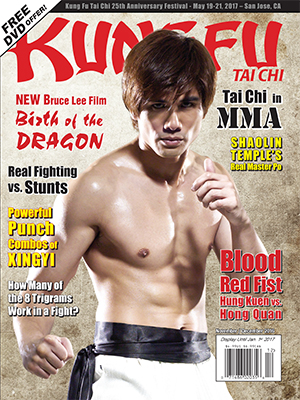
NOV+DEC cover leaked

…leaked by this issue’s cover master, Phil Ng.

straightblast5 Chicago, Illinois
Follow
Kung Fu Tai Chi Magazine (November / December 2016 issue) www.kungfumagazine.com #KungfuMagazine #KungfuTaichiMagazine @jedinitekrew.emperor
9,384 likes
3d
straightblast5Kung Fu Tai Chi Magazine (November / December 2016 issue) www.kungfumagazine.com #KungfuMagazine #KungfuTaichiMagazine @jedinitekrew.emperor

Our official announcement

The Table of Contents for our NOV+DEC 2016 issue are online now.

BotD catching a lot of flack

They say teh Steve Mckee character is loosely inspired by Steve McQueen. I wonder if the reaction would be different if it was based on GM Al Novak? Prolly not now. Whitewashing is such a hot button topic in film nowadays.

ASIAReviews For the Bruce Lee Biopic are Out and Asians Should Be ****ed
By Ryan General Posted on October 3, 2016 1

The early reviews for the Bruce Lee biopic “Birth of the Dragon” are out and, understandably, Bruce Lee fans are angry for burying Bruce Lee and all the other Asian characters in the background.

Audiences are ****ed after seeing Bruce Lee, played by Hong Kong actor Philip Ng, depicted as a dumbed down, ****y and one-dimensional character who takes a subdued role in his own biopic in favor of a white guy.

Bruce Lee fans who were expecting a film about the Jeet Kune Do master’s earlier years in America and his legendary fight with Kung Fu master Wong Jack Man were largely disappointed. Who would’ve known a movie titled “Birth of the Dragon” would be centered on the tired White Savior Trope?”

Undeniably, Caucasian character Steve McKee is the star of the movie and audiences are to follow his adventures in learning kung fu and winning the heart of an Asian girl instead of watching Bruce Lee discover himself and develop into the legendary “dragon” that people recognize him to be.

User reviews on IMDB reverberate with disgust over what this film has brought to the big screen. Here are some of them.

User Bawlife calls it “Hollywood racism galore”:

“Film reduces Bruce Lee into a side character in his own story to force a white guy into the lead. Why is the main focus of the trailer on this silly white American dude? Asian males can never take the lead role. Only the sidekick even in their own movie. It is disgusting. White people, would it kill you to stop inserting yourselves into everything?

“And of course the white guy is dating the Asian girl. Can you stop socially engineer Asian girls to only see white guys as acceptable dating partner? Stop shoving this down our throat. A white guy kisses an Asian girl. Every movie. It’s like they want to brainwash us that Asian girls belong to white men. This turns into a sickening Asian fetish in real life.”

Consciouskendrik complains that the film is nothing but “a disrespectful appropriation of Bruce Lee”:

“Hollywood is racist. This movie disrespects the legacy of Bruce Lee. I highly recommend everyone to boycott this movie. The movie serves to perpetuate negative stereotypes regarding Asian women, men, and the culture.

“It’s perspective forces the viewer to indulge in racism against people of color. The racism is very subversive and is spread by more than just one movie. Movies like these are bountiful in Hollywood(denigrating Asian culture).

“I noticed a very disturbing pattern in Hollywood. They do not want Asian men in the lead role even in their own biopic.”

Nightmarephoenix is just angry:

“I never write reviews for anything, but this time I absolutely had to. THIS IS NOT A FILM. IT’S ANTI-Asian PROPAGANDA. Yellow Peril, 2016 version.

“This entire film is a carefully hidden propaganda piece that portrays Lee as some unsexual, angry, kung fu loser who accomplishes nothing.

“Meanwhile, a white guy actually stars as the main character of the movie, gets the (Asian) girl, and wins the day.

“What? What just happened? A film about Bruce Lee that ISN’T actually about Bruce? This propaganda piece focuses on stereotyping, dehumanizing, and denigrating Asians and Asian culture.

“Of course, that’s no surprise. If you google ‘kulturemedia’ , you’ll find a bunch more examples where western media wages war against Asians in this century. Highly recommend people to avoid this film, and watch ‘The slanted screen’ instead.”

For Udemypreview, the movie is trash.

“I wanted to watch a movie about the legend Bruce lee. Not another white washed movie deleting/altering/hiding his history and Again disrespecting Asians with another white male Asian female interest. Truth is movies spread lies and it hurts societies. In this case. Asian men.

“the lies that Hollywood continues to spread must be stopped. You are creating racists with everyone who watches it. Bruce lee is a legend and you are trying your best to take everything away from him and his people. When will it end? Trash.”

Other reviews reflected the same disappointment and anger toward how the movie missed the opportunity of telling a compelling biopic that is worthy of Bruce Lee’s legacy.

//youtu.be/nrFhIz1GLMo

This largely fictionalized film was directed by writer-filmmaker George Nolfi who explained to Deadline why they decided to center the story using young Steve McKee’s character:

“The reality is, Bruce Lee and Wong Jack Man did not know each other for a long period before the fight and they weren’t heavily involved with each other after the fight. From a narrative standpoint, you needed eyes on the story that would allow you to have a run up to the fight and… I don’t want to spoil what happens after the fight… but you needed that to get to our third act.”

Good article by Charles Russo

BRUCE LEE VS. WONG JACK MAN: FACT, FICTION AND THE BIRTH OF THE DRAGON
FIGHTLAND BLOG
By Charles Russo


Illustration by Andrew Strawder

In late autumn of 1964, Wong Jack Man piled into a brown Pontiac Tempest with five other people as the sun set on San Francisco Bay. The group departed Chinatown and traveled east over the Bay Bridge to Bruce Lee’s new kung fu school on Broadway Avenue in Oakland. After weeks of back-and-forth messages and rising tensions, high noon had finally arrived.

The showdown that occurred that night in front of just seven people behind locked doors was a legendary matchup by just about any standard. It posited two highly dynamic 23-year-old martial artists who shared a compelling—almost yin/yang-like—symmetry between them: the quiet ascetic and the boisterous showman, traditional against modern, San Francisco vs. Oakland, Northern Shaolin against Southern. The fight that ensued would affect the remainder of both of their lives. And even still, this symmetry would persist: one would silently endure the fight’s long shadow for decades, while the other would boldly become a global icon before passing all too soon.

Far more than just some youthful clash of egos, the incident has a much wider relevance. Not only did it shape the fighting approach of the man who would become the world’s most famous martial artist, but the match itself was a key moment in a battle of paradigms. If Bruce Lee is indeed a philosophical godfather of modern mixed martial arts competitions, then his fight with Wong Jack Man was a qualifying moment, a crucible that tested the validity of martial techniques much in the way that early UFC fights would in the late 90s, tearing back the curtain to bluntly expose what was effective and what was mere hype.

Yet this context has mostly gotten lost in the shuffle over the past half-century, as the showdown seems to permanently teeter between absurd urban mythology and obsessive hero worship of Bruce Lee. With Hollywood gearing up to release its latest sensationalized rendering of the fight, a new wave of misinformation is already starting to take hold. George Nolfi’s hyperbolic new film Birth of the Dragon will frame Wong Jack Man as a Shaolin Monk on pilgrimage who eventually teams up with Lee to battle the mafia. This movie will file in alongside the often-maligned 1993 biopic Dragon: The Bruce Lee Story, which framed the fight as a dungeon battle in front of some kind of elder ninja counsel, concluding with Wong cheap-shot kicking Bruce in the spine.

By simple contrast, the factual history is infinitely more compelling than the mythology.


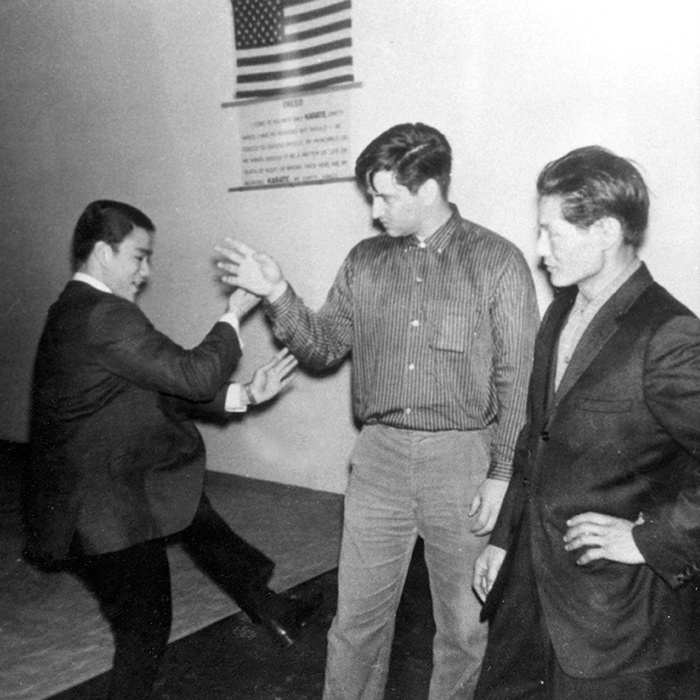
A young Bruce Lee with key Oakland-era colleagues Ed Parker (center) and James Lee in Ralph Castro’s kenpo school in November of 1963. Bruce had found a very likeminded group of martial artists within James Lee’s orbit in Oakland, and would soon relocate from Seattle to continue collaborating with them. (Photo courtesy of Greglon Lee)

Oakland

By the early 1960s, the San Francisco Bay Area was home to a robust martial arts culture that was populated by a diverse array of talented practitioners, who hailed from southern China, Hong Kong and Hawaii. Bruce dropped out of college, and abruptly left a good situation that he had built for himself in Seattle, to participate in this pioneering scene in the Bay Area.

Most notably, he took up residence in the city of Oakland to collaborate with James Lee (no relation), a blue collar local who was twice Bruce’s age, who had a lingering reputation for his youthful days as a no-nonsense street fighter and body builder. Yet James was also a brilliant innovator for the martial arts in America, and was already enacting the sort of martial arts future that Bruce was just beginning to envision. James was publishing his own books, designing his own workout equipment, and running a very modern training environment out of his garage. He quickly introduced Bruce into his orbit of talented and progressively-minded colleagues, which included innovative jujitsu master Wally Jay and early American kenpo karate pioneer Ed Parker. In 1963, James would produce Bruce’s first book—Chinese Gung Fu: The Philosophical Art of Self-Defense—through his self-run publishing company.

Altogether, Bruce very much found what he had wanted in Oakland: a unique martial arts think-tank laboratory where he could practice and discuss martial arts 24/7 among experienced and likeminded collaborators. These Oakland days encapsulated key milestones in Bruce’s life, including the creation of the only book he ever published in his lifetime, getting noticed by Hollywood, his fight with Wong Jack Man, and his initial development of Jeet Kune Do. However, this era typically gets minimal attention in most biographical works, despite its formative significance. In keeping with that trend, Birth of the Dragon will not only omit the likes of James Lee from its storyline, but also completely drop Oakland from this history, and instead set the entire era within San Francisco, where things were very different for Bruce.


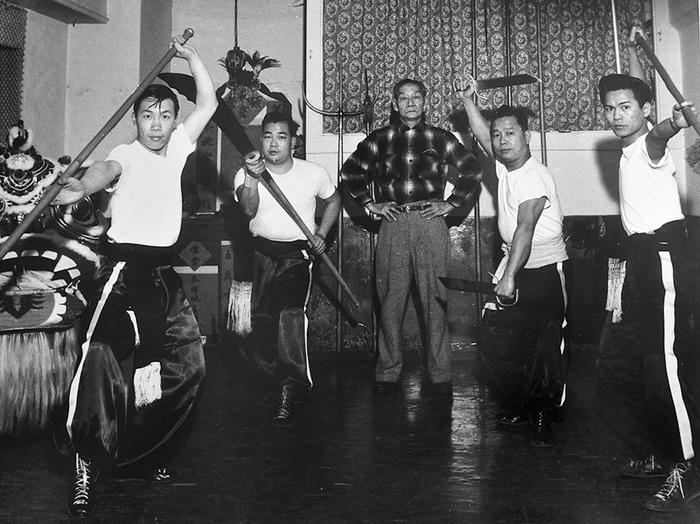
Lau Bun (left) and TY Wong governed the martial arts culture within San Francisco’s Chinatown for three decades. Most descriptions of the Bruce Lee/Wong Jack Man fight have little context for Chinatown’s martial arts culture and how it factored into the affair. (Photo Courtesy of UC Berkeley)
continued next post

Continued from previous post

Chinatown

Across the water from Oakland within the city of his birth, Bruce Lee was perpetually at odds with the martial arts culture of Chinatown. In fact, there is a laundry list of little-known incidents and tensions that occurred between Bruce and Chinatown martial artists dating back to when he first returned to America in the spring of 1959. As Bruce quickly learned, San Franciscos martial arts culture operated in very different fashion from the one he experienced in Hong Kong as a teenager.

For about three decades, Chinatowns kung fu culture was presided over by two longtime local tong enforcersLau Bun and TY Wongwhose trailblazing careers have mostly fallen into obscurity. In the 1930s, Lau Bun opened Hung Sing, which is likely the first public school of the Chinese martial arts in America. He maintained a rigid discipline over his students and other martial artists within the neighborhood. For years, Lau Bun did not allow Chinatown to devolve into the sort of daily youth violence that Bruce Lee grew up around on the streets (and rooftops) of Hong Kong during the 1950s, where students from rival martial arts schools regularly challenged each other to fights.


Lau Bun (center) with senior students in Hung Sing, his basement training studio off of Portsmouth Square in San Francisco’s Chinatown. In 1959, 18-year-old Bruce Lee would have a little known run-in with this crew. (Photo courtesy of UC Berkeley)

TY Wong arrived to San Francisco in the early 1940s. As a junior tong member to Lau Bun, it often fell to TY to clean up rowdy and drunken behavior around the neighborhoods Forbidden City nightclubs. The name of his schoolKin Montranslated to mean the Sturdy Citizens Club. And like Lau Bun, TY expected a specific code of conduct.

Word of Hong Kongs challenge culture and the tenacious reputation of its Wing Chun practitioners had preceded Bruce Lee to San Francisco. Bruce had spent his teen years learning Wing Chun kung fu within Ip Mans school in Hong Kong, where he enthusiastically embraced the simple and streamlined nature of the style. Economical, swift and direct, Wing Chun emphasizes in-fighting along the opponents center line, employing short kicks and rapid punches in close proximity. The style had a reputation for being results-oriented, and on the streets postwar Hong Kong, that was a crucial distinction.

Not long after arriving to San Francisco in 1959, Bruce Lee had a heated incident with Lau Bun and his senior students in Chinatown. When Bruce came to Hung Sing, he didnt know anything about San Francisco, recounts Sam Louie, one of Lau Buns senior students at the time. There were seven or eight of us in class. He came down to show off some hands, and tried to say to us that Wing Chun was the best. So our sifu threw him out.


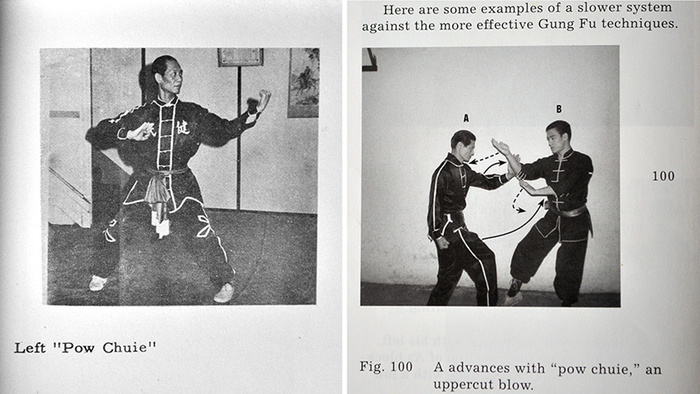
A comparison of technique stills from TY Wong’s 1961 book, Chinese Kung Fu Karate, alongside imagery from Bruce Lee’s 1963 book, Chinese Gung Fu. TY, Bruce and James Lee would all package insults into their books from this era, aimed between Oakland and San Francisco.

Instantly then, Bruce had gotten off to a bad start within Chinatown. These tensions would only build over time as he increasingly became a vocal critic of traditional approaches to the martial arts, whichin his minimalist Wing Chun mindsethe saw as heavy on flair but short on effectiveness. One of the most pointed examples of Bruces criticism is hidden in plain sight within Chinese Gung Fu, where in a photo-by-photo case study, Bruce is seen dismantling specific techniques that are put forth in one of TY Wongs earlier books. This is featured in a section titled Difference in Gung Fu Styles, in which Bruce distinguishes between what he sees as superior systems (namely, his own) versus slowerhalf-cultivated systems (that of TY Wong and other more traditional masters like Lau Bun). Bruces book was readily on sale within Chinatown, and the insults were not lost on locals. So when TY Wong subsequently characterized Bruce Lee as a dissident with bad manners, it was a view shared by most martial artists within Chinatown.

At about the same time of Bruces book being published, Wong Jack Man showed up to Chinatown, and quickly made a name for himself as a dedicated and highly skilled practitioner. He was the first to bring a northern style to the neighborhood, and he proved elegantly athletic in demonstrating it. In many ways, his style appeared to be an inverse of Wing Chun: expansive, acrobatic, and oriented around long-range attacks. Chinatown was quickly impressed with Wong Jack Man, and embraced him in every manner that they had shunned Bruce.


TY Wong (standing, 2nd from right) with his teenage students in his Kin Mon Physical Culture studio on Waverly Place in Chinatown. Notice his one white student (Noel O’Brien) on the top right, who followed Al Novak in a steady stream of non-Chinese students that TY taught throughout the 1960s. (Photo courtesy of Gilman Wong)

Chinese-Only?

The long-held rationale for Bruce Lees fight with Wong Jack Man has asserted that top brass in Chinatown took exception to Bruce teaching non-Chinese students kung fu, and sent Wong Jack Man over to Oakland as an enforcer to settle the matter with fists. This theory, which was rendered in heavy-handed fashion in Dragon: The Bruce Lee Story, has always been completely void of details as far as who exactly took exception. If anyone in Chinatown was to make this call, it would likely have come down from Lau Bun or TY Wong. Yet, there is not only scant evidence to support this, but developments at the time prove highly contrary to this perspective.

When asked about the idea that Chinatown sought to reprimand Bruce for teaching non-Chinese, Al Novaka hulking WWII veteran and close friend of James Leeshrugged it off, I think thats mostly made up. Novak would know, because by 1960 he was a white student regularly training with TY Wong at Kin Mon in Chinatown without incident. A few years later, TY took on Noel OBrien, a local Irish teenager. In Hung Sing, Lau Bun was training a Hawaiian named Clifford Kamaga, and also showing no open opposition to his senior student Bing Chan, who was accepting all types of students at his own newly-opened school just a couple blocks away in Chinatown.


Lau Bun (2nd from top right, with glasses) standing with Hop Sing Tong members and a Lion Dance squad in Marysville, California, during Chinese New Year celebrations in 1961. Lau Bun’s Los Angeles colleague and noted kung fu master Ark Wong (2nd from top right) would eventually give a formal interview to Black Belt Magazine in 1965 expressing that he was open to teaching all types of students, regardless of race. (Photo courtesy of UC Berkeley)

Of course, the situation was not without nuance. Bruce Lees early classes, particularly in Seattle, were indeed groundbreaking for how diverse they were, in terms of both race and gender. And the Chinese-only martial arts code was a very real policy that existed for decades, and one that had surfaced against Bruce at various early points in his life. Yet the code was in its final throes by the 1960s. In fact, in early 1965 (very shortly after Bruces showdown with Wong Jack Man) Ark Wong, a well-respected kung fu master in Los Angeles, gave a high profile cover story interview to Black Belt Magazine in which he said in explicit terms that he was open to taking on any type of student willing to learn from him.

So for as tangible as the exclusion code had been, martial artists from the Bay Areaincluding many of Bruces colleagueswidely express skepticism at the idea of it being the core reason for that particular fight.It was never about that, says Leo Fong, a versatile veteran martial artist who knew the landscape well. It really had to do with Bruces personality.


Bruce Lee’s demonstration at Ed Parker’s inaugural Long Beach Tournament in August of 1964 is typically cited as a key moment in his career (in which he first get noticed by Hollywood), but is typically sanitized to omit the critical lecture he delivered to an international crowd of martial artists. (Photo courtesy of Barney Scollan)

continued next post

Continued from previous post

The Dissident

By the start of 1964, Bruce began to double-down on his earlier criticism of “ineffective” styles and techniques, and began given lecture-heavy demonstrations featuring stinging rebukes towards “dry-land swimmers” practicing the “classical mess.” By contrast, he referred to his own approach as “scientific street fighting,” and made a habit of demonstrating other styles and then methodically explaining why they wouldn’t work in a street fight. One of the styles he liked to perform and then dismiss was Northern Shaolin, and he began to air these viewpoints to some very large and qualified audiences.

At Ed Parker’s inaugural Long Beach Tournament in August, Bruce delivered a scathing lecture that disparaged many existing practices, including such common techniques as the horse stance. “He just got up there and started trashing people,” explains Barney Scollan, an 18-year-old competitor that day. Although Bruce’s showing at Long Beach is often painted in glossy terms, many of those in attendance corroborate the polarizing nature of his demonstration, in which half the crowd perceived him as brash and condescending. As longtime karate teacher Clarence Lee remembers it: ““Guys were practically lining up to fight Bruce Lee after his performance at Long Beach.”


In late summer of '64, Bruce accompanied Hong Kong starlet Diana Chang Chung-wen (“the Mandarin Marilyn Monroe”) on a promotional tour of the U.S. west coast in support of her latest film. This brought them to the Sun Sing Theater, in the heart of San Francisco’s Chinatown where Bruce’s demonstration and critical lecture would infuriate the neighborhood’s martial arts practitioners. (Photo courtesy of UC Berkeley)

A few weeks later before a capacity crowd at the Sun Sing Theater in the heart of San Francisco’s Chinatown, Bruce gave a similar demonstration, and even went as far as to criticize the likes of Lau Bun and TY Wong by declaring “these old tigers have no teeth.” It was a considerable insult coming from a young martial artist towards two highly-respected members of the community.

At this point, a confrontation wasn’t surprising…it was logically inevitable, especially when considering that Bruce had been challenged for similar reasons in Seattle a few years earlier on far less provocation. That fight was also predicated on the content of Bruce’s demonstrations at the time, when local karate practitioner Yoichi Nakachi took issue with Bruce’s martial arts worldview and loudly issued a challenge. Yoichi pursued him for weeks. When the two finally fought, Bruce obliterated Yoichi with a rapid series of perfectly places punches and a knockout kick in an 11-second fight that left him unconscious with a fractured skull. Oddly enough, the entire affair tends to get shrugged off as meaningless; when really, it should be seen as a case study.


Bruce Lee with student Barney Scollan in east Oakland, where Bruce eventually relocated his school into James Lee’s garage. An earlier formal location on Broadway Avenue—where the Wong Jack Man fight took place—proved to be short-lived. (Photo courtesy of Barney Scollan)

“Made to Fight”

One of the most enduring questions that still remains difficult to answer, is—“Why Wong Jack Man?” Of all the practitioners in Chinatown to step forward to issue a challenge, why was it a recent transplant that had never even met Bruce Lee before?

There are two main theories on this. The first is that because Wong Jack Man was poised to open his own martial arts school in Chinatown, he stepped forward in an opportunistic moment to generate some publicity. Local tai chi practitioner David Chin asserts that Wong said as much when he signed a challenge note to be delivered to Bruce. Yet a more popular theory professed by many local sources from that era is that Wong Jack Man was duped into fighting Bruce, essentially the new kid on the scene goaded into a schoolyard brawl without grasping the stakes.

But who were those five people that drove over to Oakland with Wong Jack Man? In the front seat with Wong were David Chin and Chan “Bald Head” Keung, two martial artists that frequented the Ghee Yau Seah (The Soft Arts Academy), a sort of tai chi social club that had been established within Chinatown in the early 1930s. In the back seat, were a trio of hanger-on troublemaker types, with no strong connections to the neighborhood’s martial arts scene: Ronald “Ya Ya” Wu (whose nickname reflected his constantly yammering mouth), Martin Wong, and Raymond Fong. As Wong Jack Man would later put it, this group was “only there to see the hubbub.”

No one in the car was a student of TY Wong’s Kin Mon or Lau Bun’s Hung Sing, but tied instead to the Ghee Yau Seah. In fact, Lau Bun’s senior student Sam Louie remembers his school mates abiding by Lau Bun’s code of conduct and admonishing this crew as they riled themselves up that day prior to the fight: “We said, ‘It has nothing to do with Hung Sing.’ And we explained to them, ‘You go into someone’s studio…it’s no good. Whether you win or lose…it’s no good.’”

In Oakland, Bruce would only have two witnesses: his recent bride Linda Lee (who was 8 months pregnant at the time) and his close colleague James Lee (who had a loaded handgun nearby in case things spiraled out of control). This made for a total of nine people in the room, only three of whom are alive today. With a couple of very rare exceptions, Wong Jack Man has stayed perennially quiet on the matter. Linda Lee and David Chin, who were on opposing sides of the conflict, give a generally similar account: the fight was fast and furious, spilling wildly around the room. The exchange was crude, and far from cinematic. After landing an opening blow on Wong’s temple, Bruce struggled to decisively put away his evasive opponent like he had in Seattle a few years earlier, and quickly found himself heavily winded by the encounter.

Eventually Bruce’s relentless advance caused Wong to stumble over a small step, into an untenable position on the floor where Bruce hollered “Do you yield?” in Cantonese over and over while pummeling him repeatedly. Having lost his footing, Wong had no choice but to concede. “From there, he said he gives up and we stopped the fight,” recalls David Chin. “The whole thing lasted…not more than seven minutes.”

As with any good schoolyard fight, the exaggeration soon took on epic proportions. Storylines of Bruce slamming Wong’s head through a wall, or of Wong having Bruce in a headlock and ready to knock him out when the cops arrived, are just a couple among many. Perhaps the most absurd of the hyperbole, which is now a regular storyline in the press surrounding the upcoming release of Birth of the Dragon, is that the fight lasted for 20 minutes, a notion which is not only wholly inconsistent to the accounts of all proven eyewitnesses, but contrary to all basic sense for the nature of a street fight.


A rare image of Bruce Lee demonstrating techniques the night before the first Long Beach Tournament, in the summer of 1964. (Photo courtesy of Barney Scollan)

In the fight’s aftermath a war of words took place in local Chinese newspapers, in which both Bruce and Wong denied starting or losing the fight. In time, the urban mythology surrounding the incident would cite that Wong issued a call for a rematch in his article, though the exact wording suggests otherwise: “[Wong] says that in the future he will not argue his case again in the newspaper, and if he is made to fight again, he will instead hold a public exhibition so that everyone can see with their own eyes.” Although not an exact quote from Wong, the wording is curious—made to fight—and hints at the idea that Wong was indeed manipulated into the affair.

What is generally agreed upon is that Bruce Lee’s messy victory—light years from his precise 11-second win over Yoichi in Seattle—was a catalyst for him to finally overhaul his approach. For a martial artist who all year long had been so loudly professing the effectiveness of his technique against the inferiority of others, Bruce found the Wong Jack Man fight to be a sober reality check, in which both his technique and his conditioning came up very short of his expectations.

The timing was right for Bruce to begin tangibly forming his new system, Jeet Kune Do. He had already been synthesizing many of the influences that he had been exposed to in recent years—from James Lee’s street-fighter sensibility to Wally’s Jay’s propensity for innovation—to form an integrated system personalized to the individual. In creating Jeet Kune Do, Bruce incorporated elements of Wing Chun, fencing, and American boxing into a minimalist-based approach with a philosophical orientation.

Yet among the more egregious historical liberties that the new film appears to be taking, Wong Jack Man’s character will literally explain core Jeet Kune Do principles to him, as if it wasn’t the fight itself that impacted Bruce, but Wong’s personal martial arts wisdom.
continued next post