Those who say that banning shark fin soup is “an attack on Asian culture” are full of ****. It would be laughable if it weren’t so pathetic. Shark fin soup is NOT an essential part of anyone’s diet. It’s a novelty item. The very essential role that sharks play in the oceans far outweighs anybody’s right to kill even one in such a cruel and wasteful manner. It’s not about culture, it’s about greed, pure and simple. It’s a lack of consideration for anything but their own bottom line. If banning all shark fin soup interferes with someone’s right to profit from it or eat it, well that’s too **** bad.
[QUOTE=Jimbo;1259922]Those who say that banning shark fin soup is “an attack on Asian culture” are full of ****. It would be laughable if it weren’t so pathetic. Shark fin soup is NOT an essential part of anyone’s diet. It’s a novelty item. The very essential role that sharks play in the oceans far outweighs anybody’s right to kill even one in such a cruel and wasteful manner. It’s not about culture, it’s about greed, pure and simple. It’s a lack of consideration for anything but their own bottom line. If banning all shark fin soup interferes with someone’s right to profit from it or eat it, well that’s too **** bad.[/QUOTE]
More and more, I am expecting a day when we begin using military pressure on other countries because their abuse of nature begins to negatively effect our ecosystem functions. And likewise with other countries banding to pressure us in the US if we don’t get with it on climate issues and green house emissions.
[QUOTE=GeneChing;1259919]
//youtu.be/WC9FM1s13Y0
I’m meeting with WildAid today actually.  [/QUOTE]
lmao that’s got to be one of the most pathetic videos in existence 
yeah it’s not good to **** up the eco system but there are far crueller things going on to animals in the west than that :rolleyes: but i guess that’s just to do with overpopulation
don’t forget the human race is just a virus after all
My time in China taught me that, like the West, what is called gourmet or delicacy is, in most every way imaginable, inferior to the common food.
11/14/2017 03:33 am ET
Trump Trades In Steak For Shark Fin Soup In Vietnam
The dish, a delicacy in some countries, has been linked to severe animal cruelty.
By Nick Visser
JIM WATSON VIA GETTY IMAGES
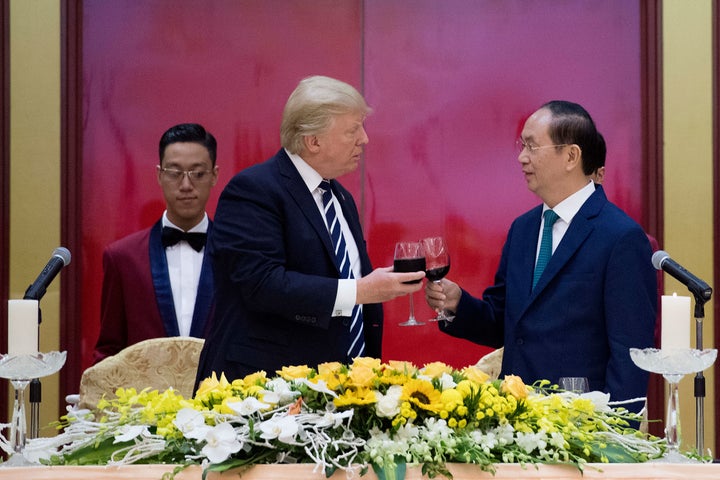
Vietnamese President Tran Dai Quang toasts President Donald Trump during a state dinner in Hanoi on Nov. 11, 2017.
President Donald Trump reportedly dined on shark fin soup during a meal in Vietnam.
The dish, which is considered an expensive delicacy in some countries, has prompted a widespread outcry from environmental groups for its links to animal cruelty.
According to The Associated Press, Trump ate the dish as part of a state dinner in Hanoi during his 12-day trip across Asia. E&E News confirmed the evening’s menu featured shark fin soup as the meal’s fifth course.
[QUOTE] Shark Defenders @SharkDefenders
President Trump dined on shark fin soup in Vietnam
They must have been all out of well done streak and ketchup
Sad.
10:34 AM - Nov 13, 2017
9 9 Replies 27 27 Retweets 32 32 likes
Twitter Ads info and privacy
John R Platt @johnrplatt
Trump ate #shark fin soup in Vietnam. Extinction in a bowl, on Trump’s plate. https://twitter.com/EENewsUpdates/status/930163366043189249 …
12:18 PM - Nov 13, 2017
12 12 Replies 74 74 Retweets 60 60 likes
Twitter Ads info and privacy
Trump is widely known to be a picky eater who prefers to dine on steak with a side of ketchup. However, the president made no comment about the shark fin soup when it was presented to him, White House pool reports said.
Shark fin soup is popular in China and demand for the dish, which can sell for up to $400 a bowl, has skyrocketed as the country’s economy has grown.
Based on some estimates, more than 70 million sharks are killed annually to satisfy demand for the soup. To obtain the meat for the dish, fisherman catch the sharks, hack off their fins and throw the animals’ mutilated bodies back in the water. Because the sharks need their fins to swim and breathe, the animals slowly suffocate or bleed to death as they sink to the bottom of the ocean.
Although major awareness campaigns about the environmental impacts of shark fin soup have been successful, the dish is still served in eateries around the world.
Some states, including California, have banned the sale of shark fins and a bill was introduced earlier this year in Congress to extend that ban nationwide.[/QUOTE]
The menu from that Washington Post report - surprised he went for it:
8:40 p.m.
President Donald Trump is praising Vietnam in brief remarks before a state dinner, calling the nation “one of the great miracles of the world.”
He says the United States and Vietnam have “come a long way,” in an apparent reference to the Vietnam War.
Trump added that “there is nothing more impressive” than the success of the country. He spoke during a state dinner featuring local flavors.
On the menu: steamed rice powder rolls “with fluffy pemmican”; shrimp rolled in fried egg; a seafood soup made with fish maw, shrimp, scallop and shark fin; and Dong Tao chicken rolled with lotus and mushrooms.
Besides dinner, Trump is scheduled for talks with Vietnamese leaders before heading to the Philippines, his last stop on the trip.
WildAid update
Jackie Chan, Yao Ming back ad campaign against ivory, shark fin and rhino horn trade
David Beckham, Lupita Nyongo, Britains Prince William are among the celebrities to have joined charity WildAids drive to change attitudes towards the selling of endangered animal parts
PUBLISHED : Wednesday, 14 March, 2018, 11:44am
UPDATED : Wednesday, 14 March, 2018, 12:44pm
Kylie Knott
kylie.knott@scmp.com

Chinese basketball great Yao Ming and Hong Kong martial arts star Jackie Chan are among the celebrities taking part in global conservation organisation WildAids latest campaign to end the illegal trade in wildlife.
Called Partnership for the Wild, the campaign launched on March 14 in Africa, the US and Asia aims to raise awareness and cut consumer demand for illicit products such as elephant ivory, rhino horn and shark fin soup.
Shark fin still on most Hong Kong restaurant menus for Lunar New Year banquets, study finds
Chinese concert pianist Lang Lang and actresses Li Bingbing and Angelababy are also campaign ambassadors, as is singer Jay Chou. Britains Prince William, former soccer player David Beckham, actresses Lupita Nyongo and Maggie Q, and businessman Richard Branson are also supporters.
The campaign, created in partnership with outdoor advertising company JCDecaux, will help spread WildAids message that when the buying stops, the killing can too. It has been translated into six languages and will be launched in more than 10 countries by the end of this year.

Jackie Chan appears on a billboard as part of the WildAid campaign. Photo: WildAid
More than 600 billboards featuring Yao are on display at the Beijing Capital International Airport and in other major cities in China. The campaign will be rolled out in Tanzania, East Africa, this month, and shark protection messages will be promoted in Hong Kong and Thailand.
The World Wide Fund for Nature (WWF) says the huge demand for shark fin, regarded as a delicacy at Chinese banquets, is a major reason for the drop in shark numbers. Shark fin is still on the menu in Hong Kong restaurants.
WildAid chief executive Peter Knights said: Thanks to JCDecauxs generosity, we will be able to reach more people in more places with messages that will help protect imperilled wildlife.
WildAid estimates up to 30,000 elephants are killed illegally every year.

Yao, Britains Prince William and David Beckham appear in a WildAid campaign ad. Photo: WildAid
In January, Hong Kong lawmakers voted overwhelmingly to ban the trade in ivory, a move environmentalists described as a lifeline for elephants. Ivory sales in the city will be phased out gradually, stopping completely in 2021.
Threads:
WildAid Tiger Claw Champion
Banning Shark Fin Soup
Ivory
busted!
$420k hkd = $53,518.50 usd
[url=“http://www.scmp.com/news/hong-kong/hong-kong-law-and-crime/article/2149783/shark-fin-and-seahorse-imports-indonesia”]
shark fin and seahorse imports from indonesia worth hk$420,000 seized; two hongkongers arrested

published : Thursday, 07 june, 2018, 8:33pm
updated : Thursday, 07 june, 2018, 8:32pm
clifford lo
hong kong customs officers have arrested two company directors on suspicion of smuggling 360kg (794lbs) of dried shark fins and seahorses into the city from indonesia.
A shipping container said to contain fish maw was selected for inspection during a risk assessment at kwai chung port on monday after the consignment arrived from indonesia.
Officers at the customshouse cargo examination compound seized 140kg of suspected dried seahorses and 220kg of dried shark fins, according to the customs and excise department.
The haul had an estimated market value of hk$420,000 (us$53,520).

the goods were seized at hong kong’s kwai chung container terminal. Photo: Martin chan
on wednesday, officers arrested a 64-year-old male director and a 63-year-old female director of a sheung wan dried seafood shop suspected to be involved in the case, the department said in a statement.
The pair were released on bail pending further investigations.
Importing or exporting an endangered species without a licence carries a maximum penalty of 10 years in jail and a hk$10 million fine in hong kong. Anyone moving unrecorded cargo faces seven years in prison and a hk$2 million fine.
Any suspected smuggling activity can be reported to hong kong customs 24 hours a day on +852 2545 6182.
busted!
$420k hkd = $53,518.50 usd
[url=“http://www.scmp.com/news/hong-kong/hong-kong-law-and-crime/article/2149783/shark-fin-and-seahorse-imports-indonesia”]
shark fin and seahorse imports from indonesia worth hk$420,000 seized; two hongkongers arrested

published : Thursday, 07 june, 2018, 8:33pm
updated : Thursday, 07 june, 2018, 8:32pm
clifford lo
hong kong customs officers have arrested two company directors on suspicion of smuggling 360kg (794lbs) of dried shark fins and seahorses into the city from indonesia.
A shipping container said to contain fish maw was selected for inspection during a risk assessment at kwai chung port on monday after the consignment arrived from indonesia.
Officers at the customshouse cargo examination compound seized 140kg of suspected dried seahorses and 220kg of dried shark fins, according to the customs and excise department.
The haul had an estimated market value of hk$420,000 (us$53,520).
the goods were seized at hong kongs kwai chung container terminal. Photo: Martin chan
on wednesday, officers arrested a 64-year-old male director and a 63-year-old female director of a sheung wan dried seafood shop suspected to be involved in the case, the department said in a statement.
The pair were released on bail pending further investigations.
Importing or exporting an endangered species without a licence carries a maximum penalty of 10 years in jail and a hk$10 million fine in hong kong. Anyone moving unrecorded cargo faces seven years in prison and a hk$2 million fine.
Any suspected smuggling activity can be reported to hong kong customs 24 hours a day on +852 2545 6182.
U.S. legally harvested shark
China tariffs could hurt remaining US shark fin business
By PATRICK WHITTLE, ASSOCIATED PRESS PORTLAND, Maine — Jun 29, 2018, 12:04 AM ET
A new set of Chinese tariffs on U.S. seafood including products made from shark fins could jeopardize what remains of the American fin business.
China announced the tariffs in mid-June that are expected to apply to exported American goods such as lobster and salmon. They also will apply to whole or cut shark fins, as well as shark fin products that are canned or preserved.
The U.S. has long banned “shark finning,” the practice of removing the fin from a shark and discarding the animal at sea. But it’s still legal to remove and sell the fin of a legally harvested shark after it’s brought to land.
The steep tariffs could have implications for American shark fishermen and processors. China is one of the biggest buyers of shark fins.
This is kind of ironic…
Cathay Pacific, Four Seasons Hotel, Shangri-La Group, Conrad HK & Star Ferry Co
I used to love shark fin soup but stopped eating it after meeting Peter Benchley (author of Jaws) at an ACAP event. ACAP was a precursor to my work with WildAid - I wrote about that in a former TC Media publication, World of Martial Arts (see the NOV+DEC 98 issue)
Shark fin: Cathay Pacific among major Hong Kong firms uniting in pledge to end global trade
Four Seasons Hotel, Shangri-La Group, Conrad Hong Kong and Star Ferry Company some of the big names promising to put pressure on other businesses
PUBLISHED : Saturday, 03 November, 2018, 8:04am
UPDATED : Saturday, 03 November, 2018, 11:11am
David Vetter
david.vetter@scmp.com
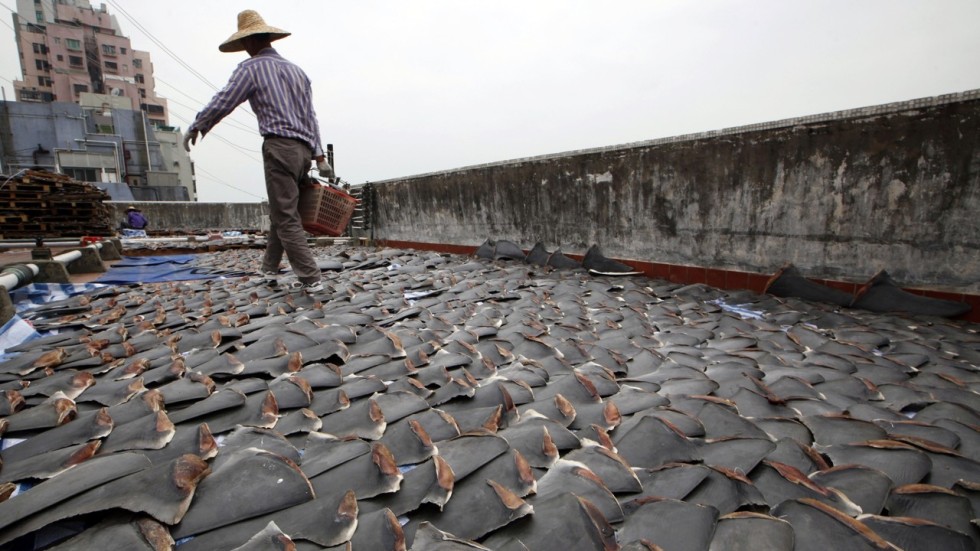
Major corporations across five industries in Hong Kong on Friday signed a pledge to put an end to the global trade in shark fin.
Airline Cathay Pacific was joined by businesses ranging from hotels to advertisers in committing to the Global Shark Pledge, an initiative by wildlife protection organisation WildAid.
Hong Kong is a major hub for the trade. As much as 50 per cent of global supply passes through the city, much of it on its way to mainland China.
WildAid says the industry relies on the killing of up to 73 million sharks every year.
Other big names signing the pledge included the Four Seasons Hotel, Shangri-La Group, Conrad Hong Kong, and The Star Ferry Company.
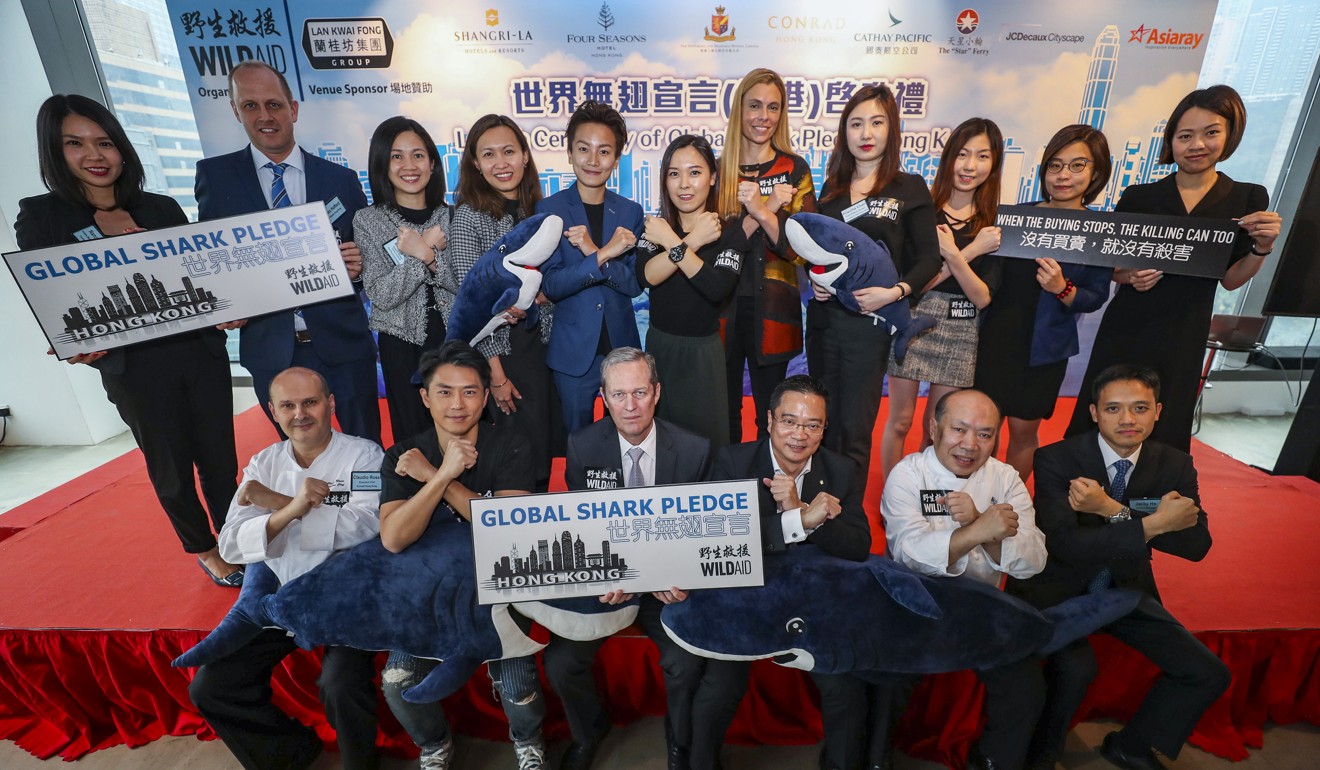
Participants and ambassadors spread the message for WildAids Global Shark Pledge on Friday. Photo: Edward Wong
The firms all promised not to use or transport shark fin and to put pressure on other businesses to follow suit.
Activism has helped slash demand for shark fin in China, the worlds biggest consumer, by more than half since 2011, WildAid said. Many large restaurant chains have stopped serving it or have replaced the ingredient with substitutes at traditional Chinese banquets.
Weve been running an advertising campaign for a decade now to encourage people in Hong Kong not to buy it. But then we moved on to the airlines and container shipping companies, said Alex Hofford, a WildAid campaigner.
The result has been 45 airlines including Hong Kong flag carrier Cathay refusing to transport shark fin as cargo.
Conservation group WWF says Hong Kong shark fin imports dropped by half between 2007 and 2017.
A critical mass has formed, Hofford said. Weve lobbied the business sector now its time for them to carry our message forward.
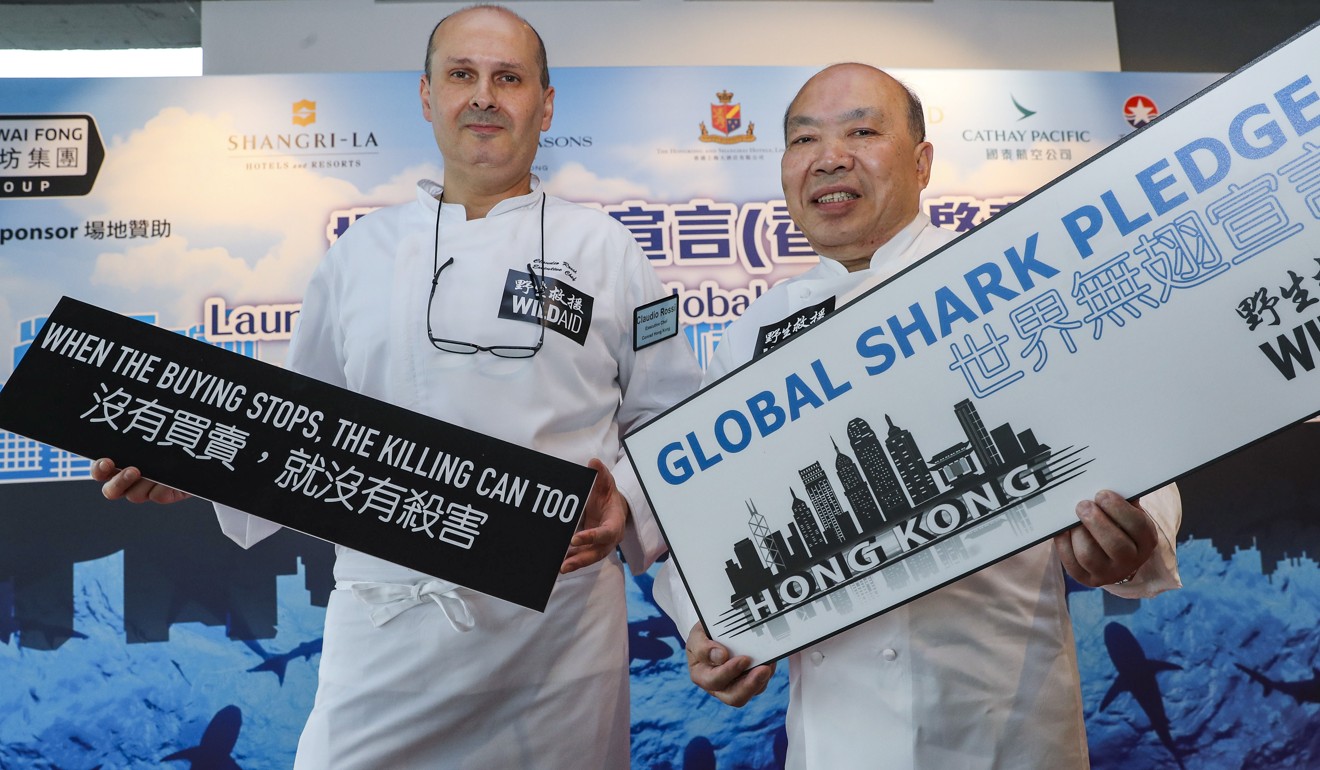
Claudio Rossi (left), executive chef at Conrad Hong Kong, pictured here with Four Seasons executive chef Chan Yan-tak, said shark fin was completely unnecessary as a culinary ingredient. Photo: Edward Wong
Claudio Rossi, executive chef at Conrad Hong Kong, said shark fin was completely unnecessary as a culinary ingredient.
There are many alternatives, and in the past 10 years Ive seen a lot of improvement. Many five-star hotels have stopped using shark fin. With this inspiration and drive, the smaller restaurants can follow our lead, he said.
Andy Chan, senior director of food and beverage for the Shangri-La Group, said: We have an obligation as a company to help customers make sustainable food choices. We stopped serving shark fin because it was the right thing to do.
Last month fast-food chain Maxims, Hong Kongs largest restaurant business, said it would remove all shark fin products from menus by 2020.
Hofford said WildAid now had its sights on other major chains such as Fulum, which is listed on the Hong Kong stock exchange.
The Maxims decision really sent shock waves up the shark fin supply chain, so were calling on Fulum to sign our pledge because theyre the second biggest restaurant group, he said. It would be great if they were the second domino to fall.
when the buying stops, the killing can, too
Toxic delicacy of shark fin causes ecosystem chaos, and consumers are pushing back
By Marian Liu, CNN
Updated 9:55 PM ET, Mon February 4, 2019
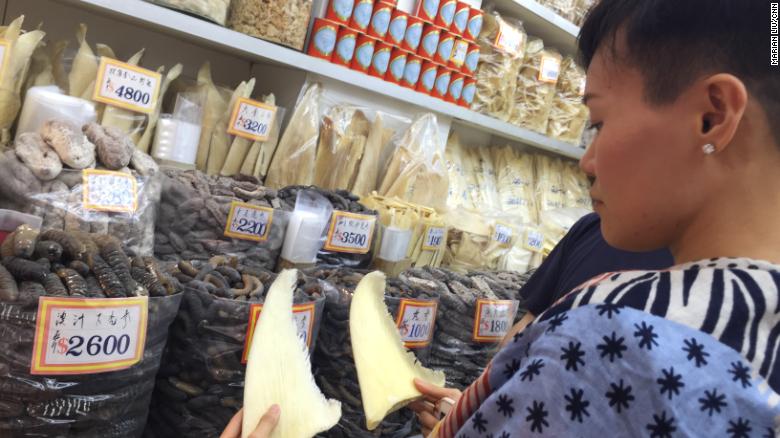
Photos: Shark fin in Hong Kong
The bigger the fin and the thicker the veining, the more expensive it is, merchants said.
Hong Kong (CNN)Adeline Chan’s nose crinkled at the market’s pungent, briny smell.
Chan and her mother were once regulars at Hong Kong’s Dried Seafood Market, in Sheung Wan, where endless stalls display plastic bins stuffed with various forms of dried shark fin.
“We don’t need shark fins for ourselves, but sharks need their fins,” said Chan, now a vegan. “I stopped consuming shark fin soup four years ago after learning what sharks had to go through before a bowl of shark fin soup is served.”

Adeline Chan used to eat shark fin.
But fins continue to be popular at these stores, along with other delicacies such as sea cucumbers, scallops and abalone.
According to Hong Kong’s tourism board, this seafood market has been around for at least 50 years, but the dried seafood trade can be traced to the 1860s, said Sidney Cheung, director of the Centre for Cultural Heritage Studies at the Chinese University of Hong Kong.
Shark fin has long been a status symbol at Chinese dinners, particularly for wedding banquets.
As much as half of the global supply has been found to pass through Hong Kong, the second-highest consumer of seafood in Asia at 71.8 kilograms (158 pounds) per person per year. This is more than three times the global average, according of the United Nations Food and Agriculture Organization.
And on Chinese New Year, many family dinners will include shark fin. Last year, the Hong Kong Shark Foundation found that over 80% of 291 Chinese New Year menus in Hong Kong included these dishes.
A culture of fins
For many Chinese families, culture dictates the consumption of shark fin.
“There was an old saying in Hong Kong in the 1970s: ‘To stir shark fin with rice.’ It was used to describe the lifestyle of the wealthy, implying that they were rich enough to afford shark fin on a daily basis,” said Tracy Tsang, manager of WWF-Hong Kong’s Footprint program.
“Today, the older generation still considers serving shark fin to their guests during banquets a sign of hospitality.”
Many people in China, Taiwan, Indonesia, Singapore, Macau and Vietnam all consume shark fin – primarily the Chinese population.
“The concept of ‘no fin, no feast’ is still deeply rooted in many people’s minds,” said Bowie Wu Fung, an 86-year-old Hong Kong actor who now speaks for WildAid, appearing on billboards in Hong Kong against shark fin consumption.
Fung hopes to reach the older generation, who constitute the bulk of the buyers at Hong Kong’s Dried Seafood Market.
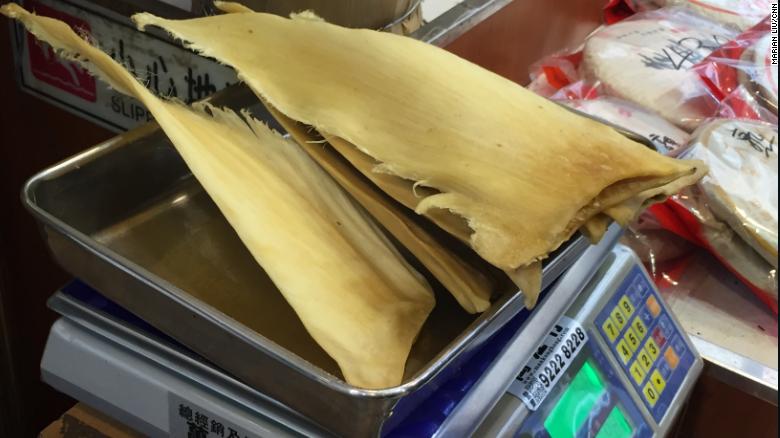
The bigger the fin and the thicker the veining, the more expensive shark fin is, according to store owners.
“Shark’s fin is one of the ‘four treasures’ of Chinese dried seafood, along with fish maw, dried abalone and sea cucumber,” said Daisann McLane, director of the gourmet food tour company Little Adventures in Hong Kong. “All four are expensive products that are valued for their rarity and also for their texture.”
The bigger the fin and the thicker the veining, the more expensive it is, store clerks at Hong Kong’s Dried Seafood Market said.
Prices can range from $90 Hong Kong dollars (about $12) for 600 grams (1.3 pounds) for small shredded pieces to $7,000 Hong Kong dollars (around $930) for 600 grams. According to a report released in 2016 by the conservation organization Traffic, shark fin prices can range from $99 to $591 per kilogram in Hong Kong.
On the lower end, a shark fin set lunch can cost $80 Hong Kong dollars to 90 Hong Kong dollars ($11 to $12) at Chinese restaurants, while some upscale places charge up to $1,200 Hong Kong dollars ( $160) for a bowl of shark fin soup, Tsang said.
‘A shark trading hub’
More than 1 million tons of shark are caught each year, according to a 2018 study in Marine Policy, which named Hong Kong as the “world’s biggest shark trading hub” where shark fin imports have doubled since 1960.
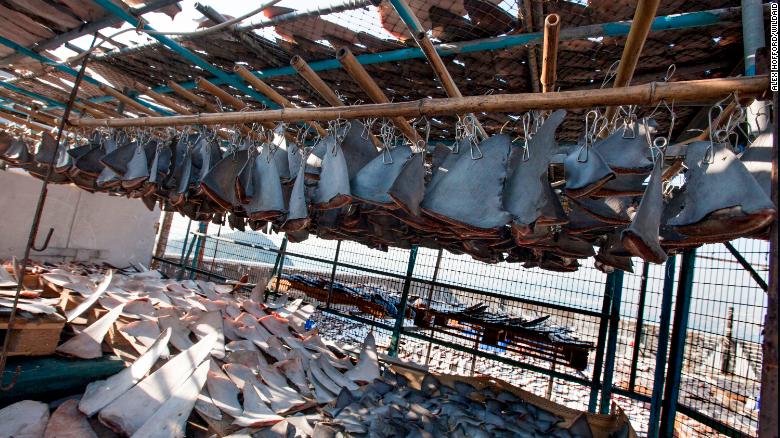
Over 18 thousand shark fins were estimated to be drying on a Hong Kong rooftop.
Nearly 60% of the world’s shark species are threatened, the highest proportion among all vertebrate groups, and the populations of some species, such as hammerhead and oceanic whitetip, have declined by more than 90% in recent years due to the shark fin soup trade, according to the study.
DNA studies have further revealed that one-third of the shark species represented on the Hong Kong retail market may be threatened with extinction.
“Sharks are in crisis,” said Andy Cornish, leader of WWF’s Global Shark and Ray Initiative. “The demand for shark fin in East and Southeast Asia and for shark meat in other parts of the world are the major drivers for the overfishing of sharks. This is, by far, the biggest cause of the shark population decline. Currently, 100% of shark fin sold in Hong Kong is from unsustainable and/or untraceable sources.”

Shark fin with skin, during the drying process, taken in Hong Kong, near Sheung Wan.
Hong Kong customs seized at least 5 metric tons of illegal fins between 2014 and July 2018. From January to October 2018, there were six smuggling cases of endangered species of shark fins with seizure, involving a total of 236 kilograms (520 pounds) of dried shark fins, according to Hong Kong’s Agriculture, Fisheries and Conservation Department.
But continued interest is putting the environment – and humans – at risk.
continued next post
Continued from previous post
Ecosystem chaos
When a shark’s fin is sliced off, the animal dies, said Yvonne Sadovy, lead author of the Marine Policy study and a professor in the School of Biological Sciences at the University of Hong Kong.
“It cannot move, feed or swim, so it just starves to death on the sea bottom. Maybe it is like cutting the wings off a flying plane: The plane will be destroyed,” she said.
Sharks need their fins for steering, balancing and, for some, breathing.
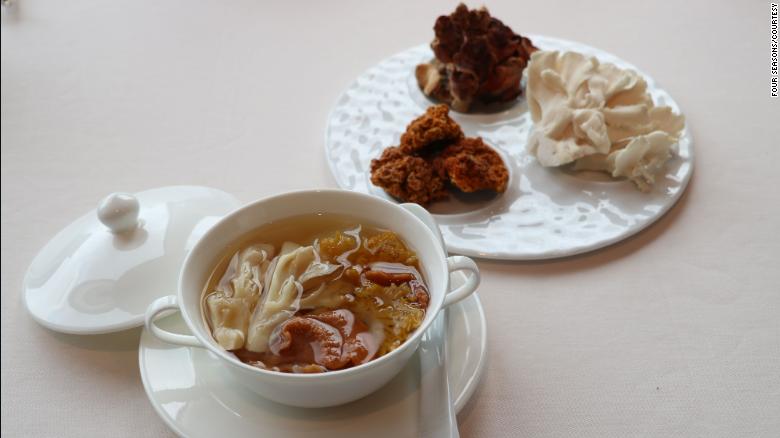
A replacement for Shark Fin Soup from Four Seasons, Double Boiled Maitake Mushroom soup.
“There are sharks that must continue swimming to be able to breathe, as they rely on the forward motion to keep water passing through their gill slits and get oxygen,” said Stan Shea, marine program director for the Bloom Association Hong Kong, a nonprofit that works to preserve the marine environment.
When their fins are cut off, “they are likely to die of suffocation, as they are no longer able to breathe by swimming forwards. (For others), they are unlikely to suffocate but die either by starvation or watching as other animals ‘consume’ them alive.”
In addition, as a predator at the top of the food chain, sharksa are critical to maintaining balance in the ecosystem, Shea said. Its loss could cause “behavioral change” and “chaos.”
For example, when numbers of sharks decrease, their prey will increase and overeat the next level on the food chain, which is why cownose rays wiped out the scallop population in North Carolina, Sadovy said.
“Most sharks are important predators and therefore can play key roles in keeping ecosystems functioning. Depletion of sharks is expected to have negative effects on populations of prey species, many of which may be also be sharks, or rays,” said Nick Dulvy, co-chairman of the International Union for the Conservation of Nature’s Shark Specialist Group.
‘Why the heck would you eat it?’
Eating shark meat could be harmful to humans, too.
Studies have found that sharks accumulate marine toxins, as long-lived predators at the top of the food chain. The levels of these toxins, including mercury, lead and arsenic, exceed recommended dietary levels, according to articles in Marine Pollution Bulletin.
Hong Kong’s Centre for Food Safety warned against the consumption of predatory fish species after finding a sample from a supermarket that contained a level of mercury eight times the permissible limit in 2017.
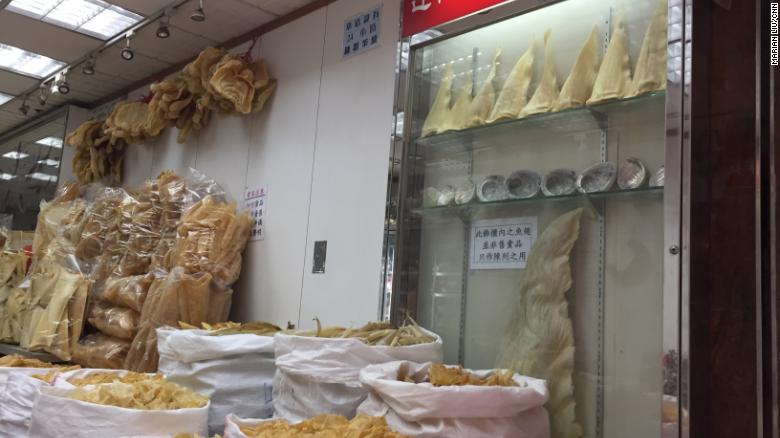
Shark fin is easily accessible in Hong Kong at the Dried Food Market.
“The main food safety concern for shark fin/meat and other large predatory fish is the accumulation of mercury, especially methylmercury,” the center said in a statement.
“Methylmercury is the most toxic form of mercury affecting the nervous system, particularly the developing brain. At high levels, mercury can affect fetal brain development, and affect vision, hearing, muscle coordination and memory in adults.”
In 2016, WildAid tested samples of raw shark fin samples from Hong Kong and Taiwan’s dried seafood markets and found that all contained above the permissible amounts for arsenic and more than half exceeded levels for cadmium, a known carcinogen.
“If something damages your brain, why … would you eat it?” asked Deborah Mash, professor of neurology at the University of Miami. “There’s also no good evidence for health benefits.”
A 2016 study by Mash found a cyanobacterial toxin in sharks fins linked to the neurodegenerative diseases Alzheimer’s disease and amyotrophic lateral sclerosis, often called ALS.
Analyzing 55 sharks across 10 species from the Atlantic and Pacific oceans, her team found that the majority contained the cyanobacterial toxin -N-methylamino-l-alanine, together with another environmental toxin – methylmercury – which is known to accumulate in sharks.
Traditional Chinese medicine may also have no need for shark fins.
“To my knowledge, shark fin is never a part of Chinese medicine practice,” said Professor Lixing Lao, director of the School of Chinese Medicine at the University of Hong Kong. “Chinese medicine community is nowadays very much aware of protection of endangered species to be used in the Chinese medicine practice.”
Besides, “shark fins have no taste on their own. It barely offers a crunchy texture when you bite into it,” said executive chef Chan Yan Tak, the first Chinese chef to get three Michelin stars, at the Four Seasons in Hong Kong, which stopped serving shark fin in 2011. “The flavor comes from the soup: a superior stock that is boiled for eight hours with Yunnan ham, chicken and pork ribs.”
Increasingly, public attitudes toward shark fin are turning.
Pushback from big voices
According to parallel studies in 2009 and 2014, consumption of shark fin in the last year surveyed in Hong Kong went down from more than 70% to less than 45%.
In contrast, the acceptability of excluding shark fin soup from weddings went up from around 78% to 92%, according to studies by the marine environment nonprofit Bloom Association of Hong Kong.
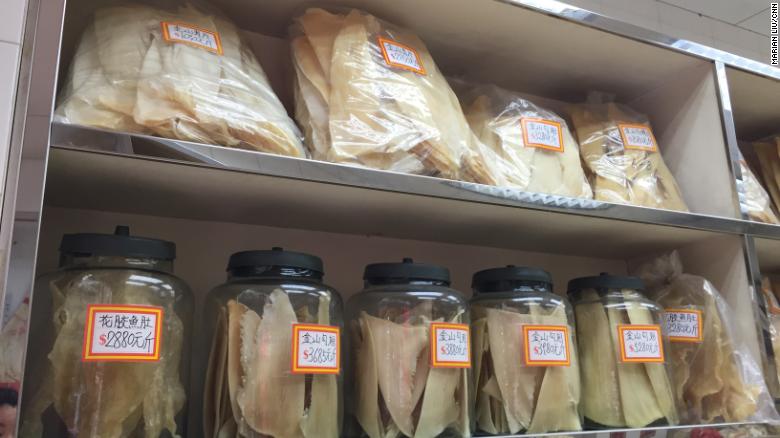
Dried shark fin are easily accessibly in Hong Kong at the Dried Seafood Market.
WildAid and WWF-Hong Kong estimate that more than 18,000 hotels, 44 international airlines and 17 of the 19 largest container shipping lines have stopped serving shark fin and banned it from cargo, affecting close to three-quarters of global shipments. The volume of shark fin imported into Hong Kong has also dropped by half, from 10,210 metric tons in 2007 to 4,979 metric tons in 2017, according to Hong Kong’s Census and Statistics Department.
“It was a big challenge initially, getting customers to accept our shark fin policy,” said Andy Chan, senior director of food and beverage for Shangri-La Hotels & Restaurants, which took shark fin off its menus in 2010. “We accepted that it would mean a substantial cut for our banqueting business. We initiated the policy because it was the right thing to do. We recognized that as a species, sharks are threatened with extinction, and if this happens, it would put the health of our oceans and fisheries at risk.”
Joining Shangri-La in pledging to stop the sale of shark fin are Cathay Pacific, Four Seasons and, most recently, the popular Hong Kong restaurant chain Maxim’s, by 2020. The Four Seasons and some others offer a vegan version of the soup.
“As more hotels and restaurants join together in this pledge, we send a strong signal to our community and can together help to reshape dining concepts around sustainability,” Tak said.
WWF and WildAid are working to persuade more companies to make the pledge against shark fin. Recently, WildAid campaigner Alex Hofford talked to the Fulum Group, one of the largest Hong Kong chains with more than 80 restaurants, about reviewing its policies.
Citing the nonprofit’s motto, Hofford said, “when the buying stops, the killing can, too.”
I used to love shark fin soup but I stopped eating it after I met Peter Benchley working for ACAP under Jackie Chan (I wrote about that back in the World of Martial Arts issue NOV+DEC 98, back when I was still a freelancer).
worst choice
Shark Fin is Always the “Worst Choice”
July 15, 2019
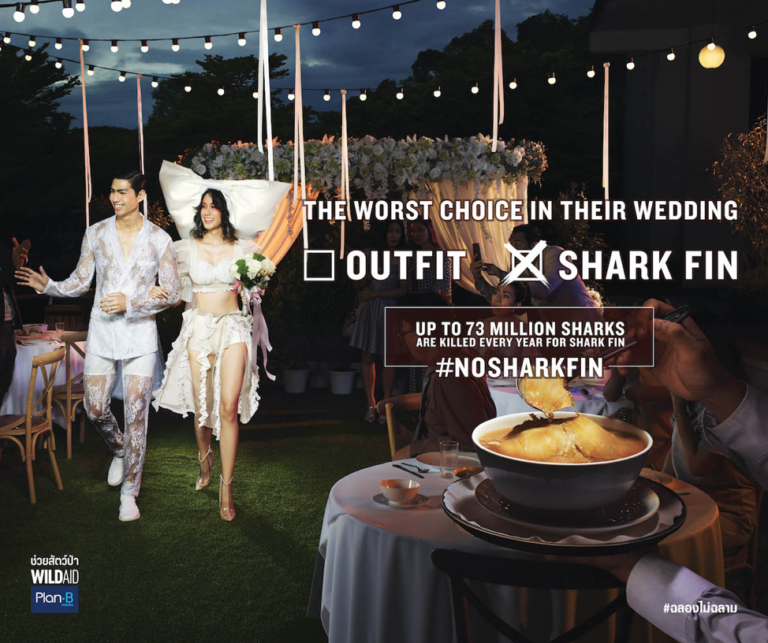
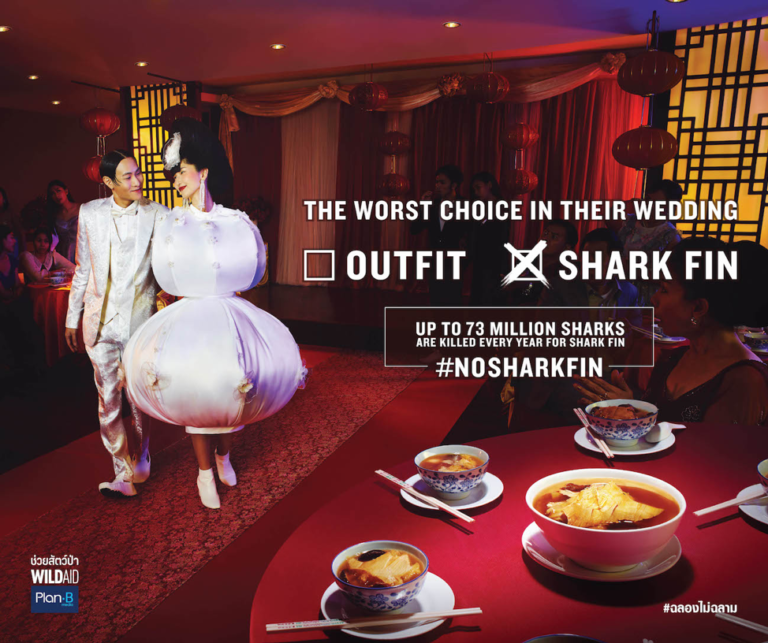
In honor of Shark Awareness Day, international conservation organization WildAid and Plan B Media PCL, one of Thailand’s leading outdoor media service providers, urge the public to stop serving and consuming shark fin. The advertisements, placed on Plan B’s media platforms in prominent locations around Bangkok, feature wedding couples dressed in controversial outfits suggesting that their fashion statement was not the “worst choice” they made but rather their decision to include shark fin on the menu.
The campaign builds on WildAid’s “Celebrate with #NoSharkFin” initiative calling on the public to forgo shark fin at weddings and celebratory events. According to WildAid’s survey findings, 57% urban Thais have eaten shark fin and, even more alarmingly, 61% plan to consume it again in the future. Survey respondents said they consumed shark fin most often at weddings (72%), family meals at restaurants (61%) and business meetings (47%).
The shark fin trade is depleting shark populations, putting many species at risk of extinction, while also causing environmental degradation and fisheries collapse. An estimated 100 million sharks are killed every year and fins from up to 73 million end up in shark fin soup. Thailand is home to an active domestic market for shark fins, with many consumers unaware of the cruel practice of “finning” behind each bowl of shark fin soup: a shark’s fins are often cut off at sea and the shark is thrown back into the water to suffer and die slowly.
“We are proud to support WildAid in its fight to help protect sharks,” said Palin Lojanagosin, Chief Executive Officer, Plan B Media PCL. “Plan B media is deeply concerned by the depletion of shark populations worldwide and the widespread consumption of shark fin in Thailand. This partnership aligns with our organization’s values and together with the strength of our out-of-home media platforms and hard-hitting campaign messages from WildAid, we are confident that our efforts can have an impact in ending consumer consumption behaviors that threaten the health of our oceans.”
Plan B Media PCL has consistently showcased its commitment to social responsibility by sharing their media platforms with non-profit organizations to deliver messages concerning societal and environmental issues. This partnership serves to help improve the ocean’s ecosystem by ending threats sharks face from consumption of their fins.
“WildAid’s partnership with Plan B is instrumental in bringing this urgent crisis to light and helping to save sharks by promoting the message of #NoSharkFin,” said John Baker, Chief Program Officer at WildAid. “Thanks to their support, we can push for a newly accepted standard where sharks are permanently off the menu.”
The creative concept for the “Worst Choice” advertisement series was developed pro bono for WildAid by BBDO Bangkok, Thailand’s leading creative and advertising agency. Apart from outdoor media, these advertisements will also be widely distributed on social media platforms and other online platforms.
Shark Awareness Day is observed annually on July 14.
About WildAid
WildAid is a non-profit organization with a mission to end the illegal wildlife trade in our lifetimes. While most wildlife conservation groups focus on protecting animals from poaching, WildAid primarily works to reduce global consumption of wildlife products such as elephant ivory, rhino horn and shark fin soup. With an unrivaled portfolio of celebrity ambassadors and a global network of media partners, WildAid leverages more than $230 million in annual pro-bono media support with a simple message: When the Buying Stops, the Killing Can Too.
1,400 Pounds
I wonder how many sharks 1,400 lbs of fin equals…
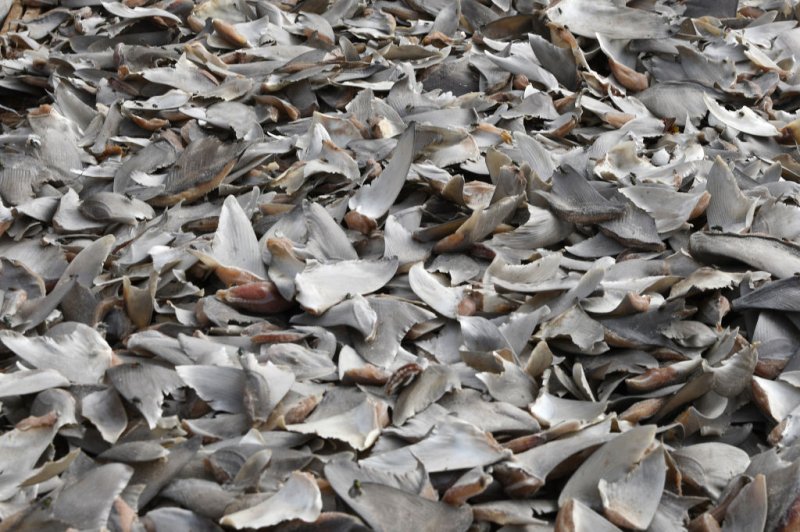
In this file photo, dried shark fins are displayed at a stand for sale at the beach of Hann, Dakar, on July 22, 2019. Wildlife inspectors seized 1,400 pounds of shark fins at a Miami port, officials said on Monday. Seyllou—AFP/Getty Images
BY ASSOCIATED PRESS FEBRUARY 3, 2020
(MIAMI) — Wildlife inspectors seized 1,400 pounds (635 kilograms) of shark fins at a Miami port, officials said on Monday.
The U.S. Fish and Wildlife Service said the shipment of dried fins arrived in 18 boxes and was believed to have originated in South America, and likely bound for Asia.
Officials estimated the total commercial value to be between $700,000 and $1 million.
Tens of millions of sharks are killed each year by smugglers who cut the fins from live animals, according to conservation groups. They are often turned into shark fin soup, considered a Chinese delicacy.